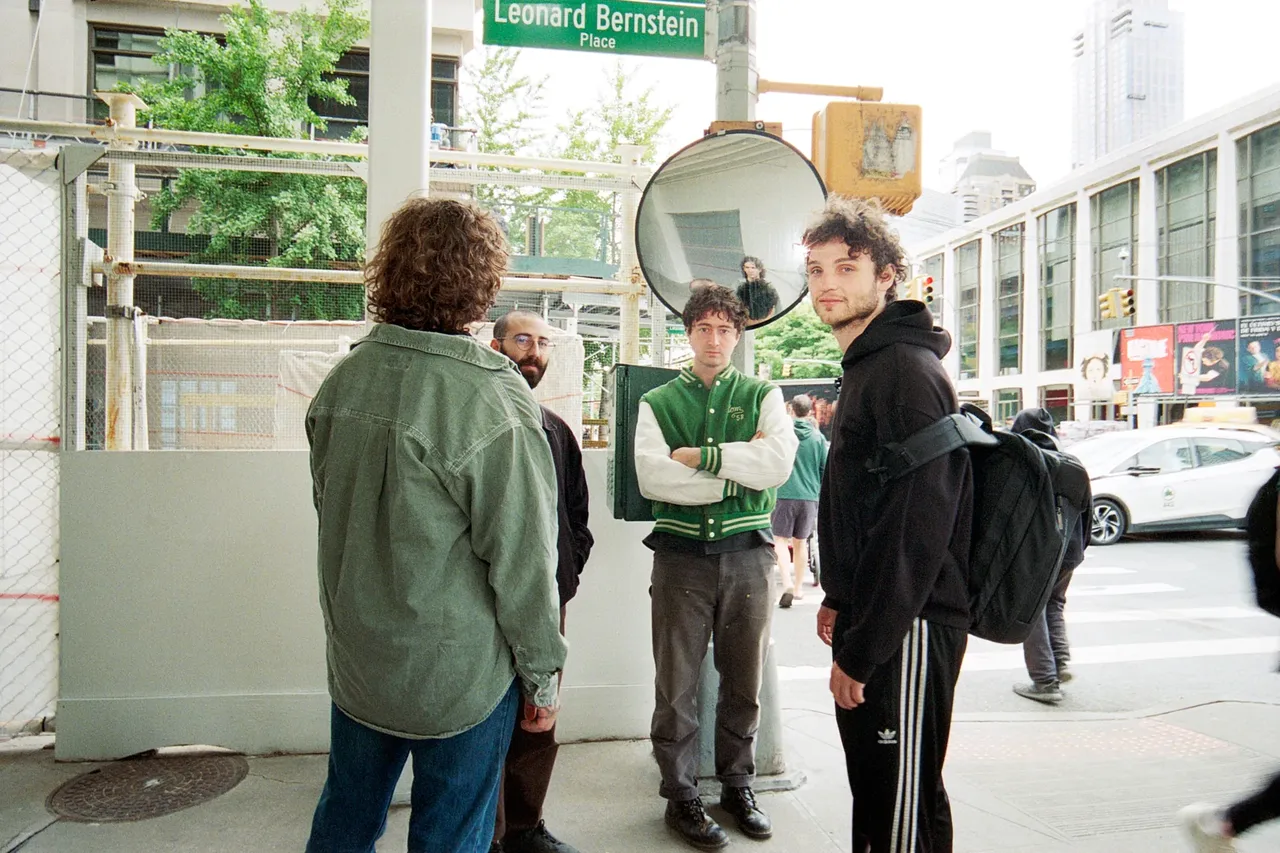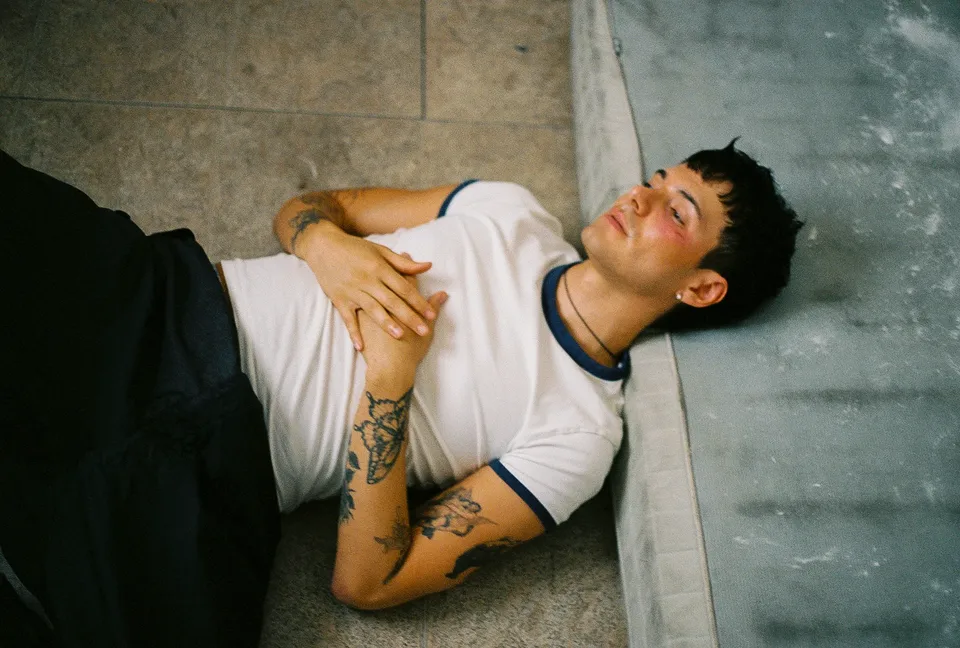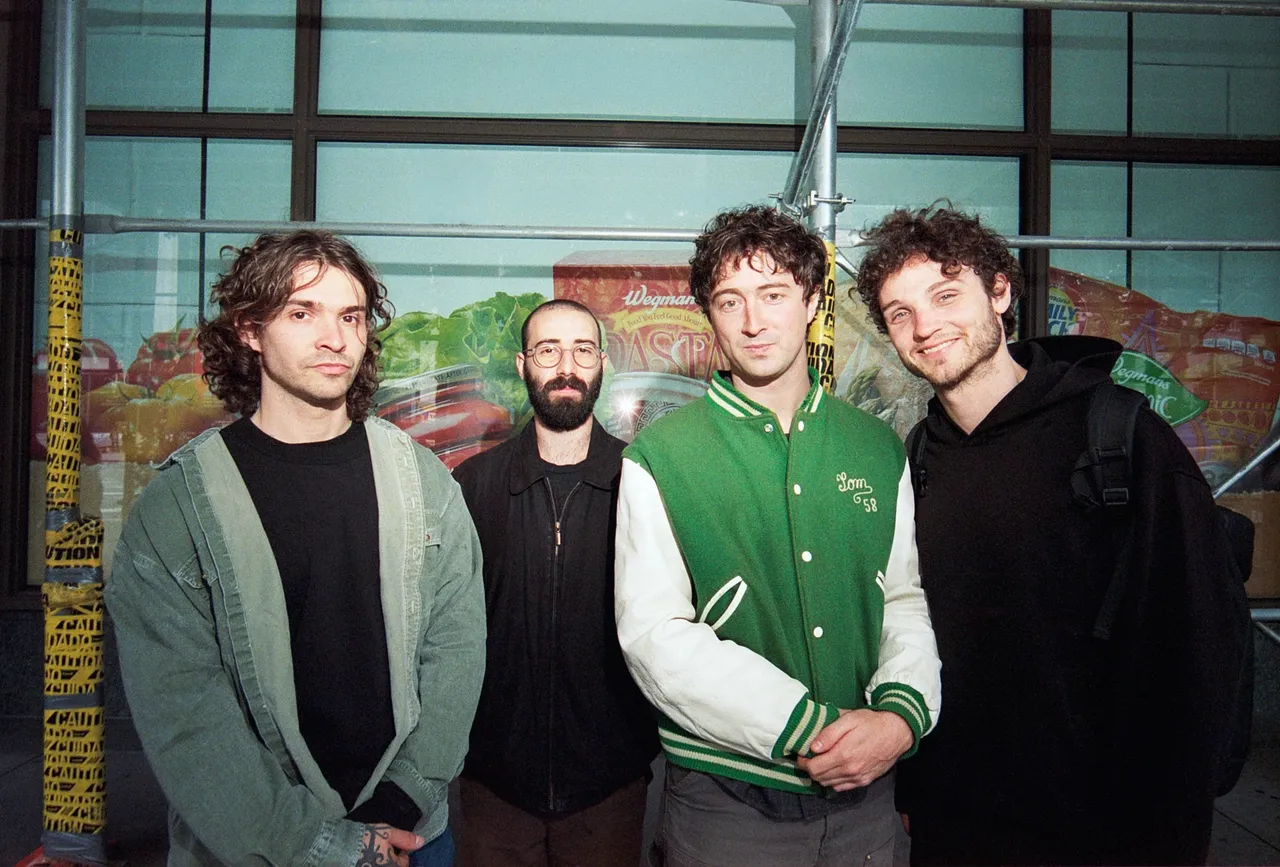
Ask Jack Tobias and Saguiv Rosenstock to describe what happens between their guitar and synth lines, and you get the same answer from both of them: Kanō Hōgai's Two Dragons in the Clouds, an 1885 ink painting of two creatures coiled through the same sky, impossible to say where one ends and the other begins. It hangs at the Philadelphia Museum of Art, with Philadelphia fittingly being the very city where Zack Borzone and Sam Pickard first locked themselves away together during the pandemic to become this band, YHWH Nailgun .
That coincidence tells you more about YHWH Nailgun than perhaps any mission statement could manifest. What began as just the two of them grew to a four-piece in New York, and all four still describe what they do as a single organism running on four sets of hands. Zack states the method plainly: “You keep your intentions pure and the band happens naturally.”
Magazine, their latest record for 4AD, ostensibly repudiates much of what made their debut 45 Pounds so bruising. Sam abandoned the rototoms that gave 45 Pounds its low, cavernous thud. Zack stripped the reverb from his own voice entirely, and for the first time on record he sounds like an actual person standing in an actual room. He describes the earlier feeling almost medically: until recently, he says, the album felt like a huge wound anyone could touch. For Zack, the wound has now scarred over, and playing the songs live has turned into something closer to catharsis.
By the time these questions reached them, the tour had dispersed the four of them across three countries: Jack answering from Guatemala, Saguiv waiting on a visa in Costa Rica, Zack back in New York already at work on new material. Then, Zack and drummer Sam performed together at End of the Road in Dorset on Thursday, 3 September. It has been an enormous year on the road, taking in Sónar in Barcelona, a run through Australia and New Zealand where Saguiv watched kangaroos with joeys in their pouches outside Melbourne and Jack was led out into the bush by tourmates Purple Pilgrims, and a full US and Canadian leg still ahead that eventually brings the band home to Brooklyn in October. I put the following questions to YHWH Nailgun during a brief gap in that touring cycle, examining Magazine's exposed nerve, apocalyptic symbolism, and the psychocultural ghosts still haunting New York's downtown scene.
It’s lovely to speak with you guys! How are you all doing? How has post-album release life been treating you?
Jack: Currently in Guatemala. Things are good. Ready to get back to writing.
Saguiv: Currently in Costa Rica waiting for my visa.
Zack: In NYC working on music feeling alllllright.
Saguiv: Currently in Costa Rica waiting for my visa.
Zack: In NYC working on music feeling alllllright.
I must say I’m still in awe of Magazine, it’s an astounding record, congratulations on the release! How have you felt about the album’s reception, now the dust has settled a bit?
Jack: So far, it’s been good. I’m still happy with it.
Saguiv: Thank you! Divisive reception. But it’s a good thing, there’s dialogue.
Zack: Very glad we made this record. Been learning a lot watching an audience react to it on this scale.
Saguiv: Thank you! Divisive reception. But it’s a good thing, there’s dialogue.
Zack: Very glad we made this record. Been learning a lot watching an audience react to it on this scale.
Whilst you guys were creating Magazine, were there any artists or bands you were listening to or drawing inspiration from, whether from your own New York scene or from somewhere completely different? Can you point to a way in which any of those artists shaped an artistic choice on the record?
Zack: We talked about drilling down into rock music for this one. I was thinking about making heavy gravestone songs and being simple and clear. I was thinking about the blues. I wanted to make genocide pop. I was repeatedly listening to Coltrane’s Interstellar Space record, which to me feels similar to Magazine. Fast and slow at the same time.
Jack: We didn’t go into writing the album with clear inspirations drawn from other bands or musicians but I think things you enjoy just come through in the subconscious.
Saguiv: I think I was listening to some Tom Waits, Sly & The Family Stone and Sumac if I remember correctly. I don’t think I was funneling this consciously into Magazine except for maybe the vibe of blues from hell present in a lot of Tom Waits’ music.
Jack: We didn’t go into writing the album with clear inspirations drawn from other bands or musicians but I think things you enjoy just come through in the subconscious.
Saguiv: I think I was listening to some Tom Waits, Sly & The Family Stone and Sumac if I remember correctly. I don’t think I was funneling this consciously into Magazine except for maybe the vibe of blues from hell present in a lot of Tom Waits’ music.
Magazine was recorded as a four-piece, yet the band often speaks of itself as a single-organism, a ‘state’ rather than a collective of individuals. How does this dissolution of individual authorship manifest in your compositional process? Are there moments wherein the boundaries between your respective instruments become so porous as to be indistinguishable, and if so, what does that do to your sense of agency or identity within the group?
Zack: You keep your intentions pure and the band happens naturally.
The interplay between Saguiv Rosenstock’s guitar and Jack Tobias’ synths is often so entangled as to be sonically ambiguous. Do you intentionally seek to blur the boundaries between analogue and electronic, organic and synthetic, or is this a natural consequence of your collective sensibility?
Jack: I think of Saguiv and myself as Kanō Hōgai’s painting from 1885 Two Dragons in the Clouds.
Saguiv: I think of Jack and myself as Kanō Hōgai’s painting from 1885 Two Dragons in the Clouds.
Saguiv: I think of Jack and myself as Kanō Hōgai’s painting from 1885 Two Dragons in the Clouds.
45 Pounds was cataclysmic and dense, predicated on rototoms with Zack's voice enveloped within reverb. Magazine strips nearly all of that away. If 45 Pounds was the sound of a band proving what it could do, what specifically was Magazine trying to say that the first record's density simply didn't leave room for?
Jack: That there’s more to the world. We are always developing and adding and pivoting. I’m excited to share future work as it’s going to be very different than what 45 Pounds and Magazine were but it’ll still be YHWH.
Saguiv: Guitar riffs. Or Magazine is more about freedom and giving ourselves the liberty to do whatever we’re feeling over preconceptions of what we’re supposed to be.
Saguiv: Guitar riffs. Or Magazine is more about freedom and giving ourselves the liberty to do whatever we’re feeling over preconceptions of what we’re supposed to be.
Zack, your lyrics on this album are at once imagistic and elusive, drawing on religious symbolism, bodily flagellation, and humour both abstract and surreal. With the removal of vocal effects, the words are now more exposed than ever. How do you conceive of the relationship between language and sound in your work? Was there any apprehension about how increasing the clarity of the lyrics would be received by fans?
Zack: I want the words to have something for you so making them clear was an important step. Until recently, Magazine felt like a huge wound anyone could touch. Now, it’s in the past and performing it is very fun.
The decision to preserve accidents and sonic ‘errors’ as in the static bursts on Ballerina, suggests an embrace of contingency and imperfection. Is there a philosophical idea or aesthetic significance that guided this artistic choice?
Jack: It’s important to convey the human element behind the music. I think it’s what connects you to the music more. It exists in electronic music with Aphex Twin and Nicolas Jaar as much as it does in bands like Germs or Guided By Voices. For me, when I can hear the person behind the instrument, it’s really exciting.
Saguiv: Rock is human music and should be dangerous, but at the end of the day we lead with whatever’s exciting to us.
Saguiv: Rock is human music and should be dangerous, but at the end of the day we lead with whatever’s exciting to us.
In 2020 it was just Zack and Sam: voice and rototoms against the world, nothing else in the room to hide behind. You've been a four-piece since 2022. What theoretically has survived from that original, stripped-down chemistry once Jack and Saguiv joined, and what had to be given up to make room for two more sets of instincts?
Zack: Sam and I were talking a lot about music and found what would be the imaginary terrain we write the songs in. I had also for a long time been fantasizing about a new kind of music and had dreamt a palette of sounds and a structural logic. The project is fit closely to our skillsets, and we all contribute equally.
Magazine ends on To the Devil, saturated with serpents, beasts and hellfire, and then closes with Zack's voice dropping to something hushed and reconciliatory as the track fades into silence. It’s a beautifully tender way to end something that vicious. Is that hushed ending a resolution, or rather just the sound of the record reaching an apotheosis, with no more highs left to escalate to?
Zack: Yea it’s the smallest resolution but it’s the most you can offer.
On the subject of the Devil, your lyrics certainly don’t shy away from apocalyptic invocations! How do you situate that language within traditions of eschatological thought, and to what extent do you see your work offering catharsis, or merely aesthetic enactment for a young, disillusioned YHWH Nailgun fan that appears to seek refuge in end‑time imagery?
Zack: It’s hard to imagine how it feels for someone else to listen to it, especially someone younger than me. I don’t think of this album really as an end-times record, but I know I was sensing a kind of death process. I’d rather situate it with poets who are close to death.
“Rock is human music and should be dangerous.”
Sam’s said the band would rather build something of its own than spend energy tearing other people's things down, that pure opposition rarely produces anything worthwhile. And yet you call your own sound hellacious, and you've built two records soaked in apocalyptic, hellfire imagery. How do you negotiate a patently hell-bent sound with a stated rejection of the reactionary?
Saguiv: One thing is the symbolism utilised in the lyrics or musical and artistic aesthetics; another thing is letting a trend or other transitory ideas be your artistic compass.
Your sound has always read as a direct rebuttal to a certain strain of ironic detachment that defined a lot of 2010s indie rock, with Sam telling Crack that the late 2010s indie scene had a kind of unseriousness that made him uneasy, everyone several degrees removed from actually meaning anything. On the subject of irony, a couple years ago I chatted with the New York-based duo Frost Children for METAL, where we explored the so‑called zen of cringe, wherein cringe becomes a vehicle for sincerity, while also freeing oneself from the trappings of irony. Frost Children pursue that path through hyperpop maximalism, whereas your escape from irony has led to lyrical ruthlessness and artistic vulnerability, particularly in choices such as to strip away layers of reverb and delay to expose Borzone’s voice in its stark immediacy. Do you see these divergent strategies as parallel repudiations of New York’s irony‑laden musical culture, converging under the broader rubric of New Sincerity? To what extent has that philosophy of sincerity over irony shaped the production and lyrical decisions on Magazine? And do you agree that “to be cringe is to be free”?
Jack: I’m not really thinking about things being cringe or not. We are just making music we want to make, in a sincere way. I think there’s a great world of artists doing really genuine things in New York at the moment.
Saguiv: Cringe is just re-packaged irony and detachment, both are insincere but in different ways.
Saguiv: Cringe is just re-packaged irony and detachment, both are insincere but in different ways.
In a conversation with i-D, Sam said that if you peel back a certain downtown New York scene, all you find underneath is people who hang out together, and separately that “eight in ten bands are cosplaying,” borrowing a decade wholesale because it's easier than having a voice of your own. As a self-diagnosed Particularly Annoying Person, this naturally made me think of Mark Fisher’s hauntology, particularly his postulation that contemporary culture is trapped in the recycling of lost futures rather than generating new ones. When you describe eight in ten New York bands as cosplaying entire decades, do you see that as a uniquely local symptom of the city’s nostalgia economy, or as part of a wider hauntological epidemic in which artists feel compelled to inhabit past styles because the cultural infrastructure no longer supports artistic dissent? How does YHWH Nailgun work against that gravitational pull toward the mould? Is your forgoing of an irony-pilled NYC culture a deliberate attempt to carve out a future that does not yet have a name?
Saguiv: Yes.
Your performance on Adam Friedland's TAFS Unplugged show was absolutely brilliant! How was your experience performing on the show?
Jack: It was fun, I think that show is great.
Regarding the TAFS show, I do have to enquire on something; Adam Friedland runs on a specific kind of comic distance, perfected from his Cum Town days: never getting caught fully meaning anything, always being a level of irony ahead. Your project operates on refusing exactly that distance, choosing instead to champion sincerity. And yet, on TAFS Unplugged’s fake retro talk-show set, we witness you four tearing through Sickle Walk, Give Blood, Ballerina and Hips on a Wheel back to back, replete with zero jest or pastiche, while the bug’s own fans immediately read the booking as proof he’s still plugged in. Do you not find performing on this show to be at all a contradiction, or indeed a capitulation, of your ethos? Are you concerned that reactions such as the aforementioned essentially turn your uncompromising set into evidence for somebody else’s cultural fluency rather than your own record?
Jack: His fans are our fans.
Saguiv: I think he’s generally pretty sincere. It can be hard to detect sometimes or come across as ironic because of the comedic packaging, but you can always tell how he feels about the big stuff.
Saguiv: I think he’s generally pretty sincere. It can be hard to detect sometimes or come across as ironic because of the comedic packaging, but you can always tell how he feels about the big stuff.
Jack, you’ve joked before about how hard it is to keep a real rock band together in this city when the practice space you finally found gets torn down, like every space before it. How many rooms have you lost at this point, and what happens to a band like yours if the last one goes?
Jack: There’s always a way. We actually just got a new one (not because of demolition) and we’ve been writing the best songs we’ve ever made in this new spot.
It’s been a massive year of touring for you! Barcelona, Australia, New Zealand, UK, and there’s still a full Canada and US run ahead before you’re back in Brooklyn in October. How has it felt for you all being out there touring that much? Any shows or moments along the way that have really stuck with you? And how do you approach the challenge of translating the brief, explosive material of Magazine to the stage?
Zack: Magazine feels so good to play, been having fun refining it.
Jack: I really enjoyed New Zealand. Our friends in Purple Pilgrims took us out to the bush and to the ocean and it was incredible. The show was also one of my favourites in a while too. The show put on by NTS in London in the empty train station was incredible too. Great sound, Lolina held it down and it was free.
Saguiv: We saw kangaroos with babies in their pouches in a park outside of Melbourne. They look like animatronics, it’s kinda surreal and uncanny
Jack: I really enjoyed New Zealand. Our friends in Purple Pilgrims took us out to the bush and to the ocean and it was incredible. The show was also one of my favourites in a while too. The show put on by NTS in London in the empty train station was incredible too. Great sound, Lolina held it down and it was free.
Saguiv: We saw kangaroos with babies in their pouches in a park outside of Melbourne. They look like animatronics, it’s kinda surreal and uncanny
Once the tour wraps up at the end of October, what's next on the horizon? Is new music already starting to come together, or is everyone just looking forward to some proper time off first? And Sam, any chance you get back to Beheadings Online once things quiet down?
Jack: More. Our best music yet.
Saguiv: More. Our best music yet.
Saguiv: More. Our best music yet.