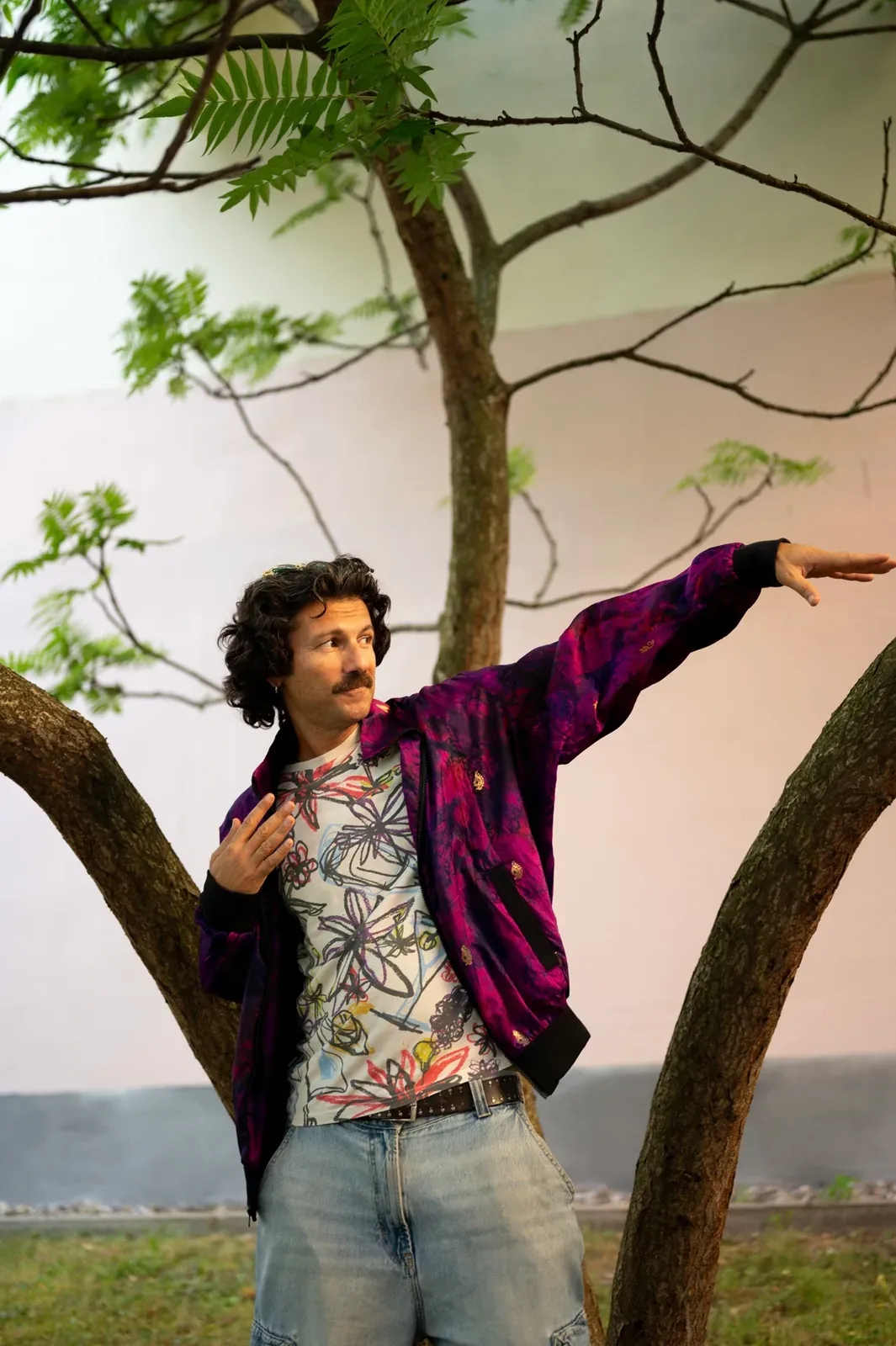
Thirteen years of music and a life that has changed considerably along the way have led Elninodiablo to this moment. Today, the artist releases DRK NGHT FTSL, a twelve-track album bringing together compositions conceived across the Himalayas, Thailand, Bali, Berlin and beyond. Through expansive, cinematic electronic soundscapes, the record traces a deeply personal journey of transformation, with each piece carrying something of the places he visited and the person he was when he created it.
We first came across the work of Stephanos Pantelas, the artist behind Elninodiablo, five years ago, and caught up with him again just over a year ago to discuss his debut album, The Downey Groove. A few weeks before this new release, we spoke once more to find out how he was experiencing the final countdown to a project that was never actually intended to become an album. “There was also a story being told through my subconscious that only became clear when I decided to release this album,” he explains.
There is a lot of life behind these twelve tracks. Leaving Berlin after a decade and saying goodbye to Lunchbox Candy, the queer party series he had built there, opened up a different chapter in his creative journey. Looking back on those decisions, Elninodiablo also reflects on the pressures of an industry increasingly obsessed with instant success and what it means to remain independent as an artist. “I am not striving to impress anyone or needing to be part of a scene or a genre,” he tells us. And after thirteen years, he seems quite happy to let the music speak for itself.
There’s just over a month to go before DRK NGHT FTSL is finally out. How are you feeling now that you’re so close to sharing something this personal with the world?
I feel expansive, calm and centred, ready to share this music and my process for those willing to listen.
You never actually set out to make this album. At what point did you realise these pieces belonged together?
The idea for this album started marinating in August 2025, when I revisited some of these compositions and felt instantly drawn to them. Intuitively, I felt that perhaps it’s time now to open my ‘Pandora’s Box.’ Once I began re-working them and recording new material, it became apparent in early 2026 that this would be my next album. It was fully aligned.
The record has been thirteen years in the making. What has that time allowed you to understand about the music that you couldn't have understood at the beginning?
The majority of the music on this album came spontaneously, like when a painter feels inspired to make a portrait on the fly or when a writer has to put something down on paper instantly because of an inspiring reflection. I had been travelling for many years, and recording this music was the soundscape to some incredibly beautiful and powerful locations I visited. It’s akin to journal entries; the music feels private and intimate, and it’s a creative practice for me. When I looked back, there was a common thread that connected the tracks on this album: they were emotional and expansive, and they held the frequency of the locations where they were conceived and recorded. There was also a story being told through my subconscious that only became clear when I decided to release this album.
We first highlighted your work in METAL more than five years ago. Looking back now, what feels most different about the artist you were then?
I am not striving to impress anyone or needing to be part of a scene or a genre. I don’t need all the bells and whistles. I feel calmer, more peaceful and more confident in my craft, taking more risks and feeling connected with my authentic expression.
We live in a moment obsessed with immediacy: constant releases, instant reactions, the next viral track. What has it meant to let this project grow so slowly, almost at its own pace, in that context?
Life experiences can make great art! I also appreciate the freedom I have as an artist. I am largely unaffected by the immediacy and urgency of the industry because I am operating outside of these norms.
Do you think artists are still given enough time to develop?
That depends on the artist, or who is even considered to be an artist these days; certainly there’s a plethora of artists that evolve and develop over time. The ones that are genuinely in it because of the art will remain in the long run, keep creating and evolving. Sadly, we do live at a time when people measure their worth through their popularity on social media, and that has seeped into all forms of ‘art.’ The worst part is that we have normalised mediocrity, instant fixes and performance versus substance. Discernment is dwindling away, and many people won’t recognise great art even if it slaps them in the face. When you are constantly accustomed to fast food, is your discernment sharp enough to appreciate a gourmet meal?
Labels, platforms and audiences can all seem focused on finding the next big hit, while artists who do not break through quickly are often left behind. How do you think that pressure is shaping the kind of music being made right now?
I see that as two different disciplines. The commercial, industry-led machine keeps pushing ‘music’ as a marketing campaign that sells a ‘lifestyle’ or feeds someone’s ego-mind identity - it’s never about the music; it’s about numbers and sucking people’s attention and money for personal gain and commodities. Usually the music turns out to be uninspiring, contrived, predictable and vacant. On the other end of the spectrum, now more than ever, there’s an incredible amount of quality music being made and released on a daily basis that is so worth exploring. Bandcamp is a great example of how you can dive in and discover brilliant artists. That’s only possible because of technology - even if artists need to find pioneering ways to get paid for their work nowadays or have to maintain day jobs to keep making art.
If you are aspiring to make good music and find an audience, you will come up with a way to make that happen. If what you want is to be famous, that is a whole different ballgame. What it means to be an artist is ever-changing, especially with the speed at which AI is evolving. Soul-art, human-art, stories, depth, emotion and connection are essential now more than ever, as is being able to tell the difference between human art and artificial art.
If you are aspiring to make good music and find an audience, you will come up with a way to make that happen. If what you want is to be famous, that is a whole different ballgame. What it means to be an artist is ever-changing, especially with the speed at which AI is evolving. Soul-art, human-art, stories, depth, emotion and connection are essential now more than ever, as is being able to tell the difference between human art and artificial art.
And where does social media fit into that for you? Has constant visibility changed what it means to be an artist?
I made a promise to myself to only use social media for 10 minutes per day, unless I am creating the content. Like so many things in life, it’s a paradox - you either use social media as a tool to your advantage, or you become entranced, dependent and programmed by it. The positive aspect of it is, as an artist, you can be sovereign in curating and creating your own universe, find an audience and make things happen without needing to rely on others or compromise yourself. In terms of visibility, I am not someone who broadcasts my everyday life all over social media; I use it sparingly, mostly to connect with audiences around my music releases and events.
Almost exactly a year ago, when we spoke about The Downey Groove, you described that record as a snapshot of a moment in time. DRK NGHT FTSL feels almost like the opposite, carrying thirteen years of places and different versions of yourself. Does it feel like a continuation of that journey, or something entirely different?
The approach was actually the same; the only difference is that The Downey Groove came together in one fell swoop as a whole album (in about 6 weeks), whereas the new album became apparent as a complete body of work after 13 years. The individual tracks featured on DRK NGHT FTSL were also birthed spontaneously and in the moment.
This album was written across the Himalayas, Thailand, Bali, Berlin, Brazil, Cyprus, Australia and New Zealand. When you listen to it now, do you hear music first, or do you immediately return to those places?
I instantly return to the feeling and frequency of those places. The music and the locations are completely intertwined. The anchor is more of a feeling and a state of being rather than a vision or specific memories.
The record documents a period of profound personal transformation. What emotions surfaced most strongly as you put it together?
Sadness, grief, melancholy, fear, longing, rage, elation, euphoria, joy; the whole spectrum. In the end, the ‘dark night’ is a long-winded process of purging out all the passing phenomena that are not truly YOU - I call it the ‘subtractive synthesis of the soul’. Layers and layers of stuck emotions, distortions, limiting beliefs, ego-mind identities and energies are transformed and alchemised back into the original template of source consciousness. All you are left with is a presence and awareness so expansive, bright and sharp, shining like the sun.
Were there feelings in these tracks that you only recognised years later?
Yes, absolutely. In fact, having all this time and space to reflect from a detached point of view enabled me to connect more deeply and more objectively with the music. As if someone else was invited in to curate it. And indeed I had been someone else when most of it was created.
Leaving Berlin, stepping away from a creative community and ending Lunchbox Candy were major shifts in your life. Did this album help you process those endings, or did it simply capture them while they were happening?
This album was only made possible because of ending Lunchbox Candy and leaving Berlin. After 10 years in the Berlin vortex, especially while running such a popular event like Lunchbox Candy, you can’t help but absorb that energy and become it to a certain extent. I absolutely loved it, but it only represented an aspect of my creative output, and I began to feel frustrated, limited and restless, both artistically and personally. Once I stepped out, I was able to reconnect with the multi-faceted nature of my creativity, a softer and more vulnerable side of my artistry which is in total antithesis to my Berlin chapter.
You’ve described the album as a ritual honouring your process. What does that mean to you now that the ritual is almost complete?
I am learning that rituals are important for me. They can signify major chapters in life. I feel like I have finally captured and documented the past 13 years, and I am now ready to move forward with less baggage and more clarity.
When you hear DRK NGHT FTSL from beginning to end today, what do you feel?
I feel content that I did these tracks justice after all. This album is like a time capsule that tracks my life and progress over these years. It is also a testament to the massive influence the environment you inhabit has on you. I can’t imagine I would’ve come up with these tracks in my studio in Berlin (apart from Unchained, which was entirely recorded at the Funkhaus).
The initial sketches were rough, but the ideas were ambitious, epic and expansive. Listening back to the album, especially after the incredible masters by Lopazz (Stefan Eichinger), brings a heartwarming glow and a soft inner smile, with a good dose of melancholy sprinkled all over it.
The initial sketches were rough, but the ideas were ambitious, epic and expansive. Listening back to the album, especially after the incredible masters by Lopazz (Stefan Eichinger), brings a heartwarming glow and a soft inner smile, with a good dose of melancholy sprinkled all over it.