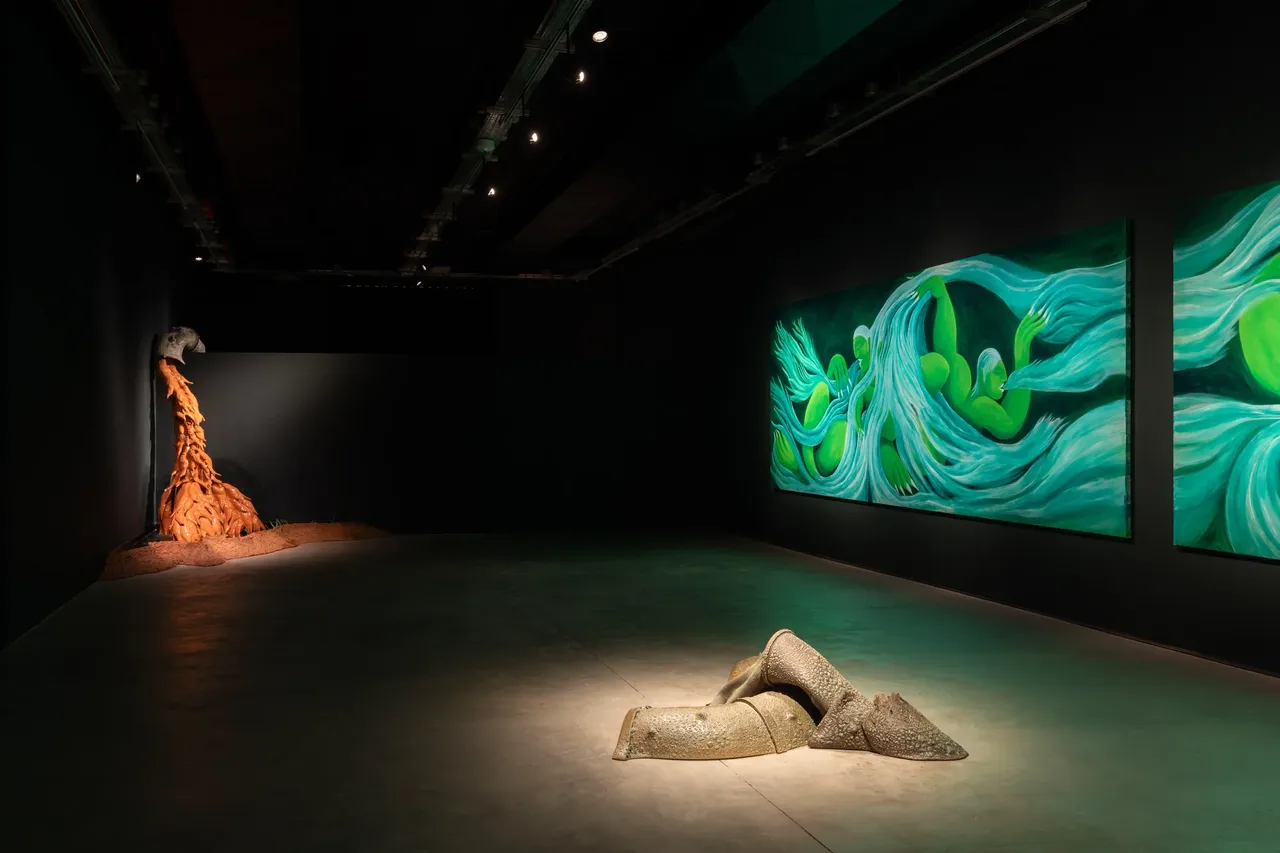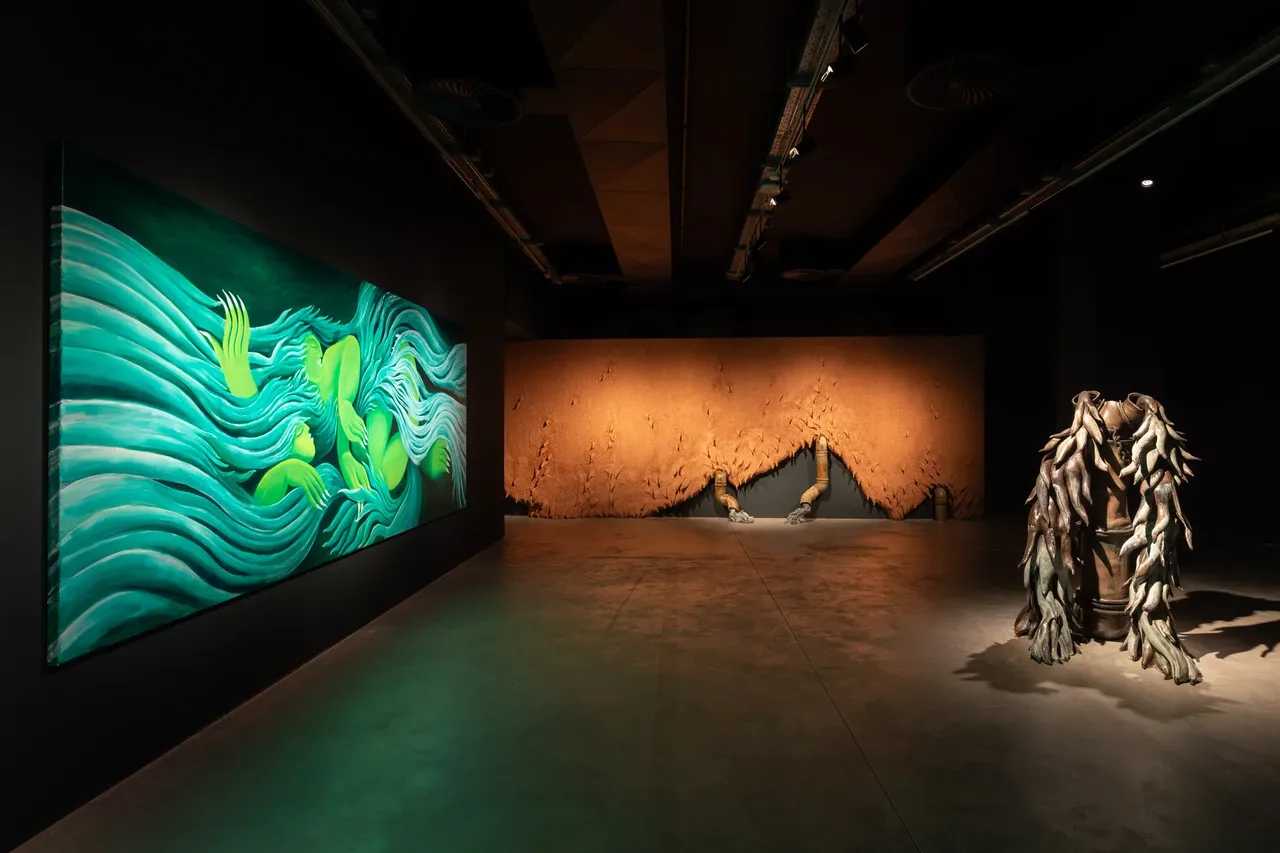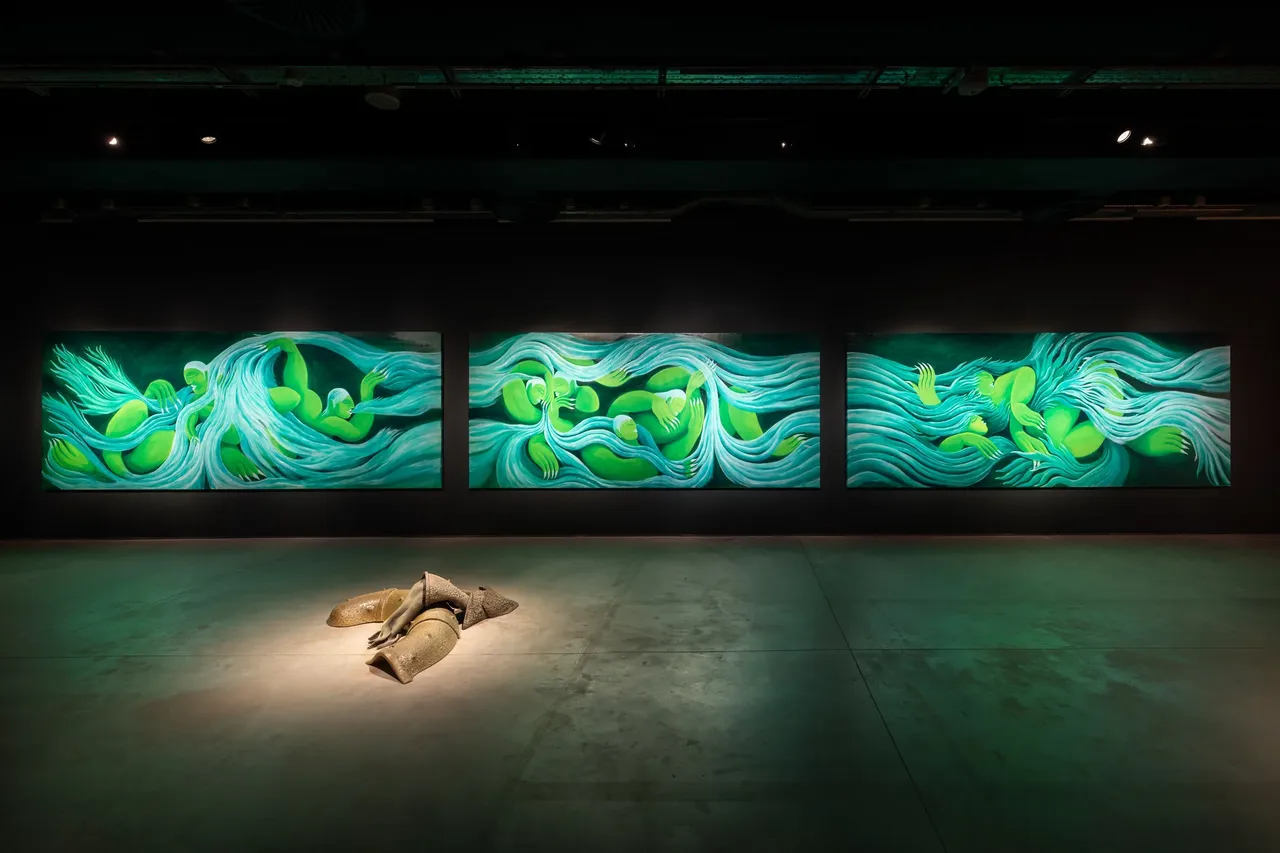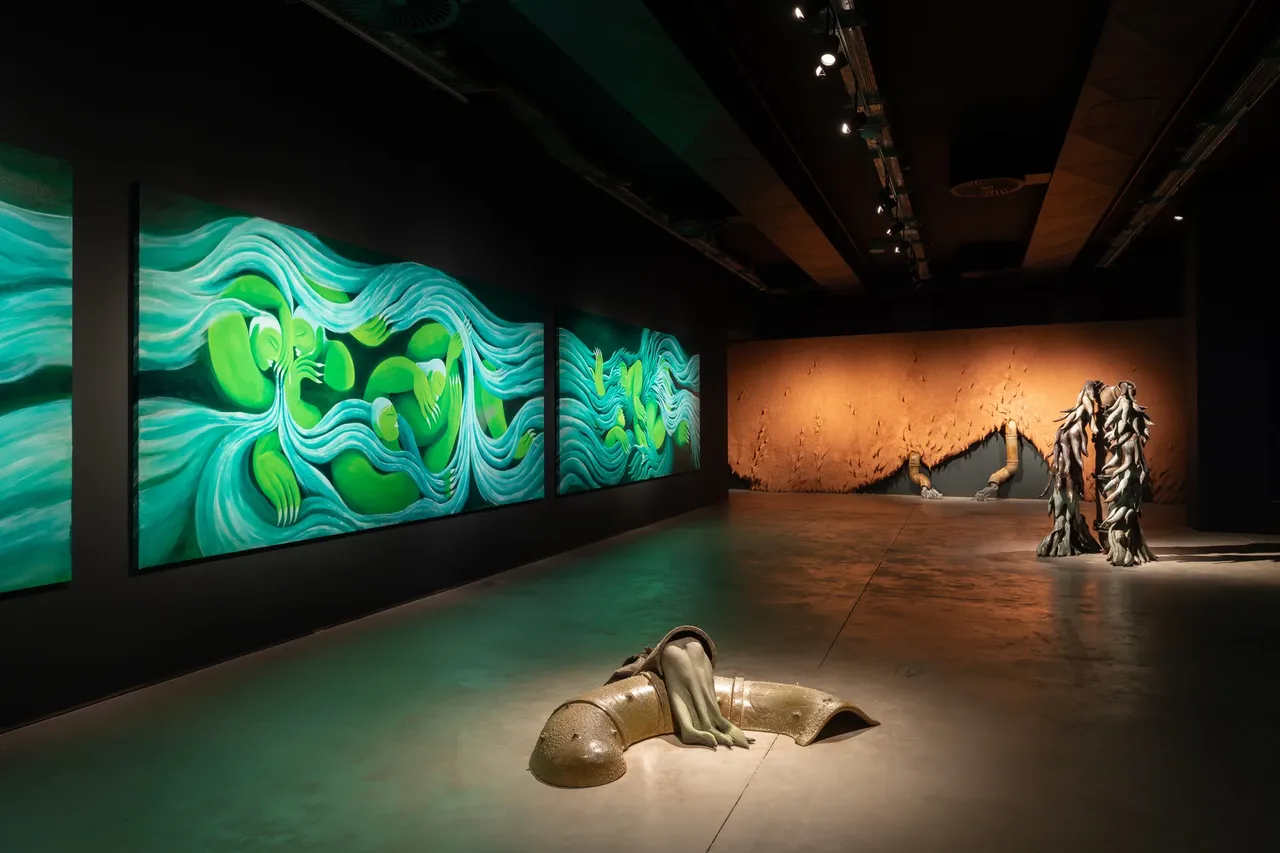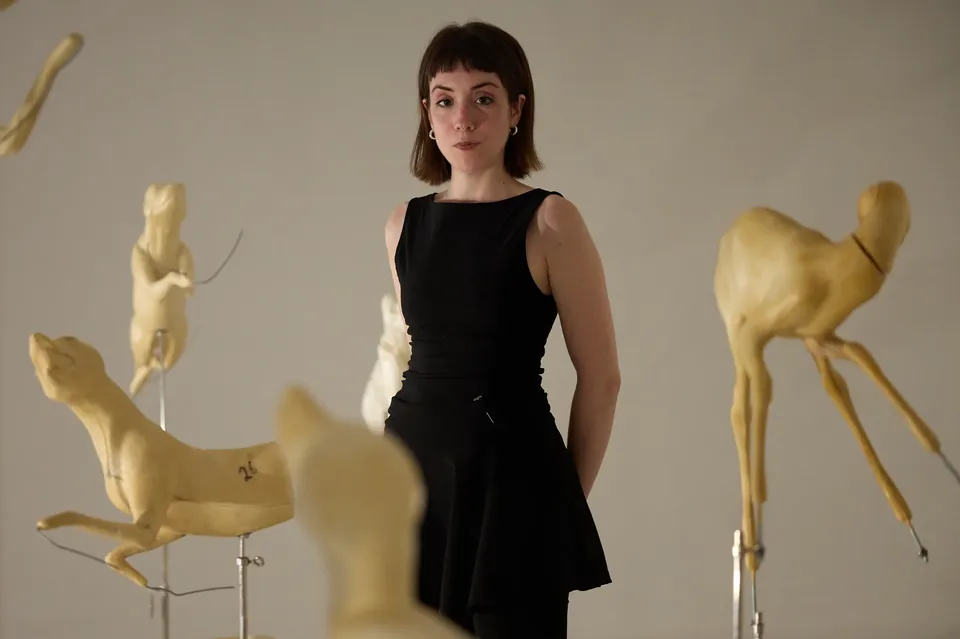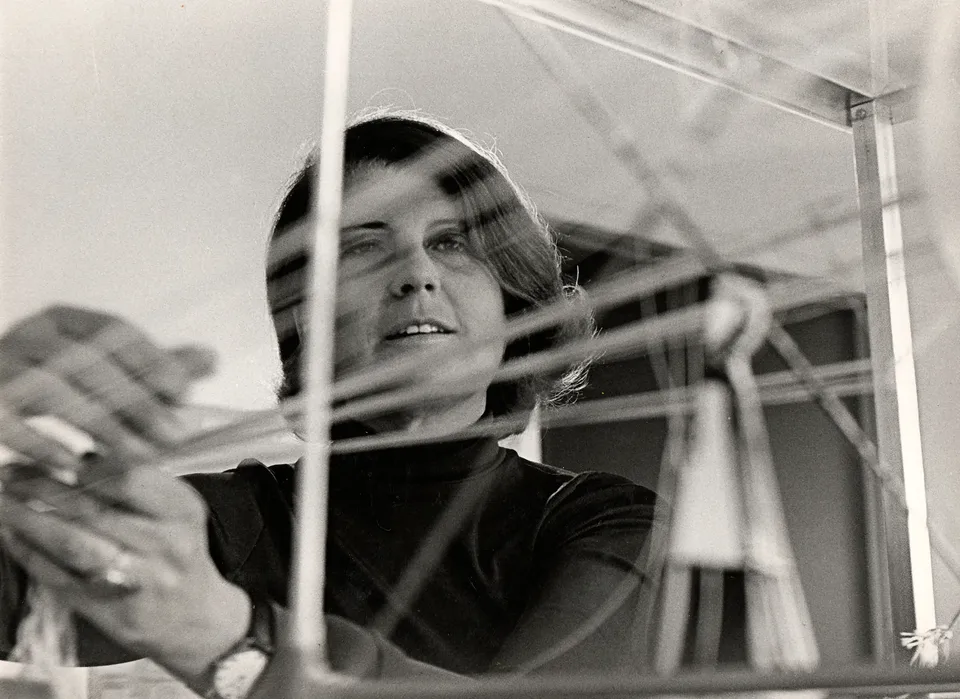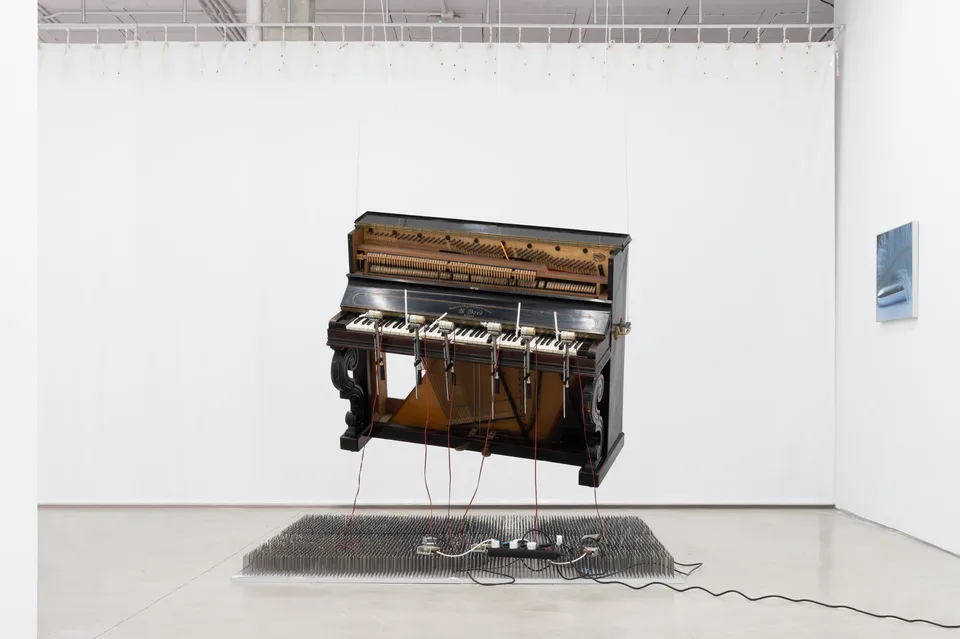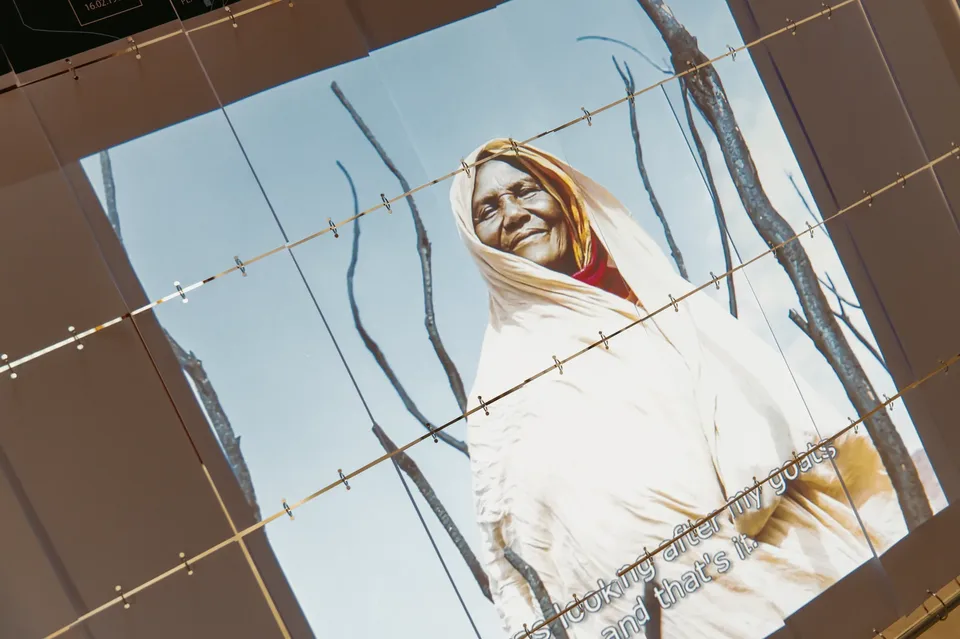
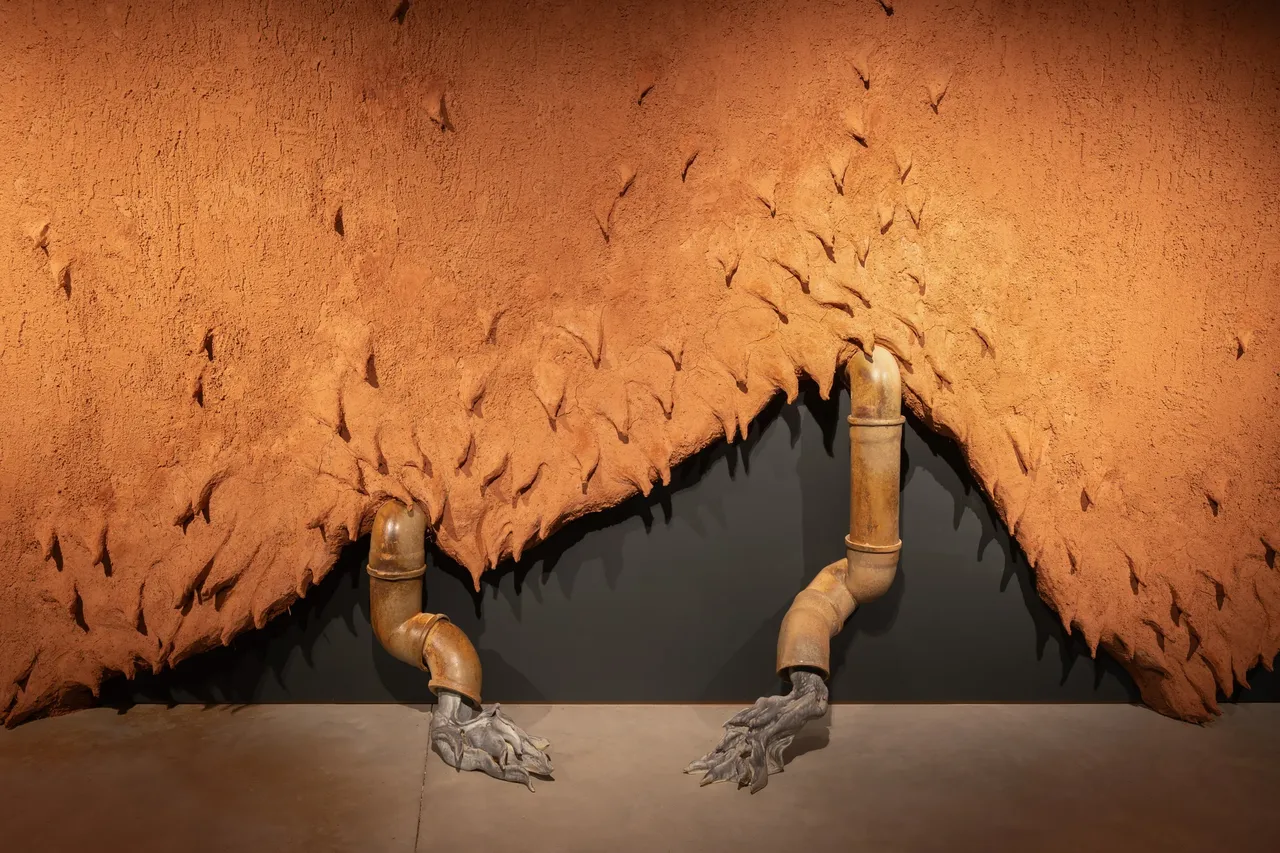
How comfortable are we with a body we can’t quite place? Inês Zenha gives that question a physical presence in Murky Waters, where contorted ceramic forms, painting and flowing water bring desire and discomfort into close quarters. Following its presentation at Museo CA2M in Madrid, the exhibition has moved to the Project Space at Lisbon’s Centro de Arte Moderna Gulbenkian, where it runs until 8 February 2027. Curated by João Mourão and Luís Silva, this version brings the works together in a more concentrated space, letting their relationships unfold through light, darkness and water.
For Zenha, those shifting forms are bound up with lived experience: a lesbian identity, a trans body, the intimacy of chosen family and the difficulty of being seen through somebody else’s categories. There’s tenderness here, including towards what we have learnt to find strange or disgusting. We speak with the artist about protecting a practice from the art world’s demands, listening to clay when it refuses to cooperate, and finding a sense of release in water.
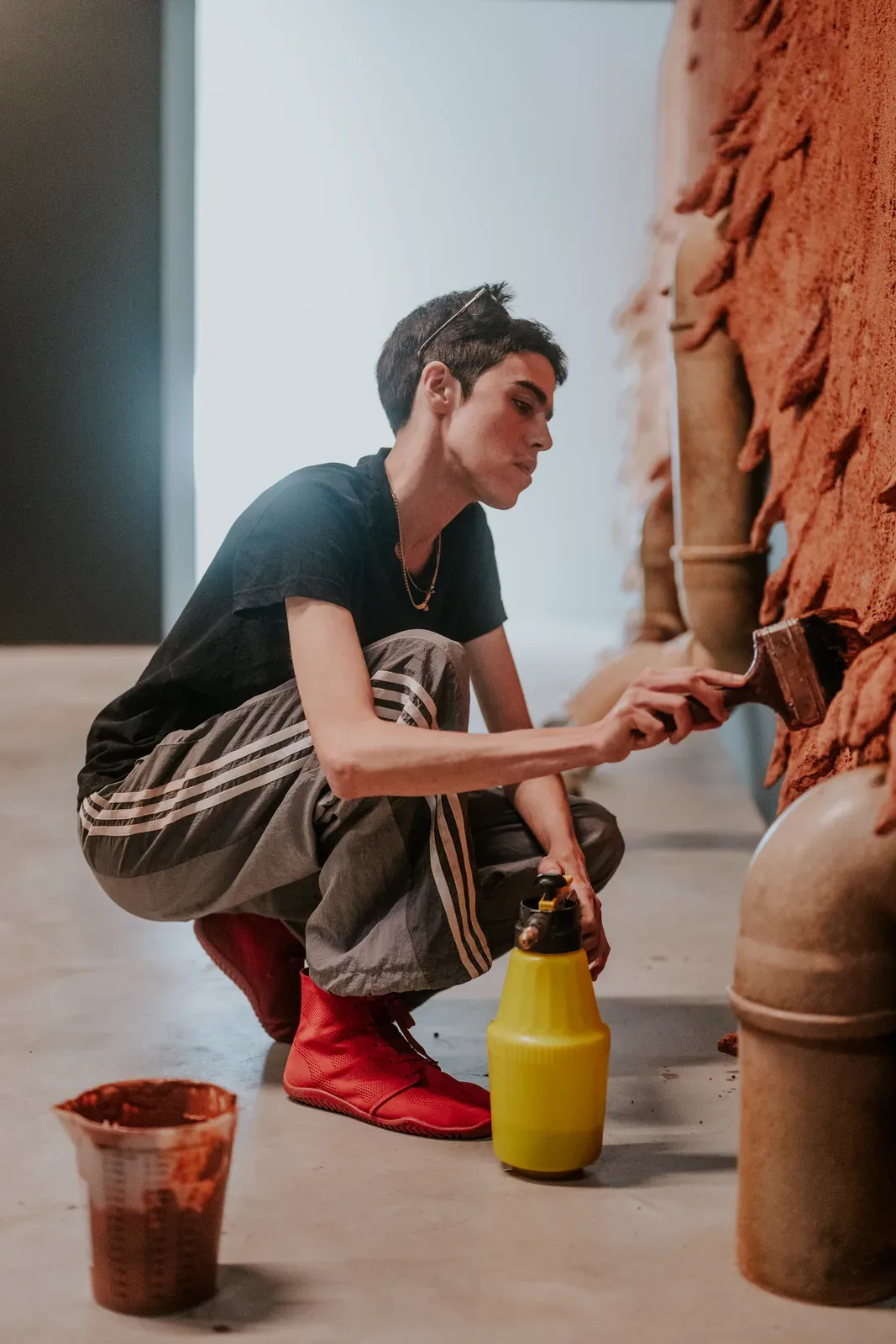
Hey Inês, it’s a pleasure to interview you. To get to know you better, what does a ‘normal’ day in your life look like?
I don’t think I have very normal days these days… Life has been very generous to me with work but I lack the stability my practice requires. I have been moving a lot lately, changing studios, homes, countries. So my days involve trying to sort those things out so that I can finally be in my cocoon creating with my lover, who is also a ceramicist. When I finally immerse myself in the process of making, I’m in my happy place. I’m a full-time lesbian lover, a full-time working artist and a full-time home-seeker. My dream is that my practice can help me find a home, or whatever that means…
When discussing your work, you told me you started off in a very academic, conceptual way. Then, you took a break from making art but somehow found your way again, but with a renewed style. What did you learn about yourself and your creativity during that time off?
That break was forcefully imposed by external circumstances. But it reconnected me with art-making in a way that was perhaps lost. I often say that the day I stopped trying to make art is when I feel I became an artist. I learnt again that art can be my best companion on the journey of healing, of being honest with myself. Having a studio practice gave me a pathway towards emotional honesty with myself and with others. It taught me to love and be gentle to myself, to see beauty and power when everything points towards the opposite. I’m only where I am today because of my work and my loved ones.
At a time when all things are hyper-accelerated, stepping away and looking at a situation from afar seems more important than ever. Is there anything from that time off that you still try to incorporate into your daily life and artistic practice?
Yes, definitely. With all the fast-paced demands from the art world, I feel my job as an artist, before creating, is first and foremost about protecting my creative process from the capitalist rhythm of production and consumption. What I mean is that before immersing myself in a production, I must remind myself that I can’t act like a machine. I must remain honest and tuned to the reason why I create, and not to what the market expects of me, and this is a very hard balance to find.
Murky Waters was first presented in Madrid and has now evolved for Lisbon. The space is a bit smaller, so you’ve had to show fewer pieces. How did you make that selection, and why do you think the works you’re exhibiting are the most representative of the message(s) you want to convey?
I always work with a continuous narrative and flow of becomings. Murky Waters began where my all-white sanitary church installation Resurrection ended. So when we imagined it together in Lisbon with my curators and friends, João and Luís, we felt it was more important to expand on the underground and the murkiness that are so central to the ideas I wanted to convey.
The idea behind this selection was to create a space where love and interdependence can emerge from the very conditions that society has sought to stigmatise, reject, or render invisible while also inviting people to sit with ambiguity and therefore to draw them closer to what feels strange or unfamiliar. For me, I tried to orchestrate this feeling with not only the physical works, but also with the symphony they create together with the light, the water, the darkness, the drama. CA2M was more of a journey through different physical spaces while my show in Lisbon gave more opportunity to feel everything in one room.
The idea behind this selection was to create a space where love and interdependence can emerge from the very conditions that society has sought to stigmatise, reject, or render invisible while also inviting people to sit with ambiguity and therefore to draw them closer to what feels strange or unfamiliar. For me, I tried to orchestrate this feeling with not only the physical works, but also with the symphony they create together with the light, the water, the darkness, the drama. CA2M was more of a journey through different physical spaces while my show in Lisbon gave more opportunity to feel everything in one room.
“I’m a full-time lesbian lover, a full-time working artist and a full-time home-seeker. My dream is that my practice can help me find a home, or whatever that means…”
Water isn’t only a metaphor in Murky Waters; it moves through the exhibition almost like a living presence. It even makes the maintenance of certain pieces, like the fountain, difficult. How do you think differently when you work with a material that can’t be fully controlled?
I would like to say that I learn from my mistakes, but this water journey is just like my work, unresolved, always spilling, always becoming, perpetually escaping rigid thinking. I become very reluctant to work with it each time, but then I jump quite impulsively and then something new happens and so then again I humbly adapt.
Another material that can’t be fully controlled is clay; you try to mould it to your will, but when it goes into the kiln, you can’t be certain of the outcome. How important is the unexpected, the mutable, even the ‘mistake’ both in your creative process and in the final result?
There’s a certain unpredictability in the work I do in ceramics. Not only because of the multi-layered and reactive glaze process I use, but also because I work by creating multiple, contorted parts that fit onto each other. It’s technically challenging as I always have to count on the fact that clay has memory. Clay not only remembers but also wants to become the movement that the shape seeks to convey.
I usually think whenever something fails in my intentions, it just carries its own desire to be its own thing. I respect that tremendously. Even when moulding in the wet phase, I usually achieve my forms by listening to what the body of clay wants to do and I allow the forms to contort to their own limits. As if both of our bodies were playing with the limitations of what we can do between each other. But it was in these moments of making mistakes that I have found most of my glaze recipes. Rules were broken, but also there were many studio accidents involved.
I usually think whenever something fails in my intentions, it just carries its own desire to be its own thing. I respect that tremendously. Even when moulding in the wet phase, I usually achieve my forms by listening to what the body of clay wants to do and I allow the forms to contort to their own limits. As if both of our bodies were playing with the limitations of what we can do between each other. But it was in these moments of making mistakes that I have found most of my glaze recipes. Rules were broken, but also there were many studio accidents involved.
The idea of ‘becoming liquid’ lies at the centre of the show. What possibilities does liquidity offer that a fixed or clearly defined identity can’t?
Becoming liquid allows us to think outside boundaries. Water takes on different states as it escapes its containers. To think of our embodiment as liquid in relationship to identity politics is to say that we are ever-changing and resisting categorisations that can’t fully grasp an individual’s personal or lived truth. This is quite personal to me as someone who recognises themselves neither as a woman nor as a man, but something in the middle or even both.
My desires and understanding of my own lesbian identity also shift over time. The ever-changing body that I occupy influences how I feel and perceive myself. But in living that I also become the vessel for the attempts of others to categorise me or perceive me in a fixed way. To think of ourselves as bodies of water is to remember that we are made of the same liquids that were once ancient and inhabiting other living organisms, but also to remember that our own cells belong to a larger universal dance of liquids exchanging between us, others and all other liquid beings. If our bodies do belong to this watery realm, why is it that our cultures create such hard edges around them?
My desires and understanding of my own lesbian identity also shift over time. The ever-changing body that I occupy influences how I feel and perceive myself. But in living that I also become the vessel for the attempts of others to categorise me or perceive me in a fixed way. To think of ourselves as bodies of water is to remember that we are made of the same liquids that were once ancient and inhabiting other living organisms, but also to remember that our own cells belong to a larger universal dance of liquids exchanging between us, others and all other liquid beings. If our bodies do belong to this watery realm, why is it that our cultures create such hard edges around them?
Murky Waters rejects ideas of hygiene, purity and order, embracing instead what is murky, strange or contaminated. Do you think that by displaying those pieces in a respected institution like the Gulbenkian Foundation, you’re contributing to the broadening of what’s accepted regarding bodies?
I’m not sure my work operates in that way. I mean, I believe my work on one hand creates a language of the divine and beautiful for the parts of us that are made to feel monstrous or invisible and within that, I hope it helps someone like me to feel seen, understood, beautiful or even magical. On the other hand, it doesn’t necessarily seek to play an active role in dismantling these perceptions or convincing people of something they feel distant from. Rather, it opens a space in which one can sit with their own projections, fears, and discomforts and start a conversation around that. It is more interesting to me not to define myself, but to present people with another body through which they can encounter estrangement. And in that fine line between disgust and pleasure, they can perhaps begin to question the boundaries they have inherited, allowing themselves to remain with the ambiguity of an experience that resists a resolution.
“I must remain honest and tuned to the reason why I create, and not to what the market expects of me, and this is a very hard balance to find.”
The exhibition has been described as both a temple and a drain. What interests you about bringing together a sacred space and a system associated with waste?
Waste serves as a metaphor for all that we deem disgusting or dirty, and for all the things we learn to repress emotionally and culturally, eventually digesting and internalising these suppressions as natural or normal. How these judgements are produced and how they sit inside our bodies and manifest to the outside world interest me.
It’s also interesting to look at the symbolic relationship within our religious heritage, between heaven as a site of transcendence and divinity, and the earth as a site of sin and temptation. This hierarchy between what is pure and what is impure, or what is spiritual or corporeal still affects our ways of relating and existing in society today. The processes of decay and the transformation of our liquid bodies become reminders of our material existence beyond cultural constructions; they are reminders of the parts of us that we might want to conceal.
It’s also interesting to look at the symbolic relationship within our religious heritage, between heaven as a site of transcendence and divinity, and the earth as a site of sin and temptation. This hierarchy between what is pure and what is impure, or what is spiritual or corporeal still affects our ways of relating and existing in society today. The processes of decay and the transformation of our liquid bodies become reminders of our material existence beyond cultural constructions; they are reminders of the parts of us that we might want to conceal.
In works such as Somos Lodo, Desenterro, Águas-Vivas and Becoming-Hydra, human bodies coexist with animal, vegetal and monstrous forms. What can these hybrid figures express that a recognisably human body can’t?
By escaping a specific meaning, and rather focusing on flesh and liquids, I think it allows space for connections to be made. By making everything one multiple living organism that falls somewhere between all those lines of human, animal, vegetal, mineral, natural, artificial, magical… I think it does evoke the common place between all these things and I believe that common place to be our ability to hold and to be held, to carry and to be carried.
You invite visitors to enter a choreography of flows rather than remain passive observers. What would you like someone to feel physically while moving through the exhibition?
I can’t really predict how people will feel physically; I believe that to be very personal, but I do hope they feel somewhere close to their pores.
Your work imagines forms of kinship beyond the conventional family and even beyond the human. How does the idea of a chosen family shape the worlds you create?
My chosen family has been integral to my personhood. The relationship we built is a living manifestation of these relationships of interdependence I speak about. We all have very different identities, with very different histories and cultural and social backgrounds. How we find ourselves inside each of our differences has been our common place. We have all radically opened our most vulnerable selves to each other and have learnt and grown in such unexpected ways. They are a huge part of my life and my work ends up being a reflection of my shared life and experience with them too.
“To think of ourselves as bodies of water is to remember that we are made of the same liquids that were once ancient and inhabiting other living organisms.”
Has making Murky Waters changed your own relationship with water — or with any ordinary bodily ritual such as bathing, drinking, sweating or crying?
The work comes from this very intimate relationship I have to water. So it’s more this relationship that affects the work, rather than the other way around. Bathing has been a very important one, especially in relation to the work. Bathing in public, for instance, is something quite intense for me as a trans person. I still struggle with having to display my naked body in the public arena just so that I can access something so natural and soothing for myself. I don’t struggle today with my own nudity, but with how the gaze of others falls onto my naked body. The path towards a body of water is painful, but once in the water I can finally let go. That feeling is very much reflected and translated into the paintings as well, with the beings never revealing their sexual organs. My work has helped me find and feel good inside myself, but there will always be real-life changes that I find hard to overcome.
If the exhibition were itself a creature, what kind of creature would it be, and what would it want from us?
I wouldn’t know what kind of creature it would be because we would be inside of them, listening to their fluids and perhaps then realising that this creature lives and feels inside all of us. If you still see a creature outside, it might mean you haven’t listened to the one within.