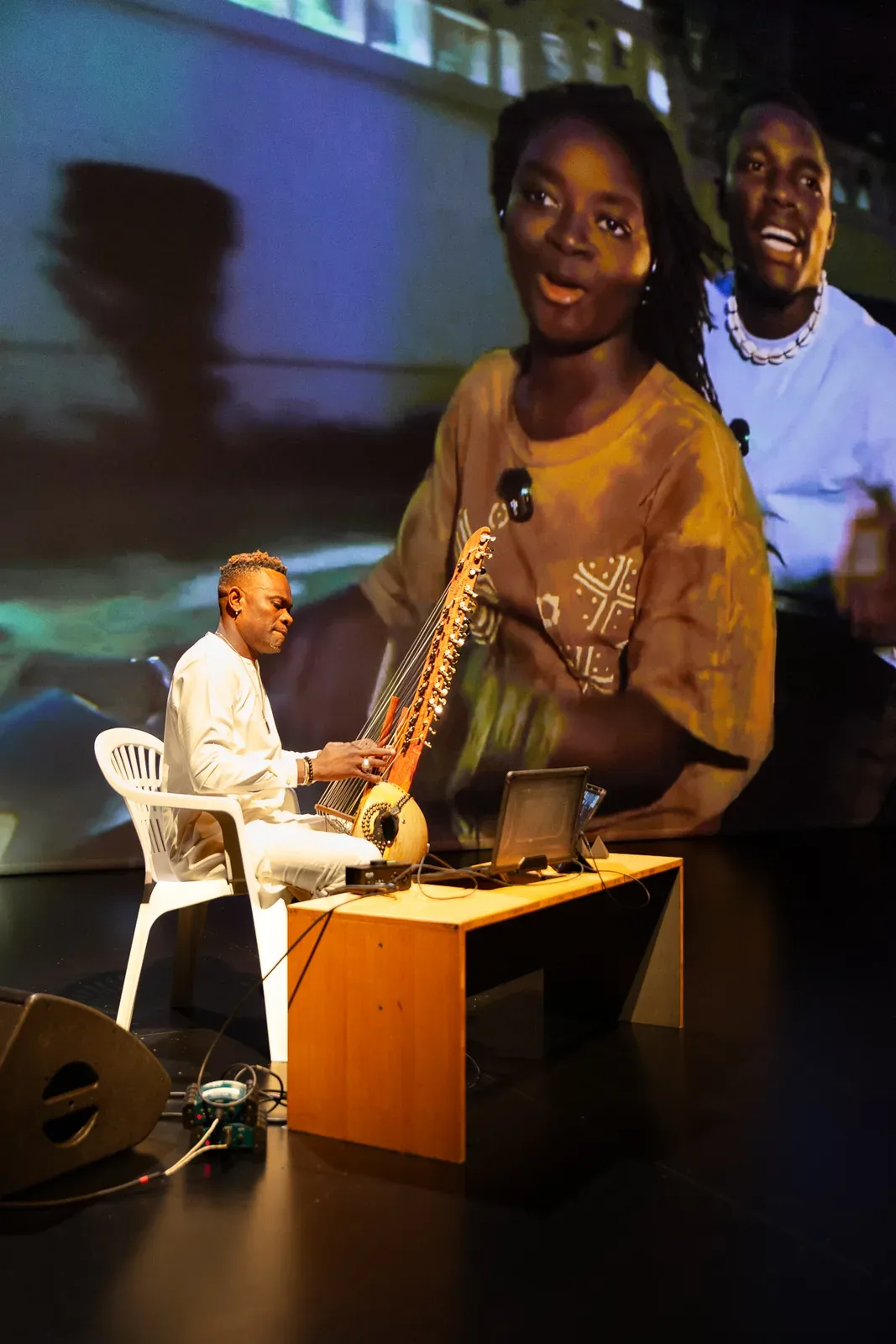
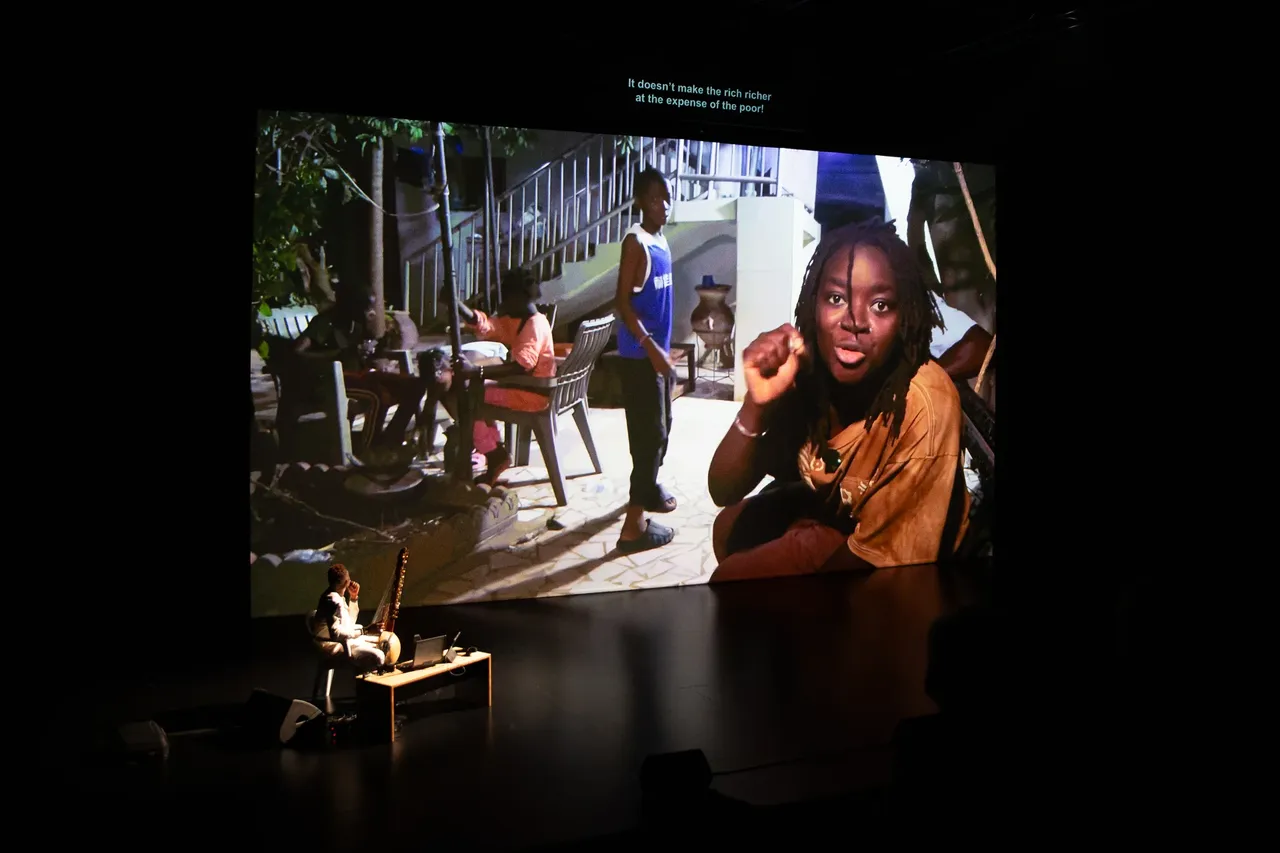
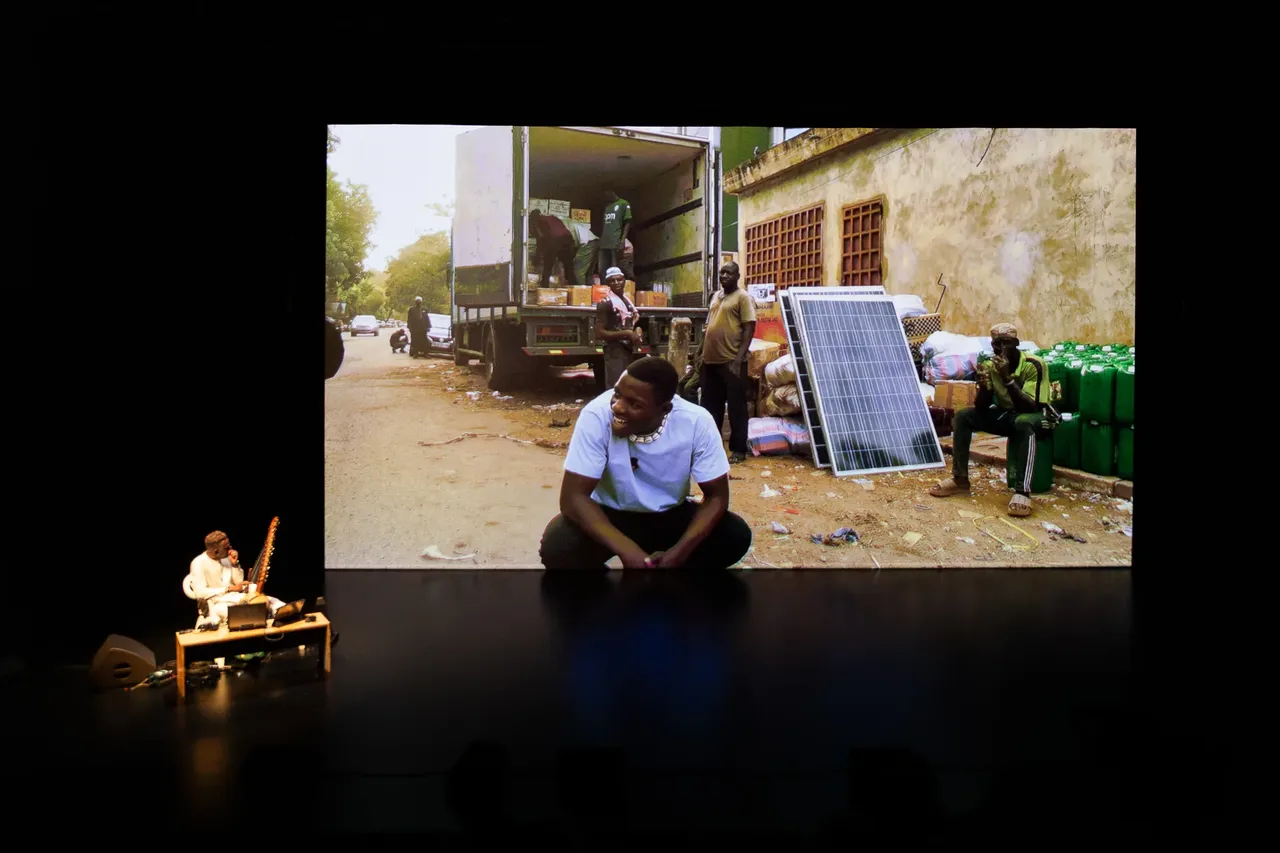
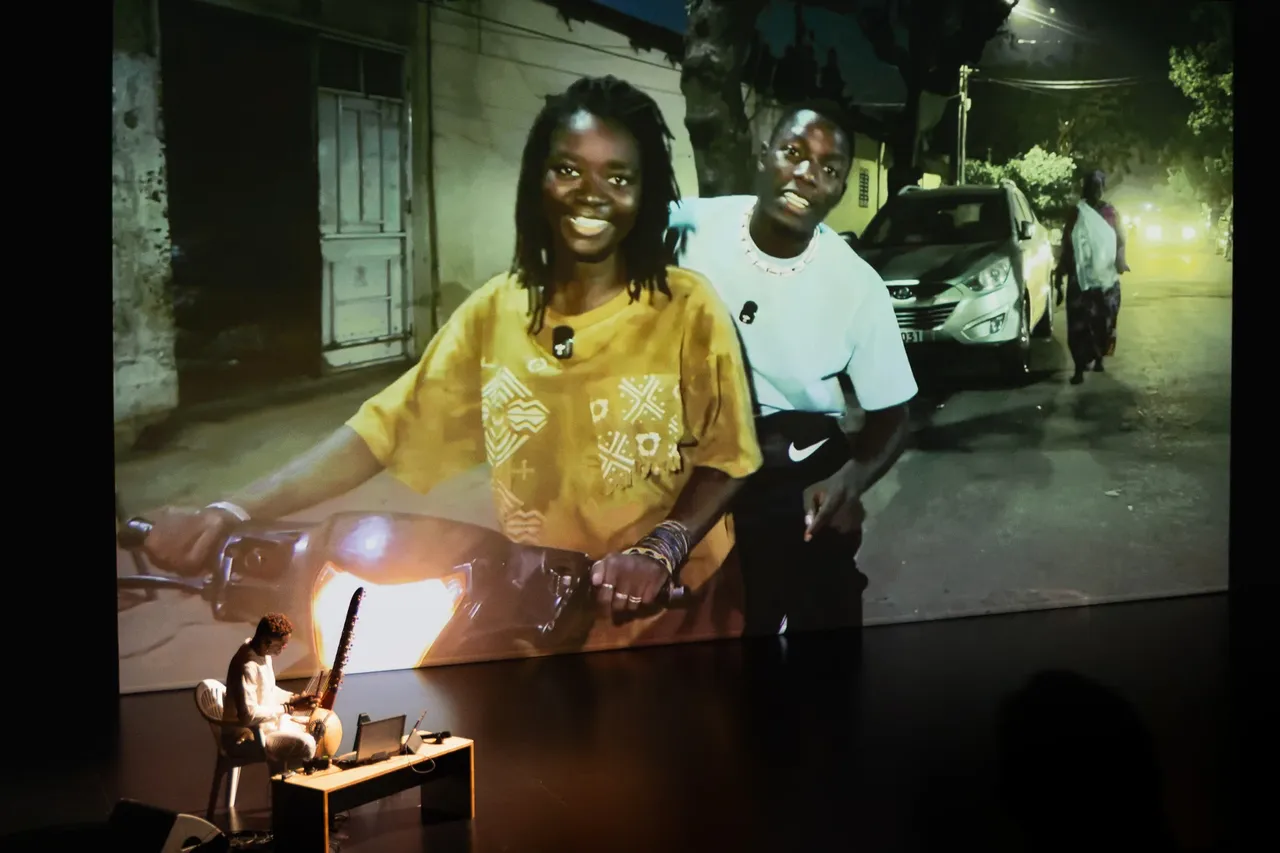
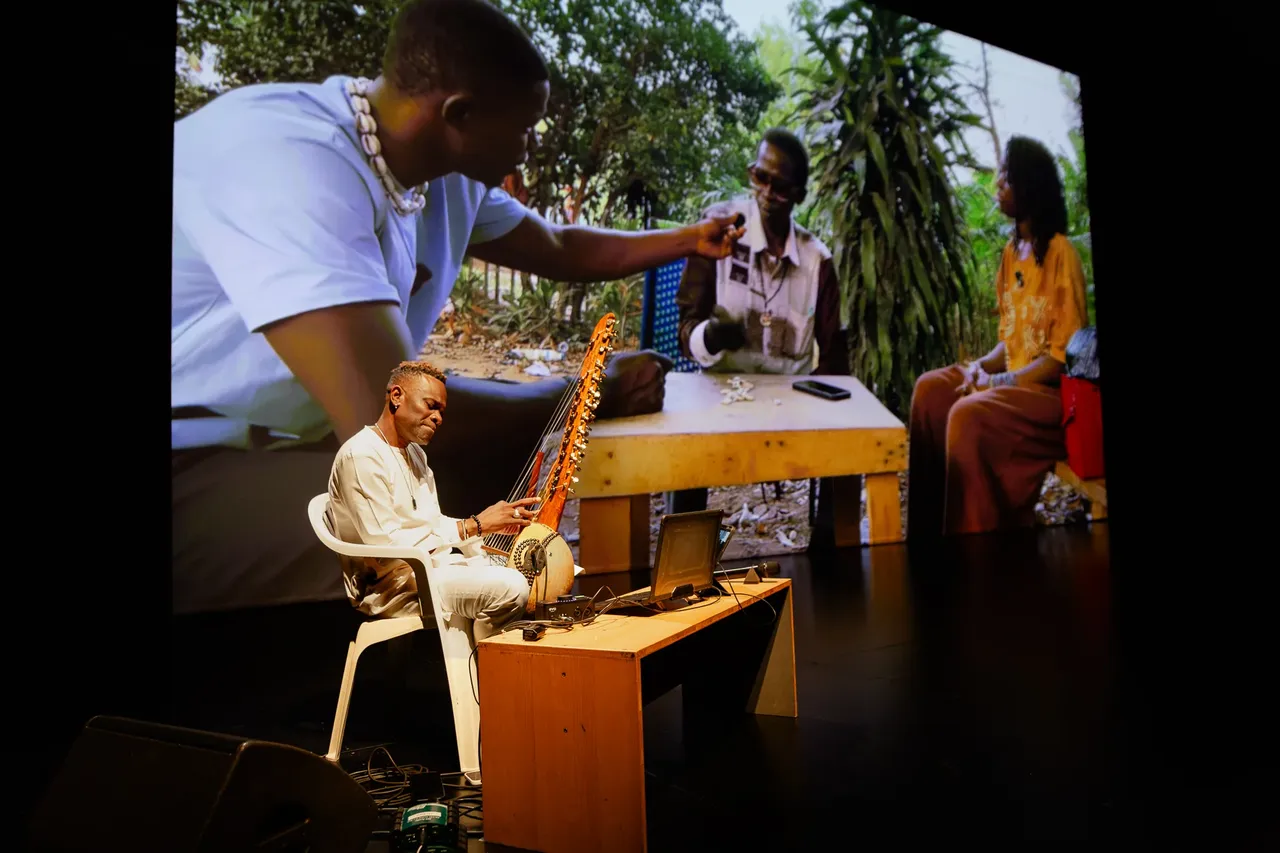
As evening falls in Bamako-Coura, the lights go down in the Culturgest auditorium in Lisbon, sheltered from the downpour outside. Two young people weave through the traffic in the historic neighbourhood of Mali’s capital, on foot or by motorbike, while a camera broadcasts their every movement live to dozens of spectators seated in a European theatre. Anything can happen during the eighty-minute sequence shot. This is the premise of Mali Futur Live, the hybrid piece created by the German collective Rimini Protokoll — under the direction of Stefan Kaegi — and Caroline Barneaud (Théâtre Vidy-Lausanne), together with the Malian company Les Praticables, led by Lamine Diarra. We attended the production on 21 November as part of the Alkantara Festival.
The work is a mixture of road movie, television broadcast and an excursion into a reality few people know. The set-up is as simple as it is dizzying. From Mali’s capital, Diarrah Dembélé and Kassim Dagnogo make their way through Bamako-Coura, accompanied by Alfousseny Konaté’s camera and an assistant. At the other end of the connection, musician Chérif Soumano provides a live soundtrack with his kora and some electronic sounds. The entire neighbourhood takes part in this improvised urban choreography.
In a dystopian future marked by climate change, Europe could face conditions similar to those Mali already knows in the present. Transformed into visionaries of sorts, the protagonists roam the streets in search of clues to that future. In their fantasy, they imagine that the precarity that characterises their everyday lives today anticipates what Europe might experience in a few decades. Mali is the future and Lisbon the past that must learn from Mali if it wants to survive.
After the introductions, Diarrah and Kassim show us an empty classroom; they foretell that this is what our schools of the future will look like. With no children to sustain the adult economy or care for their elders. The route continues to a street stall selling cans of petrol. ‘When your oil runs out, you’ll find yourselves like this too,’ they predict in French. It’s chilling to hear the audience laugh in disbelief at every warning. The fact that many streets in Mali are unpaved allows water to be absorbed better. ‘When temperatures soar because of climate change, you’ll have to tear up the tarmac so the earth can breathe.’ They also recommend planting more crops in cities and building adobe houses like those in their country.
What is the ideological heart of the show? The paradox of resilience. And the piece itself knows it: in its notes, it asks ‘how to think about the future when resilience has become another name for fatalism’. What we perceive as a lesson in sustainability may, however, be, for them, a forced response to scarcity. Even admiration can be condescending. ‘And you, do you make your own computers and mobile phones yet? Do you know which great power you’ll depend on in the future?’ they ask mockingly. Mali depends in part on investment from China. A large part of their country’s budget goes on defence. ‘Can you imagine that amount in Europe?’ they add.
The second half of the itinerary unfolds by motorbike. They head down to the river and show us how polluted it is. ‘Take care not to do the same to yours.’ Despite the technical and human limitations, the pace never flags, not even when the connection cuts out a few times.
The pyramid commemorating the young people murdered in 1991 is another stop. Mali’s military dictatorship lasted until that year. A popular uprising, put down with hundreds dead, opened the way to democracy. After the coups of 2020 and 2021, the country came under military control once again. Led by Assimi Goïta, the so-called Transitional Government dissolved all political parties in 2025 and extended its mandate without calling elections. Which is why they take us to the former headquarters of one of the political parties that no longer exist and ask us, ironically, how democracy is doing in our country.
Despite everything, they are involved in cultural projects that nobody talks about; when it comes to Mali, only armed conflicts attract any interest, they remark. The reversal of perspectives in this creative apparatus could allow them to criticise their own present indirectly without making a head-on denunciation. By addressing Europe, they can speak of the precarity, economic dependence and authoritarianism they know in Mali without putting themselves at risk of political repression.
Behind this adventure is a three-way collaboration. The project grew out of a meeting in Bamako in 2024 and had a first version, Sini Cinéma, in 2025. Since 2016, Les Praticables has been developing an artistic laboratory closely connected to the residents of Bamako-Coura. They stage their performances in squares, courtyards and patches of wasteland, as there are no venues in the neighbourhood. Although the initiative comes from the Malian company, a creation deeply rooted in Bamako needs a transnational framework to be presented simultaneously to European audiences.
The structure that, in my view, allows Les Praticables to speak to Europe without exposing themselves is also the one that could turn them into suppliers of ‘African authenticity’ while European institutions accumulate prestige. Diarra seems aware of the danger surrounding who controls the narrative. In an interview in October 2026, he explained the two conditions: equality between the three organisations and retaining control over the story Malians tell about themselves.
Their case, on a small scale, recalls that of Rachel Ojuromi, the Nigerian girl who went from parodying Chanel’s catwalk shows on the streets of Lagos, in clothes made with a friend, to walking for the French house in Paris in October 2026. As with Les Praticables, the African talent already existed before receiving the backing of a European entity. Is the West recognising that creativity or reserving for itself the privilege of consecrating it?
It is night in Bamako now. Almost an hour and a half has passed. The itinerary ends at Diarrah’s home, where four generations live, something common in Mali. She, for example, shares a room with her four sisters. ‘And you? How many square metres do you have?’ she asks the spectator directly. Under the guise of a warning addressed to Europe, the protagonists are recounting their own reality. Meanwhile, in Bamako, life goes on without waiting for the curtain to fall.
Every Friday, METAL Weekly gathers the week's stories. Subscribe.