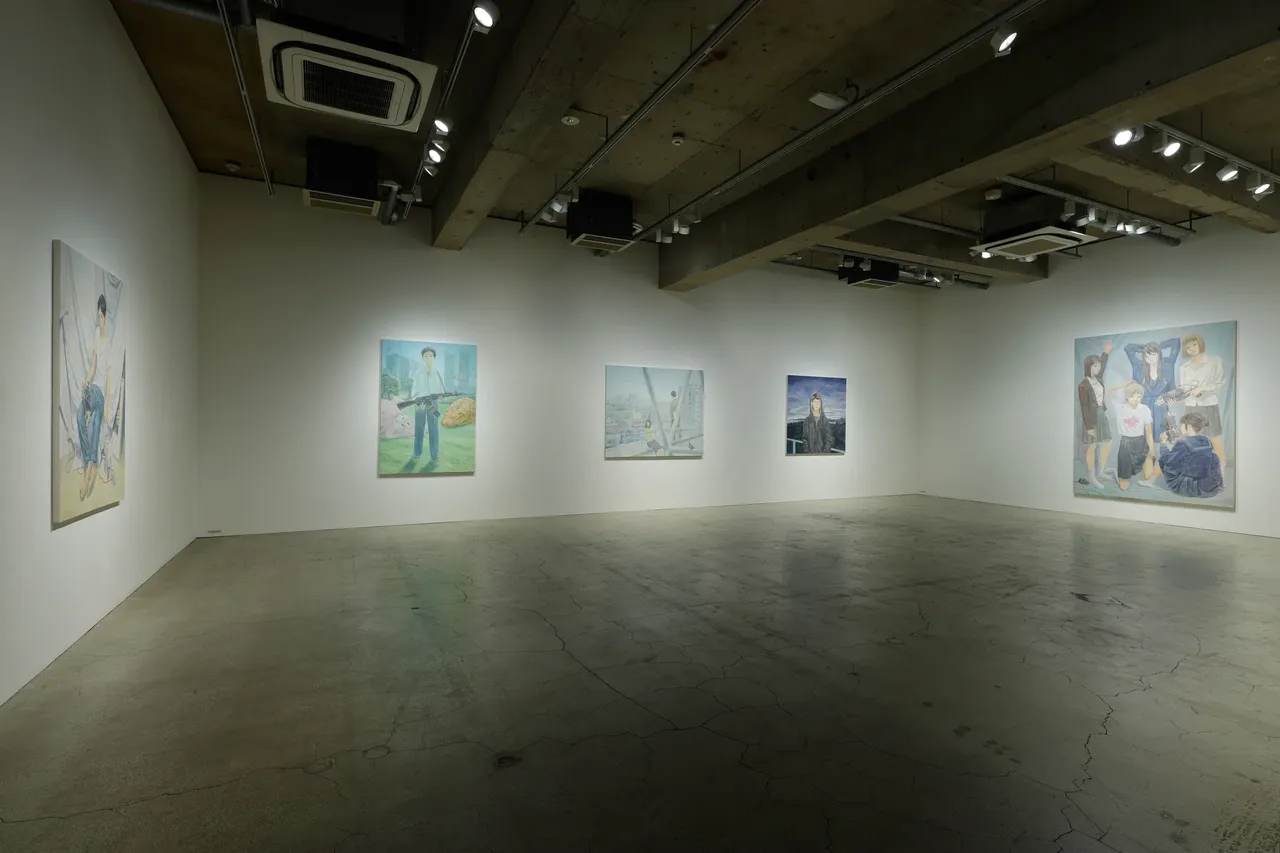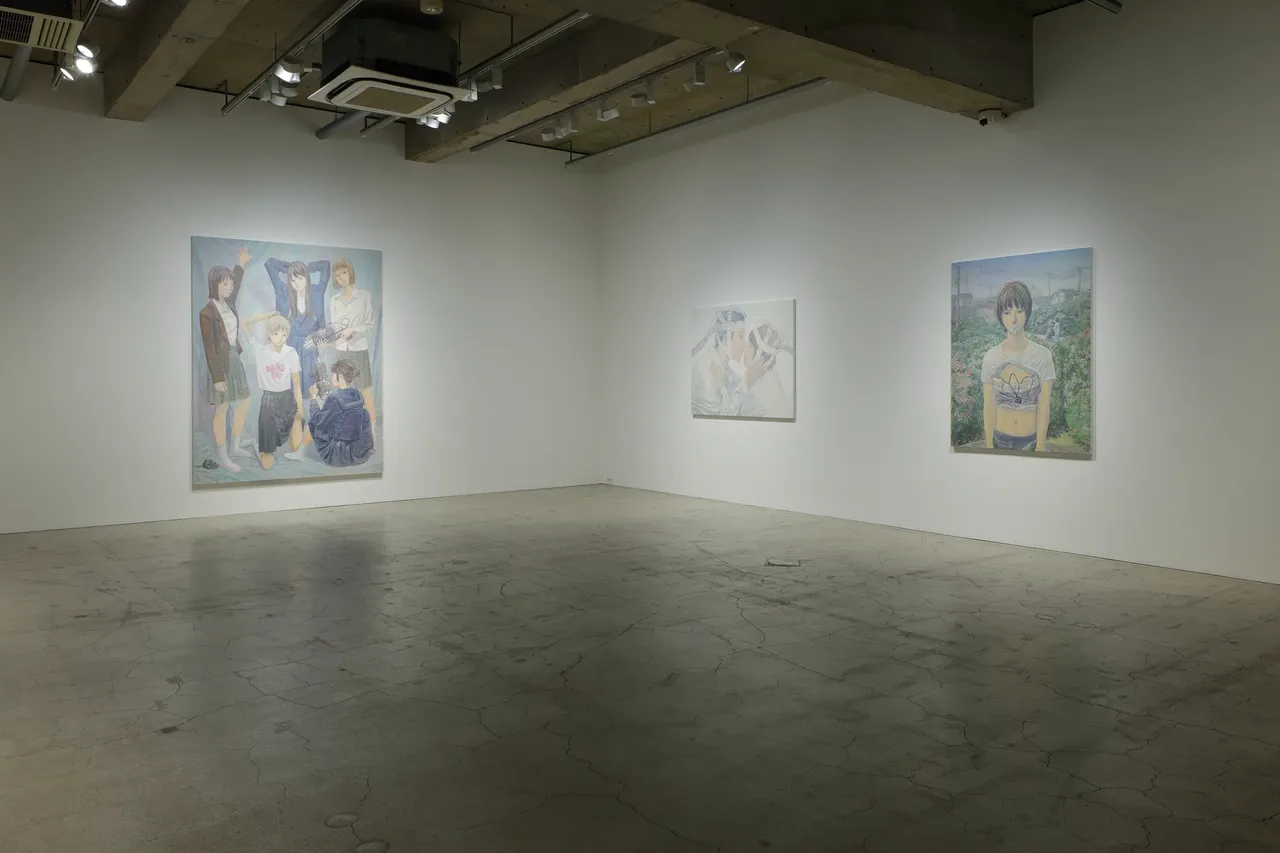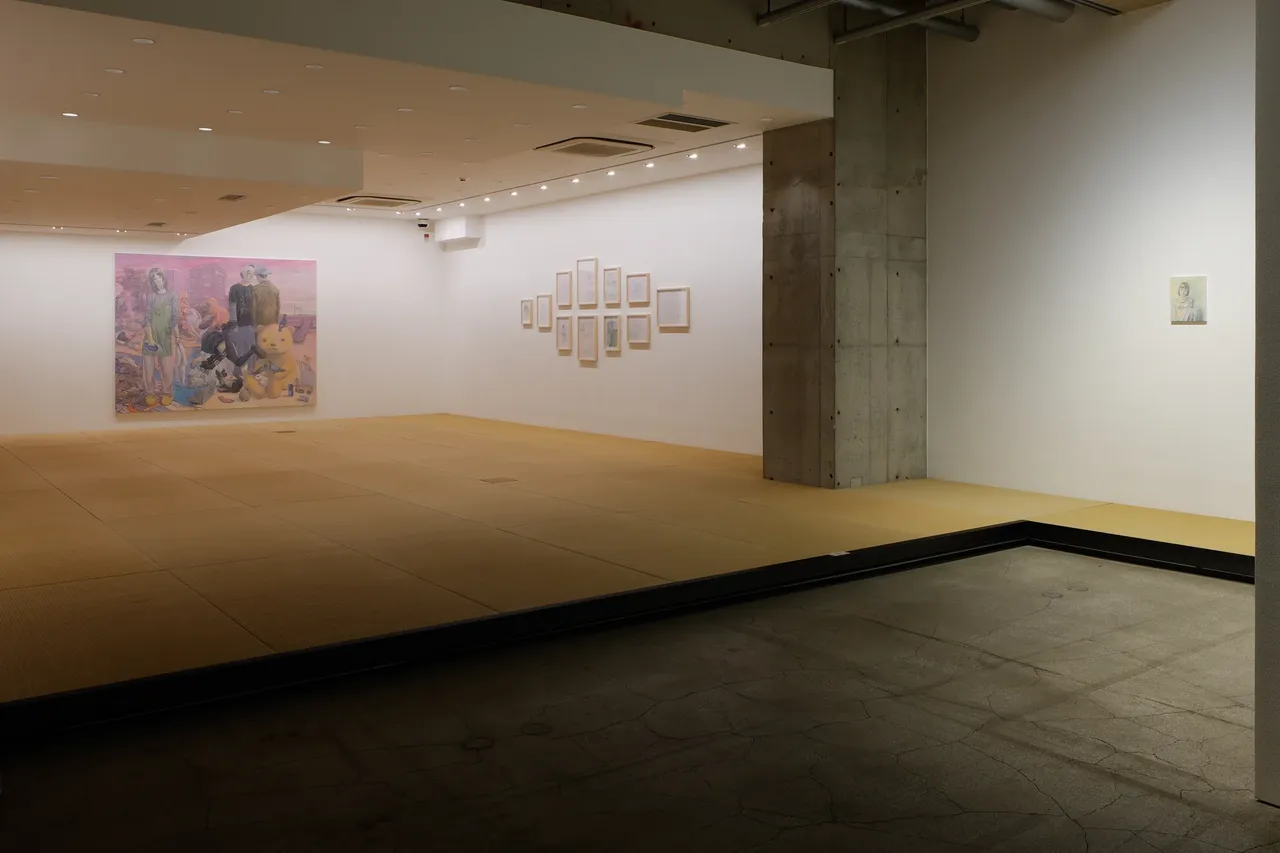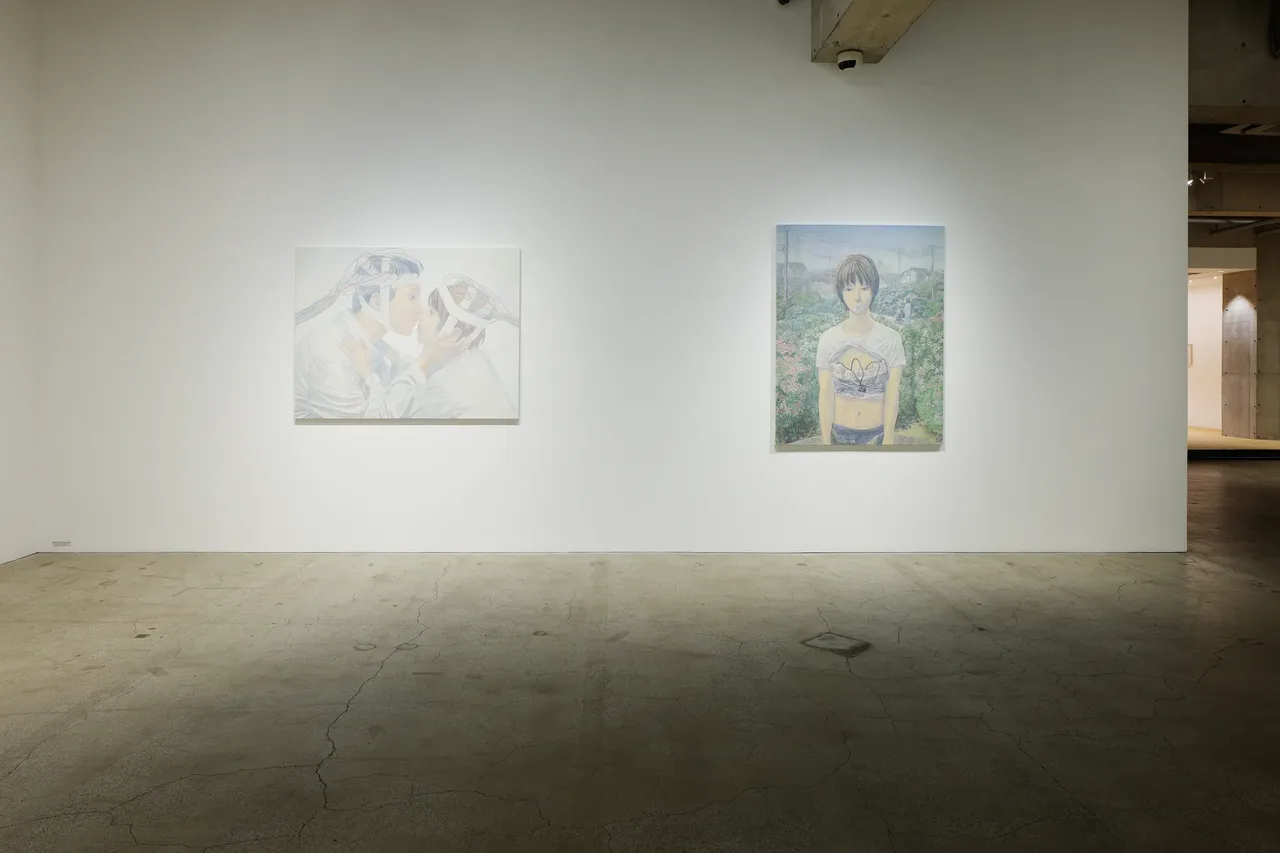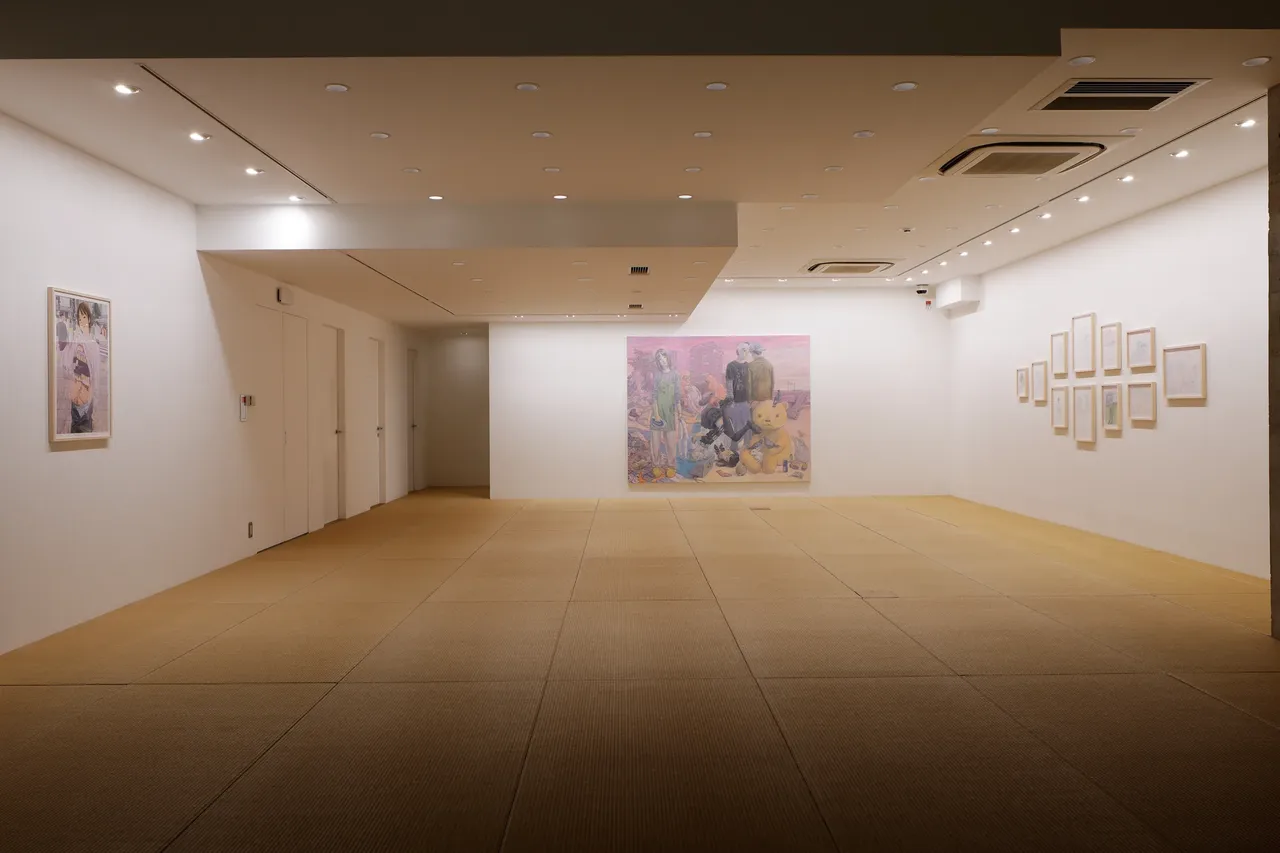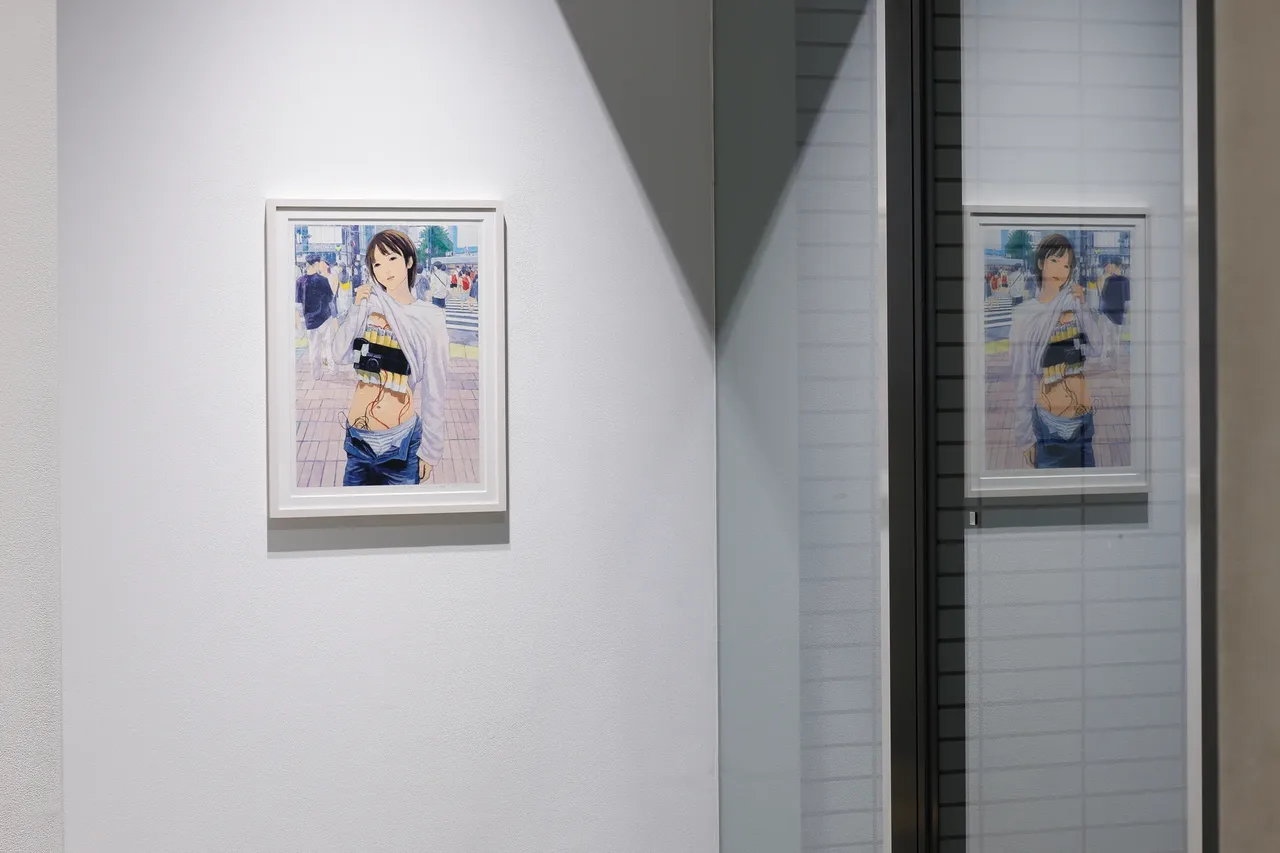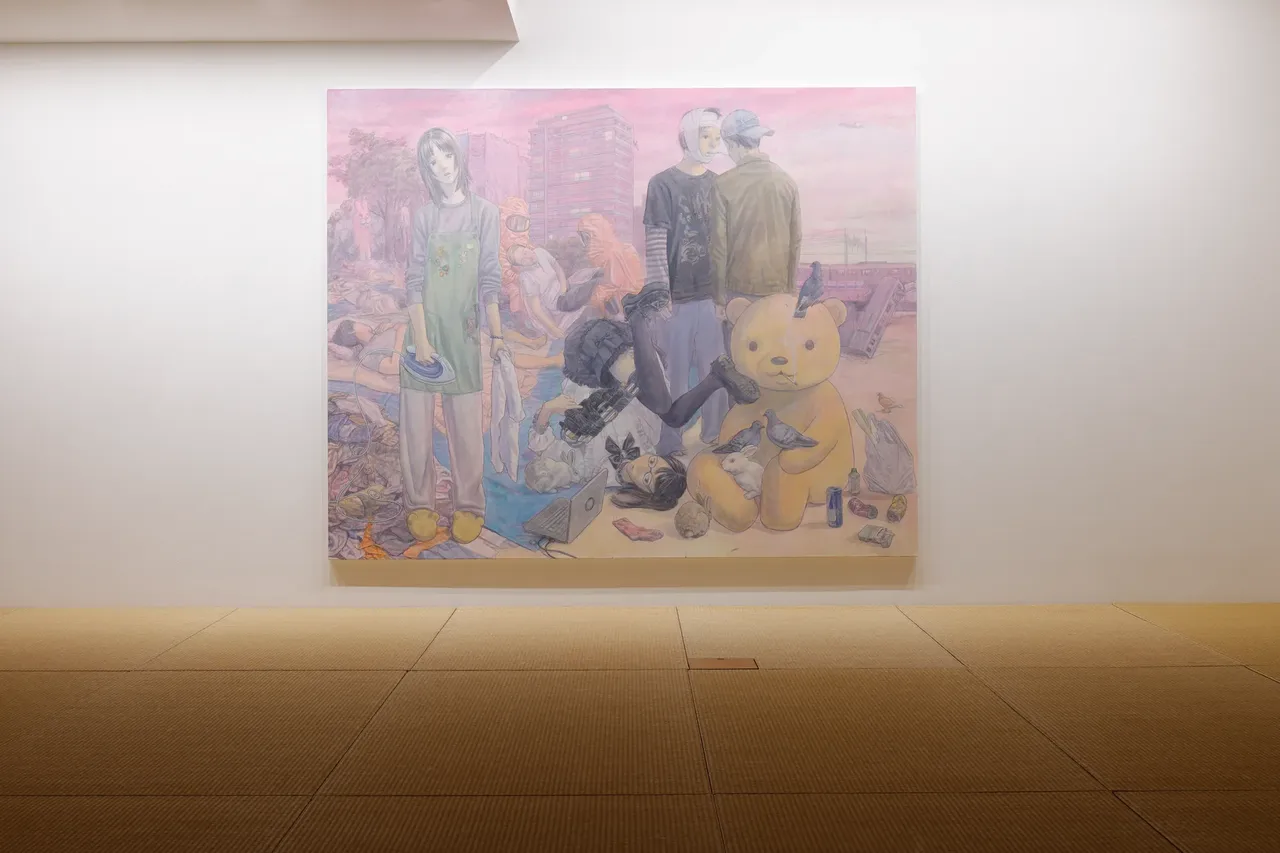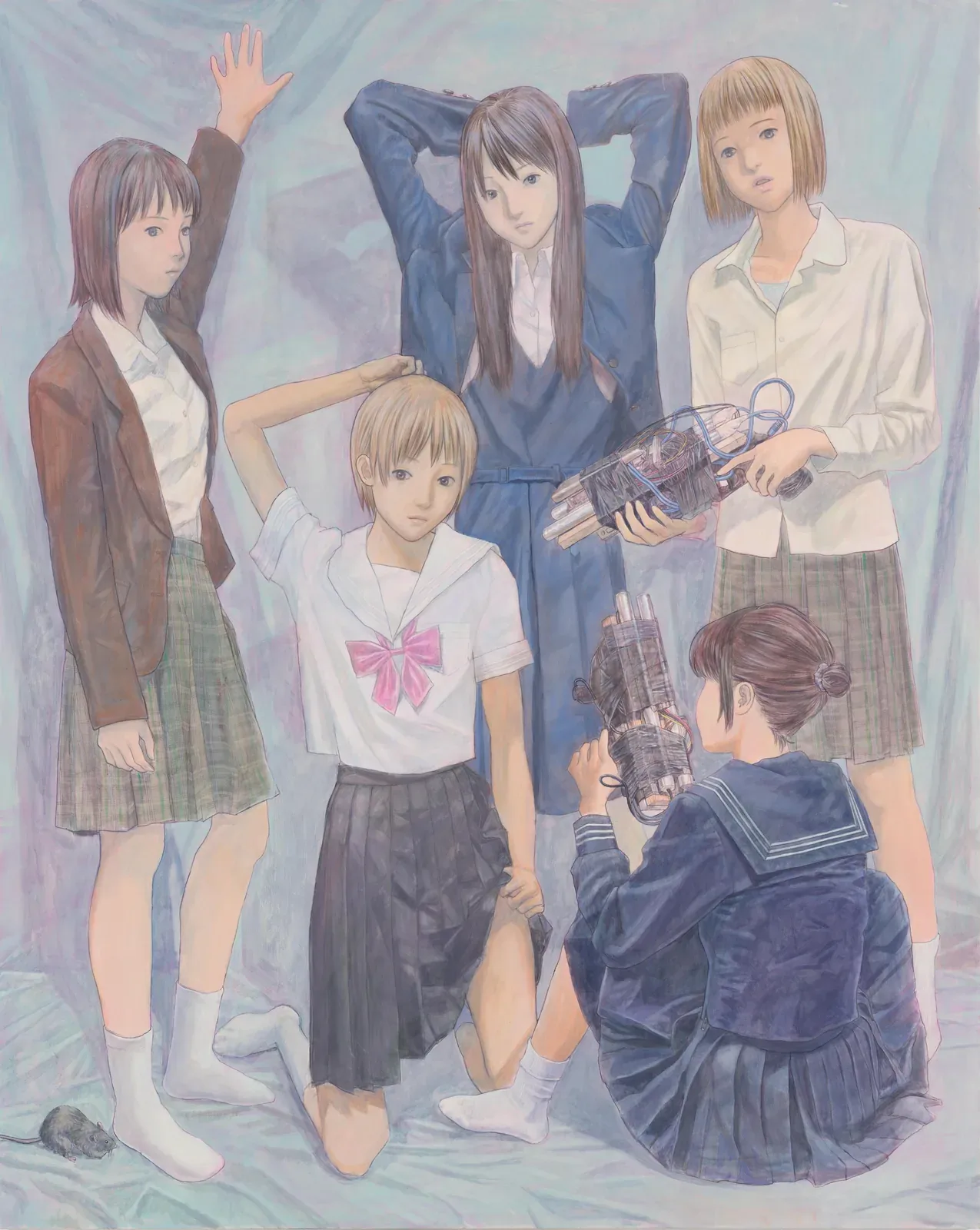
Girls with sailor uniforms, pastel colours and guns in their hands. At first glance, Utanhole’s paintings seem to belong to a world of contradictions, where innocence and violence collide in unsettling ways. Beneath their delicate surfaces lies a much more complex exploration of reality, imagination and the images we struggle to make sense of. In her latest exhibition, Zipgunslingers, the Japanese artist takes us further into this uneasy territory.
From an early fascination with manga to an ongoing, deeply personal engagement with image-making, Utanhole has developed a distinctive visual language through painting. Her work is less concerned with storytelling or fixed interpretations than with the possibilities of images themselves: their ability to evoke, unsettle and shape our understanding of the world. Zipgunslingers revisits some of the formative influences behind her practice, bringing them into dialogue with her ongoing exploration of the image as a means of perception and expression. We spoke with the artist about the thinking behind the exhibition, the references that have shaped her practice and the images that continue to inform her work.
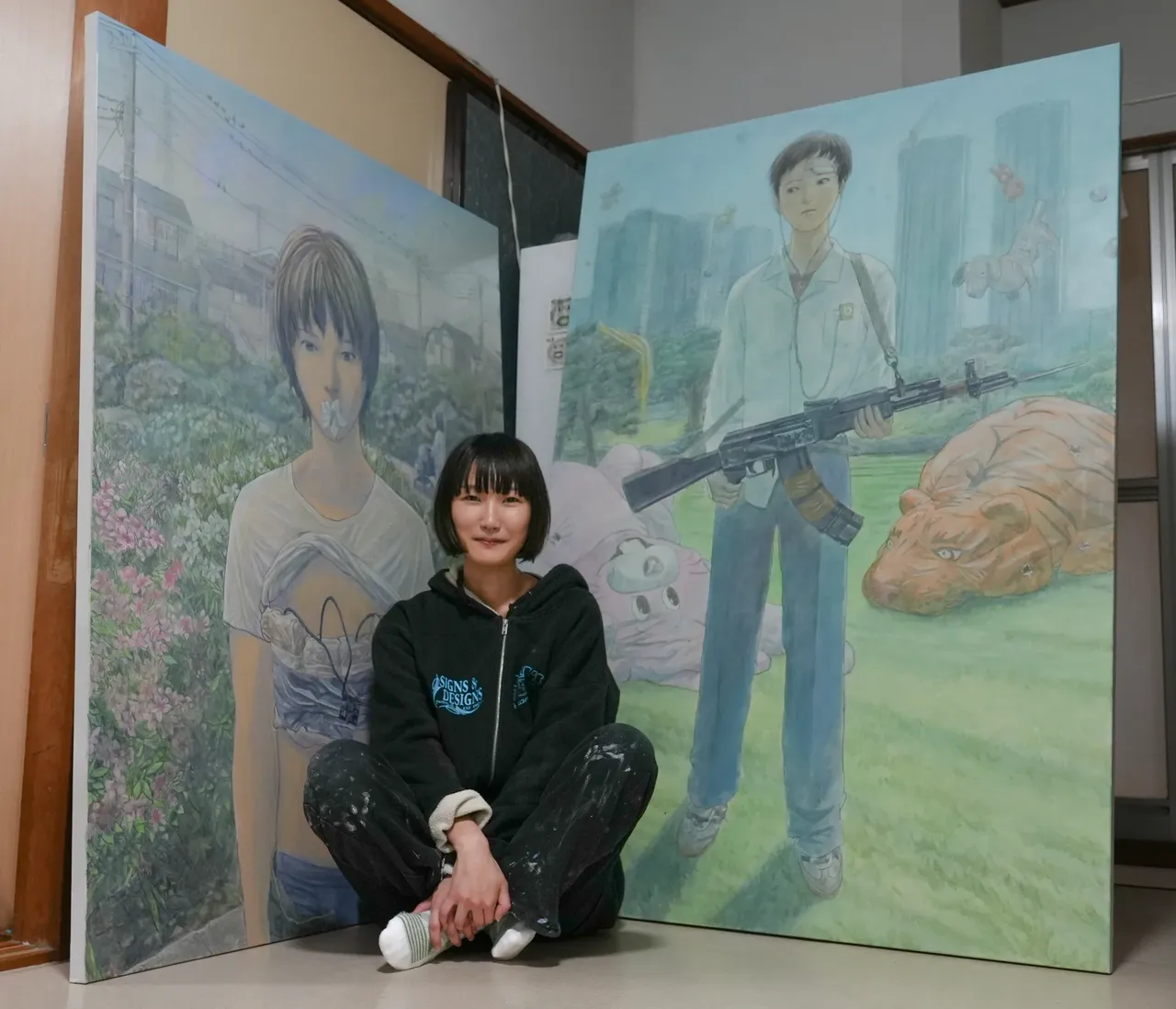
Hi Utanhole! First of all, it’s such a pleasure to meet you. Thank you so much for taking the time to speak with us. How have you been? What has life been like lately, both inside and outside the studio?
After finishing the work for the exhibition, I spent a while just lazing around. But I’m already getting started on the next work.
You’ve recently opened your new exhibition, Zipgunslingers, at Takashi Murakami’s Kaikai Kiki Gallery. How does it feel to finally present this new body of work?
The production period was fairly short, so I was relieved that the gallery ended up filled out nicely. A surprising number of people came to the opening, too. I’m happy about that.
Before we get into the exhibition, I’d love to go back a little. You once mentioned that you originally dreamed of becoming a manga artist. What attracted you to it growing up? And does that early fascination still influence your paintings today?
I was a kid who loved daydreaming on my own, so I loved the world of manga, where you can immerse yourself in all kinds of worlds. But there are also manga that aren’t just entertaining but serve as a guide for how to live. Ashita no Joe (Tomorrow’s Joe) is one of them.
One of the most distinctive aspects of your work is its visual language. Your paintings combine delicate lines and soft pastel colours with scenes that can be unsettling or even violent. How did you develop this particular aesthetic?
For this exhibition I’ve also used black paint. I do of course use glazing, a technique typical of oil painting, but I layer it so thinly that the pencil underdrawing remains visible. That’s because, even though the effects of oil paint are necessary for giving form to my images, I’m not very interested in the kind of materiality that is typical of painting.
For me, an image is something spiritual. There is only an intense image, and when I try to turn it into something that can be shared with everyone, it needs a certain size, and oil paint is effective for that, so that’s why I do it. The fact that delicate drawing is the foundation of my work comes, I think, from my experience of making manga. As for colour, I think my identity as a Japanese person also plays a part. I’m drawn less to vivid colours than to subtle tones that seep slowly into the heart. And, surprisingly, I think oil paint is well suited to expressing that.
For me, an image is something spiritual. There is only an intense image, and when I try to turn it into something that can be shared with everyone, it needs a certain size, and oil paint is effective for that, so that’s why I do it. The fact that delicate drawing is the foundation of my work comes, I think, from my experience of making manga. As for colour, I think my identity as a Japanese person also plays a part. I’m drawn less to vivid colours than to subtle tones that seep slowly into the heart. And, surprisingly, I think oil paint is well suited to expressing that.
I’m curious to hear more about your relationship with colour. How do you approach colour when starting a painting? Do you plan the palette beforehand, or does it evolve as you work?
Once I’ve more or less finished working out the light and shadow, I make the palette.
“I was a kid who loved daydreaming on my own.”
You once mentioned how deeply a film by Lars von Trier had moved you when you were younger. Beyond that experience, what kind of things feed your imagination today? Is there a film, song, book or even an everyday experience that has inspired you lately?
Recently I read the novel Solaris and was deeply moved. I love Tarkovsky’s film of Solaris, but I’d heard that the original author was dissatisfied with how it turned out, so I’d been curious what the novel was like. Having read it, I understand very well why the author was unhappy with the film’s concept. Solaris is something no one has ever seen: a sticky, reddish-black ocean. Toward the end of the novel there is a torrent of description of the phenomena the ocean produces. It’s terrifying and beautiful, the kind of writing that gives you goosebumps. In the film, I think, those images were either treated as entirely peripheral to human emotions like romance and nostalgia, or not depicted at all. But to me, those images seemed to be what really matters. I don’t know whether I can turn them into a painting, but I’m going to try.
We’re constantly exposed to images of disasters, conflicts and tragedies, particularly through social media. Do you think this has changed the way we respond to these events? Has it influenced the way you approach these subjects in your paintings?
I was born in 2001, so I was born into that kind of world to begin with. If anything, it’s harder to feel that it’s abnormal.
Many of your paintings feature young characters, particularly girls wearing school uniforms. What draws you to this imagery? Do you think your work reflects something about the generation you belong to, or the experience of growing up today?
I wore a sailor uniform in junior high, and I think I’m one of the people who had the gloomiest adolescence in Japan, if not the number one, then certainly in the top tier. I know nothing about the sparkling high-school-girl life. I also hated that I was expected to wear something as ridiculous as a sailor uniform. It’s a ridiculous outfit. That’s exactly why I deliberately put it on myself now and, how should I put it, turn it into a painting. Because it reminds me of the anger I felt back then (laughs).
You’ve previously spoken about the idea of chūnibyō, that adolescent tendency to construct an idealised inner world and become completely immersed in it. What do you find most interesting about this mindset that has helped you to create your characters?
Well, “chūnibyō” is a word I used before, simply as a convenient way to describe my work. It’s not that I’m always trying to depict chūnibyō, and it isn’t my theme. But I might be chūnibyō myself.
There’s sometimes something quite absurd or even darkly humorous about your paintings. Is humour something you consciously bring into your work?
I like humour. No matter how hard I work on a painting, I’d like to keep a certain leeway, a feeling of: well, in the end, it doesn’t really matter. Something I was absorbed in as if my life depended on it a moment ago, and the next moment I’ve lost interest. I wonder if that could be called humour.
Let’s talk about Zipgunslingers. In some of your earlier paintings, your characters seemed to exist alongside scenes of destruction, whereas in this new series we see them holding weapons themselves. What prompted this shift?
I’ve been painting people with weapons for a while now. Before I started making tableaux in my current style, I drew many drawings of kids holding guns, in a series called Gunslingers. So, it’s less a shift than a return to my origins.
“The violent or aggressive imagery in my paintings should not be taken as a direct expression of my own desires or impulses. […] I’m trying to understand reality.”
The characters in this new series seem to have a particular relationship with power. Do you think they’re seeking some kind of control, or are they simply playing with the idea of having it?
To begin with, I’m just painting pictures, so I’m not assuming a story or a drama driven by the characters’ feelings and desires. I think manga and a single painting are completely different in that respect. I don’t know what they want either. But there was the shooting of Shinzo Abe in Japan. A zip gun was, in reality, made in secret, without anyone knowing, and then it ended up actually being used. It was done by someone dressed in a way that no one would pay attention to. We notice nothing until it happens. And that zip gun also seemed to me like a symbol of the very force of arms being made somewhere out of sight, and that image inspired me. So, I turned it into a painting, that’s all. I’m not trying to give it any doctrine or any particular set of values. For example, you could interpret it as frail schoolgirls defending themselves with zip guns, banding together to protect one another. But their expressions refuse even that interpretation, don’t they? That’s how I painted the picture Zipgunslingers.
Your paintings seem to exist somewhere between the real world and a deeply personal imaginary universe. When you paint, do you feel you’re trying to make sense of reality, or are you more interested in creating a world of your own?
If my work is understood as some kind of expression of my inner self, I think that’s absolutely wrong. Anger and other emotions are merely a driving force. Some people look at my paintings as if they were psychoanalysing them and worry about my state of mind. When I said that my work should not be understood as an expression of my inner self, I didn’t mean to reject viewers’ personal interpretations or their freedom to relate the paintings to their own experiences. What I wanted to say is that I don’t think the violent or aggressive imagery in my paintings should be taken as a direct expression of my own desires or impulses. My emotions, such as anger, may drive me to paint, but that doesn’t mean the images themselves reveal my personal psychological state.
I paint large pictures, and go out of my way to show them to people, precisely because I suspect the real world might be like this, and I’m testing that. So, I think it’s closer to say that I’m trying to understand reality.
I paint large pictures, and go out of my way to show them to people, precisely because I suspect the real world might be like this, and I’m testing that. So, I think it’s closer to say that I’m trying to understand reality.
As your work evolves, do you ever feel the need to move away from themes or visual elements that have become closely associated with your practice? How do you keep things fresh?
I do sometimes repeat the same motifs, but ideally I’d like to come up with a completely different invention every time. It doesn’t always work out that way, though. Shifting my viewpoint a little is also important, and I think new ideas can come out of that kind of practice, so I’ll try not to take it too hard.
As your work reaches a wider international audience, do you find it interesting to see how people from different cultural backgrounds interpret your paintings? Have you ever received an interpretation that surprised you?
I find it very interesting. When I painted a schoolgirl with her bottom showing, some people were absolutely furious (laughs). But there were also people who left very sharp interpretations of the same painting in the comments, and that made me happy.
And finally, is there something you’ve been particularly curious about lately that you’d like to explore in your next body of work?
The ocean of Solaris that I mentioned earlier. But I might fail. I’d also like to try painting people of many different races. That might take a while before it takes shape, though.