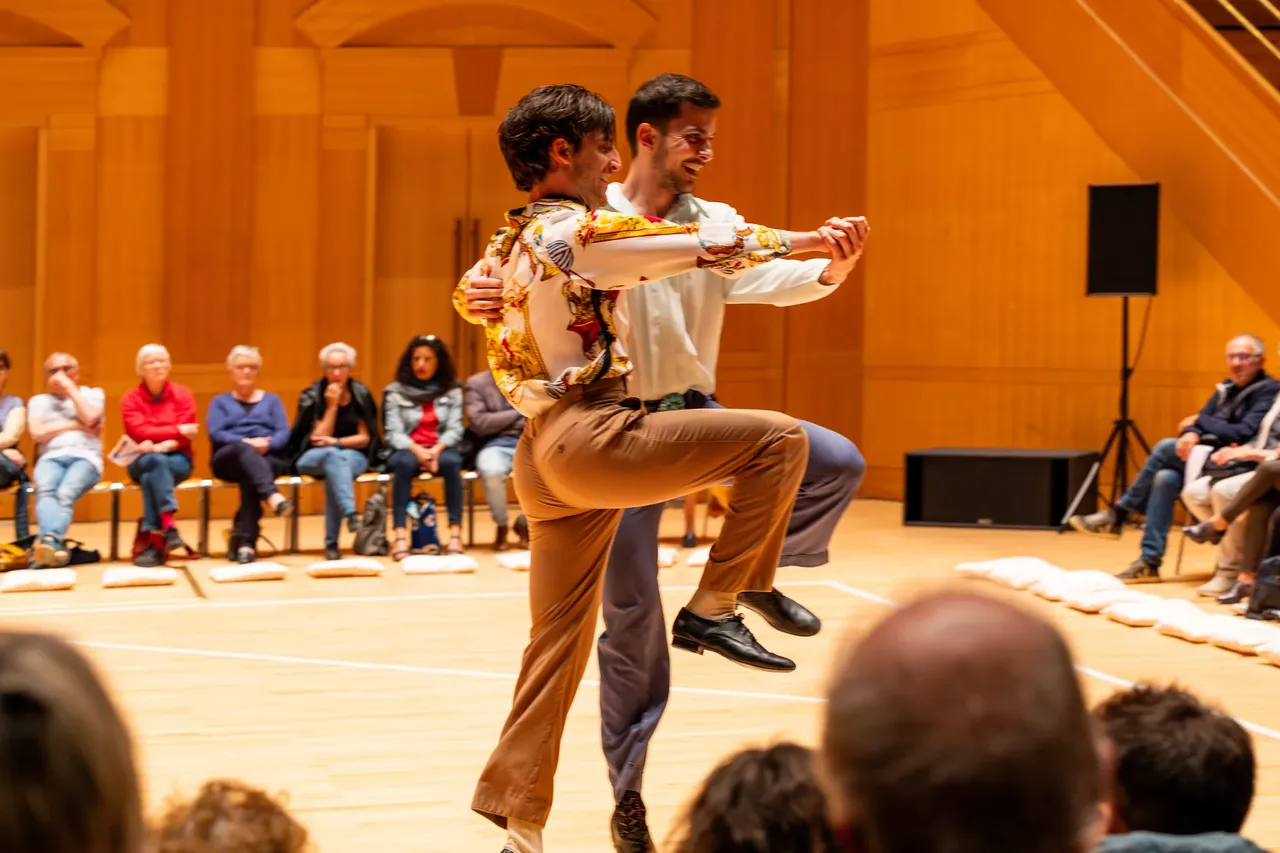
In Save the Last Dance for Me, Italian choreographer Alessandro Sciarroni, winner of the Golden Lion for Lifetime Achievement in Dance at the 2019 Venice Biennale, explores what happens when a dance outlives its original social context and reappears on stage a century later. The performance duet we saw on 14 November at Lisbon’s CCB, as part of the Alkantara Festival programme, rescues from oblivion the polka chinata, a male dance from early twentieth-century Bologna whose steps Sciarroni faithfully reproduces, although their transfer to the stage exposes them to a contemporary gaze that could alter their meaning.
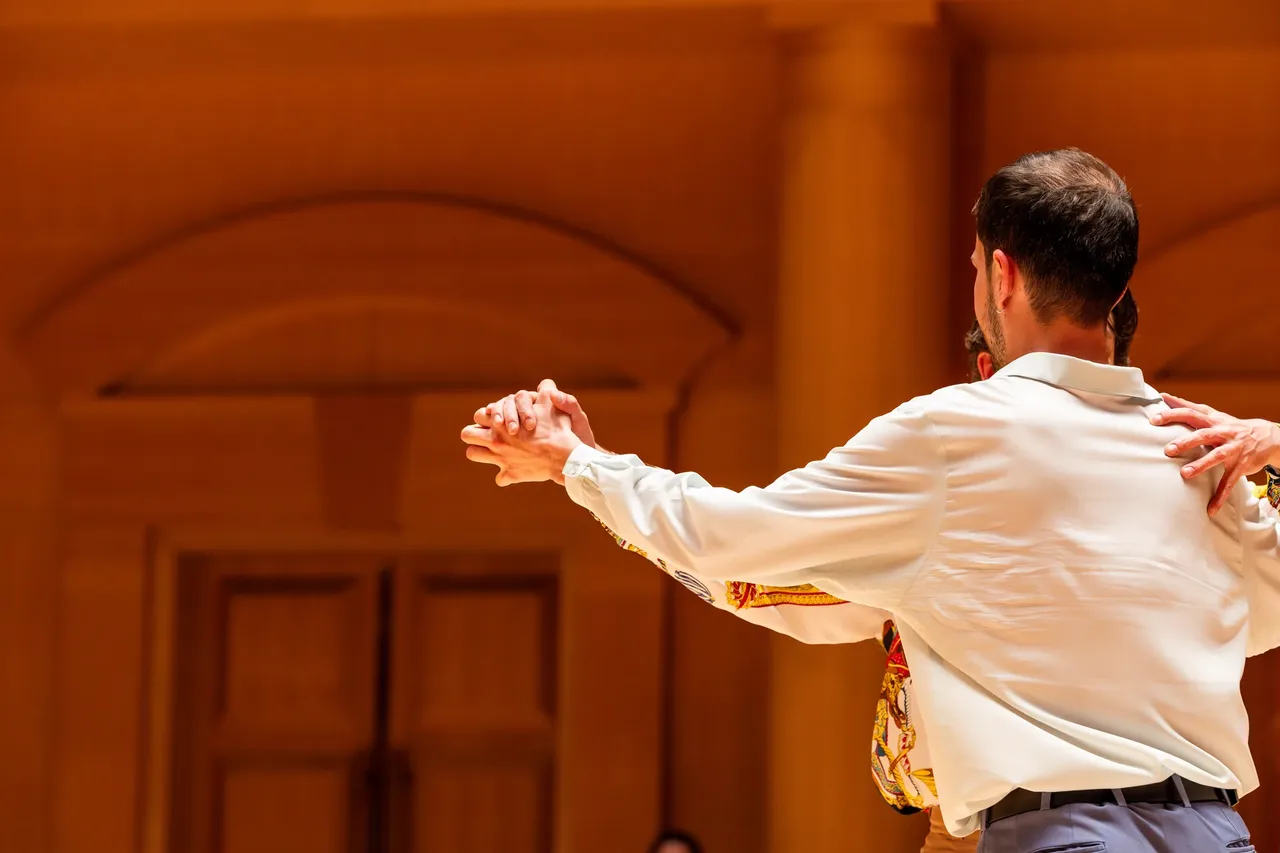
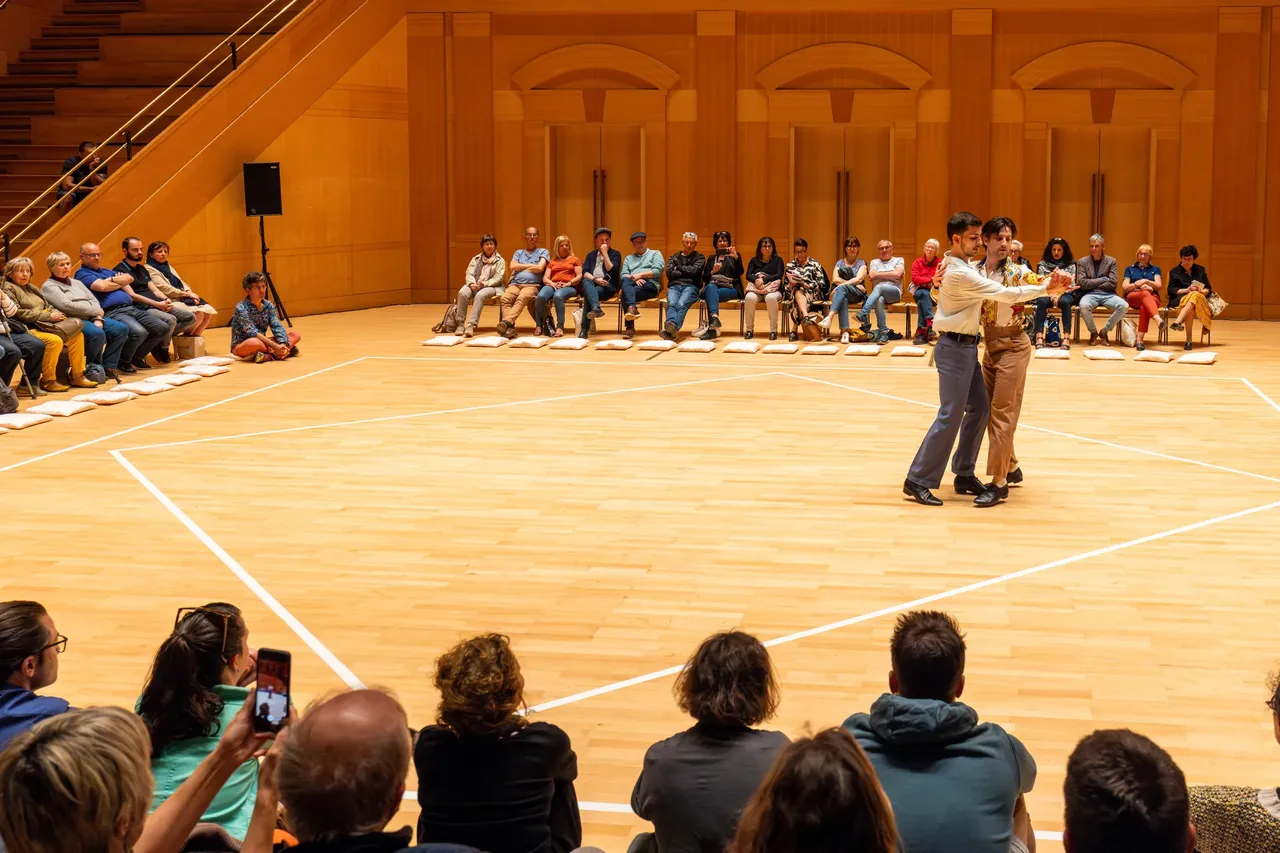
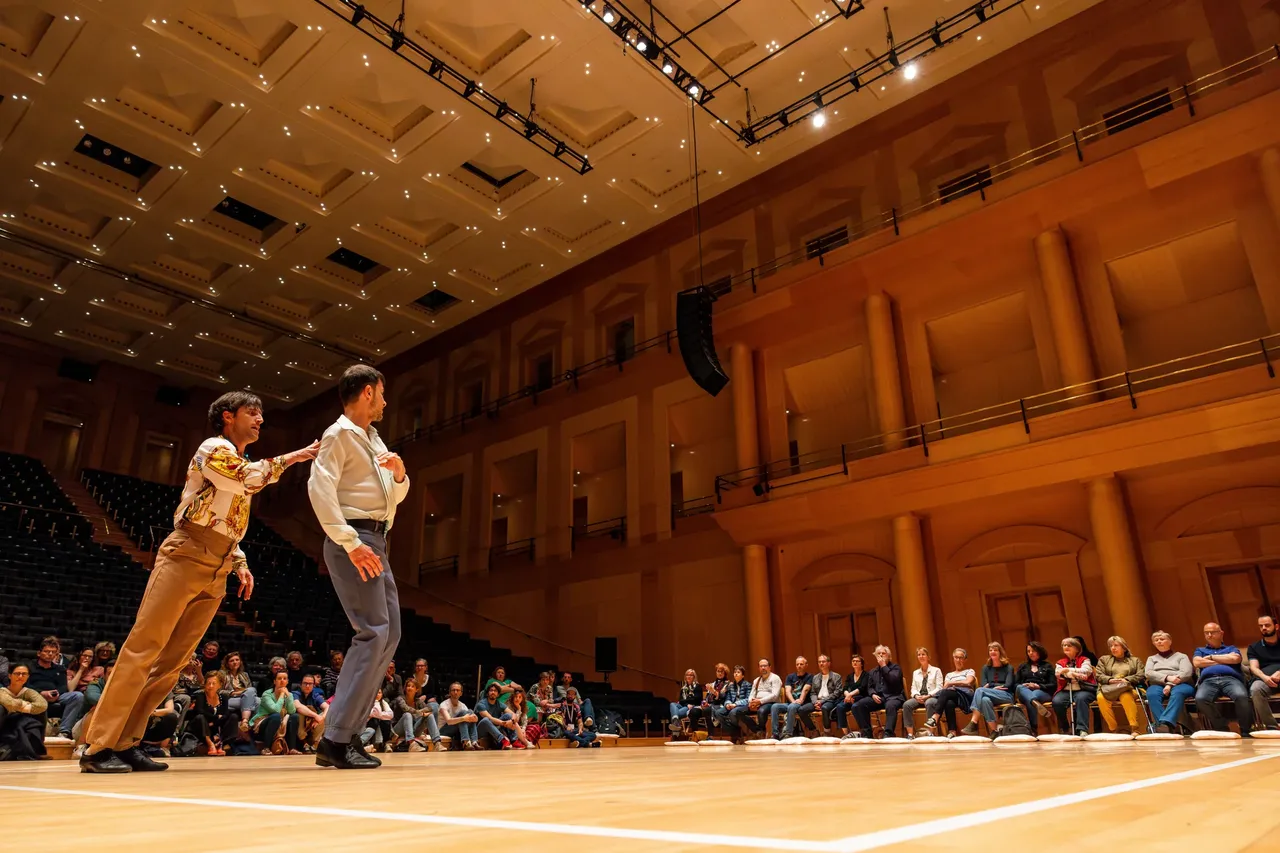
As the electronic music by Aurora Bauzà & Pere Jou begins, Giovanfrancesco Giannini and Gianmaria Borzillo enter hand in hand through one corner of the ring. The sun filters through the glass walls of the foyer at the Centro Cultural de Belém. In a sequence of great technical difficulty, two bodies locked in a close embrace spin without letting go, lowering and straightening themselves again and again. With each turn, trust in the other must be redoubled. It is this that keeps the centrifugal force they generate together from pulling them apart.
Other, faster turns are superimposed on the basic turn this intimate duet traces around the room. The succession culminates in a multiorgasmic human spinning top whose whirling apotheosis eventually disintegrates, only to begin again shortly afterwards. A turn within a turn within another. In that magnificent whirlwind, slight modifications are introduced with each new iteration, without beginning or end. Their knees never quite touch the floor, but with each frenzied rotation they bend a little lower. There is a reason they call it polka chinata, that is, crouched.
By the eighties, the polka chinata had almost disappeared. When Sciarroni took an interest in it, only five people were practising it in Italy. The piece, developed in collaboration with filuzziani dance master Giancarlo Stagni, who reconstructed the dance from video recordings from the sixties, unfolds as an acrobatic loop as splendid as it is dizzying.
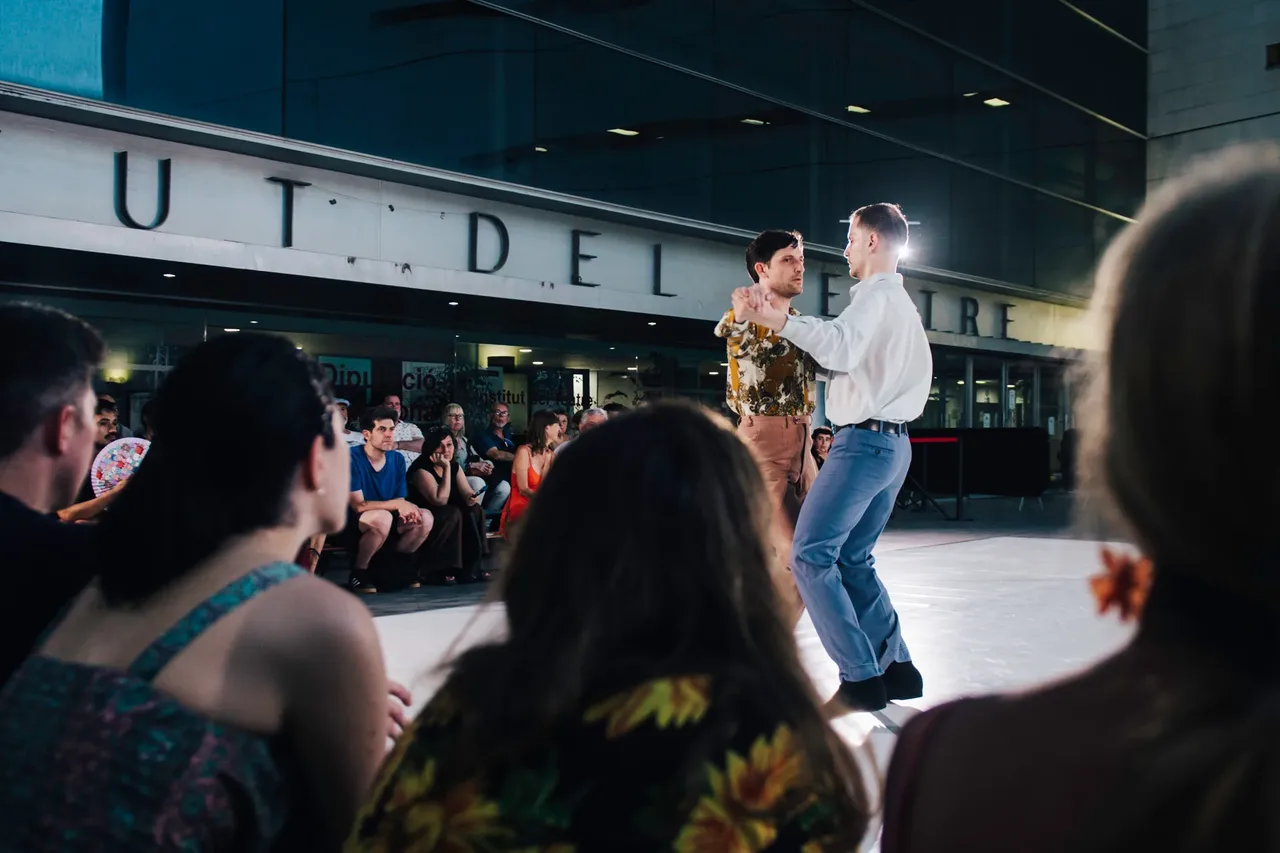
Save the Last Dance for Me continues a line of work Sciarroni has pursued for years: taking practices from outside the performing arts circuit, such as the Tyrolean Schuhplattler in Folk-s, the juggling in Untitled or the goalball in Aurora. On this occasion, Borzillo and Giannini trained with Stagni for about five months to master a technique that demands much more than coordination: strength, balance and an astonishing ability to rotate. The resulting choreography extends a dance that normally lasts two or three minutes to twenty. That stretching out transforms the display of virtuosity: it is now, above all, a test of endurance.
Roughly halfway through the performance, the dancers’ smiles mingle with their gasps, the complicity of their glances, their half-finished sentences and the pleasurable tiredness they make no effort to conceal. The sustained repetition of the turns lays bare the effort usually hidden behind the skill. Each pause allows them to prepare for the next thrust while drops of sweat gleam like precious stones in the reflected sunlight. The sensuality of this endangered dance evokes the exhaustion of intercourse. After the final ovation, a bonus track: they return to dance for a few more minutes to the original music of the polka chinata, to the sound of an accordion. They leave hand in hand too, and so ends a performance that is, in its own way, a gesture of preservation.
Save the Last Dance for Me appears at first glance to be the resurrection of the polka chinata. Yet Sciarroni doesn’t construct an ethnographic diorama to exhibit the dance as a folkloric curiosity, nor does he update it with whimsical ideas: the original steps are respected. The choreographer does, however, extend its duration, so that physical prowess gives way to fatigue, and replace the accordion with an electronic soundtrack that frees the work from the sentimental trap of revival. The intention was to save the dance from oblivion. To that end, the dancers give workshops wherever they perform it, though not during this festival: by 2025, some six hundred people around the world had already taken part in them.
The performers entering and leaving the room hand in hand has a curious eloquence that leaves hanging in the air the image of a meeting and a farewell between two people who love each other, without specifying how. A dance that a century ago formed part of a male courtship ritual to impress women can today, removed from that heterosexual framework, prompt more or less automatic homoerotic or queer associations.
One might wonder whether spectators project their own ghosts concerning homosexuality and masculinity onto that male contact, or whether they are simply discovering something the choreography sets in motion. Most likely, both things happen, and each person’s age, experience and desire determine in what proportion. Sciarroni, for his part, told the French magazine MaCulture in 2023 that he didn’t want to tell a love story between two men; he’s more interested in how contemporary audiences perceive what probably went unnoticed by spectators at the beginning of the last century. He also explained that the subject of his research in this piece is the relationship, and that the dance acts as a metaphor for trust in the other and the need to trust in order not to fall.
Twenty minutes are enough for Alessandro Sciarroni to confirm that it takes neither two hours on stage nor a vast cast nor eye-catching stage design to splash the spectator with a sensuality that needs no justification. The title, taken word for word from a 1960 song by The Drifters that plays with trust, fidelity, desire and possessiveness within a couple, seems to anticipate a farewell that the choreography seeks to prolong for eternity.
© Raoul Gilibert - Passages Transfestival-Metz 2023
© Raoul Gilibert - Passages Transfestival-Metz 2023
© Raoul Gilibert - Passages Transfestival-Metz 2023
© Raoul Gilibert - Passages Transfestival-Metz 2023