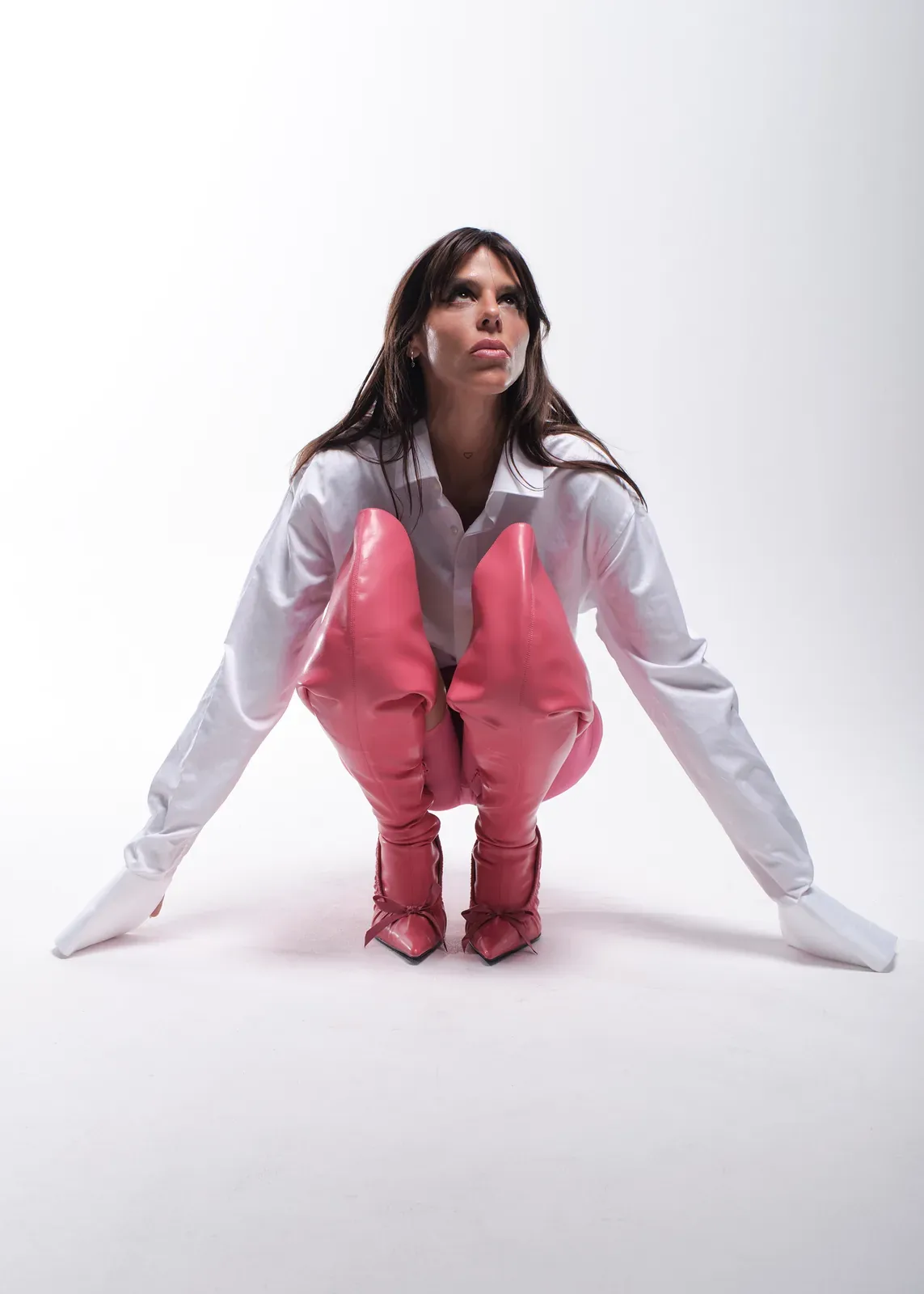
Identity is never quite as singular as we might like to think. It is accumulated, borrowed, reshaped and carried across borders, often without us noticing. For Portuguese DJ and producer ØTTA, the places we inhabit become inseparable from the people we meet, the sounds we absorb and the versions of ourselves we leave behind. Having moved between Lisbon, London, Paris, Rio de Janeiro and Barcelona, she’s built an artistic language that resists geographical and sonic boundaries. Her debut album, Pele de Mar, brings these disparate coordinates together, tracing the intimate relationship between movement, memory and belonging.
Released through Hotties, the party, label and community she founded, Pele de Mar is less an exercise in defining an identity than an attempt to capture everything that makes one. From Brazilian percussion and Latin rhythms to the bass-heavy influences of London's electronic underground, the album reflects a life shaped by cultural exchange and constant reinvention. We meet Øtta to discuss the politics of belonging, the sounds that become part of us, and why finding your own voice might have less to do with knowing who you are than allowing yourself to keep changing.
In 2024, you said you didn’t want to make an album just for the sake of releasing eight tracks; you wanted to stop somewhere, focus, and make something with meaning. What changed between then and Pele de Mar?
I think it finally felt like the right time. For me, making a debut album was never going to be about putting eight tracks together and calling it a record, as I said. I wanted to be able to stop everything else and fully immerse myself in the experience, in the creative process, the message, what I wanted to explore, what I wanted to say, and ultimately what my voice was.
I think what changed was simply time and experience. I’ve been touring so heavily these past years that I never had the space, physically and mentally, to make an album the way I wanted to, and I probably also needed those extra years to learn more, live more and have a clearer idea of what I actually wanted the album to be.
I think what changed was simply time and experience. I’ve been touring so heavily these past years that I never had the space, physically and mentally, to make an album the way I wanted to, and I probably also needed those extra years to learn more, live more and have a clearer idea of what I actually wanted the album to be.
You describe the album as a map of the places, people and relationships that have shaped you. When did you realise you weren’t just making a record, but documenting a part of your life?
That was there almost from the beginning. I’ve always needed a story or a concept behind what I create. Before music, I studied and worked in architecture, and one thing I carried from that is this habit of looking at references and the context around something before I start creating. I still work like that with music; I like having something that grounds the creative process.
So when I started the album, one of my first questions was: what am I actually trying to say with this? And I realised that before trying to make some big statement, I wanted to show people who I am. I didn’t see it as documenting my life, but naturally my experiences, the places I’ve lived, the people I’ve met and the relationships I’ve had are what made me who I am. That idea was there from the beginning: no two people have lived the exact same combination of experiences. We’re all shaped by different places, people, relationships and memories, and I think that accumulation is ultimately what makes each of us unique.
So when I started the album, one of my first questions was: what am I actually trying to say with this? And I realised that before trying to make some big statement, I wanted to show people who I am. I didn’t see it as documenting my life, but naturally my experiences, the places I’ve lived, the people I’ve met and the relationships I’ve had are what made me who I am. That idea was there from the beginning: no two people have lived the exact same combination of experiences. We’re all shaped by different places, people, relationships and memories, and I think that accumulation is ultimately what makes each of us unique.
The title imagines the ocean becoming your skin. What does that image mean to you, and how does it connect to your relationship with Portugal, Brazil and the other places that have become part of your identity?
For me, Pele de Mar is about the traces that places and experiences leave on you. In the same way that the sea leaves salt on your skin, we carry memories, people, rhythms and cultures with us, and over time they become part of who we are. Portugal and Brazil have always been deeply connected, historically and culturally, and the sea is part of that connection too. We share a language and there has always been a lot of cultural exchange between the two countries. Growing up in Portugal, Brazilian music and culture were already very present in my life, and I’d also been travelling to Brazil regularly for years.
But the title isn’t only about Portugal and Brazil. I’ve lived in Lisbon, London, Paris and now Barcelona, and every place has left something with me. The sea became a metaphor for that movement: you move, you change, but you carry traces of everywhere you’ve been with you.
But the title isn’t only about Portugal and Brazil. I’ve lived in Lisbon, London, Paris and now Barcelona, and every place has left something with me. The sea became a metaphor for that movement: you move, you change, but you carry traces of everywhere you’ve been with you.
“When I started the album, one of my first questions was: what am I actually trying to say with this? And I realised that before trying to make some big statement, I wanted to show people who I am.”
Pulso. brings together Latin rhythms, sensual house and the bass-heavy sounds you absorbed in London. When you were making it, were you consciously bringing these different chapters of your life together, or did they naturally meet in the music?
Actually, I see Pulso. differently because that track isn’t really connected to London. Pulso. means ‘pulse’, and it was much more about capturing the pulse and rhythm of Rio, the energy of the city, the percussion, the movement and that feeling of constantly having rhythm around you.
The track I connect much more to my years in London is Frio, which means ‘cold’. There’s the literal side of it, because London was probably the coldest place I’ve lived in, but also the contrast I felt between cultures and that colder feeling compared to the warmth I associate with Portugal and Latin cultures. Musically, that UK influence is much more present in Frio with this breakbeat-driven rhythm and a more melodic, house and garage-influenced lead that comes from the sounds I absorbed while living there.
The track I connect much more to my years in London is Frio, which means ‘cold’. There’s the literal side of it, because London was probably the coldest place I’ve lived in, but also the contrast I felt between cultures and that colder feeling compared to the warmth I associate with Portugal and Latin cultures. Musically, that UK influence is much more present in Frio with this breakbeat-driven rhythm and a more melodic, house and garage-influenced lead that comes from the sounds I absorbed while living there.
You spent six years playing in an orchestra before becoming a DJ and producer. Looking back now, what from your classical training do you recognise most strongly in the way you make electronic music?
I think classical training gave me a musical language before I even started making electronic music. I already had an understanding of scales, keys, rhythm, timing and harmony, and my ear had been trained from a very young age. Later, when I went to Point Blank Music School to study electronic music, I realised I was picking things up quite quickly because those foundations were already there.
But I think it goes deeper than the technical side. Being in an orchestra for six years meant being surrounded by instruments all the time. We were kids, so during breaks everyone would end up picking up each other’s instruments and trying them. Once you understand the logic behind one string instrument, for example, it becomes much easier to understand another. Without really noticing it at the time, I was learning how different instruments work, how they relate to each other and how different parts can exist together in one piece of music.
I can still feel that today, even when I’m DJing. Sometimes I can immediately hear that something is off without consciously checking the key or thinking about the theory behind it. And in production, having those foundations means that when I have a rush of ideas, I can get them down quickly without interrupting that creative flow to figure out the musical basics. It also gave me a much broader pool of musical references from very early on, and by now we know a girl loves a reference to create.
There’s a tension throughout the album between movement and belonging: Lisbon, London, Rio, Paris, and the relationships that connect those places. Do you think travelling has made you feel more rooted in who you are, or more aware of how many versions of yourself exist?
I don’t know if I see it as different versions of myself, per se. I think it’s more that every place I’ve lived and every culture I’ve experienced has expanded who I am. The more you live, the more you experience, the more you learn and understand, and I think you become richer as a person because of it. When you move somewhere, you’re influenced by your surroundings almost without noticing it: the way you dress changes because of the weather, the way you speak changes because of the language, the way you behave changes because you’re adapting to a different culture and different circumstances.
And then all the experiences and memories you gather while living in those environments become part of you too. I noticed that especially when I would go back to Lisbon. Something that had become completely normal to me after living in Paris or London wouldn’t necessarily be familiar to someone back home. My idea of what was “normal” had expanded because my life had expanded.
At the same time, travelling has definitely made me more aware of my own roots. When you’ve never left your country, there are so many things about your culture, your references and your way of seeing the world that you just take for granted. Then you live somewhere else and quickly realise that those things aren’t universal. I think that distance made me understand and value where I come from in a completely different way. So, I don’t see it as becoming different versions of myself. I’m still the same person, but every place I’ve lived has added something to who I am, while also making me understand much better what I already carried with me from home.
Rio is a love letter to Rio, while Frio captures what London represented to you. If places can become part of our identity, what do you think each of these places gave you that you couldn’t have found elsewhere?
I think every place gives you something that you couldn’t have found elsewhere because it’s not only about the place itself. It’s the place, the moment in your life when you were there, the people you met, the culture around you and the references you were exposed to. That exact combination only happens once. Even going back to the same city years later wouldn’t necessarily give you the same experience.
London was where a lot of things started for me. It was the first time I properly lived outside the bubble I had grown up in in Lisbon, and I discovered a lot about myself there, both as an artist and as a woman. I grew up a lot, became independent, and it’s also where I started my career. It’s impossible to sum up almost ten years there, but one thing that really stayed with me was the creative community around me. I began putting on my own parties because I wanted somewhere to play, and I was surrounded by creatives from different disciplines building things together and creating their own spaces. That really influenced the way I later thought about creating my own artistic universe and community.
Rio gave me something completely different. Brazil has been a love of mine for a very long time, so I already had a strong relationship with the country, its music and culture. But living in Rio meant being surrounded by rhythm in a completely different way, in the music, the percussion, the pace, the streets, the way people dance and the energy of everyday life. I could finally stop being a visitor and actually have a routine there, make music every week, build relationships and properly immerse myself in it.
And I think the same applies to Portugal, Paris and now Barcelona. They all belong to completely different moments of my life and have come with their own people, references and experiences. None of them could replace another, because what each place gave me is tied to who I was and what was happening in my life at that exact time.
The album brings together collaborators including Bibi Babydoll, Lua de Santana and Fiah Miau. What were you looking for in another person when deciding who could enter this very personal story?
I think it was important for me to work with artists who genuinely care about their roots and bring that into their own work, since the album is also such an honest expression of identity and of being unapologetically who we are.
Bibi is Brazilian and very connected to Brazilian culture in her music. Lua is Spanish-Brazilian and explores both sides of her identity, making music in Portuguese and Spanish, and Fiah does the same with her Argentinian and Latin roots. They all have very strong identities as artists, and that was a must for me.
They’re also three incredibly talented, strong women with very distinct personalities and sounds. I wanted every collaboration to feel like they were bringing their own identity into the album, rather than just having a feature for the sake of having one.
You’ve spoken before about not wanting to fit into a particular sound. After a decade of developing your own language, do you think defining yourself has become less important to you or more?
I think defining myself is still important to me, but I stopped caring so much about whether that definition makes sense to other people. I’ve never really fitted under one umbrella or into one box, musically or personally, and at some point I stopped trying to. I’m getting older, haha. In a way, it’s funny because I’ve just made an entire album about identity and who I am, so clearly understanding and expressing myself is still very important to me. But I think there’s a difference between defining yourself and allowing other people to define you. After all these years, I’m much more comfortable just following what feels like me, even if it doesn’t fit neatly into one sound or one scene.
“In the same way that the sea leaves salt on your skin, we carry memories, people, rhythms and cultures with us, and over time they become part of who we are.”
Hotties began as a party and grew into a label and community. Now that Pele de Mar is coming through that, what does it mean to release such a personal record through something you built yourself?
It feels amazing:) Hotties was always built as a platform for freedom of expression, so being able to release a project this personal through something I’ve also built myself feels very special. We were just talking about not fitting under one umbrella, and I think Hotties became my way of creating my own home, my own universe, where I could have the freedom to be exactly who I am. So for an album that is so much about identity and being honest about who you are, I don’t think there could have been a more natural place for it to live than in its own home.
The album’s central idea is that what makes us unique is the accumulation of everything we’ve lived through. Has making Pele de Mar changed the way you understand your own uniqueness?
I don’t think it changed the way I understand my own uniqueness, but I think it added to it, which is different. Making this album became another experience, another set of memories added to everything I’ve already collected throughout my life. And I guess that almost proves the idea behind the album. You keep living, collecting experiences, meeting people, going places, making things, and all of that keeps adding new layers to who you are. So Pele de Mar didn’t necessarily change the way I see myself, but the experience of making it has now become another part of what makes me, me.
If your earlier releases were about finding ØTTA, does Pele de Mar feel more like introducing us to the person behind her?
I don’t really see it as earlier releases being about finding ØTTA and now finally showing you the ‘real’ one. I think she was always there. Being an artist is a continuous process, not an arrival. It’s the same with any creative practice. When I started studying architecture, I didn’t immediately know what my language or aesthetic was either. You’re surrounded by so much information and so many references, and over time you develop your own way of seeing and doing things. Music has been the same for me.
The ØTTA from my earlier records was still completely me at that moment, just as Pele de Mar is completely me now. Time changes, your desires change, you get older, you experience more, and you understand things differently. And I have no idea who I’ll be or what I’ll want to make in ten years. So, I don’t think this album is the moment I finally became or found ØTTA. It’s just the most honest representation of who she is at this point in my life.
The ØTTA from my earlier records was still completely me at that moment, just as Pele de Mar is completely me now. Time changes, your desires change, you get older, you experience more, and you understand things differently. And I have no idea who I’ll be or what I’ll want to make in ten years. So, I don’t think this album is the moment I finally became or found ØTTA. It’s just the most honest representation of who she is at this point in my life.
You’ve spent years moving between countries, scenes, sounds and versions of yourself. If Pele de Mar captures ØTTA as she is now, what part of yourself are you still trying to discover?
I honestly don’t know yet (laughs). I’ve finished making an album that took me through this whole process of looking at who I am, where I come from and everything that has shaped me, so give me a minute! But I think what I want to maintain more than anything is my curiosity. I never want to reach a point where I feel like I already know exactly who I am as an artist, what I’m interested in or what I have to say. I want to keep being surprised, questioning things, changing my mind and finding subjects, sounds or ideas that make me look at something differently. I think that openness is what keeps creativity alive for me. So, I can’t tell you what part of myself I’m going to discover next, but I hope I always stay curious enough to find out.