There’s something about Martiño Rivas that resists urgency. Maybe it’s the way he speaks, to understand rather than impress. Or the way he inhabits the silence between question and answer, as if something essential unfolds there too. At a time when everything seems to demand instant definition, firm opinions, fixed identities, unshakeable certainty, he settles comfortably into doubt. And builds from there.
This interview is taken from Issue 54 and adapted for our digital platform. Order your print copy here.
Our conversation begins in motion, literally. He’s stepping out of a gym in A Coruña after a weekend of mountains, mud, and open air. But it quickly becomes clear that this constant movement isn’t only physical. There’s a deeper restlessness at play: a need to structure time, to give it meaning within a profession defined by long stretches of uncertainty. Being an actor, he admits, means learning to coexist with emptiness, with what doesn’t happen. Discipline becomes a way of holding things together, but it also raises a more uncomfortable question: what does it really mean to be productive?
Throughout the conversation, Rivas moves between reason and instinct, control and surrender. He talks about characters, but inevitably about himself too—about impulses he doesn’t always understand, decisions he can’t fully explain. Yet, rather than sounding lost, there’s a quiet clarity in the way he speaks: the kind that comes from accepting that not everything needs to make sense.
As he reflects on fatherhood, time, emotional intensity, and the performative nature of the industry, a portrait emerges that feels disarmingly honest. One that doesn’t try to please, but to remain true to a simple idea: living without needing to have everything figured out.
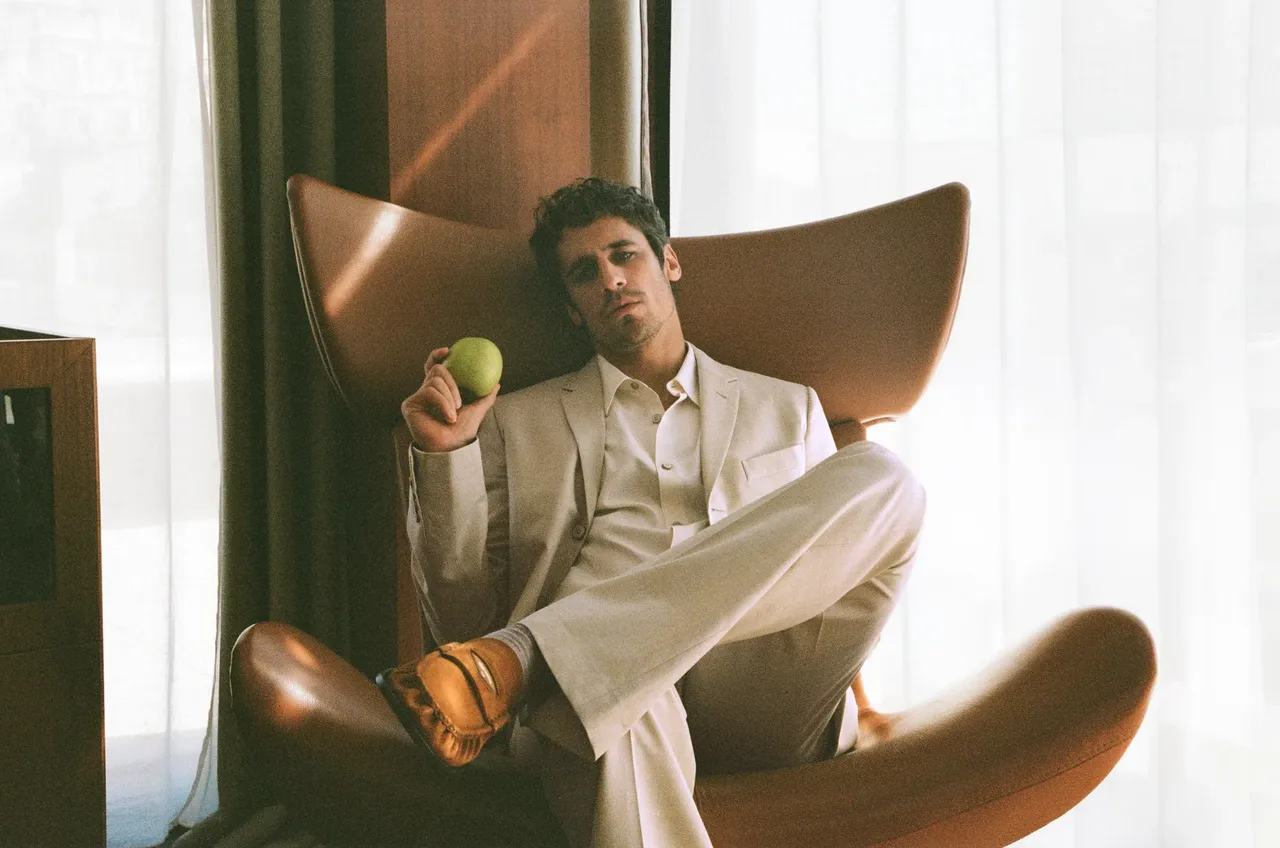
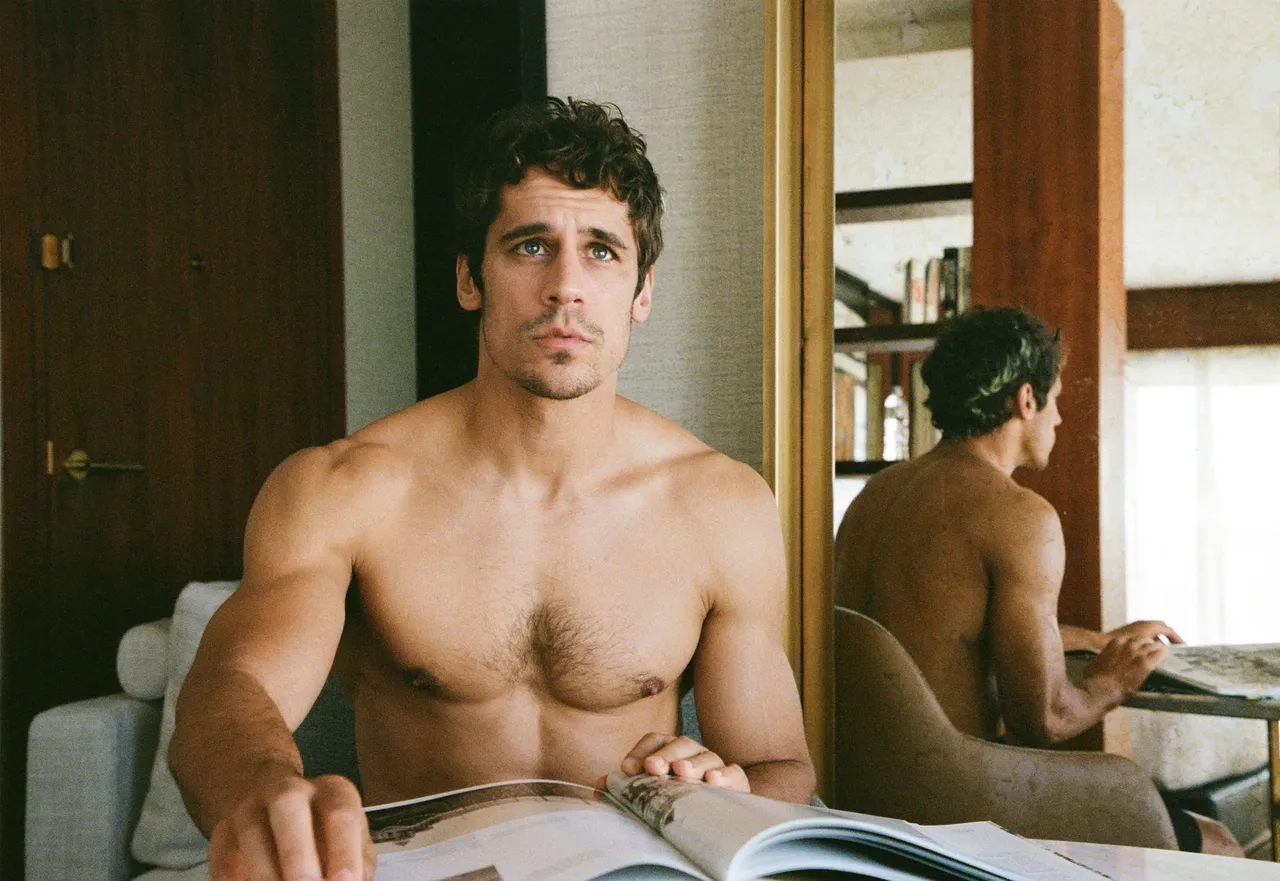
Beige tailored blazer, classic white button-up shirt, beige tailored trousers and LV Jazz loafer in softly grained nubuck calf leather, all LOUIS VUITTON.
What a clear day it is where you are, where exactly are you?
In A Coruña.
I’m so jealous, honestly! It’s such a beautiful area.
Yeah, it really is wonderful.
And what are you doing? Tell me, what does a typical day there look like for you?
Well, I’ve got a pretty calm routine. I wake up in the morning, have breakfast slowly, go and train… right now I’m on my way to the station because I’m heading back to Madrid this afternoon.
So, you’ve got a busy day ahead.
Yeah. I came for the weekend and did a really beautiful trail race in the Barbanza mountains, around Muros. The landscapes there are incredible. It’s honestly amazing for your head running in the mountains, being in contact with nature, it puts you in your place, really calms your ego. And now it’s time to head back to Madrid.
But where exactly are you right now?
Honestly, I’m sitting on the curb in the car park outside the gym I go to.
Your gym selfies have gone viral on social media, and it gives the impression that taking care of yourself through exercise is really important to you. Do you take good care of yourself? What role does sport play in your daily life?
I try, at the very least, to break a sweat once a day. I make an effort because it makes me feel really good, both physically and mentally. That’s pretty important.
Do you work out even on weekends?
I might come across as a very organised person, but I’m not really. Sport isn’t part of a rigid routine for me. I listen to my body and try to move when it asks me to. But yeah, if I had to sum it up, I usually train five or six days a week. The intensity and type of activity vary, but I try to stay active.
Would you say you’re someone who finds it hard to stop? Do you need to always be in motion?
Yes, although I don’t just mean physically. I’m constantly going from one place to another, carrying groceries or doing daily tasks, moving around. I’m not entirely sure where I’m heading, but I don’t stop. I’m quite restless and I stay in motion. I rarely stop, even if I don’t know where I’m going.
Not to get too existential, but often the destination is the least important thing. Moving forward is what gives value to the experience.
Yeah, I believe something similar. There may not even be a destination we’re meant to reach. Going and going, that’s what we’re supposed to do. Exercising is part of that journey. Working out first thing in the morning helps me start the day right. I drop my daughter off at school and then go to train. From there, the day really begins.
Right now, we’re exposed to a very insistent so-called healthy lifestyle culture, especially online. Sometimes it’s even hard to disconnect from it when you’re relaxing on holiday or travelling with friends, don’t you think?
I’ll admit that it does make me a bit uneasy when I’ve gone several days without feeling like I’ve done something productive. What would be interesting is to question what I actually understand by productivity — whether it really is that, or if I’m just distracting myself and fooling myself into thinking my time has value. But in our profession, we work very little. If I don’t impose some discipline on myself, I feel like time slips through my fingers and I haven’t made the most of it. An actor who works two or three months a year on a paid project has had a great year. So, I try to give my time some structure outside of those periods, build a routine that keeps my head in the right place.
“Being an actor means being part of a collective effort, a shared project. I have to trust the professionalism of the people I work with.”
That’s very true about actors’ working periods in Spain. It forces you to spend a lot of time without the kind of work that usually shapes your daily routine.
Yeah, and I handle that quite badly, to be honest. That’s why I try to impose routines that make me feel creative. Something that really helps is setting up my own space, an improvised office that pushes me to structure a working day. Then, when the afternoon comes and I’m with my daughter, or at night when I wrap up the day, I feel like I’ve achieved something and feel a bit more accomplished. Sometimes I think about other artistic disciplines that I envy. Not because their situation is less precarious, but because, for example, a carpenter or a painter, even if they need materials, can produce independently. An actor can’t; we need an industry, logistics, an audience. It’s a social act, and that’s very hard to recreate at home. What we do is quite ephemeral. It disappears, fades, unless it’s recorded in a film or series. But all the prior work: preparing texts, learning poems, rehearsing monologues, training, doing articulation exercises, is intangible. You can’t see or touch it, even if you’ve trained a lot and explored new tools. That’s why I try to impose that discipline, otherwise the day dissolves very quickly. A craftsman, at the end of the day, washes his hands, stands up, and there on the table is the work he’s done.
With your years of experience, have you developed a specific way of approaching a role? Do you have an acting method?
I have certain tools, but everything changes depending on the character, the project, and its demands. It’s not the same preparing a period film, where you have to ride horses, as doing a comedy or a sitcom entirely shot in a studio. Each project is different, and the director’s guidance is also decisive. You never climb the same mountain, and you rarely make that climb with the same people. That said, there are recurring patterns: I try to understand the character’s journey, their arc, grasp the script’s structure and visualise it as a whole. Know where my character comes from and where they’re going. I try to arrive with the text learned, that gives you a lot of security. Ideally, you’d be able to mentally review everything like a theatre performance, from beginning to end, from a wide perspective, like being the audience watching from the stalls. But scripts often arrive late, which forces you to work at a frantic pace. Still, the key is always knowing the text well, showing up prepared.
I agree. Not being prepared puts you at a real disadvantage.
Absolutely.
Now that you mention how you approach your projects, would you say you always need to understand why your characters act the way they do? Or can you work from uncertainty?
Characters often work the same way as the people who play them. Many times, I don’t really know why I do the things I do in real life either. In the end, what matters is doing what works for the scene. You can build internal justifications and have them there to rely on if you need them, but you can also let yourself be carried by something more spontaneous in the moment. I try to arrive with a plan, but remain open, follow my intuition and react to what’s happening in the present. Prepare everything so that later, when you’re there, you can forget it and trust that you’ve incorporated it into your way of working. It’s important for me to be able to react to what’s happening in the moment while knowing that, inside me, I carry everything I’ve learned and worked on beforehand. That allows me to relax and be calmer.
You just said that characters are often like people.
Yes, whether you’re a person or a character, sometimes we don’t know why we do what we do. Do you always know why you do everything?
I’m very afraid of not knowing why I do things.
Sometimes I follow impulses whose purpose is to satisfy an immediate need. I know that in the long term it’s not the most beneficial, but I still let myself be carried away. If I analysed everything from a more rational perspective, I probably wouldn’t do many of the things I do. But sometimes you give in.
Don’t you think that if you don’t know why you do things, you let others build that narrative for you and your actions?
People are always going to create their own narrative, whether you want it or not. Everyone draws their own conclusions. What matters is that you’re at peace with what you do, or at least that you know how to forgive yourself. You can’t avoid being judged. Value judgments will always be there.
Are you at peace with yourself?
I try.
Me too. Trying, even if you don’t succeed, is probably the first step towards living more calmly.
In my case, I try not to regret the things I do.
Is it easy not to regret things when you’re constantly exposed to other people’s opinions?
I think I handle other people’s opinions quite well.
That can’t be easy.
No, it isn’t. But even so, I try to understand where all the opinions I’m exposed to come from, and understand the current climate we’re surrounded by and the ecosystem we live in. All of that is part of the game we’re playing. Opinions are something ephemeral, they change quickly. They’re constantly in motion. Many times, I look back and what I once considered negative, I now see in a more positive light. But still, despite everything, I’m a person full of doubts. I’m sure of very few things in my life, I find it hard to be categorical.
For a moment you reminded me of the ending of “Doubt”, when Meryl Streep tells Amy Adams she has many doubts. But even though I consider myself a big fan of not being sure about anything, I’d like you to tell me something you are certain about.
It might sound surprising, but I’m very sure that our ecosystem deserves to be cared for and preserved. We have to treat mountains, rivers, seas, the environment better. That I’m certain about, and at least it’s a starting point.
How do you contribute to taking care of the environment?
To be honest, I don’t do much. I try not to consciously contribute to the damage we inflict on nature. But at the end of the day, I’m part of the system, part of this machinery we’ve built in the world. I’m in it whether I want to be or not.
I get the impression that you live very much in your own ecosystem, that you’ve shielded your private life and rarely let the public look in.
I’m a private person who keeps their private life where they want to keep it.
How do you manage that?
Simply by not living my life as if it were an open wound.
But nowadays that’s almost impossible.
I’m managing it, or at least I like to think so. I’m trying, at least.
Would you say you have many open wounds?
I’d like to say they’re more scars than wounds now. Although, of course, life works in such a way that when one wound heals, another appears, and so on until the end. It’s very difficult to be at peace all the time.
Let me tell you that living in peace with everyone would be a bit boring.
You’re right, because something always ends up happening in life. When some serious event interrupts your life, at least it helps you put everything into perspective and think, was I really tormenting myself over this? You realise it was nonsense, something meaningless you were worrying about for no reason. But well, that’s part of the mystery of being alive.
You and I are ten years apart. And when I turned thirty, I looked back at my life with a slight sense of unease. How do you remember your twenties?
Well, in those years I did what I thought I had to do.
Don’t we tend to idealise that period of youth?
I wouldn’t say we idealise it, but I do think we learn to look at it with perspective. The problems that once seemed insurmountable, I now put into perspective more easily. Back then, it’s true that most of us had fewer responsibilities and much less stress, although I already felt quite overwhelmed, maybe because of my personality and character.
“I don’t have dreams anymore; I only have nightmares. All I want is for things to stay as they are.”
As we approach our thirties, we often start to outline our life plans, or hear our friends doing so: getting married, buying a house, having a child. What was your life plan?
I don’t remember outlining a life plan, and if I did, I think it was a complete mistake. Life does what it wants with us. It’s healthy to have an idea of how you’d like your life to unfold, but deep down very little of that depends on us, and we have almost no say in it. Even so, that doesn’t mean we should live with indifference, far from it, but we should be aware that the game is constantly changing and that our control over it is very limited.
Tell me how you set boundaries in your life.
I try to know how to set them, but many times I don’t succeed. That’s often the goal, to learn to establish them, sometimes for better or for worse.
You speak with such composure; I sense a certain intensity.
I’m quite an intense person, as you may have noticed. Intense is something I’m told very often.
Do you believe intensity is understood nowadays? Many people use that word in a negative way.
Intensity can be understood, and what matters is how each person manages it. You can understand and embrace your intensity without losing the need for someone to one day tell you, “Relax, you’re overwhelming me”. It’s important to listen when someone tells you that, and above all to be kind to one another.
Aren’t intense people magnets for other intense people?
I don’t know. I try to surround myself with all kinds of people, I don’t follow a specific pattern. And I don’t think I attract a particular personality type either. I have very different circles of friends. Variety in your environment is always a good thing.
One thing I’m sure of: intensity doesn’t attract calm. Intensity is like misery, it loves company.
I so admire people who live life from a place of calm. People who are able to breathe, to do things slowly, step by step. Although I don’t think we really know how others experience things internally. You might see someone who seems calm but inside they’re about to explode.
No one really knows anyone.
Yes, that’s true. I can share a moment, an afternoon, or many days with a friend and still not know how they truly feel inside. We all have so many different facets. I get the impression there are many aspects of them I don’t know and don’t dare to explore. I don’t want to give them a deep X-ray. I know how a friend is with me, how they interact with me, and I can more or less sense what they’re like inside; but everyone has a private life and that will always remain private.
If we go further, do we really know our partners or even our own parents?
That’s what I was saying before. I don’t even know myself or why I do the things I do. We all surprise others with the decisions we make at certain moments. I feel surprised by decisions from my past.
Could you give me an example?
I don’t know, I’m not sure I want to tell you. If I give an example, I run the risk of it being blown out of proportion.
When I was younger, I got a lot of tattoos. My left arm is full of them, and now I’m surprised when I see an arm that looks like it belongs to someone else.
I try to be someone who is rational. I don’t have any tattoos, which is a bit unusual for my generation. I’ve never got one because I’ve always thought I’d regret it. However, my sister is covered in tattoos, very different ones, even quite rough. One day I asked her if she thought she might regret them in the future, and she told me that maybe she would, but that those tattoos tell her story and take her back to who she was at that moment, that they’re part of who she is and her time on this planet. She doesn’t see them as a mistake, just as part of her life. If I applied that philosophy and joined her, I’d hang up right now and go to the studio to get several tattoos. But I’m not like that, I’ll always find a reason strong enough not to do it. I don’t identify with tattoos, and I don’t want to take on that long-term commitment.
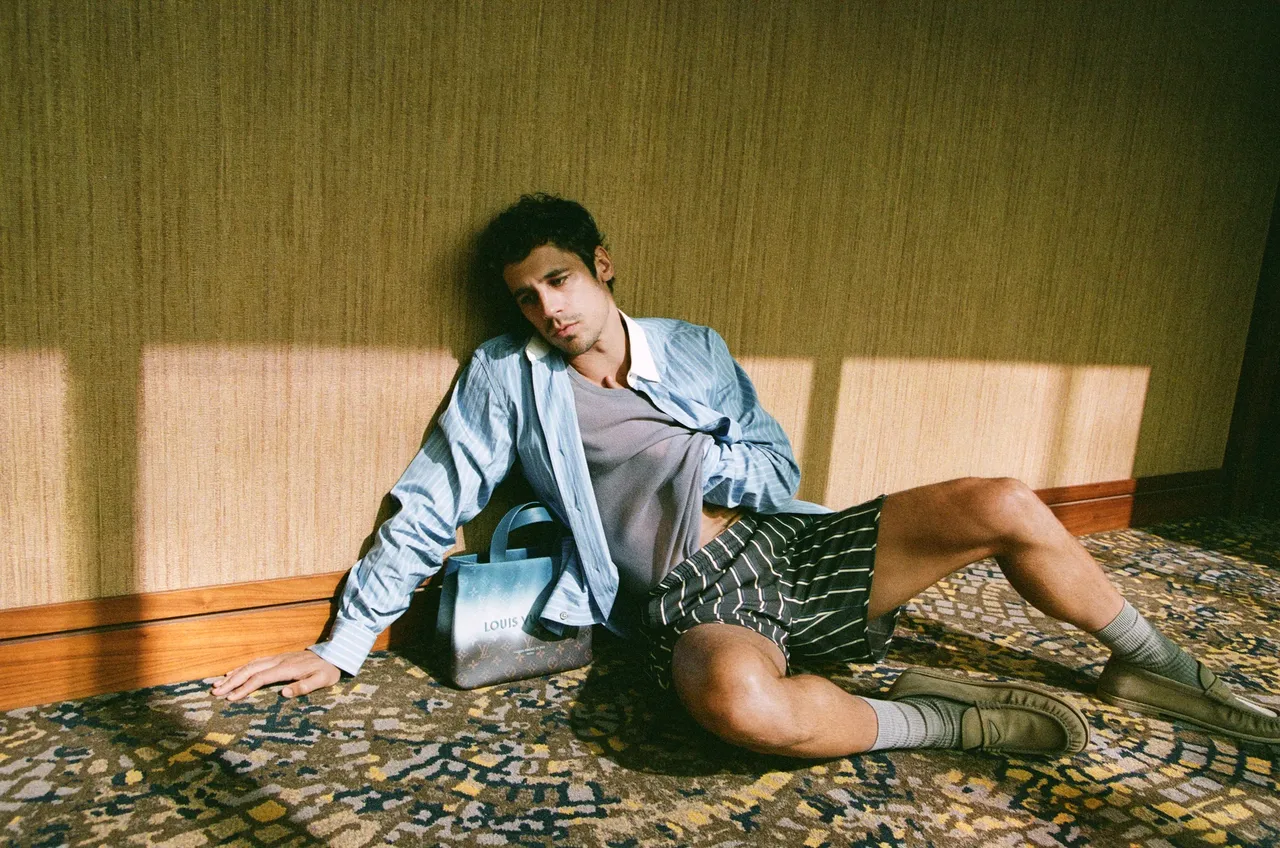
Tailored pinstripe jacquard shirt and classic grey T-shirt, striped running shorts, Mini Shopper Tote in vibrant monogram coated canvas, and LV Jazz loafer in softly grained nubuck calf leather, all LOUIS VUITTON.
I think the commitment people associate with tattoos tends to be exaggerated.
I don’t see the need.
So, I take it you’re not an impulsive person.
Not at all.
How does that rational side of you coexist with the emotional side required to be an actor?
For me, being on stage is the easiest thing in the world. I mean, it’s where I feel most protected, because I don’t have to think about my… well, the decisions I make. In reality, I know the consequences are minimal. The performance is already rehearsed; you know where your character begins and ends. I can do it better or worse tonight, but I’m not going to let anyone down, I’m not going to disappoint anyone, I’m not going to hurt anyone. No, no, the stage isn’t the problem.
Messing up on stage does have consequences.
What can really happen? That I forget the text for a moment and a fellow actor steps in to save me. Nothing traumatic or seriously bad is ever going to happen.
Even so, it requires a lot of responsibility.
Of course it does, and I take that on. But I’m not afraid of being on stage. Life outside the theatre is what scares me a bit more.
Your new project, “El problema final”, is a bit scarier than usual. There’s an impossible crime where everyone present is a suspect.
Yes, it’s a mystery series, but with incredible locations and we all look very good (laughs). We shot in a kind of palace in Lloret de Mar, next to a cliff with lots of vegetation. I’ve never been to Tuscany, only seen photos, but it can’t be very different from where we shot “El problema final”. So, you can picture it: the sea was turquoise and there were beautiful flowers. It was an incredible landscape. The sets were also spectacular. Everything was very well taken care of, and we were treated really well.
Do you like mystery stories?
I like all kinds of stories. The only genre I try to avoid is horror. I don’t like horror films. Musicals, comedies, thrillers — I love all of that.
You’ve ended up talking to a big fan of horror. Why don’t you like it?
I think the only purpose of horror cinema is to scare, just as the only purpose of melodrama is to move you emotionally. That’s a purpose that doesn’t appeal to me.
That’s a very reductionist view.
I’m a very reductionist person (laughs). I’ve never really watched horror films beyond classics like “The Exorcist” or “Rosemary’s Baby”. The Spanish title of the latter basically gives away the plot — it practically spoils the ending — while the English title is much more subtle. It’s quite an unfortunate translation. But no, I don’t have a go-to horror film.
You should be more open.
Since my time is limited, I prefer to be selective.
“I’m not afraid of being on stage. Life outside the theatre is what scares me a bit more.”
Since “El problema final” is about suspects, would you say you’re someone who finds it hard to trust people?
At first, yes, it’s hard for me. I’m cautious. I don’t go around hugging everyone on the street. I don’t know if you like that answer. I’m sociable, but very Galician. People always say that with a slightly negative connotation, but I’ve learned to accept it. I’m very Galician.
What does it mean to be “very Galician”?
I don’t know, honestly. I ask myself the same thing.
Does being an actor help you open up and trust others more?
Being an actor means being part of a collective effort, a shared project. I have to trust the professionalism of the people I work with. I want to trust, and I do trust, the focus puller, the cinematographer, the makeup artists who cover the spot they need to cover and so on with everyone working on a film. I’m part of a team, and I have to trust it and row in the same direction.
Are you usually satisfied with the final product you’ve been part of?
Sometimes I love it, and other times I think it’s terrible.
How do you deal with it when you think it’s terrible?
You process it however you can, at least you got paid for the job. If it’s terrible and you didn’t even get paid, that’s really a tough situation. At the end of the day, you do the best you can. An actor has a problem when you see something that’s actually good, but you feel like you did very badly and didn’t deliver what was expected of you. Laziness, lack of motivation, and complacency are very dangerous.
Tell me someone you trust blindly.
I trust my parents blindly, although they can also be wrong. That said, I never suspend my analytical capacity. I listen to my parents’ opinions and take them into account, but no one is free from making mistakes.
Did it take you long to realise that parents make mistakes?
Maybe around thirty. That’s when I really realised not only that they mess things up too, but that once you reach a certain age, you realise you don’t really know what’s going on either. As a child, you assume adults are kind of heroes, or at least that they know what’s going on. Then you grow up and realise things aren’t as clear or straightforward as you thought.
Does it scare you to remember that now that you’re a parent yourself?
I like to think I’m doing quite well. I try to be as present as possible, and I’m happy with how I’m doing.
When someone makes a mistake with you, do you forgive easily? What do you consider unforgivable?
For me, the hardest thing to forgive is betrayal, someone hurting me deliberately. That’s much more complicated, especially when you know how much it hurts. Even more so if, when you try to talk about what happened and find a way to fix it, you see the other person doesn’t want to, doesn’t care, is completely indifferent. That’s when you really realise you were wrong, that you don’t matter to that person. And that hurts even more when you valued the relationship highly, when what you had meant something important, something special, even. Suddenly you discover it didn’t mean the same to them.
And what about you, do you find it hard to say sorry?
Not at all. I spend my life apologising. Especially when I’m late, I’m always saying, sorry, sorry, I’m late.
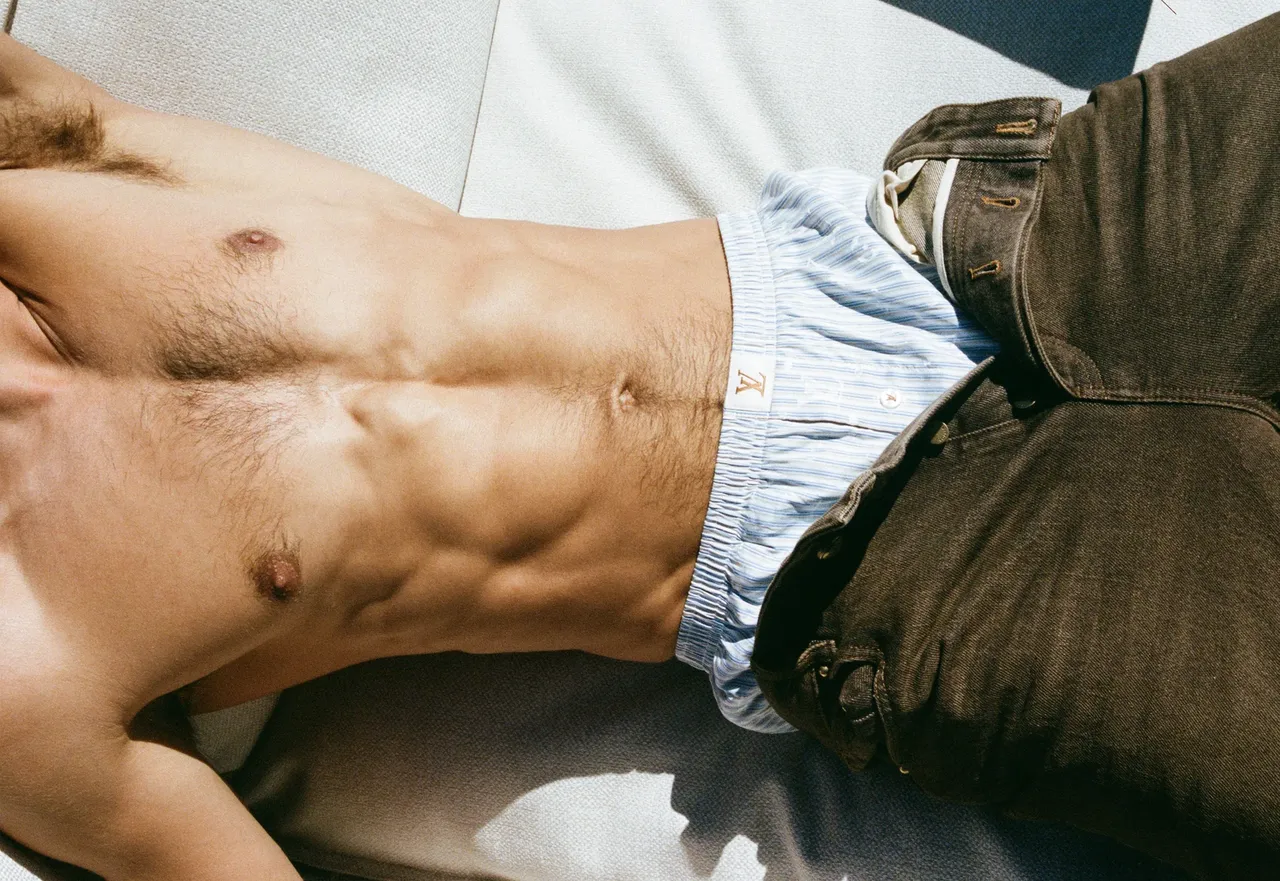
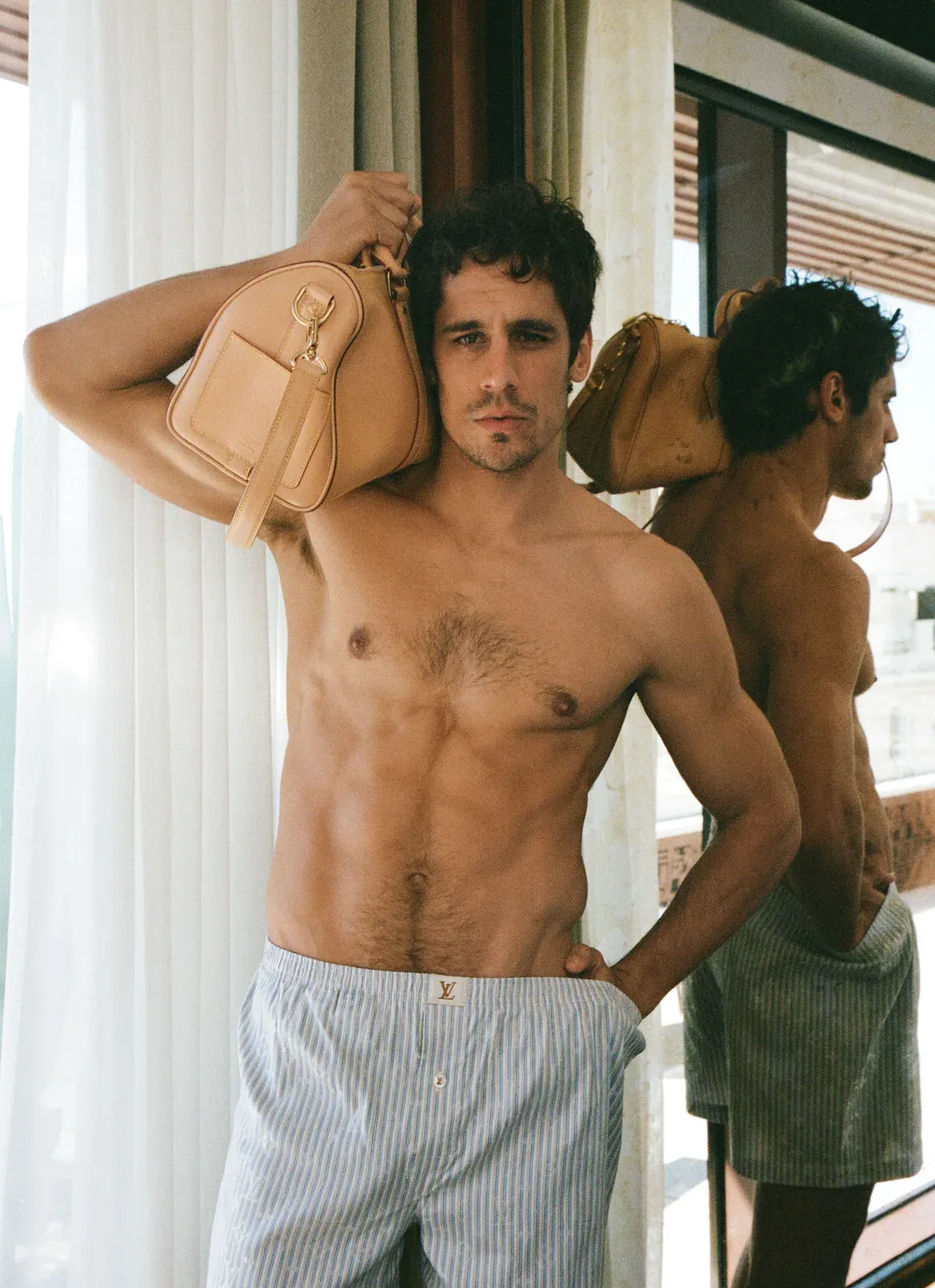
Coffee indigo skate denim trousers and classic striped boxer shorts, all LOUIS VUITTON.
Many people think apologising is a weakness.
Yes. We tend to think kindness is a weakness.
Apologising requires humility, and that’s rare in an industry so built on appearances like film.
You can’t take anything in the industry seriously. It’s all a game, all a performance. My work itself is very serious, of course, one of the most serious things there is. But everything around it is a show. When you have to attend events, it’s all canapé culture. You put on your shirt, go there, show up, stay a while, smile, shake some hands, give a few hugs and that’s it, it’s part of the show.
Have you ever been part of that show from the other side, as a fan of something or someone?
No, I’ve never been a fan of anything.
Of course you have.
No, I’ve never been the kind of person who’d want to have coffee with a celebrity. For me, they’re just people. What interests me about a filmmaker or a writer is their work. Them, as a person. I mean, if I see an incredible performance and someone says, “Let’s go backstage and congratulate them”, I think: no. They’ve already given me what they had to give, I’ve already received something extremely valuable. I don’t need to know what’s behind the curtain.
When you were younger, you starred in the series “El internado”, which gave you a large fanbase. Can someone with so many fans not be a fan of anything?
Yes, no, yes, yes. I mean, if it makes them happy. I see people queuing for eight hours outside a hotel to see a singer or actor walk by, and I just think: okay, fine. I wouldn’t do it, I have too many things to do.
Have you never eagerly awaited the release of something: a film, an album, a series?
Now everything is much more moderate. Maybe years ago, yes, but not anymore. Nothing gives me that intense excitement now. I’ve become very sceptical about everything. I don’t have dreams anymore; I only have nightmares. It happened recently: I was having dinner with two younger actors, talking about their dreams, everything they’d like to achieve, working with this person or that one. And they asked me, “What about you? Don’t you have one?” And I said, no, not really. And that’s when I realised I don’t have dreams anymore, I have nightmares. All I want is for things to stay as they are. That’s what I’d like: no more obstacles, no more fires to put out, just a calm existence.
Five or six years ago I interviewed you for METAL Magazine, and I actually have a Polaroid I took of you. You had a shaved head and were wearing a tank top, very Brad Pitt in “Fight Club”.
Yes, I remember! That afternoon was fun.
How would you say you’ve changed since then?
You tell me.
You’ve stayed true to your essence, maybe a bit more bearded.
Yes, I think you’re right.
Would you say you’re as happy as you were when you were younger?
I remember being in second and third year of secondary school and laughing so much in class that my abs actually hurt, really hurt, you know? I had a great time as a kid, I was happy. Not so much now.
Would you go back if you could?
It’s not that I wouldn’t, it’s that no one would go back anywhere because it would change everything. If I went back now, all the good things that have happened to me, everything I’ve lived — my daughter, all of that — would disappear. You can’t erase that. That time was what it was, and it was wonderful. The only thing I might regret is not having enjoyed it even more. But thinking about going back… I don’t engage in that kind of thinking. It seems pointless to me. I prefer to focus on the present.
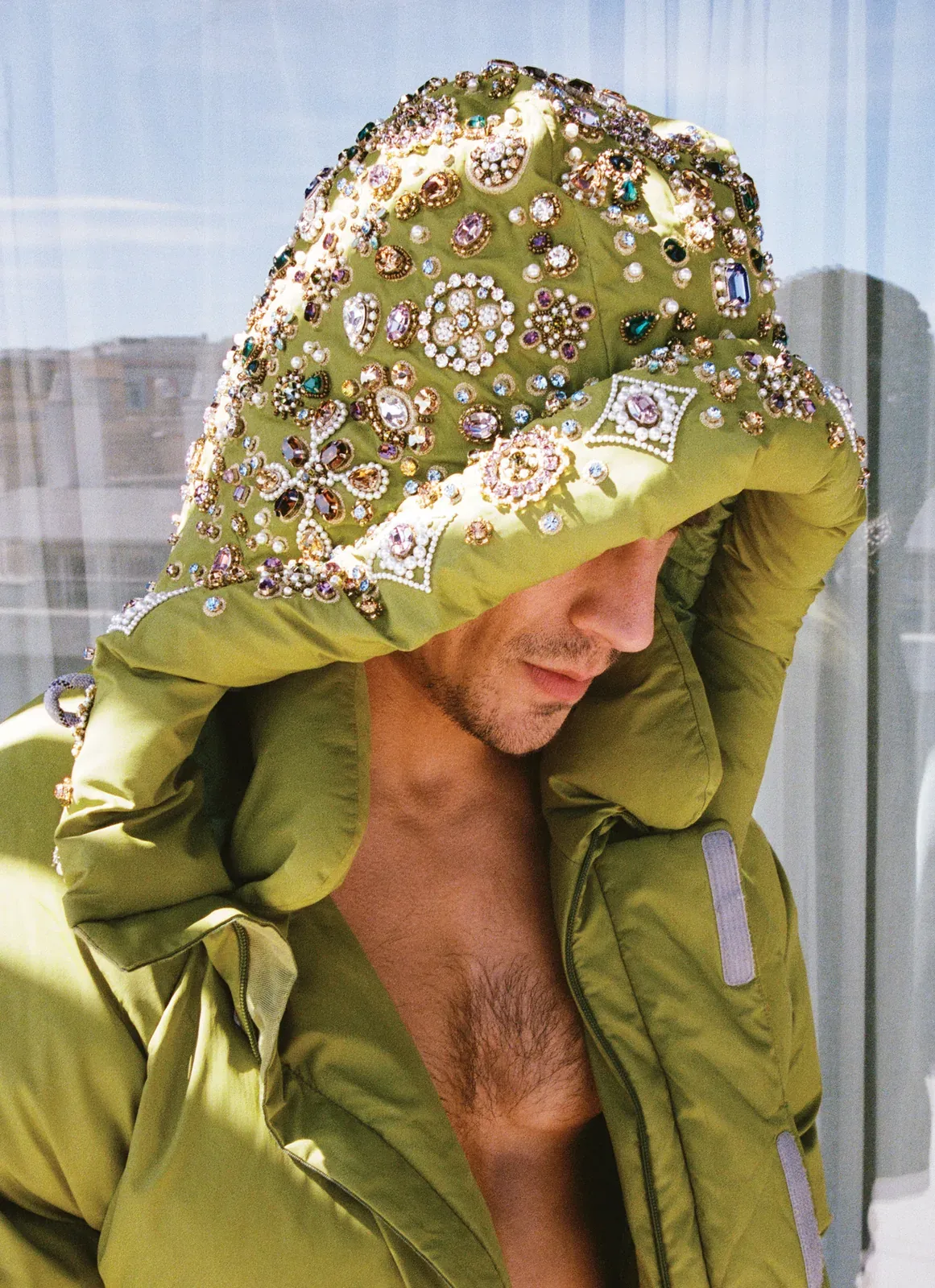
Zipped blouson with embellished hood LOUIS VUITTON.
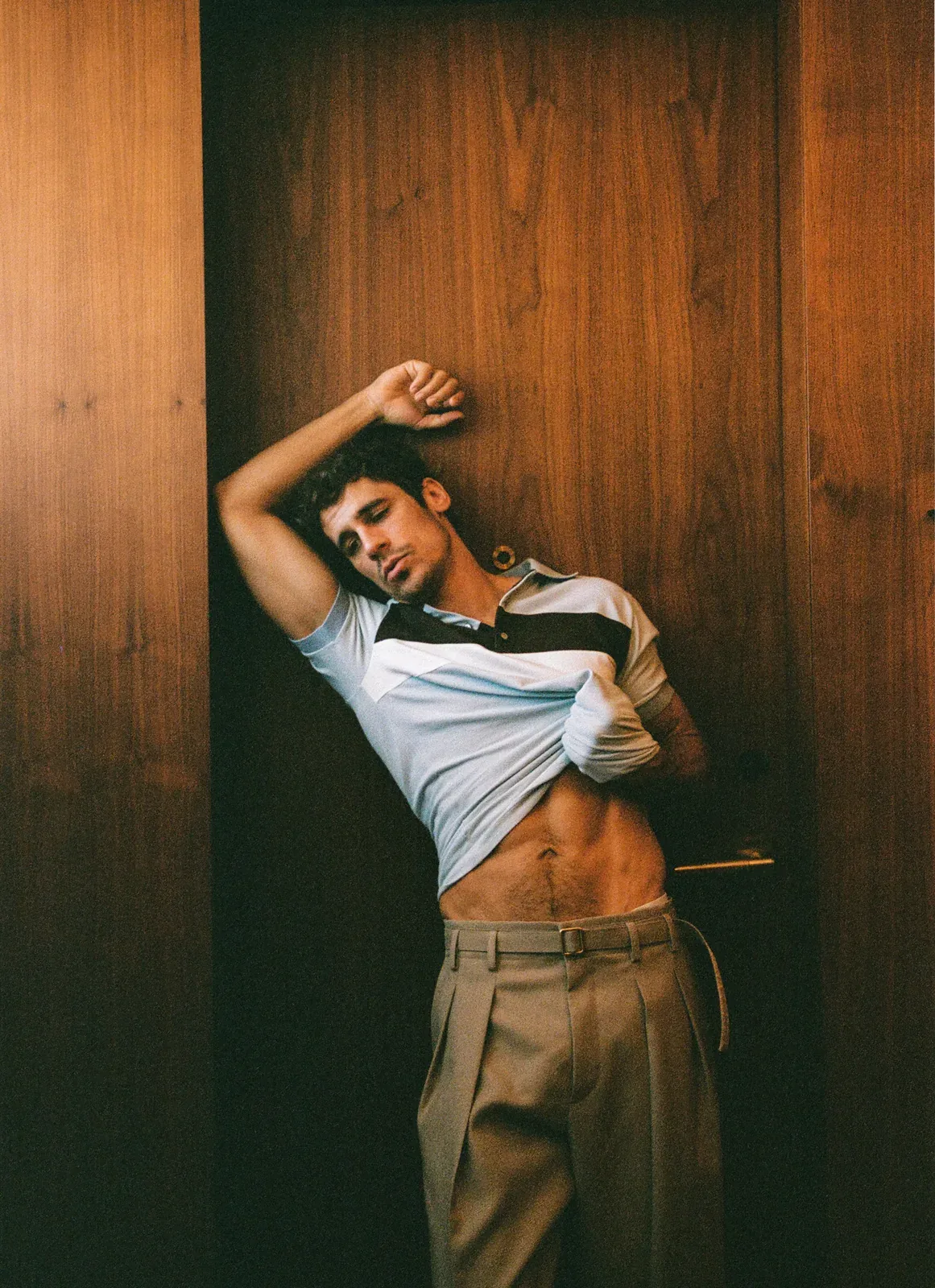
Striped short-sleeve polo shirt and classic beige tailored trousers, all LOUIS VUITTON.
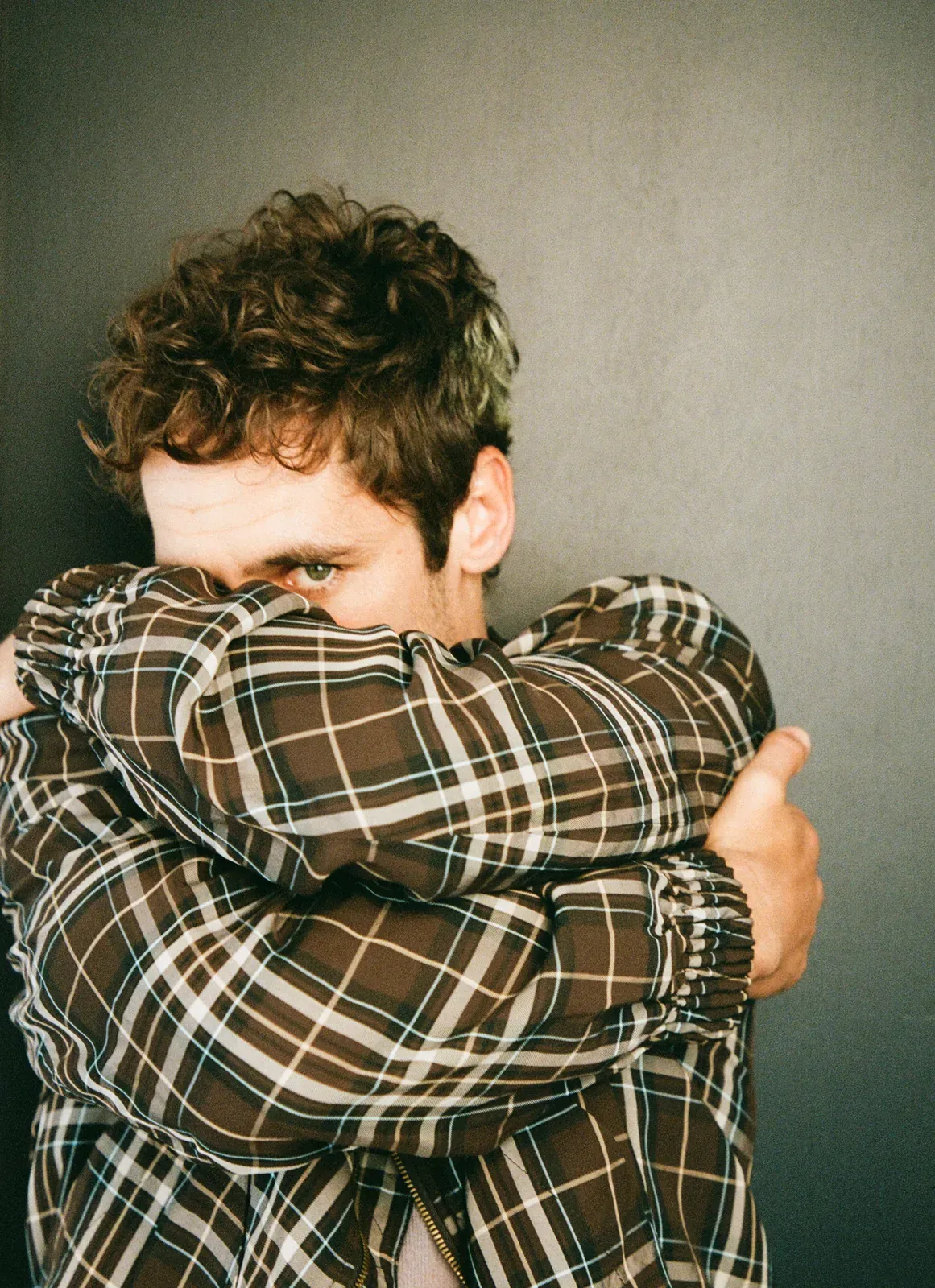
Pleated tartan shirt LOUIS VUITTON.
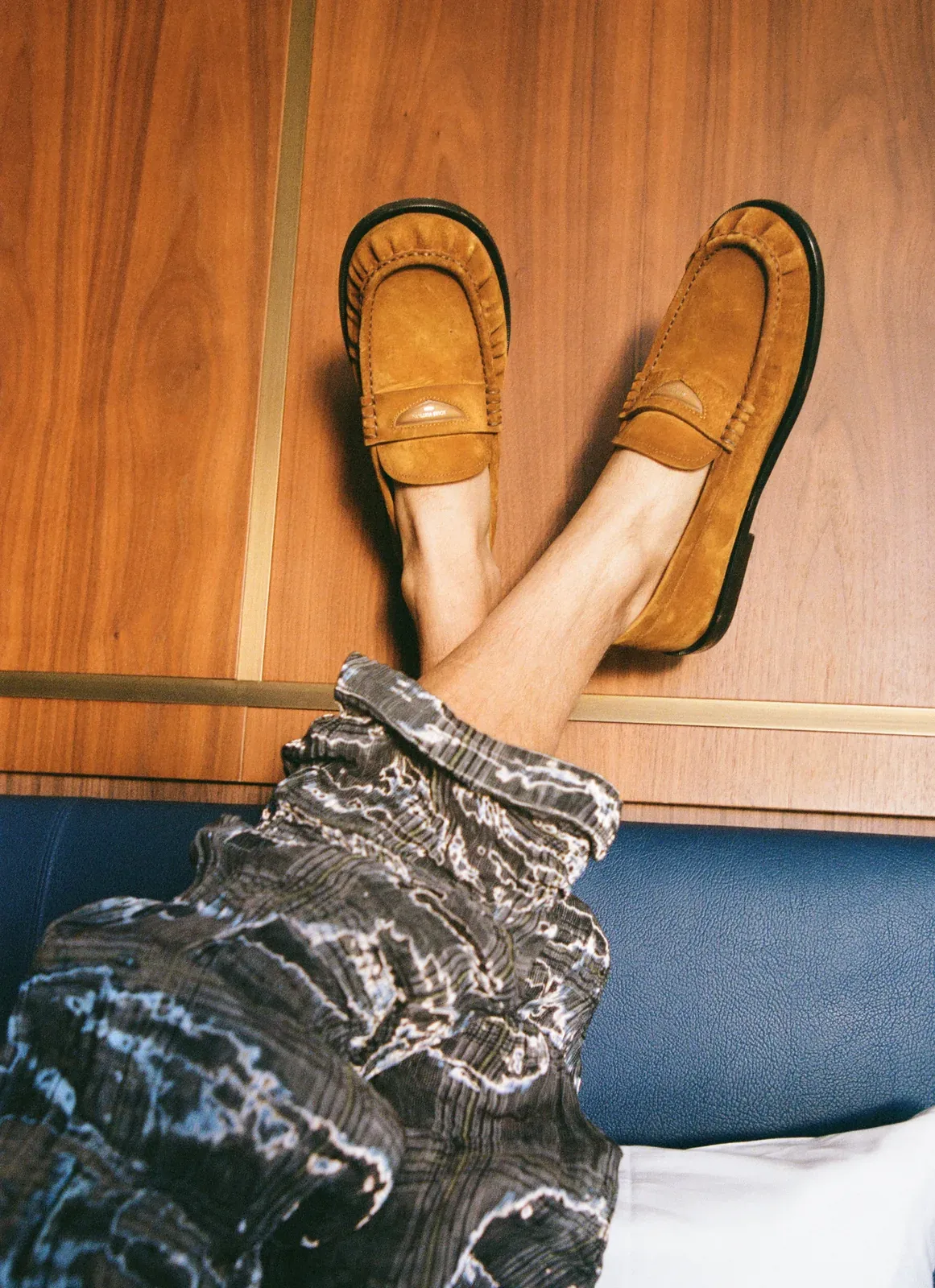
Overprinted POW metallic cargo trousers and LV Jazz loafer in softly grained nubuck calf leather, all LOUIS VUITTON.
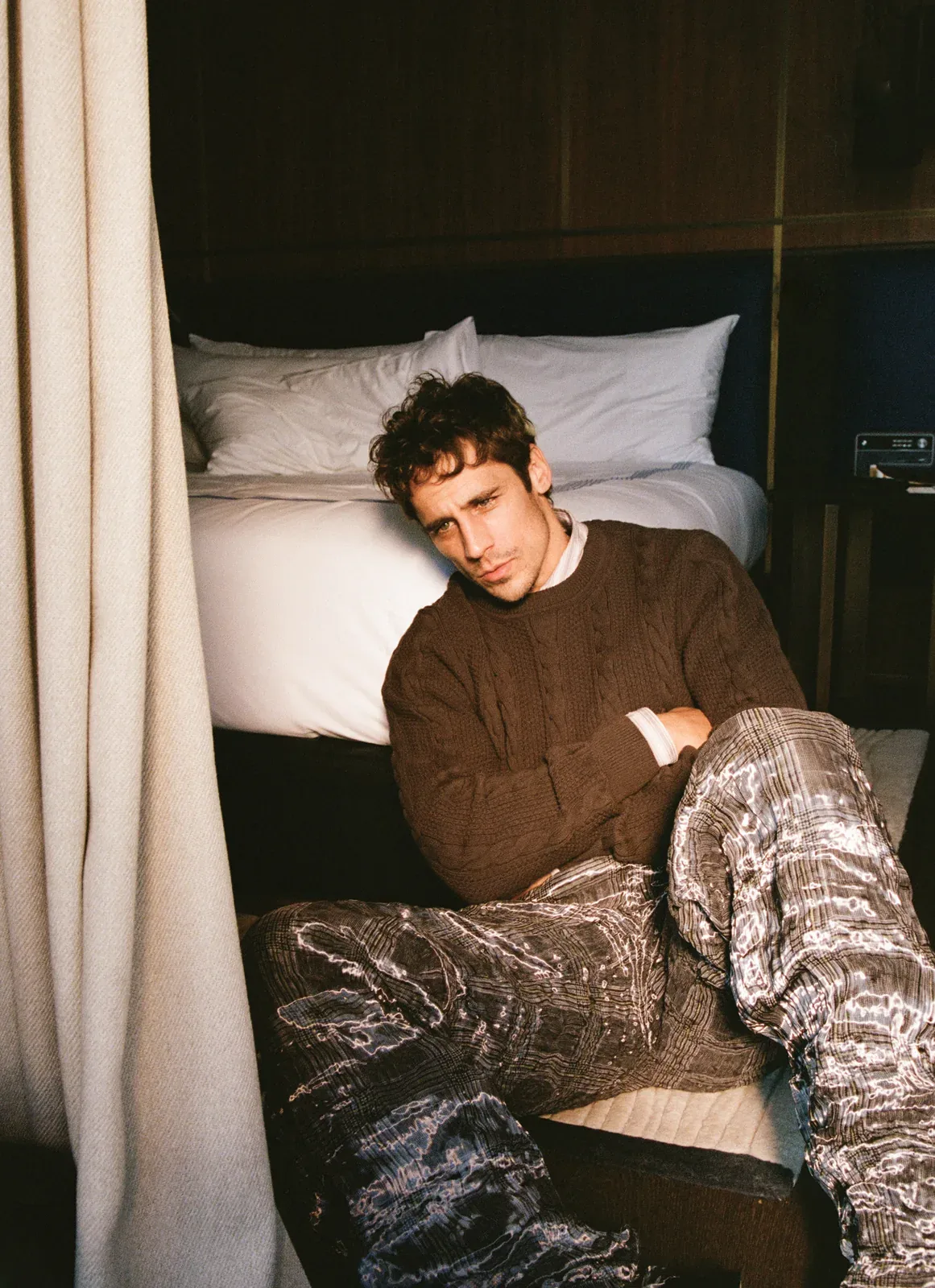
Cable-knit jumper with braided texture detailing, white cotton shirt with a structured silhouette, and overprinted POW metallic cargo trousers, all LOUIS VUITTON.
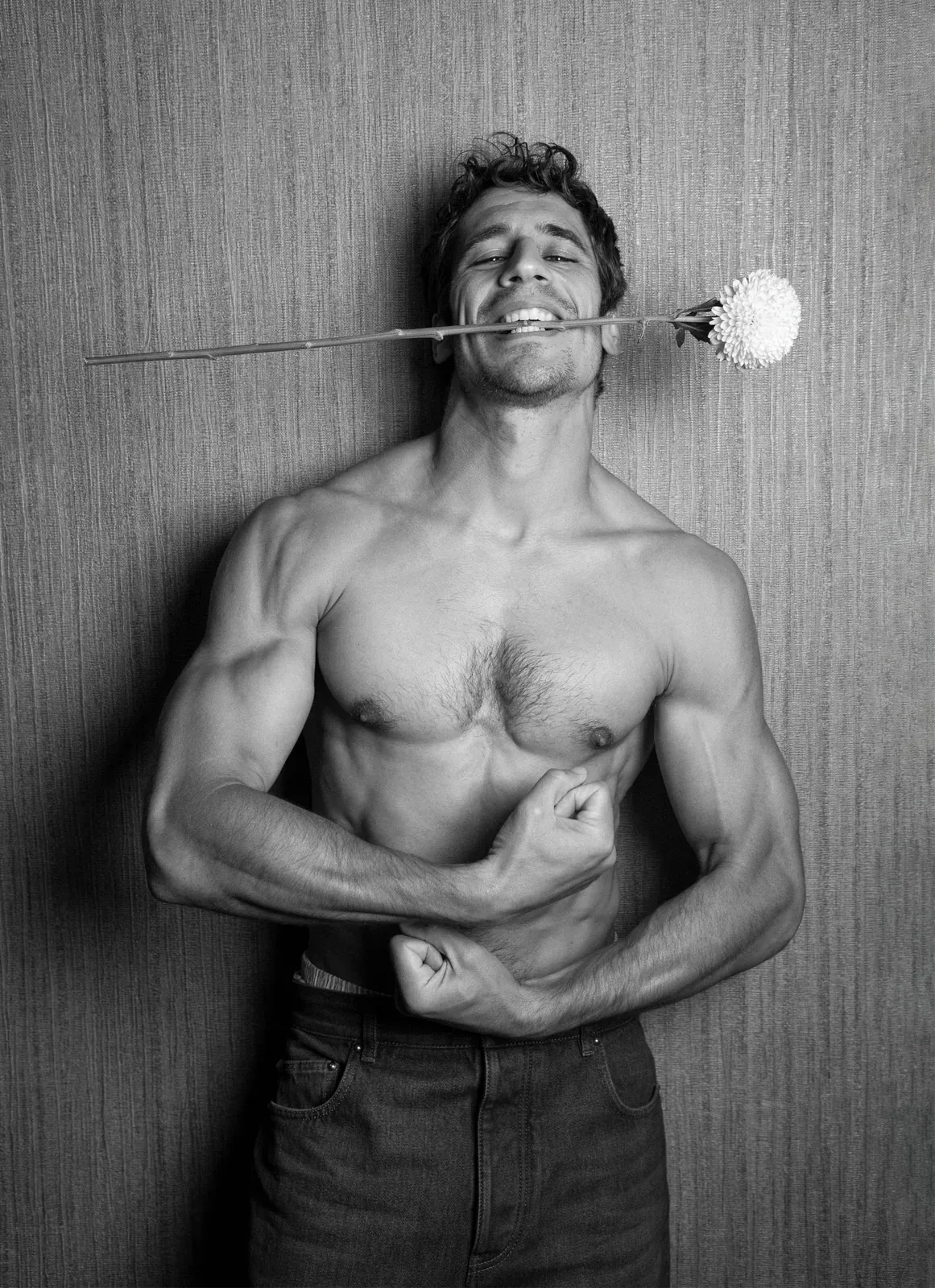
Classic denim trousers LOUIS VUITTON.
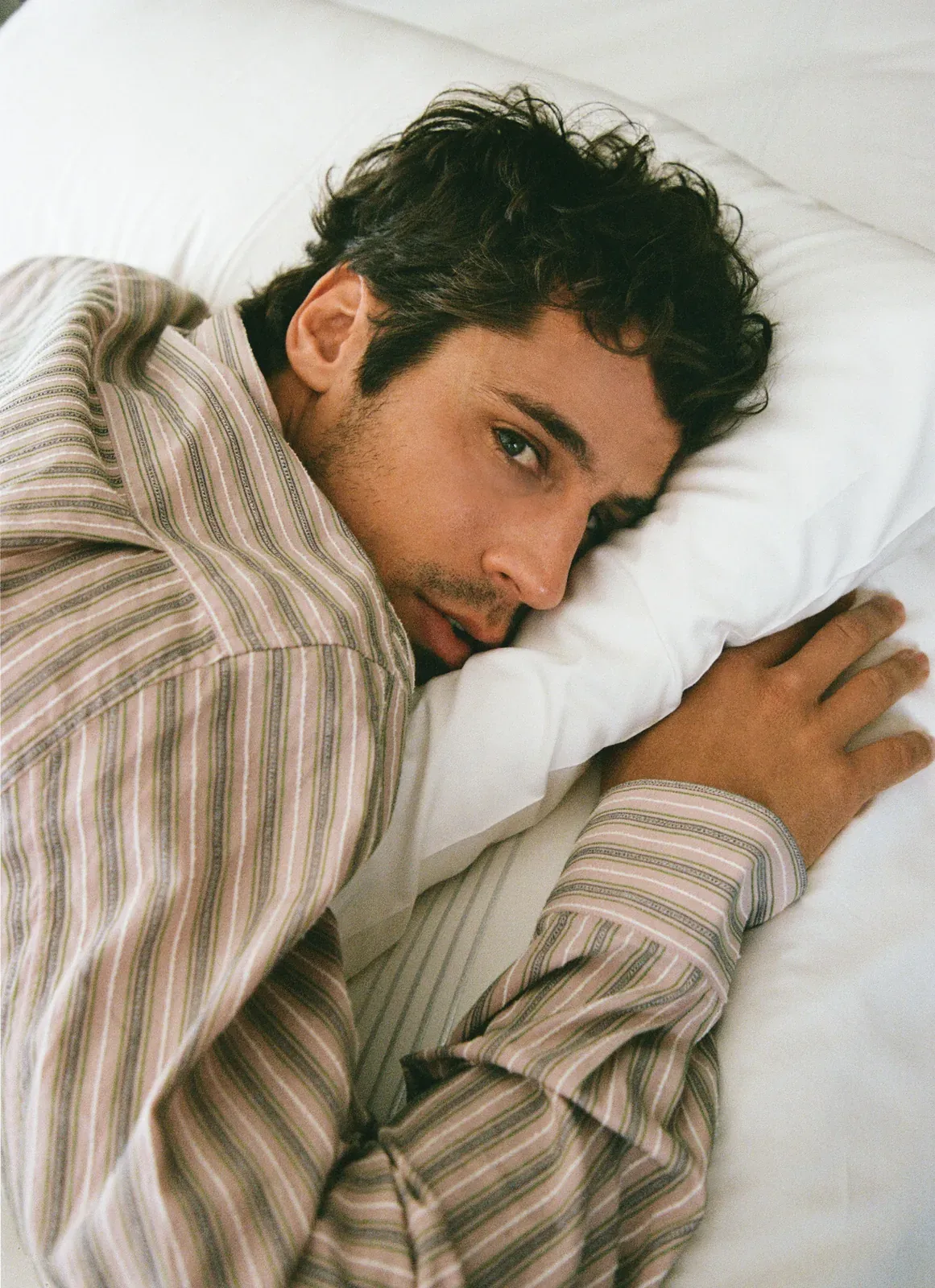
Classic striped shirt LOUIS VUITTON.
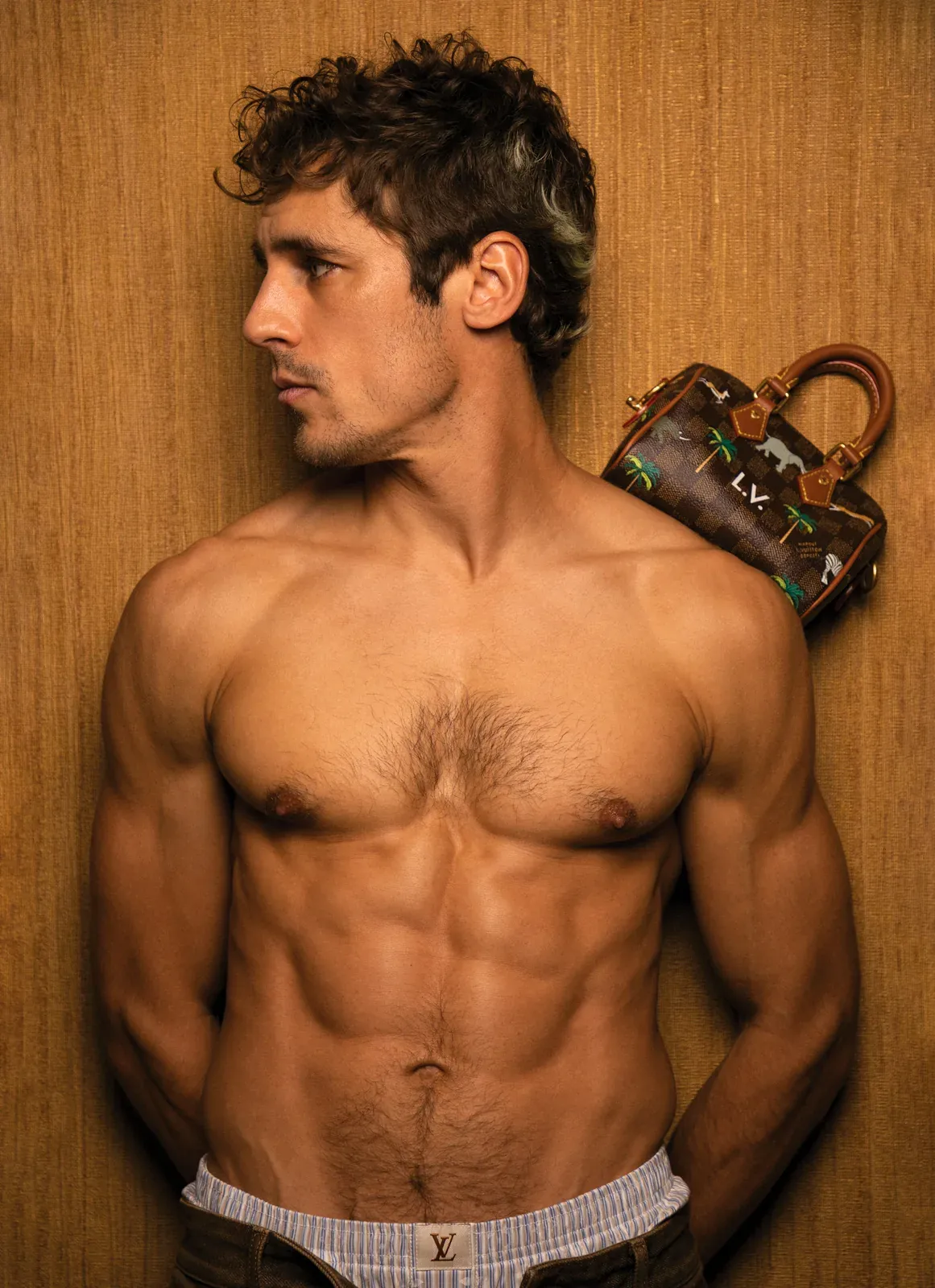
Coffee indigo skate denim trousers, classic striped boxer shorts and Speedy 18 bag with shoulder strap x The Darjeeling, all LOUIS VUITTON.