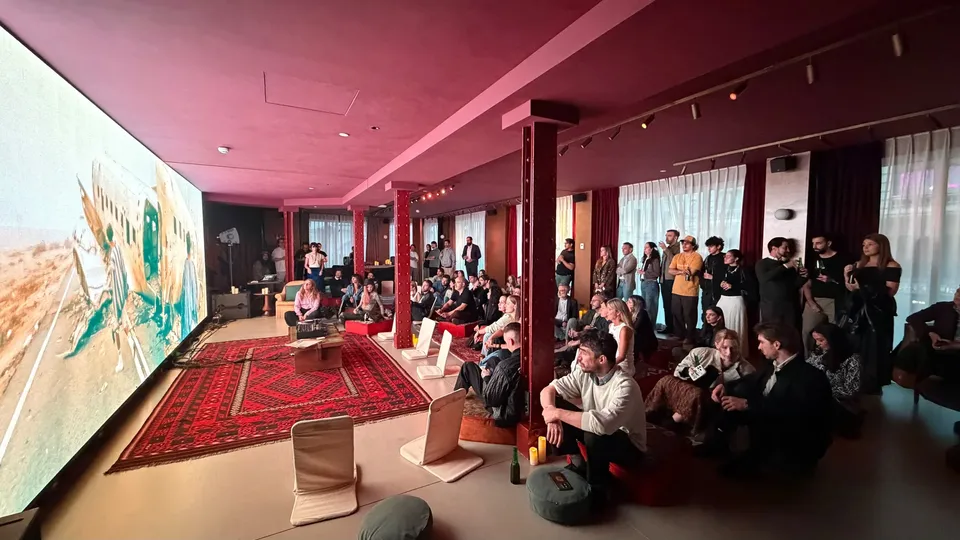
Son of acclaimed Greek-French director Costa-Gavras, Romain Gavras rose to prominence amid the controversy surrounding Justice’s Stress music video, followed by adidas commercials, collaborations with M.I.A., Jay-Z and Kanye West, and fashion films for Dior and Louis Vuitton. That same undercurrent (controversy fused with a fashion eye) runs through his new work, Gener8ion: Visions of 2034. Presented at 180 Studios in London until 30 August in collaboration with musician Surkin, it’s an audiovisual world of ten peripheral dystopias set in imagined futures, with contributions from Swedish rapper Yung Lean, 070 Shake, Yannis Philippakis of Foals, actress Charlize Theron and choreographer Damien Jalet.
Together, Gavras and Surkin turn 180 Studios into a living laboratory of art, sound and performance. Something shifts here: in the gestures of youth, the reflexes of pleasure, the machinery of control. The world becomes a network of anomalies, familiar but off. Gavras’ signature is all over it: controversy, violence, a pull you can’t look away from. In Leeds, students smoke melted antenna hardware for the rush. In Mumbai, digital replicas of Hollywood actors perform emotion with perfect precision. In Idaho, internet mythology hardens into broadcast. In Athens, teenagers occupy toxic shorelines that once drew tourists. In Hangzhou, children celebrate a prophet who changes every year. Baudrillard hangs over all of it: images no longer follow the world; they come first.
The ten-work show drifts through a near future that lingers rather than arrives: a portrait of how culture is consumed, processed and forgotten. At its heart, Gavras asks one question: what survives, and what doesn’t? The video, the album, the exhibition: all turned back on themselves. We’ll walk you through each of the ten pieces.
BAIKONUR – Kazakhstan, 2034
This is the first work to open the exhibition, on 180 Studios’ ramp. Right away, you’re met with a Soviet-like astronaut aesthetic: cosmonauts departing for space, set against a 1973 interview with Hannah Arendt. Where Idaho’s separatists insist heaven lies beneath our feet, Gavras looks the other way — upward, at the oldest dream of all: leaving Earth behind entirely. One shot stays with you: the camera holding on the launched rocket as it hangs in the sky like a star, tracking it until it vanishes.
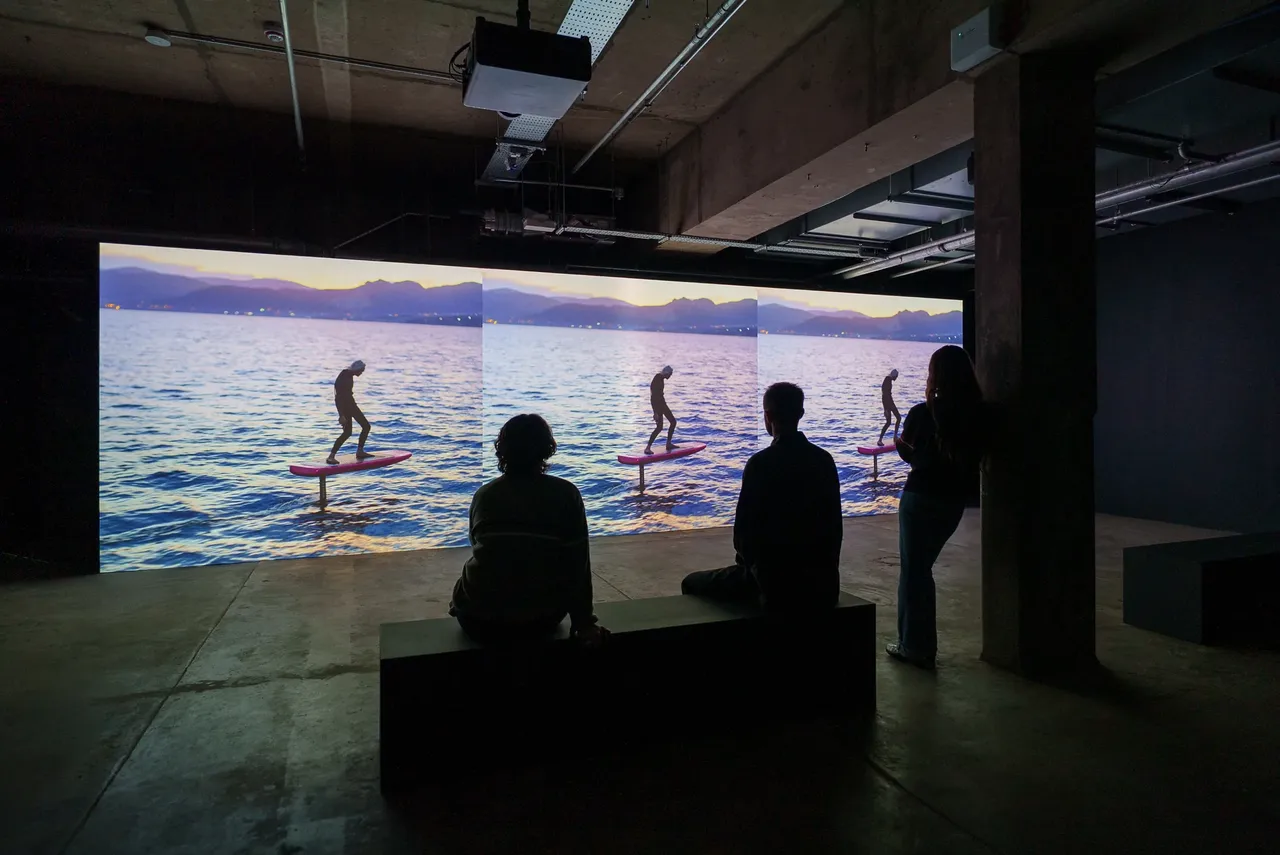
NEO SURF – Athens, 2034
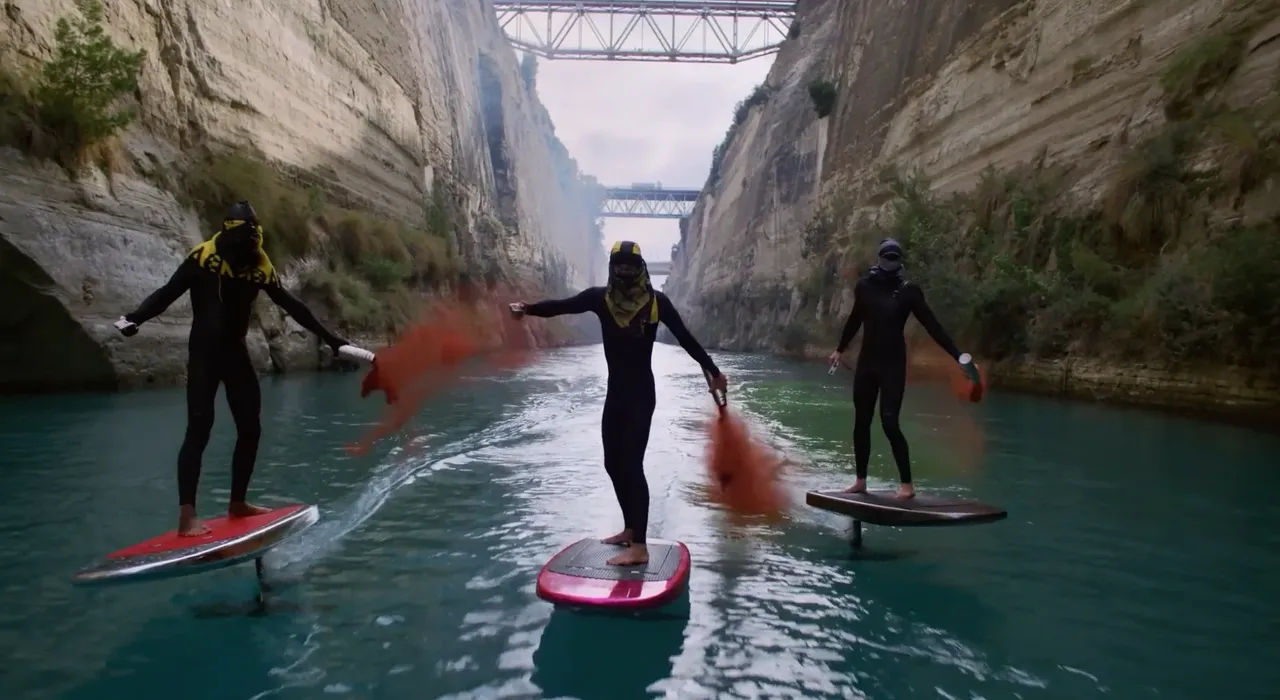
Three screens project the film at once, sometimes mirroring each other, sometimes pairing like the spread of a hardcover magazine — a vast digital one. The exclusion zones ringing Athens have become playgrounds: after toxic algae blooms poisoned the coastline in the late 2020s, the shoreline was abandoned to ruin, and the young have claimed it back, treating the contaminated waterfront as both turf and arena. The result sits somewhere between a fashion film and a dreamy art-house short. Gavras once again uses the landscape’s natural textures and his camera angles to pull the viewer into this neo-apocalyptic world — right down to the closing shot, the surfer leaving the frame on a foilboard.
SLEEP MODE – Shenzhen, 2034
An in-between installation, bridging one room and the next. No screen this time — instead, a mannequin of a Korean guard set before ten ARP 2600 synthesizers breathing out a synthetic version of nature, threaded through a canopy of cascading vines. At the centre the guard sleeps on the job, trading watchfulness for dreaming — the machine drifting off into visions of the living world it was built to mimic.
VOLCANO – Eruption of Sundhnúkur, 2034
A lovely, striking vision of a volcano in full eruption — one foot in high-end nature documentary, the other in stylised narrative. The camera flies in close above this grand display of Mother Nature, cut against vast ultra-wide shots of smoke rising from the fields. One question lingers: how did Gavras keep the equipment from melting into the lava? Worth knowing.
BORN FREE (ARCHIVE) – Los Angeles, 2034
I still remember the first time I saw Justice’s Stress — that 21st-century hunger for ultra-violence, Kubrick à la mode. This R-rated piece runs in the same vein. Out on the city’s east side, police trial experimental methods of “behavioural pacification” on the Reds, an armed group the state branded a terrorist organisation in 2033. M.I.A. feeds into the frenzy and discomfort, building to a climax — spoiler alert — in which one of the kids used to test the methods runs across a minefield and is blown to shreds, dismembered in front of the viewer, in the goriest moment of the whole exhibition.
LOVE & TEARS – Mumbai, 2034
Gavras had already worked with Charlize Theron on a Dior J’adore commercial in 2018. Here, the actress pours emotion in front of his lens, moving from happiness to sadness — a live launch for the PrimeFocus™ 3D rendering engine, which conjures hyperreal doubles of Hollywood stars capable of summoning any feeling on command. Emotion itself is now an industry: outsourced, refined and copied without limit. The installation plays across four screens, one in each corner of the room, wrapping the viewer in a circular experience with a single bench at the centre.

GOSH (ARCHIVE) – Hangzhou, 2034
I’ll admit I was confused; this was one of those things you’ve half-heard of but aren’t sure is real. Tianducheng, in the Chinese city of Hangzhou, is a housing development modelled after Paris, complete with a replica of the Eiffel Tower. Known as a ghost city, this Paris District is where children mark the yearly feast of a local prophet, a celebration that plays like a collage of borrowed faiths, imported mythologies fused into a single ritual.
GOD HATES SPACE – Independent State of Idaho, 2034
This installation has one of the widest screens of the exhibition. A piece of homemade propaganda from the Agartha Liberation Army, a 6Chan-born insurgency that has broken away from the United States. They hold that the Earth is hollow and salvation waits inside it; their creed bans space travel altogether: heaven, they insist, is below, not above. The perfect mirror to the cosmonauts that opened the show: where Baikonur reached for the sky, Idaho digs in the opposite direction.
STORM I & II – Leeds, 2034
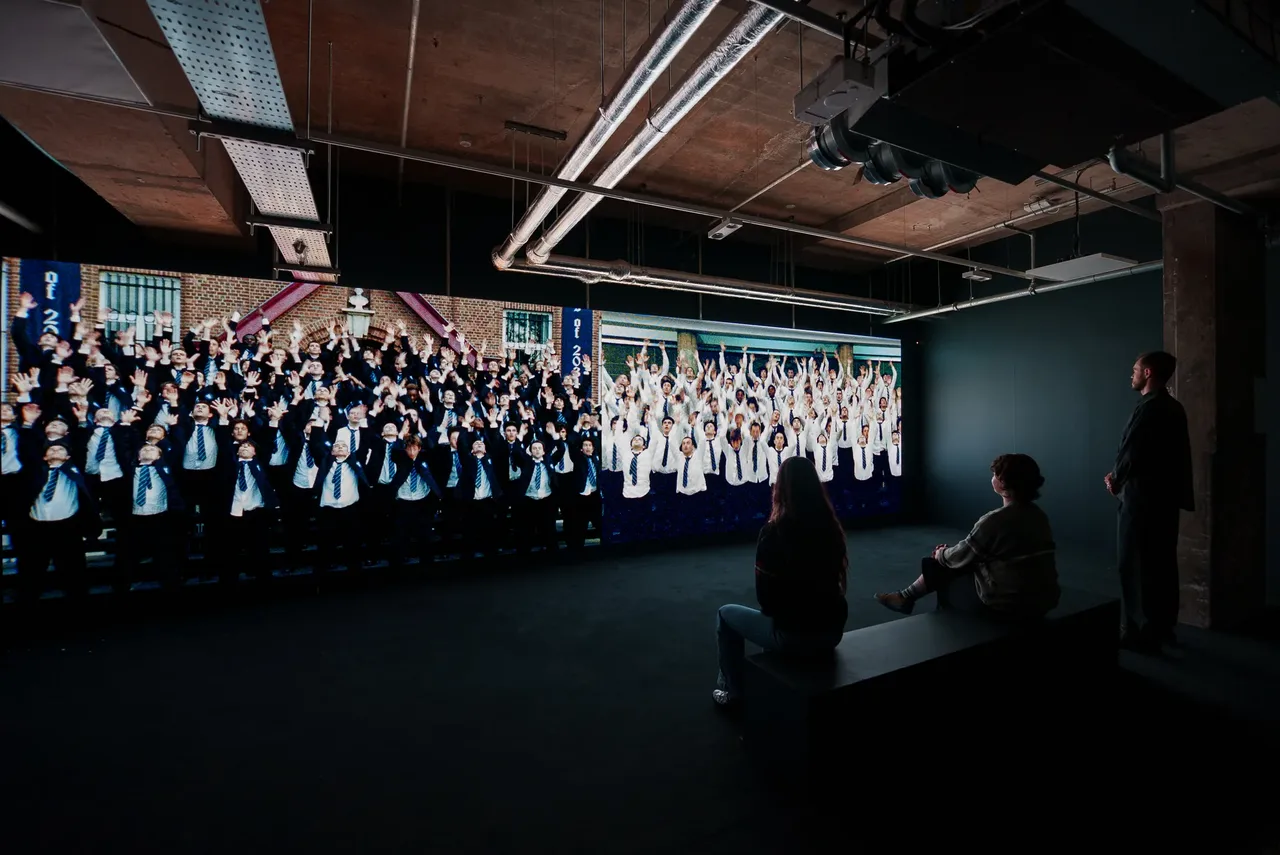
This is probably the most popular piece in the exhibition, and the one that brought real controversy. The video was shot at Cardinal Mercier College in Braine-l’Alleud, Belgium, where the project was reportedly pitched to staff as a portrait of “youth in the eye of the storm”, the involvement of established creative names reassuring them during approval. The violent content, fighting rings and drug use came later as a surprise: principal Gregory De Smet told The Bulletin these weren’t images the school wanted associated with it.
A second controversy followed online: the original cut carried a banner bearing the name of Institut Le Rosey, an exclusive Swiss boarding school, which was quietly scrubbed from the version now live on YouTube. Fitting, for a show about what culture consumes and forgets. Its cinematic choreography and visual style have turned this collaboration with Swedish musician Yung Lean into a viral phenomenon. A craze sweeping the UK’s elite boys’ schools: pupils melt lithium MR3 out of 6G antennas and smoke the residue. They call the high “aggressively fun”, revolt and boredom collapsed into one ritual.
A second controversy followed online: the original cut carried a banner bearing the name of Institut Le Rosey, an exclusive Swiss boarding school, which was quietly scrubbed from the version now live on YouTube. Fitting, for a show about what culture consumes and forgets. Its cinematic choreography and visual style have turned this collaboration with Swedish musician Yung Lean into a viral phenomenon. A craze sweeping the UK’s elite boys’ schools: pupils melt lithium MR3 out of 6G antennas and smoke the residue. They call the high “aggressively fun”, revolt and boredom collapsed into one ritual.