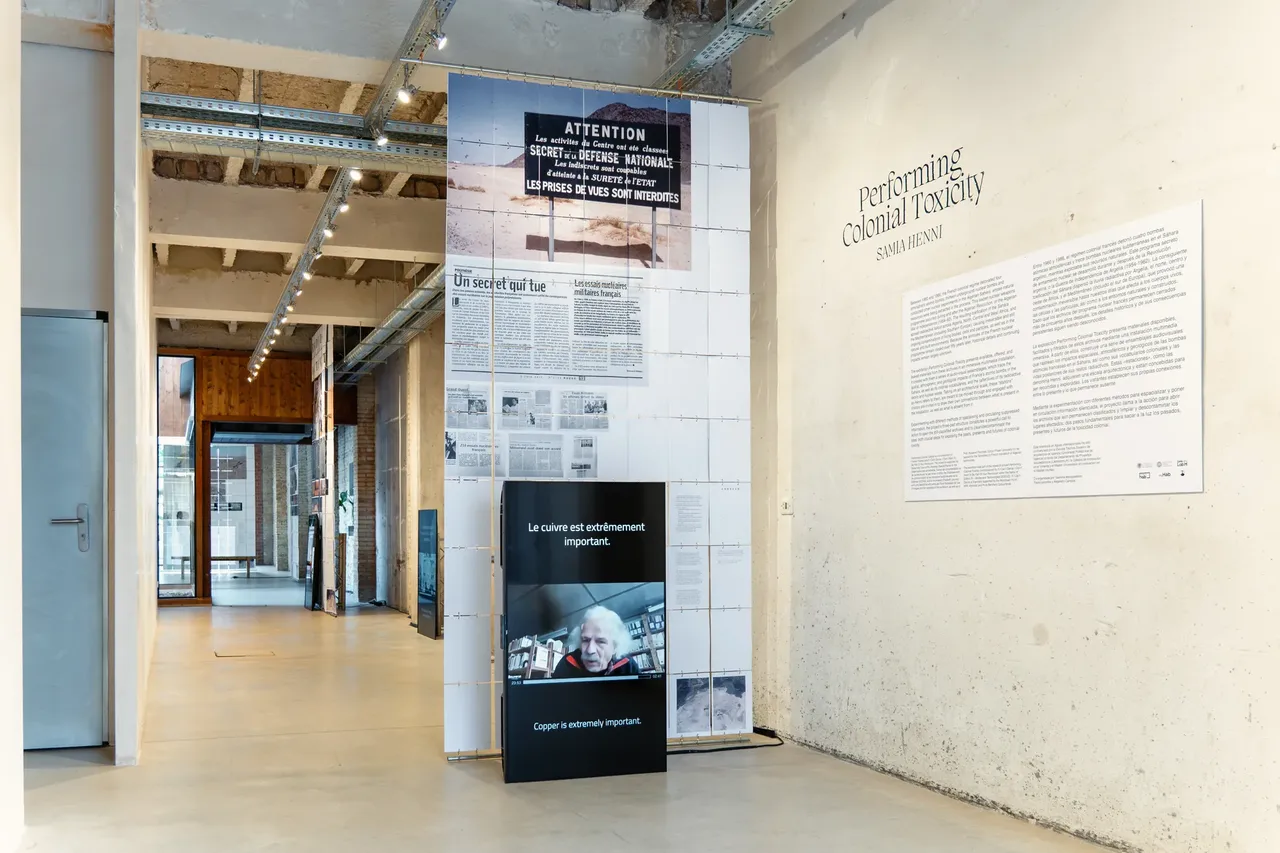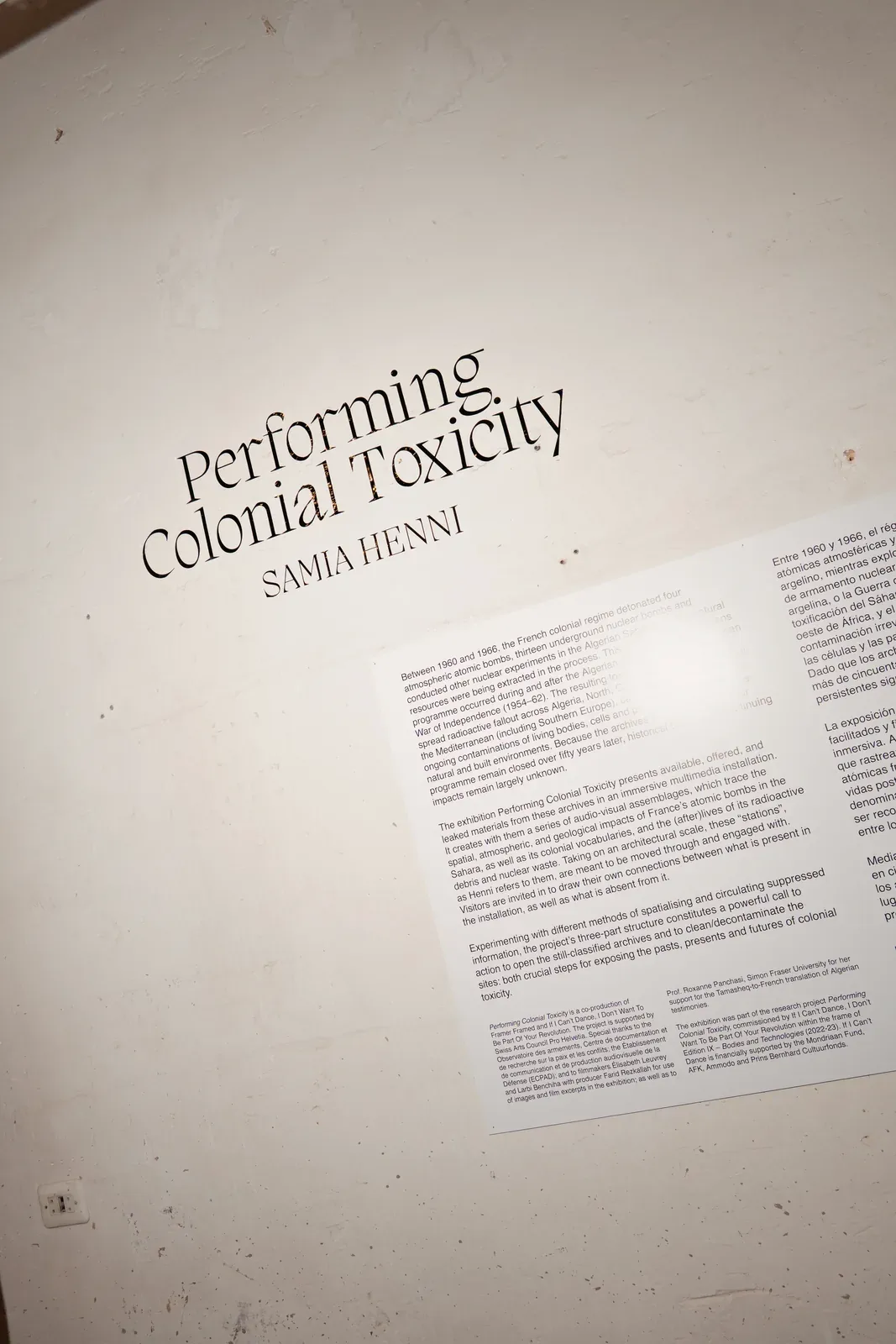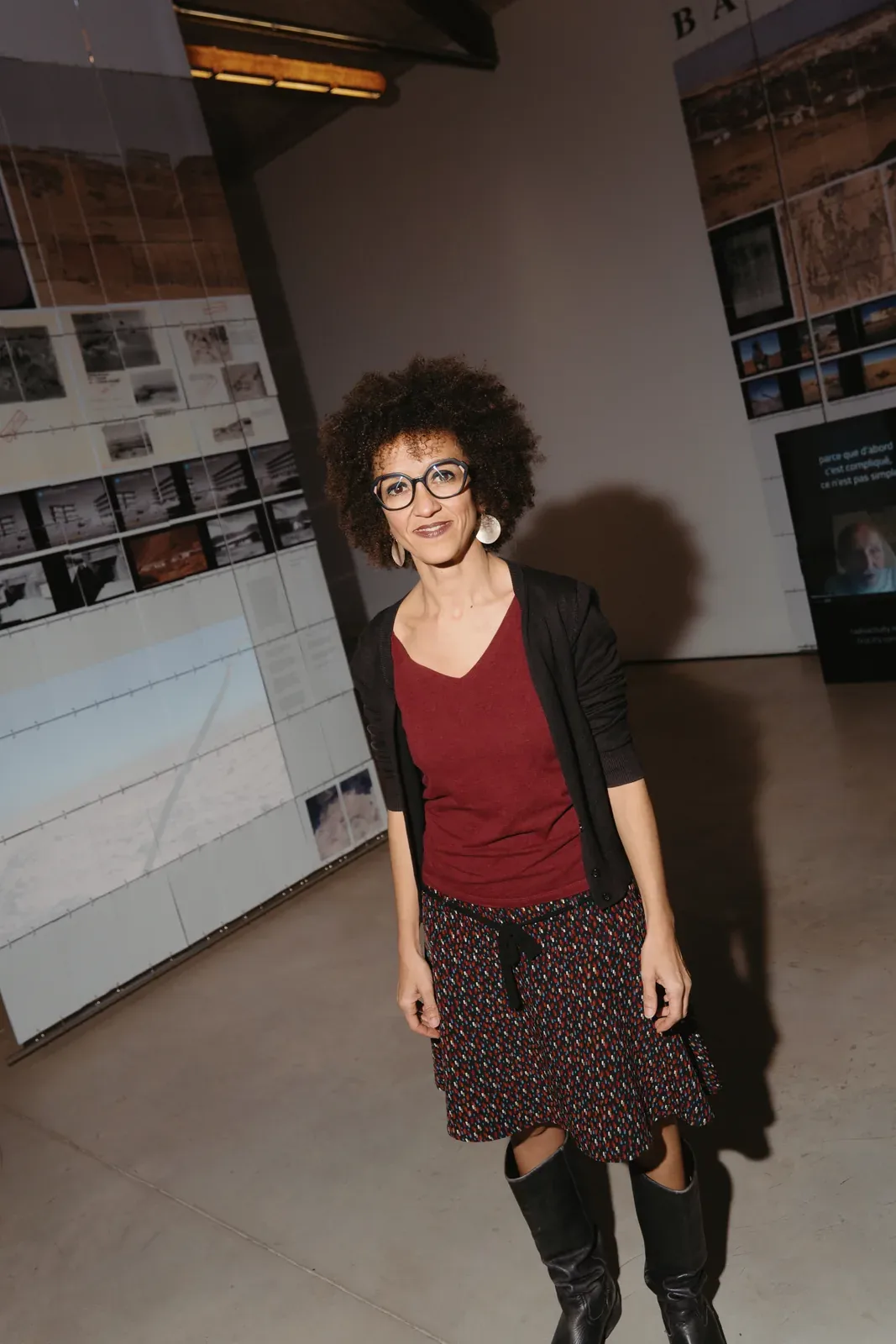
The history we know is not necessarily the whole story. Chernobyl has a lesser-known counterpart in the Algerian Sahara: a nuclear legacy that remains largely out of sight. Between 1960 and 1966, France conducted a series of nuclear tests in the region, beginning with Gerboise Bleue on February 13, 1960. But, as Samia Henni puts it, “radioactivity has no borders” — nor does it conform to the boundaries of time. The bombings may have stopped, but their story remains very much alive. This is the history Henni brings into public view in Performing Colonial Toxicity, an exhibition on view at Aguas Internacionales in Valencia until 1 November.
More than six decades later, the radioactive contamination left behind continues to affect the land, those who lived through the tests and the generations that followed, as well as the surrounding environment. Yet much of this history remains classified, its archives restricted and its consequences insufficiently acknowledged. A public secret. Through photographs, maps, films, archival documents, and testimonies, Henni creates a ‘nomadic’ installation that explores not only the immediate and lasting effects of the tests, but also the infrastructures that sustained them. Architecture is the starting point, the evidence of the colonial project and a material trace of its ongoing consequences.
At the heart of Henni’s work is a challenge to the colonial platitude of the desert as an empty territory, a space supposedly available for occupation, experimentation, and exploitation. Designed to be experienced physically, the exhibition invites visitors to move through its stations, reflect on colonial practices, and consider what it means for colonial toxicity to perform.
In this conversation with METAL, Henni reflects on the research behind her project, the role of testimony and an open archive, and the ways architecture can expose histories obscured by colonial power. Performing Colonial Toxicity confronts us with a past that has never entirely passed.
Samia, I’d love to hear about the installation in your own words. How did Performing Colonial Toxicity come about?
It’s a long-term research project that started in 2020, when I learned that the official archives relating to the French nuclear weapons programme were supposed to open to the public in 2022. I started reading and collecting all kinds of information around it, so that I would be prepared for this archival research.
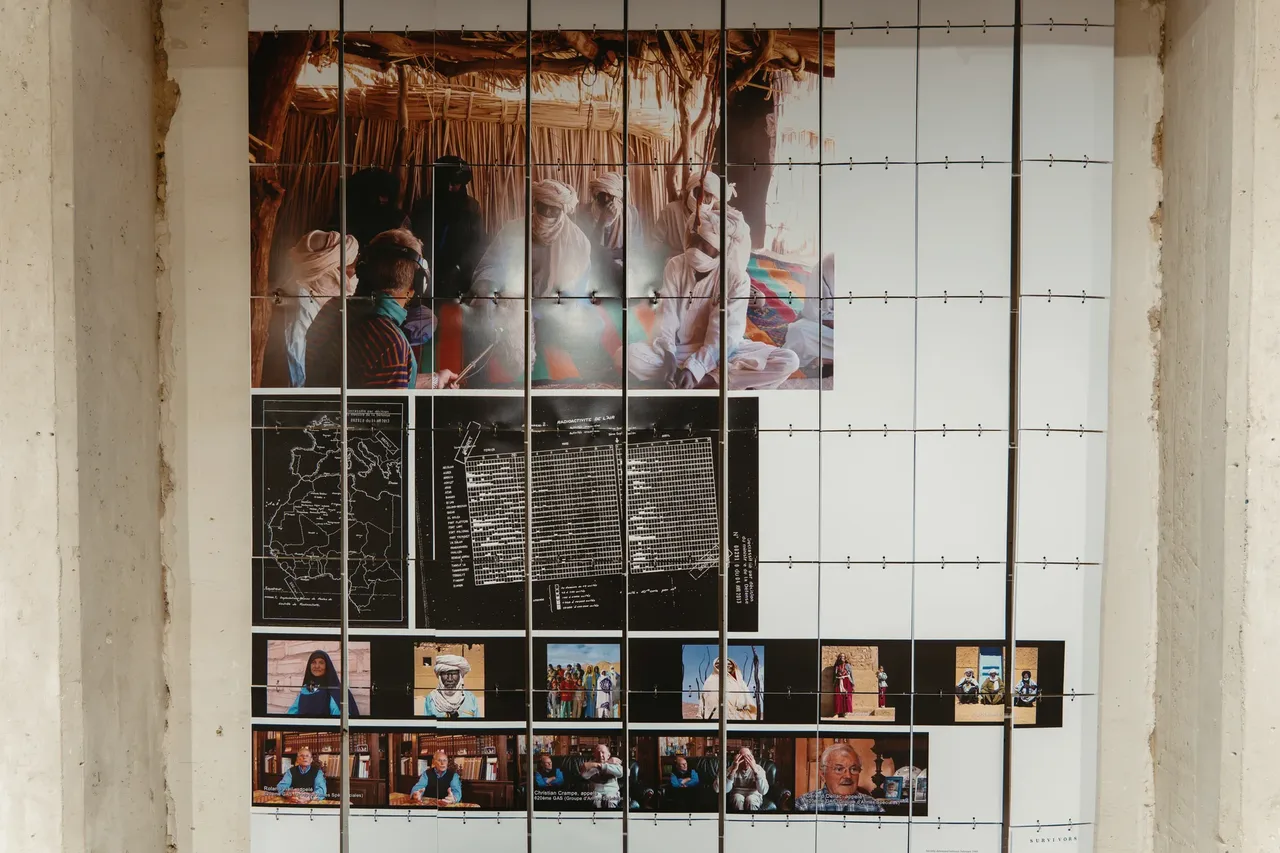
But in 2022, the archives were not declassified, and the French government did not really grant access to these primary sources. So, I decided to continue, instead of contributing to the same process of historical amnesia, and to find a way to create a body of documents to testify to the contamination of the Sahara, but also to its impact on French veterans and Algerian, Saharan, and African populations. I started collecting photographs, maps, reports, and any kind of document that represented these events.
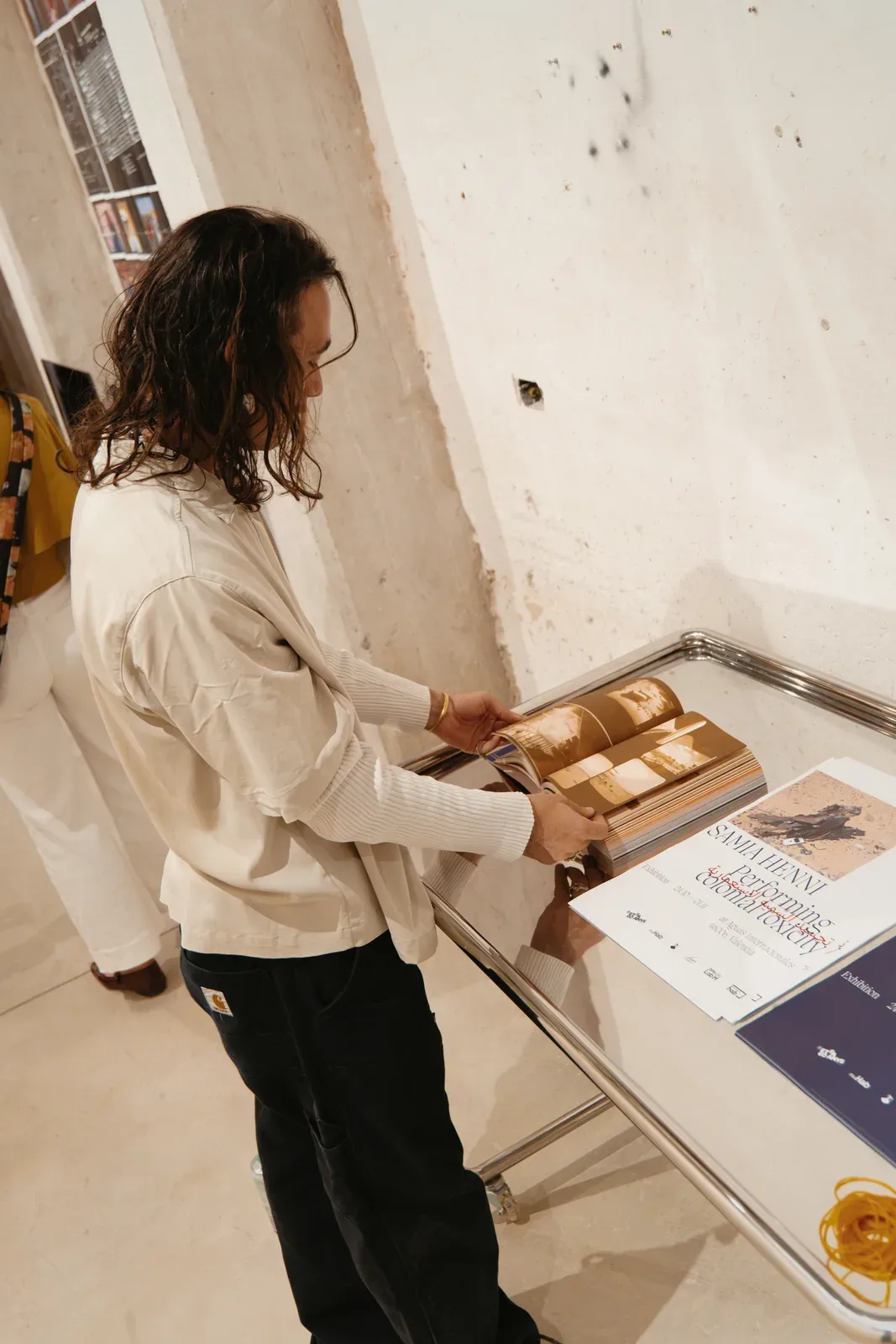
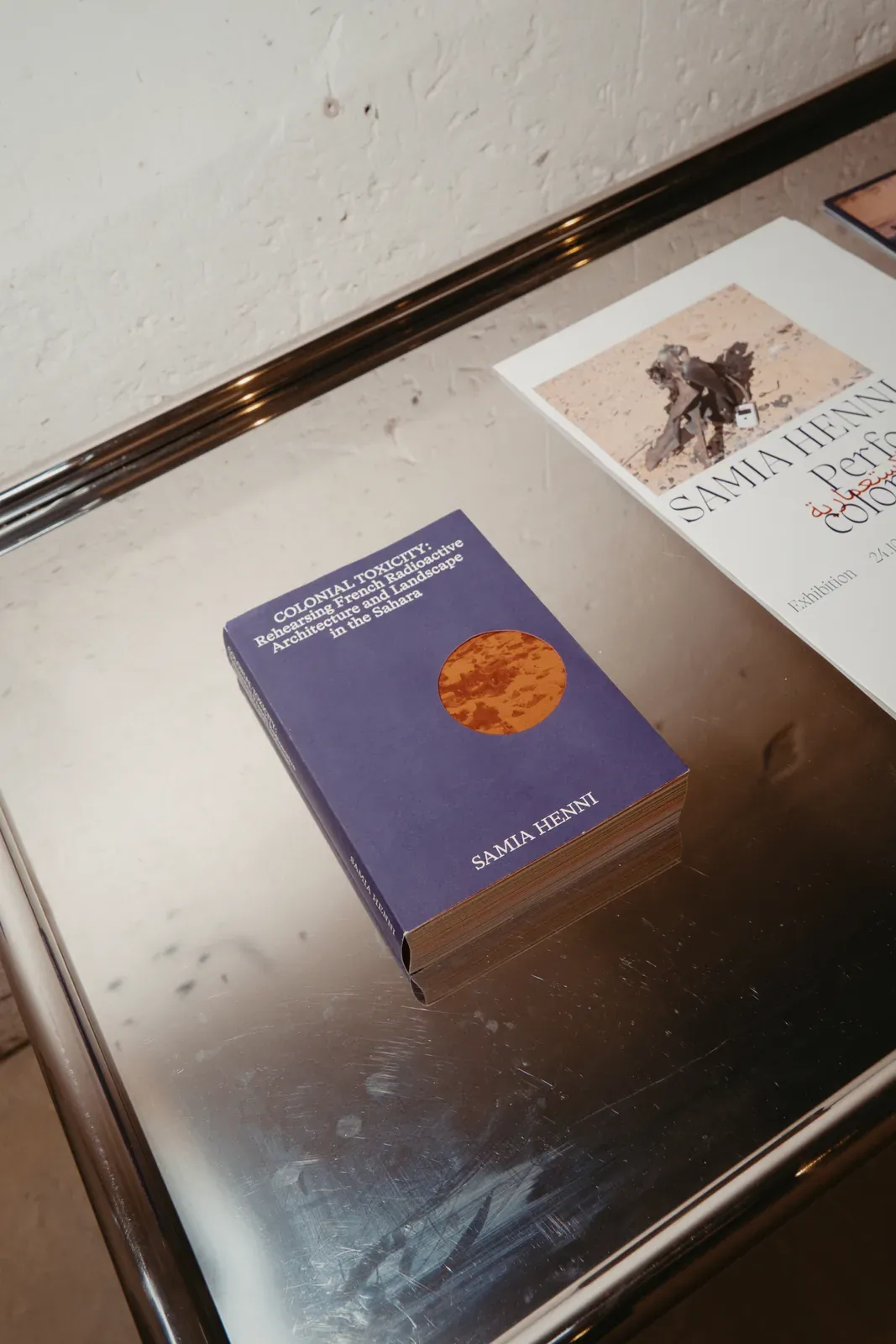
Then, in late 2021 and early 2022, I was invited by If I Can’t Dance, I Don’t Want to Be Part of Your Revolution, a performing arts organisation based in Amsterdam, to be part of its biennial, called Bodies and Technologies. I proposed finding a way to make this body of archival material public through a translation project (The Testimony Translation Project), a publication (Colonial Toxicity: Rehearsing French Radioactive Architecture and Landscape in the Sahara) and this exhibition (Performing Colonial Toxicity).
Given that many French nuclear archives remain classified and this is still a politically sensitive history, how did you approach your research? Did you ever encounter any pressure or resistance along the way?
Not really, because I didn’t ask anyone (laughs). It wasn’t public. I was contacting different associations and victims, going to the sites, and gradually collecting all kinds of evidence. I was creating this body of material without announcing it, without making it public. The very first public moment was the Testimony Translation Project, then the exhibition, and then the publication. In a way, it was too late for those who were planning to impede this work.
Since it was published, the book has won three prizes, two in the Netherlands and one in Switzerland. It sold out quite quickly and was then reprinted in 2025. So, the book was disseminated and spread quickly. The exhibition was also designed to travel. It started in Amsterdam in October 2023, then travelled to Zurich, Berlin, Paris, London, Fribourg, the US (Providence), and Canada (Ottawa and Montreal), and now it’s here at Aguas Internacionales in Valencia.
Since it was published, the book has won three prizes, two in the Netherlands and one in Switzerland. It sold out quite quickly and was then reprinted in 2025. So, the book was disseminated and spread quickly. The exhibition was also designed to travel. It started in Amsterdam in October 2023, then travelled to Zurich, Berlin, Paris, London, Fribourg, the US (Providence), and Canada (Ottawa and Montreal), and now it’s here at Aguas Internacionales in Valencia.
You’ve gathered an enormous amount of material for this project. How did you approach organising it and shaping the narrative of the exhibition?
When I started collecting these documents, I went from almost nothing to hundreds of folders and printed papers. It was quite a lot, and I was very impressed by the narrative that it was not possible to talk about this nuclear programme in the Sahara because there was no evidence, no documents, no archives. I was inspired by a sort of guerrilla research and the overwhelming amount of information.
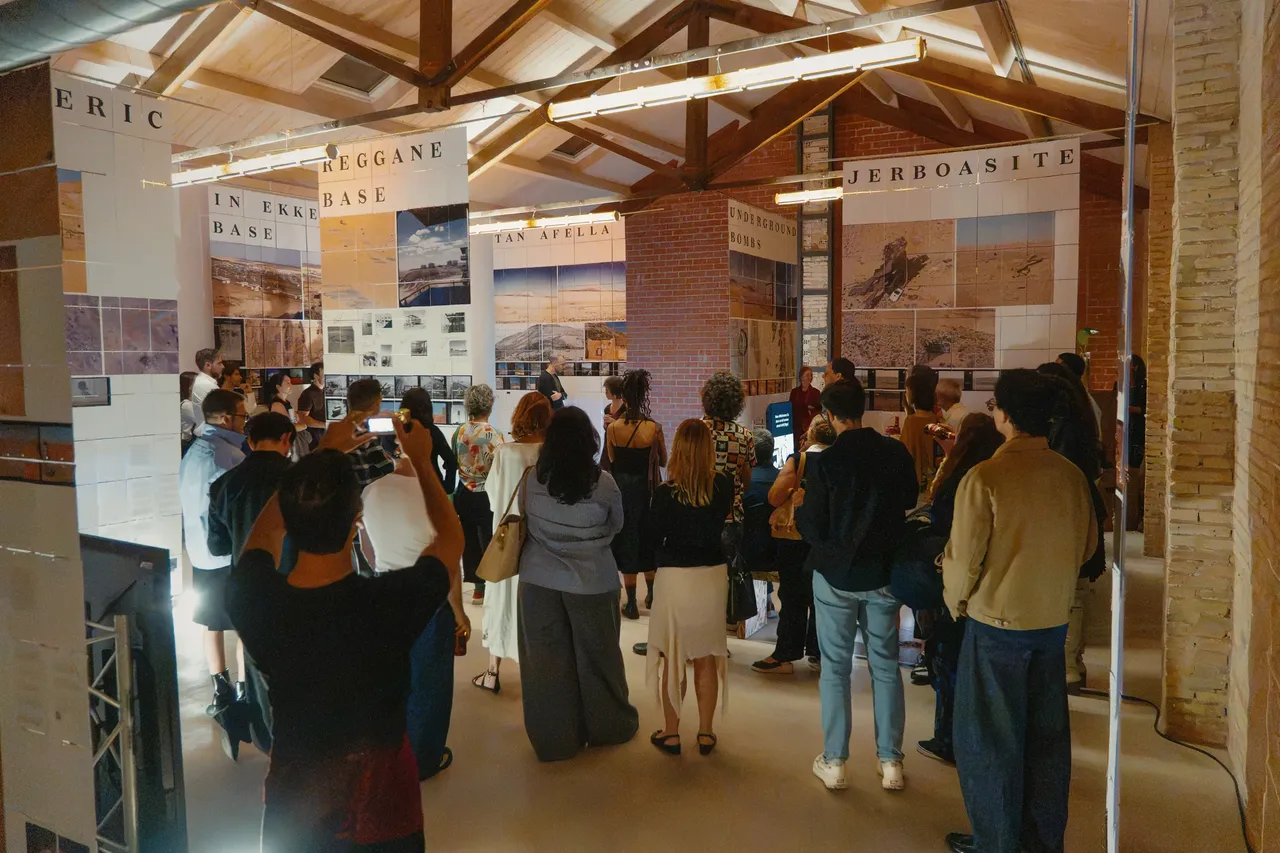
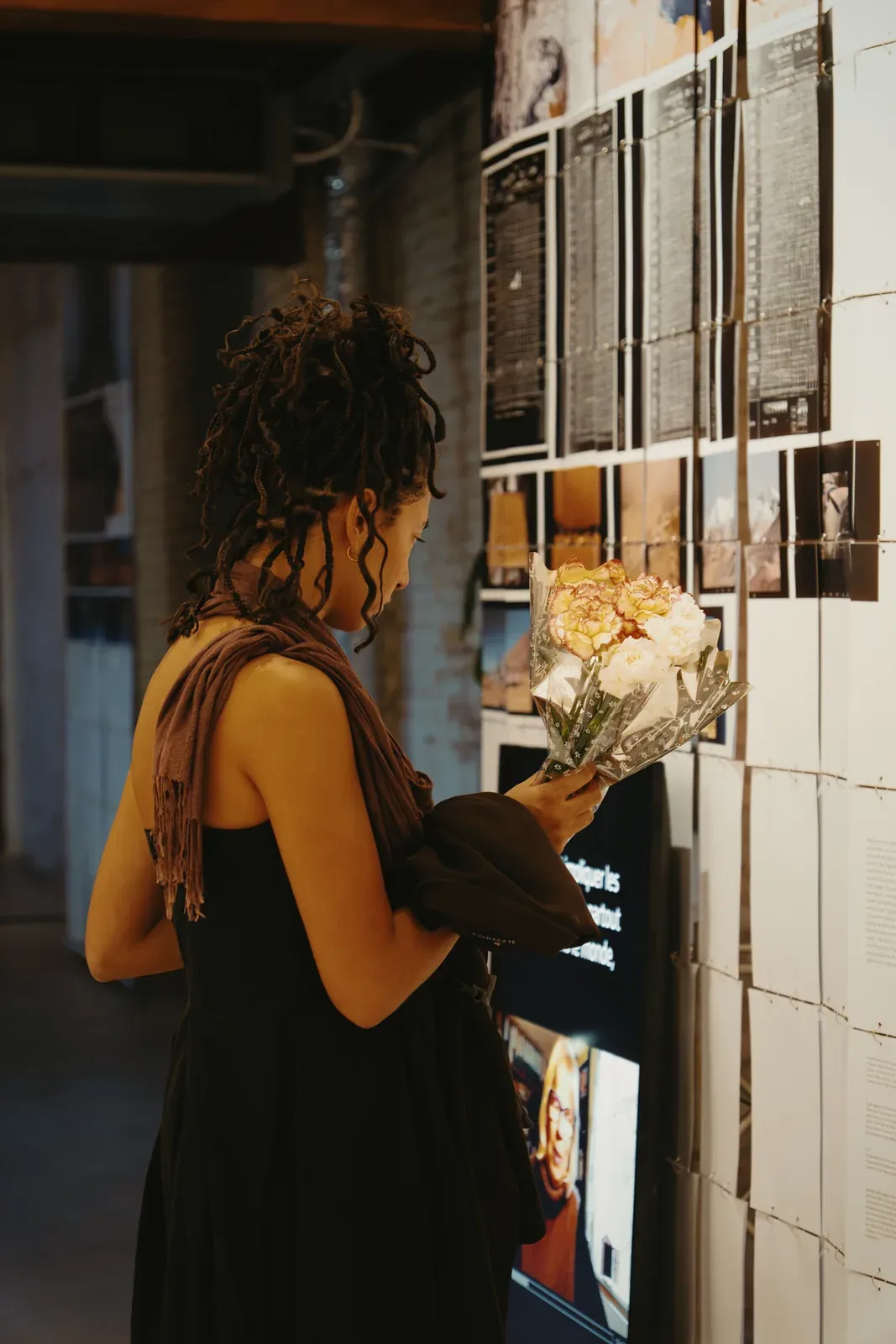
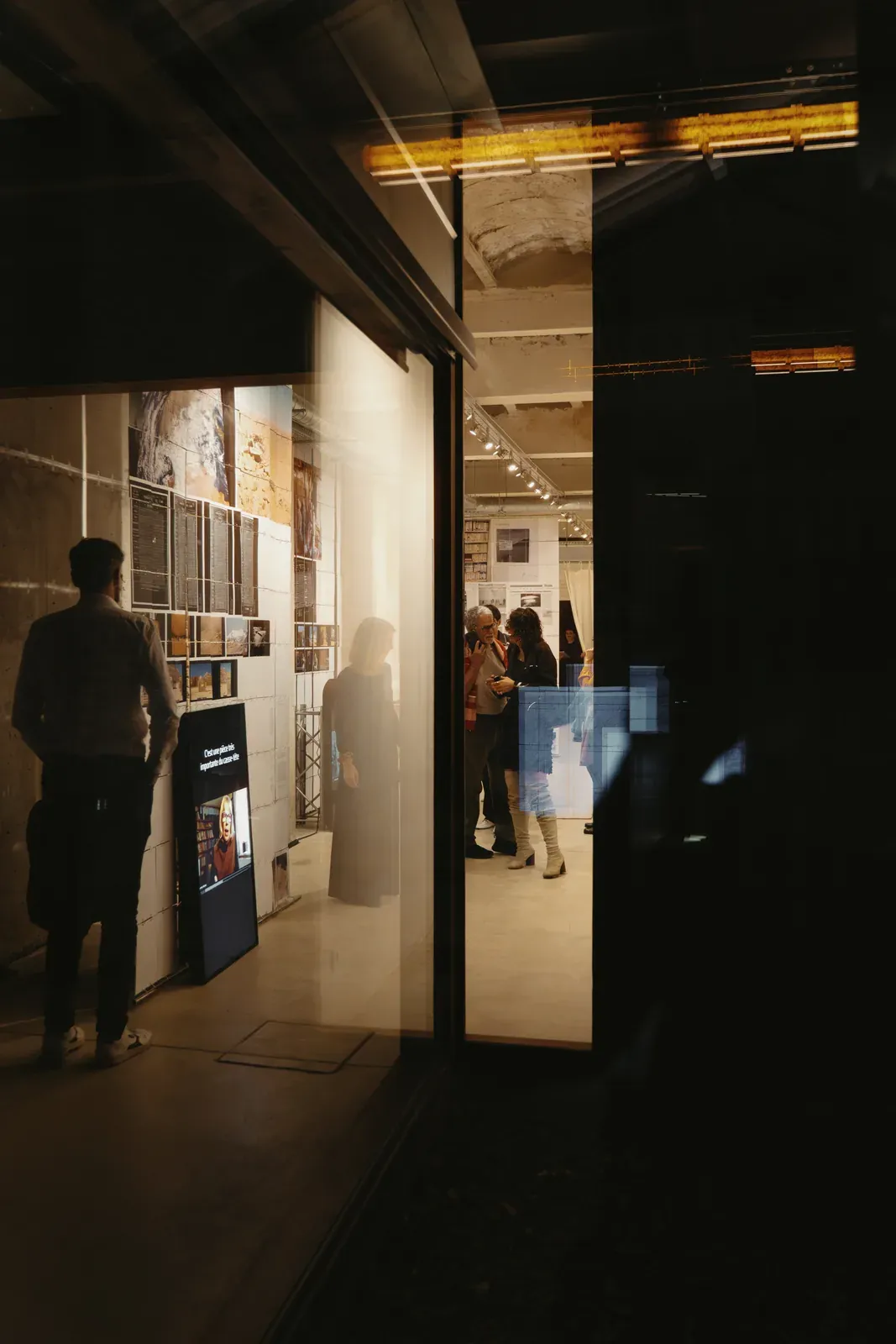
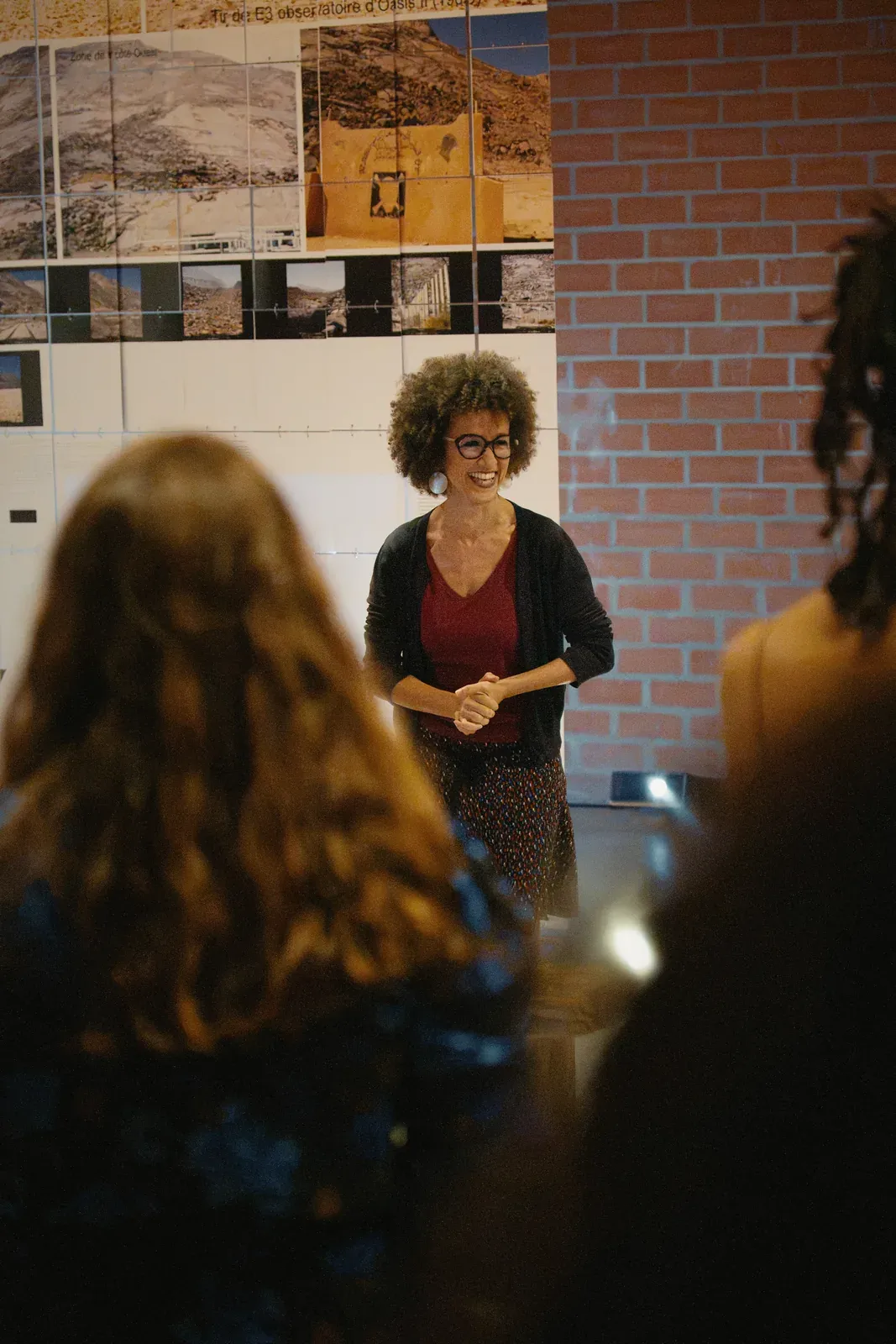
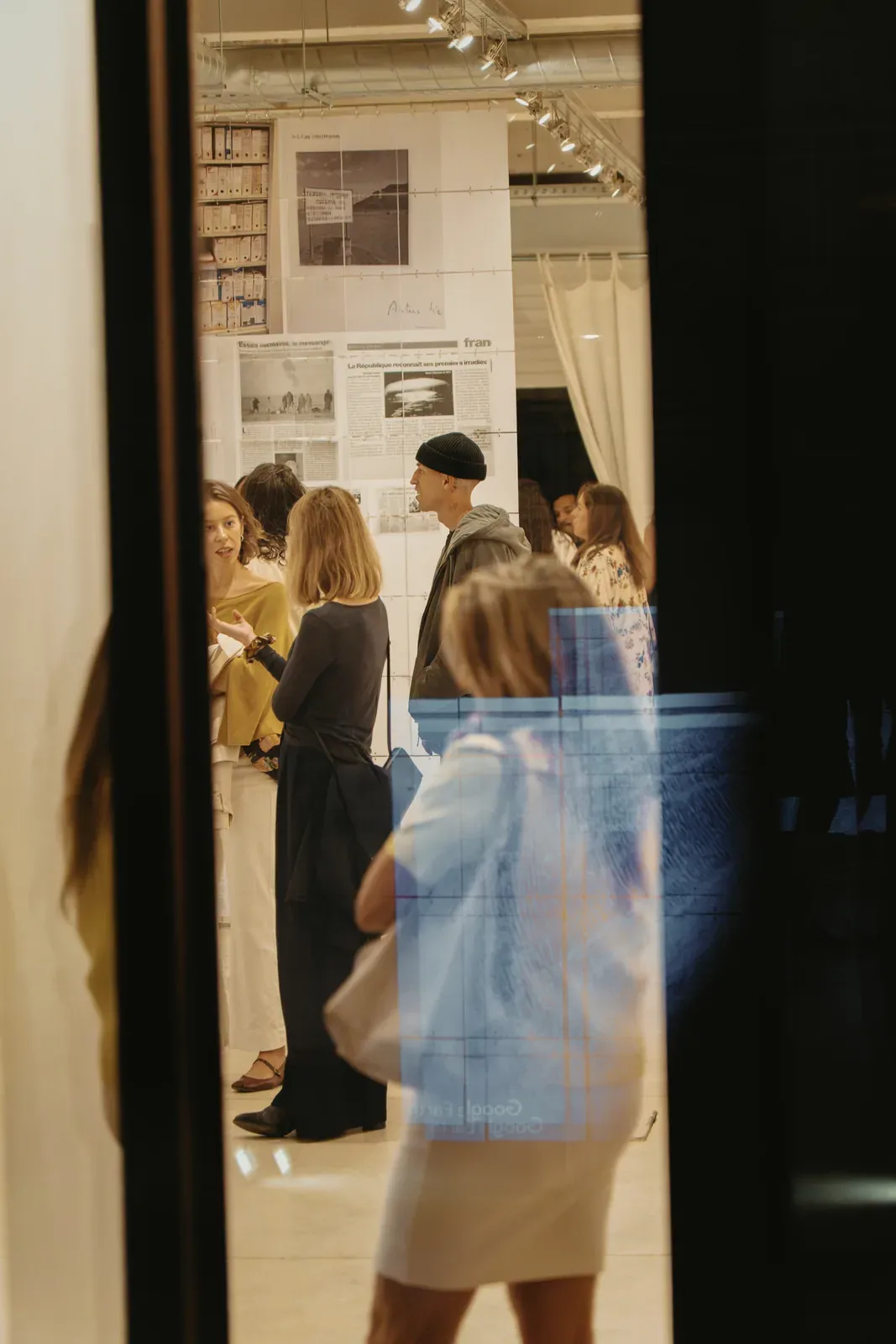
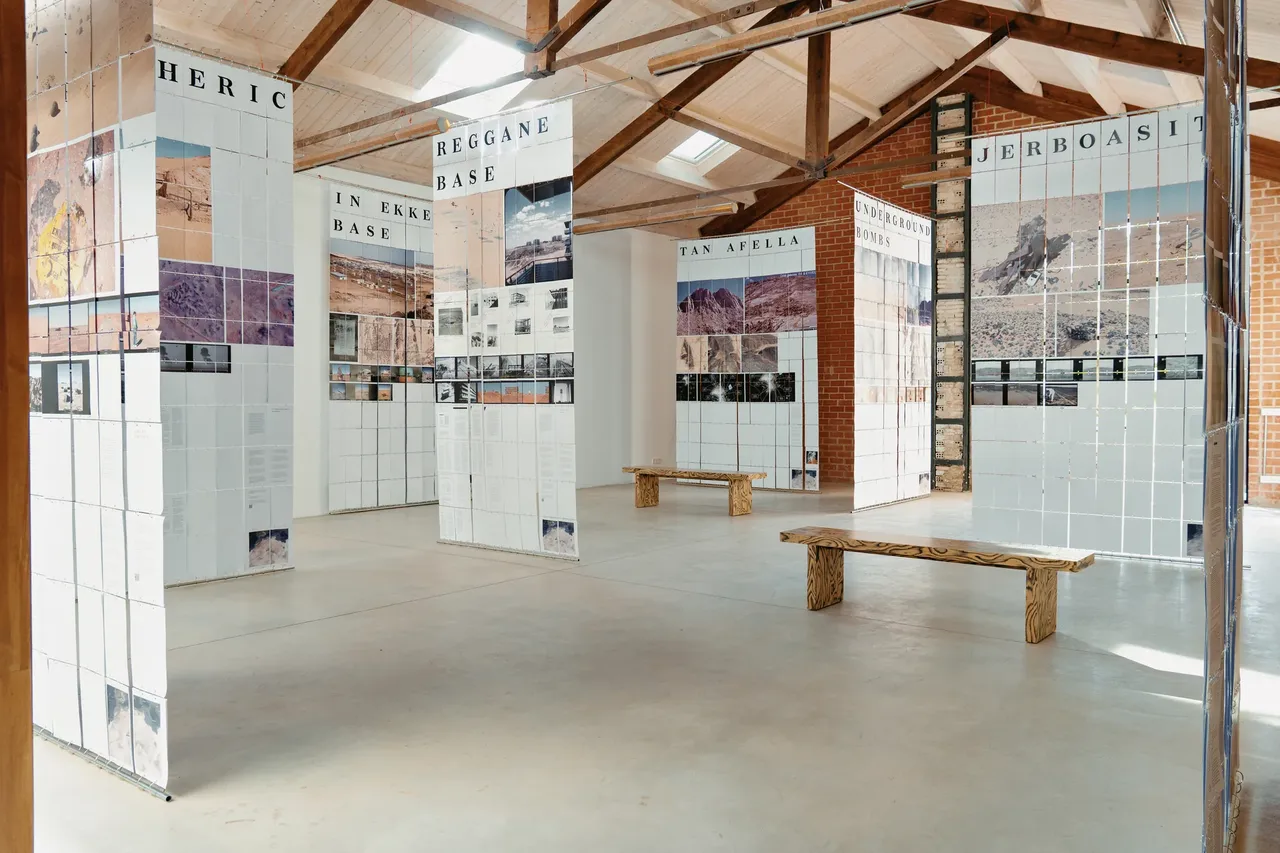
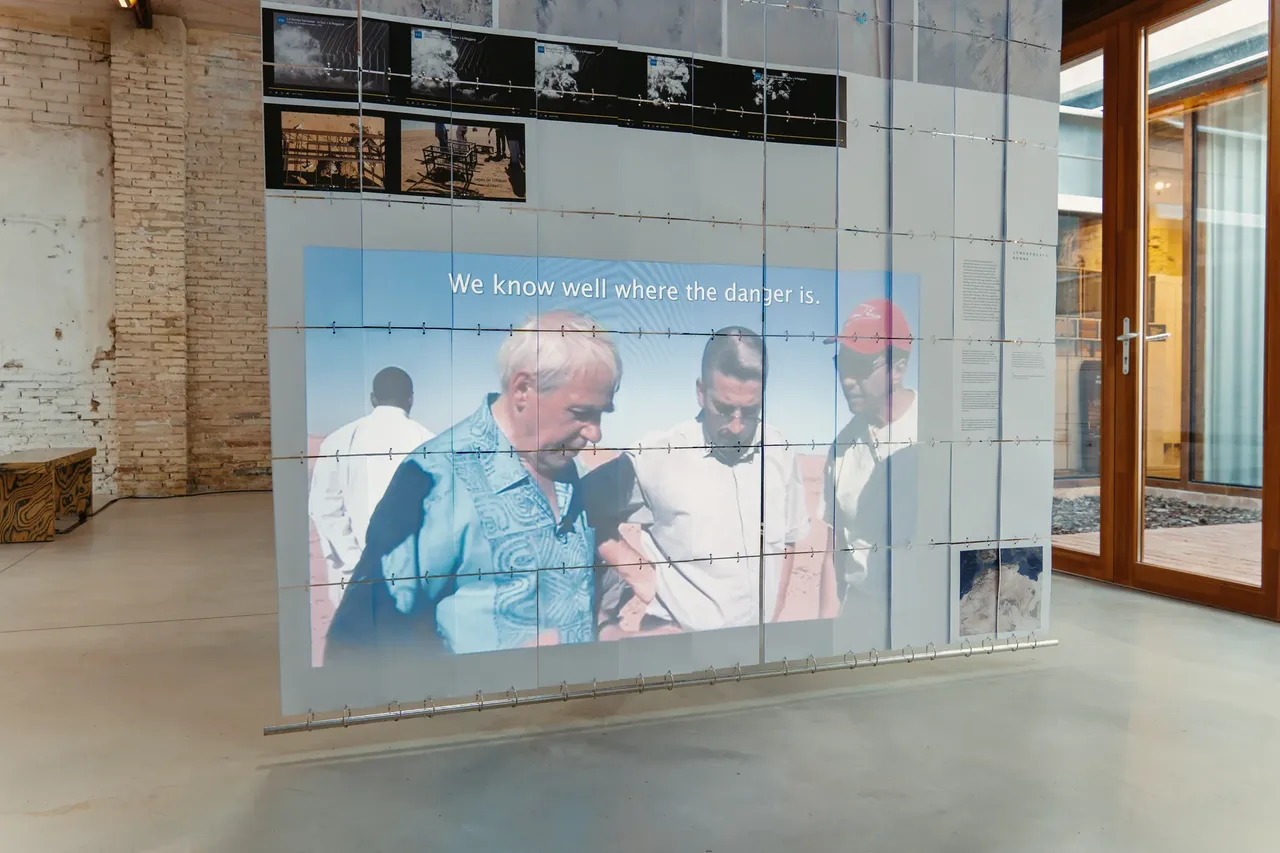
I had to find a way to make it accessible to audiences who are not familiar with this history. With the exhibition, I created these sorts of stations, with panels and very large totems as well. There are thirteen titles, thirteen topics: Reggane, In Ekker (the nuclear bases), the question of justice, of radioactivity, of exposure, etc.
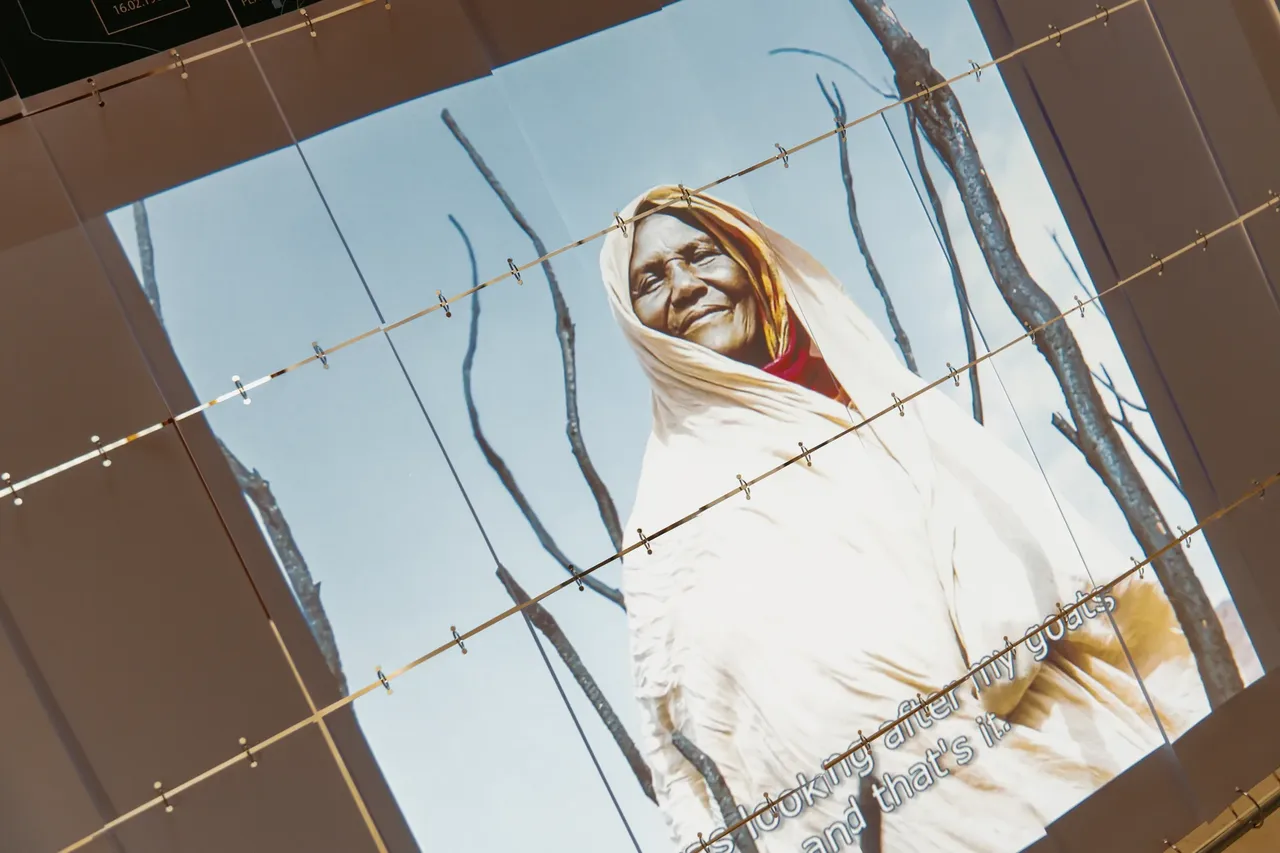
Each of the stations has two sides, so visitors can see the images, the maps, the testimonies, as well as the videos screened onto the stations. They are a series of interrelated but also autonomous stations, each providing visitors with information about a specific topic. There is always a paragraph that explains what they are looking at. They are fragments of these events, stories, and histories presented to the public.
The book is very different. We organised it around the two sites: Reggane and In Ekker. We are talking about the French nuclear programme, which started in 1960 and ended in 1966, but it never really ended because the radioactivity is still there and will continue to be there for many years to come. So, we structured the book around the two sites, with chapters that gather the documents in an attempt to create a repository of evidence.
Was there a particular reason you chose this format, with the stations, to present the information?
I think the main reason was to design a travelling exhibition, a sort of nomadic archive. I was thinking of a way to create panels that can be unfolded, packed into boxes, and sent around the world. We used standard A4 paper, printed with a regular colour printer. So, the institutions hosting the exhibition can either unfold the already assembled A4 sheets or print them there.
That is also why we created these stations, which are not only autonomous and independent but also carefully positioned within the space. We created new spaces within the existing space; for example, we barely use the walls as we favour self-standing stations. They are all vertical, but if you look at them horizontally, you can still see a continuation between them, a sort of horizontal landscape. Visitors are always surrounded by these environments of radioactivity and contamination. That is the main reason why the exhibition was designed this way.
That is also why we created these stations, which are not only autonomous and independent but also carefully positioned within the space. We created new spaces within the existing space; for example, we barely use the walls as we favour self-standing stations. They are all vertical, but if you look at them horizontally, you can still see a continuation between them, a sort of horizontal landscape. Visitors are always surrounded by these environments of radioactivity and contamination. That is the main reason why the exhibition was designed this way.
“The idea is that colonial toxicity performs on the visitors, the people who are in the exhibition.”
How do you want people to experience the work as they physically move through it?
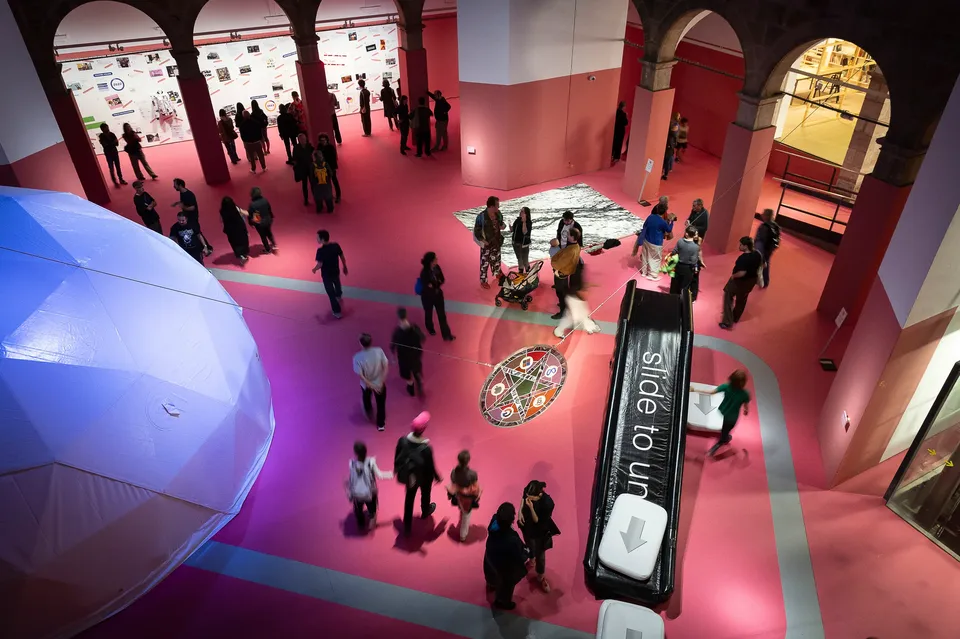
I designed the exhibition for human bodies. It’s called Performing Colonial Toxicity, so when you enter, you are somehow forced to use your senses. You can see, hear, touch, and move around the space. And as you move, the stations almost follow your energy and movement because they are very light. There isn’t a specific way or path to follow; you can start at any station, whichever attracts you the most. It really depends on how the visitors want to interact with the exhibition.
For example, we also printed the testimonies. This is when viewers come very close to the station, because they are interested in reading them. So, there are different ways of interacting with, viewing, and experiencing the performativity of colonial toxicity.
For example, we also printed the testimonies. This is when viewers come very close to the station, because they are interested in reading them. So, there are different ways of interacting with, viewing, and experiencing the performativity of colonial toxicity.
About performativity, I am particularly drawn to your use of the words “performing” in the exhibition and “rehearsing” in your book. Why did you choose these words? What, or who, performs or rehearses colonial toxicity?
For the exhibition, I wanted to have an impact on the viewers. The idea is that colonial toxicity performs on the visitors, the people who are in the exhibition. For instance, people are moved when they read the testimonies and learn about what Algerian and French victims have experienced.
I’ll give you one example. There is a physicist who explains in an interview how radioactivity operates and what radioactivity is. He went to Reggane and In Ekker with his independent organisation, and they took samples from the Sahara. They found radioactivity in the excrement of a living animal, a camel, so this has an impact on the visitor. This is how colonial toxicity performs on us, or onto us.
The question of rehearsing relates more to the book. The idea is to “rehearse” this colonial toxicity through documents, photographs, illustrations, films, maps, and texts, through any kind of evidence that repeats the same things. There are also repetitions that don’t come from the same sources, as well as imperfections. A rehearsal is not the final piece. In theatre, for example, you rehearse to get to the results you want, but here we can’t do that; we are still in that phase of rehearsing.
We really wanted to keep these imperfections. By that, I mean the absence of images, low-definition documents, and things that are not normally included in books. Here, we are still working with this kind of incompleteness.
Architecture plays such an important role in this project, especially when it comes to the buildings and housing for the people who worked at nearby sites. As an architect yourself, why do you think it’s important to understand colonialism through the built environment?
This is a very important point. Nuclear programmes required many infrastructures: buildings, laboratories, housing, entertainment and scientific facilities, and so on. They built so much.
Normally, nuclear states are required to dismantle what they built and clean up the sites, even though it is impossible to fully clean or decontaminate radioactive sites. The French authorities claimed that they dismantled everything, but there are still structures, as this exhibition clearly shows. Some buildings have become ruins, while others are almost carcasses — parts of buildings that have become waste and are polluting the territory.
For me, all this contaminated architecture and the destroyed environment are part of the evidence, an open-air archive. One could go and visit these sites, map them, document them, or even measure the radioactivity they contain with a Geiger counter. We show the Reggane and In Ekker bases, but also all this human-made radioactive matter that was created in connection with the bombs: bunkers, remains of concrete, metal, and so on. There are still many buildings that are present and visible in the Sahara today.
This goes hand in hand with the colonial – and, arguably, still neocolonial – idea that there is nothing and no one in the desert, in this case in the Sahara, which you also explore in your exhibition. Why do you think this idea has been so persistent? How does it shape your way of presenting the research?
This is an important part of the work. Before Colonial Toxicity, I edited a volume called Deserts Are Not Empty (2022). We also organised an online lecture series called Into the Desert: Questions of Coloniality and Toxicity at Cornell University in 2020, and we tried to do exactly this: to show how many imperial or colonial powers around the world — the US, the UK, France, Russia, China, Israel — all share this colonial platitude that there is nothing in the desert, that these places are empty. Of course, this is completely false. The book really showed and insisted that deserts are not empty. They are full of human and nonhuman lives.
I tried, at least in the fields of architecture and art, to prepare the ground with this edited volume. I also invited artists, filmmakers, and curators to reflect on and dismantle this platitude, how these powers promote the narrative of emptiness in order to fill these territories with extraction, contamination, destruction, and so on. In my introduction, titled Against the Regime of Emptiness, I connected these ideas and exposed these reflections.
I tried, at least in the fields of architecture and art, to prepare the ground with this edited volume. I also invited artists, filmmakers, and curators to reflect on and dismantle this platitude, how these powers promote the narrative of emptiness in order to fill these territories with extraction, contamination, destruction, and so on. In my introduction, titled Against the Regime of Emptiness, I connected these ideas and exposed these reflections.
“It’s important to learn how to prioritise those who are victims, who are still suffering the consequences of the nuclear bombs today.”
Talking about art, I find it really beautiful that you include conversations and more lyrical pieces, such as the poems, because art is also a way of expressing people’s perspectives. Was this intentional from the start, or did it come naturally through the process?
It was intentional. In fact, it was the very first form of publicness. Instead of starting with the exhibition, the visuals, I thought it was important to start with the textual, the experiences of people who lived in the Sahara: Algerians and people from neighbouring countries, but also French veterans who were there during the programme, returned to France, and suffered from different diseases.
It’s important to learn how to prioritise those who are victims, who are still suffering the consequences of the nuclear bombs today. We invited 20 colleagues from different parts of the world, and we selected 40 witnesses. We wanted to make this a collective effort, so each colleague translated two testimonies. So, yes, it was intentional.
It’s important to learn how to prioritise those who are victims, who are still suffering the consequences of the nuclear bombs today. We invited 20 colleagues from different parts of the world, and we selected 40 witnesses. We wanted to make this a collective effort, so each colleague translated two testimonies. So, yes, it was intentional.
Do you view your work as a way to raise awareness of the ongoing contamination and put pressure on the French authorities to open the archives?
Yes. At the end of the book, I say that this is really a call not only to make the archives accessible to all, but specifically to decontaminate the sites, compensate the victims, and provide them with medical support as well. Many of their children were born with deformities. The impact is very serious.
So, for me, it’s a first step towards greater awareness, but more work on this topic is undoubtedly needed. The exhibition started in 2023, and the English version of the book came out in 2024. This year, it was also published in French. We will also have an exhibition in Paris this November, in French, for the first time. We are also organising public programmes with victims and anti-nuclear associations.
I hope that things will move forward. What I can say is that many researchers, filmmakers, and writers are taking up this topic to make sure it becomes known in their respective fields.
Chernobyl, for example, is remembered, and there is even a commemoration of this “accident”. But there was also one in the Sahara, the Béryl bomb, which was also a sort of “accident”. It was many times more powerful and more dangerous than Chernobyl, and it is even closer to Europe, but who remembers it? Who commemorates it? We should be aware of our history. I say “our” because everyone is involved in it. Radioactivity respects no borders.