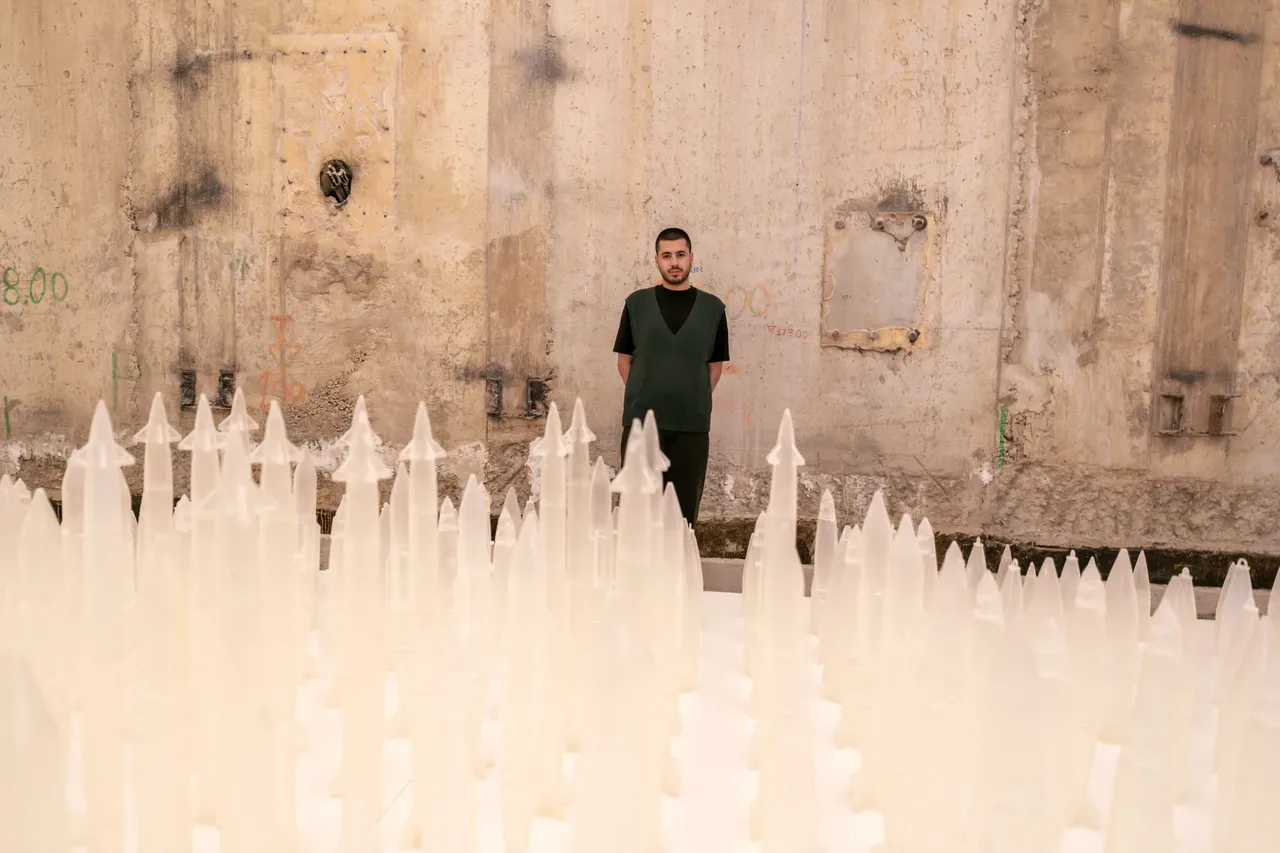
Following its presentation at the Québec City Biennial, Handle with Care, an installation by Lebanese-Canadian artist Elias Nafaa, examines the mechanisms through which violence is designed, classified and circulated. Now on view at MUZEU in Braga, Portugal, until October 18, Nafaa turns the tables on the instruments of war, rendering them fragile objects that confront the viewer with the hostility they embody.
Since October 2023, Lebanon has been experiencing successive escalations of violence, with a daily landscape marked by the constant buzzing of drones, blasts and shattered glass. Living in Canada at the time, Elias Nafaa experienced this violence from a distance, a perspective that later became part of the work itself.
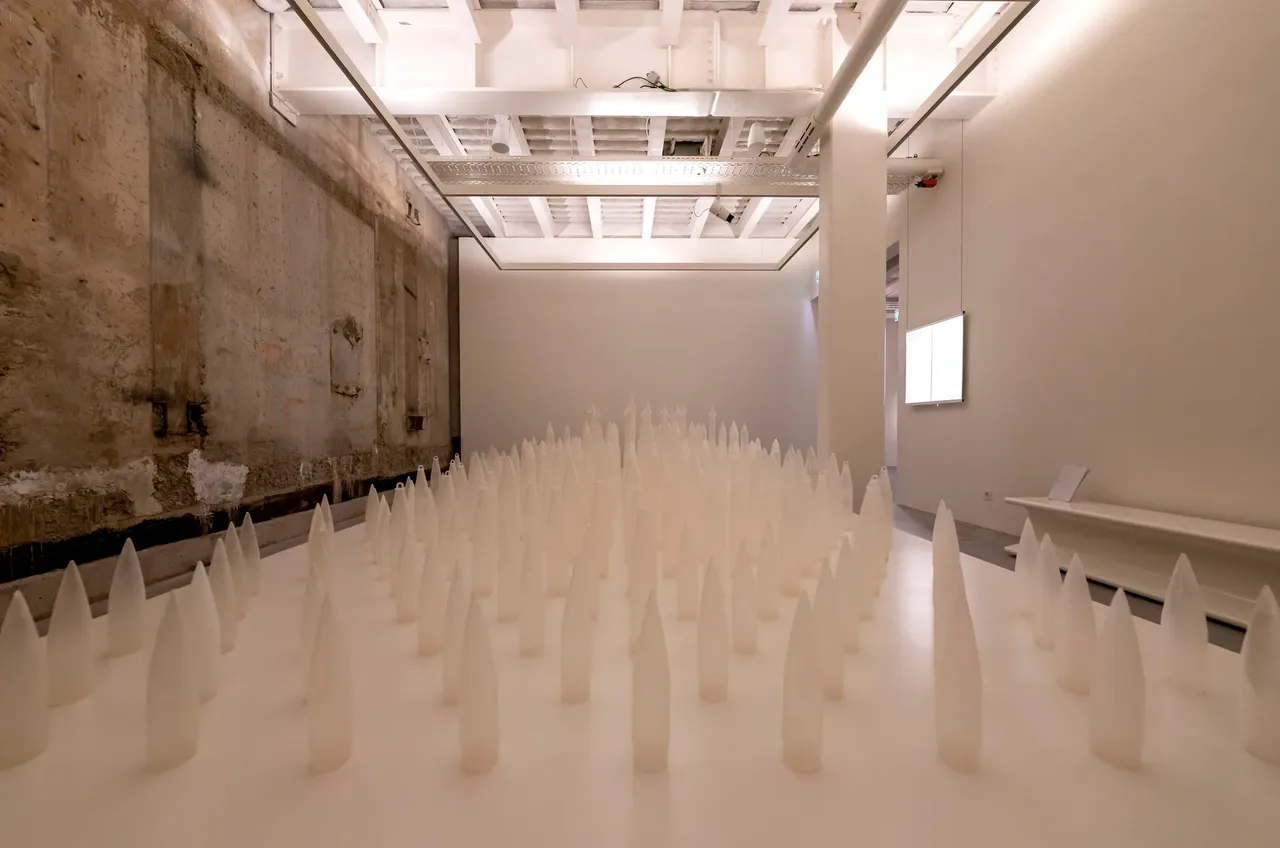
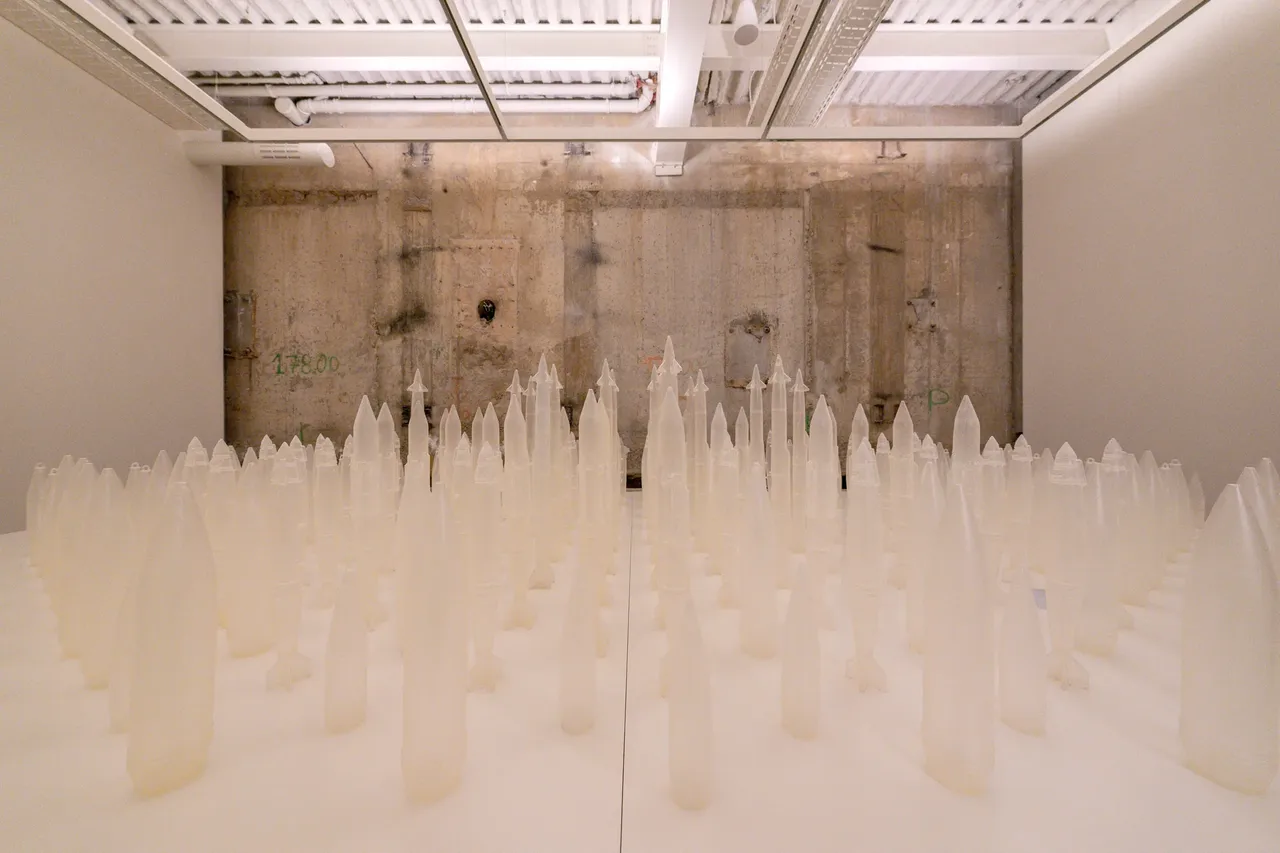
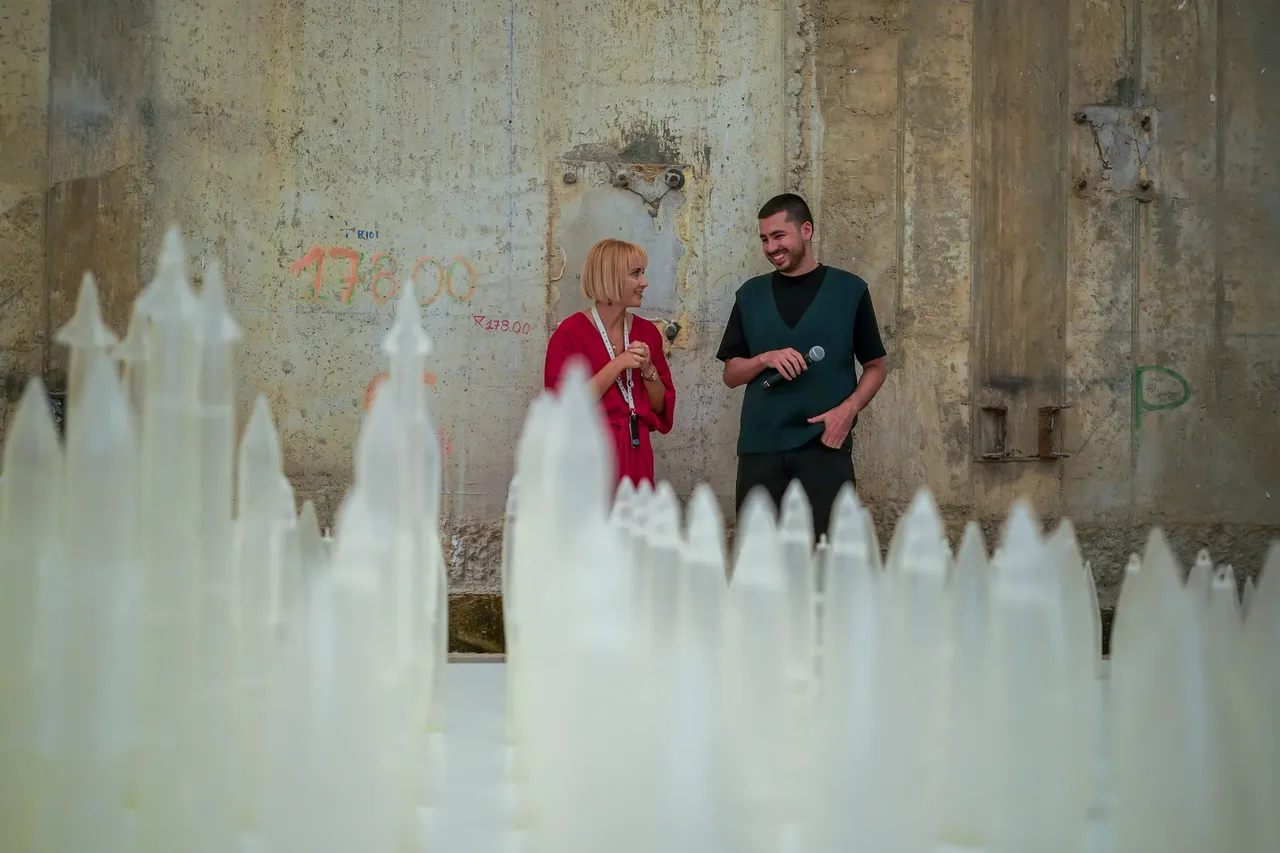
In his construction, the weapons are shrunk, put into a place where “we would be the ones looking down at them”, a reversal of power. The installation consists of three hundred cast-resin forms based on six munition families documented in relation to strikes affecting Lebanon since 2023. Their distribution within the installation was informed by the research, while the objects themselves are scaled down at different ratios. They are accompanied by a sound composition that approaches violence without reproducing it directly. Together, the weapons become a mass, a landscape of war. For Nafaa, the work creates another way of encountering violence, moving between research, material transformation and physical experience to create a form of contemplation that goes beyond the numbers and images through which war is usually mediated.
Irony takes over the title Handle with Care when, at the time of the interview, the main components of the installation had not yet arrived in Braga. Customs spent considerable time determining the potential danger of the resin models, something that, as Nafaa points out, does not happen when the objects being shipped and delivered are the actual weapons.
Could you tell me a little bit about how Handle with Care began? Did you have a clear idea of the work from the beginning, or did it reveal itself as you were making it?
I left Lebanon in 2023 for many reasons, but also because of the situation there. In 2024, the violence continued to intensify, with the destruction of the south and Beirut. By the end of 2024 it was very intense. But I was in Canada. I was not there with my friends and family, and my experience of this violence was mainly from abroad, through the circulation of images. That made me want to make a symbolic gesture. My impulse was: what if I could inflict on these weapons the same violence they are inflicting on us? So, instead of them looking down at us, we would be the ones looking down at them. Instead of allowing them to destroy buildings and break glass, which was mainly what I was seeing, I wanted to make them out of the fragile, glass-like materials they were destroying. That’s why I used resin. It looks somewhere between glass and ice. I was seeing it from Québec, surrounded by these winter landscapes, and they reminded me of the violence as well. There was this whole dynamic that happened.
At the same time, I started researching the geometry. So, in the space, there are three hundred forms based on six munition families. The broader research draws on datasets documenting thousands of strikes and conflict events in Lebanon, rather than a total count of individual weapons. We are talking about a span of two to three years, and the violence is still ongoing.
At the same time, I started researching the geometry. So, in the space, there are three hundred forms based on six munition families. The broader research draws on datasets documenting thousands of strikes and conflict events in Lebanon, rather than a total count of individual weapons. We are talking about a span of two to three years, and the violence is still ongoing.
What about the weapons? How did you choose which ones to include?
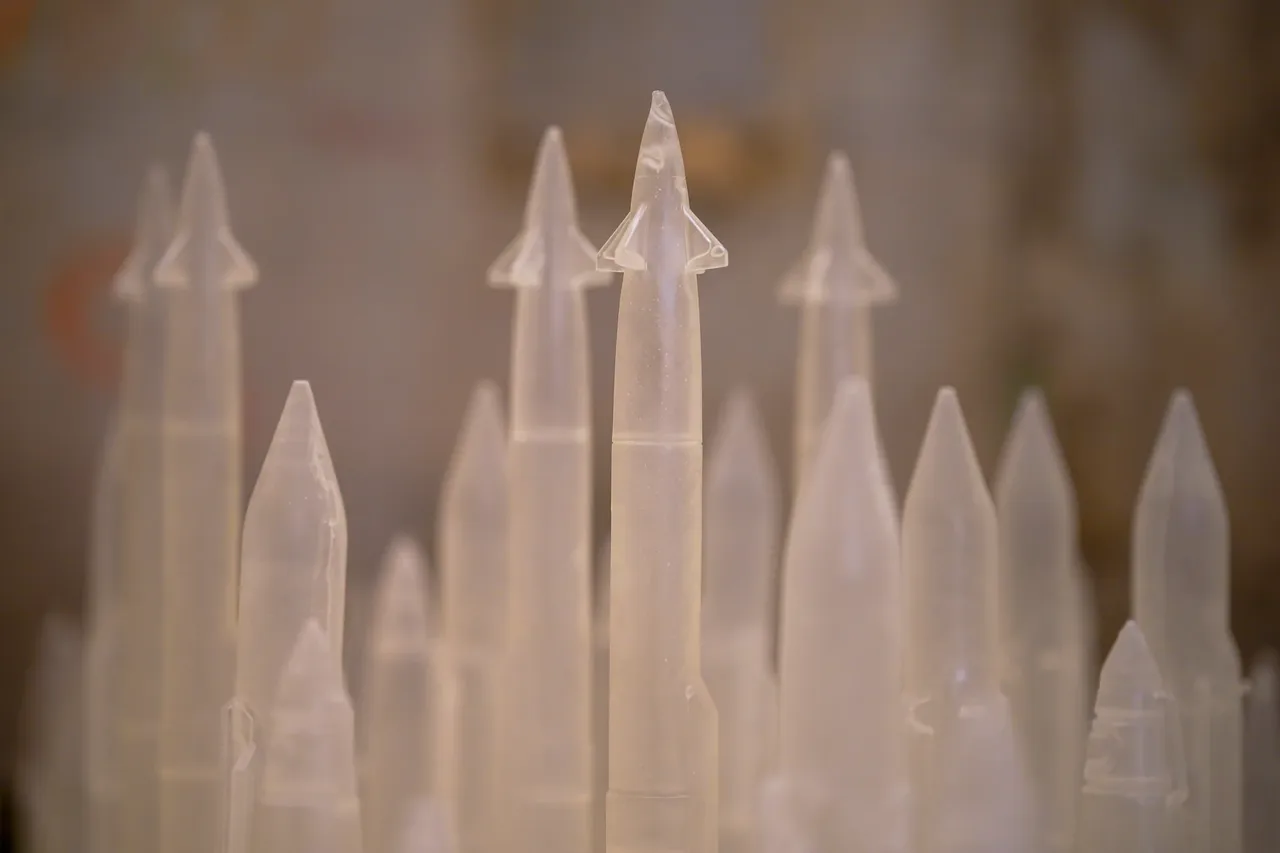
I selected six munition families through research into publicly documented traces, including fragment photographs, investigations and mapping platforms. The distribution of the three hundred forms is the internal composition of the installation and is not intended as a statistical distribution of strikes. Some munition families appear in greater numbers than others within the installation, but that distribution functions as a reading tool rather than a statistical representation of their frequency of use. The smallest one is forty centimetres in the space, but eighty centimetres in real life. The largest is ninety centimetres in the space, but five metres in real life. They are all scaled down.
Each one is designed to produce a different kind of effect. The M107 is a 155 mm high-explosive artillery projectile designed to produce blast and fragmentation on impact. Cluster munitions disperse multiple explosive submunitions over a wider area, and some of those submunitions can fail to detonate and remain dangerous long after a strike. Their use is prohibited for States Parties to the Convention on Cluster Munitions. Then there is white phosphorus. The M825A1 is a 155 mm white-phosphorus smoke projectile designed to generate a smoke screen, with incendiary effects and the potential to cause severe burns. Human Rights Watch states that, under international humanitarian law, the use of airburst white phosphorus is unlawfully indiscriminate in populated areas, and has documented its use by Israeli forces in populated areas of southern Lebanon since October 2023, with risks of civilian harm. Fragments can also remain in the ground and reignite when exposed to oxygen, extending the impact into fields, orchards and agricultural practices. JDAM is a GPS/INS guidance kit that converts an unguided bomb into a guided munition. One of the forms in the installation references a 2,000 lb BLU-109 penetrator bomb in a GBU-31 JDAM configuration, which is designed to penetrate hardened structures before detonation and produce effects inside the structure or below the surface. Another of the six families is the Rampage, a standoff air-to-surface missile.
The work is looking at the whole economy of violence, but also the design of violence itself. The space presents three hundred of them, but not just as a sample. I was mainly interested in reaching a threshold that creates a certain intensity in the space, after which you start to question this idea of repetition, and at what point violence has become so normalised and accepted.
Each one is designed to produce a different kind of effect. The M107 is a 155 mm high-explosive artillery projectile designed to produce blast and fragmentation on impact. Cluster munitions disperse multiple explosive submunitions over a wider area, and some of those submunitions can fail to detonate and remain dangerous long after a strike. Their use is prohibited for States Parties to the Convention on Cluster Munitions. Then there is white phosphorus. The M825A1 is a 155 mm white-phosphorus smoke projectile designed to generate a smoke screen, with incendiary effects and the potential to cause severe burns. Human Rights Watch states that, under international humanitarian law, the use of airburst white phosphorus is unlawfully indiscriminate in populated areas, and has documented its use by Israeli forces in populated areas of southern Lebanon since October 2023, with risks of civilian harm. Fragments can also remain in the ground and reignite when exposed to oxygen, extending the impact into fields, orchards and agricultural practices. JDAM is a GPS/INS guidance kit that converts an unguided bomb into a guided munition. One of the forms in the installation references a 2,000 lb BLU-109 penetrator bomb in a GBU-31 JDAM configuration, which is designed to penetrate hardened structures before detonation and produce effects inside the structure or below the surface. Another of the six families is the Rampage, a standoff air-to-surface missile.
The work is looking at the whole economy of violence, but also the design of violence itself. The space presents three hundred of them, but not just as a sample. I was mainly interested in reaching a threshold that creates a certain intensity in the space, after which you start to question this idea of repetition, and at what point violence has become so normalised and accepted.
How did the sound come into the work?
It’s the seventh element. The materiality of the sound is important because you kind of see a form in the space that fades away. You’re not able to identify the weapons. This was very important for me because I didn’t want to glorify them. That’s also why the lighting is indirect, rather than directly exposing them. They kind of disappear and play with your perception. You can see their footprint and their repetition, but you don’t necessarily see the actual weapon.
For the sound, I worked with Cynthia Zaven, a Lebanon-based composer and artist. We were talking about sound as another dimension of violence: evacuation warnings, the constant presence of drones, sonic booms, and the ways these sounds become part of everyday life. These were part of the broader conceptual conversation around the work rather than literal source recordings used in the composition.
But at the same time, as I did with the sculptures, I didn’t want to import the violence into the space or literally reproduce those sounds. Instead, we thought about the ground as a surface absorbing and carrying the impact of violence. Cynthia composed Tender Grounds, a two-channel composition based on field recordings and electronics.
For the sound, I worked with Cynthia Zaven, a Lebanon-based composer and artist. We were talking about sound as another dimension of violence: evacuation warnings, the constant presence of drones, sonic booms, and the ways these sounds become part of everyday life. These were part of the broader conceptual conversation around the work rather than literal source recordings used in the composition.
But at the same time, as I did with the sculptures, I didn’t want to import the violence into the space or literally reproduce those sounds. Instead, we thought about the ground as a surface absorbing and carrying the impact of violence. Cynthia composed Tender Grounds, a two-channel composition based on field recordings and electronics.
The research behind the work is incredibly precise. What was that process like for you?
I think it started with what I had in my photo library. When you look at the news, you see a lot of these videos, so I slowly began identifying the types of weapons I would see most frequently, and then I researched them through news or reports. I included a selection of the research materials in the booklet to make the sources and identification process accessible. It brings together the references used to identify the munition families, along with information about which types were documented and where. There were also wider mapping techniques that were publicly available. For example, Beirut Urban Lab at the American University of Beirut produced visualisations, one of which is included in the booklet, that monitor military activity across Lebanon’s southern border using ACLED data. They show a clear asymmetry in the frequency and distribution of strikes, with strikes into Lebanon by the Israeli Armed Forces far outweighing those recorded in the opposite direction. The platform maps reported military activity over time using ACLED data. The data they used came from ACLED, the Armed Conflict Location & Event Data. ACLED is a conflict-monitoring organisation that collects and maps data on political violence and conflict events around the world. There is also a Human Rights Watch report on the use of white phosphorus in Lebanon. So, there was a lot of research and investigation, but at the same time, much of this information was already available. I’m making it available in a way that goes beyond the numbers, which can desensitise people to the reality behind them. In this space you have a confrontation with these objects. There are three hundred of them, but they are scaled down, so there is also a form of interaction that goes beyond the documents and the data.
The title Handle with Care seems to carry a certain irony. What, for you, needs to be handled with care here: the objects, the lives they represent, or our relationship to violence?
That’s interesting. So, it’s a play on the circulation of these objects. Weapons are shipped with a lot of care, like any other commodity, and they circulate freely. There’s an entire economy, from their conception and design to their production, circulation, and use. There’s an irony in handling with care something that causes so much violence. There’s also an irony in the work not being here because, apparently, it is considered more dangerous than the actual weapons.
The work is really about the tools that enable this form of violence, and about their circulation and conception. These are objects that are handled with a great deal of care, and I think that also comes with the vocabulary of defence and protection, or the language of military violence, which can end up doing the exact opposite. That is something I’m also interested in within my practice: the idea of how care can replicate harm, and how sometimes it can tip into corruption or violence.
The work is really about the tools that enable this form of violence, and about their circulation and conception. These are objects that are handled with a great deal of care, and I think that also comes with the vocabulary of defence and protection, or the language of military violence, which can end up doing the exact opposite. That is something I’m also interested in within my practice: the idea of how care can replicate harm, and how sometimes it can tip into corruption or violence.
The work feels ultimately about human lives, but there are no human figures. Why was that absence important to you?
I was more interested in the mechanisms that enable these forms of violence, violence that happens to people, but also to buildings, the land, and all the different components of life. When you look at the weapons themselves, you can begin to understand what each is designed to do and what kind of effects it produces. They create a more global form of a landscape. That’s how I wanted to approach the subject.
“The work is looking at the whole economy of violence, but also the design of violence itself.”
The installation is visually striking at first, until you realise what the objects represent. Was that tension deliberate?
It’s a form of confrontation because weapons and the aesthetics surrounding them can become very fetishised. It was also something I was conscious of. I didn’t want people to think, these are beautiful weapons, which is why you can’t really see them in the space. They kind of become this whole mass. But I think it’s interesting to be confronted with something that is related to violence, and to think about the double standards in the way it is talked about. I think that is replicated in the experience of the work, even though I tried to resist that aestheticisation as much as possible.
Is that moment of realisation something you had in mind when you made the work?
Yeah. What I’ve noticed is that people are very scared to come close to it. When they enter the space, a lot of them walk very far. They try to see the objects, but then find it difficult because the forms start to disappear. The weapons are hollow on the inside, so it wasn’t just a process of conversion or dematerialisation. I was also stripping them of the mechanisms that make them functional, which also creates this kind of translucent effect. So even when you try to confront them, you have a hard time perceiving them.
The thing is, this work is not just about the current war. It’s about all the previous ones and all the future ones to come. It kind of exists across all these temporalities. It keeps taking on new forms because violence is ongoing.
The thing is, this work is not just about the current war. It’s about all the previous ones and all the future ones to come. It kind of exists across all these temporalities. It keeps taking on new forms because violence is ongoing.
How do you experience war from a distance? Do you feel guilt or responsibility for being away?
It comes with living abroad. You feel the guilt of not being able to be with your friends and family and support everyone. But at the same time, to what extent can you control the violence? There is a sense of powerlessness that comes with being away. It’s very debilitating. The work comes from that experience, from transforming it into a project that can dissect all of this reality. And I think the project speaks to that experience.
As you said before, we are constantly exposed to violence, to the point where we’ve become desensitised. Was resisting that kind of numbness part of what you wanted the work to do?
It’s a way of giving the information a different form and creating a physical encounter with it. Images and information can circulate extensively without necessarily producing sustained attention. I wanted to create another kind of encounter by making the material physically present in a space.
The installation was first presented in Québec. How was it received there?
It was very positive. But when the Québec City Biennial opened on February 28, the United States and Israel began strikes on Iran that same day. Within days, Israeli strikes across Lebanon intensified again. The reception to this type of work has been very positive because it speaks to the present and to everything that is unfolding. It’s also a work that gives people access to a lot of research and source material, because sometimes we have information that is very complex, very documented, but that people might not otherwise have access to.
How did the idea of bringing the work to Braga come about? How do you feel about showing it in this political context?
There was a certain irony in bringing a work concerned with the circulation of weapons to Braga and having the work itself held in customs. I don’t think of it simply as a political work, but rather as a gesture that reveals information differently and asks you to confront it.