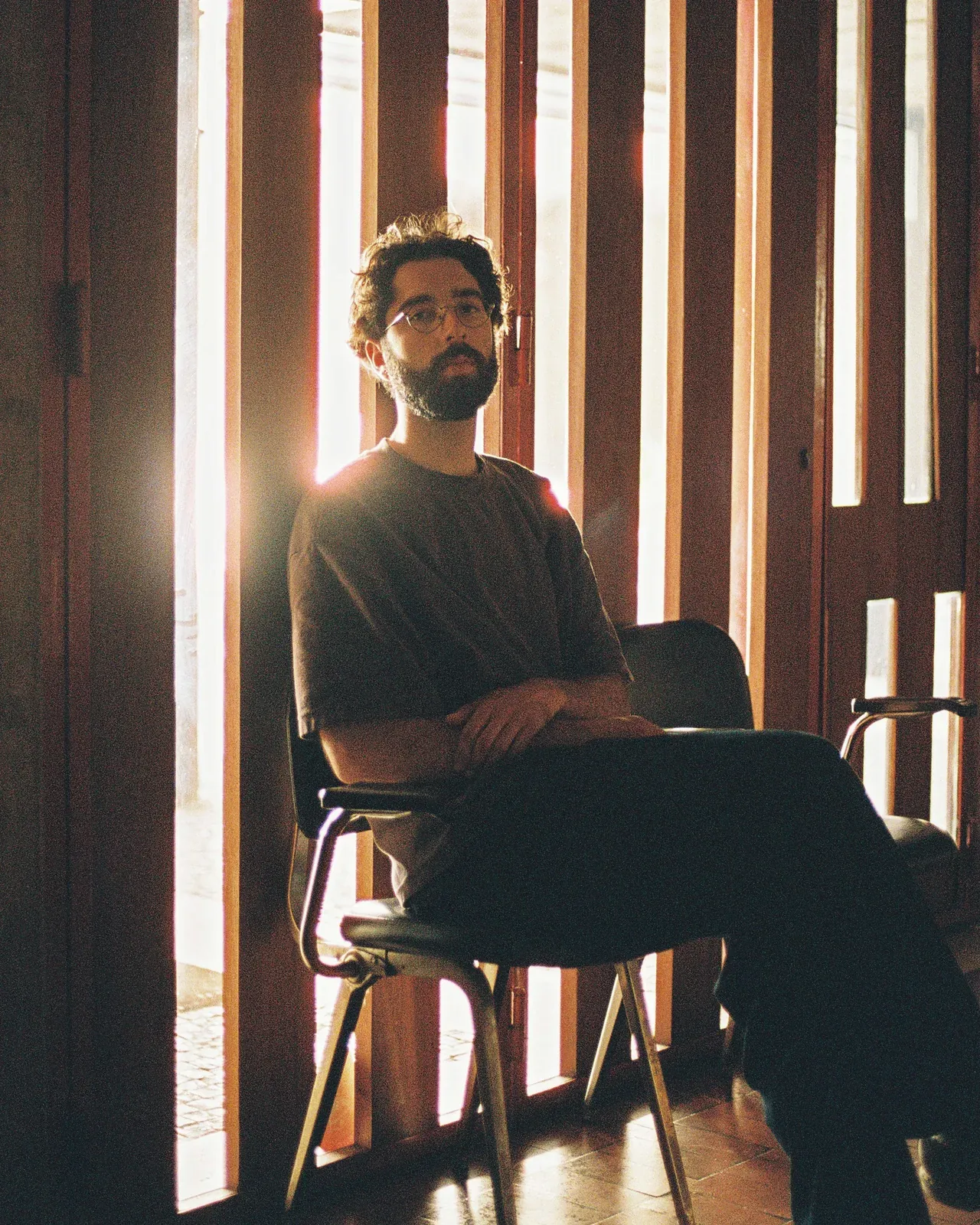
What happens when muscle memory becomes code? Portuguese musician António Feiteira has spent the last few years finding his own answer. With Língua Espúria, the second Amuleto Apotropaico release on PERF, he translates his improvisational language as a drummer into an entirely electronic system, allowing rhythms rooted in the body to mutate into something increasingly unpredictable. Its first glimpse arrives with Abafador, out this week ahead of the album's release on 13 November.
Inspired in part by Milford Graves and his understanding of the body's hidden rhythms, Feiteira embraces technology without surrendering instinct, leaving enough space for accidents to change the direction of his music. "Malfunctions can be huge creative catalysts," he tells us. "Losing control usually leads you to find some kind of new 'expanded technique'." We speak with him about this new language, the references behind it and why sometimes the most interesting thing a system can do is surprise its own creator.
António, Abafador is out this week, giving us the first glimpse of Língua Espúria, which arrives in just over two months. How does it feel to finally start sharing this new chapter of Amuleto Apotropaico?
It feels great! The new album is the first register of a new language I've been working on for the last couple of years. Tiago, who released the debut record through his label, PERF, showed interest in maintaining the collaboration, and knowing his tendency towards more 'ambitious' music, it made sense to compile some of these new works as Amuleto Apotropaico's new instalment. It's been finished for a while, and I already have some of the following chapters lined up, so it's especially exciting to have this new iteration properly introduced to an audience.
Why did Abafador feel like the right place to start?
Abafador felt like the most complete introduction to the whole; it aggregates all the key aspects of the record. You get these splintering percussive mechanisms, harsh shimmering pads and an elegiac character that gives the album a unifying thread. Plus, the synth line that introduces the track feels like a proper annunciation.
If you had to build a moodboard for Amuleto Apotropaico, what would we find on it? I'm thinking beyond music too: artists, images, places, books, films, objects or anything else that feeds into its universe.
There are a couple of references that quickly come to mind. Reza Negarestani's Cyclonopedia was crucial while building the systems used in the record—taking an object and, through speculative means, bestowing some degree of intelligence or agency upon it—in a way, just like apotropaic amulets. His ideas catalysed a mythology that I built surrounding the different actors within the patches, a kind of sentience that especially thrives in the generative nature of some of the tools used. His concept of the ()hole complex was also important to the general narrative, as it made me value plot holes as creative resources, giving room for interpretation to lurk within these maximalist, inconclusive organisms.
Hillel Schwartz's Making Noise also played a big part in world-building. Every sound in the record is in some way mimetic, most often referencing extra-musical elements—for instance, the main percussive lines replicate speech patterns—and Schwartz's holistic yet non-linear metaphorical structures somehow validated the creation of an alternative fictional map for the compositions.
Hillel Schwartz's Making Noise also played a big part in world-building. Every sound in the record is in some way mimetic, most often referencing extra-musical elements—for instance, the main percussive lines replicate speech patterns—and Schwartz's holistic yet non-linear metaphorical structures somehow validated the creation of an alternative fictional map for the compositions.
And musically, who are the artists you keep coming back to? Has anyone fundamentally changed the way you understand rhythm or sound?
I draw a lot from Morton Feldman's music. It might sound antithetical given the maximalist nature of Língua Espúria, but his work's attention to spatiality is something I try to replicate, although sometimes in a twisted way. There's a particular obsession with resonance in the upcoming record: I tried to create a kind of 'placelessness' by emphasising disparate impulse responses and panoramics, organising sounds in impossible chambers. Feldman's ability to evoke a feeling of stasis is something I try to emulate as well. You can actually hear me trying to reach for that kind of atmospheric inertia in the first part of Abafador, through these slowly swelling harmonics beneath the percussion.
“When working with feedback systems or tools of a generative nature, the most exciting part of the process is being surprised by what you've put together. Malfunctions can be huge creative catalysts.”
Amuleto Apotropaico began as a project between you and Francisco Pedro Oliveira, built around a very physical dialogue between percussion, guitar, flute and electronics. With Língua Espúria, you're moving into a very different electronic framework. What made you want to take the project in that direction?
The project has been quickly shapeshifting since its beginning. In its first form, we'd actually use the same drum kit: Francisco would use transducers and feed them back against my kit's drumheads in these short noise sets. There was a rush to incorporate every new tool or technique into the performances, and it naturally evolved to a stabilising point where electronics took over. While arranging what would become the self-titled Amuleto Apotropaico record, which was essentially a heavily manipulated selection of live recordings, I delved deeper into software, triggering a fixation with tools like Max/MSP.
Soon enough, I started gravitating towards the digital to host whatever ideas I had, firstly out of convenience and later as a preferred work environment. Its endless, cumulative nature and problem-solving aspects felt appropriate for what I was seeking in this new chapter.
Soon enough, I started gravitating towards the digital to host whatever ideas I had, firstly out of convenience and later as a preferred work environment. Its endless, cumulative nature and problem-solving aspects felt appropriate for what I was seeking in this new chapter.
Milford Graves has been an important reference in developing this new material. What was it about his work and his understanding of the body's rhythms that resonated with you?
Milford Graves's music has always been a big reference, but it was Jake Meginsky's Full Mantis that properly introduced me to his improvisation philosophy. In the documentary, he explains how the body's secret rhythms guide his playing and how irregularity implies health, embracing chaos through a fascinatingly cohesive thought structure. His conversion of the body's rhythms into function generators was also a motivation for these latest hyperreality-related endeavours.
You've built a system that takes your own improvisational language as a drummer and translates it into electronic patterns. How do you translate something so rooted in instinct and muscle memory without losing the human element?
The way I understand it, improvisation is essentially a creative rearrangement of pre-acquired vocabulary. There are phrases, techniques and rudiments that you consciously or unconsciously commit to memory and restructure while performing. My system is, at its core, a sequencing algorithm mapped to MIDI controllers through which I can intuitively recall specific patterns that make up my improvisational language, adding a chain of resonators that allows me to change the timbre of every hit. Manually triggering these events outside of quantisation grants the persistence of a human dimension.
How important is losing control to your creative process?
Very important. Especially when working with feedback systems or tools of a generative nature, the most exciting part of the process is being surprised by what you've put together. Malfunctions can be huge creative catalysts. Losing control usually leads you to find some kind of new 'expanded technique'.
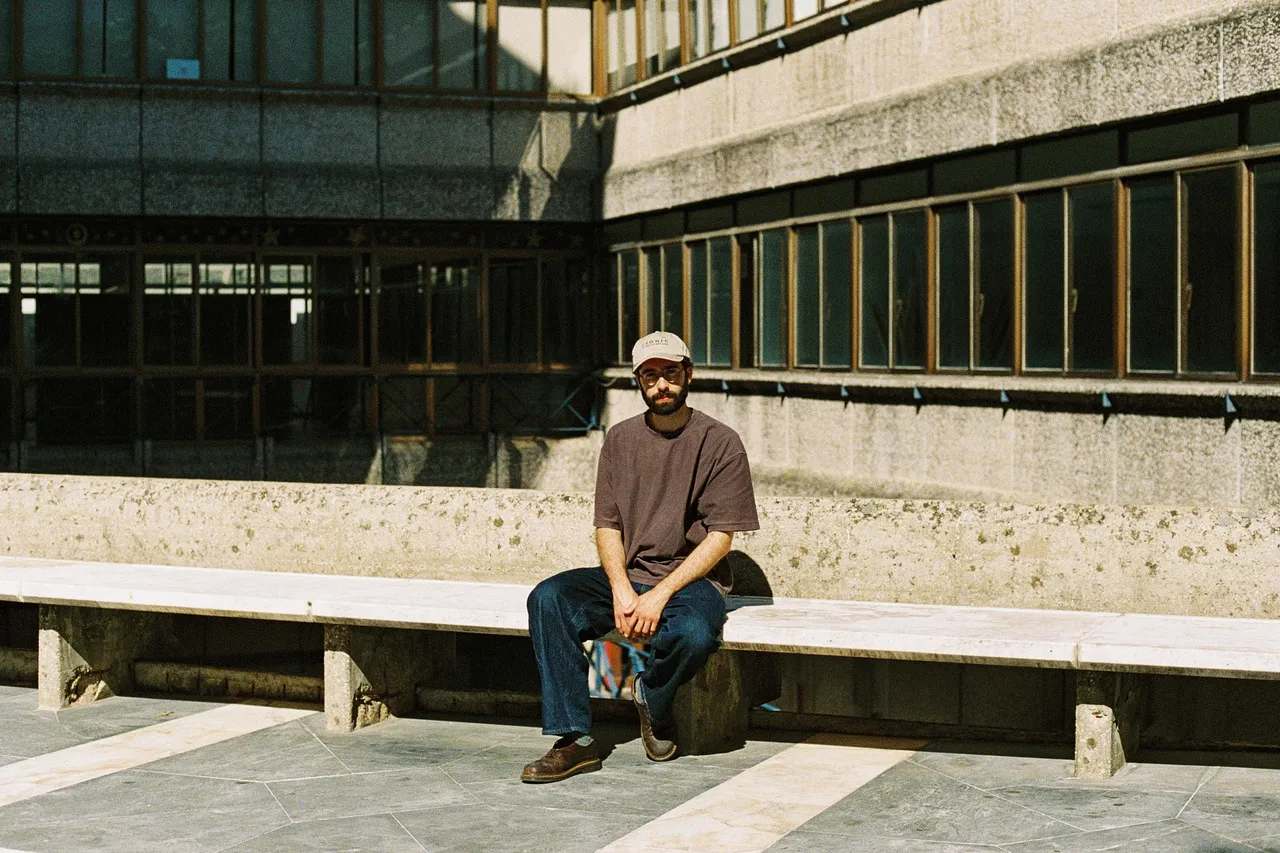
Last year you released a four-track EP featuring Apotropia I and Apotropia II, while Apotropia III will appear on Língua Espúria. What connects these pieces, and what does Apotropia represent within the wider project?
There's a plaintive character to all of those pieces that leads me to catalogue them as different iterations of the same idea. They share a long build-up as the introduction, leading to some kind of epic resolution. I have a clear tendency towards this kind of narrative structure. It's something I actively avoid, but there are instances where a particular piece will slip through the selection process. All pieces connect to each other through a personal fictional framework, but to explain it would only detract from the listener's experience.
You grew up in Santa Maria da Feira, and Amuleto Apotropaico has always maintained a relationship with the folklore and rhythmic traditions of northern Portugal. How does the place you come from continue to shape what you create?
I think this record attempts to break with those associations. There was never a conscious influence while making the album; in fact, there's a deliberate search for the otherworldly and the uncanny. Humanised pulses trigger hyper-inorganic voices; whenever an element evoked anything too concrete, I made sure to conjure a misleading counterpart.
The title Língua Espúria translates to ‘Spurious Tongue’. Without revealing too much before November, what can you tell us about the meaning behind it?
It's a reference to the methodology used, the idea of simulation at the core of the system. Tongue also felt like an appropriate reference to the speech-mimetic percussive phrases around which the compositions were built.
You presented this new incarnation of Amuleto Apotropaico live at Damas in Lisbon on 10 September, with RCA in Porto following on the 18th. With the acoustic instrumentation of the earlier material giving way to electronic circuits and a system built around your own percussive language, what can we expect from Amuleto Apotropaico on stage now?
You can expect to hear a few previews from the upcoming record, but the focus will be on new, improvised material. The thrilling part of working with this kind of instrument is that every concert turns into its own thing.