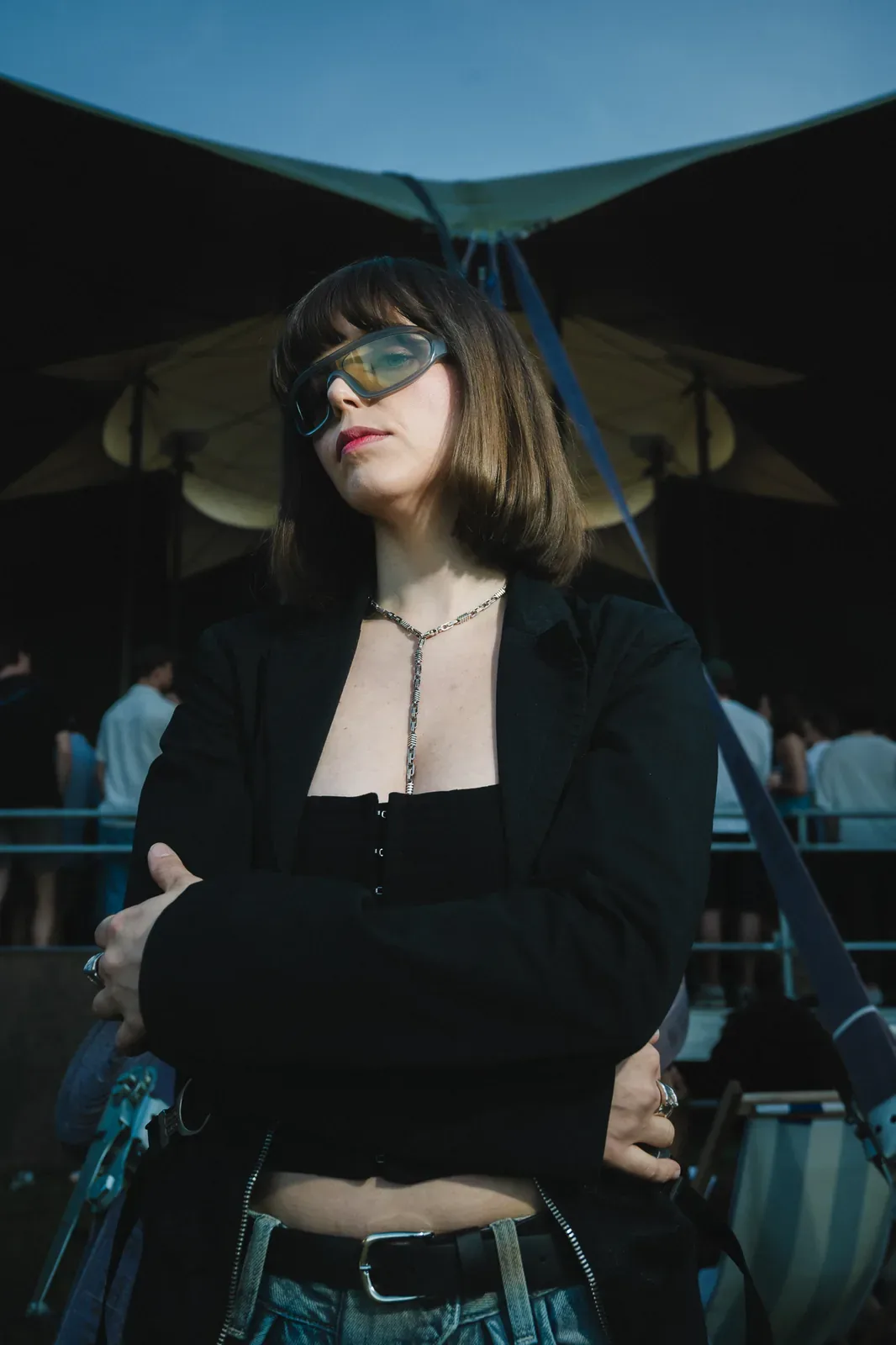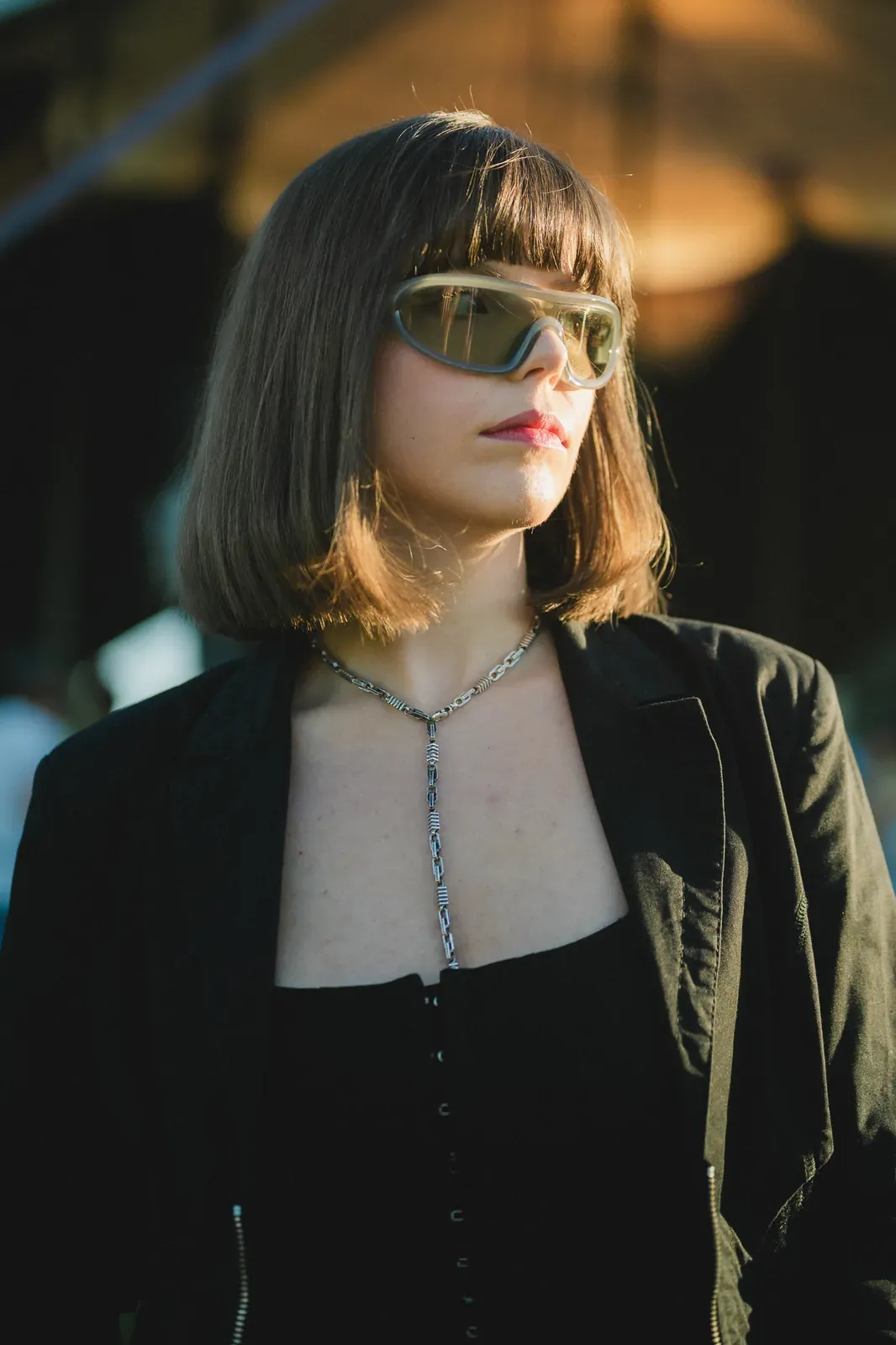
We first spot Sedef Adasï as she struts towards us across Lentekabinet’s lakeside Poppy field. It’s early evening, and the field is dotted with sunburned visitors in oversized plain tees, making Adasï instantly recognisable in a fabulous look: tailored denim, black corset, big aviator sunnies. She looks impossibly fresh for someone who already had three major events this weekend.
Yesterday, she played two gigs in London. The day before, she was in Berlin, hosting Hamam Nights — the queer party she started eight years ago in her hometown, Augsburg, named after Turkish bathhouses for sweating and a sense of belonging. “Everyone is welcome, and we embrace every culture,” she says. Tonight, she’ll close Lentekabinet’s Poppy stage. You might think that these dramatic set changes would be exhausting. But Adasï loves it. “I get excited about these different venues,” she says. Her approach behind the decks is intuitive — a percussive blend of house, techno, acid, bass and the occasional well-timed nostalgic classics. But you can’t really put her music into words, as she’s so attuned to the crowd. According to her, planning her sets “would feel like cheating the audience.”
She possesses this attunement off-stage too. On the short walk from the Poppy stage to her dressing room – a container with the bass vibrating through the walls and into our interview’s recording – she seems to encounter more familiar faces than unfamiliar ones, giving everyone a warm hug. “I should keep my eyes like this,” she half-jokes, tilting her aviators towards the ground. I don’t like using the word ‘cute’ to describe a female DJ who, herself, touches on the challenges of coming up in a world dominated by straight white guys. But Adasï is cute – in a highly-skilled DJ kinda way, for whom the dancefloor is a space of belonging, and whose main goal is to “put a smile on everyone’s face and give them a cute memory.”
On Friday you hosted a Hamam Night at Panorama Bar; yesterday you played Gala festival and the afterparty. Now we’re here at Lentekabinet, where you’re about to close. That’s quite a shift in spaces. How do you land in each?
I land quite spontaneously and easily because I get excited about these different venues. A club night, an afterparty and a festival are three different types of playing music. It’s fun to get ready for the weekend when you have such an intimate space and then a big stage.
How do you get ready for a weekend like this?
Rather than preparing my sets in advance or relying on the same tracks, I prefer to keep things spontaneous. I draw inspiration from a wide range of music and enjoy responding to the energy of the crowd, allowing each set to unfold naturally. I’ll have all the influences from the set time, whether it’s day or night, whether the stage is packed, what the DJ played before and from there it’s always spontaneous. When I come to the booth, I get the feeling. Therefore, I always like to have new stuff to try out in different venues. To create a journey, it has to be exciting.
So the musical journey you take your audience on, that’s also a journey for you?
Of course! There’s always some excitement or being a bit nervous, because I have all these new tracks and I never know if they’re going to work. But to me, the main part of DJing is reading the room – or the stage – and not having everything set up.
I heard a rumour that you once served a Turkish Breakfast at Panorama Bar. But you told me that's not quite how it went?
I think people got it wrong, (laughs) because when I had an early set time, I said I’m serving breakfast. So the breakfast is the music. But besides that, for Hamam nights I always host [pre-]dinners. From the beginning – eight years ago in Augsburg – I was always cooking for my friends. I’d just make a Turkish soup and some Turkish bites so we could all chill before the party together. It’s been a very intimate gathering, like Christmas dinner or a family gathering.
“To me, the main part of DJing is reading the room – or the stage – and not having everything set up.”
It feels like your philosophy is about making people feel at home.
Yeah, of course!
But a lot of people see the dancefloor as an escapist thing. How does that work for you?
I have a Turkish background and grew up in Germany. So I know what it’s like to be outside the box, to not be integrated. Growing up, I was searching for a community, for belonging. The dancefloor is a space where we all belong together. Nobody should be excluded. For me, it’s this warm feeling of a family, which I know from my Turkish family. I know what that love can be like, and I saw this love, magic and family on the dancefloor. It’s also this hospitality thing. Turkish people are very hospitable; we love to host people, to have family around. It’s really nice to have this on the dancefloor.
When you started Hamam in your hometown, Augsburg, was it the first queer party of its kind there?
There was a good one called Rabauke Rabaukin, and we were all friends, but this was once a year or so. The main electronic scene was straight and white, and there weren’t many female DJs. I loved [Rabauke Rabaukin], but as an artist I was also curious to host my own. But also afraid! Not every DJ is a promoter, and not every promoter is a DJ. Sometimes, I miss the sensitivity of realising that both of them are art forms. You can mix two tracks. You can throw a party. But what’s your party about? What’s the substance? What community do you want to reach? What do you want to leave – as a DJ, as a promoter, as an artist? Back to the party. I was like, if those boys can do it, let me try.
You’ve since taken Hamam from Augsburg to other places, including Club Raum here in Amsterdam. When the set and setting shift so much, what changes about your party and what stays the same?
In every city – Amsterdam, New York, Berlin, Augsburg – there are different kinds of people with different queer histories or immigration backgrounds. It’s always interesting to see what kind of people gather because this party is very inclusive. Everyone is welcome, and we embrace every culture, and it’s about making that shine. Everywhere, people show up in their best Hamam way. With every party in a new city, the community grows in a beautiful way.
“The dancefloor is a space where we all belong together. Nobody should be excluded. For me, it’s this warm feeling of a family.”
I have the same question about your approach to DJing. When the setting shifts – from an intimate afterparty like the one you played yesterday to now closing Lentekabinet’s Poppy stage in front of a massive crowd – what changes to your approach as a DJ? And what stays innately Sedef?
I’d describe myself as a chameleon, very fluid. I think that's my personality in general — I can adapt to different environments and energies. Gala Festival and the afterparty that followed showed that perfectly. The festival called for something more expansive and energetic, while the afterparty created space for a deeper and more adventurous journey. I love being able to move between those worlds and respond to what the moment asks for.
As you’ve mentioned, your approach behind the decks is completely intuitive. There’s no set planning or anything.
I do dig a lot of music in advance before my gigs, then I just play.
Do you have a formula that you work with? Or some tricks?
I don’t have any formula (laughs)! The formula is just me, my feelings and emotions, and how I sense the people around me. I think the magic happens when there’s space for the unexpected. Technical precision is of course important, but I’m drawn to the moments that feel instinctive and alive. When you respond to the energy of the room in real time, the set becomes something unique, and that’s often where the strongest emotions come through.
I love these moments on the dancefloor, where you have no idea how you ended up there, musically.
And I do feel like people feel that energy. This is the exchange. For me, preparing would feel like lying to the audience.
So what’s the main feeling you want to leave with your audience?
It might sound cheesy: I want to put a smile on everyone’s face and give them a cute memory.
So it’s almost time for your set.
Oh my god!
Sorry, you still have more than an hour. But for the sake of closing this interview, can you tell us what you have in store – in six words or less?
Sweat, cute chaos, and dancefloor chemistry.