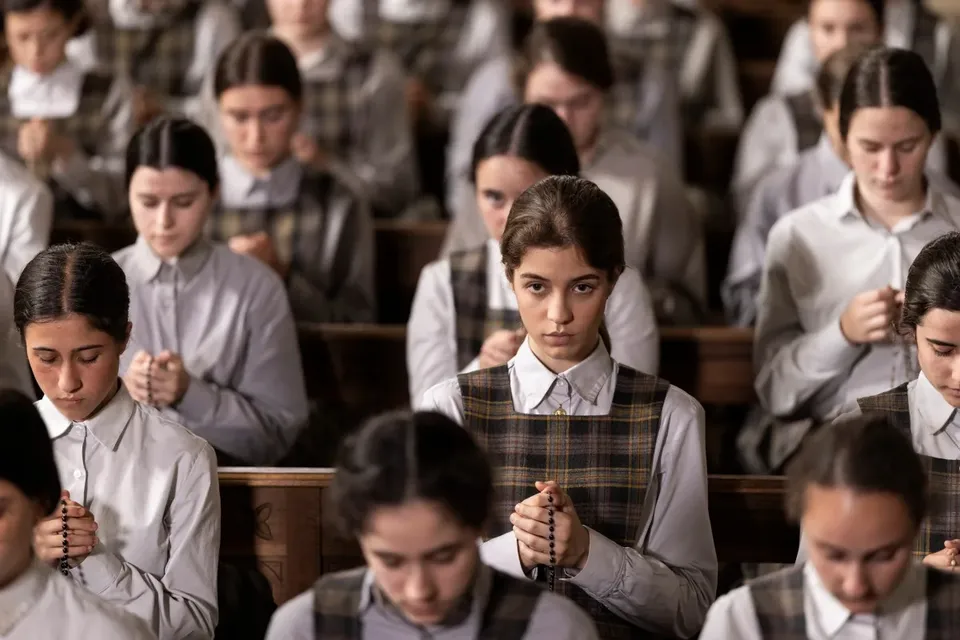
With Everytime, Austrian director Sandra Wollner turns grief into something both intimate and quietly supernatural. Her third feature, now screening at the Stockholm International Film Festival, won the Un Certain Regard Prize at Cannes this year and is Germany’s submission for Best International Feature Film at the 2027 Oscars. For it, she teamed up with Gregory Oke, the cinematographer behind Aftersun (2022). Both her earlier features made their mark too: The Impossible Picture won Göteborg’s Ingmar Bergman International Debut Award, and The Trouble with Being Born premiered at the Berlinale.
The film’s roots are personal. Wollner draws on a fall that left her in intensive care, a chance bar-corridor encounter with a stranger who had lost her sister as a child, and the absurd moment of laughter at her father’s deathbed that became one of the film’s key scenes. Much of her research came from Nick Cave’s The Red Hand Files, the newsletter where Cave writes openly with readers about the loss of his son. She chose it so she wouldn’t have to ask anyone directly about their grief.
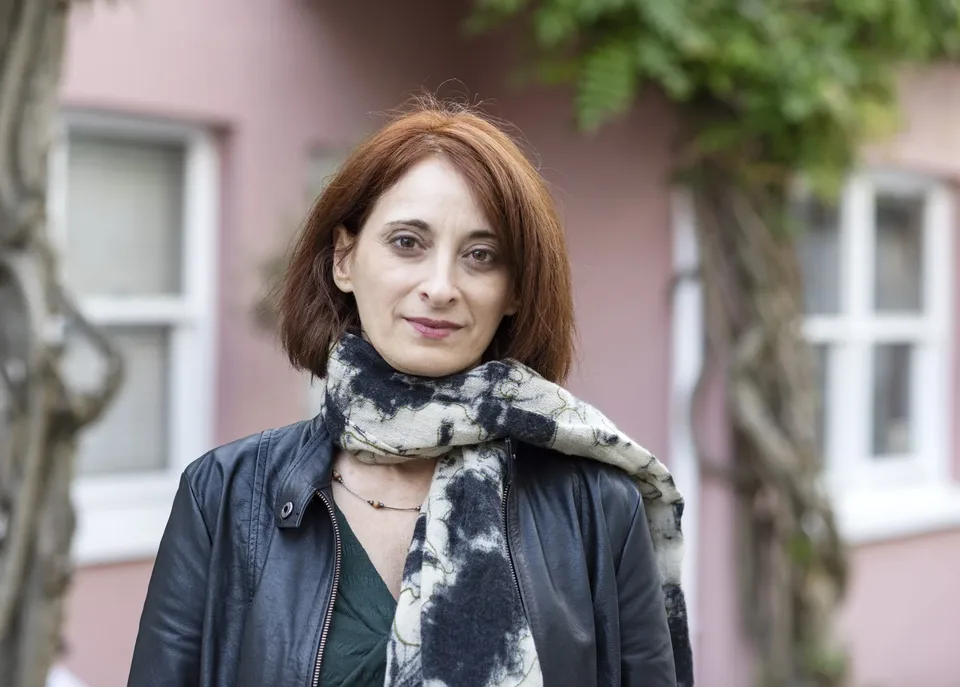
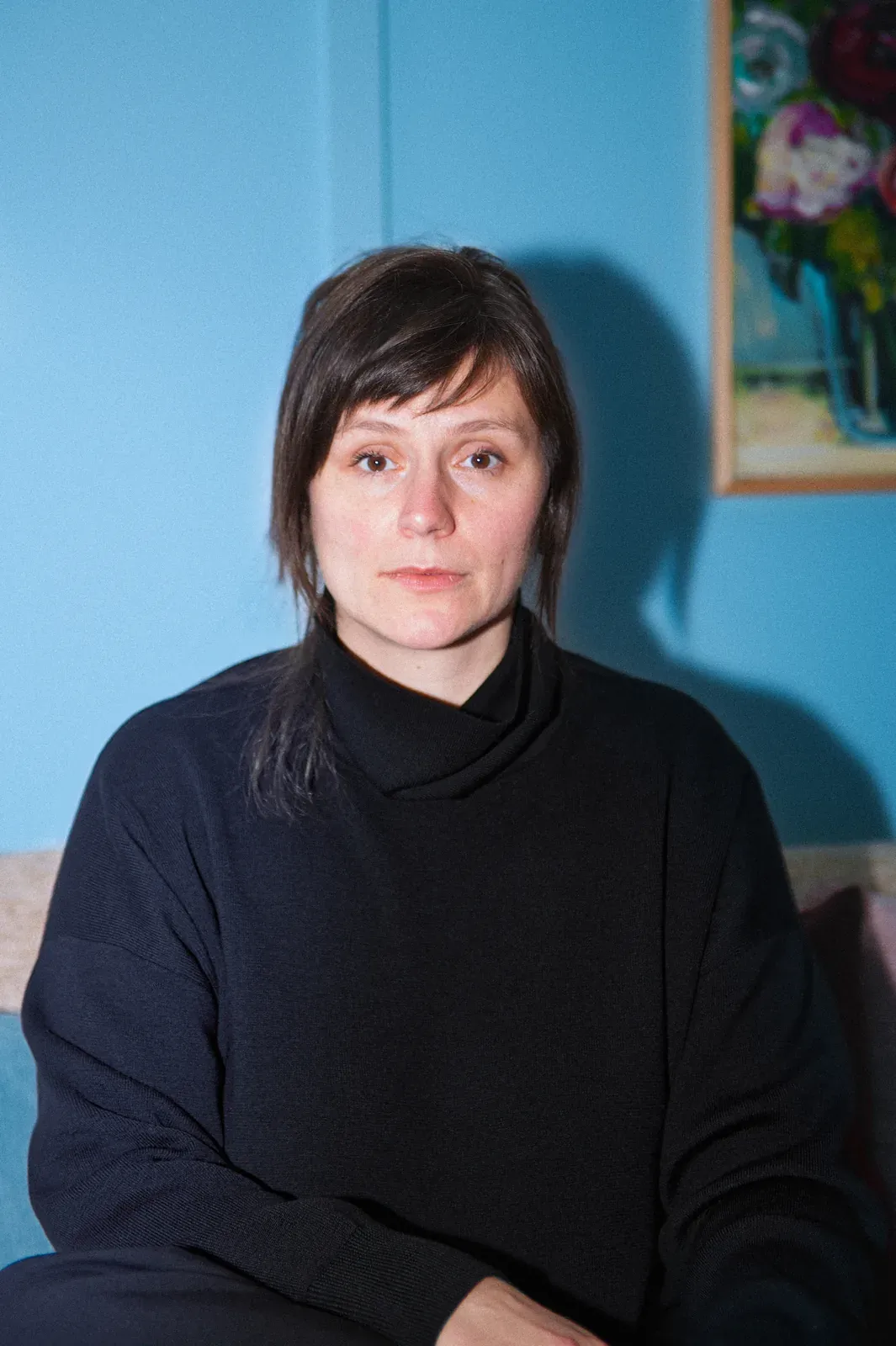
We sat down with Wollner at the Sheraton in Stockholm, fresh off her flight from Vienna, to talk about the momentum of a third film that firmly establishes her in the industry, shooting Berlin as if the universe itself were watching, and the power of grief and memory.
Fair warning: the conversation wanders deep into the film’s final act, spoilers included. If you haven’t seen Everytime yet, consider this your cue to bookmark the page, catch it on the big screen, and come back. We’ll be here, watching from a very long lens.
Congratulations on your Un Certain Regard award at Cannes. What did the award mean to you?
We were already thrilled to be invited. Cannes happens to be the biggest festival in the world, so the platform is huge and you get a lot of recognition, and then we also won the award. I’m so happy for my whole team and everyone involved. I do feel that winning at a festival is something very special because there’s a jury. With film awards in the wider sense, people often haven’t seen all the films they’re voting for. At a festival, a designated jury watches every film, and they discuss it. So you feel very appreciated.
Your previous feature, The Trouble with Being Born, premiered at the Berlinale, and now Everytime has won at Cannes. Beyond the recognition, does that track record make it easier to make the next film?
Definitely. Honestly, it started with my first feature, which I also made at film school. The Trouble with Being Born was my second, my graduation film from the Filmakademie Baden-Württemberg. The first was The Impossible Picture, and we showed it at a small but very well-connected festival in Hof, in Germany. After that we got invited to a lot of festivals, Göteborg for example, where we won the Ingmar Bergman International Debut Award. Since then, there’s been a kind of track record.
And the money does help, the prize money itself, because it gets you to the next film. Sometimes this industry feels very gated: you have to be able to afford to make films. I don’t come from a family that’s in film. I’m from a normal working-class family. But through the prizes, I was lucky enough to make the next movie.
And the money does help, the prize money itself, because it gets you to the next film. Sometimes this industry feels very gated: you have to be able to afford to make films. I don’t come from a family that’s in film. I’m from a normal working-class family. But through the prizes, I was lucky enough to make the next movie.
And in terms of distribution and investors, does it help? Or is it back to square one every time, just with more to show?
I’m very grateful that I live in a system where public funding made those films possible. I’m Austrian, so it’s mostly Austria and Germany together. One film was only Austrian; this one was half and half. The good thing about that is that profit isn’t the first question. When I talk to filmmakers in the US, you really have to have a big cast or you won’t get the money, or you have to guarantee the numbers later. So I really value that we can make films on a level where profit isn’t the thing that matters most.
Now that you have this success, do you think you’ll keep getting that support from Austria, or will you move to a different stage?
I hope so. Of course it makes things easier. Then again, none of us knows what the funding system will look like in the next few years. We’ve seen it on a political level too. And it depends on the script. If you write something completely shit, they won’t give you the money. So let’s say if I don’t fuck it up, it might be possible again.
“I really value that we can make films on a level where profit isn’t the thing that matters most.”
You studied at the Film Academy in Germany, and I read that you’d worked in other kinds of visual work before. Now, with three acclaimed films, can you focus on filmmaking full-time, or do you still go back and forth?
Honestly, I’ve focused on just that since my first film. I worked before I started studying, so I had some money saved. I was already twenty-eight when I started film school, and I’d been making films all along: short films, no money, the way you do. During my studies I had the time, and I’d saved for a kind of sabbatical year. I did some jobs, first AD on other sets, sometimes dramaturgical supervision. But since the first film, since Hof and Göteborg, there was prize money that made it possible to do the next one. You never know if it’s going to work out. And back then I didn’t have kids. Now I do, so life becomes more expensive.
I’d love to focus on Everytime. What made you want to tell this story? What was the trigger?
There wasn’t one trigger. It was an overlay of a lot of stories I’d carried with me for quite some time. The film is about a mother losing her daughter. I once met a sort of Melli, the little girl in the film, but grown up, in Berlin. One of those weird moments: you’re at a bar, in a small corridor between the toilets and the front, and she told me she’d lost her sister when she was a kid. I don’t even know how it came up. I never met her again but I thought about her, and it came at a time when I’d already started writing about this mother. I’d also experienced something in my teenage years, where I saw a trio like these characters.
I sometimes feel that writing is a bit like daydreaming. You have characters in front of you very clearly and you just follow them: ah, this is the mother, there’s the little girl. What are they doing? Are they sitting with this group of teenagers, trying to attach themselves to the place where her daughter used to be? That was the first image.
And on an anecdotal level, I had quite a bad accident around my graduation. I fell from one floor to another and broke my skull. I was in intensive care for two weeks, and since then I’ve been deaf in one ear and have tinnitus, so it did have an effect on me. But the interesting part wasn’t that it felt traumatic. It was that I kept rethinking the falling. I never remembered the impact. I think that’s how the falling image came into this film.
So the stories developed out of that foundation of different experiences.
Yes. It’s not that I sit down and lay everything out. That comes as well. But the first thing that came was the mother, the kid and the boy, and I had to follow them. They were so clear in front of me. I saw them in this group of teenagers, and the relationships between them were what interested me.
Out of curiosity: why the title Everytime?
When I told my partner about the story (my partner is a filmmaker as well, Timm Kröger, and he’s annoyingly talented), he sat down at the piano and played a little melody, which also became the core of the whole score. Our composer developed it, of course. And this word just came up: everytime. It sounds so esoteric but it’s very pragmatic. Someone is playing a beautiful song and you think, that should be the title. Only afterwards you figure out what it stands for, because it came from a feeling I couldn’t articulate in the moment.
I think I can now. In our minds, as human beings, we’re time travellers. We travel to the past and to the future constantly in our imagination. I think we do it particularly in grieving. When we try to remember someone vividly, we bring them from the past into the present. And we don’t just remember their past. Even with a smaller loss, like a parent, you think, “I would have called him then.” So you also remember the future, and everything comes together in an eternal now.
I think I can now. In our minds, as human beings, we’re time travellers. We travel to the past and to the future constantly in our imagination. I think we do it particularly in grieving. When we try to remember someone vividly, we bring them from the past into the present. And we don’t just remember their past. Even with a smaller loss, like a parent, you think, “I would have called him then.” So you also remember the future, and everything comes together in an eternal now.
I love that. I know a lot of people have asked you about the accident scene, but I wanted to take a different angle. We see this wide shot over Berlin from a long distance, and yet we’re also so close. There’s a contrast there. What did you want to say with that?
I might repeat myself if you’ve read other interviews, but it’s still my answer. With every film I make, I question who is actually looking. I never fully answer it, but I don’t think, “Ah, there’s the camera.” I question the medium. At the very beginning, I wonder whether it should even be a film, or a play, or something else. Since I’m a filmmaker, I always end up with the same answer, but there’s something interesting in the friction of that question: why is there a camera in the first place?
And I feel that whoever is observing here mirrors the pain of Ella, the mother. One line I had very early came from a Skeeter Davis song, asking why the sun goes on shining. It’s a love song, but I think we’ve all experienced it, even if not with the biggest loss of all. You lose someone, you go outside, and you think: what the fuck, how can that be? The world keeps spinning, the sun is still shining. It can have a healing quality, or it can feel very cynical. So I wanted the perspective to be as if the universe itself were watching. I think one of our biggest contradictions as human beings is that we have to take ourselves as the most important, just to be able to walk around and look someone in the eye…
And I feel that whoever is observing here mirrors the pain of Ella, the mother. One line I had very early came from a Skeeter Davis song, asking why the sun goes on shining. It’s a love song, but I think we’ve all experienced it, even if not with the biggest loss of all. You lose someone, you go outside, and you think: what the fuck, how can that be? The world keeps spinning, the sun is still shining. It can have a healing quality, or it can feel very cynical. So I wanted the perspective to be as if the universe itself were watching. I think one of our biggest contradictions as human beings is that we have to take ourselves as the most important, just to be able to walk around and look someone in the eye…
“I sometimes feel that writing is a bit like daydreaming. You have characters in front of you very clearly and you just follow them."
And make sense of things?
And make sense of things! On the other hand, we know that the universe doesn’t give a shit. People do if we’re not there, but in the bigger picture no one cares. That attitude is mirrored in a lens so far away that it can’t act on anything, yet it could still hear your innermost thoughts, or a young laugh coming up. Of course, I never thought the audience would sit there thinking, “Oh, a very long lens, probably the universe looking at it.” But I hoped some of that feeling would come through.
There’s something almost divine about it. It took me a while to even find them in this beautiful Berlin cityscape. They’re so far away.
Yes. And later on we see the computer game…
Yes, I’ll get there soon! The film shows grief at different tempos. Instead of an immediate reaction to the tragedy, it surfaces later. The boyfriend, for instance, collapses late in the film and tells the mother he should have been more careful. Why did you choose to let grief arrive late?
First of all, in my teenage years I only experienced the aftermath of something. I witnessed it from a distance, after the big thing had already happened. I think that had an influence. And as a writer, of course I wrote what happened in the minutes right after, what they would do. But it didn’t feel depictable to me. I didn’t feel like the right person to depict that kind of grief in that very moment, about the biggest loss of all. What I could tell was this grief observed from a greater distance. Something similar to what Nick Cave once said.
Oh, that’s something I also wanted to get into.
Ah, great. But I didn’t want to show the biggest feeling because they could never overcome it. They’ll have to live with that grief for the rest of their lives. So I was more interested in the moment when they already try to function.
That makes sense. Similarly, we don’t see the mother cry until the end, right after a funny moment, and that’s what finally triggers it. Can you tell me about that choice?
Honestly, the stupid fart was something that happened in my life. When my dad died, I was there with him. They didn’t move him to another room because there was no space, so there was another man behind him, who didn’t die, and who suddenly started to fart insanely loudly. We had to laugh so hard. It was so beautiful to be able to, because I know my dad would have loved that.
So I was looking for something you wouldn’t reflect on, something you’d react to immediately. You either laugh at a fart or you don’t, and I think the majority of people would, in a weird way, still laugh. It needed to be something so small, so stupid, that it allows you to laugh. And within the laughing, of course, she realises there’s a different feeling, and that lets her break out.
So I was looking for something you wouldn’t reflect on, something you’d react to immediately. You either laugh at a fart or you don’t, and I think the majority of people would, in a weird way, still laugh. It needed to be something so small, so stupid, that it allows you to laugh. And within the laughing, of course, she realises there’s a different feeling, and that lets her break out.
Back to what we were saying about the game. Right after the tragedy, you take the viewer into the 3D game. I was curious about your take on memory, grief and digital worlds, and how they connect for you.
I’m always searching for a way to portray someone’s inner world. I think that’s what we do in filmmaking: we try to portray an inner world and make it more understandable, something we sometimes lack in real life, seeing how someone else sees the world. Jessie played this game, but she also built that world. It’s not Minecraft; it’s a game called Vintage Story that feels a bit like Minecraft, where you can build your own worlds and walk through them. Her sister would never have been allowed into that world while Jessie was alive, of course. But I found it very touching. It’s like going through a diary, or looking at photos, or going through someone’s iCloud: walking through a world someone built. I felt very strongly about that inner world Jessie left behind, in such a weirdly banal place.
“In our minds, as human beings, we’re time travellers. We travel to the past and to the future constantly in our imagination. I think we do it particularly in grieving.”
I really enjoyed the film, and it’s beautifully shot. You worked with Gregory Oke. I read you had some people in common and reached out to him. How did that come about, how did he react to your proposal, and why him?
I saw Aftersun and I was in love. My partner was my DoP before that, and we saw it together and thought, “Oh God, this feels very close to the language I’m searching for.” So I reached out. He read it and was interested, but he told me (I don’t want to sound vain about it) that he’s very picky. Even though he lives in Germany and is well known, he hadn’t had many offers that interested him. He’d had conversations after Aftersun, but nothing that sparked something.
So how did you convince him?
I didn’t have to. We met for coffee and breakfast, and first we talked about how we like to work. He started out directing and writing himself. I work with my partners, who I now also have a company with, in a way where, for example, when my partner shot his film I was an artistic adviser on his set. We always step into someone else’s shoes and try to help create their vision. I think that’s where we felt very connected, because he did the same with Charlotte Wells and others; they worked on each other’s films. It was always a collaboration where people really understood that it’s about one person’s vision. That sounds so logical, but you really have to find people who will fight for the weird ideas together with you. It’s rare to find someone who speaks the same language. That’s why it was such a special connection.
You shot digitally. Everyone wants to shoot on film. How would shooting on film have affected the timeline and budget?
In the very beginning, when I already knew it would be Everytime, with this very long sunset and an orangey-pinkish feel, I thought, oh my God, this is the one that has to be on 35. What I learned is that if you really want to shoot on film, you write it into the script and make it clear from the very beginning. I’m a co-producer on my films, so I have a say in where the money goes. It’s a budget question. Someone who shoots analogue a lot would argue you save time in colour correction because it’s already there, and you can always find a good deal.
But we had a normal budget for a feature, and I was shooting with kids, so you need more days. And I wrote something that’s so easy to write in a script, “the sun doesn’t set anymore,” but very hard to show on film. You need a lot of days just to shoot that one and a half hours. So it came down to choosing between shooting days or film, and I had to choose the days.
But we had a normal budget for a feature, and I was shooting with kids, so you need more days. And I wrote something that’s so easy to write in a script, “the sun doesn’t set anymore,” but very hard to show on film. You need a lot of days just to shoot that one and a half hours. So it came down to choosing between shooting days or film, and I had to choose the days.
I’m also curious about the square sun. How did you do that? Is it CGI or AI?
No AI on the image. It’s CGI, a composited shot, made with a great visual artist. It was an image I had very early on. I composed it myself at the beginning for a poster, which is now one of our posters.
I want to check that I understood the last part of the film. Melli looks through her mother’s purse, finds the pills and takes one. Is that right?
Yes, but why are you questioning it?
“You really have to find people who will fight for the weird ideas together with you. It’s rare to find someone who speaks the same language.”
Because it shaped how I read the rest. She seems high, which is uncomfortable to watch. Then she sees the little red-haired girl, who I read as her sister’s reincarnation, and she’s tripping on the rocks, looking at the sun, mirroring how her sister died, but then nothing happens. Did I understand it right?
You were on the right track. But do you remember that she spits it out?
Oh, yes!
She spits the pill out. I wanted you to feel exactly that uncertainty: she took it in her mouth, then spat it out, but maybe she swallowed something. That question should stay in your mind. She goes around the corner and sees the little girl, but then her mother comes and sees the girl too. I wanted you to feel unstable.
That’s exactly how I felt.
It’s very important to feel unstable before you’re allowed onto ground that belongs to a different reality. We’re coming from a film that’s very grounded for ninety minutes, and to allow that shift, so it’s not just a dream but a weird shift in reality, it needed a kind of magic trick.
We were talking about Nick Cave before. He lost his son in circumstances similar to the story, and in The Red Hand Files people write to him openly about grief. He describes how he and his wife have changed, and even how their son seems to visit them.
Yes, I know about him, and I read The Red Hand Files. That was basically my biggest source of research because I didn’t want to talk to real people about it. I didn’t want to draw from their grief. And of course I had his story in mind, about the boy.