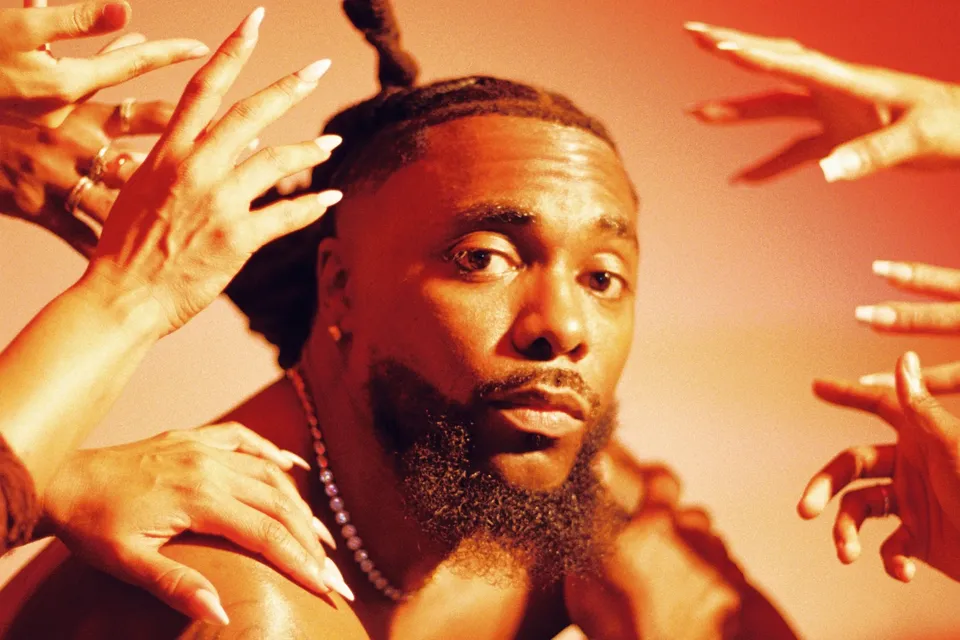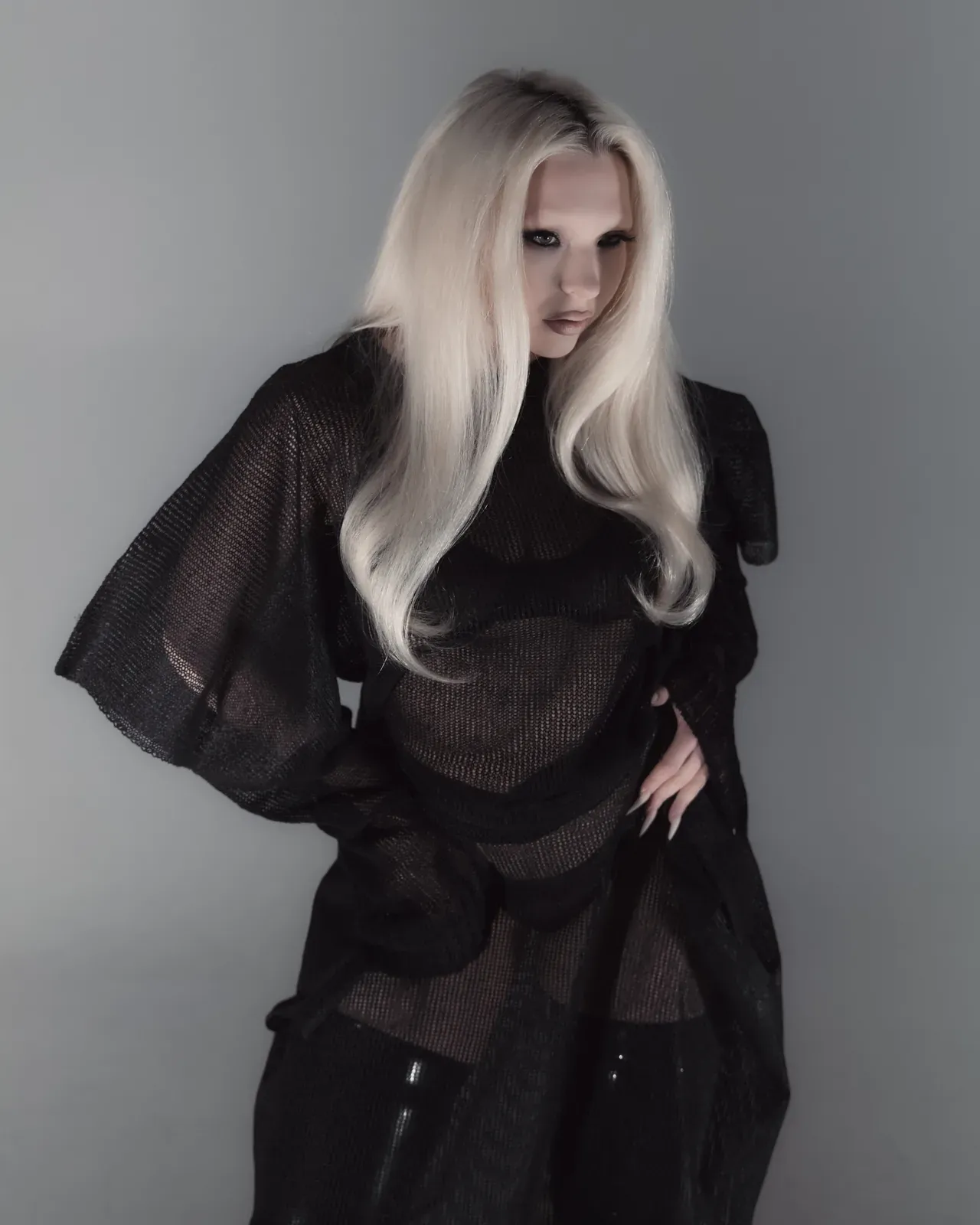
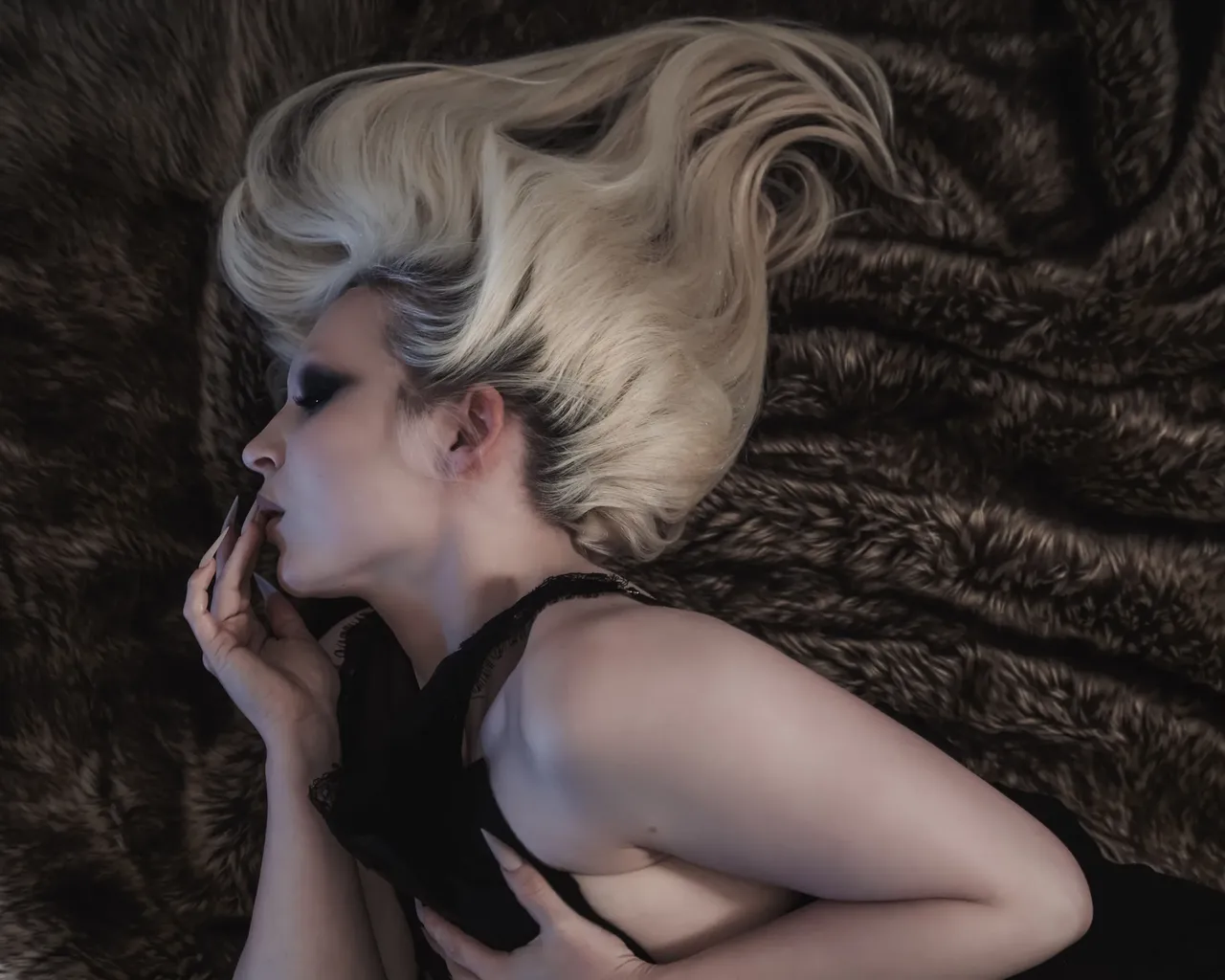
In an age where feminism isn’t enough, Cobrah needs you to worship her. Amidst confusing times full of empty altars, rising conservatism and consumption, the masses look for guidance, leadership and liturgy. Belonging has become its own religion and those who are rebellious, or antiestablishment, have formed communities and follower bases. At the centre of the rebels’ ecstatic shadowy congregation stands Cobrah, one of the most transgressive voices in contemporary music, leading with a vision that is equal parts ferocious and intimate.
This interview is taken from Issue 54 and adapted for our digital platform. Order your print copy here.
The Gothenburg-born-and-raised Cobrah has built a world where femininity and fetish collapse into one another and where power is both performed and reclaimed. Emerging with her 2019 debut EP Icon, she quickly carved out a space defined by rubber-clad aesthetics, avant-garde fashion and tongue-in-cheek club bangers, making waves in Reddit’s hyperpop forums as she tells us. Tracks like Good Puss and Brand New Bitch quickly became cult classics and initiated a yet-to-be-named fanbase of loyal and fervent devotees. What then fuelled this steady ascension was a string of viral hits and two more EPs, Cobrah and Succubus, the latter of which earned her a Swedish Grammis and solidified her status across the underground and global stages alike.
Cobrah enforces a doctrine of devotion. To her body and her mind. She is the school, the news, and the truth. Presenting her long-awaited debut album Torn, she veers her world-building towards a romantic, introspective and emotionally open expression, turning inward without losing her bite. It’s not a departure from her past work, but a recalibration of it. Entirely written and creatively directed by herself, it reveals a more exposed and fully fledged dimension of her artistry, punching herself out of the box her iconic sound has put her in. “I love doing characters”, she admits, “but this time I’m peeling it all off.” It’s this tension between the persona and the artist that defines Cobrah shedding her skin. Songs like Platinum, IG and Unoriginal are exemplary nods to people wanting to be like her, look like her and do like her while other tracks explore her fears, letting go of her sins and projecting her true desires. Despite fearing alienating her audience, her fanbase has grown beyond its original niche, turning into something more detail-oriented and devoted to both craft and spectacle in equal parts. Growing up without the weight of religious guilt or reverence has translated itself into an artistic freedom where nothing is sacred other than intention, power, and self-definition.
While her aesthetic often reads as political due to its sexual, liberatory and confrontational nature, she resists being positioned as a spokesperson. In a world desperate for moral guidance through idols, she holds up a mirror reflecting not only our desires but our fears. Her focus remains inward, on her work itself rather than its interpretation. In that sense, Cobrah doesn’t lead by instruction, but by example, refusing to remain static in a world that demands consistency. When asked what she might confess, after all this, she pauses. Then laughs. The answer is unexpected, disarmingly sincere, and perfectly serves as a reminder that even the most constructed and explosive personas have their cracks.
Hi Cobrah! Nice to see you again. How are you? What’s been exciting or interesting to you recently?
Well, I’m very excited to come to Madrid tomorrow actually.
No way, I’m in Madrid right now too.
I’ll see you tomorrow then.
Perfect. The last time I spoke to you, Torn hadn’t come out yet, but your debut album has now been released into the world. Have you noticed its repercussions and impact on your followers? Have they grown? Is that the goal?
Yes, I think they’ve grown, and it’s been very well received, better than I thought. The nicest thing that people say is that they like all of the songs, which is very important when you make so many that it feels like a complete thing that you want to listen through; so, I’m really happy, I feel very good.
Did you have any fear or reservations about your fan base not fully accepting this new era?
I think so, because I’m exploring new things and there’s always that scare of asking yourself if people will get you like this or will they only get you when you’re this other way, but I feel they like all of the different parts that I brought with this album. I’m really overwhelmed with how well it’s been received.
As a long-time listener, I would say this record is your most vulnerable and introspective body of work, even though they’re terms thrown around loosely now. What made you want to be transparent in this way?
The more I did EPs, the more I became known for doing a very specific thing. I knew I could do so much more. I really wanted to show what else I like, what more I can do, especially now. I’ve been rehearsing for the tour all week and I’m dancing a lot more; I’m expanding my skillset too, so that’s why it was important for me. I felt I was boxed in a way where it didn’t really feel like it was the truth.
What are some early memories of the follower base you have cultivated?
When I started, I didn’t really think about fan bases that much. The way I found my fan base from the start was that I googled my own name and was trying to find somebody writing about my music and then saw everyone writing about it under the hyperpop forum on Reddit. I didn’t know what hyperpop was when I wrote the first EP but I see now why they wrote about it, so the fan base that I got came as a surprise to me. Now it’s grown even wider with the new types of music, and I meet more people that are music nerds rather than pop culture nerds that are really into electronic music and how detailed the production is. I feel the main group of fans expanding. I am really thankful though because my fan community are really appreciative of what I do. They’re not judgy, they’re very happy, very supportive and they’re very into the details of what I do and see the efforts. I remember at the start I was an unpolished queen and I would forget to wear mascara on my Instagram photos and then they would comment “yass, no mascara queen!” or small stuff like that. They still do but in a different way. I love them a lot actually.
Do they have a name?
No! Help me.
That’s a lot of pressure on me.
I know it’s a lot. I feel like the name should come organically if somebody calls themselves something and then it catches on.
I’ll leave that up to the readers. Were you part of any online fan communities when you were growing up or when you were getting into music?
Not really. I was a big fan of a group called The Dresden Dolls and I used to go to their shows all the time. I would travel all the way to London, which when you’re a kid it’s quite far away from Sweden to go to see a show. I would buy all of the merch and buy the sheet music so I could play it at home but I was never really an online kid in that way where I was chatting to other fans and stuff, more like a hardcore direct fan.
I want to take it back to your formative years in Gothenburg. You took up piano, guitar, and flute and were interested in local bands and musical theatre. How has Sweden influenced your sound and aesthetic?
My upbringing has shaped them a lot and having the friends I had. When I was sixteen you couldn’t go out for drinks, but my friends would be in metal bands and we would go and watch concerts every evening because that’s what you do in your free time when you want to go out but can’t go out drinking. I don’t even like metal music that much (laughs). I was always really into alternative things and that’s the very core of the city where I’m from. It’s one of the biggest places for metal music where all the bands come and it’s a city of rebellious people.
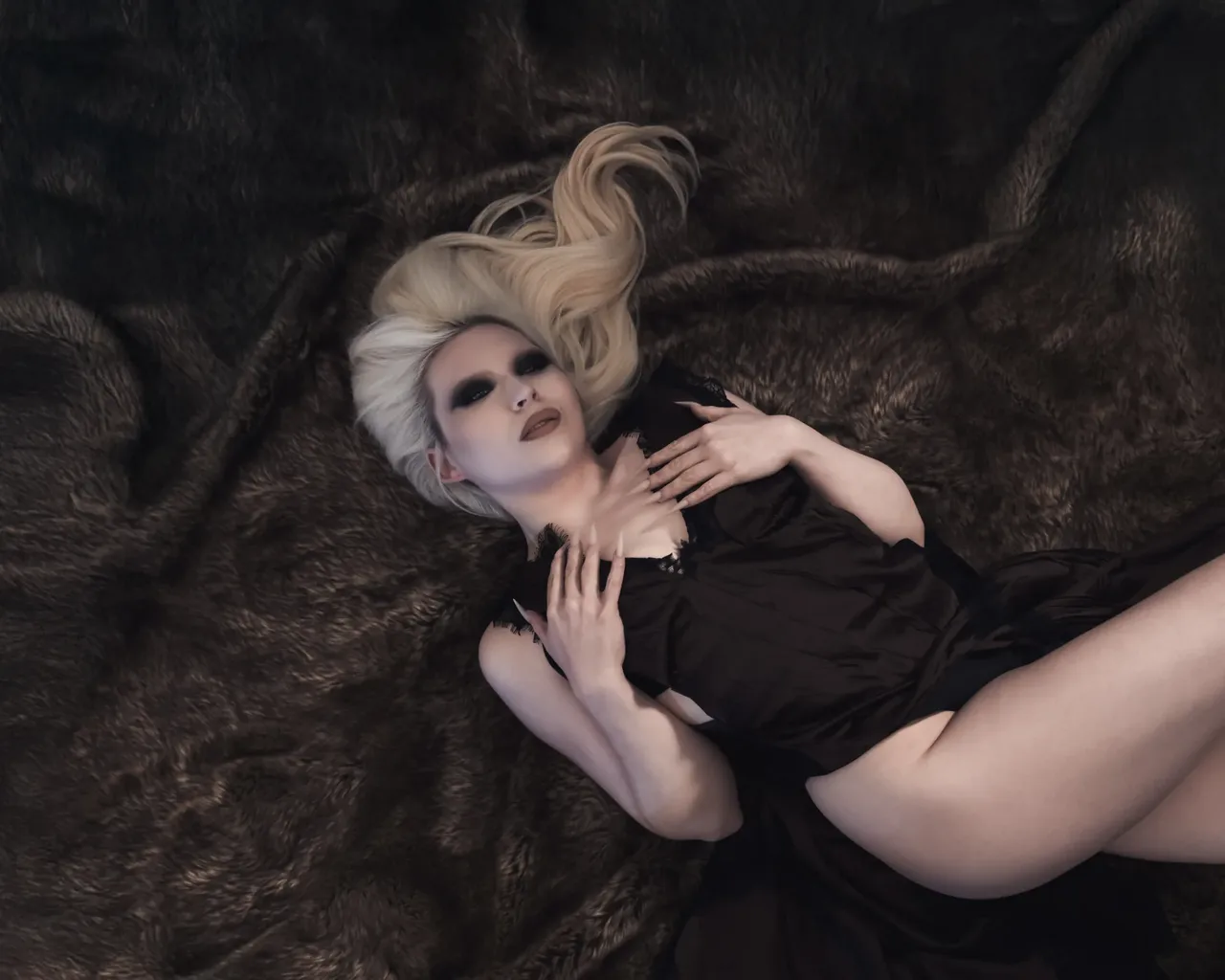
Dress SIA ARNIKA.
Has religion played a role in your years growing up either at home or in your environment?
No, not at all. I’m from two atheist parents so I’ve never been religious or taken part in that in any way actually. Maybe that’s why I’m so unbothered with my own art, I don’t feel anything is sacred. It’s all about power and being in control of yourself rather than having something holy.
I guess you don’t carry the religious guilt that some artists might do then, right?
No, God is not in the room with me.
I’m guessing you haven’t been to a confessional, but what would you say?
That’s such a good question. Let’s do the other questions and I’ll have it in the back of my mind because I want to give you a good answer.
I will come back to that then. Is it hard to be so vulnerable when a lot of the image you have built around your persona and sound has been quite explosive, sexual and confident?
That’s where I was wondering if people would get Torn, because I’ve been known for being impersonal, very out there and chasing a vibe being more about the look than the person, but that’s why it was important to shift it. I felt like I couldn’t be an artist that only did a thing for shock value because if I’m going to have a longer career, people need to follow me and not just this one thing that I do. I will evolve whether I like it or not and I’m going to do more albums and I’m going to explore other things in the future, so I need my fans to get a sense of who I am.
What do you listen to when you feel that vulnerable and romantic way towards someone?
I really like to listen to indie folk music. A Bon Iver and Lykke Li sad acoustic playlist is my go-to.
There is a lot of darkness in your art and artists have frequently turned to religious imagery to express that. You haven’t. Is there a reason why?
I don’t like to involve it because I don’t feel like I have a relationship with it. I’m not anti and I’m not pro. It’s such a sensitive topic that if you use it you need to have a point. You have to use it in a way where it makes sense for you and my music doesn’t relate to religion in any way more than some people who are religious thinking it’s outrageous.
Your sound has been undeniably influential and innovative, you’ve become a leader spearheading it. You said that “culture caught up” with you as “people started to recreate it”. When do you think people began adopting this sound you pioneered? Do you see it as catching up or profiting?
When it felt like it was important to me was when I started to write the album. That’s when I realised these songs that I’ve been making I hear them on the radio, and I hear other artists doing the same type of thing. Not that it’s a copy or that it frustrated me, but what I do is less rare now. I don’t want to take credit for creating something, because there are a lot of artists before me that did similar things like Peaches did Fuck the Pain Away many years ago. So, I’m not sure if I created something extremely unique but, at least, I feel a lot of people started to do what I was doing and then it stopped being interesting to explore.
People hopped onto that Cobrah bandwagon.
In a sense, a little bit.
I read you found community in the sex clubs you frequented in Berlin. How did your time there add to the previous background?
This is a misconception that has spread like a wildfire so we can set the record straight. I was in Berlin because I had an internship there when I was studying music. I was with this producer, and he did not like me at all and would never take me out to do fun things. I lived in Berlin, but I didn’t like it. People thought that I was raving every day but no, I was actually kind of sad there and hated techno and then when I came back to Sweden, I was much more self-assured. That’s where I found it, in Sweden, and it came from Berlin not working out the way I thought it would and then trying my own way. I met this photographer because I was doing a photoshoot exploring the visual world for Cobrah and she put me in lots of latex because she was a latex enthusiast. I found her through my Facebook, and I would try everything on, and it felt amazing. It was such a new feeling where I could be a woman but also in charge and empowered and not in lazy cute lingerie. That’s when I asked her where I could feel like this again because I wanted to make music and be an artist that exists in this sphere, and she told me about this fetish club. I emailed them my demos without them being released and that was my first gig as Cobrah. I’ve only played there about two or three times and then I started doing more like normal music gigs, but it was really the seed of who I became afterwards.
The whole Berlin storyline is a misconception then.
It’s a misconception because people hear Berlin and they think Cobrah must love it.
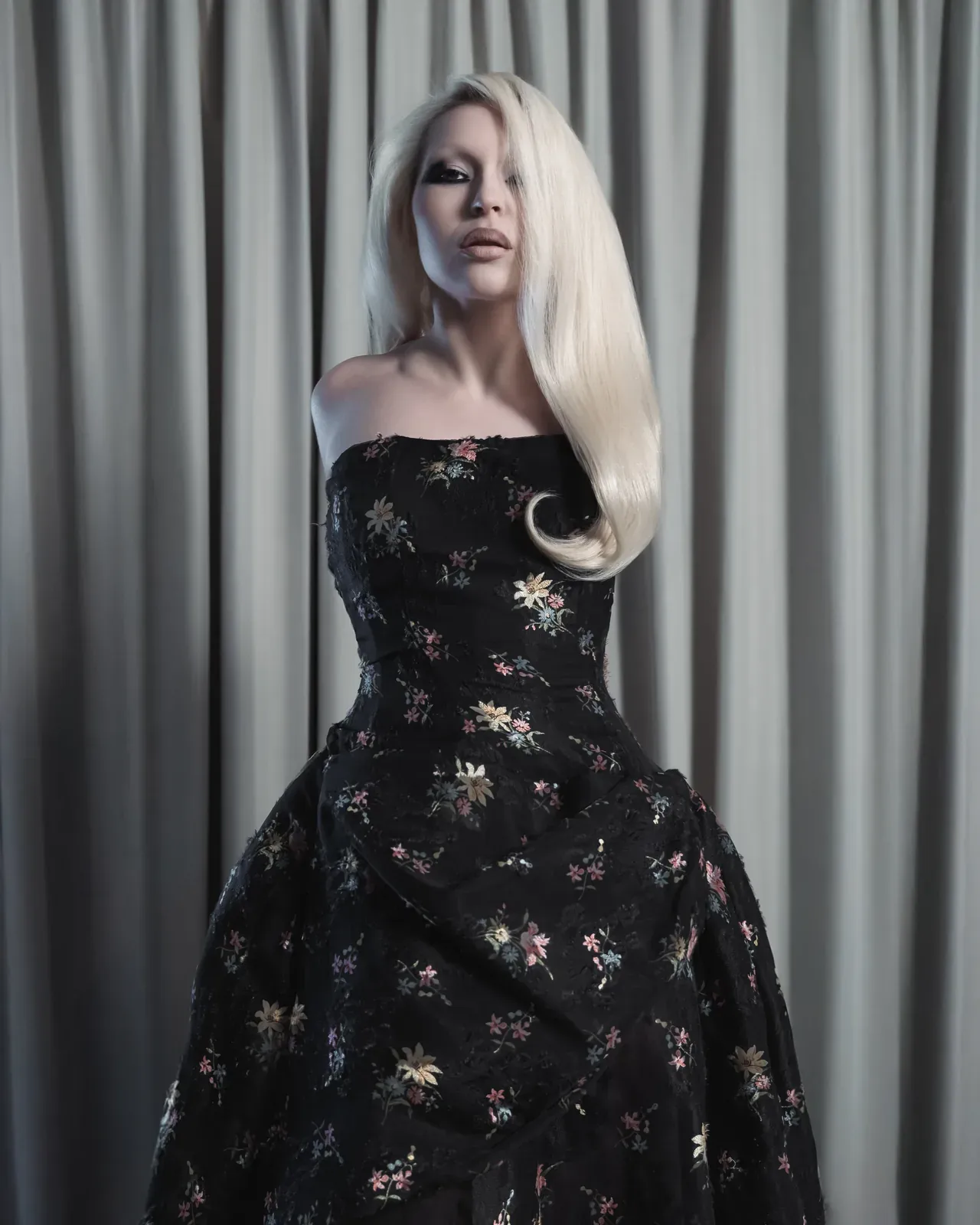
Dress DIOR.
Have you gone back since and enjoyed it more?
I want to say yes but, no. Last time I was there I was performing, so I did not get to stay for a long time, but one day I will go, and I will have a wonderful time. Maybe when I play there next time in May or June. It really bothers me that I have to pay cash everywhere. There’s something about Berlin, I don’t think Berlin wants me, but I will give it a try until I like it because everyone does, so I’m in the wrong on that one.
Have you come across or observed addiction in those environments?
No, not really. I only did about three shows and I was really young, so even if there was anything I didn’t really come across it like that. I was there as a performer rather than a participant of the club too.
Do you have any vices?
I eat an absurd amount of candy. I know it doesn’t sound bad but to me it is. I have now stopped putting it on my rider because I cannot eat more. All my crew and everyone I meet, they ask me if I’m still eating candy and I’m like yeah, every day. When I was a kid, I used to dream about eating candy for breakfast, lunch and dinner and then one day you stop dreaming that, but that day has not come yet. When everybody goes out and has a cig, I go out and I have a little candy.
What’s your go-to?
Liquorice, the black one. If it’s European it’s good, because the American and the Australian ones are not but the Swedish, Danish and the Finnish ones are very good.
Cobrah the candy connoisseur.
I am for sure. For Christmas I got five kilos of liquorice from my family because they know I like it so much. I’m telling you it’s not a silly thing; it’s a very real addiction.
You wear dark and subversive clothing and your music often expresses that same sexual liberation, do you feel you represent or even personify the intersection of the queer, fetish and goth community with your artistry and persona?
I do, but that’s not my intention. I don’t intend to represent a community in that sense. I get very politicised because of what I do; it has this more liberal political point of view regarding sex, but I just do it because I like to be extreme. I like to be brave and do exciting things. I really like aliens, I’m a big gamer and I love the harder aesthetic ways to express myself. I’ve always felt if I express myself in an alluring or feminine or sexual way with a soft approach, it feels too submissive. I feel like then I’m just in the box of a sexy girl and that is very lame. That is bending over for the general view of what a sexy woman is, and it feels very wrong in my heart to do that; that’s why I’m into doing more extreme things because I’m appealing but on my own terms. I’m not appealing in a pink bra that everyone loves, that some person figured out is the sexiest thing for a woman. I get to decide what the sexiest thing is for me. So, I don’t feel like it’s a community thing, it’s more setting my own standards for my own creative expression and performance.
This reminded me of Lady Gaga speaking about her 2009 VMAs performance about essentially wanting to scare people when they wanted her to be sexy. She said she’d put “some absurd spin on it” that made her “feel in control” when they wanted her to “be sexy” or “be pop”.
Exactly, it gives you control. If there’s a way you’re supposed to do things, you’re aligning with someone else, and as an artist, you’re supposed to have your own view of who you are. That’s why people like artists that don’t align with those expectations.
Would you say that Cobrah is antiestablishment then?
Yes, but in a very whimsical way.
Speaking of clothing, how has your relationship with it evolved over the years?
I was just at the Matières Fécales show, and it was really incredible; I was in awe of everything. I love a show when you can tell it’s well made and tailored to perfection. Sometimes that is missing in fashion. It’s not just a look; it’s multi-layered. I was at the Dilara [Findikoglu] show as well and they had this incredible cherry dress with real cherries that were dripping and staining the gown. I’m always into performative things, I like theatre and goth aesthetics, so those brands really appeal to me because I want to wear them and become a part of their fantasy too.
Who have been some of your fashion icons?
I tend to follow brands because most people change their style a lot, but Doja Cat does really well. She changes so much that sometimes it’s so off my personal preference but at least it’s someone who really has fun with it and that’s very admirable. To be an artist that does a worm dress and then something really glam and then something really rock, I like her a lot because she’s a chameleon.
“I love doing characters, but this time I’m peeling it all off.”
Your outfits at the catwalks showed a lot of skin, as per usual. Do you think you’ve always been comfortable in your skin?
No, not at all — quite the opposite, I’d say. Showing skin and working with skin has made me overcome that affair because I felt like I had to sacrifice my comfort to be able to do what I want to do. I have a vision, and I want to use my skin this way or be naked so if I was uncomfortable with it, I just had to suck it up. Maybe that’s why it was a little scary to be so confident, but when I was growing up, I was very uncomfortable.
Do you rely on Cobrah as a persona to get over that fear?
I mean, I wouldn’t go around naked at a club if I wasn’t there as Cobrah; that would be extreme even for me (laughs). I’m getting more and more comfortable with it I’d say, and I don’t really have a problem with it. What’s important is that it’s something that I want to do, and I get to decide when I want to play on skin or play on transparent clothing and lingerie, I am the decider. If somebody suggested it, then you’re pleasing again and we’re not about that.
As someone who is so imaginative and prone to worldbuilding and storytelling, do you like to face your fears and problems head on?
For sure, I’m a very direct person. I want to know if there’s a problem.
Has there been a conflict you have had to overcome throughout your career with that directness?
There’s conflict when you go through life all the time, but not really. Being very direct is a good way to avoid conflict, which is what I always try to do. I feel conflict comes from misunderstanding or when there’s a political relationship, but I never really have conflict with people because if you tell people how it is then you figure it out together very fast, so you don’t take things personally either. I’m a very easy woman; I’m not a drama queen and if someone says that I’ve done something shit then maybe I did something shit. You don’t get better as a person if you fight people with your personality. Easy going, easy life.
That’s a very Nordic approach.
I think so as well. I often feel like my personality clashes with people from other countries because they’re not used to being that relaxed about things.
So, when you tour do those cultural clashes come up for you?
Not too much because I travel with my touring party and I know a lot of them already. I tend to surround myself with people that are easy going. I love a good nerd. I get along the best with the crew like I’m not an artist that has a lot of other artist friends. I like the producers, the sound techs, the dancers and the backstage people because they’re also easy going.
What is the best advice someone you look up to gave you?
I cannot quote them, and I didn’t get direct advice, but I took it as so. There was this interview with a painter that I watched, he talked about making art and the idea of “it’s the journey and not the destination” but he said “it’s not even about the journey, it’s about figuring out your own work and that is such a painful thing that everyone has to go through but it’s the most joyful thing that you can do. It’s not what becomes of it but the process of finding yourself in your own creative work is the most value you can ever get no matter the success.” That hit me because that’s what I struggled with a lot when making Torn, was finding that path again.
Which painter was it?
Hugo Winder-Lind. He paints sheep.
Good advice. In this desperate search for referents to serve as a moral or aesthetic compass, who or what do you look to when you are lost or in need of guidance?
I call my mum a lot, family and close friends. I’m not really a soul searcher like that where I look for emotional or spiritual guidance. I’m so used to that not being a part of me because I don’t believe in God or bigger things but in general whenever I have a big conflict in life or something that I’m thinking and worrying about I like to call my mum even if I don’t take her advice. Bad advice is a redirection to figure out something great instead and talking to someone that listens and knows you since you were literally birthed is quite valuable.
Who were some figures you looked up to in your formative years? Have they changed?
I was really into female artists especially alternative ones. I got a book about female contemporary artists and I found out about Marina Abramović. There was a picture of her sitting on a pile of bones, I thought it was so cool that I looked into all of her work and I found her to be such a cool woman that I wanted to try to do something like that. I would rent a space, and I put plastic all over the walls, on the floor and I asked my sister to dip her head in a massive bowl of tomato sauce and then flip her hair around, I thought that was really fun. Amanda Palmer from The Dresden Dolls, she would show her tits on stage and be very powerful. Then, softer artists like Kate Bush and Björk’s earlier albums were big inspirations for me.
I read you used to be a music teacher, have you since heard from any of your students?
I do have DMs because now they’re old enough to listen to Cobrah, which is weird like I knew you when you were thirteen and now, you’re an influencer on TikTok. I think they just found out about me and saw that I used to be their teacher from back in the day. I had to keep it separate at the time to be professional.
Are they Cobrah fans?
I think so. I mean, I was teaching music so it’s a subject that allows the teacher to be a little bit crazy.
What would you say to your former students listening to you now?
Thank you for being such a good kid and come party with me when you’re old enough.
Being relatively online, and given your fame, how do you deal with hate?
It’s mostly on certain platforms where people that wouldn’t come across my music do like on YouTube. It does not bother me at all and I’m so grateful for the interaction, like yes baby keep that algorithm pumping, go off tell me I’m a slut.
Has there been a lot of parasocial relationships you’ve noticed started to form?
A little bit but not like that. I’ve met a lot of people through my socials like artists, designers and people I’ve started to work with through DM. I feel Instagram is a really good way to connect with and meet other creators.
It’s not been an intrusive kind of parasocial relationship with anyone then.
No, if someone’s weird I just block them, I try to not engage.
Were your vocals featured on an ad for the Fortnite and Kim Kardashian collaboration?
What! I don’t think so. Was it my song? Maybe I am missing a bag (laughs).
I recall it being your voice I swear. However, I do know that your track Brand New Bitch was featured on Yorgos Lanthimos’ film Kinds of Kindness. How does it feel reaching a mainstream audience without being a mainstream artist yourself?
Amazing. I don’t want to be a mainstream artist or conform to that but I’m also very enticed by the lifestyle of being exposed to a bigger audience, so things like that are really fun. I love when new people who wouldn’t be into my niche find it and like it.
Recently SZA stated that she felt like she’s “at war because of AI”. Do you agree? What is your view on AI in the music industry? Is that something you think your followers care about?
I know my listeners care about it a lot and I don’t use AI in my music. I’ve asked my producers, they don’t either, we have a really nice workflow. I don’t use it in my visuals either because creating good visuals is a skill and when you showcase what you do as an artist, that’s important to me because it’s my craft, my ideas and my expression. I have such a hard time getting my head around it because I don’t know where it will end. Do you remember when people were talking about the blockchain all the time and NFTs and that was really big three years ago? That just died and I don’t know if these AI songs are like the new NFTs. I’m interested in how it’s going to go but I don’t feel like it’s interesting for me, because why would you do art if you’re not doing the art, it makes no sense.
The last time I spoke to you, you said you were a nerd and a big gamer but never told me what you were nerdy about. What games are you playing right now?
Last year I played Baldur’s Gate and then I play The Witcher a lot. I play open-world games, and I really like medieval themes, so I play a lot of Zelda on the Switch. Now I’m in between games because I’m waiting for the new The Witcher so now I’m playing a lot of Stardew Valley which is a farming game.
At a time when sexual liberation in the mainstream feels increasingly on the wane, thanks to attacks from the conservative right, what’s it like navigating being an abrasive sex-positive female artist in the public eye and in a patriarchal world?
It feels good. I don’t know what it means to be sex positive and a lot of what I’ve done is club positive or vibes positive, but I see what you’re saying. I’m so on the far edge of the spectrum of doing whatever I like I never come across anything conservative because they wouldn’t book me or go to my shows or release my album or be in my sphere. Although I follow the news and I see the wave of conservatism in politics, I don’t feel the connection. I work in a very liberal world and that makes sense in that I can tour and do all these things and still never get shut down.
Do you see yourself as a role model?
Maybe I am to some people but I do not take on the responsibility in any form. I feel very self-centred in that way where I’m all about the art, the music that I write and the videos I create. I’m all about the creation phase really and then the result is that some people look up to me and think I do cool things, but I don’t really put myself in the shoes of advocating for people or being a good role model.
A lot of artists have recently been quite mild and avoided taking any stances regarding sociopolitical occurrences. What do you think an artist’s role is within society and how does Cobrah play into that?
I am one of those artists. I don’t really put myself into the shoes of something that is not my job or I have no insight in. Speaking out about things is such a trap, you’re damned if you do and damned if you don’t. If you say something but you say it slightly wrong, you will be known for saying a thing wrong and then you might do something that is good now but it’s not accurate anymore five years later. I try to really stay in my lane when it comes to that.
But you’re not oblivious to it either, from what you’ve said.
Yes, but I follow it as a citizen of the world. That sounds so cringe, but I follow it on the level where I’m a human and I know what’s going on but Cobrah to me exists in its own universe.
What kind of art do you find provocative or interesting?
I don’t know if I can ever get provoked by anything, but I will say it really hurts me if something’s really scary. I don’t watch scary movies. There’s this clothing store in New York that’s really scary with dolls’ heads in the window. I’ve gone there twice, and I always have to go out because it’s so scary. My friends are like, “What? You’re Cobrah, this is your jam!” and it’s too scary, too gory.
Is music ritualistic or therapeutic for you?
It’s both. It causes me a lot of anxiety and also helps me with a lot of anxiety at the same time. It’s very emotional work for sure to write music. It’s a double-edged sword.
You’ve been promoting and touring in so many different places lately. Do you have a favourite in recent memory?
Not too long ago but this Autumn I did the Gagball tour, where I DJed a lot. I played some unreleased music and that was really fun because I got to play a song with Grimes, and she came out for the night, it was a beautiful moment. I cherish it a lot to have other artists come on stage with me and do a rare pop up playing an unreleased track, even if it gets released or not.
Lastly, I wanted to circle back to your confession.
My deepest confession is that I really like The Piña Colada Song (laughs). I play it a lot; the lyrics are genius. It’s very straightforward, very direct.
What would you like to end on for the readers?
Come to my tour because I’ve been rehearsing all this week and it’s going to be so sick. I’ve never done this much choreography probably my entire life.
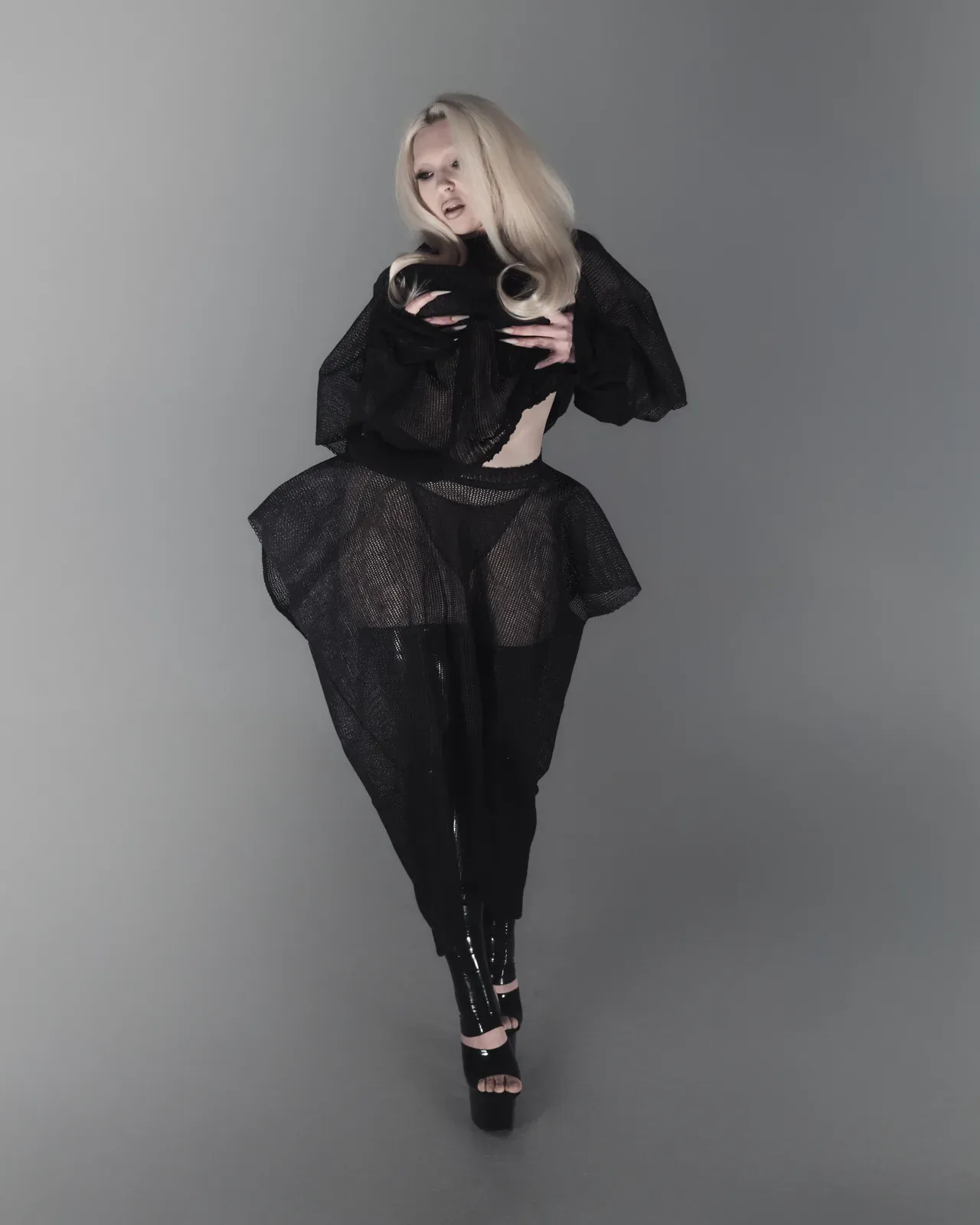
Dress ISSEY MIYAKE, underwear MAISON CLOSE.