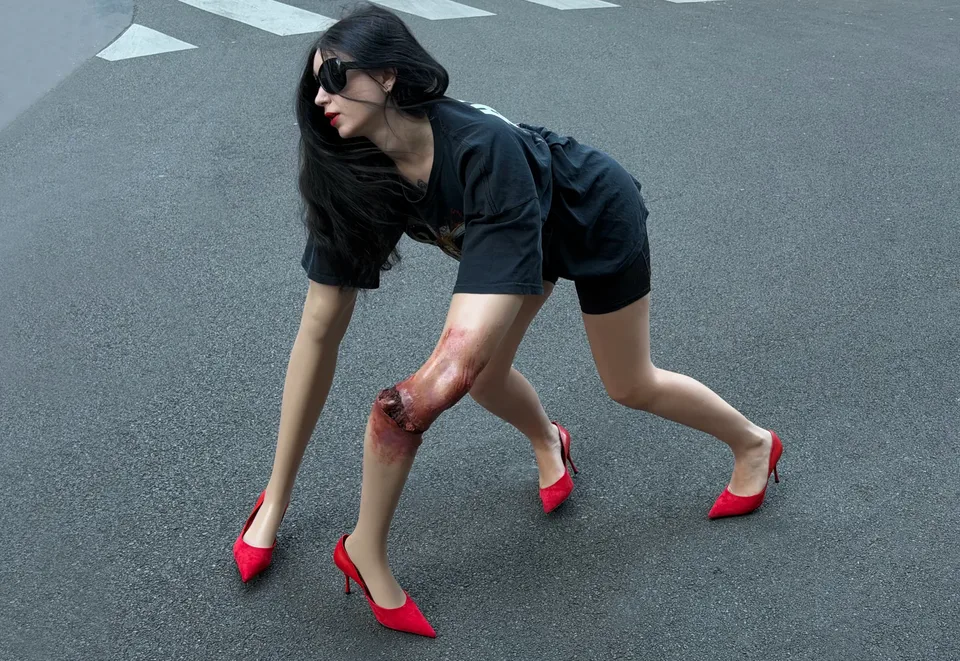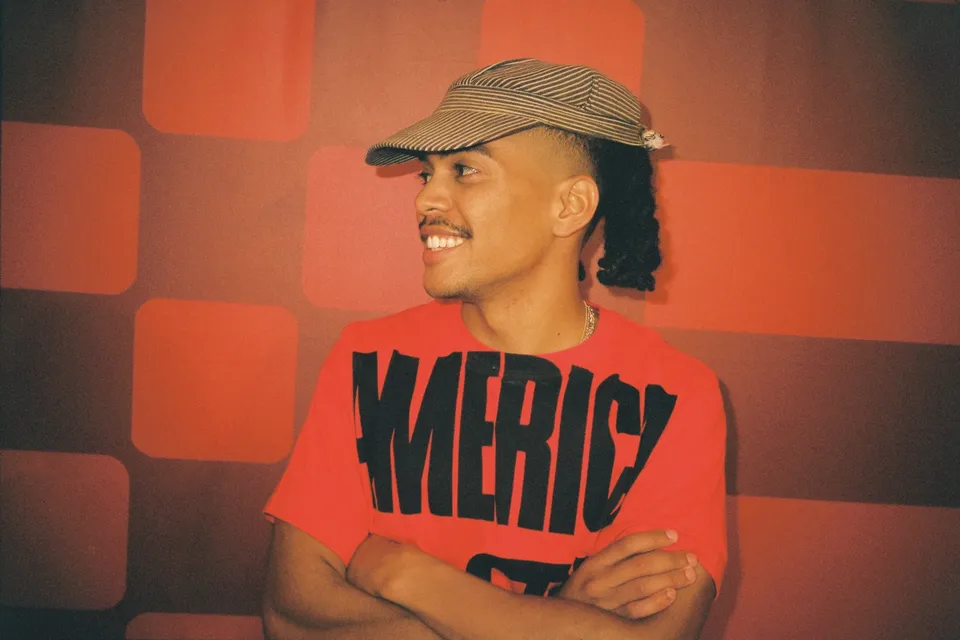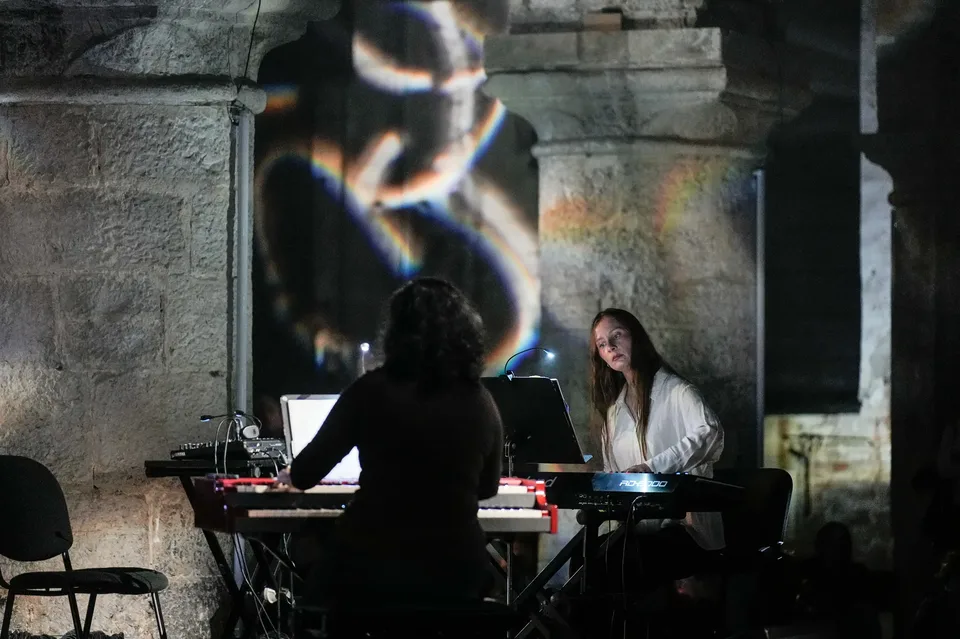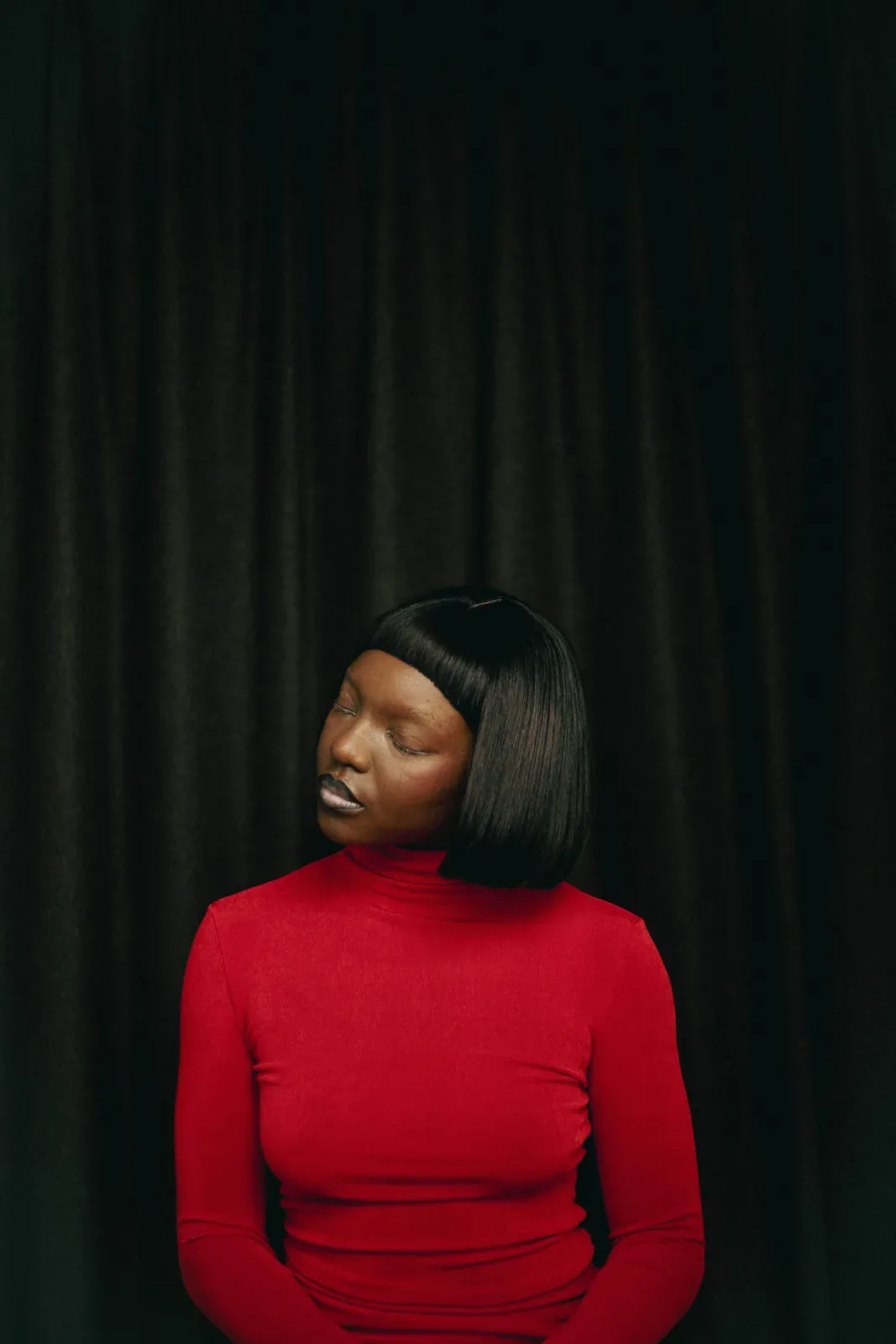
On 123, their new self-produced EP out now via Stratasonic Records, French-Cameroonian musician Astrønne explores the relationship between personal healing and collective liberation. Conceived during particularly turbulent periods of their life between London and New York, the three-track project moves freely between experimental R&B, folk and ambient music while questioning how much of who we are is shaped by other people’s expectations, and what happens when we stop seeking permission to change.
With just forty-eight hours to go until the EP’s release, we caught up with Astrønne, who told us that their ego was pleased and their soul was twerking. With humour and remarkable openness, the Paris-based artist spoke to us about their admiration for James Baldwin, coming out as non-binary and a creative process they describe as “vomit and upcycling”. At the heart of our conversation was a belief that informs much of their work: “Healing is a collective effort.”
The countdown is almost over! In just two days, 123 will finally be out in the world. What’s going through your mind as you prepare to share such a personal project?
It is a personal project, but the more personal, the more universal. A lot is going through my mind. First of all, I am infinitely grateful to the people who believed in me enough to make that possible, investing attention, time and money — and, most importantly, to my chosen family, who supported my mental and physical health throughout the wait. Secondly, my ego is pleased. The idea of a project that I recorded, produced and intentionally mixed myself — yes, I’m so very proud of this project.
Thirdly, my soul is twerking; I cannot wait for the message to spread, the love propaganda to start, and to finally be able to be a mirror and reflect honestly what I’ve been seeing. Lastly, I can’t help but think of all the obstacles and vampires that also tried to make me quit music and lose hope, people I thought were friends, family, lovers — but ultimately, I’m grateful for all the masks that fell, all the demons I exorcised and all the bullets I dodged because they brought me here and now. I’m grateful and proud to release 123 against all odds. Now I’m gonna try not to be part of the 27 Club.
Thirdly, my soul is twerking; I cannot wait for the message to spread, the love propaganda to start, and to finally be able to be a mirror and reflect honestly what I’ve been seeing. Lastly, I can’t help but think of all the obstacles and vampires that also tried to make me quit music and lose hope, people I thought were friends, family, lovers — but ultimately, I’m grateful for all the masks that fell, all the demons I exorcised and all the bullets I dodged because they brought me here and now. I’m grateful and proud to release 123 against all odds. Now I’m gonna try not to be part of the 27 Club.
A couple of weeks ago, you gave us a first taste of the project with 1 2. Why did you choose this particular track to introduce the EP, and what kind of reactions have you received so far?
1 2 is a love letter to myself, a mantra, and the most important redefinition of all: my own. Because I don’t want to die a hypocrite, I intend to embody the change I want to see in the world. I want to encourage people to acknowledge the elephant in the room, to do the shadow work, to acknowledge the walking paradox that they are, and embrace their flaws and multiplicity, so I needed to do it myself.
1 2 was like, “You can do it too.” It is the introduction to my self-redefinition: a coming out as non-binary, an ode to consent and to the illusion of free will, which is the main thing that people love minimising; and a mantra that helps me daily to question whether I’m doing/saying/thinking something because I’ve been indoctrinated and conditioned to, or because I actually want to.
The reactions I’ve received so far are very similar to mine, and that’s the magic of catharsis: most people need to hear that just as much as I did and still do. I feel like we always wait for permission to change, for strength to face the shame of our past, for external validation when it’s our responsibility to say, “Actually, not anymore” — and that’s what I meant by “I’m the water I’ve been waiting for”.
Described as the beginning of a new chapter, both personally and artistically, 123 follows a journey told through three connected acts. What made you feel it was time for this change, and how did the idea of structuring the project this way come about?
The change feels necessary when you hit rock bottom and you get the ick. The structure reflects my brain structure: triadic thinking. I’m a broken record, and I talk in mantras; most of the mantras have three parts. Like, I describe myself as a wounded healer sinner. My main enemy is a three-headed monster called capitalism, patriarchy and colonialism. The main idea behind this project is: truth hurts, truth saves, love heals. And I love the number three, so there’s no real explanation behind it. 123 is also “ready, steady, go”, and that first project did feel like an opportunity to start anew and reconnect with the essence of why I’m here in the first place: my personal healing, collective healing and collective resistance.
“The one act of resistance I have always embodied is that I refuse to change my essence; I chose to change how people have access to said vulnerable whimsy and honest nature, but I’m not changing in essence.”
Part of the EP goes back to a solo trip to New York, where you spent several days recording in a Crown Heights studio while the city was celebrating the Fourth of July. I’d love to hear more about that experience. What do you remember most about those sessions, and how much of what you recorded back then ended up on the final project?
I remember it being too warm. Hotlanta warm. I remember getting sick after trying Campbell’s soup. I remember the smell of warm trash in the street, and I wish my reason for avoiding them was more political — but I just got lost in the music, so much so that I missed my appointment with Kelela, which I still regret to this day. I recorded about twenty songs in about a week, including a diss EP I wrote as a reaction to being harassed by the label I was signed to back then, and demos of songs I wrote between the ages of nineteen and twenty-three, including 2 3, which I wrote in London, and L6VE and 1 2, which I wrote in Brooklyn.
Initially, I was invited by Daoud, a producer who heard my voice in a voice message I had sent to one of his friends, in which I was singing a Spanish song; then he asked me to come to NY. Once I was there, when he realised I was rather autonomous and our brains worked similarly, he trusted me enough to leave me the keys to his studio for a week. So I was twenty-three, sober and alone in this lush studio with a plethora of machines and instruments. Yet I just played Rhodes, my guitar and his bass. Not much of what I recorded ended up in 123 since I only picked three songs.
Initially, I was invited by Daoud, a producer who heard my voice in a voice message I had sent to one of his friends, in which I was singing a Spanish song; then he asked me to come to NY. Once I was there, when he realised I was rather autonomous and our brains worked similarly, he trusted me enough to leave me the keys to his studio for a week. So I was twenty-three, sober and alone in this lush studio with a plethora of machines and instruments. Yet I just played Rhodes, my guitar and his bass. Not much of what I recorded ended up in 123 since I only picked three songs.
While 1 2 is about choosing to change, 2 3 explores everything that can get in the way of that process. Having gone through some particularly difficult experiences yourself, has your understanding of what it means to heal changed over the years?
Yeah, I’m much more graceful with it. I’ve come to understand that it isn’t linear, and just like you can’t clean your room once and for all, it’s a constant and daily effort/work/battle until you die. I’ve come to understand that all my intrusive thoughts, doubts, guilt, fear and shame are internalised, projected lies, and they’re not mine to carry. But I am human, so relapse is around the corner, and I’ve come to understand that I need a strong support system to fight those things because trauma and gaslighting cause your hippocampus to shrink, then amnesia, so I need an army of angels and reminders. Healing is a collective effort.
I’ve come to understand that devotion works better than discipline, so my motivation isn’t “I should because I have to”; it’s “I have full custody of my inner child that I love very much, so I want to” get the help I so obviously need and deserve. Me from a couple of years ago would’ve never said any of that — God is change.
I’ve come to understand that devotion works better than discipline, so my motivation isn’t “I should because I have to”; it’s “I have full custody of my inner child that I love very much, so I want to” get the help I so obviously need and deserve. Me from a couple of years ago would’ve never said any of that — God is change.
“Vomit and upcycling” is how you’ve described your creative process. What does that actually mean in practice? And has your approach to songwriting changed as you’ve become more open about your personal experiences?
Everything has changed apart from my songwriting process. It was unintentional before, but it’s starting to be intentional: I want to be used by nobody but God/the universe/ancestors, as a vessel through music. That’s why I’ve always been into automatic writing, subconscious pulling, and what the French call “yaourt”: the stage where it sounds good but it means nothing — seemingly. I think I’ve also always been open about my personal experiences, if you check my mantras on SoundCloud and trauma dump on Bandcamp. The one act of resistance I have always embodied is that I refuse to change my essence; I chose to change how people have access to said vulnerable whimsy and honest nature, but I’m not changing in essence.
For the upcycling part, the water we drink today existed billions of years ago, so similarly, as Quincy Jones used to say, we’re just all using those same twelve notes. I’m a broken record, and I’m multiple, but it’s really just those same 123 facets, those same mantras, the same lessons over and over again. That’s why I think it’s just remixes and upcycling at this point.
For the upcycling part, the water we drink today existed billions of years ago, so similarly, as Quincy Jones used to say, we’re just all using those same twelve notes. I’m a broken record, and I’m multiple, but it’s really just those same 123 facets, those same mantras, the same lessons over and over again. That’s why I think it’s just remixes and upcycling at this point.
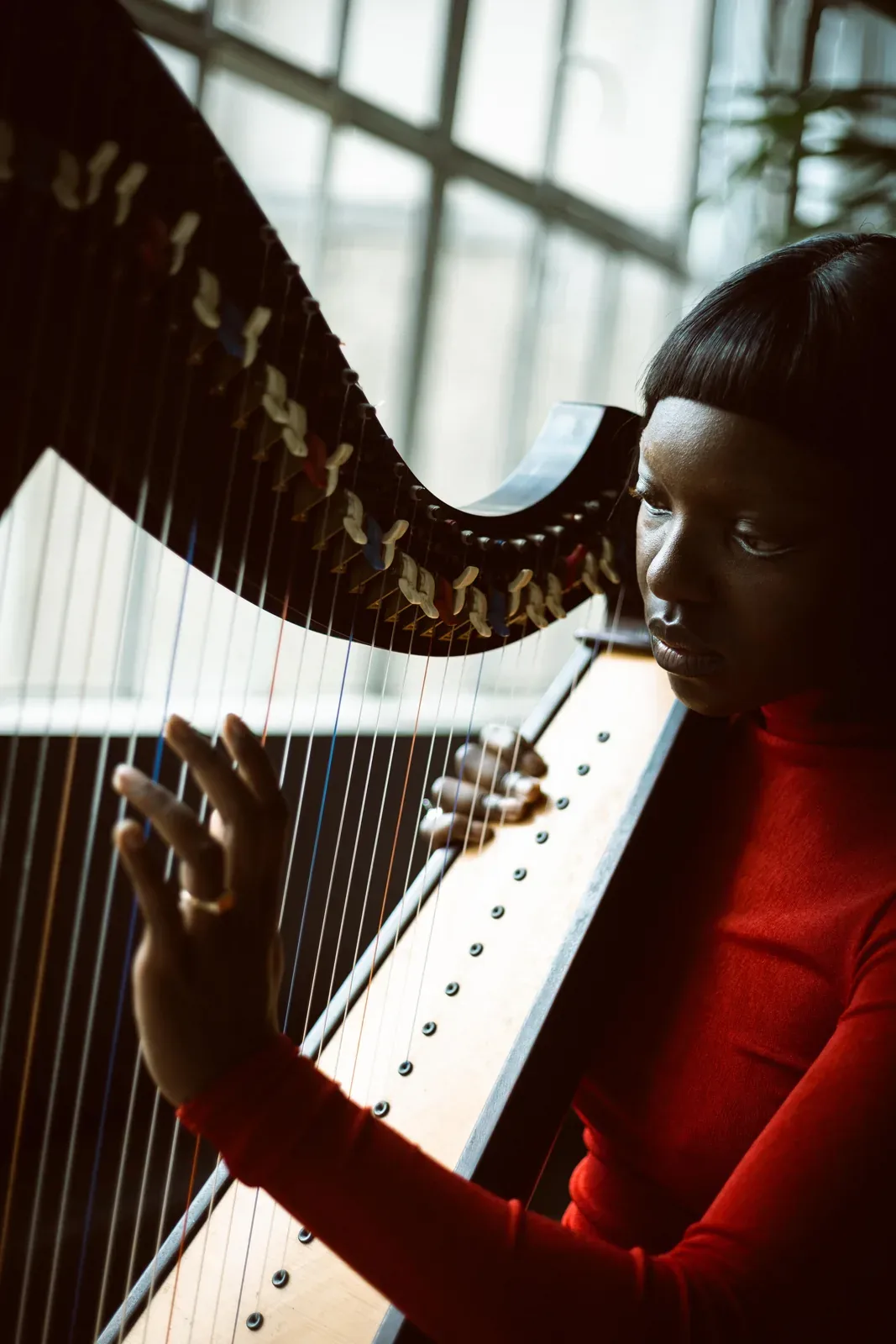
The closing track, L6VE, draws inspiration from James Baldwin and his reflections on moral responsibility. What was it about his writing that resonated with you?
I resonate with looking cute and speaking uncomfortable truths, which is never welcome in Paris, City of Lights, or Kingdom of Gaslight. To be frank, I’ve only read him partially, but I listened to him and watched him move much more. My personal excuse is that I’m Bantu and my tradition is the oral transmission of knowledge. I was moved and felt seen in his documentary, facing the Parisian spleen and negrophobia; in his film, I Am Not Your Negro, which inspired me to write a song with the same title in 2022 (unreleased); in his conversation with Nikki Giovanni; in his ability to admit being wrong, take accountability and change his mind… I am, like him, often accused of using intense words and quirky analogies. He is the epitome of what I call negrodivergence (neurodivergence + negritude). How people would probably tell him to stop making a spectacle of himself — when he was indeed spectacular. How his demeanour inspires trust, intrigue and whimsy. But the contrast between his frail body, huge smile, offbeat jokes and the scathing clarity and acute precision of his insight and direct approach to taboo subjects — I love him for that.
You’ve also spoken about love as a form of resistance. What does that idea mean to you in today’s world?
From my point of view, the status quo is an international gaslight, forcing us to play a game with rules that only become clear to us at the age of twenty-five or sometimes fifty. We’re in a coercive and abusive relationship with today’s society. I personally believe in UBUNTU, a Bantu precolonial philosophy that stipulates “I am because we are”. Bantu meaning people, ubuntu literally meaning “humanity towards others”. It’s the blueprint of what colonisers whitewashed and called humanism. Ubuntu is the welcoming and altruistic nature of Indigenous people who were then subjected to slavery, pillage, mass killings and more gaslighting. So I think Love is the blueprint, and Loving is remembering. In today’s world, we need to redefine what humanism (and love) is, to really understand what’s at stake, why genocides are being called wars and who decides (the 1%).
We need to realise/remember all the isms and phobias have been learned and can be unlearned through change. And today, resisting is just fighting for humanity. Crimes against humanity are all rooted in lies, which are projected, then internalised and spread, etc. It’s a “war” of the mind and the heart. In that context, healing is resisting, changing is resisting, and love is an act of resistance.
We need to realise/remember all the isms and phobias have been learned and can be unlearned through change. And today, resisting is just fighting for humanity. Crimes against humanity are all rooted in lies, which are projected, then internalised and spread, etc. It’s a “war” of the mind and the heart. In that context, healing is resisting, changing is resisting, and love is an act of resistance.
Now that you’ve brought 123 to life, how would you describe the whole creative journey? What have you learnt about yourself along the way, and do you feel like a different person from the one who first started working on these songs?
The only person I’d compare myself to is, in fact, my old self, so thank you for this question. I didn’t learn much; I mainly remembered truths that lay behind the mask I had built to people-please everybody’s projections and, underneath, the habits and addictions I had absorbed in survival mode. AKA, I’m multiple, and I have permission to be myself, but I must choose who has access to that.
To be completely honest, at first I was frustrated that the project was postponed and not released earlier, but God did that. I was not ready, not aligned, not committed. I needed to get the ick first, do the shadow and light work, and learn a couple more lessons to let life humble me. Now I don’t take anything personally because my trauma is undeniably systemic; I don’t feel anything but pity for my past vampires because vampirism and cowardice are diseases, and I understand that the best revenge is self-care — which is my very first mission after all, as a human being.
The whole creative journey was first vomit, then upcycling, and finally a lot of disappointments, betrayals and tests of my patience. Over and over, until I broke the silence and shame that were keeping me isolated and vulnerable to more vampires, you get it. I’m grateful for the lessons, and I’m starting to know them by heart because while I was waiting for the project to come out, the songs were infusing in my brain, body and soul like the mantras I didn’t realise they were when I wrote them.
Every Friday, METAL Weekly gathers the week's stories. Subscribe.