What happens when a live set leaves the laptop behind? During Biennale Musica, we met Brazilian-born DJ and producer alys(alys)alys in Venice, shortly before she presented her first solo live performance. Built entirely around hardware, the piece stepped away from the immediate feedback of the dance floor and into a slower, less predictable space, one shaped by texture, movement and the possibility of things going wrong.
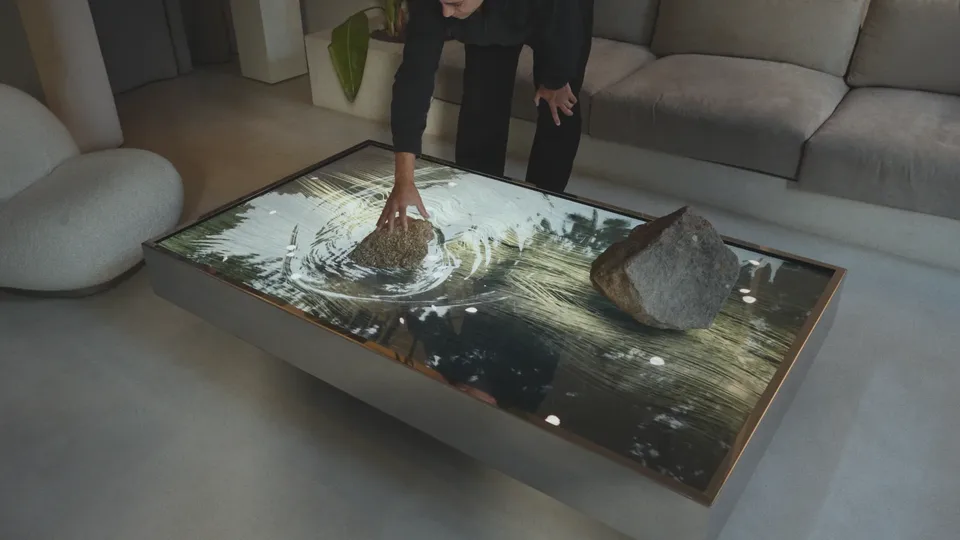
The performance unfolded like a carefully paced journey. It began quietly, with stretched-out sounds and layers that seemed to accumulate rather than lock into a fixed structure. Nearby, metal plates filled with water responded to the frequencies, making the liquid shift and splash as the sound changed. Around the halfway mark, the rhythm became more animated. It never tipped into club territory, but its progression was clear: the intensity rose, the textures grew denser and the set acquired a stronger pulse before gradually dissolving into a softer ending. An entrance, an ascent and a descent, with no computer acting as a safety net.
That tension between control and accident runs through our conversation. We spoke about learning to let tracks go, resisting the grid of the Korg Electribe, collaborating without forcing the process and the different ideas of underground community she found in Brazil and Europe. We also discussed Venice itself, a city whose water, changing seasons and uneasy atmosphere seeped into the work long before it reached the stage.
Your music often brings together sounds that might appear incompatible at first, from pop to funk to weirder, more experimental sounds. What helps you recognise when an unlikely combination works?
There’s nothing really specific that makes me think, okay, but it’s more about fragments of sounds that are catchy in a way. It can be one or two seconds. I usually try out multiple combinations. I started DJing on Traktor with loops and four channels, so I feel like my ears started getting more trained to what could make sense together. Sometimes I try it out and it doesn’t work, but I feel like the more you do, the more you start finding things to sample from.
Do you ever hear a new song and immediately think about what it could be combined with?
Yeah. I think more with pop, I would say, or even with more experimental textures. I usually tend to combine vocal parts or really catchy melodies, export the MIDI or just loop around and see how it works. I think the more you do, the more you start understanding. It’s like an exercise, I would say.
You began DJing as a teenager, and then you studied music production and sound engineering. How has moving from selecting other people’s music to constructing your own music changed the way you listen to a song?
I think it changed a lot. The good thing about starting from DJing is that I was not going too deep into technicality, so it was more about mood and vibe. But then, when you study, you start nerding things out, which is great. I try not to overanalyse things because I feel the more knowledge you have about production, the more of a pain in the ass you start becoming, and the more judgemental of things. I think it’s good to find a balance.
But it helped a lot to understand frequencies and how technicalities can be explored, and how things are sounding. I love experimental trap and this kind of distortion, so I’m excited when I’m like, ‘Oh, this is how they do this kind of thing’. It creates a lot of possibilities. I think now it’s getting easier to express myself because I move around different types of knowledge and different genres.
But it helped a lot to understand frequencies and how technicalities can be explored, and how things are sounding. I love experimental trap and this kind of distortion, so I’m excited when I’m like, ‘Oh, this is how they do this kind of thing’. It creates a lot of possibilities. I think now it’s getting easier to express myself because I move around different types of knowledge and different genres.
Rosalía always says — and she has an incredible musical education — that the more knowledge you have, the more freedom you have. Even though you overanalyse things, you know how to do them.
I think it’s good because you can break it. I learned this with Brazilian music specifically, or with more experimental trap and artists like JPEGMAFIA and Death Grips: something that might not sound like the right thing can also be good. But you know what is right and then you extrapolate from it.
“The more unfinished things you accumulate, the less space you have for new things.”
Your latest EP, soda geyser, explores rhythm and vocal manipulation. What attracted you to the voice as a material that could be stretched, fragmented or reshaped, rather than simply sung in the middle of the track?
To be honest, I listen to a lot of pop, and I think there’s something about the voice that you can play around with through glitches and explore more. I don’t know music theory that well, so I tend to like sampling more than writing down melodies and stuff. I like to play with the voice, and I work with Monstera Black as well, so I think I gained more knowledge of what can be done with it. Again, I listen to a lot of pop and trap too, like early trap, and they have a lot of these extra voices and things that I really like. Even on soda geyser, one of the tracks, effervescence, has a sample of T-Pain, but you can’t really recognise it.
You mention pop a lot. Who are your favourite pop stars right now?
Slayyyter. I’ve been listening to her album so much; it’s been on repeat. And then, I wouldn’t consider her the same, but I constantly go back to Imogen Heap.
soda geyser features bieL onLine and Monstera Black. What do vocalists, or collaborators in general, bring out in your work that you are less likely to discover when producing alone in the studio?
I think it pushes me in a lot of directions. I usually collaborate in a random way. With bieL, I was in Brazil and then we met. I was like, ‘Oh, I have this track’, and he was like, ‘I want to work on this’. The times I tried to make a track with someone in a more direct way, it usually didn’t work. It’s weird. I also think it needs to be fast. With him, the tracks were done in a week. The other person can also help you know when something is done. If you get an affirmation like, ‘Oh yeah, this is cool’, and you’re wondering whether you should tweak it more, they can say, ‘No, it’s done’. For me, it’s good to have someone else helping. Musically, it’s always interesting. You learn a lot about how people do things. And I want to work more with pop in the future.
Slayyyter, if you’re listening to this, please join in!
(Laughs) Yes! I think pop has so much exploration, and there are a lot of underground artists featured in pop, so it’s cool to work with other people.
You were saying that collaborators can help you decide, ‘This is cool, so this is done’. Do you tend to overwork something? Is it hard for you to say that a project is closed and think, ‘Okay, this song is done’?
I wouldn’t even say I overwork things, but it’s hard to say, yeah, this is done, and let go. I think it might also be a mind trick: thinking that something can reach perfection. Now I’m learning to release things or just say, okay, this is not going to come out. The more unfinished things you accumulate, the less space you have for new things. I’m learning this now, recently. Also, there’s the space on the computer (laughs).
You have described production as a process of allowing sounds to find their own direction before creating coherence through arrangement. How do you know when to intervene and when to let an accident remain an accident?
It’s hard. I think it’s really intuitive because, when I produce, I tend to have a draft of an idea in less than an hour, and that’s the core of the thing. Then it takes a bit longer to turn it into a more arranged song. But I think it’s really improvised, and then you have the base of something. It’s like when you draw: you have the idea of what the drawing will be and then you do the details.
Let’s talk about parameters of drift, which is your first solo live performance. What made this the right moment to move beyond DJing and producing and present your music in this way?
I love DJing, but I feel that sometimes you have this exchange with the audience. It’s not an individual sort of thing. You can’t play crazy if people are chilling. It’s a back and forth. With a live performance, it’s more like, this is it, and people will listen. It also means not being tied to dance; it’s not about dancing. I would say the live performance is quite experimental, a bit more ambient and a bit more IDM. It’s about exploring other ways of showcasing music. I’ve also had the Electribe for a while — around eight years — but I would play with it a bit and then put it away. It was this kind of practice of going back to it. When I got selected, I was like, okay, I’ll start performing with it, because I had never shown what I could do with it.
Did Caterina Barbieri select you? Did you send her a proposal, or did you know her from before?
No, I didn’t know her. I’m part of the residency project, so she selected five artists and I was one of them, but I sent a proposal and it was selected from the applications.
You developed the piece during the residency. You did the residency in Venice, which is a very unique place, and you allowed the city to influence what you made. Could you describe one moment when the environment altered the direction of the work in an unexpected way?
All the songs were made while I was here, or a bit in Berlin but during this period, so everything is from this year. I came in three distinct seasons: I started at the end of winter and beginning of spring, then there was the full, heavy summer, and now it’s a nice autumn. I can really see the differences in the smell, the people and the number of people — there are a lot of tourists.
The day that shocked me most was when I went to see a performance, got lost and it started to rain. I was alone in this intense rain, walking close to the water, and it seemed surreal. I can’t name one specific thing, but the city has movement. We’re surrounded by water, so it feels like something that is always moving. Taking the vaporetti to get around is really interesting.
The day that shocked me most was when I went to see a performance, got lost and it started to rain. I was alone in this intense rain, walking close to the water, and it seemed surreal. I can’t name one specific thing, but the city has movement. We’re surrounded by water, so it feels like something that is always moving. Taking the vaporetti to get around is really interesting.
“Dancing and going out are important ways to try to feel alive, to have exchanges and find some happiness or relief.”
And does this translate into the music somehow?
A bit, yeah. I tried to arrange the songs so they would change with the seasons, but the seasons aren’t just weather-related; they include everything that goes on. Some things are nice and peaceful, while others are more intense and dark. I tried to encapsulate that because it’s a really romantic city, but it can also be quite dark. It depends on the day and the time you’re walking around. If you walk at night, you can feel like someone is following you, but it’s just a narrow street. I like the contrast, and also the history here. It’s kind of crazy: it was a swamp, then it developed into this, and it might sink or it might not. It’s a crazy little place.
Since it’s your first live performance, are you nervous about it? It feels a bit more vulnerable. With DJing, you can check what people are feeling and adjust, but this is you — the audience can take it or leave it. Does it put you in a more vulnerable position?
What brought me peace was coming here yesterday. I was like, okay, there’s room for everything and people are here to listen, which is nice. I’m more worried about the technicalities because it’s a hardware setup. There’s no computer, which was a choice, it’s all analogue and you don’t know how things can go. I feel it’s part of the name, parameters of drift: you go with the flow. Whether things work or not, it’s your decision. I’m so used to the CDJs and, in a club, the setup is quite straightforward. If things go wrong, you just turn it off and on and everything is easy. I hope people enjoy it. I enjoyed the process, at least, and I think I learned a lot, which is also important.
Speaking of the hardware setup, you have a Korg Electribe EMX-1, but you are deliberately resisting the pattern-based logic of the machine. As you said, you’re going with the flow. How do you work against the habits or limitations built into the technology?
I really try to avoid repetitive kicks, for example, or structures that come from club music. In some tracks there’s one kick, and in others snares are used more as texture. I use a lot of delay and reverb to make things flow more and sit less on the grid. But it’s really about playing and trying things out. The Korg has a drum part and a synth part, so they’re combined; it’s not just drum sounds. I was trying to find something that merged well — not ambience, exactly, but textures rather than the grid.
Having grown up in Brazil but building much of your career in Europe, how do these two contexts continue to shape your understanding of underground music and community?
It’s really different. I was doing events in Brazil when I was seventeen or eighteen, so my main education, I would say, was there rather than in Europe. I was doing events with friends in my hometown and going to São Paulo quite often. It wasn’t the golden era, but it was when the parties were becoming big. These illegal — or not illegal but off-location events like Mamba Negra and Carlos Capslock — were growing, and I learned how to build a party and how many people you need to make things work, as well as how the community works.
Brazil has a large population, but it’s quite a small scene and everyone tends to help each other and know each other, which is nice. It feels more like a community. Even people who play more techno go to the more housey parties, so there’s a bigger exchange within club music in general. When I moved to Europe, I sensed more segregation between the techno people, the house people and the disco people — it’s more boxed in. But it can be easier to make it a career. Brazil has a party circuit, but you can’t really make a proper income from it.
Of course, there are also a lot of collectives in Europe. I go to Brazil every year, usually at the end of the year, to see family and friends, so I’m still connected with them. A lot of them have been coming to Europe more often in recent years, so it’s nice to see that dissemination. After Covid, I tend to worry about how things are going. Dancing and going out are important ways to try to feel alive, to have exchanges and find some happiness or relief.
You’ve spoken about the responsibility of understanding the context of a sample, particularly when producers borrow from Brazilian music without knowing what is being said. What does ethical sampling look like to you in practice?
I think it’s about understanding where things come from and the community or scene behind them, rather than using them aimlessly. I have respect for that. For example, I sometimes play funk tracks but I wouldn’t play them in Brazil because it isn’t really my scene. In relation to sampling, I would say it’s about understanding what you consume and where you take things from, on a level of genuine interest as well. Even when I play tracks or find gqom from South Africa and other genres like that, I like to study what they are, who is making them and what they mean, because sometimes the internet flattens things.