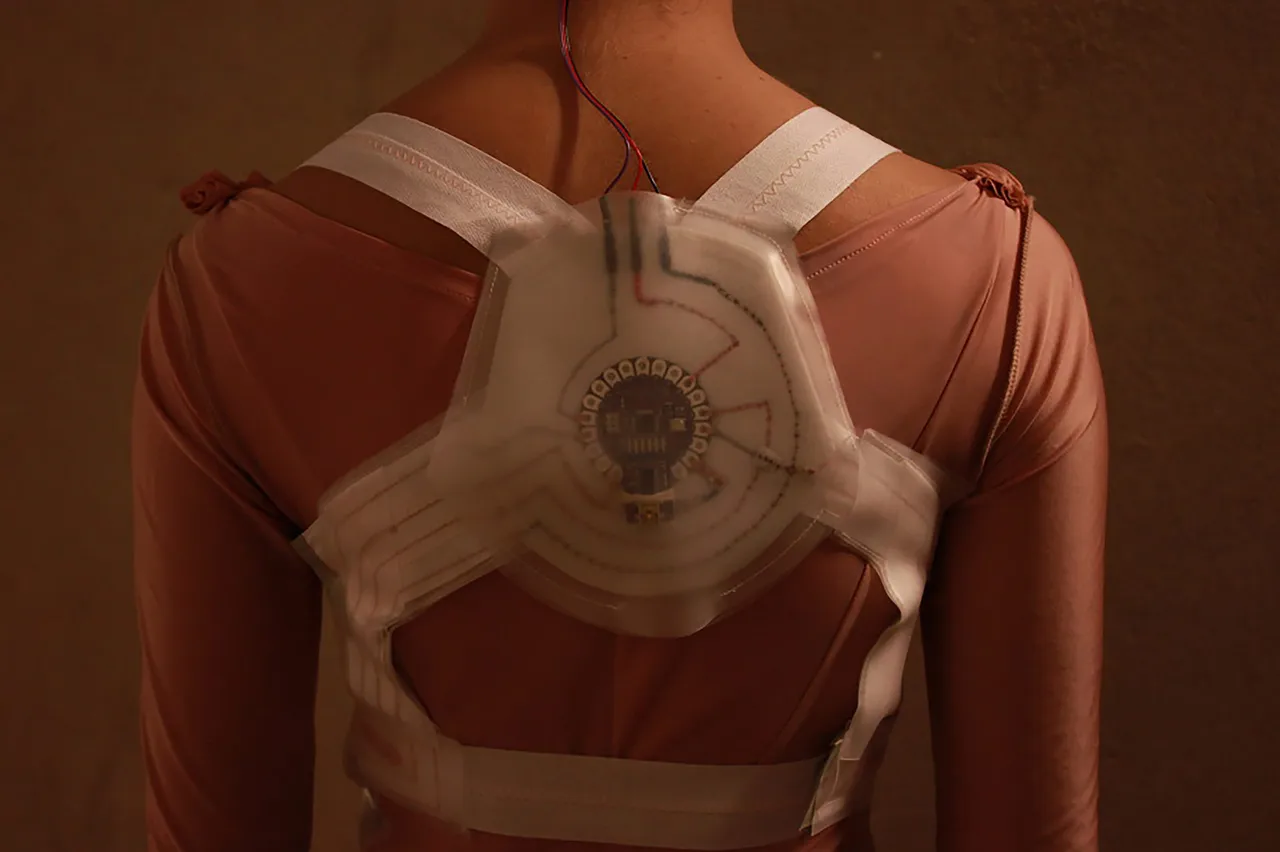
How can a tough and troublesome childhood shape personality and lead to someone exploring the psychosocial relationships between human beings and technology? What is it that makes us question scientific theories, and do it through art? German artist Monika Dorniak leaves a few meaningful life lessons by telling her own story.
Since age 5, Monika has experienced a number of events that later influenced her whole life and shaped her personality. Childhood traumas first led to her exploring the relations of body and mind, and later, during her Fashion Design studies, Monika became interested in human anatomy. Her education is mainly self-built, which makes her a diverse artist, one-of-a-kind, whose work (extremely personal) is a symbiosis of art and science, born out of internal cognitive conflicts, hours of research and observation. We talked with Monika about deep anxieties, messages she wants to deliver through her art, and why she tends to see clothing as an artificial skin.
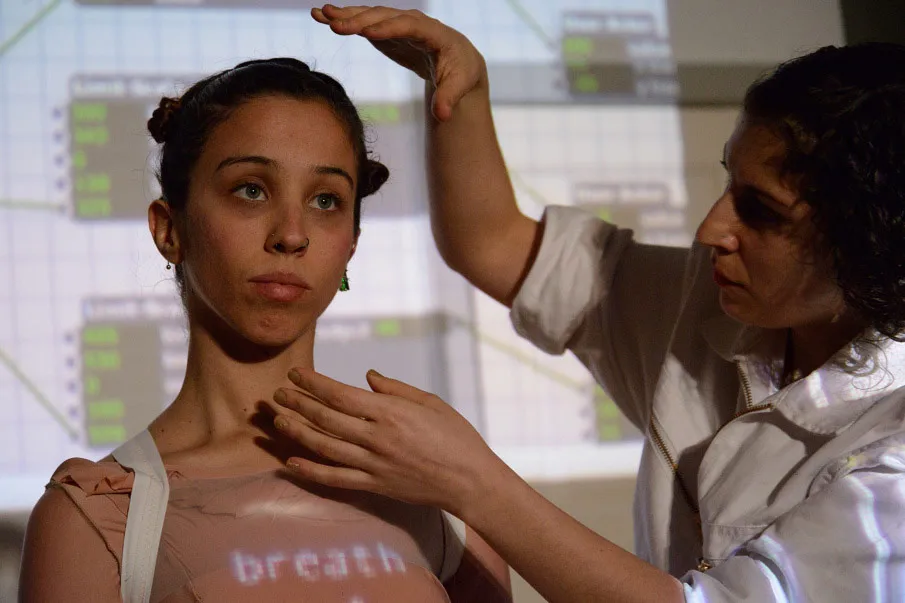
First of all, please tell our readers about your background. You went through some meaningful events in your past; what exactly influenced you as a person and had impact on your art?
My life is marked by a number of obscure indentations, which ushered me to different fields such as performing arts, psychology, cognitive science and applied arts. The diversity helped me to compose a suggestive puzzle instead of cherishing a pre-composition.
The earliest influence dates back to being not yet but existing as generative cells. My mother undertook sterilization before I was born. Our relationship was never without problems, thus I was not caught unaware to find out about it during my Psychology studies. At birth I was delivered a complex default setting without a construction manual. An essential part of my future was formed even before I was able to think. Within my work I often travel back and forth in history to examine the truth and falsehood of lives’ correlations and causalities. When I was five years old my reality was turned upside down. Shortly before visiting our Polish family over Christmas, my father had an accident in our house and died subsequently in the hospital. I was told he was in heaven to take care of me. Rather then tranquilizing me, I realized how problematic religion could be for a child seeking stability. I tried to stay in contact with a person in another dimension for a long time, that’s why my perception of time and space were altered. Perhaps I was musing when I experienced a bike accident age twelve. The incidental traumatic brain injury brought side effects as a.o., my olfactory and gustily nerves were diminished for ca. two years. Experiencing syncope with memory loss felt a bit like a tabula rasa, which made me wonder how fragile the term “identity” is. Forming my individual world of non-/fictional codes I was questioning reality early on. However, this quixotic world caused me problems in school and in my surrounding as none of my peers evidenced such a trauma. To translate my untranslatable state, I started making theatre plays and costumes together with my friends. This “social” idea to work with close people carried on into my later work. Until now I prefer a two-sided profound relationship and dialogue before starting collaboration.
The earliest influence dates back to being not yet but existing as generative cells. My mother undertook sterilization before I was born. Our relationship was never without problems, thus I was not caught unaware to find out about it during my Psychology studies. At birth I was delivered a complex default setting without a construction manual. An essential part of my future was formed even before I was able to think. Within my work I often travel back and forth in history to examine the truth and falsehood of lives’ correlations and causalities. When I was five years old my reality was turned upside down. Shortly before visiting our Polish family over Christmas, my father had an accident in our house and died subsequently in the hospital. I was told he was in heaven to take care of me. Rather then tranquilizing me, I realized how problematic religion could be for a child seeking stability. I tried to stay in contact with a person in another dimension for a long time, that’s why my perception of time and space were altered. Perhaps I was musing when I experienced a bike accident age twelve. The incidental traumatic brain injury brought side effects as a.o., my olfactory and gustily nerves were diminished for ca. two years. Experiencing syncope with memory loss felt a bit like a tabula rasa, which made me wonder how fragile the term “identity” is. Forming my individual world of non-/fictional codes I was questioning reality early on. However, this quixotic world caused me problems in school and in my surrounding as none of my peers evidenced such a trauma. To translate my untranslatable state, I started making theatre plays and costumes together with my friends. This “social” idea to work with close people carried on into my later work. Until now I prefer a two-sided profound relationship and dialogue before starting collaboration.
Why did you become interested in exploring such complex topics as, for instance, human anatomy?
By having been so close to death I evidenced that the relation between psychology and physiology is practically stronger than imparted in science. This trauma took hold of me guiding me to such interesting topics as the body and mind. During my Fashion Design studies I started a project looking at the anatomy in connection with the psychology. Working in the system I realized how my body turned into an object, like the mass-produced garments that surrounded me. The project Human Anatomy is adorning itself is imposing a strict austerity to the excessive and false representation of the human anatomy in our media-dominated society. Interpreting deeper layers of the skin (aka “dermis”) symbolized the value, which I see in garments: clothing functioning as an artificial skin delivering important messages.
After my experience in fashion design I initially went on to study Psychology for a while to explore the mind-body relation further and release myself. I had a strong desire to understand more about the development of the human identity. However, I was aware that too much knowledge could be debilitating. Thus, I concentrated further on neurological abilities such as metacognition (aka “knowing about knowing”) and meditation. This made me become more interested in contemporary dance. In truth I searched for a way to forget my past through my studies and realized that this is impossible due to the complexity of memory. Instead I learned to understand that we are able to choreograph parts of our emotions, which are dedicated to memories.
One could say that I am constantly searching for answers about human beings’ identity. I had to educate myself to become a person while growing up in a fragmented family. Coming across very individual interpretations of the body and mind throughout my research in different fields and cultures, I picked up a few puzzle pieces. This diversity made me question our westernized scientific theories, which often focus on a pre-selected group of people, making me even more aware that society perception of reality is distorted.
After my experience in fashion design I initially went on to study Psychology for a while to explore the mind-body relation further and release myself. I had a strong desire to understand more about the development of the human identity. However, I was aware that too much knowledge could be debilitating. Thus, I concentrated further on neurological abilities such as metacognition (aka “knowing about knowing”) and meditation. This made me become more interested in contemporary dance. In truth I searched for a way to forget my past through my studies and realized that this is impossible due to the complexity of memory. Instead I learned to understand that we are able to choreograph parts of our emotions, which are dedicated to memories.
One could say that I am constantly searching for answers about human beings’ identity. I had to educate myself to become a person while growing up in a fragmented family. Coming across very individual interpretations of the body and mind throughout my research in different fields and cultures, I picked up a few puzzle pieces. This diversity made me question our westernized scientific theories, which often focus on a pre-selected group of people, making me even more aware that society perception of reality is distorted.
The main course of your work is a relation between art and science. Could you please comment on this? How did you come to face this connection? Why is it important to understand both?
This symbiosis of art and science has existed throughout history, although it was abandoned by a variety of separators. This still being the case, I like the challenge to support it. Taking my A-levels in Biology and Philosophy I became interested in topics such as sustainability, genes, traditional medicine and somatic early on. Rather than reading a lot of theory, I was always more interested in applying the science to my life and experimenting with different settings such as John Cage, who was known for practicing Macrobiotics and Zen.
Currently, I am studying a MA in Art and Science at the CSM in London, where I have the possibility to process my experience after a struggling, yet stimulating quest. Between 2008-2015 I was researching and working partly in fashion design, (neuro) psychology and choreography/dance. I looked everywhere for this symbiosis of theory/practice - thinking/feeling - believing/knowing. Instead of forfeiting my quest, I started initiating interdisciplinary projects between 2011-2014 such as a collective called We Convert our Mind to Creativity.
With WCOMTC and some superb people, we curated exhibitions, symposia and workshops and connected people from a variety of fields. This project helped me realize that I was not the only one interested in legit hybrids, and this encouraged me to keep going! In my case, science is specified to the mind-body-relation, and philosophic-psychological topics such as identity. Although I own very individual experiences, I share experiences in common with my generation and translate this partly into a universal formula. Having researched in neurology I think that our anthropocentric zeitgeist demands a fresher and deeper experience of art in order to create sensual and memorial traces. Observing how our perception changed with the constant usage of technology I am making use of the development in science and technology to reflect our hybrid relationship critically.
Currently, I am studying a MA in Art and Science at the CSM in London, where I have the possibility to process my experience after a struggling, yet stimulating quest. Between 2008-2015 I was researching and working partly in fashion design, (neuro) psychology and choreography/dance. I looked everywhere for this symbiosis of theory/practice - thinking/feeling - believing/knowing. Instead of forfeiting my quest, I started initiating interdisciplinary projects between 2011-2014 such as a collective called We Convert our Mind to Creativity.
With WCOMTC and some superb people, we curated exhibitions, symposia and workshops and connected people from a variety of fields. This project helped me realize that I was not the only one interested in legit hybrids, and this encouraged me to keep going! In my case, science is specified to the mind-body-relation, and philosophic-psychological topics such as identity. Although I own very individual experiences, I share experiences in common with my generation and translate this partly into a universal formula. Having researched in neurology I think that our anthropocentric zeitgeist demands a fresher and deeper experience of art in order to create sensual and memorial traces. Observing how our perception changed with the constant usage of technology I am making use of the development in science and technology to reflect our hybrid relationship critically.
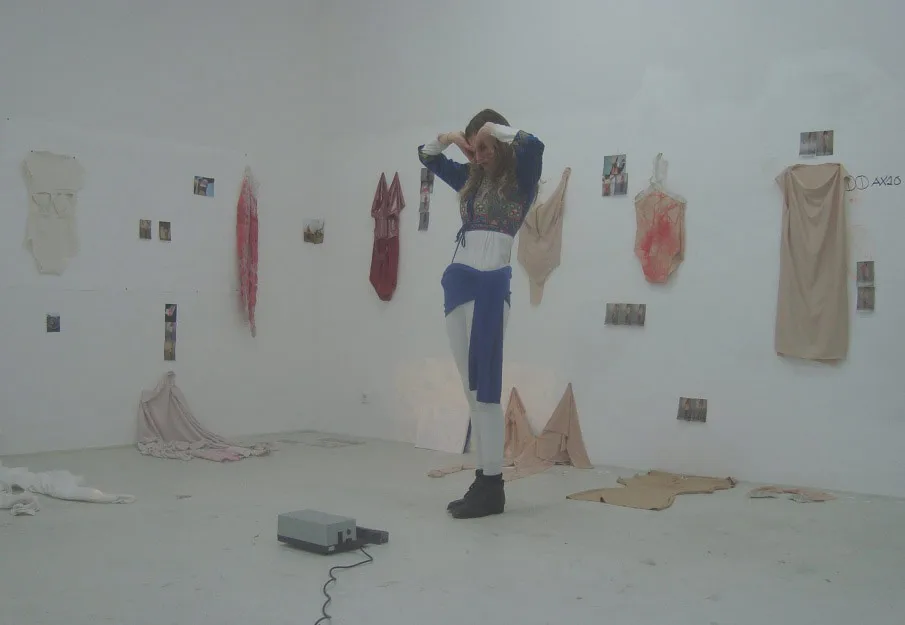
You often refer to the quote of Da Vinci that “everything is in a particular way connected.” How do you feel this connection in your art?
I explore this quote’s ambiguity. According to the butterfly effect theory, a small action can have a large impact on another time and space. This connection forces me to step outside of the present moment and relate to a wider cognitive spectrum. Comparable to playing chess, an action has many side notions: while we intend that a result will be positive, it may also be the opposite. In the end, it is certain that I don’t have an impact on everything in the future and there remains a curious unpredictability.
Stemming from a catholic family I was often questioning this idea of judging upon good and bad to make decisions. Religions’ categorizing and obsessive features often lead to problems, which are still evident in an enlightened society. Krzystof Kieslowskis work describes this struggle between thinking and feeling very well. In the Dekalogue a child is caught between two sides: his mother being very religious and his father being very rational. In Kieslowskis example it ends dramatically with the child’s death. Although sometimes separation is a natural result, I prefer agreeing and effective relations such as described in Isabelle Stengers’ philosophical essay Reclaiming animism. It opens up with the words, “Some people love to divide and classify, while others are bridge-makers – weaving relations that turn a divide into a living contrast, one whose power is to affect, to produce thinking and feeling.” By having previously constructed some doubtful and risky bridges, I am learning to become more sensitive to steady and pleasing connections these days.
Another area of interest is virtual connections. Through their implementation, connections are elaborated and outstretched to another degree! Most of us accepted to be connected with a variety of artificial networks without knowing the actual outcome yet. This connection of intimate, organic and synthetic connections is a social experiment with a lot of unconsidered voluntary experimental subjects. Although I am an active volunteer I would like to ask for a utopist reimbursement to return to my pre-internet-brain and live in a remote post-internet society!
Stemming from a catholic family I was often questioning this idea of judging upon good and bad to make decisions. Religions’ categorizing and obsessive features often lead to problems, which are still evident in an enlightened society. Krzystof Kieslowskis work describes this struggle between thinking and feeling very well. In the Dekalogue a child is caught between two sides: his mother being very religious and his father being very rational. In Kieslowskis example it ends dramatically with the child’s death. Although sometimes separation is a natural result, I prefer agreeing and effective relations such as described in Isabelle Stengers’ philosophical essay Reclaiming animism. It opens up with the words, “Some people love to divide and classify, while others are bridge-makers – weaving relations that turn a divide into a living contrast, one whose power is to affect, to produce thinking and feeling.” By having previously constructed some doubtful and risky bridges, I am learning to become more sensitive to steady and pleasing connections these days.
Another area of interest is virtual connections. Through their implementation, connections are elaborated and outstretched to another degree! Most of us accepted to be connected with a variety of artificial networks without knowing the actual outcome yet. This connection of intimate, organic and synthetic connections is a social experiment with a lot of unconsidered voluntary experimental subjects. Although I am an active volunteer I would like to ask for a utopist reimbursement to return to my pre-internet-brain and live in a remote post-internet society!
Have you received any important feedback on your work? Maybe criticism, or appreciation?
I started making art in a family without a cultural background and grew up with conflicting interests. Receiving professional criticism for the first time cuts very deep when the work arises from a biographic background. To carry on though, I had to accept that profound criticism improves ideas. And the insubstantial one needs to be consistently ignored.
The people that gave me the most essential feedback are the ones I respect due to their knowledge and wisdom. Most of the best critics crossed my way in the most curious circumstances when I allowed myself to float regardless of societies’ categories. This feedback made me aware to dig deeper. On the other hand, this state is vulnerable, as many people tend to protect their territory by attacking visitors. I support Byung-Chul Han’s idea that a new work of art needs time to develop. Han is a philosopher looking at the relation of neuronal disorders, internet and subjectivity. Often I question if I should step outside of the WWW, as it interrupts my interpretation of time. Using social media as an artist means that one can receive ignorant criticism from people who mostly don’t dare to speak face to face. Part of the virtual world is representing the insecure monstrosity of shallow prejudices, ridiculous lies and crude answers. And finally it’s a den of thieves with ideas being stolen without literally moving a muscle. Internet is an interesting exchange tool, however it will at this state never substitute a deep, authentic conversation.
The people that gave me the most essential feedback are the ones I respect due to their knowledge and wisdom. Most of the best critics crossed my way in the most curious circumstances when I allowed myself to float regardless of societies’ categories. This feedback made me aware to dig deeper. On the other hand, this state is vulnerable, as many people tend to protect their territory by attacking visitors. I support Byung-Chul Han’s idea that a new work of art needs time to develop. Han is a philosopher looking at the relation of neuronal disorders, internet and subjectivity. Often I question if I should step outside of the WWW, as it interrupts my interpretation of time. Using social media as an artist means that one can receive ignorant criticism from people who mostly don’t dare to speak face to face. Part of the virtual world is representing the insecure monstrosity of shallow prejudices, ridiculous lies and crude answers. And finally it’s a den of thieves with ideas being stolen without literally moving a muscle. Internet is an interesting exchange tool, however it will at this state never substitute a deep, authentic conversation.
Do you believe that each one of us has a hidden talent within, or some specific calling we should dedicate our lives to? How do you feel about self-growth and self-exploration?
Contrary to past theories, personhood is luckily not static. Thus, change is not linear by depending on the outside circumstances and inside experiences, such as trauma. Throughout my life I have tried to understand the default, which I received at birth. Being given a Polish and German background, I was different to most of the people surrounding me in a German rural village. This otherness was not the problem, yet the lack of acceptance I faced and the social stigma which arouse consequently. Unfortunately, social obstacles often forbid being different. Looking at neuropsychological complexity, it becomes evident that a true change takes time and ought not to be mistaken by simply appearing to be a different person. Being a different person means standing for the responsibilities of being different, which can cause you even more problems in a mainstream society.
I have learned throughout time that it is difficult to detach myself from the past. But rather than letting it take over my life, I constantly search for harmless techniques such as metacognition, to release myself from its heaviness. In the end, the development of a person is always connected with society. Only because we live in a time with seemingly progress and scientific development does not mean that society is enlightened and liberal.
Finally, I want to refer to a theory, which I was reminded of at a lecture from Lorraine Daston the other day. It says that it is more conducive to understand that one does not know yet, as thereby one will constantly seek knowledge. On the contrary, those who assume they know are likely to become ignorant.
I have learned throughout time that it is difficult to detach myself from the past. But rather than letting it take over my life, I constantly search for harmless techniques such as metacognition, to release myself from its heaviness. In the end, the development of a person is always connected with society. Only because we live in a time with seemingly progress and scientific development does not mean that society is enlightened and liberal.
Finally, I want to refer to a theory, which I was reminded of at a lecture from Lorraine Daston the other day. It says that it is more conducive to understand that one does not know yet, as thereby one will constantly seek knowledge. On the contrary, those who assume they know are likely to become ignorant.