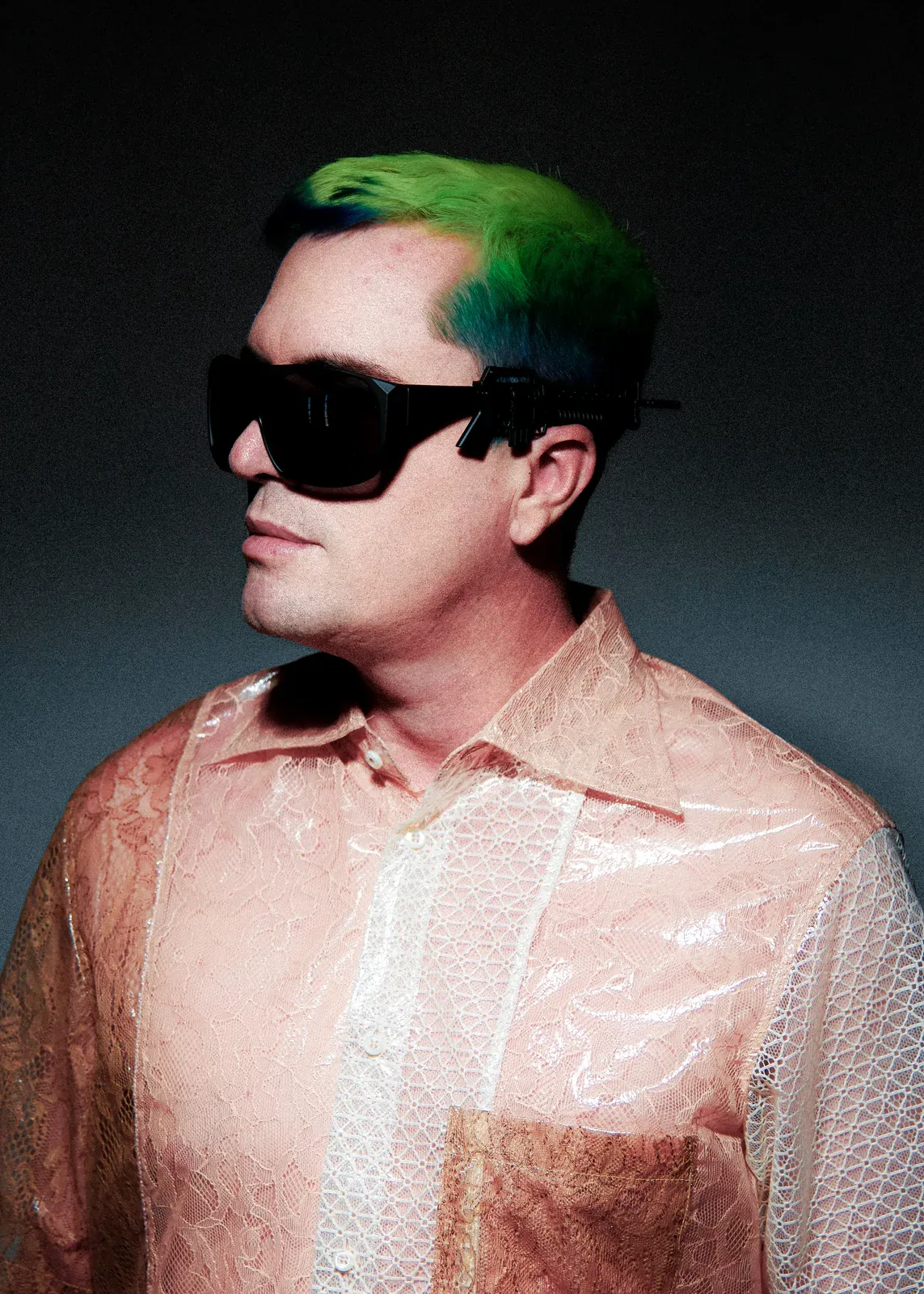
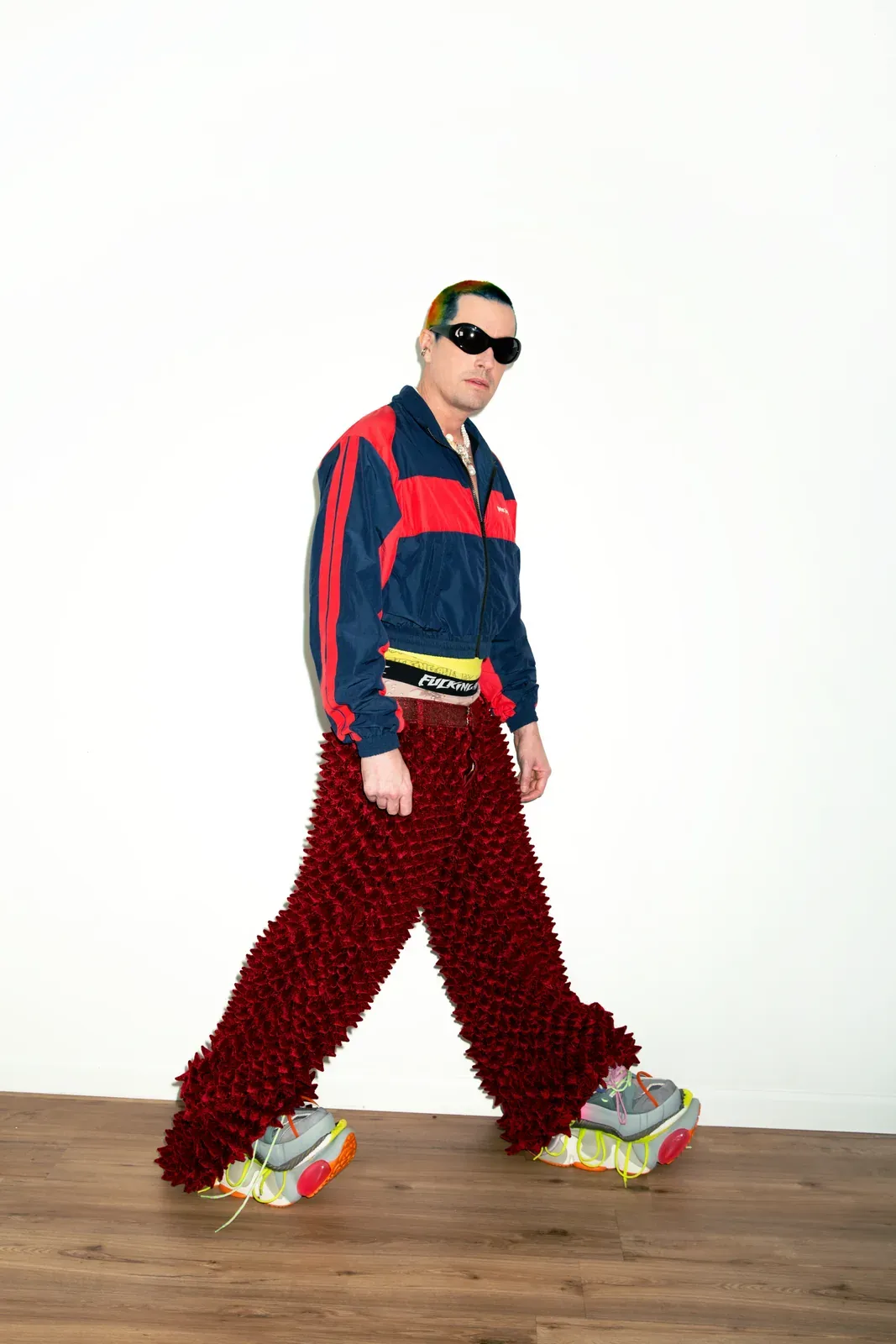
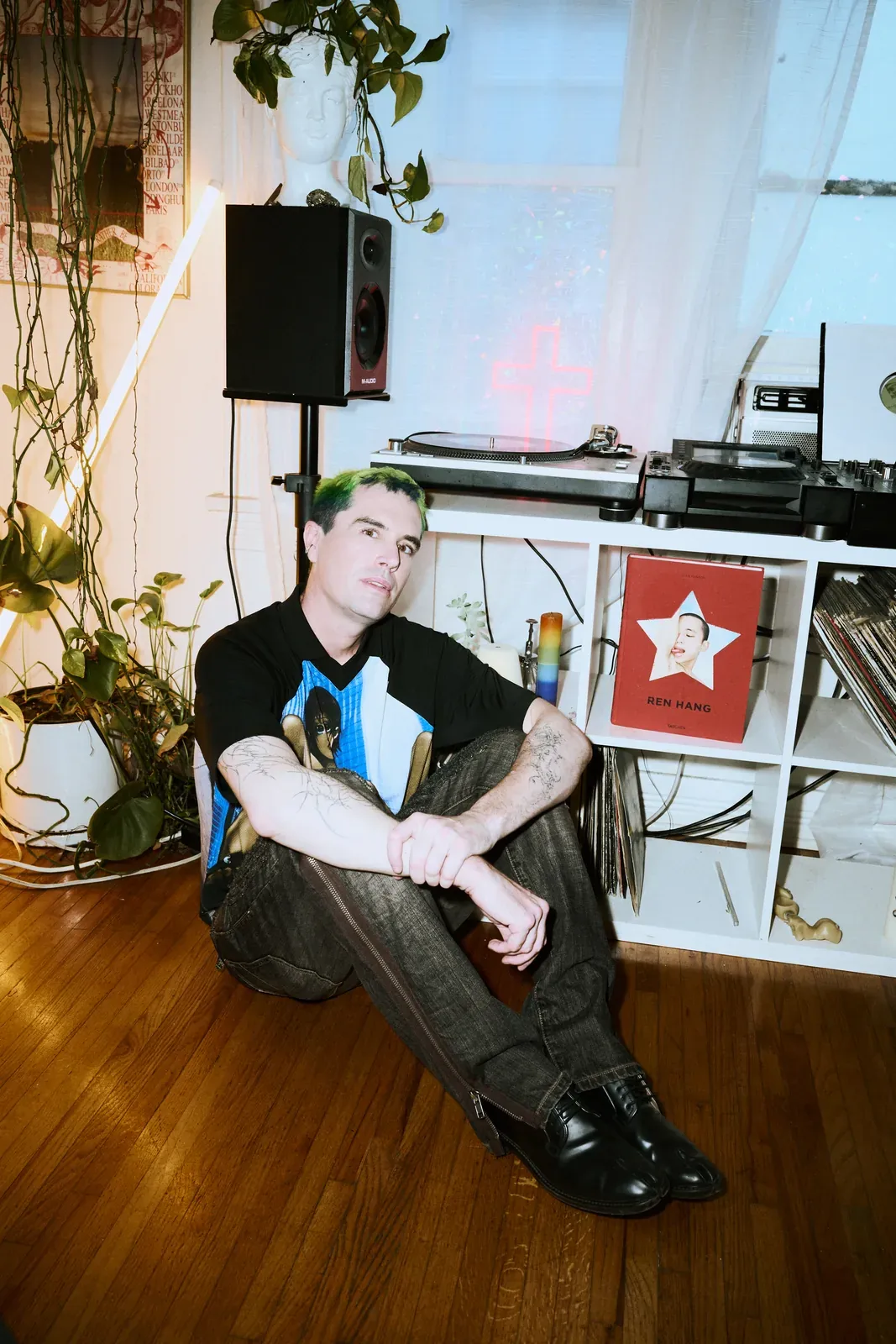
John Bryars once had a dream in which he was flying, until he looked down at his hands and discovered screws embedded in them. He could even feel himself pulling them out. It sounds like something from a David Cronenberg film, but for the Los Angeles-based producer, experiences like this have become a source of musical inspiration. His second EP, Lucid State, out today via his own label Aeonic Forme, explores that strange territory between being in control and letting things happen, with some pretty unexpected results.
The six-track record moves from the intensity of acid techno to the more delicate sounds of ambient music, reflecting Bryars’ fascination with the unpredictable nature of dreams. But his creative ambitions go well beyond the studio. Having started out in visual art, he launched Aeonic Forme earlier this year to bring different disciplines together while creating more opportunities for queer and underrepresented artists. We spoke with him about building his own musical universe, the importance of protecting underground club culture and learning to trust his instincts.
Before getting into electronic music, your creative journey actually began in visual art. What first drew you towards music, and do you remember the moment when you realised it was something you wanted to pursue seriously?
Music was actually there first. I started playing piano at nine and drums at fourteen, and at eighteen I bought my first turntables and started DJing on vinyl. At the same time, I was always making visual art. I spent much of my teens painting and eventually went to art school in San Francisco. When I was younger, I played in a group, and we got to open for artists like The Prodigy, which was incredible at that age. Being onstage and feeling that energy has stayed with me ever since. I stepped away from performing for a while to focus on visual art, but I found my way back to DJing and producing.
There was no single moment when I decided to pursue music. It was always there in some form, and I just kept coming back to it. What I love most is the process: hours in the studio, finding something unexpected, then taking it into a club and experiencing it with other people. Music and visual art have never felt separate to me. They’re two ways of building the same world. Earlier this year I closed the Basement floor at Basement in New York for BOUND. It was one of those really euphoric moments where everything just clicked. Katie Rex booked me for that night, and I’m really excited to be playing with her b2b at Bodyshop in Los Angeles on December 4. It feels like another thread of that same world continuing.
There was no single moment when I decided to pursue music. It was always there in some form, and I just kept coming back to it. What I love most is the process: hours in the studio, finding something unexpected, then taking it into a club and experiencing it with other people. Music and visual art have never felt separate to me. They’re two ways of building the same world. Earlier this year I closed the Basement floor at Basement in New York for BOUND. It was one of those really euphoric moments where everything just clicked. Katie Rex booked me for that night, and I’m really excited to be playing with her b2b at Bodyshop in Los Angeles on December 4. It feels like another thread of that same world continuing.
Your second EP, Lucid State, arrives on November 27, and you’ve described it as a record that explores the space between control and surrender. What inspired this concept, and how did it influence the way you approached the music?
Some of the tracks on Lucid State started about three years ago. Earlier this year I started building my own modular synthesiser setup, and that changed everything. I built a custom effects chain that let me manipulate sound in ways I hadn’t before. I used it to rework the older tracks and brought modular into every track, which gave the whole EP a shared sound.
The idea of control and surrender came from the music itself and from my fascination with lucid dreaming. There’s something strange about becoming conscious inside a dream and realising you can shape what’s happening, while still never being fully in control. Modular synthesis feels the same way. You build a patch with intention, and it evolves into something you never anticipated. Some of the most interesting moments happen when you stop trying to control everything. That tension runs through the whole EP. There are aggressive, distorted moments and really delicate ambient passages, and I wanted both extremes to exist together.
The idea of control and surrender came from the music itself and from my fascination with lucid dreaming. There’s something strange about becoming conscious inside a dream and realising you can shape what’s happening, while still never being fully in control. Modular synthesis feels the same way. You build a patch with intention, and it evolves into something you never anticipated. Some of the most interesting moments happen when you stop trying to control everything. That tension runs through the whole EP. There are aggressive, distorted moments and really delicate ambient passages, and I wanted both extremes to exist together.
Given your visual arts background, I’m curious about how you experience sound. Do you tend to think in images when you’re producing? And what has your experience as a visual artist taught you about making music?
Definitely. I’m a very visual person, and I associate sounds with images, colours, textures and environments. Sometimes a photograph or a piece of artwork can spark an entire musical idea. There’s one piece by Cai Guo-Qiang called Sky Ladder that really stayed with me. It’s this huge ladder of fire rising into the sky, and there’s something about the scale of it and how temporary it is that I find really moving. Bougainvillea was partly inspired by that feeling. Something beautiful, weightless and almost impossible.
At the San Francisco Art Institute I started in painting and moved into design and technology. It was a conceptual, experimental environment, and performance art was woven into the school’s history. That shaped how I make music: I’m less interested in what genre a track belongs to than in what kind of world it creates. It also shapes how I’m building Aeonic Forme. The visual identity, the artwork, the music and the direction of the label are all parts of one creative project, and I want to leave room for all of it to evolve.
At the San Francisco Art Institute I started in painting and moved into design and technology. It was a conceptual, experimental environment, and performance art was woven into the school’s history. That shaped how I make music: I’m less interested in what genre a track belongs to than in what kind of world it creates. It also shapes how I’m building Aeonic Forme. The visual identity, the artwork, the music and the direction of the label are all parts of one creative project, and I want to leave room for all of it to evolve.
“Some of the most interesting moments happen when you stop trying to control everything.”
The EP begins with a more intense, club-oriented sound before gradually moving into ambient territory. Was that contrast something you had planned from the beginning, or did the record naturally evolve in that direction?
It evolved naturally. As the record took shape, I realised it moved like a dream, shifting between completely different emotional states. I once had a lucid dream where I was flying. I looked down at my hands and suddenly realised I was dreaming. I kept flying, and when I looked again, there were screws embedded in my hands. I started pulling them out, and I could actually feel it. Then I woke up. That stayed with me because it felt so physically real. Dreams flip from euphoric to disturbing without warning, and even when they make no sense, you’re completely inside them. Dreams don’t respect structure, and I wanted the record to move with that same freedom. It starts in the warehouse or club and ends somewhere completely different, like emerging from the experience into another place.
Let’s talk about TON 618 and Unfixed States. What was the creative process behind these two tracks like? Any unexpected discoveries or anecdotes you’d like to share?
Both tracks came from a lot of experimentation. I’ve always loved the sound of the Roland TB-303, and acid has been part of my production for years, but here I wanted to push it somewhere less familiar. My process is a lot of layering and reprocessing. I’ll record an acid sequence, run it through my modular effects chain, manipulate it and record a new layer, and repeat until the original sound is almost unrecognisable.
TON 618 is named after one of the most massive black holes known, and I wanted to translate that scale and pressure into sound. It has screaming acid lines and a rubbery, almost dub-like bass. Then toward the end, a huge sub-bass comes in. I wanted the low end to feel gravitational, like the whole track was being dragged inward and pulled apart under its own weight. With Unfixed States, the idea was instability and transformation. I wanted the textures to keep shifting rather than settling into one shape. The best part of working this way is stumbling onto something you never planned.
TON 618 is named after one of the most massive black holes known, and I wanted to translate that scale and pressure into sound. It has screaming acid lines and a rubbery, almost dub-like bass. Then toward the end, a huge sub-bass comes in. I wanted the low end to feel gravitational, like the whole track was being dragged inward and pulled apart under its own weight. With Unfixed States, the idea was instability and transformation. I wanted the textures to keep shifting rather than settling into one shape. The best part of working this way is stumbling onto something you never planned.
The final track, Bougainvillea, takes things somewhere much calmer. Why did you want to end the EP on that note?
I wanted the record to end somewhere beautiful. After all the distortion and intensity, it felt like everything needed a place to open up. I’ve always had a strong connection to ambient music. It doesn’t have to go anywhere. It can just exist and let you get lost in it. With Bougainvillea, I wanted a feeling of euphoria, but a gentle, almost melancholic one: peaceful, but carrying a lot of emotion. For me, that final track is like waking up from a dream.
Earlier this year, you launched your own label, Aeonic Forme. What pushed you to take that step, and what would you like the label to represent within the electronic music scene?
I’d wanted to start Aeonic Forme for a long time. I wanted the freedom to release my own music on my own terms, but also to build something bigger than a vehicle for my own work. Coming from visual art, I’m drawn to projects that feel like complete worlds. The music matters, but so do the artwork, the design, the identity, the people involved and the way everything is presented. The name comes from two ideas. Aeonic relates to time and cycles, and Forme to the idea that nothing is ever fixed. Culture is always moving. Music, fashion, identity, technology and art are constantly feeding into each other and becoming something new.
I’m interested in music that doesn’t fit neatly into one category, and in artists willing to take risks. Representation matters to me too. Queer artists, trans artists and artists of colour have shaped underground electronic music enormously, and I want Aeonic Forme to actively make space for those voices. Ultimately, I want the label to have a recognisable point of view without being trapped by its own identity.
I’m interested in music that doesn’t fit neatly into one category, and in artists willing to take risks. Representation matters to me too. Queer artists, trans artists and artists of colour have shaped underground electronic music enormously, and I want Aeonic Forme to actively make space for those voices. Ultimately, I want the label to have a recognisable point of view without being trapped by its own identity.
The label’s first compilation, FORME I, came out earlier this month, featuring artists including Mac Declos and Maara, with proceeds going to the Transgender Law Center and CHIRLA. How do you see the relationship between electronic music and social responsibility?
Electronic music has always been tied to community and social change, especially in underground club culture. So much of the music and so many of the spaces we celebrate today were created by communities that weren’t accepted or represented in the mainstream. With FORME I, I wanted the compilation to reflect what Aeonic Forme stands for, both musically and culturally. We brought together ten artists from different corners of the underground and donated 100% of the proceeds to the Transgender Law Center and CHIRLA.
For me, community isn’t separate from the music. It’s part of why the music exists. Music can bring people together, but it can also create visibility and resources for the communities that need them. The response has been really encouraging. x3butterfly’s track abriefencounter was premiered by Mixmag, and Resident Advisor covered the release. I want future releases to stay connected to that awareness and to the communities and history this culture rests on.
For me, community isn’t separate from the music. It’s part of why the music exists. Music can bring people together, but it can also create visibility and resources for the communities that need them. The response has been really encouraging. x3butterfly’s track abriefencounter was premiered by Mixmag, and Resident Advisor covered the release. I want future releases to stay connected to that awareness and to the communities and history this culture rests on.
As a queer artist, how do you feel about the current state of inclusivity in electronic music? Is the scene moving in the right direction, or are there still important conversations we’re avoiding?
There’s real positive change. So many incredible queer and trans artists are shaping electronic music right now, and there’s a growing appreciation for what they bring. But there’s still a difference between celebrating queer culture and creating opportunities for queer artists. Representation matters, but it has to exist beyond a single event, campaign or moment.
Through Aeonic Forme, I’m able to build those spaces myself. On December 12 in Los Angeles, we’re teaming up with my good friend Lindon and his party, Straight Party, which is, of course, not exactly a straight party. The label has been releasing music since earlier this year, so this is our chance to finally bring everyone together in person. Peachlyfe will perform live for the first time alongside Dangerous Rose, Josh Steers and myself.
Clubs have historically been places where people could experiment with their identities, find community and feel a freedom they might not have elsewhere. As electronic music becomes more commercialised, it’s important to protect that spirit and keep creating real space and opportunity for the people who shape it.
Between launching Aeonic Forme and preparing to release Lucid State, it’s been quite a significant year for you. What have you learnt about yourself throughout this process?
The biggest shift this year has been learning to trust an idea before I know whether anyone else will understand it. Launching a label is an enormous amount of work, and I didn’t realise how much I’d be taking on. I’ve been involved in almost everything, from the logo and visual identity to the website, the releases and working directly with artists. In a way, it’s brought me back to my visual art background, because I’m treating the label as one large creative project.
It’s been rewarding to watch ideas that lived in my head for so long finally become real. There were moments I questioned whether people would connect with what I was doing, but this year reinforced how important it is to follow the ideas you’re genuinely excited about instead of constantly second-guessing them. More than anything, I feel creatively inspired again. Between building the label, working with modular synthesis, releasing new music and collaborating with so many talented people, I feel like I’m only beginning to understand what Aeonic Forme and my own work can become.
It’s been rewarding to watch ideas that lived in my head for so long finally become real. There were moments I questioned whether people would connect with what I was doing, but this year reinforced how important it is to follow the ideas you’re genuinely excited about instead of constantly second-guessing them. More than anything, I feel creatively inspired again. Between building the label, working with modular synthesis, releasing new music and collaborating with so many talented people, I feel like I’m only beginning to understand what Aeonic Forme and my own work can become.
Every Friday, METAL Weekly gathers the week's stories. Subscribe.