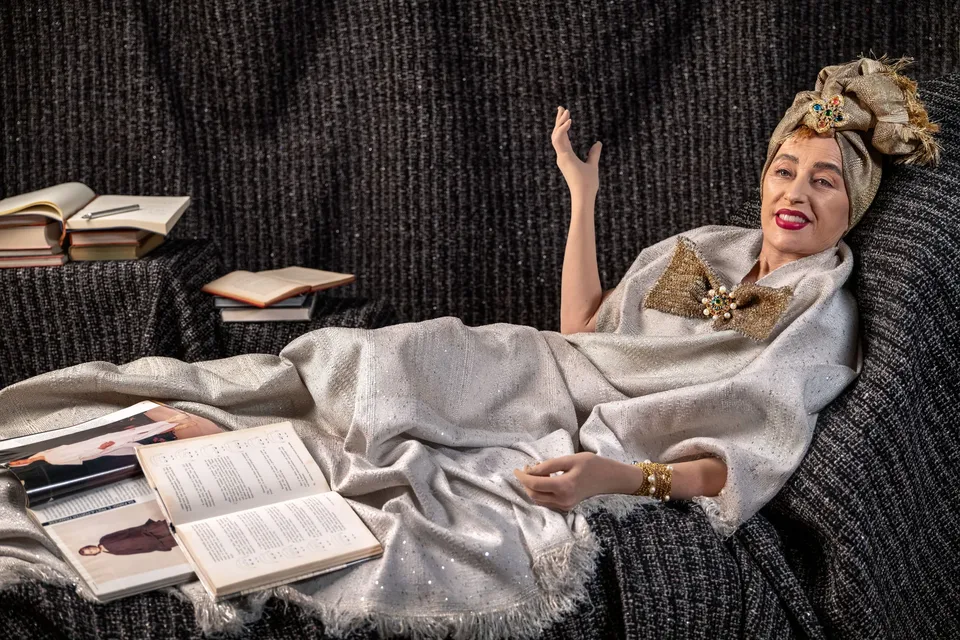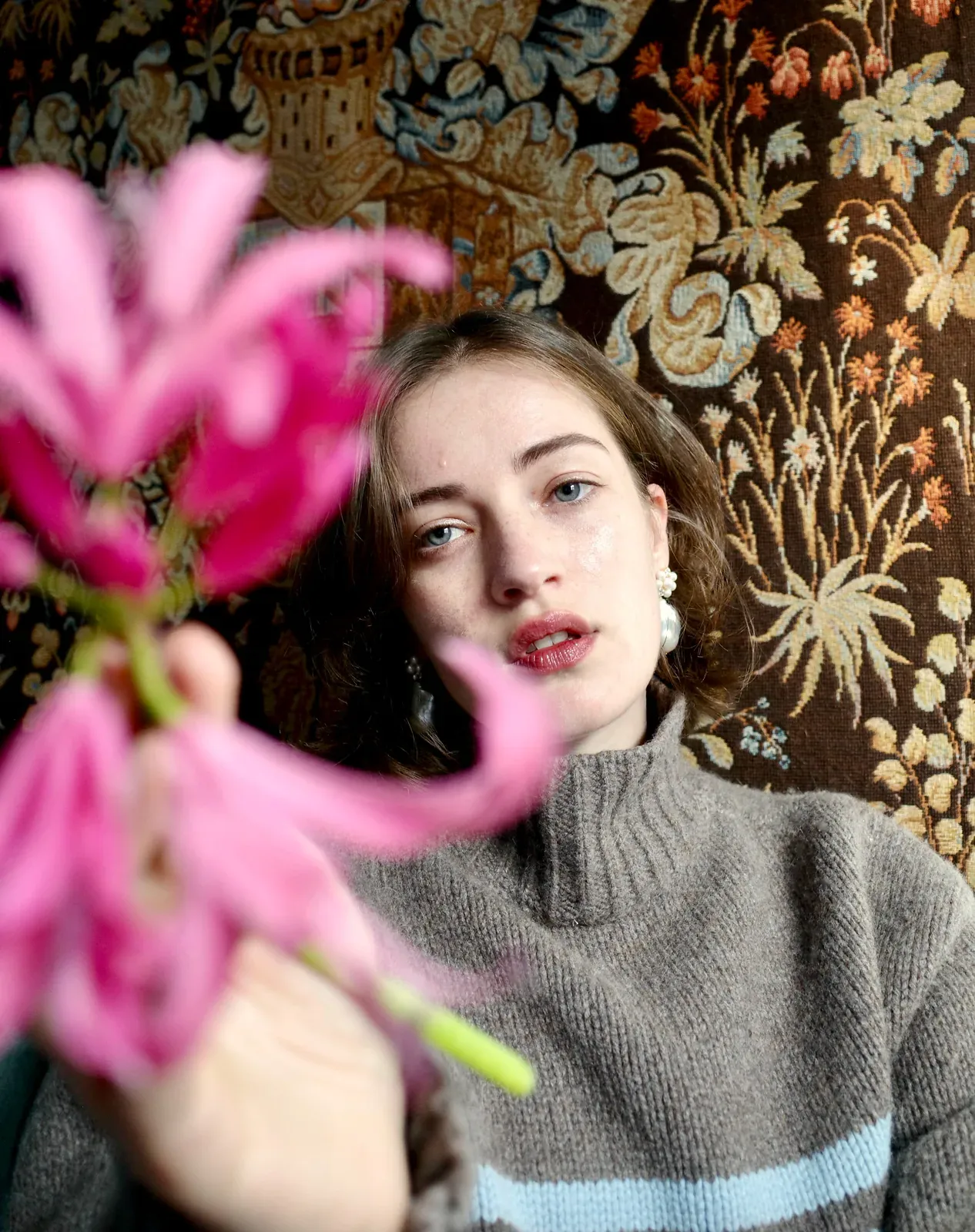
Julia Campbell-Gillies was mesmerised by flowers in an all-consuming fashion from day one. Her very first pot of bright red tulips was gifted to her as a child in South Africa. In a place where freezing temperatures never came, tulip blooms were never triggered. So, these particular flowers were a rarity to nine-year-old Julia, whose world had yet to expand beyond the small seaside town she grew up in, where the beauty standard was equally one-dimensional. Neither the world in front of her nor the world inside her had opened up yet. She was struck by the prettiness of the gift in her hand, and the novelty of it.
That fascination with ephemeral beauties has followed Campbell-Gillies ever since. As a model, florist, writer, and artist, she knows that life is dull without a bit of indulgence. And that there’s nothing wrong with nourishing that part of yourself that longs for artistic delicacies. Recently recognised by the British Fashion Council (amongst their 2026 New Wave: Creatives) for her floristry, Campbell-Gillies is weaving together the worlds of fashion and flowers in the modern age. Doubtless, the two have long been in conversation due to their knack for extravagance.
From the tulip mania of the Dutch Golden Age to the gardens of Versailles, decorative visuals have served as symbols of opulence. As Campbell-Gillies believes, there’s nothing more reaffirming than creating for creating’s sake. It’s a philosophy that she not only pours into her work but into her personal universe. With such an artistic career, it’s often easy for her to forget to be creative just for the love of it; but real joy is found through living extravagantly, which is a pursuit that can be achieved with less money than you might think. The multi-hyphenate artist helps redefine luxury as the thing that happens when you carve out time and space to truly sit with the world and wonder at it in an almost childlike way. She trusts in the idea that you have an entire garden inside yourself to nourish, full of interests and curiosities that belong to only you, and that is truly lovely and luxurious.
When you were scouted in South Africa at sixteen, you didn’t initially see yourself as fitting the conventional beauty standard. You described yourself as “freckly, pale, and flat-chested.” Did modelling and opening up your world change the way you understood or defined beauty?
Yes, beauty is very cultural. When I talk about the beauty standard, I mean it in the sort of microcosm of where I was growing up, which is a seaside city in South Africa where it’s very beach-centric. Having a gorgeous tan and a sort of Baywatch aesthetic was more the order of the day. My sort of figurehead of a South African person becoming a really famous model was Candice Swanepoel, who you may be familiar with. She’s a Victoria’s Secret model.
That was kind of the imagined opportunity if you were gonna be like a stunning South African person who ends up modelling abroad; you’re probably gonna look like her, in my head. But obviously, I grew up in the era of Tumblr, and there was definitely room for other beautiful people. It just never really occurred to me that I would have what it takes to actually be able to work as a model, you know. They’re very different things: being a pretty person where you are, being a pretty person somewhere else, and then being professionally photogenic is a whole other bridge to a whole other place.
Very true, a place or city can have a really big effect on someone’s creative work too. I know you noted when you first got to London, you thought it felt both evil and enchanting. But in time, you realised you couldn’t imagine yourself living anywhere else. What was it about London that initially made you feel really unsettled, but then eventually made you feel at home?
London is a very lonely place. And it’s very easy to feel lonely even in crowded places in London. I’ve always said that if in Paris it’s romantic to be on your own, in London it's unromantic to even be romantic, you know? There’s a certain expansiveness to it. There is no border. There’s no edge for you to feel contained. It is just quite a boundless place; it’s like ever-expanding. I think just knowing your way around a place can give you such a sense of where you belong, and that’s what I’ve always said to people arriving here. I’ve said, give yourself two years to know your own way home from anywhere, basically.
There’s a language of trying to find your way in London, and there are the codes of politeness, which often really just mean: eyes down, giving people ample space, and not really asking anyone for anything, which can be super isolating, of course. It gives you very few access points to other people, especially compared to South Africa, which is like a phenomenally friendly place, somewhat alarmingly! You can find yourself in a conversation with someone in the queue for the cashier at the supermarket, and they will be interrogating you about what you’ve chosen to have for dinner tonight, how you cook that, and what you serve it with, and you’ll be sort of in an intense conversation with almost anyone all the time, whereas London is super private. Super polite. Which can be very isolating.
“It never occurred to me that I would have what it takes to work as a model.”
Right, so you grew up with a lot of community?
I mean, community’s a weird word, especially in South Africa. There’s a community in that there’s a sort of understanding between people, which I suppose creates a concept of community. You all speak the same language, and you all have the same references, and certainly I think [in] South Africa, we have a really similar sense of humour that all people understand. It’s very dark, and it’s very sarcastic, but it’s optimistic at the same time. It’s funny because I do think that what I could never find on a personal level as [far as] community [goes] in South Africa, I’ve been able to find much more in London. The actual interpersonal aspect of community is something that I could never quite grasp anywhere in South Africa. I could never really get into a clique or a friend group. When I came here, it just seemed like there were people who had more of the same language as I had, more of the same references, the same humour.
And as someone who’s both a model and an artist of sorts in arranging flowers, you’ve become accustomed to both being looked at and then creating things to be looked at. How has that duality in your experiences changed the way that you think about the relationship between subject and spectator?
I think about this a lot! It’s something that’s really present in both tracks of my work. Time is absolutely essential with modelling as your career, your career opportunities and your shelf life. There’s sort of a joke, I call my Substack Vase Life, talking about how flowers have a certain amount of time that they can be used and that they’re beautiful for before they start sort of going over the edge. I think that sort of tension between how long is too long, how long do you have to continue to try and be visible, and at what point does it become uncomfortable to be looked at or to have to be looking at something, I think about a lot. There’s a lot of dualism in it, definitely. I’m meditating on this idea of subject and viewer a lot. Modelling is a highly visible job. There are a million photos of me online at any given point, and anyone can see my face from every angle from every year that I’ve ever been modelling, which is fourteen years as of this year. But there’s also an invisibility, where people are often really surprised by my actual demeanour in person because I think that it belies other aspects of how I speak, and my accent, and how I move. There’s a falseness to the visibility. Yes, my face is out there, my body is out there in a very two-dimensional sense, but there’s still a lot that’s secret. I think I love the flowers for that, because I think my favourite way to arrange flowers is to do it in such a way that it’s as if I wasn’t there. Sort of continue that secrecy. I want the material to be at the forefront. I don't necessarily want my concept to be what people are aware of.
Yeah, do you think you're naturally just more of a reserved person, or is it a vulnerability type of thing?
I’m not reserved, no, I don't think it’s that. It’s funny because — yes and no. It’s been a long time of being online and being available in a lot of ways. The older I get, the more I see the value in guarding certain things. I’m seeing the value in keeping some things for me, keeping some experiences and some aspects of my life that are really meaningful to me that probably mean nothing to other people; it’s a powerful thing. It’s a self-love thing to keep those things to yourself. It can be protective. Yes, on the one hand, vulnerability is super powerful and can create so much traction in your life and can create so much opportunity, but at the same time, there is a limit to that. Giving yourself gifts that aren’t for other people can be very powerful in your own creative process as well.
Gifts? Like a self-reward?
Well, secrets and experiences and places, and certain aspects of your taste that you can enjoy for yourself rather than trying to flog. Like, I get a lot of shit from my friends for my music taste. I have a really particular music taste, and I’m very obsessive about the music that I like, and it’s not really something I’ve written about. But it’s never gonna really be part of the picture, because I’m not trying to get anything from it other than what I get from it, you know? There’s definitely a part of practising your own taste that should be private.
I totally see what you mean. That is a good thing. So, the British Fashion Council has just named you on its 2026 New Wave Creatives list as the cohort's sole florist. What do you think your work represents about the evolving relationship between floristry and fashion?
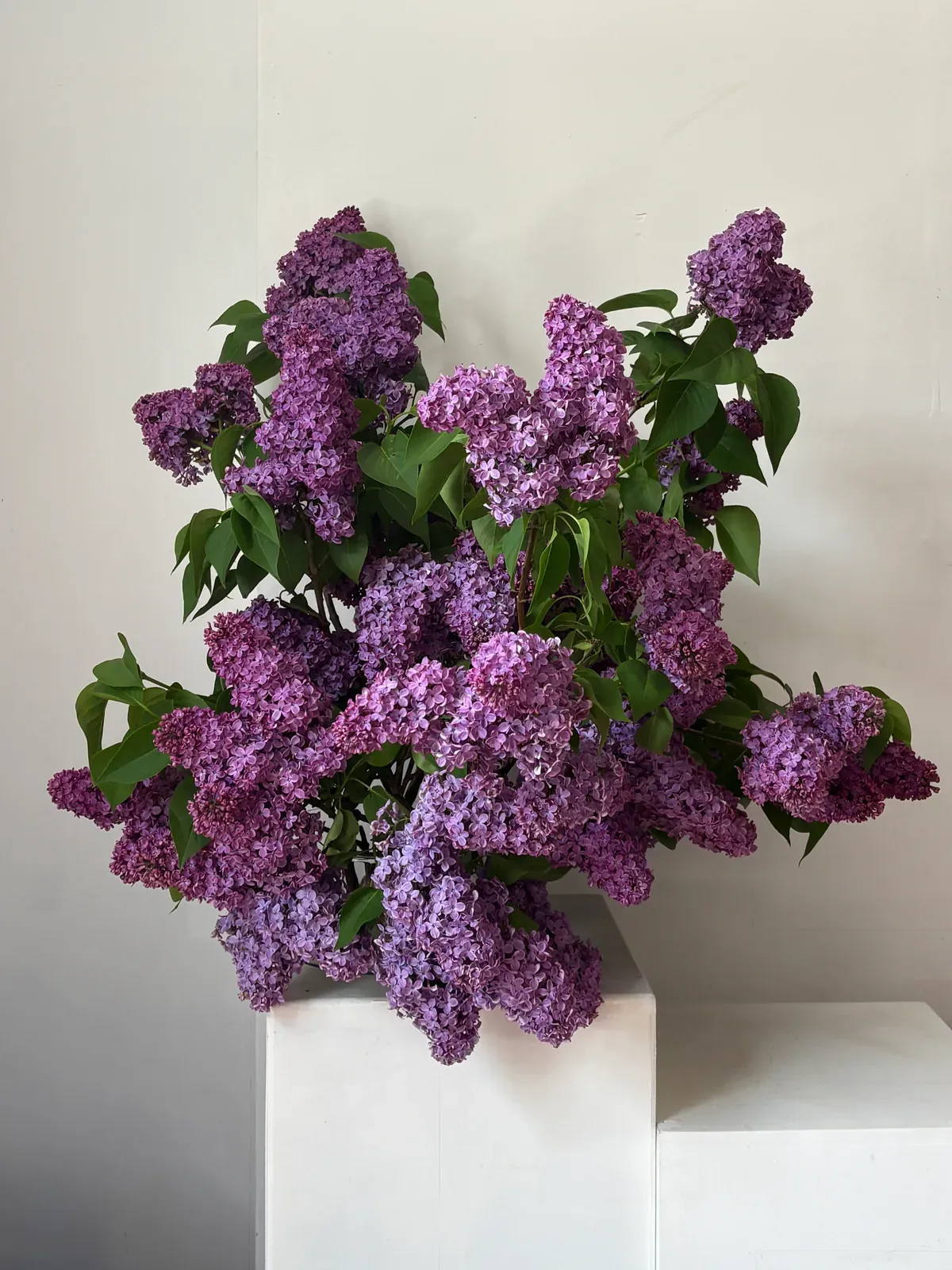
Flowers are so hot right now, man. Like, people love flowers. It’s interesting. I think we’re entering a period in society where the boundaries are really melting away about what we can turn into signifiers and commodities, hinting at our status and our wealth and that kind of thing. I think flowers [indicate] almost Marie Antoinette levels of excess, that we can afford to plough a field and grow something in it that we can’t eat, that is just beautiful. We’re grasping at this idea of a society that has enough for everyone and has enough to do things for beauty, which we all need in society right now. I think we dream of that as an idea. It’s definitely becoming a medium in and of itself because I think people can see its value even if they can’t understand its value. People often say that flowers just die, and it’s like, well, yeah, and food just gets eaten, you know? You go to a restaurant, you spend loads of money eating a beautiful meal, and we know where it ends up. It’s all of these things. Clothes are just clothes. You could wear a sack if you needed to, and you’d be alright. All of these pursuits have value that is quite philosophical, but at the same time, we still somehow all know what it means, and we all know that it’s important. Flowers are about occasion. Flowers are about importance, and underlining a moment in time, and that's definitely what I’m trying to do. I’m trying to look at this day of this year and this country and what’s growing now, because I think that shows a sort of reverence for time.
Yeah, the relationship between floristry and fashion right now is interesting. I also feel like because there’s been such a trend in fashion to lean toward the digital and technological, I think we’re now moving toward a more natural angle.
Totally! Well, I think that if flowers are analogue, the flowers I’m trying to do are a sort of pinhole photography. I’m trying to make something that’s so unbelievably hyper analogue, where I want as little intervention as possible. I want it to be something that’s like, yeah, I only want to work with the flowers that come from this place. I don't want any kind of imported aspect. I think what I’m doing is probably the most extreme end of that for sure.
Do you mean do you source like locally?
Yeah, I’m exclusively sourcing as locally as possible. One of my best growers is two miles from my studio. So, we’re really pushing the boundaries of how much we can get away with there. [Especially] in a country where — going into winter — we’re going to lose a lot of flowers and have to get creative with branches.
Does that usually mean you know them a bit better?
Totally. I think that’s my favourite aspect about the way that I work. I’m taking out so much automation that comes from buying from a market that has loads of vendors who source from the auction in Holland. There are about fifty people between you and the person who actually planted that seed. Whereas for me, there’s no one between us, like, we’re on WhatsApp, and we’re video calling, and we’re looking at what they’ve got this week. It’s much more of a human way of doing it, which I like.
Yeah, it brings so much more meaning back into it. I love that.
Totally, and I think that’s what I was looking for when I was starting out working on my own project. I’ve been a florist for ten years, but I’ve only been doing my own project for about four. I was just working for other people. This is sort of a side job that gave me some stability amongst modelling. I think when I started out, I initially felt really free and excited to kind of just create things that I thought were pretty, and then that really ran out very quickly. I feel like we’re all just fighting over the same ingredients to make the same dish every single day, and I needed to find a way for it to be more sort of soul-nourishing.
“The older I get, the more I see the value in guarding […] secrets and experiences and places.”
On that note, modelling and floristry are both such visual practices, but you’ve also always been interested in the literary scene. How is the poetry that you write affected by the aesthetic world that you find yourself in?
It’s interesting; there’s definitely a weird gap in my writing, especially with poetry, where there just aren’t really a lot of flowers in it. I don’t know why. If there’s something that’s being satiated somewhere else, it feels like it doesn’t need to come into the language there. I write a lot about trees, especially in my prose writing. But flowers, not so much. I speak about flowers by their Latin name, which I think would also be slightly alienating. But, yeah, there’s a need to communicate without language. I think it’s made me write in a stronger way, because when you remove language, and then you reintroduce it, you sort of have to justify it. Which is why I love haikus. I like really stripping an idea or a sentiment back to its absolute essentials. And asking how you communicate something with as few words as possible and being really careful and selective about that. So, [modelling and floristry] definitely influence my writing a lot.
I’m also really interested in this philosophy of yours that arranging words is like arranging flowers. What about that process is similar to you, and how do you approach it? Is it intuitive or formulaic?
My floristry rule when I’m working with someone new is: you show it as it grows; you’re only ever arranging a flower in the way that it occurs naturally. I’m not a big fan of chopping a flower really short and having it face the front. I like things to be really evocative of how they are as a plant and not just as a flower as a sort of medium. I want it to be something that shows provenance and shows the place that it comes from and reminds the person that this was a plant that had to be grown to get here. And I think arranging words is similar. I like connectedness, and I like flow, and I like something that is approachable and evocative of something real, not something that is purely symbolic. I think symbolism has to have a purpose; otherwise, you sort of get lost in the sauce, and someone could read that and feel nothing, which I would hate. I want to bring people with me.
You’ve also talked about journalling as an everyday practice of yours. What makes it a sacred experience?
It goes back to what I was talking about with cultivating trust within yourself, cultivating privacy, and having a place for your ideas to feel safe. Having a loud inner critic can be very damaging to creativity and innovation. I think you have to have a great sense of availability to yourself, which I think is really well staged by having that kind of practice, because if you’re already committed to just talking to your thoughts and listening to your ideas and your experiences and your mood and your feelings and what happened today, then the door is open for new ideas. New concepts and problem-solving can come in, which is a lot of my job. Running out of flowers; how do we do this installation? Well, we’ve got to get really creative about how we use the things we do have, sell that to a client, and make them think that it’s a beautiful idea as well. Not making anything less than anything else, but making it all abundant and wonderful and clever.
Right, yeah. What’s your earliest memory of being gifted flowers? In what way did that kind of lay the groundwork for how you would think of them?
I think the first memory was being gifted a pot of tulips. I must have been about nine. They sort of bloomed from nothing in my bedroom. We don’t really get winter where I come from, so I’d never seen a tulip before, and not for a long time since, until I moved here, really. They were red. They were incredible. I remember just every single aspect of them being so magical. That it came from nothing, or seemingly came from nothing. And this process of them blooming and blooming, more and more and more until they died was really incredible. I’ve been obsessed with flowers since I was a very small child. I've always been very transfixed. My dad is too. I think I get it from him. He’s very obsessed with the indigenous flowers of South Africa. People go birdwatching; he goes orchid watching in a field somewhere.
Wait, I love that.
Yeah, he taught me a lot about where things grow and where things come from. A lot of flowers come from South Africa, which is really cool.
Do you associate certain flowers with particular people in your life like that?
Yeah, totally. I think I do with everyone, to be honest. And colours! There are people that I feel are really intrinsically one type of colour, and they’re usually colours that don’t really occur naturally except in flowers, which is amazing and part of what’s so crazy about them. But yeah, definitely, I have a great association with a lot of people in my life to a lot of flowers.
In the past, you’ve noted wanting your creative practice to affect other people but also to change you. Is there a project you’ve worked on that’s changed you in a way you didn’t anticipate?
I did this exhibition in Naples at the beginning of last year. I didn’t really understand it at the time that I agreed to it. It was just me by myself in this Roman aqueduct underneath Naples for three days in the dark. And it was received in a really beautiful way by the people in Naples. The people on the street, the people in the cafe who had made the coffee or the pizza. It was a very eye-opening experience for me to see that people are available to nature and available to seeing places be transformed and to see time transform things. It unfolded over a month. All of the winter plants that we had installed in this very ancient space had grown and bloomed and then died. They had schools visiting, and they had politicians visiting. They sent a video from the EU parliament saying thank you for doing this installation, and it was incredible. I never expected to receive that kind of feedback for it. But people saw it as a gift. People saw it as something that I was giving to the space to make it new, and to make it something other than what it had been before, and I think that’s an amazing opportunity. This is an invented job that I’m inventing again and again, and it’s amazing how that has given me the sort of confidence to be even more bold about what I want to do, how I want to do it, the people I want to involve, and even the people I want to exclude.
“If flowers are analogue, the flowers I’m trying to do are a sort of pinhole photography.”
You’ve mentioned that you’ve been working on a single embroidered tapestry since 2012. Is that something you’re still working on? How does the act of weaving across years carry memory for you?
Very slowly! I think it’s part of what I was saying earlier about having a practice that involves your relationship with yourself. I talk about having inside jokes with yourself, having your own language that’s very private and very personal. I think trust in yourself is the most important thing creatively. You have to know that you’re gonna do the right thing, and you have to know that you know how to do that in order to even start. It’s very difficult to assert yourself creatively if you don’t actually think that you know what you’re doing, or that you have some good ideas somewhere in there. When I started the tapestry, I decided from the very beginning that I wanted it to be something that was going to take a very long time, which freed me from a lot of the kind of expectations that you can usually have about creative things where you sort of need to get it finished so you can show people. I paint a lot. I do beautiful oil landscape paintings and portraits of people, and I don’t show that. It doesn’t go anywhere online. No one knows about that. That is a purely personal pursuit. I absolutely love it. I take pastels with me, and I draw. Those kinds of pursuits of art that are intended to be long-term and personal, for your own enjoyment, are so essential when you have a creative career because otherwise everything turns into content. Everything turns into a commodity, which can be super debilitating. I think creatively when you start, the smallest seed of an idea comes into your head, and you’re already thinking about how much money you could earn from that. It’s like an absolute dereliction of creativity.
Are the images that show up throughout the years of working on this tapestry unexpected to you, or did you kind of know what it was going to look like?
It’s all roses. It’s all just roses. Yeah, I’m obsessed with flowers…
Oh, okay! Cool.
And well, they’re all very different, different panels from different years, and I think you can see progress in quite a strange way. There are different levels of confidence and different commitments to different colours. It’s a very interesting thing that one day I’ll show people.
I know we touched on timing a little bit, but what role does the ephemeral nature of flowers play in your approach to floristry? Does knowing an arrangement will soon deteriorate affect how you think of the arrangement while you’re creating it?
I get super sad when flowers die. I get super sad now. This time of year is really difficult for me. People talk about seasonal depression; I have that on crack because I lose my medium in a lot of ways.
That’s so crazy to think about, wow.
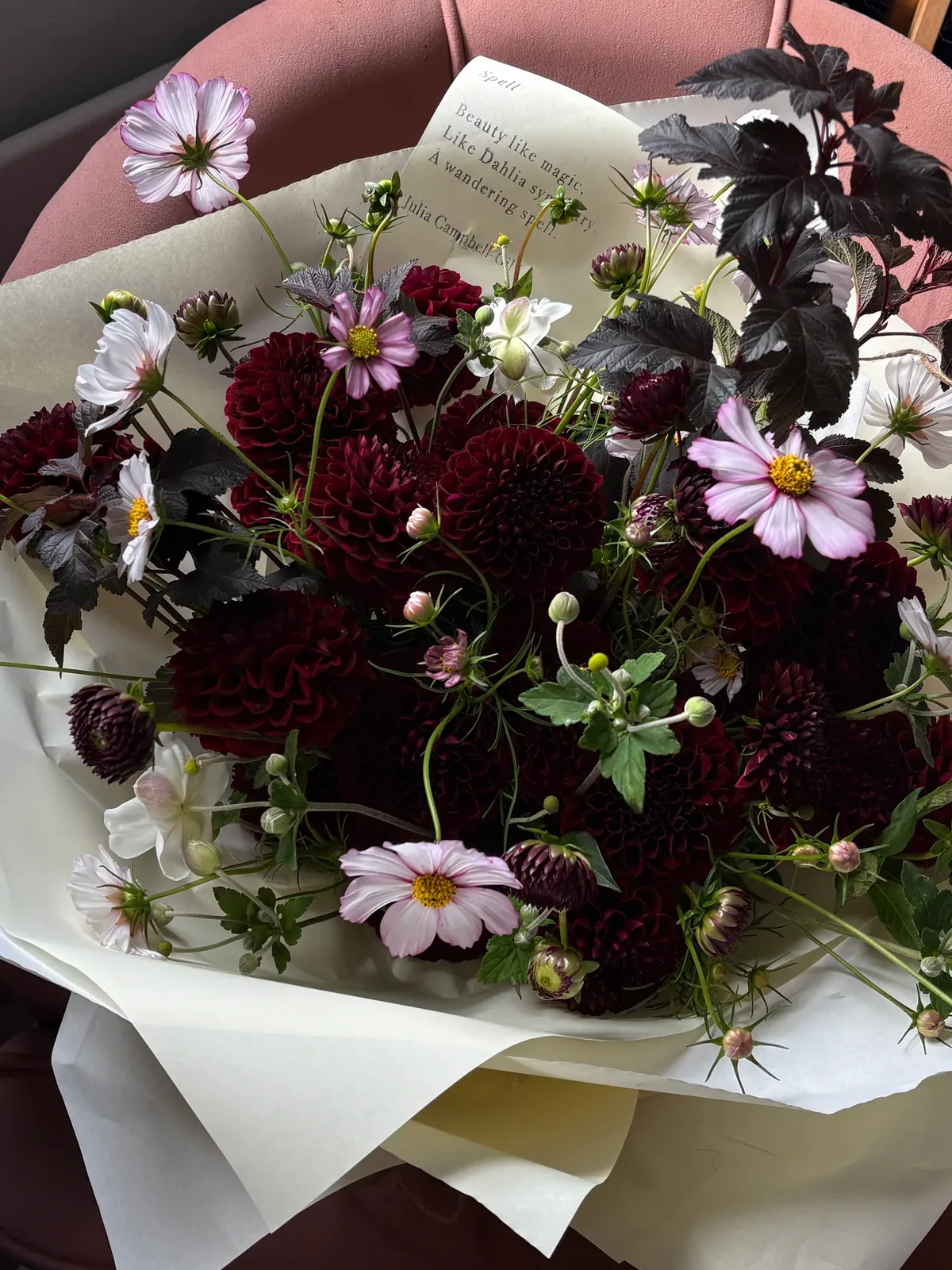
Yeah, it’s really difficult, and it involves all kinds of stages of grief, including over-ordering loads and loads of flowers just so that I can be with them for the last few weeks that we get them. Lots of people get sent bouquets randomly at this time of year because I just have too many flowers, and I just need to share them with people. But yeah, time is everything with how I work. I was thinking about this yesterday: Autumn, for example, is this period of time that has a real caricature of itself. Autumn is very evocative of really obvious things and obvious colours like orange and yellow and red. And I have an initial resistance toward the season changing, where I’m like, no, we don’t want to rush into it! It’s not quite Autumn yet! And then there’s a part of me that’s pushing deeper into it and going, okay, it’s time for orange and yellow and leaves, you know? Like, we’re doing Autumn, we’re going hardcore. And then things start to run out, and I start to think, I want to be conceptual. Autumn is about death. It’s about sleep. I’m using black foliage and such. It’s hard to state how much I think about what all of these things mean. I am really going through it, and I’m really trying to push the boundaries of the season. What does it mean? What has it meant? And what can we make it mean? It’s all very important to me.
Every Friday, METAL Weekly gathers the week's stories. Subscribe.