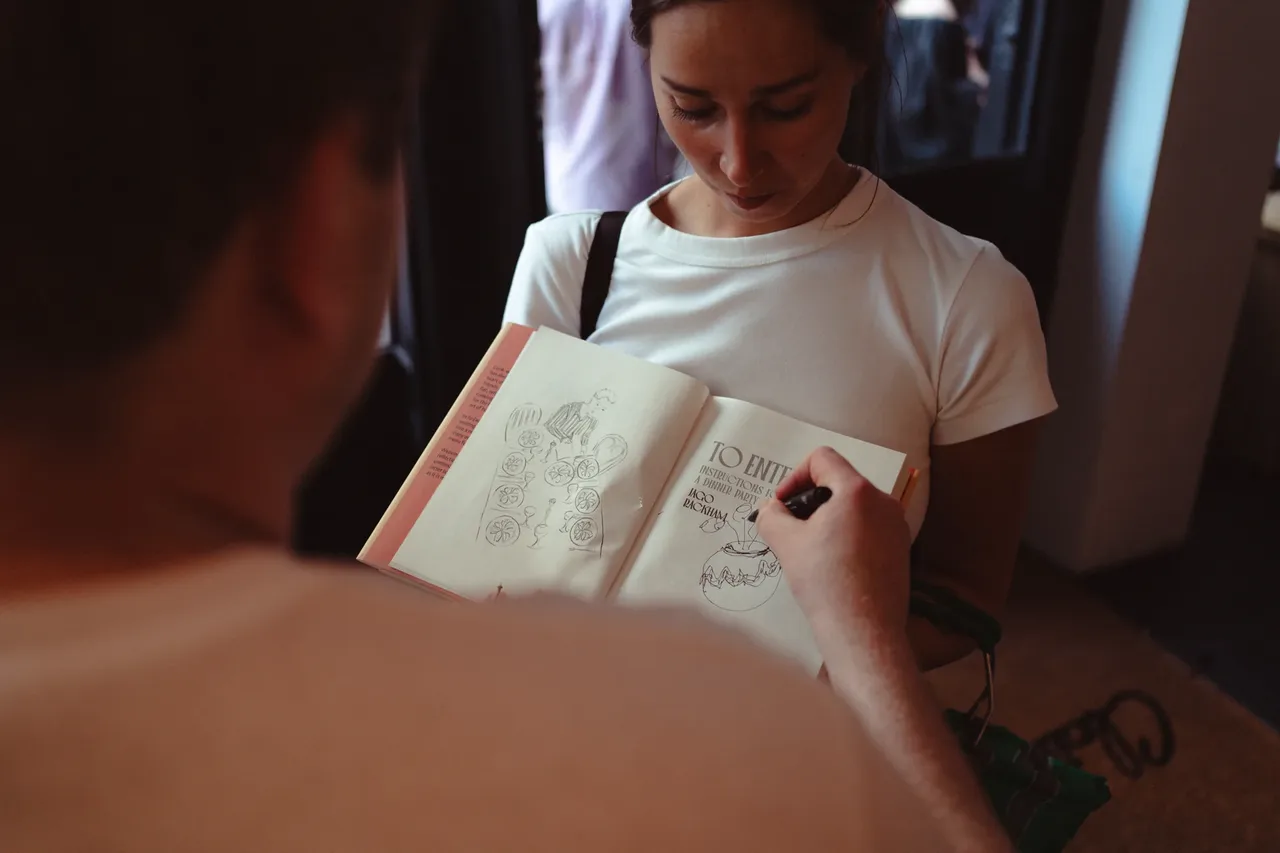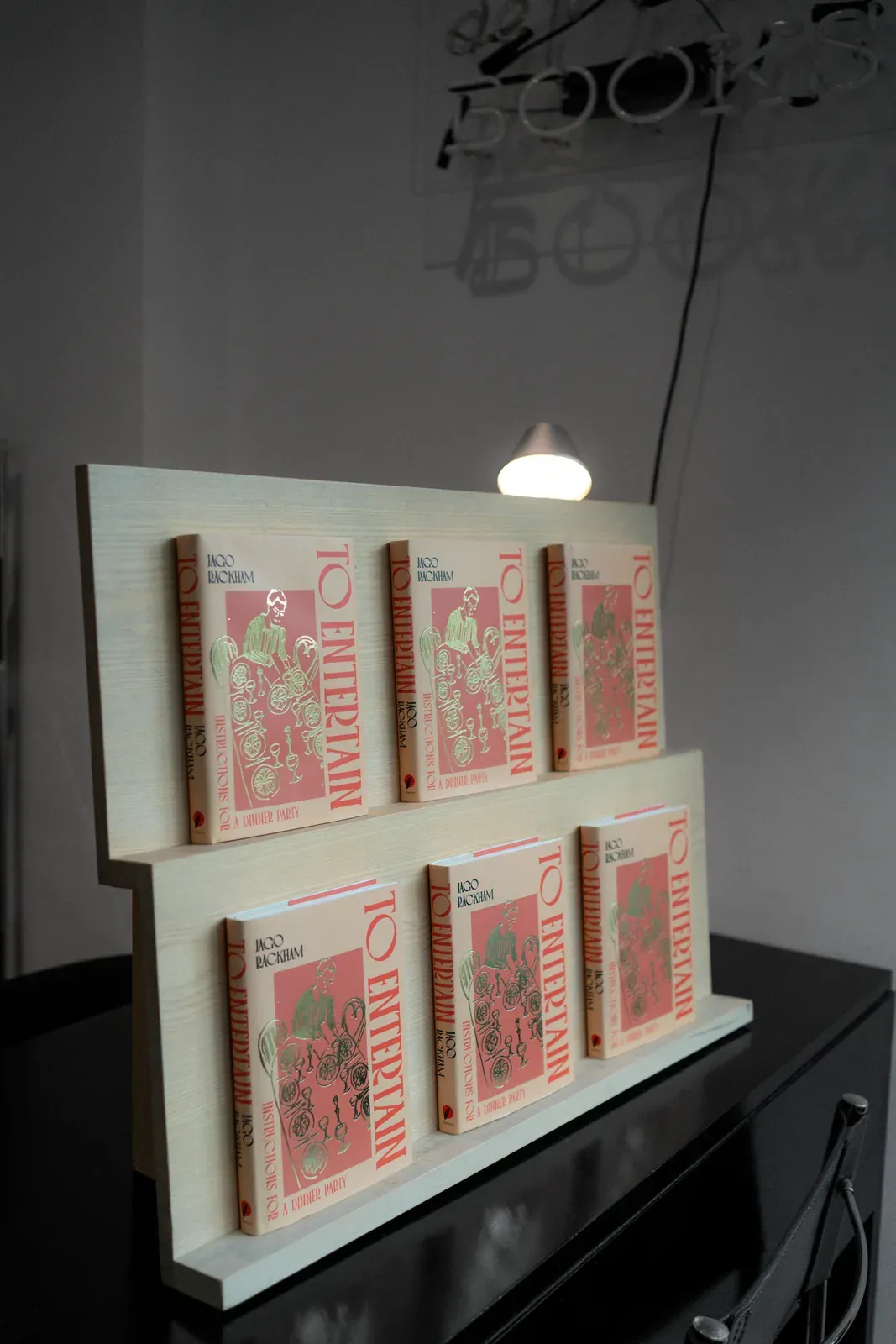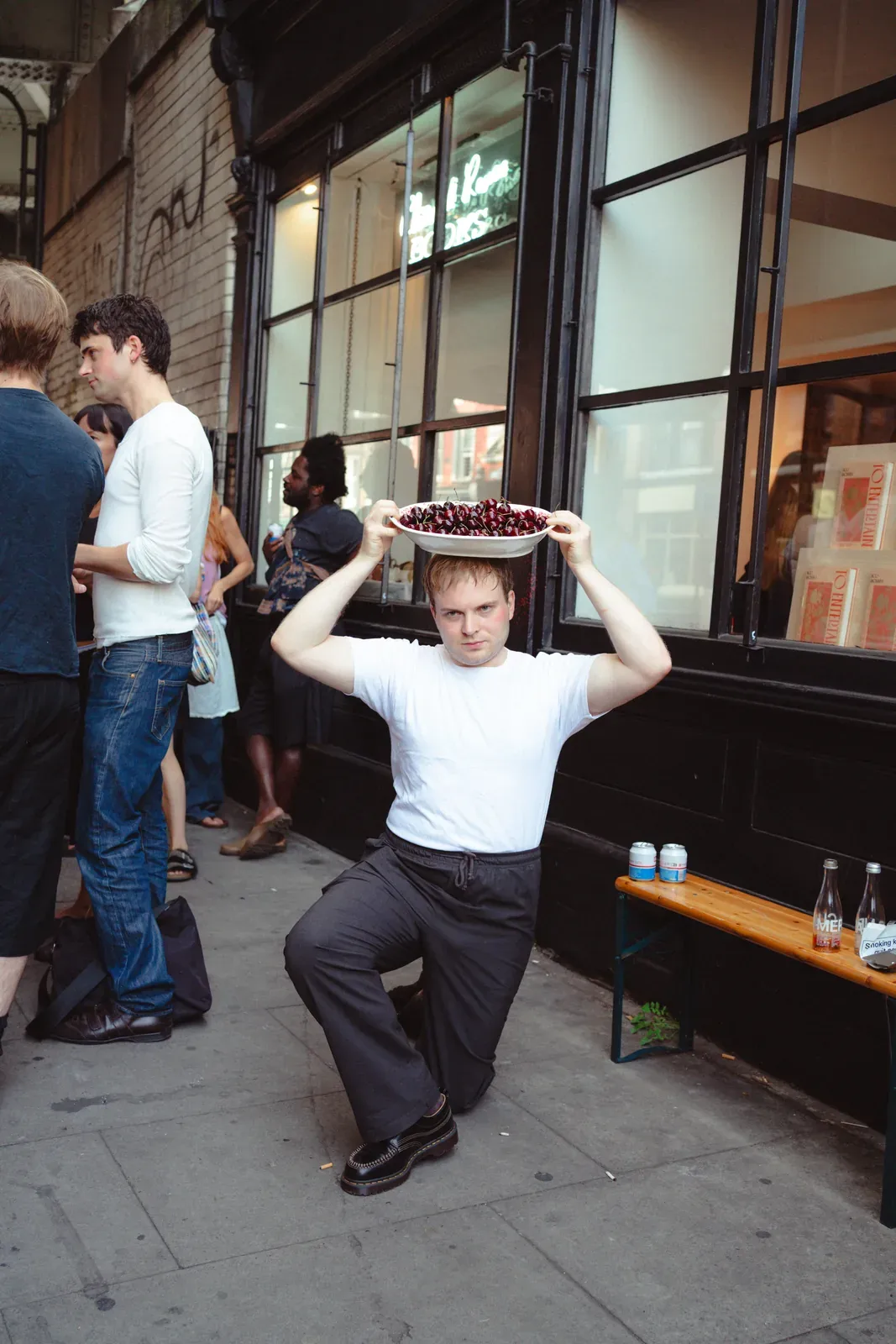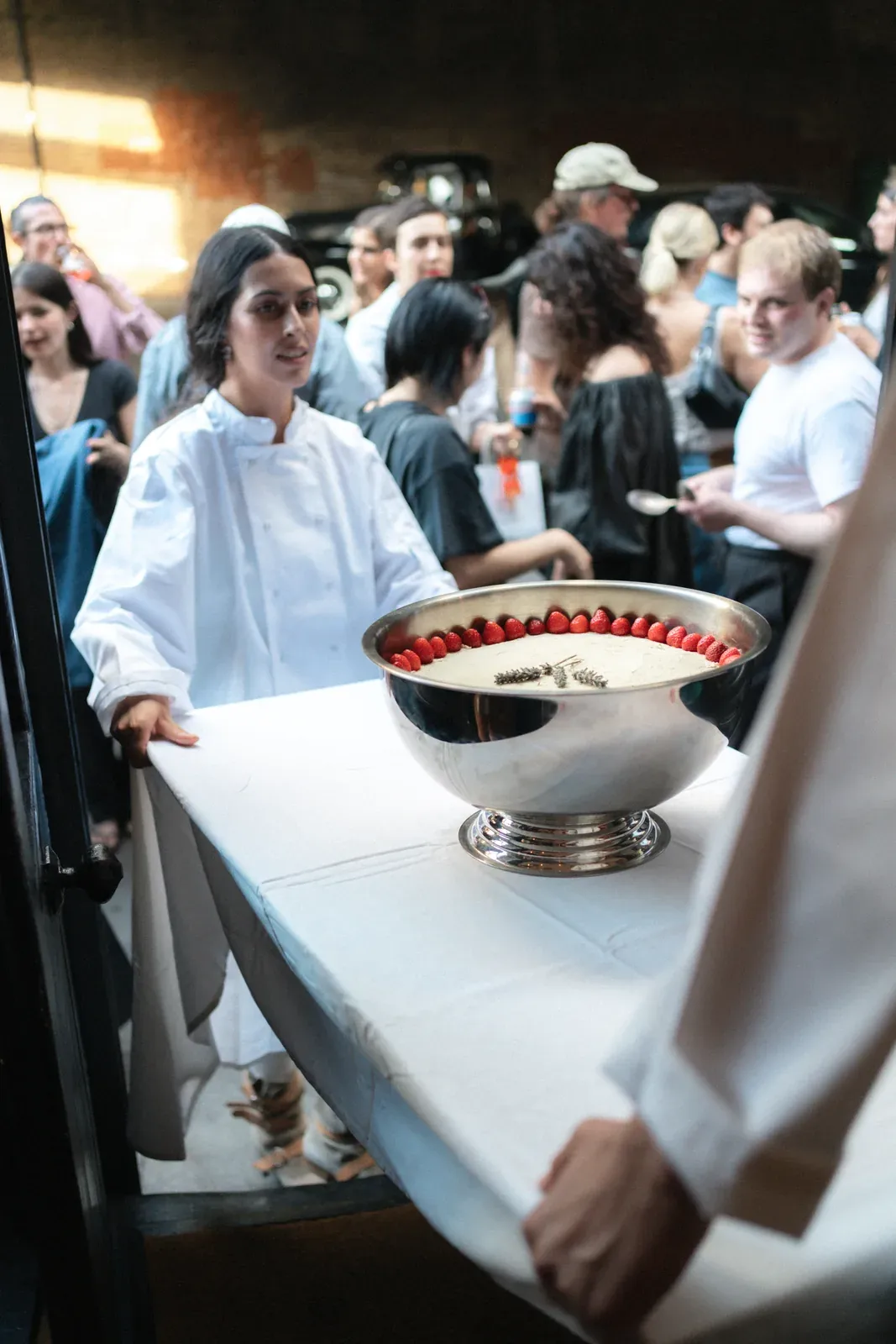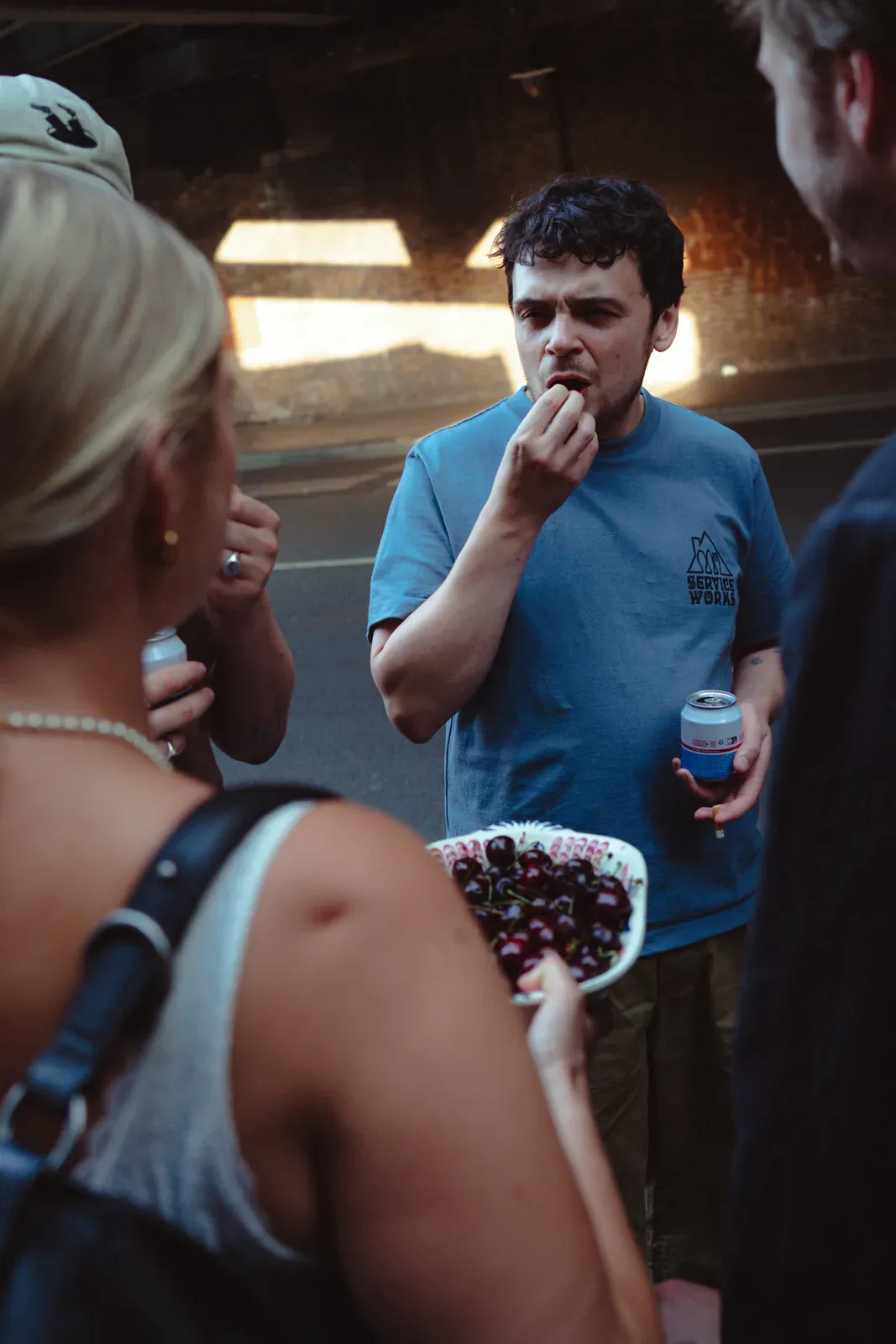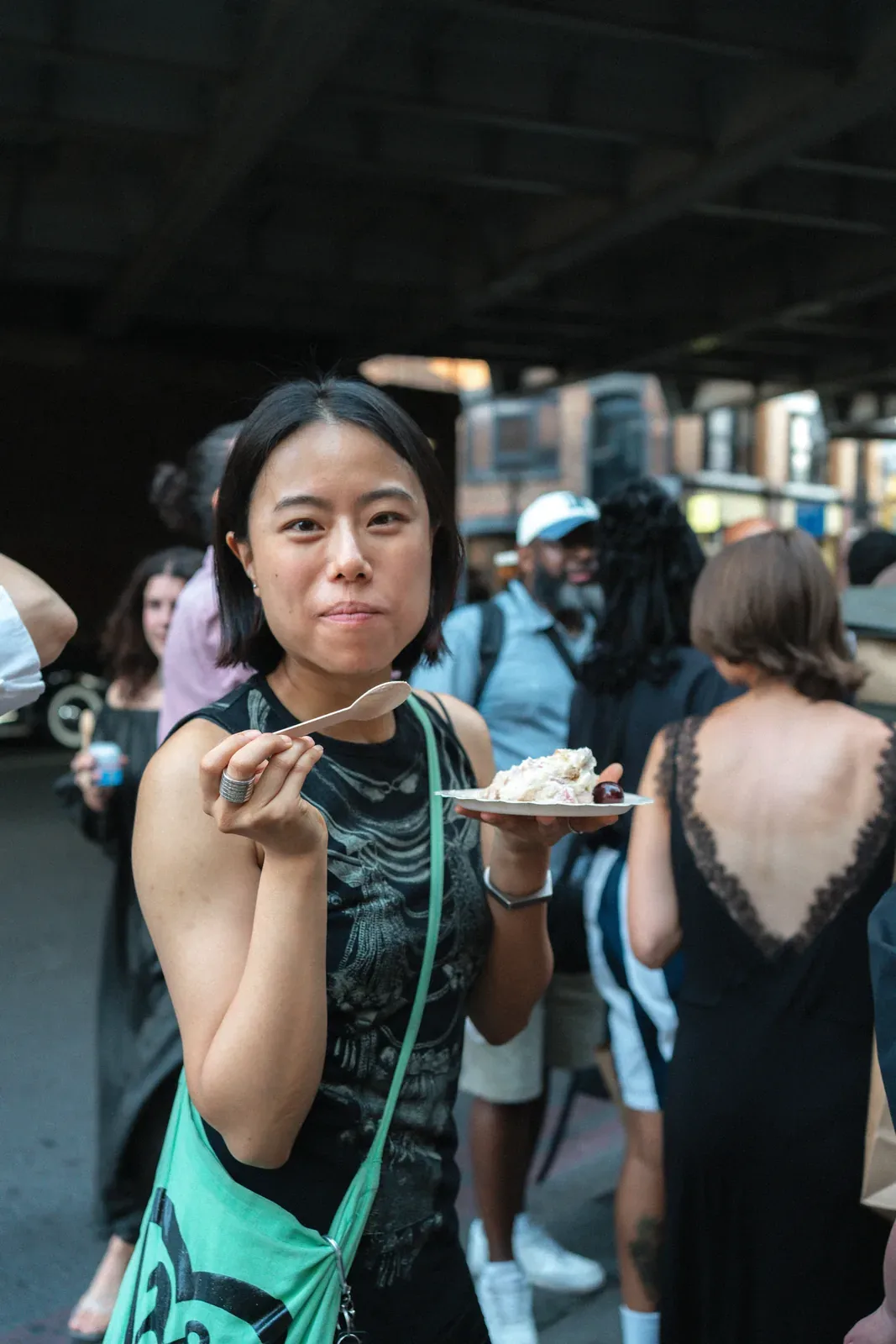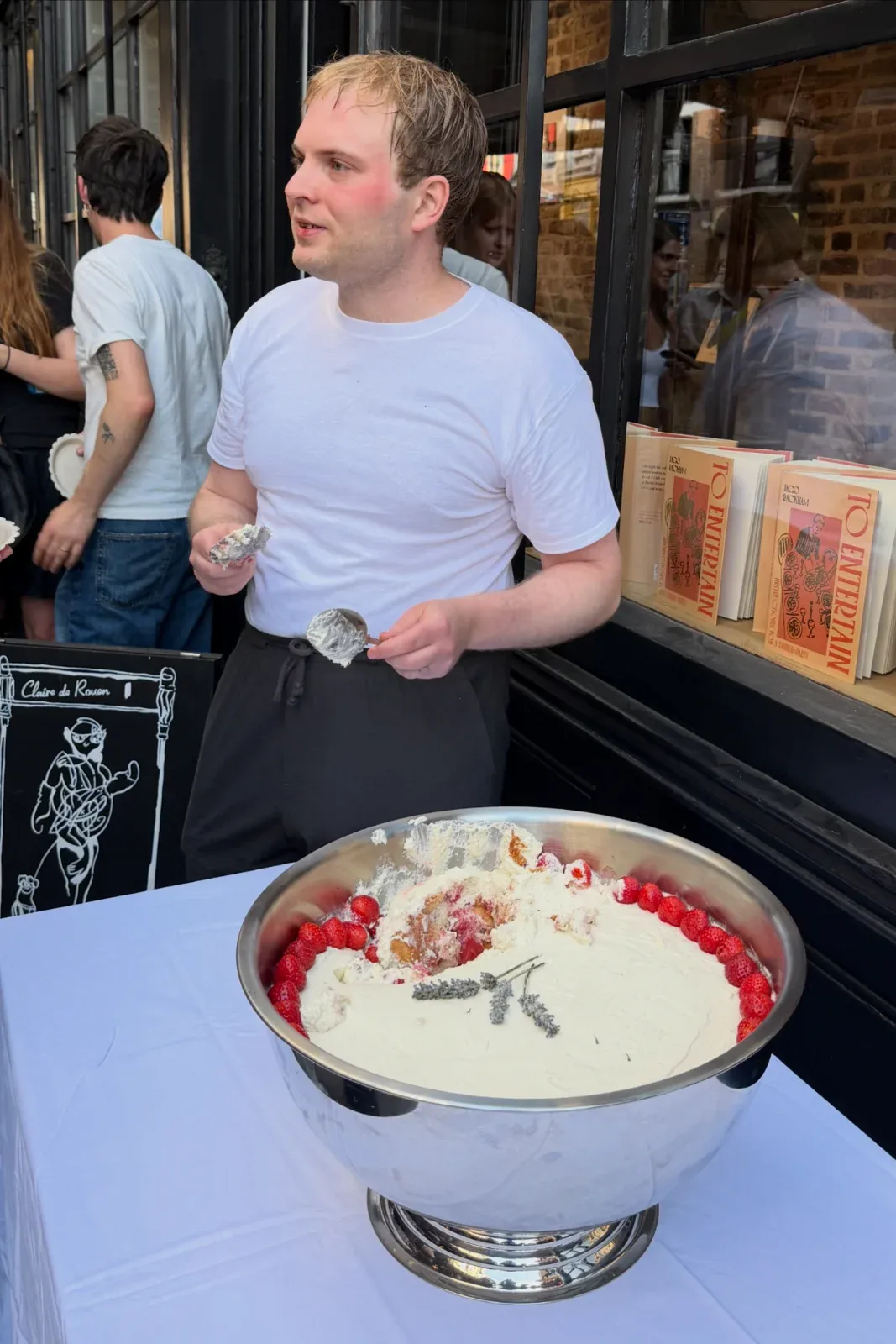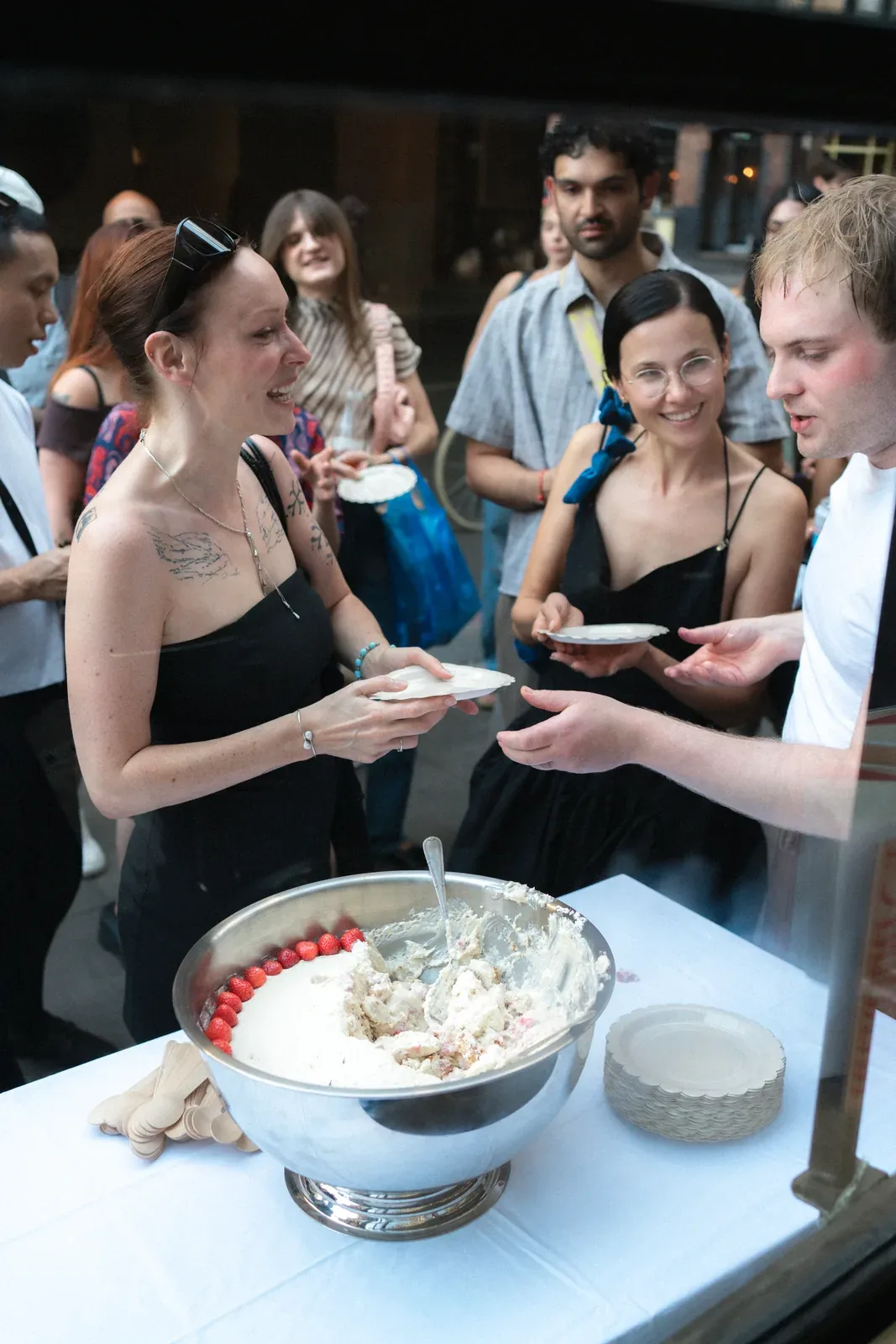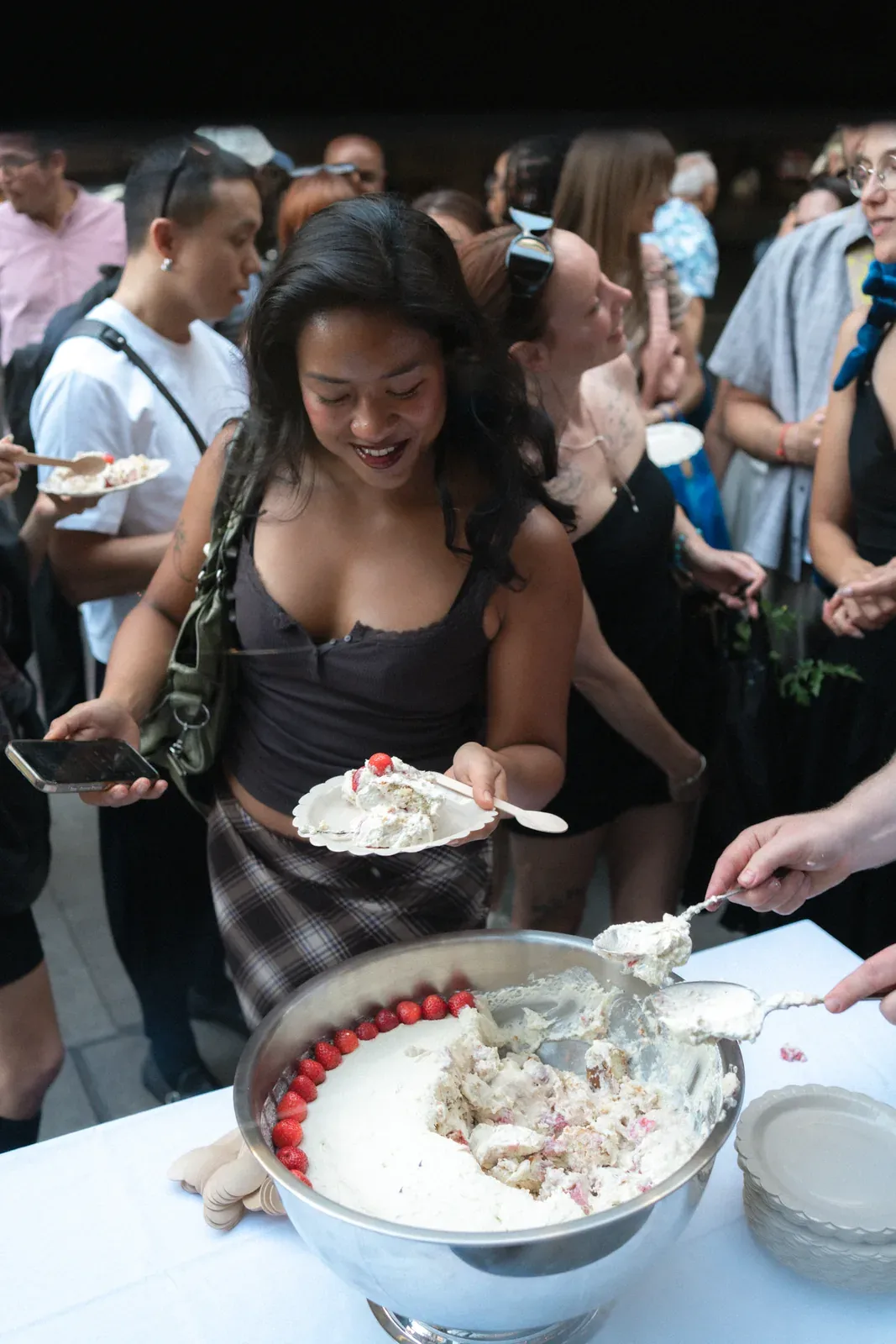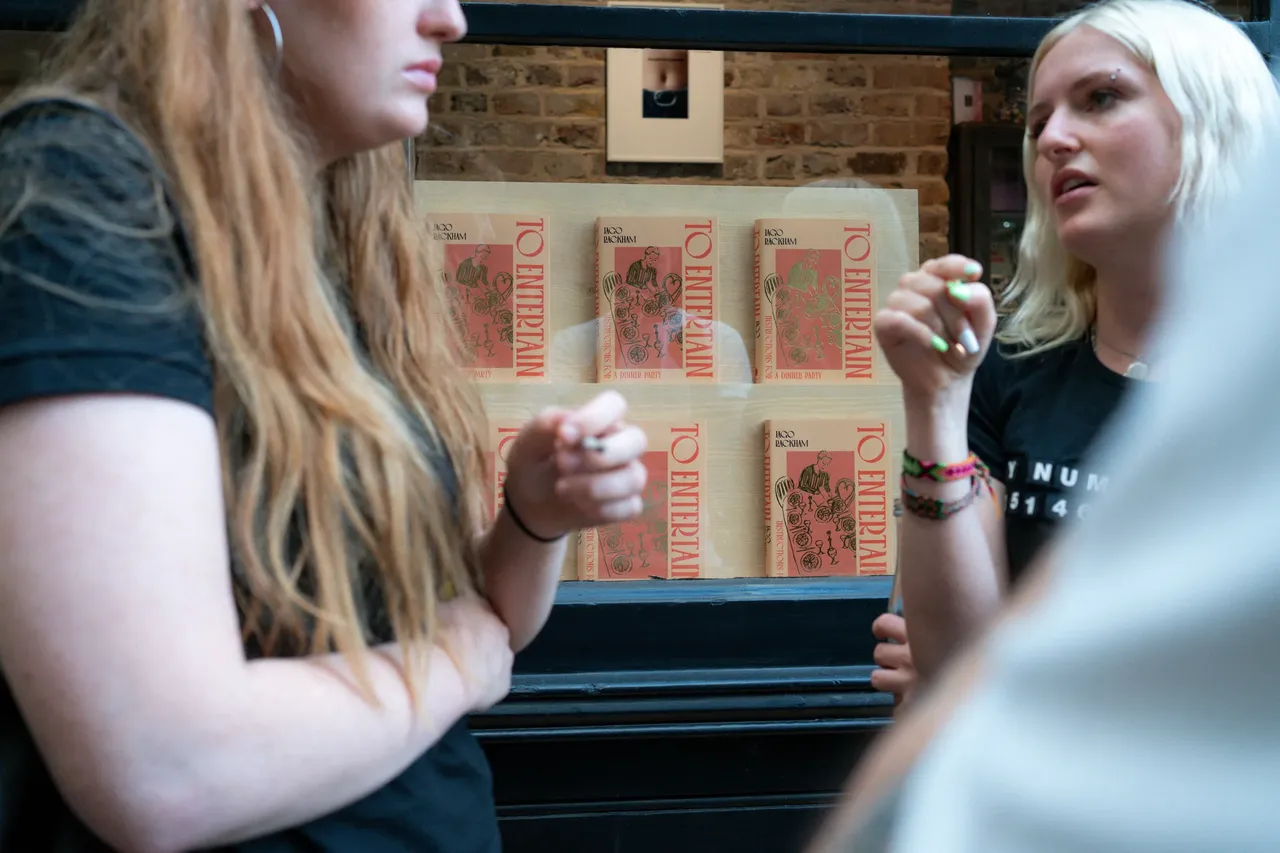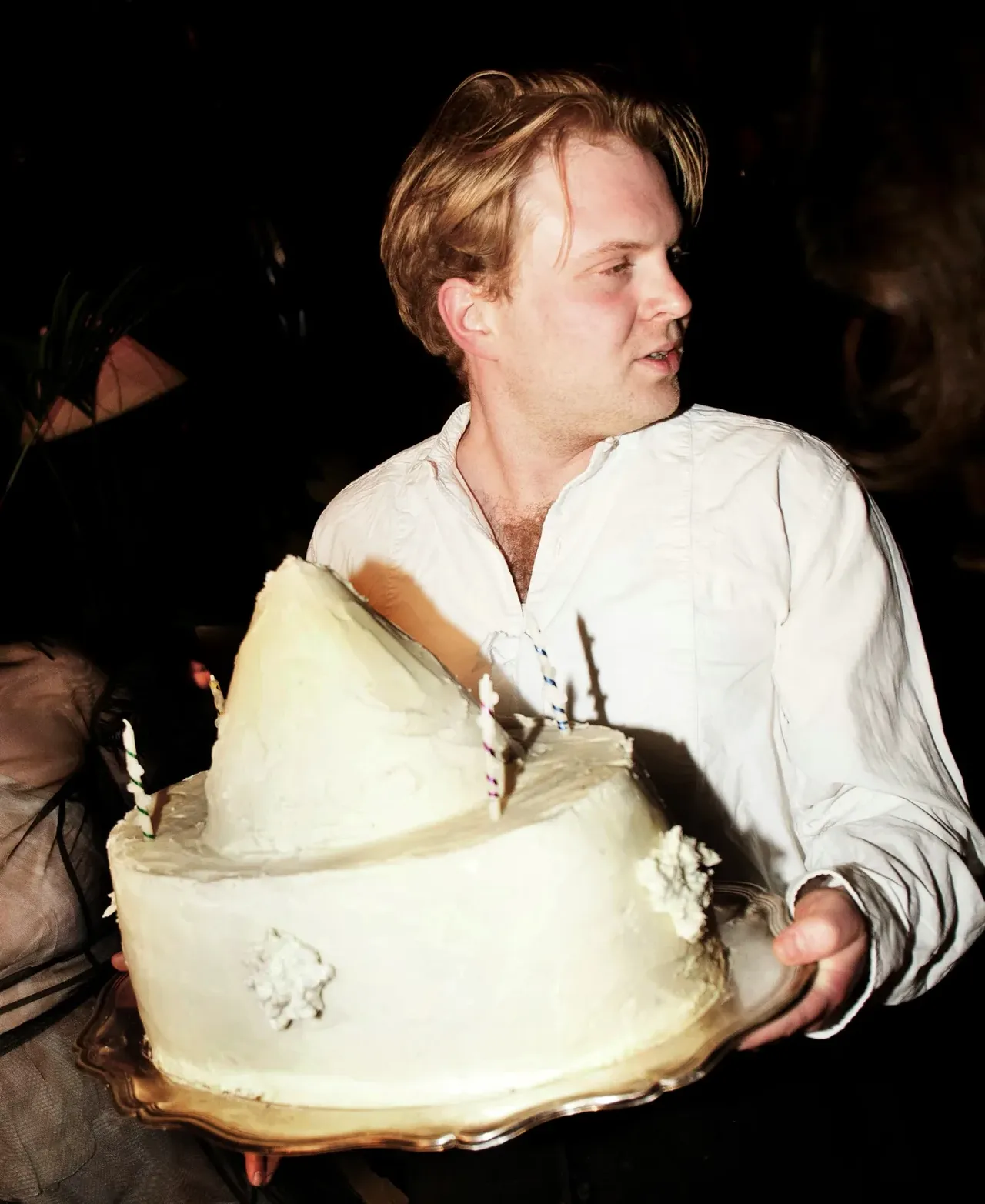
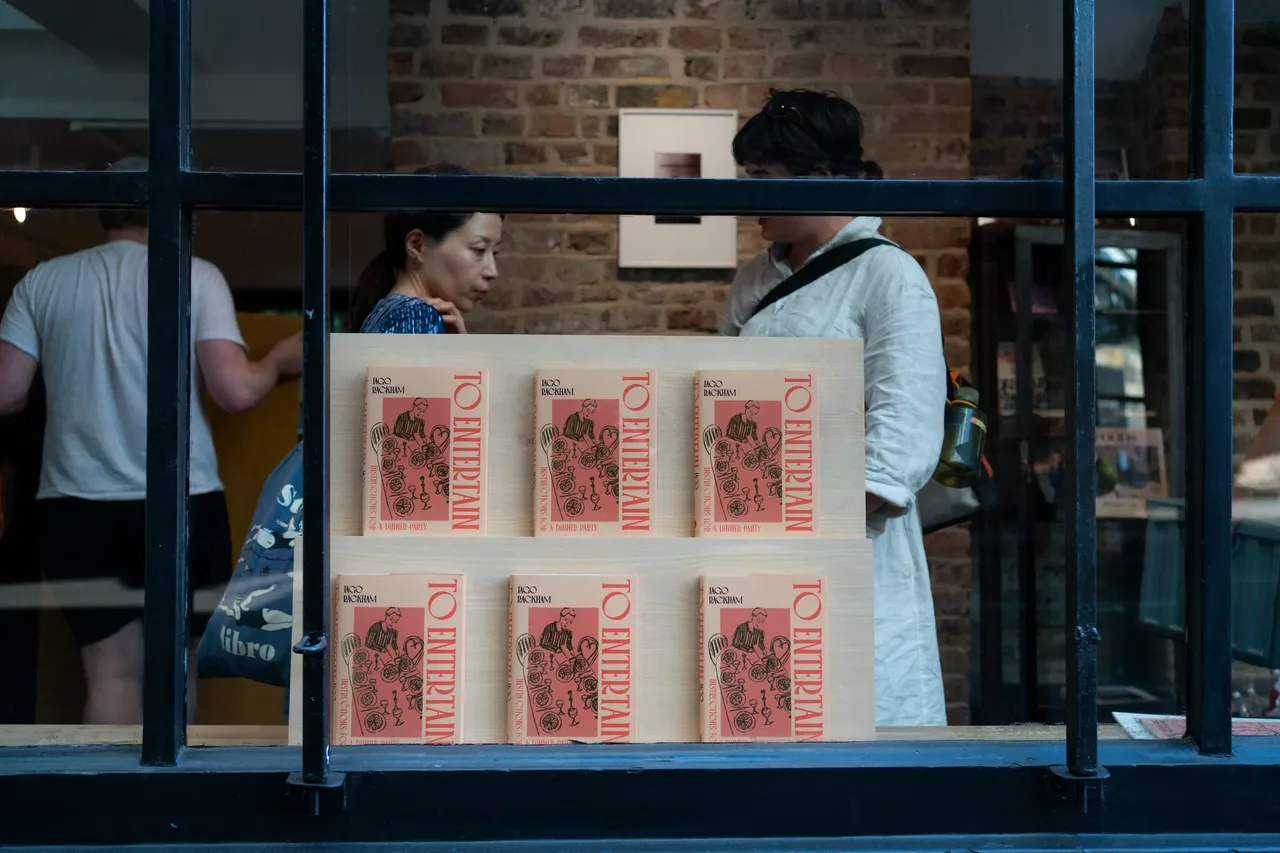
Attending a literary launch, one usually expects the same charade of warm white wine and canapés. Jago Rackham’s had a ginormous travelling trifle, buckets of gin, and a decadent tableau of culinary detritus in the form of a window display. It is all to promote his new book: To Entertain.
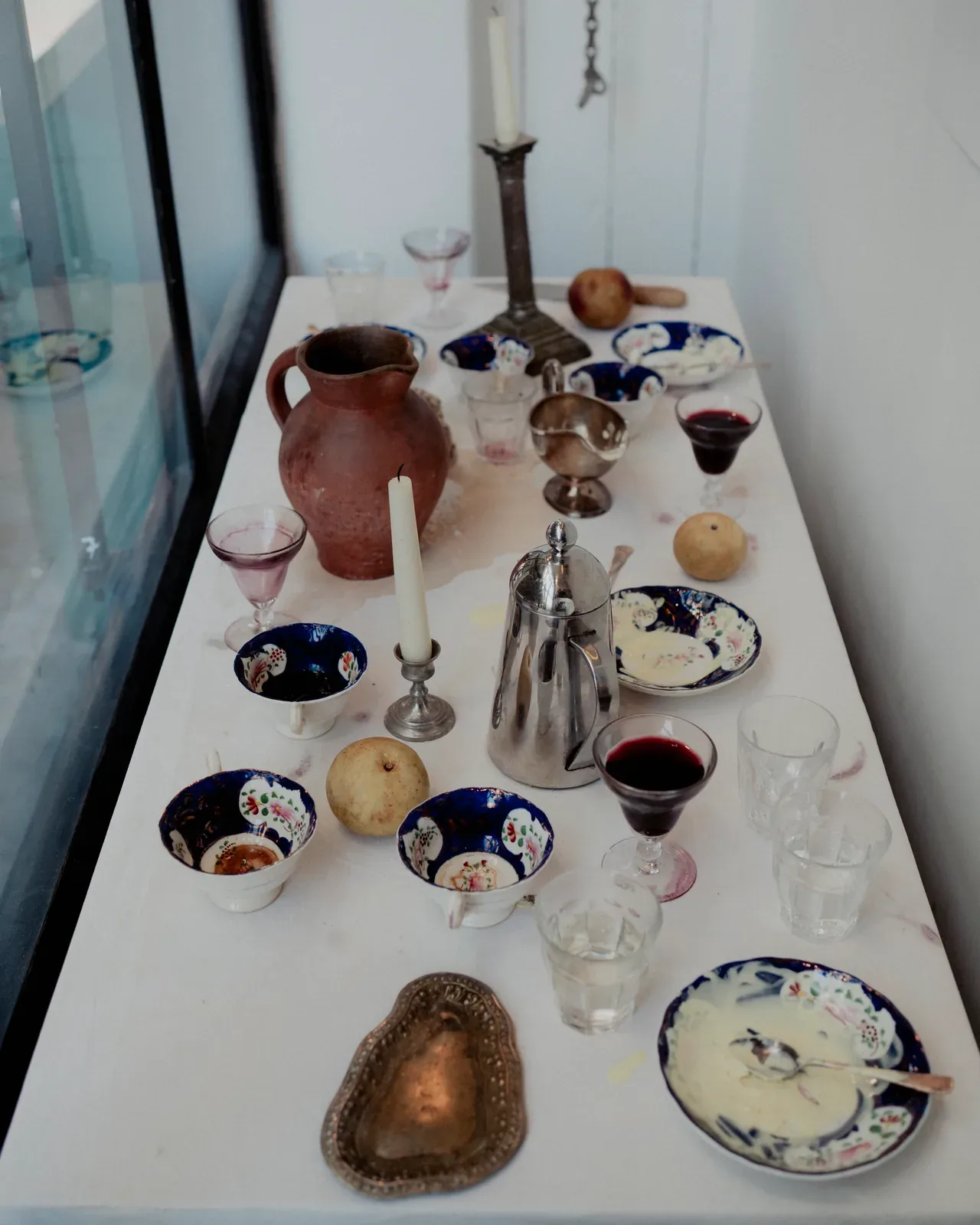
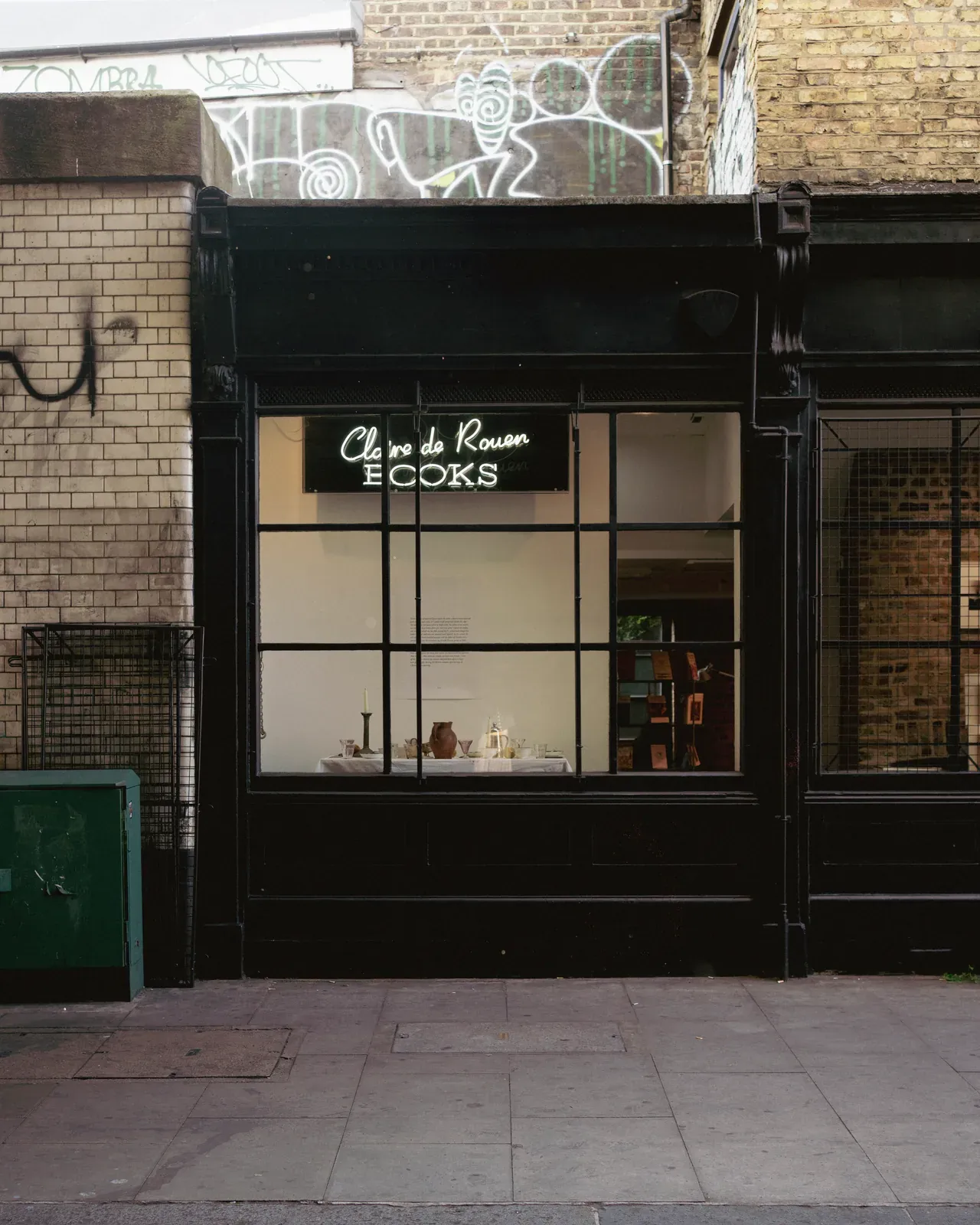
Underneath a roaring bridge in London’s East End, I find myself loitering on the pavement, a messy plate of pudding in one hand, with the other reserved strictly for cigarettes. Jago walks up to me with a gleam in his eye and asks for my butt… “for the window display”, he explains. “I need as many as possible”. Chuckling with admiration, I oblige, and wander over to the installation. Strewn across a stained white tablecloth is a chaotic assemblage of post-dinner party paraphernalia: a shattered ceramic bowl, half-eaten fruit, abandoned glasses of red wine and wax-dripped candles. Behind it, the closing passage of To Entertain, printed onto a large white sheet of paper.
The arrangement crystallises Jago’s philosophy; an imperfect gesture to perfection. “Host, you may play God”, he writes, “And like God, must know how far to extend yourself”. The book is a kind of vade mecum — an all-encompassing framework designed to guide just about anyone through the nuances of hosting a successful dinner party.
You’ve been quite open about not having taken a traditional route through professional kitchens. It feels as though we’re living in a moment where access to knowledge, techniques and inspiration is more open than ever, allowing people to build their own voices in the culinary scene on their own terms. Has that freedom shaped your approach to cooking and hospitality?
I think I come from another traditional route, that of the mother or grandmother, the person cooking at home, evolving and thinking and if they like cooking and their cooking is not simply an addition to the drudgery of childcare and cleaning — expressing themselves. For me it is the greater tradition, and much older than that of the restaurant or the chef, who are relative interlopers in the history of eating.
The question of freedom, in this context, the home context, is for me deeply rooted in England and English food, or the perceived lack of it. I used to feel like there was no grandmother looking over my shoulder, and so few rules or traditions that I could do anything. This isn’t true, there is a grand but quiet tradition in England, but it is not enforced in the way it is in India or Italy or China, it is not respected, and this lack of respect has allowed me to express myself through a cuisine which is sui generis.
The question of freedom, in this context, the home context, is for me deeply rooted in England and English food, or the perceived lack of it. I used to feel like there was no grandmother looking over my shoulder, and so few rules or traditions that I could do anything. This isn’t true, there is a grand but quiet tradition in England, but it is not enforced in the way it is in India or Italy or China, it is not respected, and this lack of respect has allowed me to express myself through a cuisine which is sui generis.
One of the most striking things about To Entertain is the breadth of situations in which you place a dinner party — from “dinners for the sick and sad” to birthdays and moments of celebration. There’s a sense that gathering around food is about an expression of care, intimacy and belonging. Do you think dining remains one of the most universal ways we have of creating connection and community?
You cannot live without eating. And I think we are social animals, and so doing something we need to do in a situation we are inclined towards is as close to nature as culture can be. Also, we are vulnerable when eating, and eating together is vulnerable, and in vulnerability there is great tenderness, and therefore care.
Faye Wei Wei’s artwork seems to embody the same embrace of imperfection and spontaneity that runs throughout your book. Could you speak a little to this artistic choice and specifically how you feel it complements the project as a whole?
Faye’s an old friend and we bonded over our love of food. The first time she came to dinner we served a suckling pig and she chewed the ears. In that I saw a peer in greed! The drawings were done at my kitchen table while I fed Faye, the first time I made her shepherd’s pie, which I’d never made before — the recipe was from Jane Grigson’s English Food. Every few drawings she’d ask to stop and I’d make her go on… I think that’s as close to the project in spirit as any adornment could be. I am incredibly grateful.
Having worked for Margot Henderson myself, when reading To Entertain, I couldn’t help but recognise a shared sensibility between your respective philosophies towards food and hospitality, particularly, the notion that the food itself is of far less importance than the overall environment of a dinner party. Has Margot been someone of influence for you?
I haven’t actually read her book, though I love Rochelle Canteen. But she will have influenced me via her partnership with Fergus [Henderson], some of whose recipes I have crabbed and pulled at in my own way. St John was opened in the year of my birth, and its approach to English food, I saw it called Anglo-French bourgeois cooking, has imprinted itself on my approach… Anyway, as someone who is in a very rich creative partnership — with Lowena Hearn — I know that nothing is really one’s own, so her influence would come thence and is not diminished by the conduit.
“My interest in food is leaning toward an interest in theatre and spectacle.”
Given that we live in a time where so much of social life happens virtually through screens, would you regard sharing food as one of the most powerful forms of human connection, and one that is especially important to maintain in this age?
Oh, literally sharing it? Yes. At first I thought you meant sharing online. Which I don’t mind either, though I get bored with it being so much work now, I used to find it very pleasurable. But yes, sit and eat together and in so doing recharge yourselves and remember why egality and love is important and not simply, what, theoretic?
There is a sense that the dinners you hold exist somewhere between a private gathering and a restaurant experience, while still retaining the intimacy and unpredictability of hosting at home. What do you think changes when food moves from a professional dining room into a more homely setting?
I think you worry about washing up, use much less butter… But I’d hope the experience wasn’t akin to a restaurant, I want it to remind one of a grandma but a grandma who’s a lush and lots of fun. Restaurants are theatres, but most importantly they are businesses — a restaurant cook must consider profit above all else (and within that they will think of many good things, many arts and kindnesses) but if they cannot make money the whole exercise is, at best, self-indulgent, at worst ruinous.
While reading the book, it became clear that you see a dinner party as a kind of ritual, often accentuated by flowers, music, candles and the like. Was there a particular memory or experience that first made you understand the power of these rituals?
Oooh that’s nice. I remember going to my grandfather’s house in Sussex and sitting under a tree for lunch in summer — the unnecessary move from inside to outside just for pleasure… I would have been five or so. But no, not really anything in particular, just Lowena’s influence and witchiness and love of ritual, which is also soothing and kind. I feel like we invented many of our own rituals over the long years of our union.
There’s a recurring celebration of naivety in To Entertain, the idea of approaching food and hosting with curiosity as opposed to strict restaurant-type rules. Do you think stepping outside the traditional structures of professional kitchens has allowed you to preserve a sense of openness?
Well, I’ve only been in a professional kitchen a handful of times, and always as an interloper. So, it’s less stepping outside of than not knowing… the naivety is part taste — I rarely like the refined, part ability — I cannot make the refined, and it is rarely fun to make something refined when you have friends for dinner. A chef isn’t present at the table, a chef is working. A host is not working, though they do labour.

It’s clear from the way you present your food that aesthetics are a significant part of the overall experience. Some of the trifles and cakes I’ve seen feel almost sculptural, existing as objects of beauty just as much as dishes to be eaten.
Thank you.
How important is visual expression in the way you think about hospitality?
As you say, I care about ritual, and ritual relies on image, on the visual. Adornment and beauty speak of so much and are so enhancing, they are integral to hosting.
Do we really eat with our eyes?
We eat with everything. And unless you’re very hungry, that everything matters.
I’d like to speak a little about London and your affection for it as a place of cultural exchange. Can you offer some insight into how it has influenced you as a city?
London is a peerless city, as is New York, as is probably Tokyo or Sao Paulo or Delhi or Shanghai, I just don’t know them… an endlessly pumping organ, a mess of people. London exists outside of England, though there are some English bits, like St James, and is its own place, transnational, unkempt.
Its food reflects this. There is, of course, a good culture of restaurants, and some very fine cooking, but what is more exciting than that is the depth and breadth of ingredients, the many influences you can take by chatting to people in shops, by curiosity and mimicry. My earliest food memory, I was in London before my parents left for Devon, is a Sri Lankan green banana curry eaten in our garden in Lewisham. And it all flows from there.
Its food reflects this. There is, of course, a good culture of restaurants, and some very fine cooking, but what is more exciting than that is the depth and breadth of ingredients, the many influences you can take by chatting to people in shops, by curiosity and mimicry. My earliest food memory, I was in London before my parents left for Devon, is a Sri Lankan green banana curry eaten in our garden in Lewisham. And it all flows from there.
“Eating with friends should offer a small utopia.”
You've spoken about cooking in professional kitchens for pop-ups and events, and how daunting it was at first. Is that something you've become more comfortable with over time?
Yes.
What helped you gain that confidence?
Well, a little experience helped — I know how the pass works, I know the importance of communication. But more than that it was an understanding of the position I hold and the position the chefs hold. I am a guest, but one who is somewhat honoured. I do not know the terrain or the rules and I make that clear, but I am also clear about what I do know and what my preferences are, and why I am there… And then it’s almost always quite fun, and I learn so much, and have my hand held a bit. I’m very upfront about what I can do and what I can’t.
I was cooking at the Plimsoll with Joshua Swinney, the head chef there, who is such a kind man, and brilliant, and suddenly it was service and I panicked but he calmed me down. I always think about his calm and patience when I’m in a kitchen and that helps a lot. Also, he kept picking string out of the pork I was serving, which was kind, but sort of gentrified the food.
I was cooking at the Plimsoll with Joshua Swinney, the head chef there, who is such a kind man, and brilliant, and suddenly it was service and I panicked but he calmed me down. I always think about his calm and patience when I’m in a kitchen and that helps a lot. Also, he kept picking string out of the pork I was serving, which was kind, but sort of gentrified the food.
You often reference artists as influences on your food — for example, Flemish painting. Are there any other artists or creative disciplines outside the culinary world that have shaped the way you think about food?
Well, first, foremost, and all other qualifiers of magnitude is Lowena, my partner. Her eye, her aesthetic nous, is where it all began. But yes, Flemish painting… music — Michael Nyman, sort of ways toward the dramatic. The brashness of my collaborator Joana Kohen. I feel more and more that my interest in food is leaning toward an interest in theatre and spectacle.
How did growing up in rural Devon shape the way you relate to food and cooking?
Growing up we ate very well but were not overly concerned with food being local — you sort of live in it, so it’s more exciting when things are from elsewhere. It was going back to Devon after living in London for a few years that I got excited by the area’s food, by the expression of the landscape, and the ways I can use this to create a faux tradition for myself, to find some sort of groundedness which I don’t really have.
You now live in London, yet your work remains deeply rooted in nature, the countryside, and the rituals of religion and folklore. Do you think communal cooking offers a kind of escape from the toils of urban life?
I think there are toils in rural life too, and a great deal of isolation and boredom. If you are a ‘professional’ you often spend a great deal of time driving away from your village into a town or city, if you are poor you’re trapped by a badly organised and often expensive transport system. And so on, so I think the communal is as necessary in the country as the city.
But yes, I absolutely think that communal dining offers an escape — eating with friends should offer a small utopia, from which one can emerge refreshed.
But yes, I absolutely think that communal dining offers an escape — eating with friends should offer a small utopia, from which one can emerge refreshed.
Finally, can you give five words which sum up a quintessential dinner party?
No, but I will give a piece of advice: never cook anything you’ve not cooked before for a dinner party.