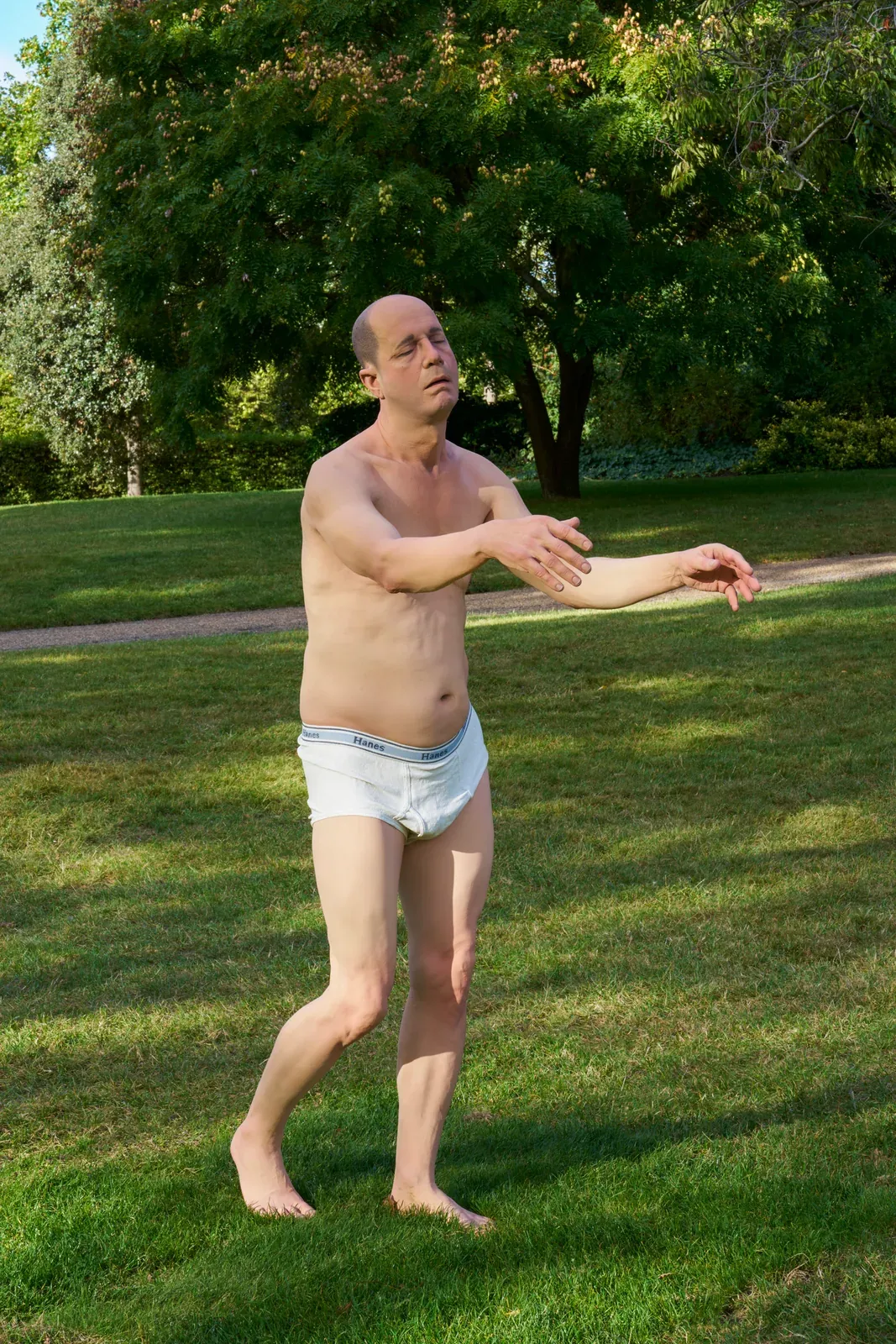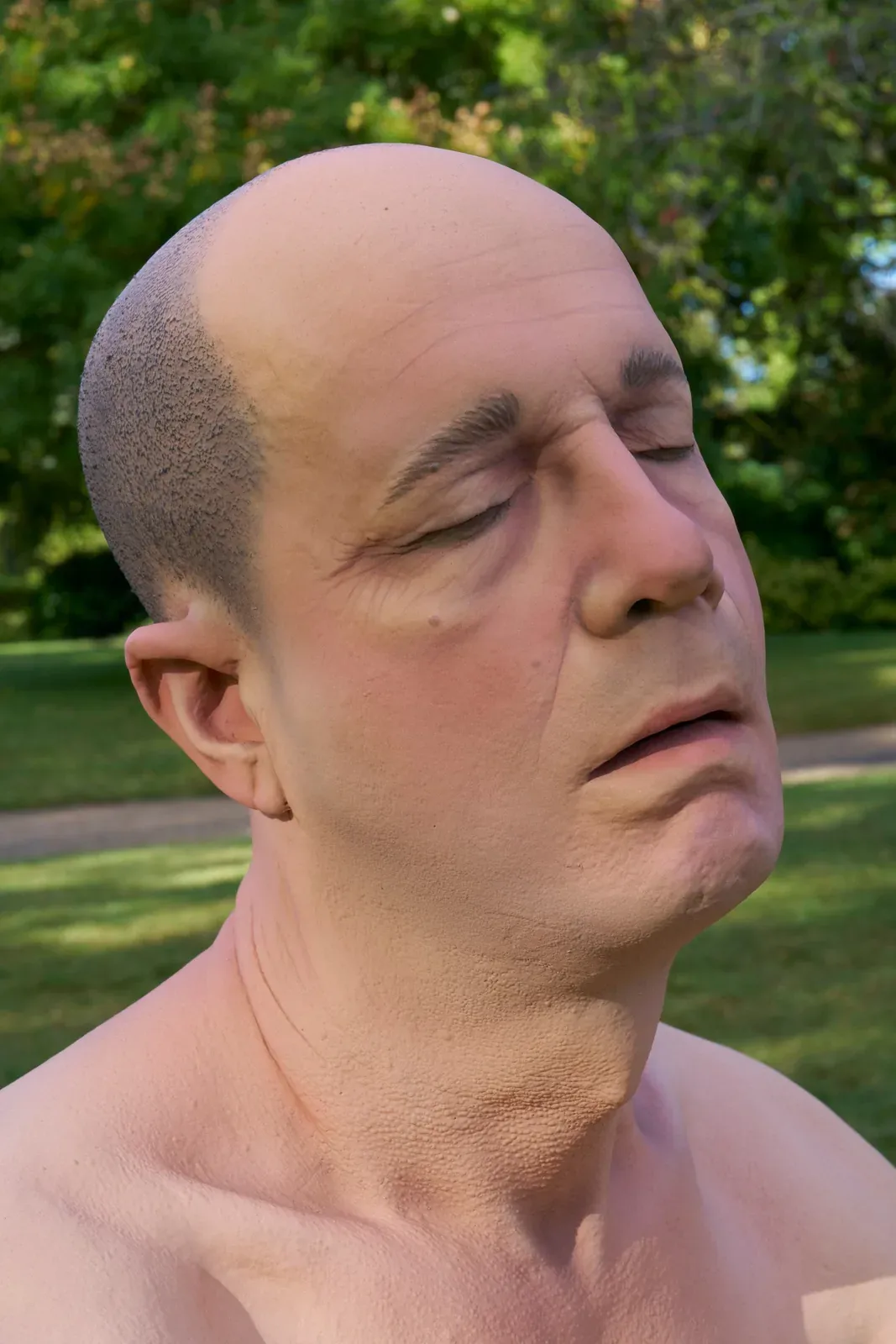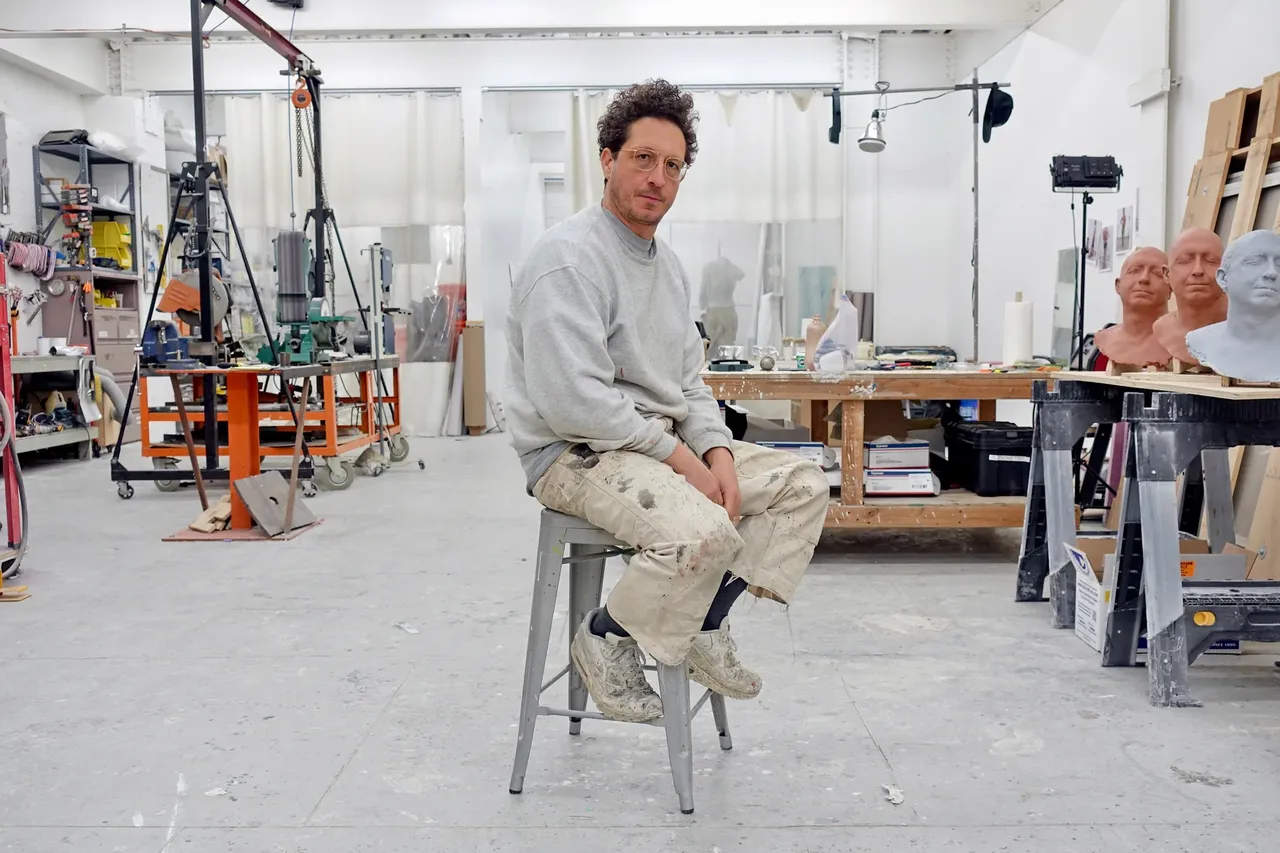
Tony Matelli doesn’t force ordinary life to become strange; he simply turns it slightly, waits, and lets reality betray its own instability. Across three decades, the Chicago-born, Brooklyn-based sculptor has made an art of this sidelong move: weeds appear to have quietly breached the gallery floor, bouquets are flipped upside down, mirrors return us to ourselves through the dust and marks left by others. His objects are deadpan but never merely jokey, exacting in their craft yet open to the slippier questions of desire, value, belonging and the self.
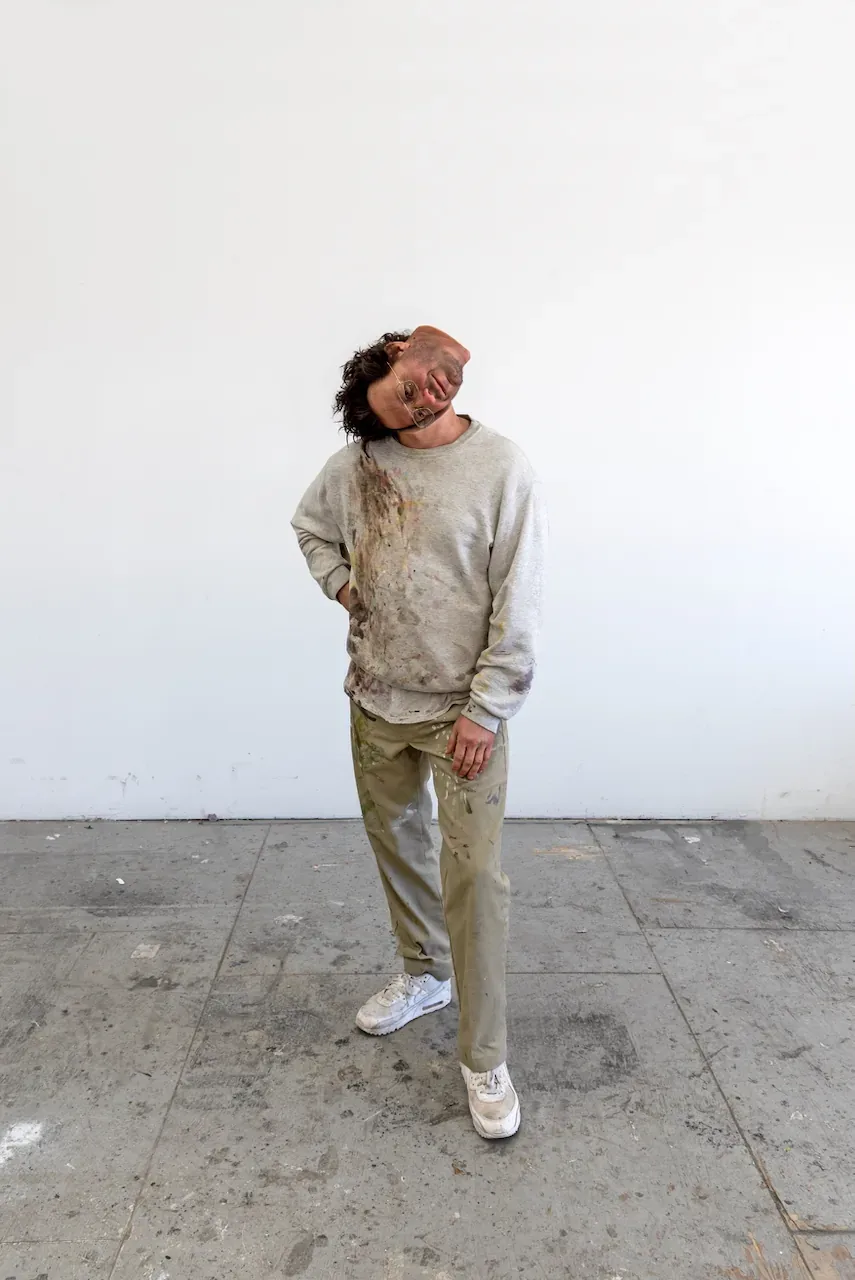
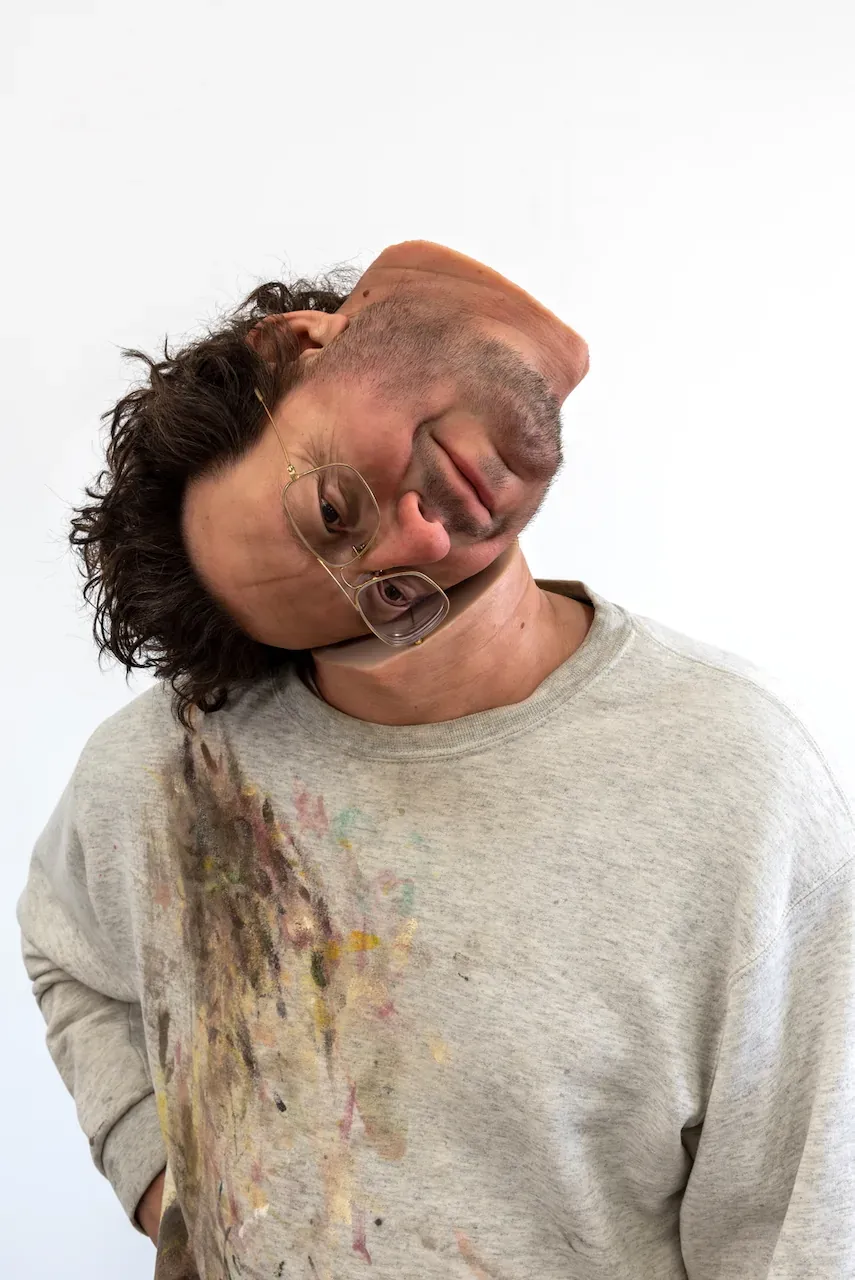
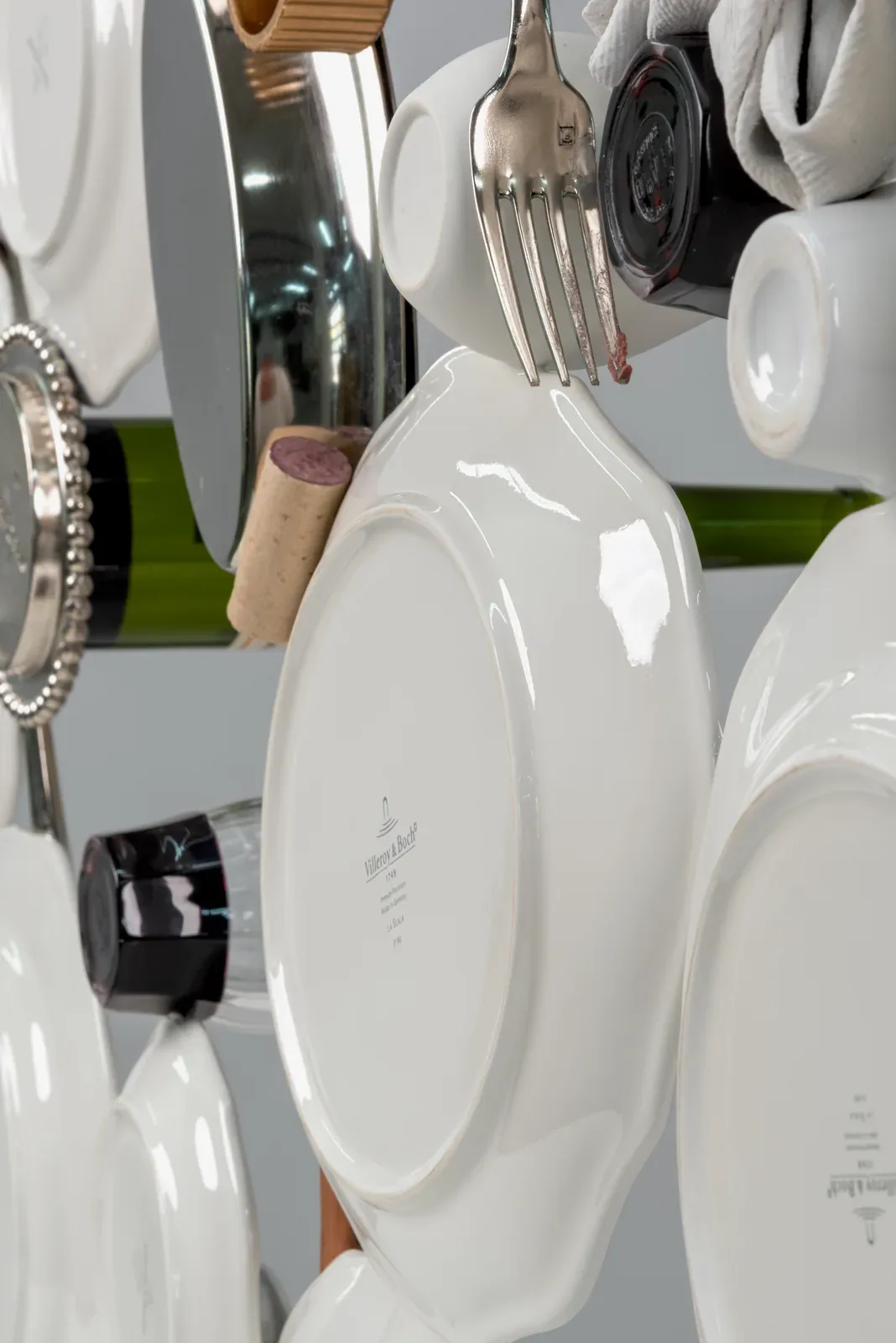
That logic animates Sideways Dinner, Matelli’s second solo exhibition with Maruani Mercier, on view at the gallery’s Knokke space on Kustlaan, Belgium from August 8 to September 6, 2026. The exhibition brings together new sculptures, including its title work: an upright field of plates, bottles, glasses and leftovers that converts the aftermath of a meal into an impossible still life. Alongside it are new Weeds, Arrangements of inverted flowers and a self-portrait whose head has been calmly rerouted across its shoulder. Here, he discusses how small shifts make familiar objects strange, the politics of weeds and the instability of the self.
Sideways Dinner takes the ordinary aftermath of a gathering—plates, bottles and glasses—and turns it into an upright, almost pictorial arrangement. What first drew you to this particular residue of social life?
With this work I wanted to take something very familiar, and usually associated with pleasure, and problematise it. I was thinking about my Arrangements, which take an ordinary bouquet of flowers and rotate it 180 degrees. I wanted to see how little I could intervene in an object to make it feel strange, even unsettling. Sideways Dinner follows the same strategy; I simply rotated it 90 degrees instead of 180.
You see all the leftover food, plates and glasses upright in what is, yes, a kind of pictorial arrangement, but it also transforms the entire dinner into an object in space. It concretises the social dimension. It also reveals things that are not seen in this context: the backs of the plates and the flat plane where the tabletop would have been. Like much of the work in this exhibition, it becomes an impossible object.
You see all the leftover food, plates and glasses upright in what is, yes, a kind of pictorial arrangement, but it also transforms the entire dinner into an object in space. It concretises the social dimension. It also reveals things that are not seen in this context: the backs of the plates and the flat plane where the tabletop would have been. Like much of the work in this exhibition, it becomes an impossible object.
The work seems to suspend a dinner table between still life, relief and a kind of frozen event. How did you want time to operate within it: as something arrested, replayed, or made unstable?
Well, it’s definitely not a relief. In fact, one of its most compelling views is from the side, where you can see the hard plane of the imaginary tabletop. The question of time is interesting because, yes, it's frozen, much like a photograph freezes a moment. The meal is not yet finished, so there is a narrative dimension as well. But I think the instability comes less from the suspended moment than from the object’s suspension in space.
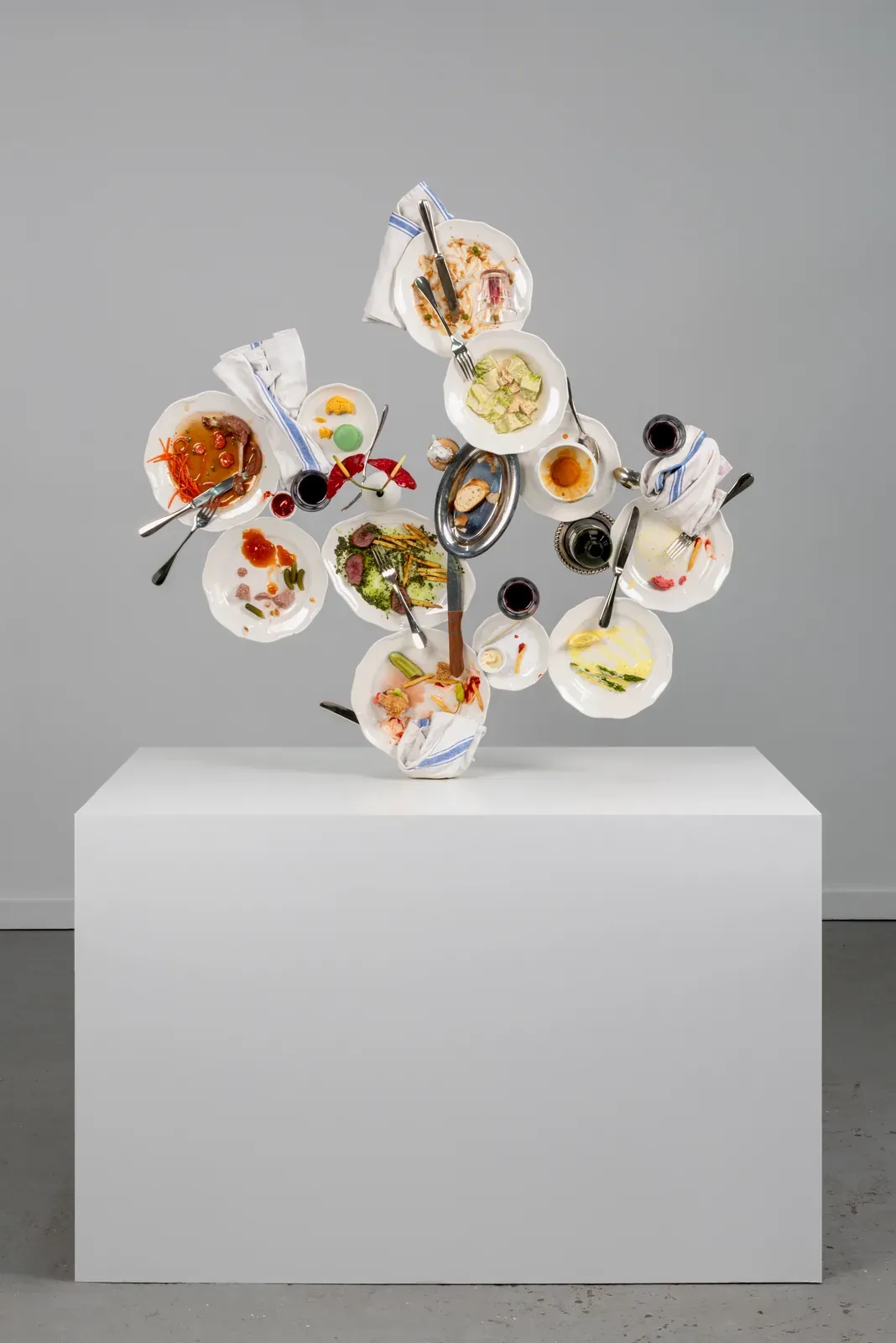
The press release describes Sideways Dinner as separating an object’s trompe-l’œil surface from its intended function. Is that separation a source of freedom for an object, or does it make the object more uncanny?
I’m not sure I fully understand what the ‘function’ of a trompe-l’œil surface would be in this case, but I do like the idea of an object having freedom. I like it when objects behave differently from how we expect them to.
Your Arrangements use flowers, a symbolically overloaded subject, yet their physical logic is overturned. In Arrangement (658), an inverted orchid balances on a single bamboo stick. How do you decide when an image has reached the right balance between elegance, absurdity and unease?
That’s a good question, and I think it points to artistic intuition. Painters are often asked how they know when a painting is finished, and nobody really seems to know. The work I make is different in that I’m not operating on a speculative picture plane. I’m working with real objects, real space and real gravity. I hate to answer in such an unsatisfying way, but if the object is physically stable and it excites or satisfies me in the right way, then I’ve found that balance. It needs to excite me, but every work has its own criteria. I trust my taste and intuition.
Flowers are conventionally associated with cultivation, care and beauty, while weeds are defined by being unwanted or out of place. What interests you in moving between those two categories?
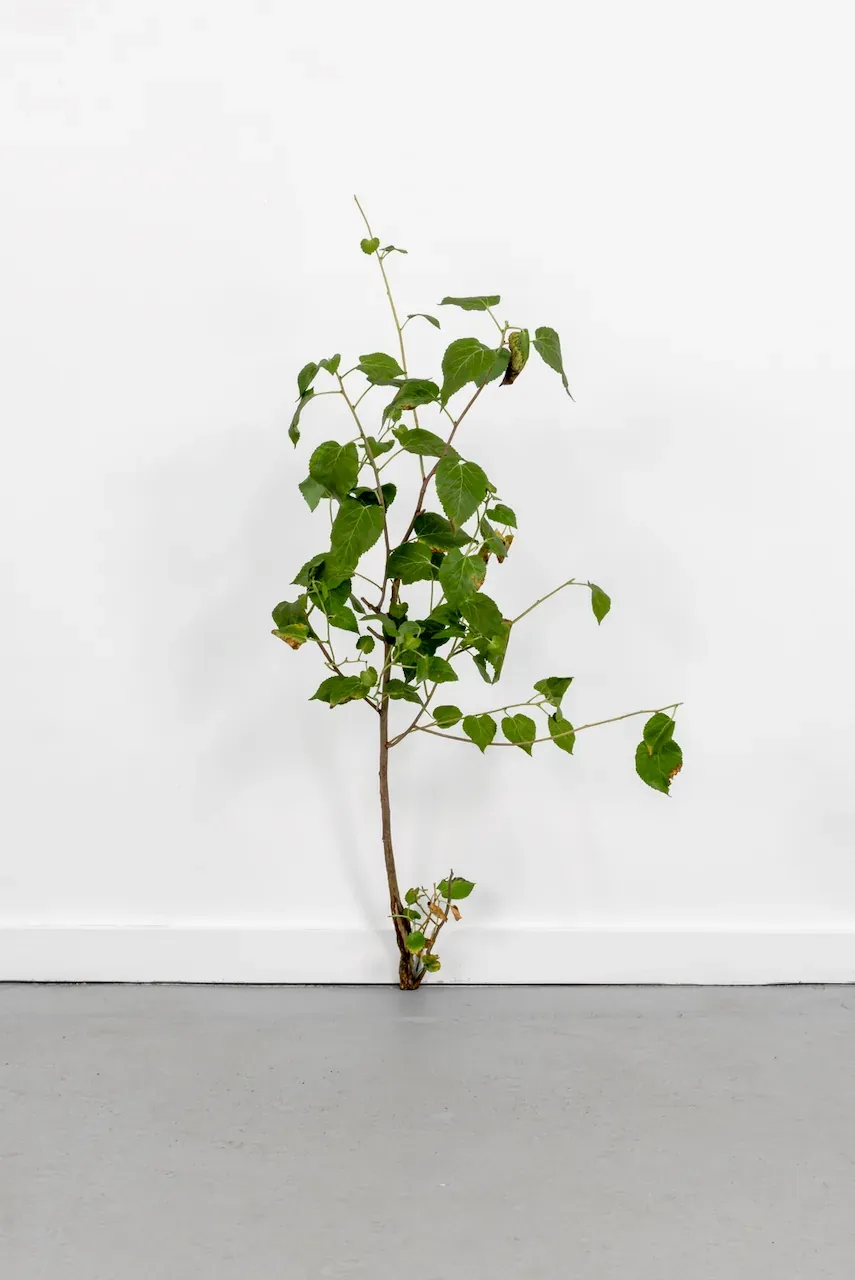
The Weeds are a very old series for me, and they contain something central to my practice: a distrust of cultivation. When I was younger I thought of this as a particularly American disposition. I wanted to celebrate the mongrel, the ugly and the unwanted, and in doing so question how we assign value in general. They’re explicitly anti-cultivation.
Years later, when I began making the Arrangements, I wanted to complicate our relationship to the cultivated and the beautiful. That’s why I would only perform these visual inversions on beautiful things — a flower arrangement or a nice dinner at a restaurant. I wanted to literally rearrange our relationship to those things, to make us look at them sideways. Maybe to introduce a little uncertainty, or scepticism. The visual tension the sculptures create mirrors the tension between my desires and my reality.
Years later, when I began making the Arrangements, I wanted to complicate our relationship to the cultivated and the beautiful. That’s why I would only perform these visual inversions on beautiful things — a flower arrangement or a nice dinner at a restaurant. I wanted to literally rearrange our relationship to those things, to make us look at them sideways. Maybe to introduce a little uncertainty, or scepticism. The visual tension the sculptures create mirrors the tension between my desires and my reality.
“My goal is always to draw people into the work, and humour is a great way of disarming the viewer while also creating tension. I’m never trying to be funny.”
You have described the Weeds as works that should initially be encountered as actual weeds rather than as sculpture. After three decades with the series, has that first encounter changed for you or for audiences who may already recognise them as your work?
I suppose it depends on how familiar someone is with my work. An informed viewer may simply see ‘Tony Matelli’ before anything else — that’s pretty difficult to account for. I think now some people probably see real weeds outside and think of me, and that’s okay. Maybe the series has become its own kind of hyperobject. All I can really control is my original intention. For viewers encountering the work for the first time, that initial surprise is still available. But the real power of the work lies beyond that first encounter. It lies in the sensitivity of the object and its ability to create an empathetic connection.
The Weeds are meticulously made in painted bronze, a material associated with permanence and monumentality. How does the labour and durability of bronze affect your thinking about subjects that are fugitive, disposable or routinely eradicated?
At first I made them out of plastic and wire. They were inexpensive materials, but they looked good and I was happy with them. The problem was that they wouldn’t stay put and they deteriorated over time. I also couldn’t make certain species because of the limitations of the material. I switched to bronze because it allowed me to make more delicate forms while maintaining their shape. It was a practical decision based on what the material could do, not because of bronze’s privileged place in art history. Bronze is used by artists for a practical reason. Of course I’m aware of that history, and it creates a productive tension with the subject matter, but that wasn’t where my interest began.
In earlier conversations, you connected weeds with persistence, disconnection and the question of what belongs where. Do those ideas carry a different emotional or political charge today?
I think they carry a profound charge today, especially in relation to migration, immigration, assimilation and ideas of cultural purity. That’s why I said earlier that the works feel very American in spirit — the opposite of pure. Rock and roll, not opera.
My original motivation, however, was largely personal. When I moved to New York I had no status and hardly knew anyone. I felt like an outsider. Socially I felt unwanted, or at least unnecessary, and I wanted to change that. So I kept showing up where I wanted to be — again and again, like a weed. Maybe not beautiful, but persistent and resilient.
My original motivation, however, was largely personal. When I moved to New York I had no status and hardly knew anyone. I felt like an outsider. Socially I felt unwanted, or at least unnecessary, and I wanted to change that. So I kept showing up where I wanted to be — again and again, like a weed. Maybe not beautiful, but persistent and resilient.
“I hope my work doesn’t suffer from literalism. I want it to embody an idea or a feeling rather than simply point toward one.”
The new self-portrait presents you in studio clothes, with the head twisted away from the body and resting sideways on the shoulder. This figure recalls classical contrapposto while also suggesting a mind physically out of alignment with its body. Were you thinking about the long sculptural history of the idealised body, or about the more contemporary experience of being mentally elsewhere?
In the sculpture the head is separated from the body. It sits where the head would normally be, but sideways. The body has been rearranged, and in turn the spirit has also been rearranged. The separation isn’t gory or grotesque; it’s matter-of-fact. That’s important because it removes narrative from the work. It abstracts the gesture and moves the sculpture closer to collage. I like the coolness of that. The overall sensitivity and detail draw you in, but the coolness of the gesture creates a speculative distance. The work is about a kind of psychic incoherence — a rupture or disturbance within the self, or within the image of the self. Really, though, it’s pointing toward a philosophical problem. Ultimately I was trying to evoke a feeling, and feelings are slippery.
In your mirror works, the viewer’s reflection is mediated by dust, marks and the traces of other people. How has that interest in the self as something contingent on others developed into the self-portrait in Sideways Dinner?
The sculpture is based on a photograph of me working in the studio. The picture was taken while I was looking at another sculpture. In a strange way it becomes a sculpture about looking — you looking at me looking. I don’t believe the self exists until it’s experienced by others, and I think we become different people in the eyes of different individuals. I see the self as fundamentally unfixed, and that’s part of what I wanted to explore with this work.
Humour is central to your work, but it rarely settles into simple irony. What can deadpan humour do that a solemn or explicitly tragic image cannot?
People are often apprehensive about art because it takes itself too seriously — or because artists do. They’ve been taught to think of art as an exclusively grand and important endeavour instead of a form of adult play. My goal is always to draw people into the work, and humour is a great way of disarming the viewer while also creating tension. I’m never trying to be funny. When someone laughs, I think it’s because they recognise something of themselves. They are connecting with the work in a powerful way.
You have spoken of wanting to create “philosophical problems” through clear, almost artless images. What makes an image capable of carrying an idea without becoming an illustration of it?
I hope my work doesn’t suffer from literalism. I want it to embody an idea or a feeling rather than simply point toward one. It’s a fair question because I do want maximum legibility, but I also want the work to have an autonomous existence and produce experiences that exceed explanation. Maybe what I’m after is legibility without complete clarity.
When I say ‘artless’, I mean excluding artistic flourishes or self-indulgence, which comes from a kind of masturbatory impulse. I find that very distracting in an artwork. Artists often want a signature style, something immediately recognisable. That’s never felt like a truthful way for me to work. I’d rather make an unadorned statement. I would like the work to have an attitude rather than a style.
When I say ‘artless’, I mean excluding artistic flourishes or self-indulgence, which comes from a kind of masturbatory impulse. I find that very distracting in an artwork. Artists often want a signature style, something immediately recognisable. That’s never felt like a truthful way for me to work. I’d rather make an unadorned statement. I would like the work to have an attitude rather than a style.