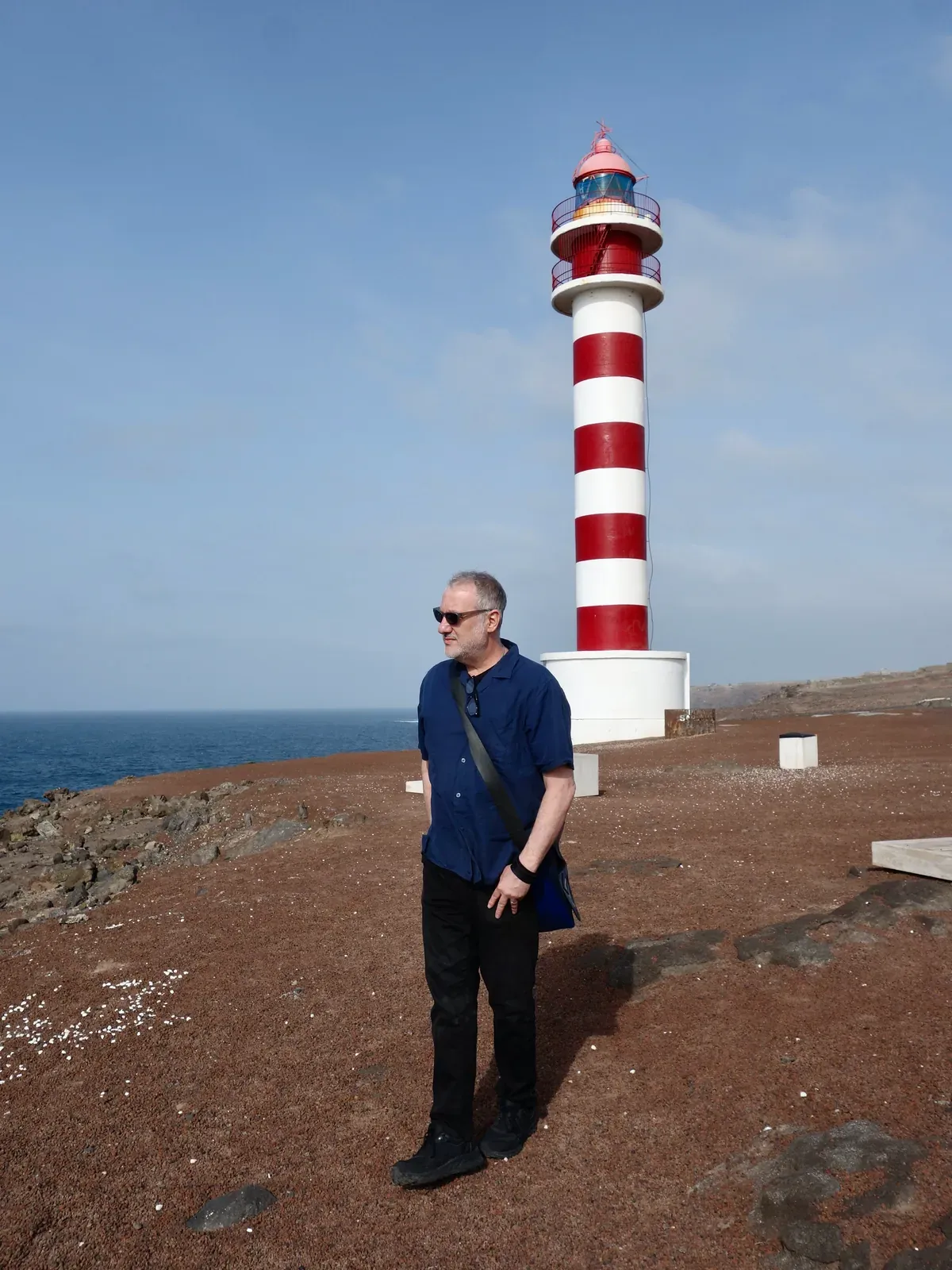
After nearly four decades of photographing the nude, Spencer Tunick travels to the Canary Islands for the project Gran Spectrum, a large-scale collective show of bodies painted in Pride-flag colours. The project makes its way to Gran Canaria, a thriving hub of queer culture for both visitors and residents, in a time of growing global restrictions for LGBTQ+ people.
Gran Canaria, the third-largest of the Canary Islands, acts as more than just set dressing for Gran Spectrum. The island is idyllic, both in its beautiful weather and its long history as a centre of queer life. From LGBTQ+ beaches and hotels to its multiple Pride celebrations, Gran Canaria models the freedom and inclusion that the artwork aims to represent. Like Pride-inspired body paint, the island is one full of colour, life, and human connection. Many have called the Canary Islands a meeting point between Europe, Africa, and Latin America, and it has certainly become a centre for tourism among the three and beyond. The islands’ history, both queer and colonial, feels relevant to the art project. It provides the basis for the line of questioning that ensues when pondering what it means for bodies to relate to space.
It is perhaps bizarre to imagine a mass horde of hundreds, even thousands, of nude people in public space, but this is Spencer Tunick’s exact niche. Known for being arrested five times over his art, photographing each US state in its barest form, and perhaps for the sheer shock value of his work, Tunick has no plans to cover up. His work teeters the line between critique of puritanical fears of the naked body and, given his repeated work in Israel as a guest of the Tourism Ministry and views on nude art in the Middle East, reifying the colonial history of photography and the (to put it mildly) strained relationship between America and the region, the world, at large. His focus on the body is not so much philosophical as it is quite literal.
Reflective of the act of composing these massive nude photographs, Tunick values the everyman over the anyone-man, so to speak, bringing up questions of individualism and collectivism, on the body as a whole rather than in pieces. Perhaps these tensions are why his work feels particularly suited to Gran Spectrum, which avoids imposing a specific discourse, and compels viewers to, more physically, take a stand.
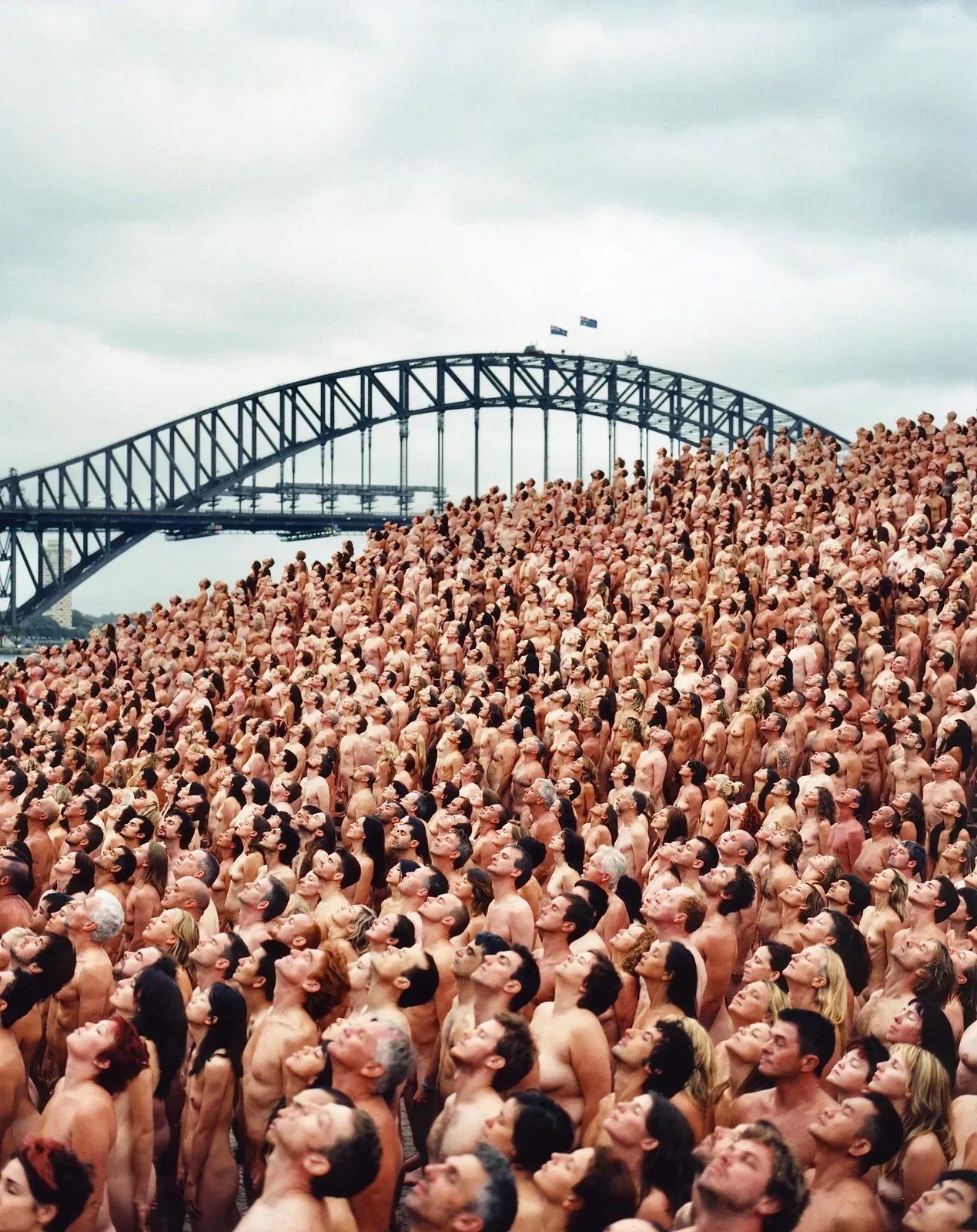
Sydney, Australia, 2010 © Spencer Tunick
We are here to talk about your upcoming project Gran Spectrum. How do you feel about it so far? Are you excited?
Yes, of course! What I do is I create abstract installations of people that I document with photography and video. And the end results of these artworks that are live, obviously, thank goodness, are large-scale photographs that people hang in their homes or in a gallery setting. So, I’m a visual artist creating photographs. My medium is people and I like that the medium changes from the people changing. If I’m working in Finland, it’s different than working in Germany, and that’s different than working in Chile or Argentina. It’s just the vibe of the people, and the spirit of the people, is often different. So not only do I like bringing my works to different countries, I love also to bring it to different events. When I was invited to do this project, which I titled Gran Spectrum, I was given the opportunity to work with eleven body paint colours. That was a unique opportunity for me because I’ve been working with body paint for ten years, so this was the first time I’ve worked with so many colours.
Nudity is quite controversial socially, but your art depicts it as very normal. What made you realise that the human body was something mundane and regular? When?
I noticed that from painting, from just going to museums in Paris and London — the Tate or the Met, or even the MoMA. It’s depicted quite frequently. For me, seeing nudity at an early age, my mother would take me to museums in New York. I lived in the Catskill mountains in upstate New York and I would come down to New York City, often with my mother who was an artist, she went to art school, and she would take me to museums. The first nude I saw really large depicted in a painting was Henri Rousseau’s The Dream at MoMA, and the woman in the image seemed so relaxed and it just seemed so commonplace to be viewed by all different ages on the wall. That sort of set me off on thinking about the depiction at a young age, not even thinking about contemporary art or historical painting, just thinking about how the naked body fits into our social stratosphere.
Has your art adapted to reflect changing cultural attitudes around nudity and politics, especially given America’s changing global position? Some of your work, like your work around oil, has focused on America as a global superpower.
I’ve done a lot of work on gas stations, right on top of them, because I was very concerned about the relationship of our existence dependent on oil from foreign countries, and also about privacy, private places and public places. A gas station is: where do private and public places start physically? Because there are no signs that say “You can’t walk here” in a city gas station. It’s open, so why not cover the pavement with bodies? And underneath the pavement is where the containers that have oil are. So, it’s sort of, the bodies separate the sky and the earth from the oil and the ground, very much like in foreign countries, not only our own country and our sea. But it’s sort of the separation of pavement and sky with the bodies. I’ve always been very concerned with oil in the sense of not only its scarcity but also its effect on the environment. How we love the great American idea of travel and freedom through taking road trips and low-priced flights, and it comes at the expense of our bodies and the environment often. Just so you know, I’m not a writer! There are artists that are visual artists and they can write essays and essays about their work. My forte is really about creating the image. I always find that the writers themselves are the artists that have the insight I might not have.
“Something magical happens and the bodies do become possibly blades of sand in a field or millions of pebbles on a beach.”
We are in an era of growing conservatism that Gran Spectrum seeks to push back against. You’ve said before that you don’t want to photograph “anyone,” you want to photograph “everyone,” valuing concept over documentary. Why do you think Gran Spectrum is a good site for this?
Well, it’s very strange about nudity and the body in the US right now, and conservatism. It’s so strange, in Melania Trump’s last book, she stated and also made Instagram posts about her defence of the nude body in art. This is coming from the Republican side, about a respect for the body! But I think they want the body to be sort of contained with rules that are laid out by a conservative agenda, whereas my art takes place in public space. In the United States, many of the states have very harsh rules about the body in art in public space. What Gran Spectrum does is it works in public space, and it takes the body, which is nude — which is usually delegated to magazines, Instagram, the internet, the beach — and brings it into public space, and the public space becomes the canvas for a short time.
Your work aims to turn the body from subject to matter for collective construction, in other words, from subject to object. Where does the role of the individual (including the viewer) fit in Gran Spectrum, which highlights queer identity often heavily rooted in individual expression?
The participants are collaborators. If you were there, you would see people shouting, people asking questions, individuals moving out and in, knowing that they’re making a larger piece. Not only for myself, but for them, for themselves. It’s a collaboration between many people. I’m sort of the catalyst, in a way, to their best hopes for a successful artwork. It will always be a successful experience because the sight of a plane of people of various skin tones nude next to you is quite a new vision that you just can’t see everywhere, unless you’re there. It is a mass, but it is a mass that is very awkward at first before it takes place. With faces, and personalities, and people moving, and discussions. But once everyone is in place, something magical happens and the bodies do become possibly blades of sand in a field or millions of pebbles on a beach.
There is a playful relationship in your work between landscape and body. How is the vision of Gran Spectrum shaped by the natural setting of Gran Canaria and Maspalomas? What is the relationship you want these bodies to have with this specific physical space?
I tried to get the bodies into a popular natural space, the dunes, but there are restrictions and rules where they don’t allow people to walk on the dunes. But there are millions of footprints, so people are doing it and no one’s getting arrested! I wasn’t even trying to get people on the main area because I don’t even think that the main area should be covered with footprints. I was just trying to do it off to the side, and still there were restrictions. I do feel they’re a little harsh because you can already see evidence of people in shoes walking, and it would just be my barefoot participants already over footprints of people in sandals and shoes! I think it would’ve been possible, so I did lose out on the opportunity of creating something in a natural environment, which I wish I could’ve done. But I’m still happy with the location, because yes, it’s about the location, but this work is more about the spirit of the people and how Gran Canaria has been a safe haven for the LGBTQIA+ community for years and years. Recently, I have a friend who I asked, “Have you heard of Gran Canaria?” He said “I was there in the 80s!” And this is someone who was quite in the queer scene in New York City in the 80s as well! That was his destination for a good time in the 80s. I’m layering a wonderful, warm blanket on top of a place that was already warm and wonderful to the community.
The Canary Islands are a particularly rich place for this project because of the islands’ lively queer culture. In Gran Spectrum, how do you plan to balance your equalisation of the body with the politicisation of queer bodies? Has doing such an overtly queer project altered your artistic process in any way?
Forever, I’ve had the queer community coming out to pose for me. And very obviously, you know it’s the queer community, like people are who they are. My first inclination is not to treat anyone differently, but just to be real, happy, and make everyone feel comfortable and included, and not point anyone out in a way that would make them feel different from anyone else. In that way, I’ve always had the idea of: Be who you wanna be, in my heart and in life.
“I’m layering a wonderful, warm blanket on top of a place that was already warm and wonderful to the community.”
Your work blurs the line between public and private space, bringing up questions of voyeurism and gendered beauty standards. How does Gran Spectrum address or explore expectations of normativity and the policing of bodies through voyeurism, especially regarding gender conformity and non-conformity?
A tactile approach to this question is that the voyeur will see sort of a structure in the work. The people participating are all volunteers and they’re all covered in paint. In this, there’s a distance from the perception of people. I think the idea of any titillation or arousal never really happens with my works as far as the vision of someone spectating. We also don’t allow spectators. It’s a performance for the participants, and the documentation is video and photography. It’s not a live performance for onlookers. When you think of eight hundred naked people, you might think how close can you get to watch as a general person, but it’s really not about that. It’s about the idea of collective euphoria coming into the moment, into the art event.
Invisibility and representation are words that are constantly brought up in queer discourse. How does Gran Spectrum address space and negative space, formally and philosophically? Is the project commenting also on who cannot, for whatever reason, show up?
Anyone can participate. We don’t have them anymore, but if you can get to an internet cafe you can sign up. This is not the 90s, excuse me for saying that! You can register on your flip phone! On your Samsung or iPhone. This is open to anyone: any race, any colour, any religion. It’s sort of an alphabet soup of collective gathering. In that, everyone is making an artwork together that they are going to have many different memories of that are very surreal, and about transcending sexuality. At times, being proud of their gender, but also making art and coming together as a community to make art. In this case, it happens to be using many of the pride colours. It’s transgressive in the fact that it is commonplace identity colours of the community, but it’s still nude in public. It’s still a lightning bolt, an explosion of life in the face of conformity and often, political and corporate control. I’m lucky! I’m lucky that people are interested!
It’s been said that Gran Spectrum doesn’t “impose a discourse,” but “compels viewers to take a stand.” Additionally, the Canary Islands “function… as an active part of [this] message.” The islands’ loaded colonial and LGBTQIA+ history, then, converge with the project. How does Gran Spectrum explore the increasingly relevant relationship between history and modernity? How does it toe the line between celebration and political rallying?
Right now, we have a situation in the world where the queer community is demonised for political gain to the lowest common denominator. There’s an opportunity if any artist has a chance to create a work that resonates for themselves and the LGBTQIA+ community that vibrates out into the world as a spectrum. Whether the photograph and the artwork is successful or not successful as an art object, just the fact that it’s happening, and that people will shed their clothes for something else besides leisure, or going to a nude beach, or the mechanics of sexuality. It is an artwork that is naked, but it’s more about the body, not about the naked body. To me, it’s more about the body without clothing as opposed to the naked body. Although I do often title my series Nude Adrift or Naked States! But still, it’s sort of the body’s place to be in a location, and it just happens not to have clothing. That creates a new language between the body and the background. In this case, the body on a volcanic island that has a long history and spirituality. And many cultures! It seems today that it’s sort of a melting pot, like a New York City in a way.
Do you feel sensationalism or stigma around the body still exists or has changed in an age of popularised cosmetic body alteration and pornography?
I think when you see a nude person in person with augmented and cosmetic changes, it’s not as shocking, or as mind-altering in a negative way as if you see a photograph. Talking about the individual, perhaps sometimes it’s objectifying the individual. But when you work, you can tone down the photograph, in a way, tone down the documentation to create a real-life scenario with real colours, no AI and no Photoshop, just in its natural state. In general, the public, an individual, just wants to feel good about themselves. I think posing for an artist or a photographer nude, no one’s being forced to do that, they do it to explore their bodies in the present day, to possibly enlighten their future. Today with social media, there are more people photographing outdoors naked than ever before. I think every photographer and their mother photographs, at least once in their body of work, naked people! Instagram is all naked! You get in that algorithm and it seems like the whole world is giving up accounting or being a fireperson or a librarian! Everyone’s naked! It wasn’t like that when I first started. There was maybe a handful of photographic artists working with the nude and outdoors in public space. Now it seems like the whole world is naked. But I always think it’s a good thing. I think the more photographers and artists working with the nude break down the political and corporate barrier of constrictions against free speech and individuality.
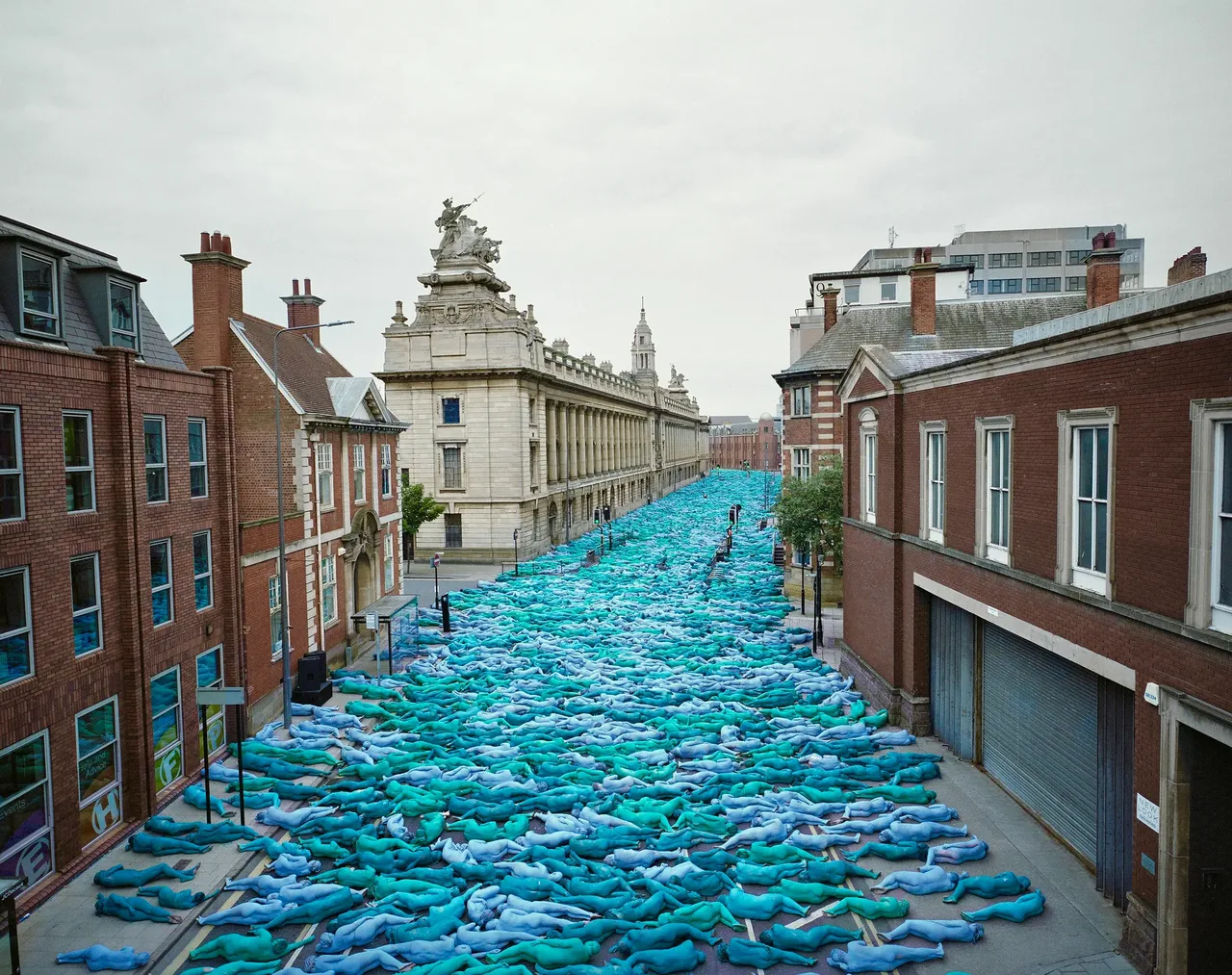
Sea of Hull, Hull, UK, 2016 © Spencer Tunick
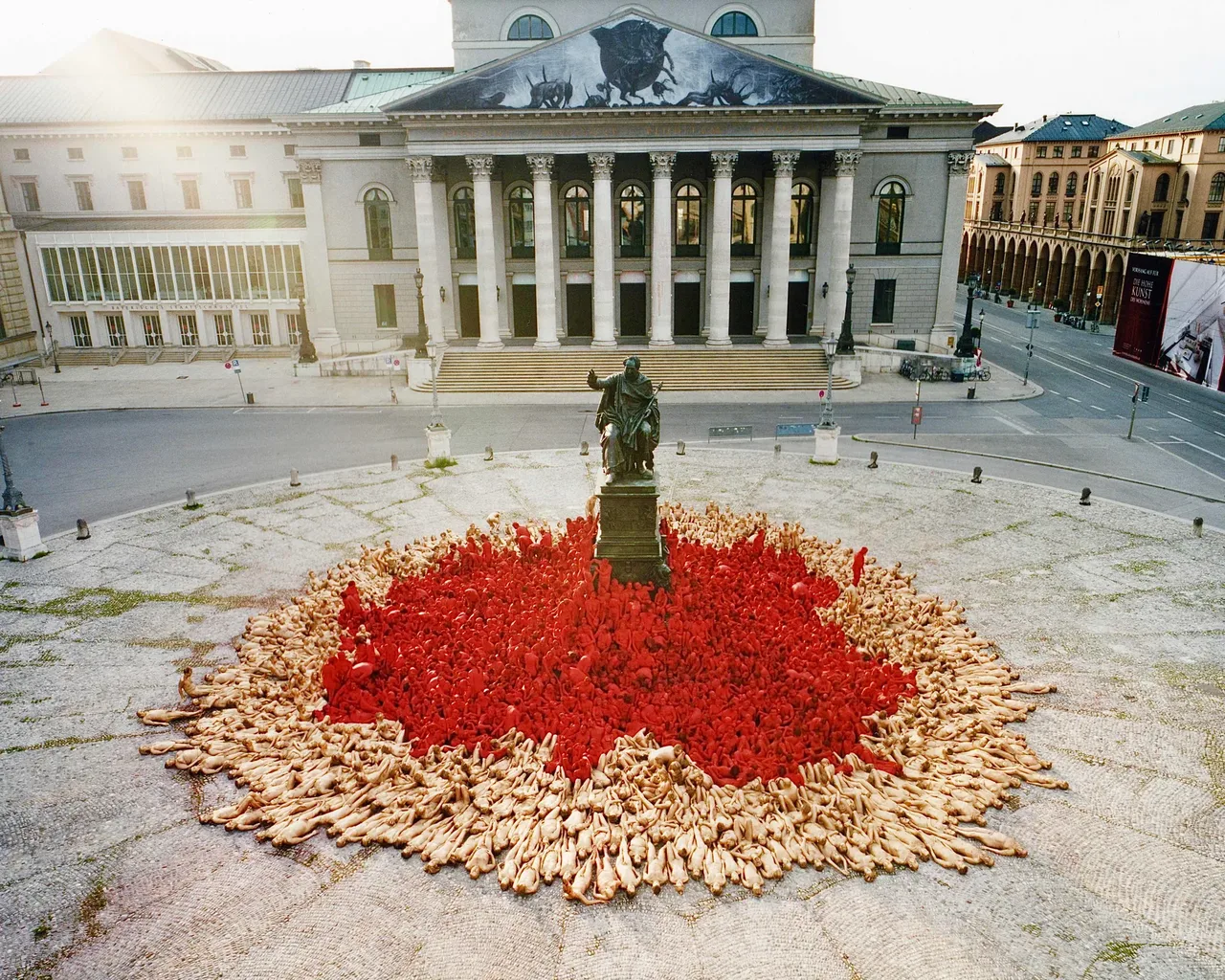
Munich, 2012 © Spencer Tunick
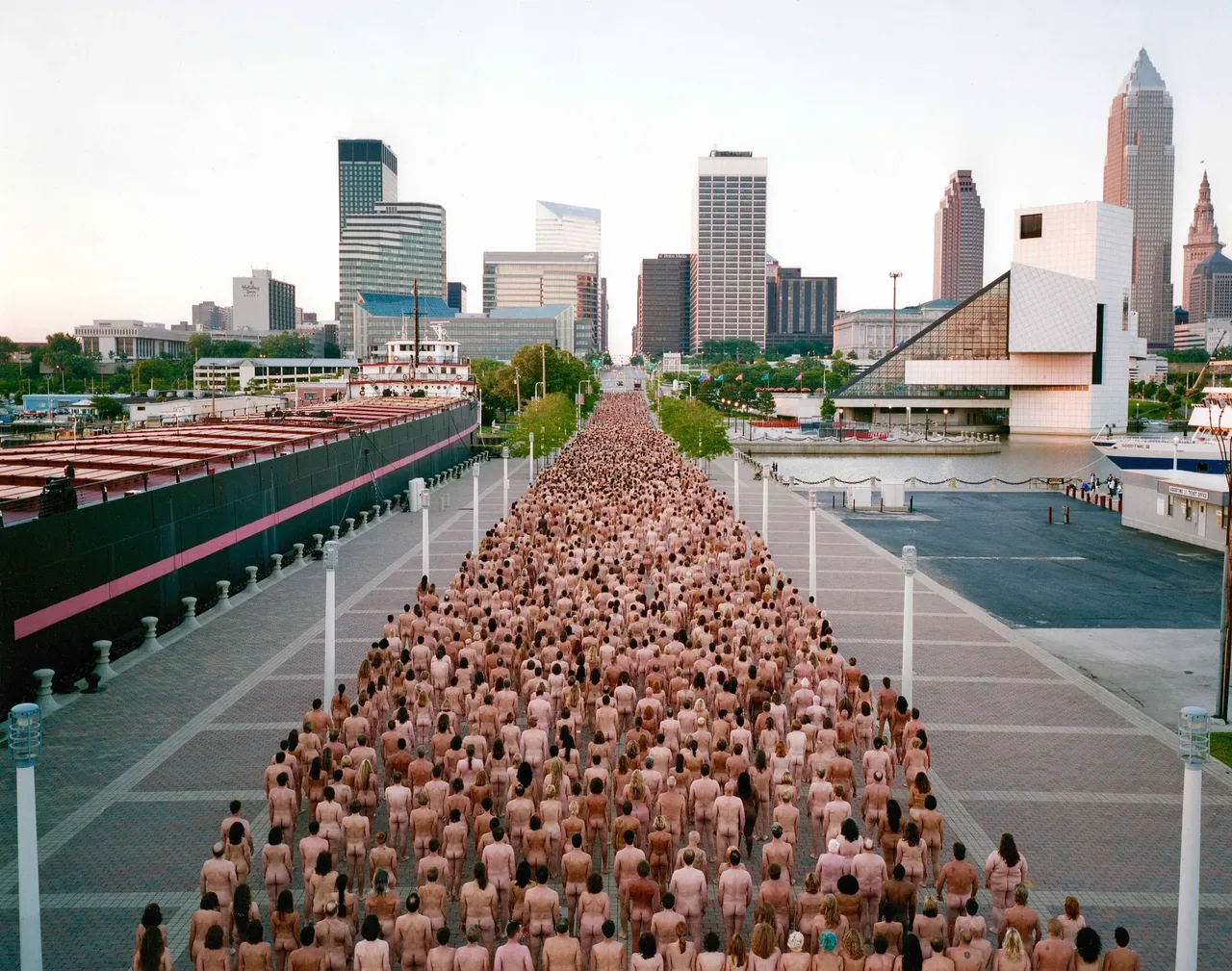
Ohio, 2004 © Spencer Tunick