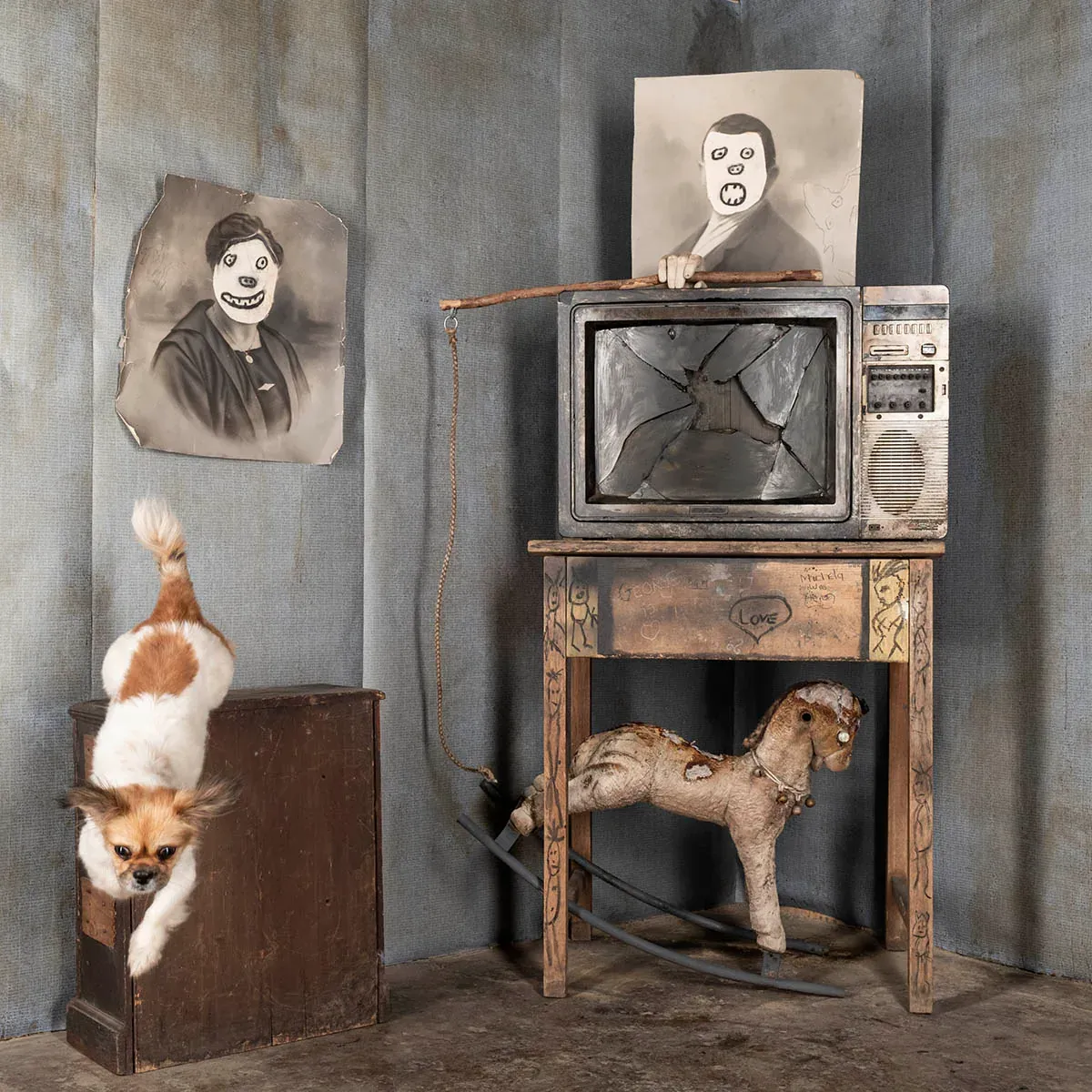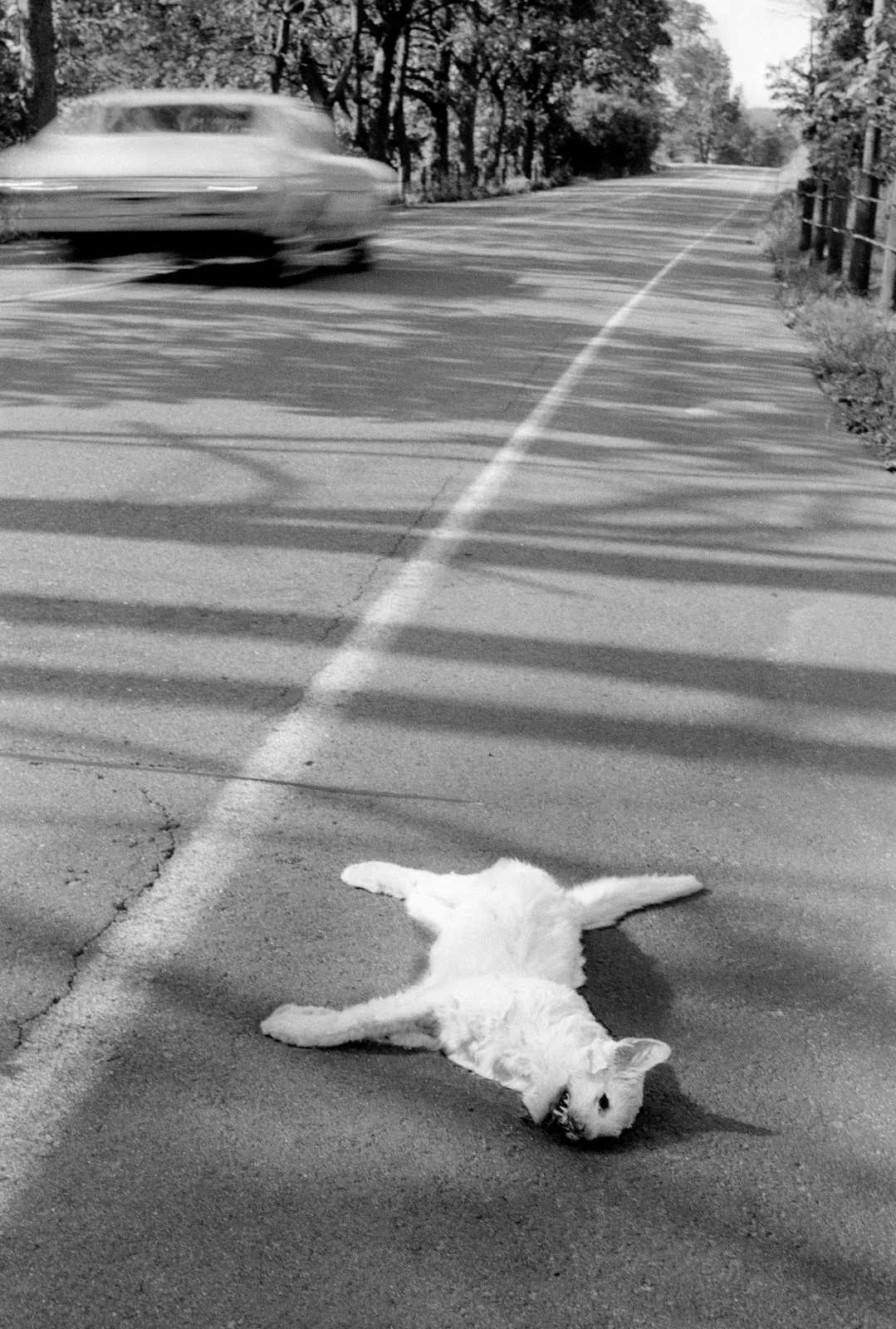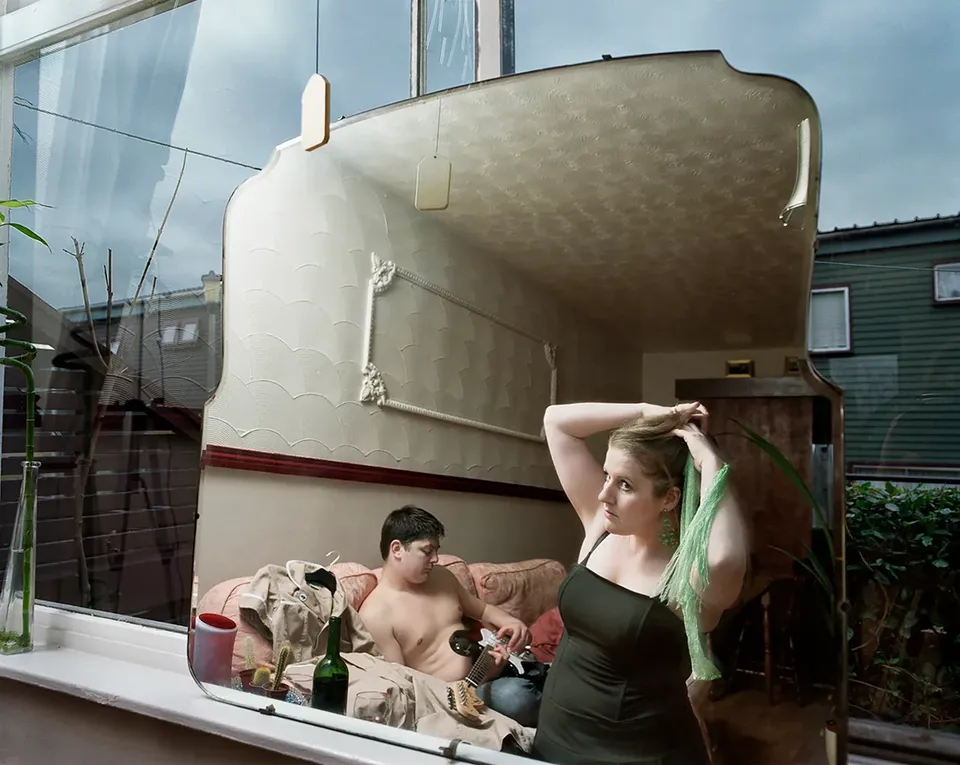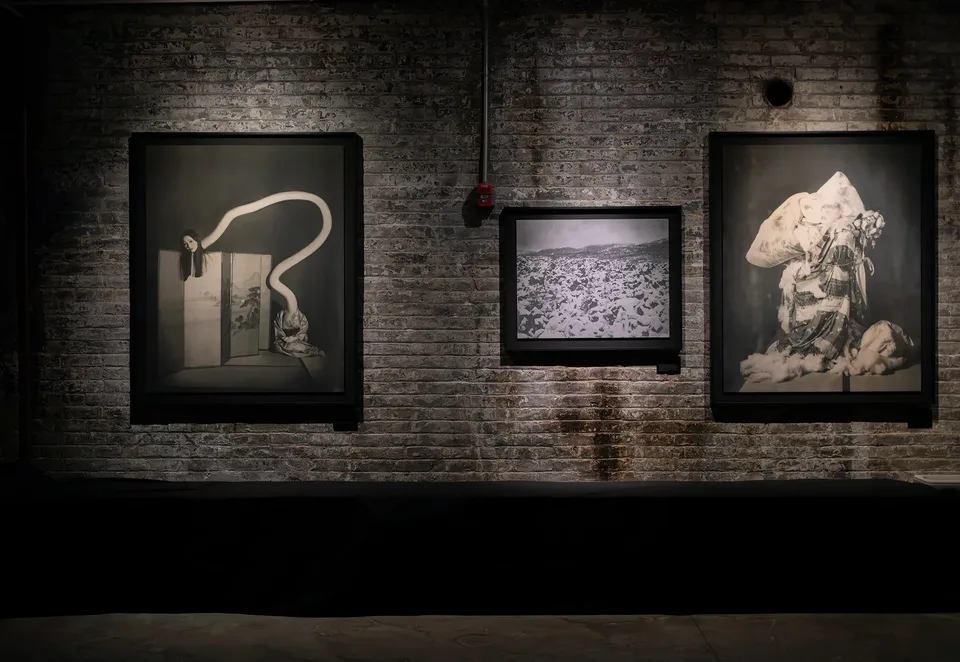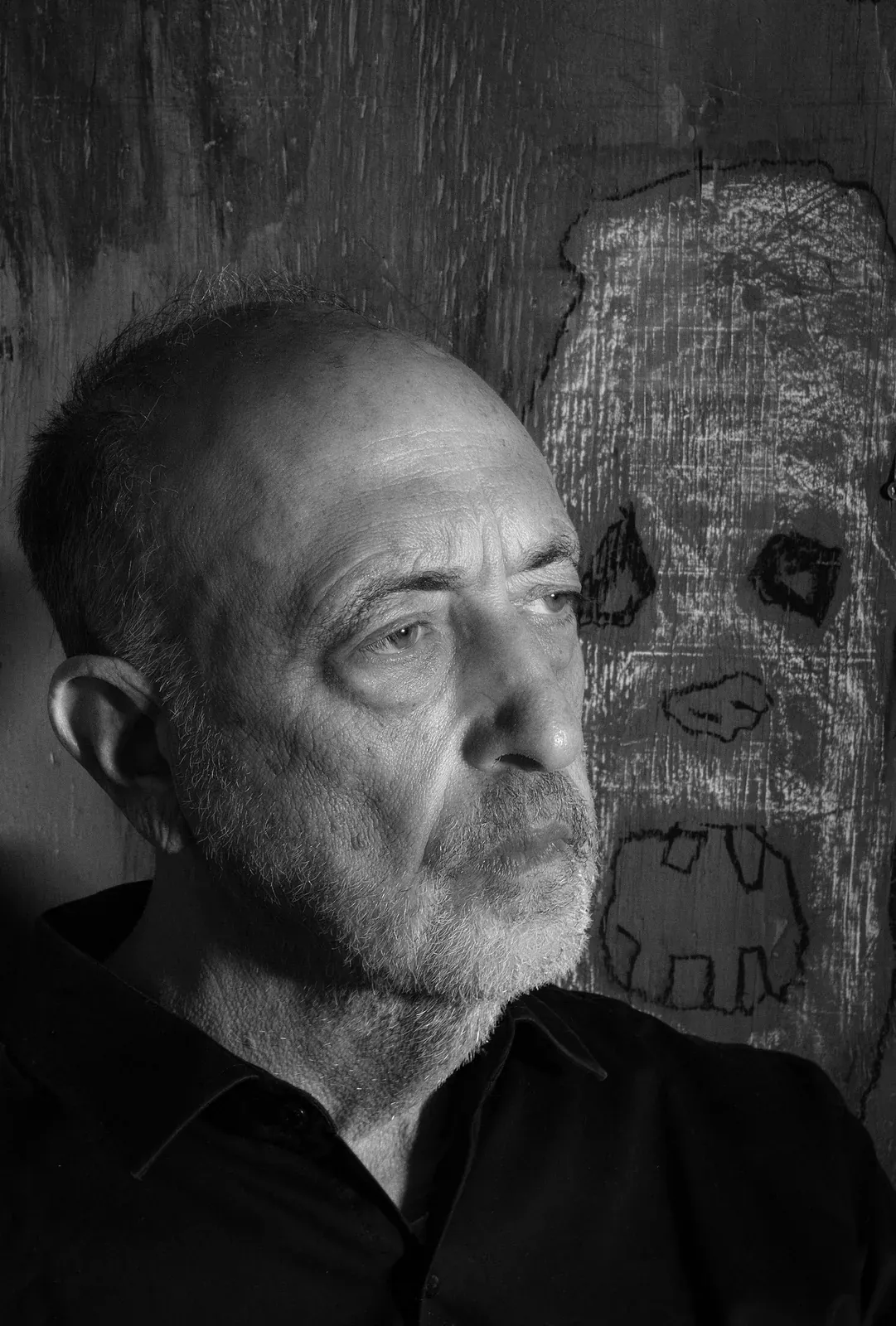
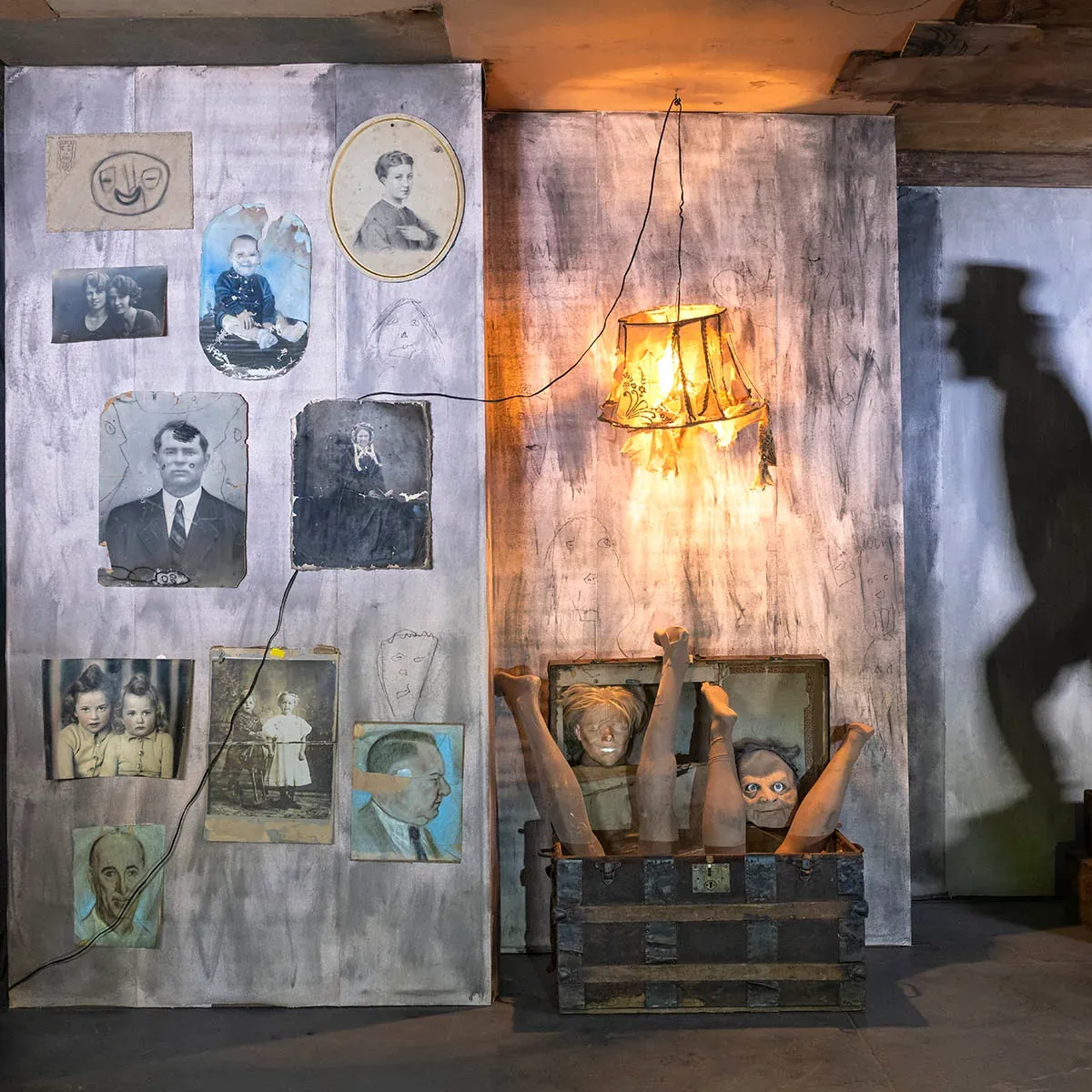
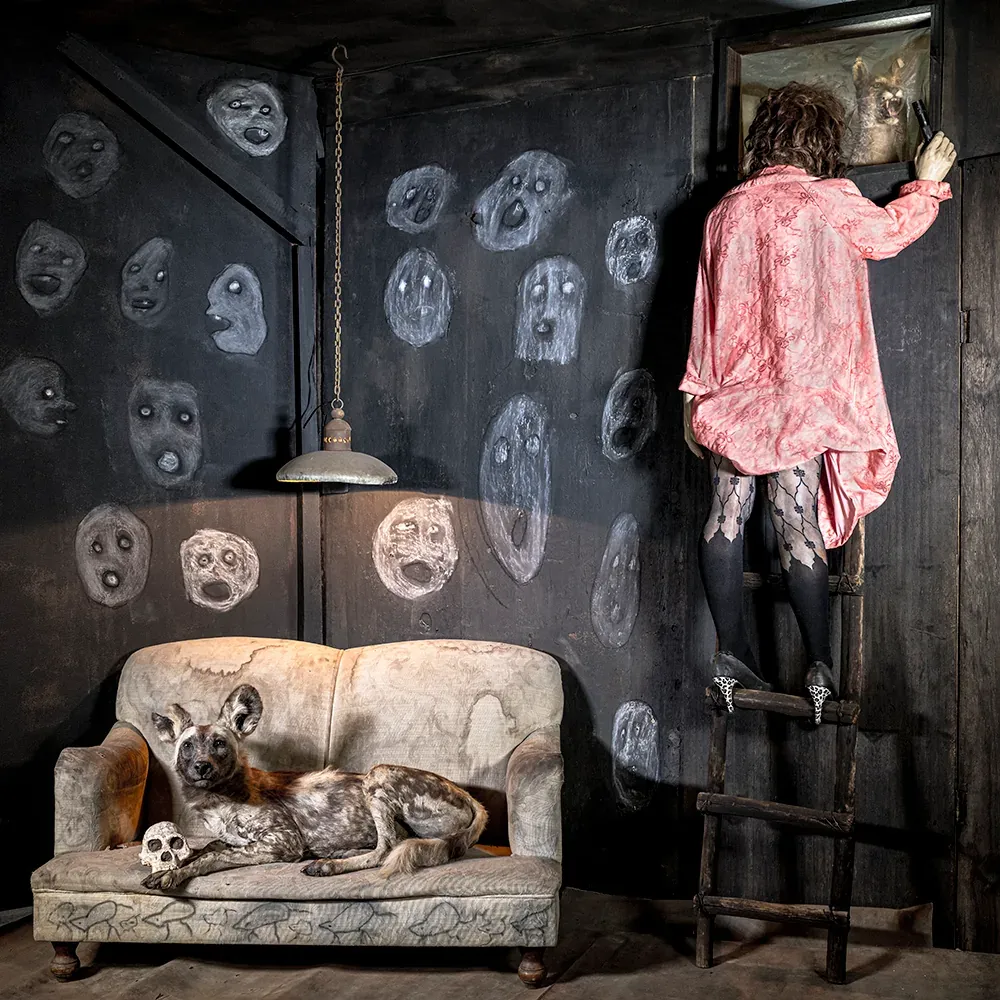
Roger Ballen has spent more than four decades building images that feel less like photographs than rooms inside the mind: uneasy, funny, theatrical and impossible to look away from. Across his work, bodies, animals, masks, drawings and found objects meet in carefully staged scenes where order and chaos are never far apart. For Spirits and Spaces, his latest show in Copenhagen’s Royal Danish Theatre, Ballen brought colour into his famously monochrome universe for the first time, opening another door into the strange psychological territory that has made his work so recognisable.
We spoke with Ballen while the show was open about the forces that shape his practice: childhood and memory, the animal within the human, the complicated business of trust and the unsettling questions that sit beneath his pictures. He reflects on photography as a lifelong commitment, and on creating images that do not offer neat answers. The result is a conversation that moves through his work with the same curious, off-kilter logic that defines it — always searching for what lies behind the mask.
Let’s start with your early stages in photography. Can you tell me a little bit about how your family has influenced you to get into the craft?
My mother worked at Magnum in the early 1960s and started one of the first photo galleries in America, representing people like Kertész, Cartier-Bresson, and a lot of other Magnum photographers. By the time I was in my late teens, I understood what was important in photography. I was able to take successful pictures by the time I was around eighteen because I was exposed to the work of great photographers and saw them in my house. My mother was friendly with them, had the books, and hung the photos around the walls, so I had a good understanding of what photography is about from the relationships she had with the Magnum people.
What about your father?
My father was a lawyer. He wasn’t really interested in the arts; he had a rational side to him. I always said that my mother was artistic and my father was rational, and I have those two sides to myself. I'm organised, I studied science, and I’m also artistic. So, I think that comes from the two personalities of my parents.
You were twenty-nine years old when your famous series Boyhood was published. What common traits have you encountered with the boys you came across and photographed?
I found that the experience of boyhood was similar wherever I went in the world. It’s a biologically driven experience. Obviously, children in rich countries spend more time in organised activities while children from poorer countries spend their time on the streets playing games. But this is the spirit of boyhood and is very similar all over the world. This is what I found, and this is what I tried to express in the book.
“My purpose in taking photographs over the past fifty years has ultimately been about defining myself. It has been fundamentally a psychological and existential journey.”
How would you characterise yourself as a boy?
Well, it was appealing. I always said the experience was one of adventure, of going into the world for the first time and finding your place in it. It was a very romantic time. People mostly remember their childhood as romantic. Obviously, there were difficult and unpleasant periods, and there were some cruel ones. But at times, I look back to when I did the book and boyhood was seen as a romantic period, you were free to discover the world on your own terms. It doesn’t mean it’s the same for everybody. It was only a viewpoint that was expressed in the book.
Where were the pictures taken?
They were taken in forty or fifty different countries. I hitchhiked from Cairo to Cape Town. I’ve travelled across Africa, Asia, South America, and America.
You attended the Woodstock music festival in the 1960s. How did you get there, and who else was there?
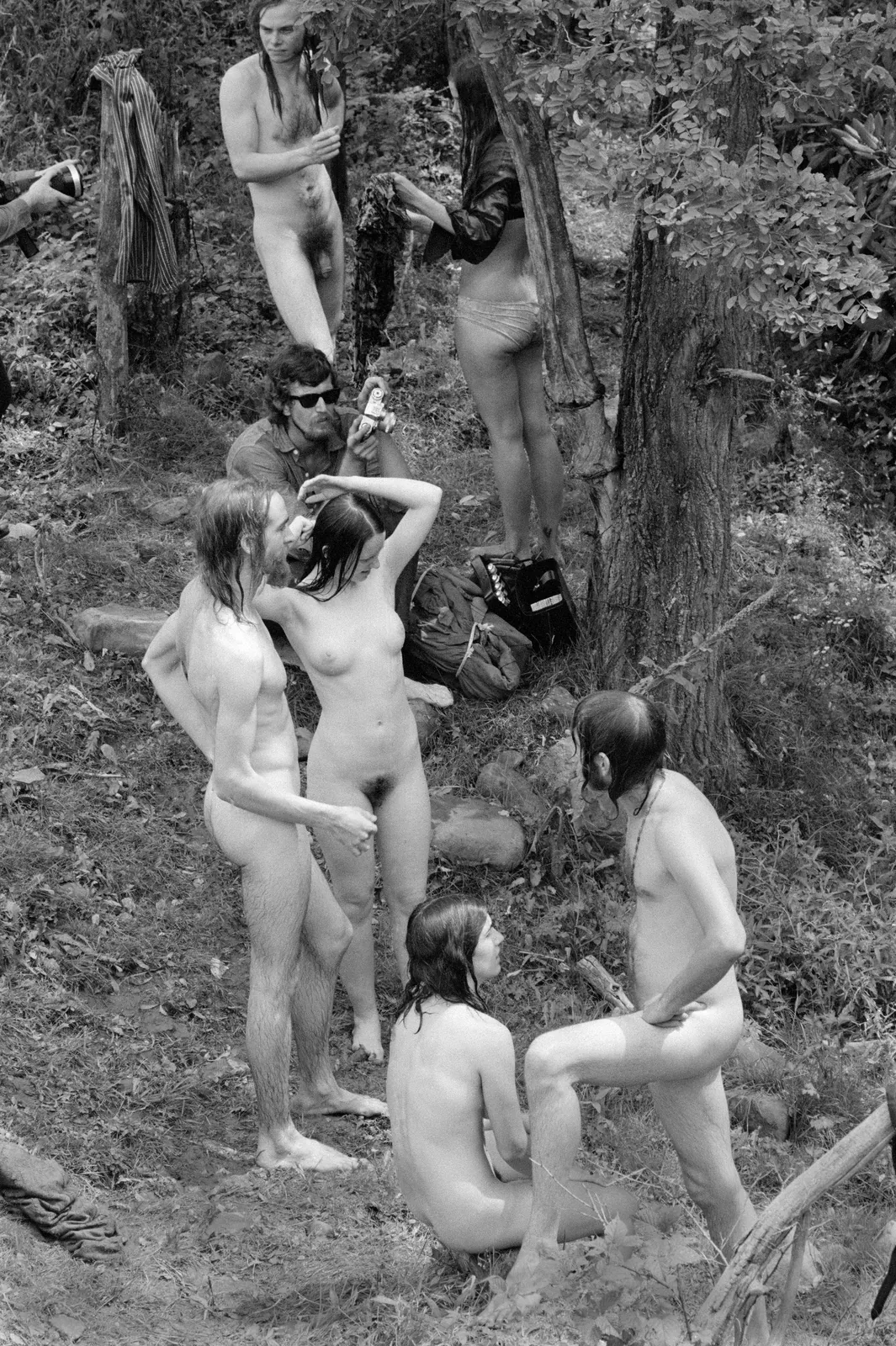
It started as a very organised festival with some of the most famous people in the world of music. They had a bad thunderstorm there, so all the fences fell and it became a free concert. There were many more people than they expected, around three to four hundred thousand people; everybody knew about it. I went there as part of the group and slept in the back of my friend’s car.
It was during the counterculture period, when people believed in free music, free love, free sex, and free drugs. This whole spirit of the times and the music symbolised that belief all at the same time. It became a symbol of 1960s counterculture, revealing itself through music and freedom. I guess it was almost the most singular event of that particular period of history.
It was during the counterculture period, when people believed in free music, free love, free sex, and free drugs. This whole spirit of the times and the music symbolised that belief all at the same time. It became a symbol of 1960s counterculture, revealing itself through music and freedom. I guess it was almost the most singular event of that particular period of history.
Masks are prominent objects in your photography. You often say that you need to explore what’s behind the mask. What is it that you are looking for, and what discoveries have you made so far?
Firstly, human beings are quite complicated. Everything on the planet is quite complicated. So, the idea is to try to reveal the most basic psychological states, the purest aspects of human nature. My goal is to actually reveal the human condition in all its complexities. It’s not very easy to do; as I said, human beings are complicated, and what we call the human condition is partly a matter of definition.
I aim to reveal the deeper psychological levels of human behaviour and its relationship to death, animals, spirits, the afterlife, and the chaos around us. These are issues that come out of the photographs I take. My first degree is in psychology, and my PhD is in geology. I study these things. I don’t know how much they help me, one way or the other, with the pictures, as they are sciences, but I’m not sure whether, if I had never studied them, I might have made the same pictures. I can’t say.
I aim to reveal the deeper psychological levels of human behaviour and its relationship to death, animals, spirits, the afterlife, and the chaos around us. These are issues that come out of the photographs I take. My first degree is in psychology, and my PhD is in geology. I study these things. I don’t know how much they help me, one way or the other, with the pictures, as they are sciences, but I’m not sure whether, if I had never studied them, I might have made the same pictures. I can’t say.
Over the years, you have done a lot of projects that are very different from each other. How do you keep track?
If you look at the book Ballenesque, you will see the names of the books: Boyhood, Drops, Outland, Shadow Chamber, Boarding House, Asylum of the Birds, Roger the Rat, etc. The book has all the dates of all the projects. I work in specific series, and I finish the series with a book. Usually, books take about five years to complete, but I have also done around twenty-five to thirty minor books and lots of catalogues. So, there’s usually an intense period of five years in which I work on a very specific project. That is all in the Ballenesque book, which is kind of an archive.
Your work is currently exhibited at Copenhagen Photo Festival. How did you decide what to show?
I wanted to show the latest work, Spirits and Spaces, published by Thames & Hudson, which is my first colour book. That’s what I wanted to do from the beginning, as there wasn’t a giant space here where I could show a massive number of photographs. So, given the space, its size, and the fact that I had just published Spirits and Spaces, I thought it was a good idea to focus on this programme.
I heard that you like going to flea markets in every country you visit. What draws you to them?
It’s hard to find good flea markets, but once I’m there, I usually find a lot of stuff. I have found hundreds of objects that could be anything from old paintings, masks, and shoes to all kinds of things. The most important thing is to find the thing that interests you, something you feel could go into a photograph. At the beginning of the process, it doesn’t mean that just because you find something special, you are going to take a photo or do anything with it, but you have to find things to work with. Usually, these markets are good places for me to look. They aren’t like major shopping malls, where I’m not going to find anything.
In your imagery, animals are a very natural part of the composition. How do you accomplish this?
It depends on the project; you can’t tell most animals what to do, so you have to work with them, to find a place for them in the picture. Sometimes they’re my animals, sometimes they live in the place, sometimes they are other people’s pets. But just because there’s an animal, it doesn’t mean you are going to create a picture. It's the same as asking how you would work with a person. Again, it depends on what you are doing.
Are you trying to uncover the animal within the human?
This is an abstract concept. I mean, eating, sleeping, having sex: these are animal behaviours, but they are very complex issues. People, when they use the term ‘animal’ in English, use it very negatively. They say, ‘Oh, you behave like an animal’. Well, that’s a bad way of putting it. An animal is genuine. It behaves according to nature. You can’t say an animal is either good or bad. Human behaviour is very complex. The way people behave can be very self-centred, very destructive, unaware of consequences, but this is not the way an animal behaves. An animal only behaves according to its instincts.
I don’t get in their heads, but I have observed them for forty or fifty years. Animals work according to their basic behaviour patterns revolving around survival, food, sex, and territory. These are important instincts that allow an animal to survive. And as for human behaviour, if you remove all the distractions, you can find that most people’s behaviour is similar to what I refer to as animal behaviour.
I don’t get in their heads, but I have observed them for forty or fifty years. Animals work according to their basic behaviour patterns revolving around survival, food, sex, and territory. These are important instincts that allow an animal to survive. And as for human behaviour, if you remove all the distractions, you can find that most people’s behaviour is similar to what I refer to as animal behaviour.
You have shot in many interesting situations and places that are definitely not accessible to most people. How did you get into those kinds of environments and gain people’s trust to work freely?
You can’t just walk into a place and start taking pictures. It takes time; you have to get people to trust you. It’s like everything else. It takes time. They have to see that you are trustworthy; they have to see that they benefit; you have to become friendly towards each other. And then things tend to be more relaxed, and that’s how you build up trust. It’s like everything else in life. It’s a normal way of behaving towards people, and some don’t do well in those environments while others do. I’m pretty good in those environments. People can feel that I am natural; they like me, and that’s why it worked out. If I was tense or anxious, then they wouldn’t like me or they would take advantage of me. I was always good with them, and I don’t make value judgments.
“A photograph is perceived as authentic if the viewer believes that the photographer has captured a moment that can never be repeated.”
Is there any series that’s particularly special for you?
All the series are special to me, that’s why I did them. If they weren’t special to me, they wouldn't have any value. You have to be intensely involved in what you’re doing to do it well. And it doesn’t matter what you’re doing; it can be anything —a butcher, a mechanic, a fashion designer— but if you don’t have a passion for what you do, you probably won’t do it well.
What do you think are the main elements or even a philosophy you are trying to apply to your photography?
I’m trying to create pictures that challenge me, that help me better understand the more complex issues of my life and the human condition in general. I question what human life is about. What is my life about? What are the core elements of human experience, of my experience, of other people’s experience? How do you comprehend the afterlife? What happens when you die? Where did you come from? All these are very, very difficult questions, and I'm trying to find ways of helping myself not necessarily answer these questions but clarify these issues in my mind in some way — not to get answers, but to say this is what it’s about.
For example, chaos pervades. Chaos pervades life, human life, animal life. You don’t know whether you will die tomorrow. You don't know how you are going to sleep tonight. You don't know this. In a way, a lot of pictures deal with the issue of chaos. It’s a very clarified chaos; that’s why people find some of the pictures disturbing or anxiety-inducing, because underneath them, those pictures are saying life isn’t simple, nor perfect, it’s not going to happen the way you hope to. It’s a state of breaking down and creating, breaking down and creating. It’s a state of continuous, unknown changes. People, even animals, are constantly adapting to what’s in front of them. As much as they can control things, ultimately they know good and bad things can happen.
That element is in the pictures, and people subconsciously understand it. They don’t necessarily know how to be clear about it or say, ‘Oh, this is about this or that’, and it’s because the pictures can have order and chaos at the same time. But they are posing questions about people’s state of mind, state of being, that they are not able to deal with or bring up, but the pictures bring up these issues that are repressed or avoided.
It’s interesting here in Denmark. I’m getting the response that my pictures are dark, and maybe it has to do with the fact that life is too ordered here, but there’s nothing dark about them. My images are about people’s shadows that they haven’t dealt with. They show an unresolved mind, an unresolved personality. I think most of them are humorous. They are like a theatre of the absurd.
For example, chaos pervades. Chaos pervades life, human life, animal life. You don’t know whether you will die tomorrow. You don't know how you are going to sleep tonight. You don't know this. In a way, a lot of pictures deal with the issue of chaos. It’s a very clarified chaos; that’s why people find some of the pictures disturbing or anxiety-inducing, because underneath them, those pictures are saying life isn’t simple, nor perfect, it’s not going to happen the way you hope to. It’s a state of breaking down and creating, breaking down and creating. It’s a state of continuous, unknown changes. People, even animals, are constantly adapting to what’s in front of them. As much as they can control things, ultimately they know good and bad things can happen.
That element is in the pictures, and people subconsciously understand it. They don’t necessarily know how to be clear about it or say, ‘Oh, this is about this or that’, and it’s because the pictures can have order and chaos at the same time. But they are posing questions about people’s state of mind, state of being, that they are not able to deal with or bring up, but the pictures bring up these issues that are repressed or avoided.
It’s interesting here in Denmark. I’m getting the response that my pictures are dark, and maybe it has to do with the fact that life is too ordered here, but there’s nothing dark about them. My images are about people’s shadows that they haven’t dealt with. They show an unresolved mind, an unresolved personality. I think most of them are humorous. They are like a theatre of the absurd.
What would you advise young photographers?
Photography is a lifelong project, you have to be as dedicated and passionate as you can. If you are going to do this as an artist, rather than as a commercial photographer, you would also need to get another profession. I tell the same thing to my children, friends, and students at universities. It is a very hard business. Billions of pictures are taken nowadays, and it’s very difficult to achieve something and then sell these pictures. Especially now with AI, which makes matters more difficult. When people look at my pictures, because they are so strange and surreal, they think it’s AI, but AI couldn’t do what I’m doing. I have worked with some of the most important AI people in the world who tried to redo my pictures, but they didn’t even come close. They couldn’t get it, there were too many pieces.