With over a decade of experience behind her, Kelela has established herself as a musical chameleon, shifting between genres with the precision of a Swiss army knife. From her early days in a rock band to her explorations of jazz, R&B, garage, pop and electronic downtempo, her sound draws from a wide-ranging pool of influences, spanning artists as diverse as Aaliyah, Incubus and Joni Mitchell. With her third album, new avatar, she once again reminds us why she’s one of the most compelling artists of our time.
Even as she seems to retreat from the online visibility that defines today’s music landscape, her artistic vision continues to evolve, challenging expectations and reaffirming her place at the forefront of contemporary music. Ahead of her performances in Madrid (Sala Lab/Wagon, 22 October) and Barcelona (Sala La Paloma, 23 October), we sit down with her to discuss her new record, the PinkPantheress collab, and the challenges of performing certain songs live.
You’ve described yourself as a late-bloomer artist, and with every era, it feels like you’ve reached a bigger audience. What do you think has allowed you to grow at your own pace, especially in an industry that seems increasingly obsessed with speed and instant success?
I think coming into this work with some maturity and having made a lot of my fuck-ups quietly and out of the public eye helped me make decisions that are true to what I really want. The other part is that I’m constantly trying to show or reveal a different facet of myself each time I make a record.
I also digested and listened to a lot of music. A lot of development happened before I ever approached my first recording, or even before I wrote my first song. I didn’t write my first song until maybe three and a half years before the mixtape. I was approaching it from a place of having had some musical training, but never with my voice. A lot of my approach has been intuitive. Ultimately, the maturity piece is a big part of it.
I saw the prodigy-obsessed culture that is the music industry as something to resist, so I was able to make decisions that reflected that upon entering the industry and releasing my first project. I was always aware of it. I already felt like my time was up, but I thought, “let me just give it one last go.” That was my approach at the beginning and it just kept going. Another thing that I think has helped is that I’ve always been concerned with filling a new niche and finding soundscapes that exist in between established sounds, rather than leaning into trends. There are disadvantages to going that route (not really being able to capitalize off trends/familiar sounds), but it does bring new audiences in with each record or remix project and build trust with my existing audience to deliver something new with every release.
You released The Bridge with PinkPantheress around the same time that she was everywhere with the Stateside remix. Do you think the relationship between mainstream and independent music has changed since you first started making music?
It’s changed a lot. It’s interesting because, when I first started releasing music, it didn’t feel like there was much of a context for what I was putting out. There are some artists I could name as predecessors to what I made. I think a lot of people, when I first came out, were like, “This is a completely new idea. You’re inventing a subgenre.” I had references to things that had happened before and that occupied both the experimental electronic space and R&B. Those examples existed squarely in Black spaces and among Black audiences. They weren’t carried over or crossing into the indie umbrella, which was mainly white bands and Black male rappers. That was what was happening at Pitchfork at the time, and that was what was being lauded.
Since then, a lot of what was considered experimental/dance music has been slowly absorbed into the mainstream. Digital streaming platforms and social media also allow for low-effort music discovery, which I think makes it more possible for avant-garde sounds to be pushed to the forefront in ways that weren’t possible before.
Since then, a lot of what was considered experimental/dance music has been slowly absorbed into the mainstream. Digital streaming platforms and social media also allow for low-effort music discovery, which I think makes it more possible for avant-garde sounds to be pushed to the forefront in ways that weren’t possible before.
“I saw the prodigy-obsessed culture that is the music industry as something to resist, so I was able to make decisions that reflected that upon entering the industry and releasing my first project.”
I started listening to your music with your first mixtape, and I didn’t fully realise how much your voice had evolved until I listened to a song from Cut 4 Me back-to-back with something from new avatar. Just as producers develop a signature sound and songwriters develop their own style, how do you think a singer can develop a distinctive vocal identity, to the point where their voice becomes instantly recognisable and an essential part of their artistic signature?
Well, one part of that is just genetics and tone. We can’t really do anything about that. It’s like, “What does it sound like when you open your mouth?” There are certain tones that kind of grab us and stand out without even being refined.
I think I’ve always had an airy tone, but my chest voice wasn’t as developed. Touring and recording gave me a lot of practice, so there’s a difference you’ll hear in that. I do feel like I have a lot more access to power in my voice in ways that I didn’t before. When I made the mixtape, I remember writing things outside my range. I’d record something once and think, “I don’t know how I’m going to do this again,” so I had to figure it out live in front of people. I was fucking up a lot in front of live audiences.
I think I’ve always had an airy tone, but my chest voice wasn’t as developed. Touring and recording gave me a lot of practice, so there’s a difference you’ll hear in that. I do feel like I have a lot more access to power in my voice in ways that I didn’t before. When I made the mixtape, I remember writing things outside my range. I’d record something once and think, “I don’t know how I’m going to do this again,” so I had to figure it out live in front of people. I was fucking up a lot in front of live audiences.
I mean, Bank Head is an incredibly difficult song to perform live.
It’s a really hard song but now I know it like the back of my hand. With every album I make, I have to figure out where in my voice I need to sing each part. This part is my chest voice, then this other part is my head voice, and I create a map in my mind of the technique I need to use to execute each part of each song in a way that mirrors the recording, but also departs from it in other delicious ways. I think people will say, “You sound exactly like the record,” and I do love that as a foundation. But I also want you to think, “This sounds like another recording of the song that I didn’t know I wanted to hear.”
Something I’ve always loved about your music is the way you layer your vocals. Turn to Dust, for example, is a personal favourite of mine, and it gives me chills every time I hear it. What does that process look like for you? Do you tend to experiment and improvise with harmonies in the studio, or do you work on them at home and come in with a more developed arrangement?
I’ve done both, but I default to writing the parts at home and then refining the recording with someone else engineering for me in the studio. I’m able to be more experimental when I’m working alone at home because I’m engineering myself, which means I can sound bad/fuck up in peace. There’s also something to be said for being creative in the studio with others — I really enjoy that too, especially when I’m working with someone who also loves arranging background vocals. Bonus if they’re obsessed with both traditional and experimental approaches to R&B BGVs.
“I’ve always been concerned with filling a new niche and finding soundscapes that exist in between established sounds, rather than leaning into trends.”
I remember you mentioning in another interview that you were thinking about exploring a guitar sound before Raven came to fruition. What made you feel that this was the right time to embrace guitars more fully, rather than doing so a few years earlier?
At the time I was trying to pursue that, but I couldn’t find a collaborator who knew the sound I was looking for. I was struggling to make it work, so instead of plowing forward, I was like, “Let me pivot. Let me go to Berlin and just jam.” I didn’t have a master plan but I knew I wanted to work with LSDXOXO. I walked out of our first session with five album tracks. I had also been listening to a lot of ambient music, specifically a duo called OCA (whose instrumental I used on Aquaphoria in 2019). I asked them if they wanted to jam, and within a week, I had pretty much ninety per cent of the record (in terms of ideas). And that’s where Raven was born.
As soon as I did that, I was like, “Okay, the next one definitely has to be a guitar record.” I was jamming with a few different people, and then I was going to leave LA, but I had one more day. LSDXOXO was like, “You should work with my friend Oscar.” We made two songs that day: idea 1 and don’t piss me off, which was originally idea 2. I told him that I wanted to do a guitar record but I didn’t want to abandon dance music. I knew there was an offshoot of this guitar stuff that the dance music should sound related to, but not literally tied to. I told him, “I feel like it’s one of two types of things. It’s either dancey goth music or a Burial-type beat. What if Static Major and Aaliyah wrote over a Burial beat? Let’s take it a step further than sampling R&B vocals and actually write a full song with that production.”
As soon as I did that, I was like, “Okay, the next one definitely has to be a guitar record.” I was jamming with a few different people, and then I was going to leave LA, but I had one more day. LSDXOXO was like, “You should work with my friend Oscar.” We made two songs that day: idea 1 and don’t piss me off, which was originally idea 2. I told him that I wanted to do a guitar record but I didn’t want to abandon dance music. I knew there was an offshoot of this guitar stuff that the dance music should sound related to, but not literally tied to. I told him, “I feel like it’s one of two types of things. It’s either dancey goth music or a Burial-type beat. What if Static Major and Aaliyah wrote over a Burial beat? Let’s take it a step further than sampling R&B vocals and actually write a full song with that production.”
This is your first time playing headline shows in cities like Madrid and Barcelona. How does it feel to finally bring your music to these audiences?
I’m really excited to play. I can’t wait, actually. I’m looking forward to bringing this particular band and setlist to places where I’ve never done a headline show because I think it feels representative of my full range: everything from heavy guitar to experimental dance music, all wrapped in an R&B bow. I don’t think I’ve seen this combination of sounds in one live experience, so it feels special to bring that to people who I know have similar tastes. Last but definitely not least, I’m stoked to connect with the people who have been supporting me in those cities for years.
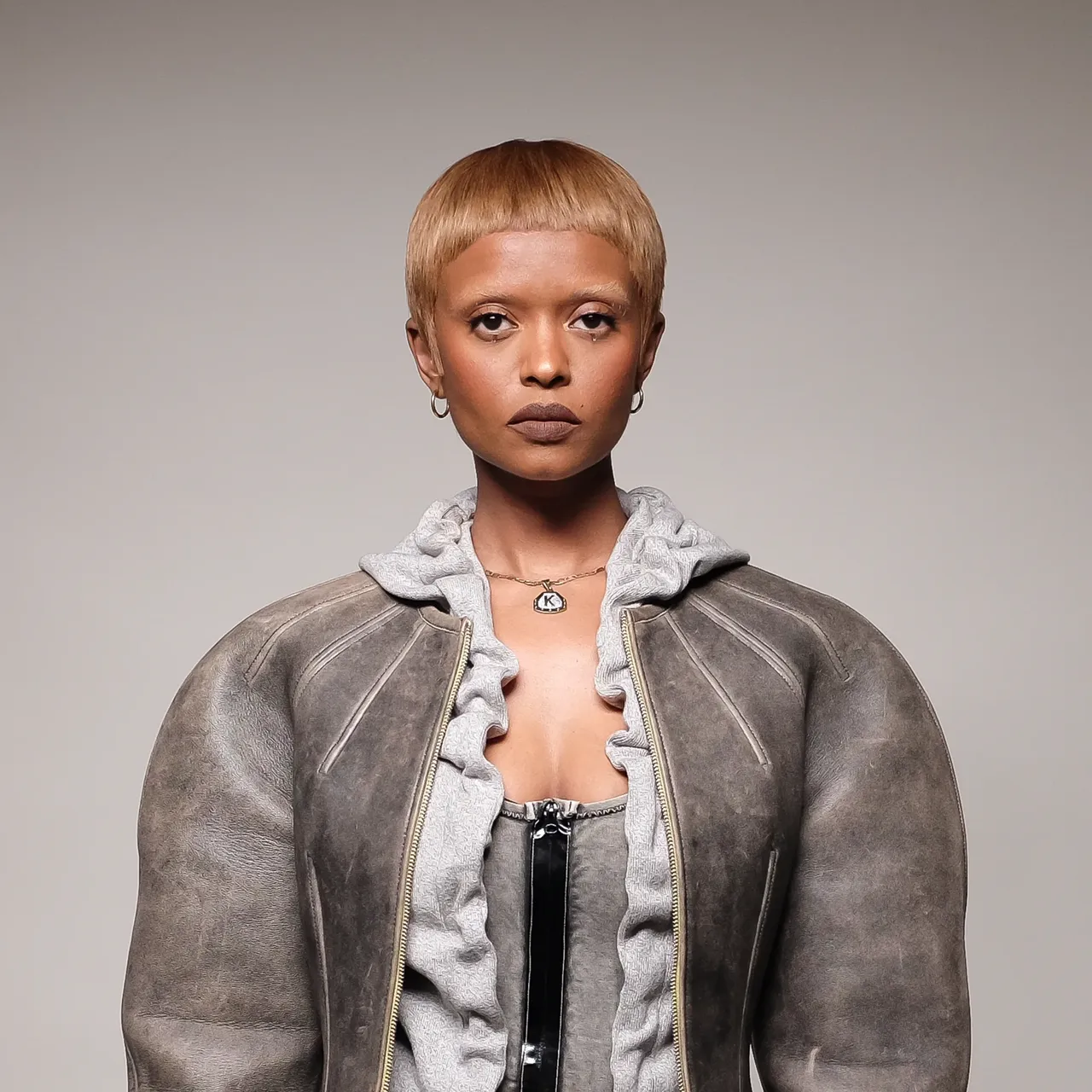
Photography by Spencer Sisselman