Adam Lewis Jacob is interested in things before they settle into a fixed meaning: objects still in circulation, images outside the archive, artists working beyond the centre. He takes apart used shoes, repurposes clothing, rearranges found footage and brings overlooked voices into new contexts, not to impose a definitive reading but to see what else might emerge.
For Adam, the act of making is a way of paying attention — to materials, chance, memory and people who resist easy categorisation. His practice moves between sculpture, film, curating and collaboration, always looking for what might still be alive in an oddity before it becomes history. During his Short Vamps for Long Wear show that’s running at Neven gallery until 24th October, we exchanged ideas with the Glasgow-based artist.
What makes something catch your attention? It could be an object, an image, a person, or even a detail that might initially seem insignificant.
I think what catches my attention is often an attitude, whether it belongs to a person or an image. It’s difficult to define, it’s something that feels slightly out of place or resistant to what’s expected of it. It doesn’t necessarily need to be loud or demand attention. Often it’s understated, but there’s still something charged about it. I’m drawn to that quality in people. Some of my friends have it. I’m interested in people who seem to possess their own presence or way of moving through the world. I notice a similar attitude in objects and places. I’m drawn to oddities in an image or environment, and to things that don't quite fit or function as intended. That might be an old building beginning to fall apart, an object left behind, or a dead end or alleyway that has no obvious purpose other than providing somewhere to hang out. It is less the age of those things that interests me than the sense that they exist slightly outside their expected role.
In Short Vamps for Long Wear, you work with shoes that have already had a life before reaching you: they have been worn, desired, bought, sold, and eventually discarded. What interests you about working with objects that already carry a history?
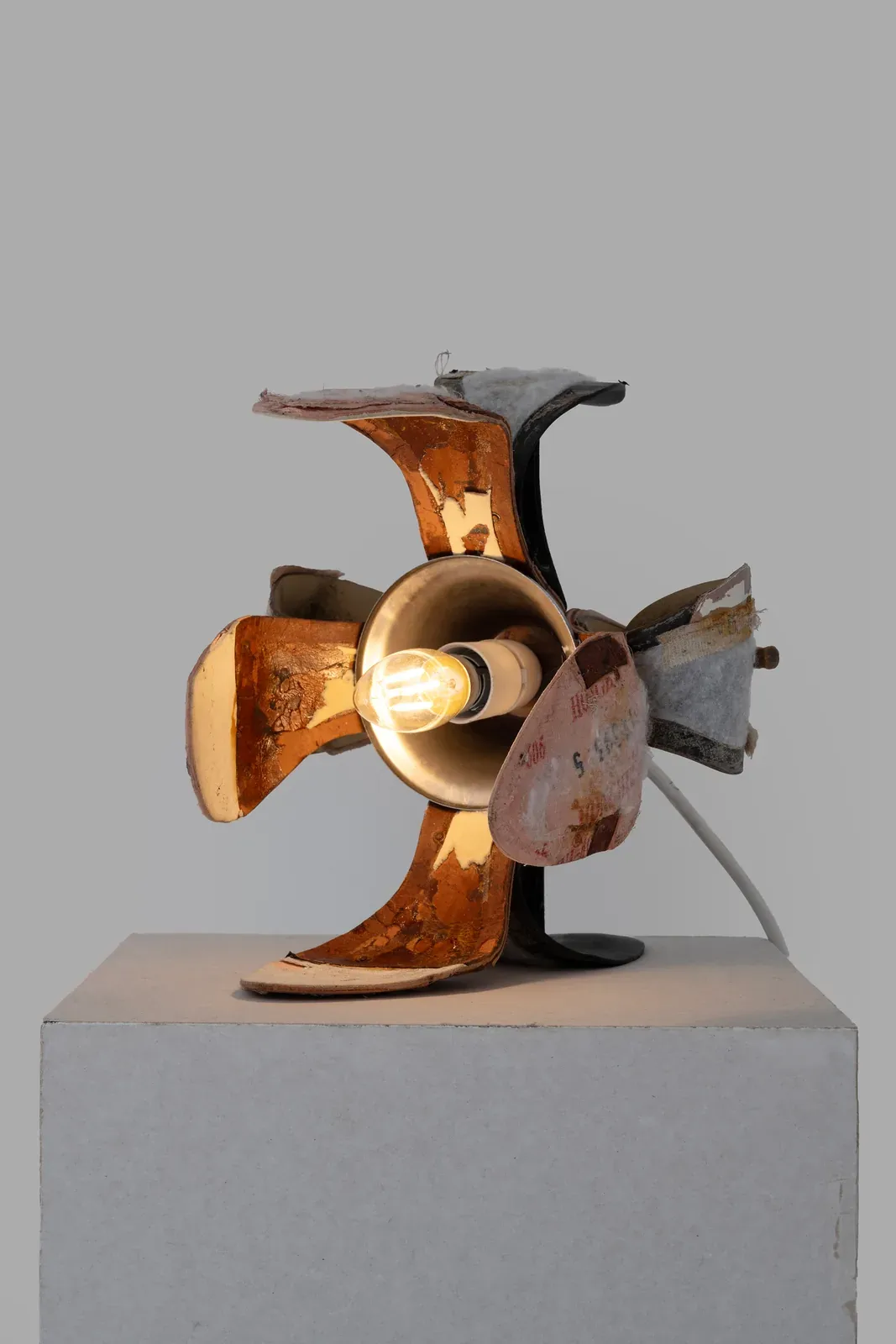
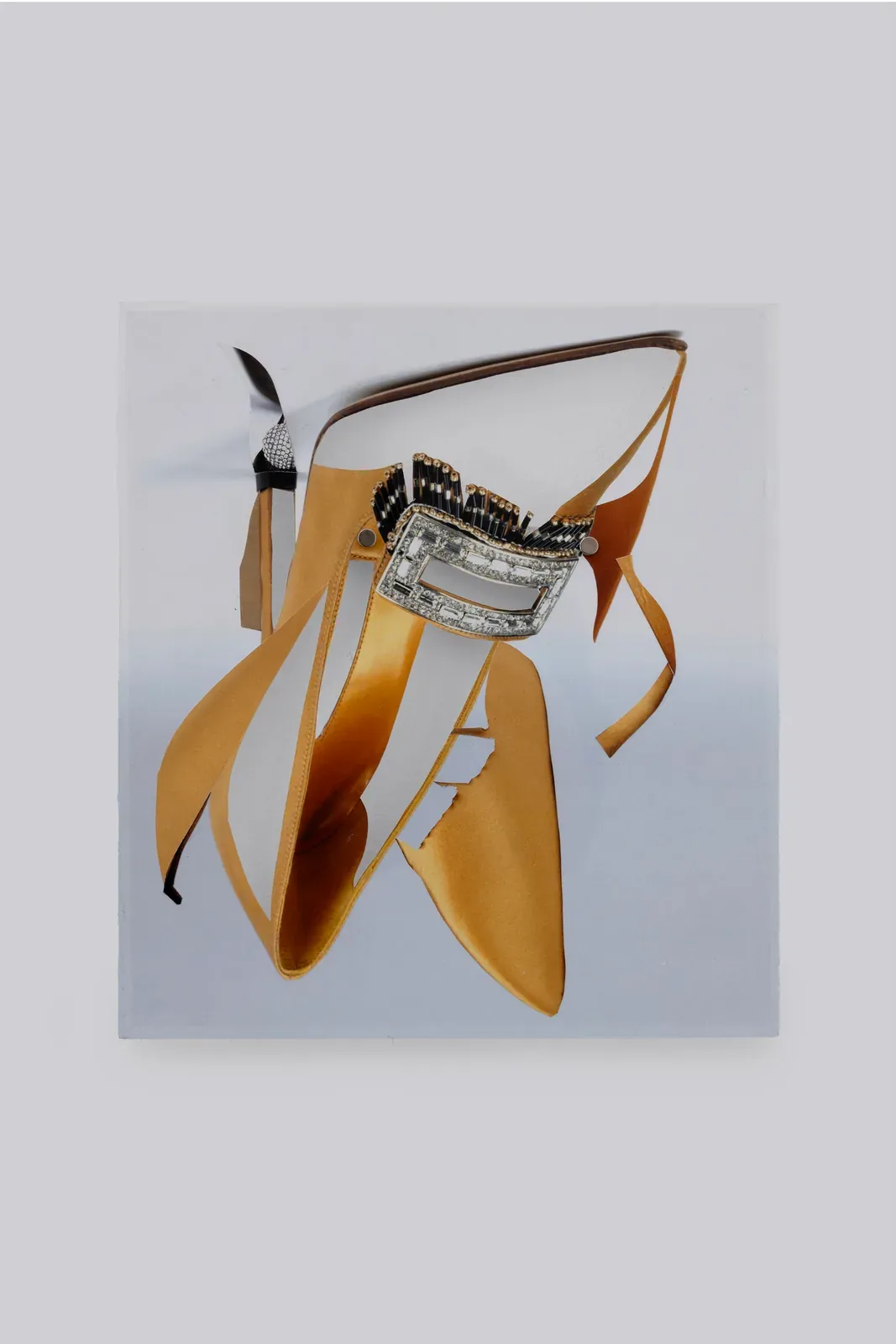
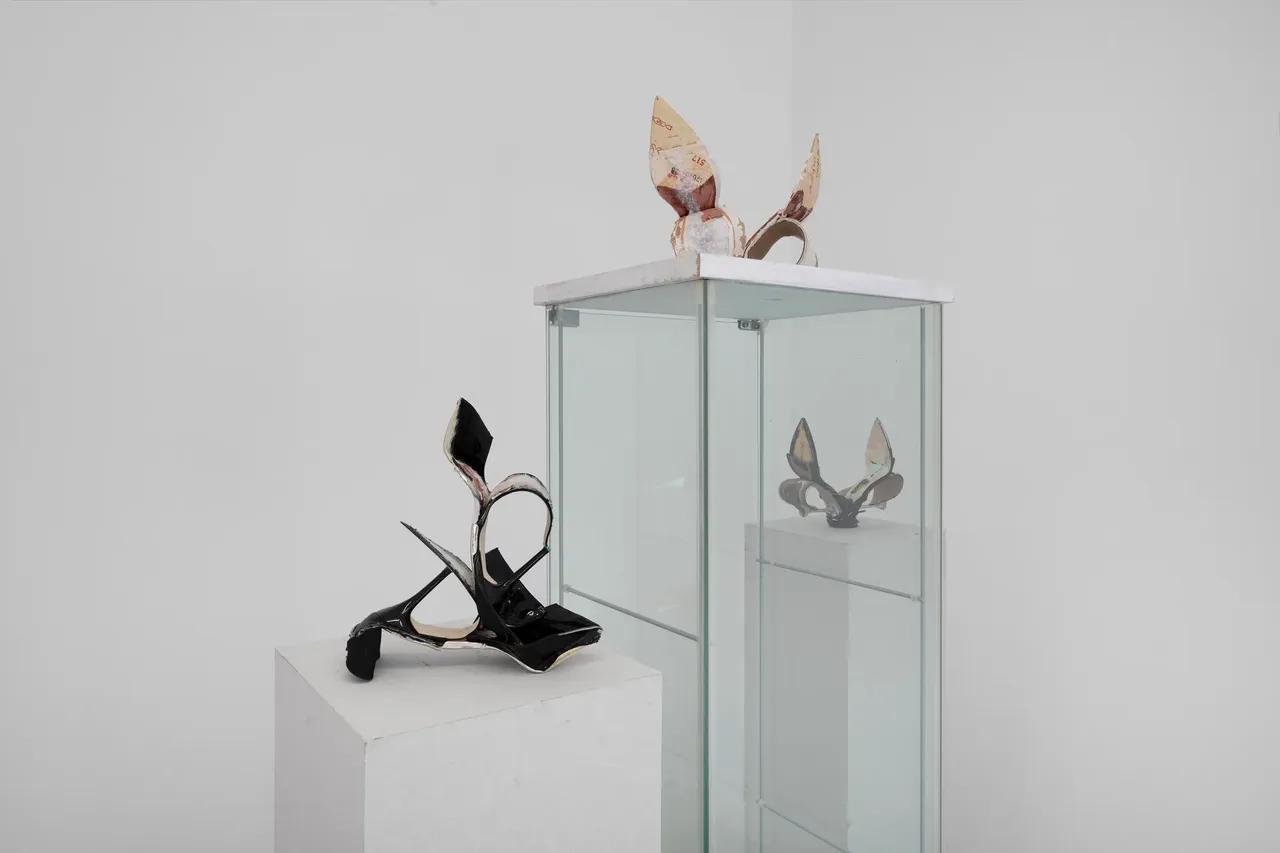
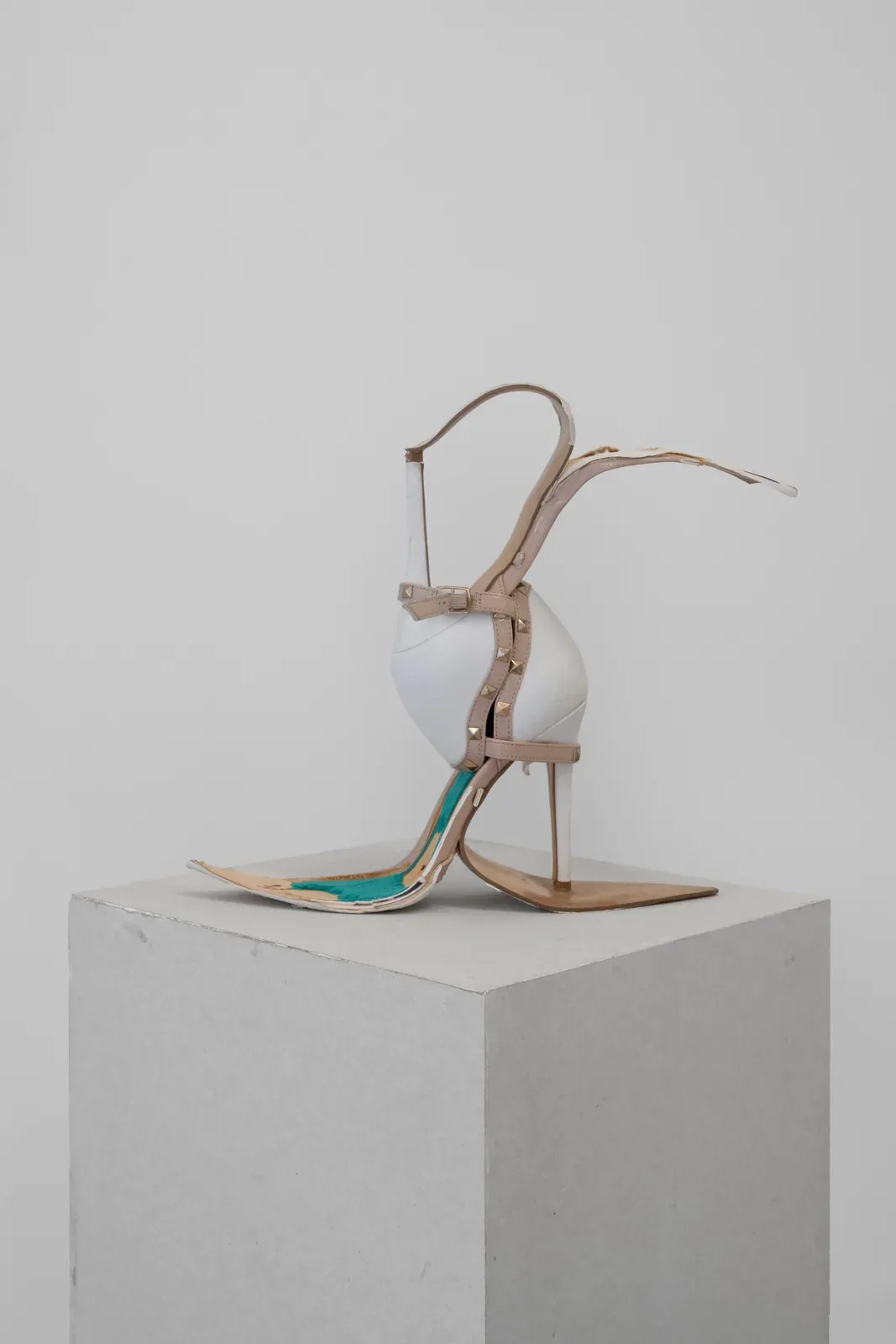
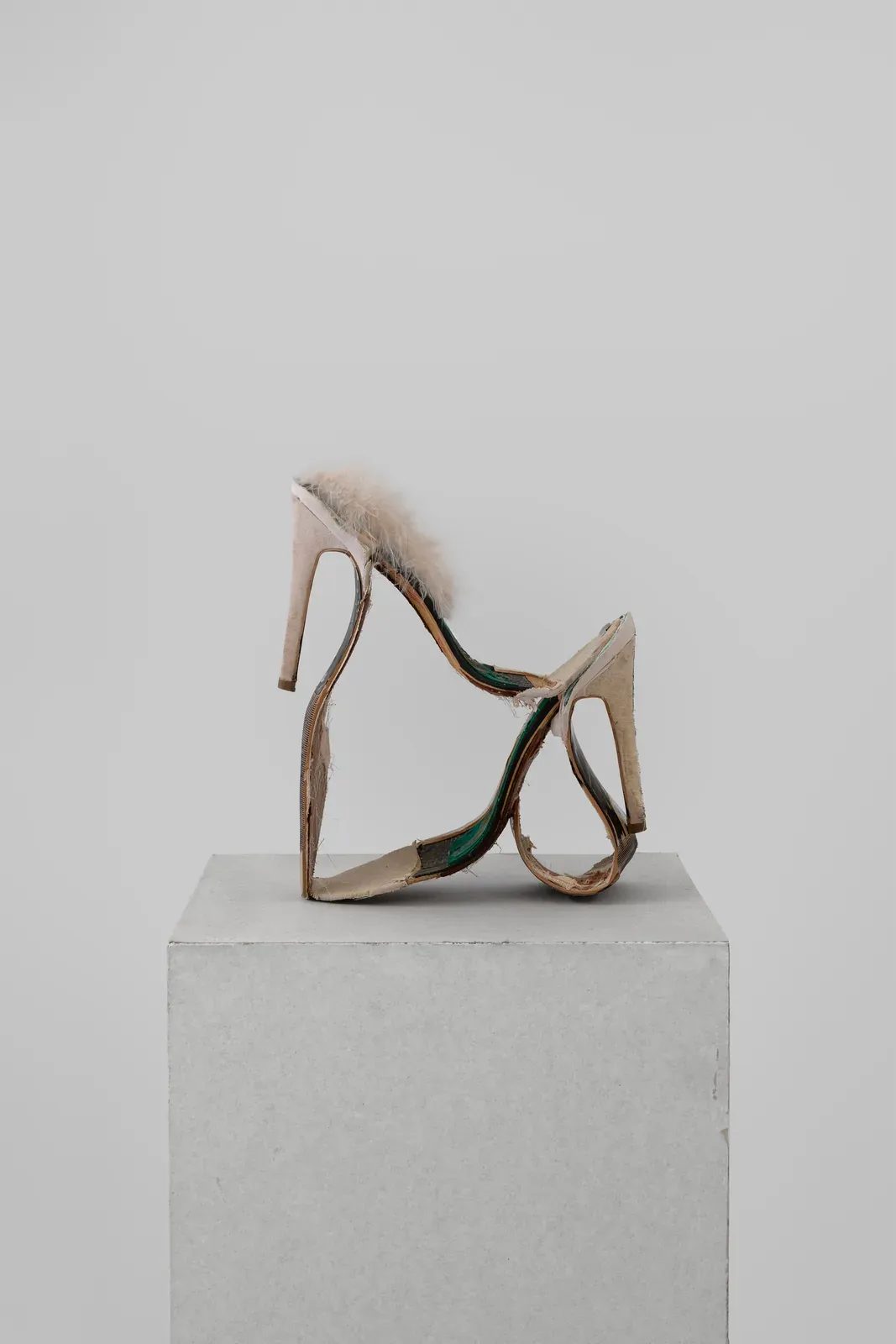
The decision to work with used shoes wasn’t really that intentional. I would find them while walking around markets or charity shops, looking for things to take to the studio. I’ve always been into how people arrange objects at markets. Once in the studio, I became interested in ideas about history and circulation. Most of the shoes are inexpensive, mass-produced or associated with fast fashion. By the time I find them, they’ve already been designed, manufactured, desired, bought, worn and discarded. It feels more appropriate to take apart something that’s already served its intended purpose than to buy a new object simply to destroy it. I like looking at what’s already there and seeing what happens when its construction and history are opened up. As a child, I used to draw clothes, tracksuits and trainers, and I invented my own brand and logo. I’m not sure I wanted to become a fashion designer, but these were some of the earliest creative things I made. It therefore felt natural to return to objects connected with clothing. The first time I exhibited a shoe sculpture was at Systema in Marseille last year. Around the beginning of 2025, I was also experimenting in the studio with my friend Sam Wood, who has a background in fashion and opened up many possibilities for me. I think that allowed me to push ideas in different directions, starting by taking things apart. I’ve also been making dresses from blazers that I find in similar places. I turn them inside out and cut open the fabric to reveal their construction, transforming the blocky form of the blazer into something more shapely. They are not really intended to be worn. I think of them more as a way of revealing the sculptural qualities already contained within the clothing.
“I’m very interested in giving in to the work and working collaboratively.”
There is something almost archaeological about the way you take the shoes apart: codes, threads, traces of glue, colours and details that would normally remain hidden begin to appear. What are you looking for when you start looking beneath the surface of an object?
I’m not really looking for anything. I want to be surprised, to react. Before I began working in this way, I had no idea what I would find inside the shoes. The codes, threads, colours and typography, as well as the clues they contain about where and how the shoes might have been manufactured, all became interesting through the process. I’m particularly drawn to the patina of the glue and fabric, and to its unexpectedly painterly qualities. I never know what colours or details will appear. There is no opportunity to choose them; I have to react to what is already there. The same is true of the forms. There are only so many things the material will allow me to do. The approach is improvised, so at a certain point, a form begins to appear and I just try to encourage it. I think of that process as being similar to improvised music. You do it for an hour and, at the end, you have something. If it works, it works; if it doesn’t, then whatever. It’s more about doing it. I try not to overwork the sculptures. Often, the thinking has already happened beforehand, while the act of making is intentionally instinctual. I really want to reach an unthinking state.
Shoes, and particularly high heels, have such a particular relationship to desire, the body and seduction. When did that fetishistic dimension become part of your interest in them?
From the beginning, I was aware of the fetishistic associations of shoes because it is difficult not to be, particularly with high heels. But that was not really what attracted me to them. As I worked with shoes more consistently, they began to evoke more personal memories. When I was young, my mum worked in an office and would drop my sister and me at my nan and granddad’s house before work. She would take off her high heels to drive and change into flat shoes, so there was always a small pile of shoes in the footwell of the car. I remember their look, feel and smell, and the atmosphere of being in the car early in the morning. That is what the shoes recall for me: a particular period of childhood, adolescence, pre-teen, before desire or seduction. At the same time, shoes are bodily and psychologically charged objects. They also make me think about inexpensive high-street fashion borrowing the appearance of luxury. I guess these things speak to aspiration and routine. Once dismantled, the absent body can become even more noticeable or not. The shoes no longer retain the shape and traces of someone who wore them, but they still carry those codes and signifiers. High heels also occupy a strange space between fashion and punishment. They can look beautiful, but many of my friends talk about the discomfort of wearing them or being expected to wear them for work or at social events. I’m interested in that tension between glamour and control, personal expression and enforced uniform. It brings together fashion and sadomasochism and, in broader terms, makes me think about society’s willingness to accept oppressive and exploitative conditions.
You often work with materials that already exist — archival images, found footage, used objects — and rearrange them until they begin to say something else. Do you feel that your work is more about inventing something new, or discovering something that was already there?
I’m not sure I entirely believe in the distinction between inventing something new and discovering something that was already there. Nothing is completely new; it is always a development of what came before. What interests me is how we use and rearrange information, images and objects that already exist. I’m drawn to bringing things into contact that would not usually sit together, whether that is two images, a process and an object, or a group of people. I remember discussing these ideas with my former tutor Frances McKee, who was training to become a medium at the time. It made me think about whether ideas are invented or are somehow already present, waiting to be received or recognised. Early YouTube was formative for me because it felt wild and unstructured. You could disappear into strange corners and find amazing material. We used to talk about YouTube as the contemporary medium, like a spirit medium possessed by all of these voices and projecting them out into the world across time. When I was younger, I was preoccupied with finding something completely new or discovering a new way to operate within the art world. Now I’m more interested in living with material and being of service to it. While making Idrish, my film about the anti-deportation activist Muhammad Idrish, I wanted to work with what I called “heavy material”: material that already possessed weight and purpose. I tried to let my own artistic ego disappear behind it. That is ultimately impossible because every act of selection is subjective, but working in that way allowed me to find something I could not have invented in advance. I also believe we learn by using, adapting and changing what is already there. I sometimes find the word “archive” difficult because it suggests museums and institutions. I’m more interested in images, objects and personal collections while they are still living and circulating. Museums can be where art goes to die. Once material enters them, it does not always find its way back out. I like to catch things before they go in.
There is a constant movement between destruction and reconstruction in your work. What becomes visible only once something has been broken apart or taken apart?
I don’t really think of the process as destructive. Taking something apart is not necessarily the same as destroying it. I am trying to reveal another possibility within the object and find out what else it might be capable of becoming. As for what becomes visible, you’d have to tell me. Not knowing is the reason I do it. I want to discover what becomes visible, but I am not interested in deciding that meaning in advance. For me, it is more about doing and searching than making a didactic statement. If I already knew what the process was going to reveal, I probably wouldn’t do it.
Chance seems to have an important place in your process: you find words inside the shoes, allow materials to determine part of the outcome, and let different things come into contact with one another. How much control do you need to retain over a work, and how much are you interested in giving in?
Chance is the best. I sometimes think of it as an alternative to the capitalist system we live under, where we are constantly required to make intentional choices, or are given the illusion of choice, while having very little meaningful control. Making art can offer the opposite experience, or not. But for me, it creates a place to relinquish total control and see what happens. The main decision I retain is recognising when the work has finished. Sometimes I make that decision, but often the shoes and the process seem to make it for me. I am very interested in giving in to the work and working collaboratively. Listening to inert objects appeals to me. I like the idea of being open to the work rather than submissive to the structures that govern our lives. I think being an artist is one way of pushing against them. Continuing to be an artist feels like a genuinely political choice at the moment because it has become so materially difficult.
There is a sensitivity towards outsiders, subcultures and people who exist slightly outside what is considered the centre that runs through your practice. What draws you towards what exists at the margins?
I grew up in a small coastal town, in the suburbs, and you get a strong sense of what exists outside the culture being presented to you through television and radio. I have always felt at home in those spaces, or even in looking outside of the outside. Like many people who are interested in the margins, I think it began with a suspicion of the centre. As I have got older, though, I have become less convinced that insiders and outsiders are stable categories. Insiders are strange too. I am drawn to people who have created their own languages, communities and ways of working without waiting for institutional recognition. The subject of my upcoming film is Edwin Pouncey, who is a good example of this. As Savage Pencil, he has spent decades creating work across underground comix, music, illustration and journalism without fitting neatly into any one cultural category. I was introduced to his work by my friend, the brilliant curator Róisín McQueirns who curated an exhibition of his work at Céline, an artist-run exhibition space in Glasgow that I co-founded and ran with Céline Amendola and Michael White for ten years. Céline has now closed, but I remain very proud of what we achieved together. It brought a community together and provided a space outside of the main institutions where artists could show work and take risks. I continue to pursue those interests through G.G.’s, a new curatorial project focusing on subcultures and artists whose work has been overlooked or sits uneasily within established institutions. For me, curating, collaborating and filmmaking are all ways of paying attention to work and people who cannot easily be contained by conventional art-world categories. These collaborative projects are really key to my way of working and allow me to explore the ‘margins’ as you call them.
“Nothing is completely new; it is always a development of what came before.”
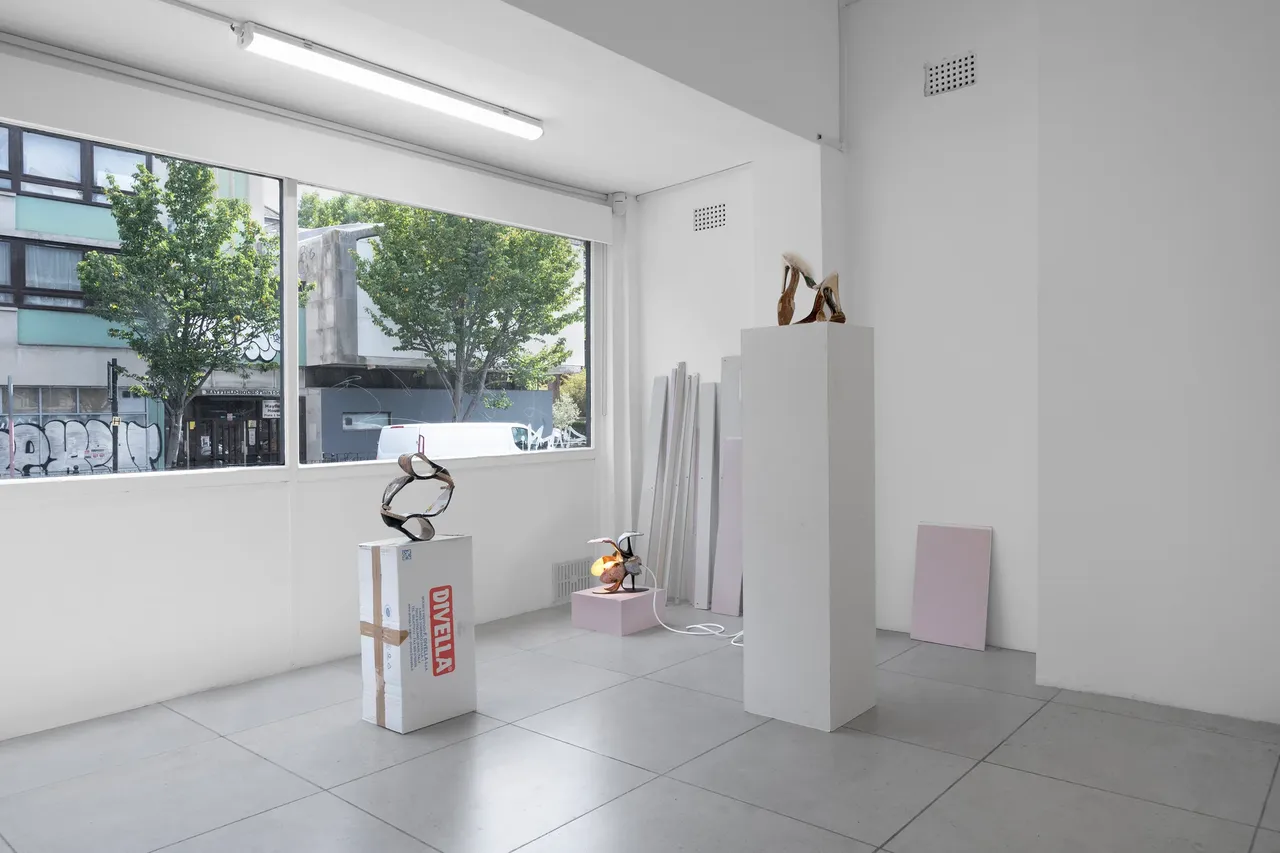
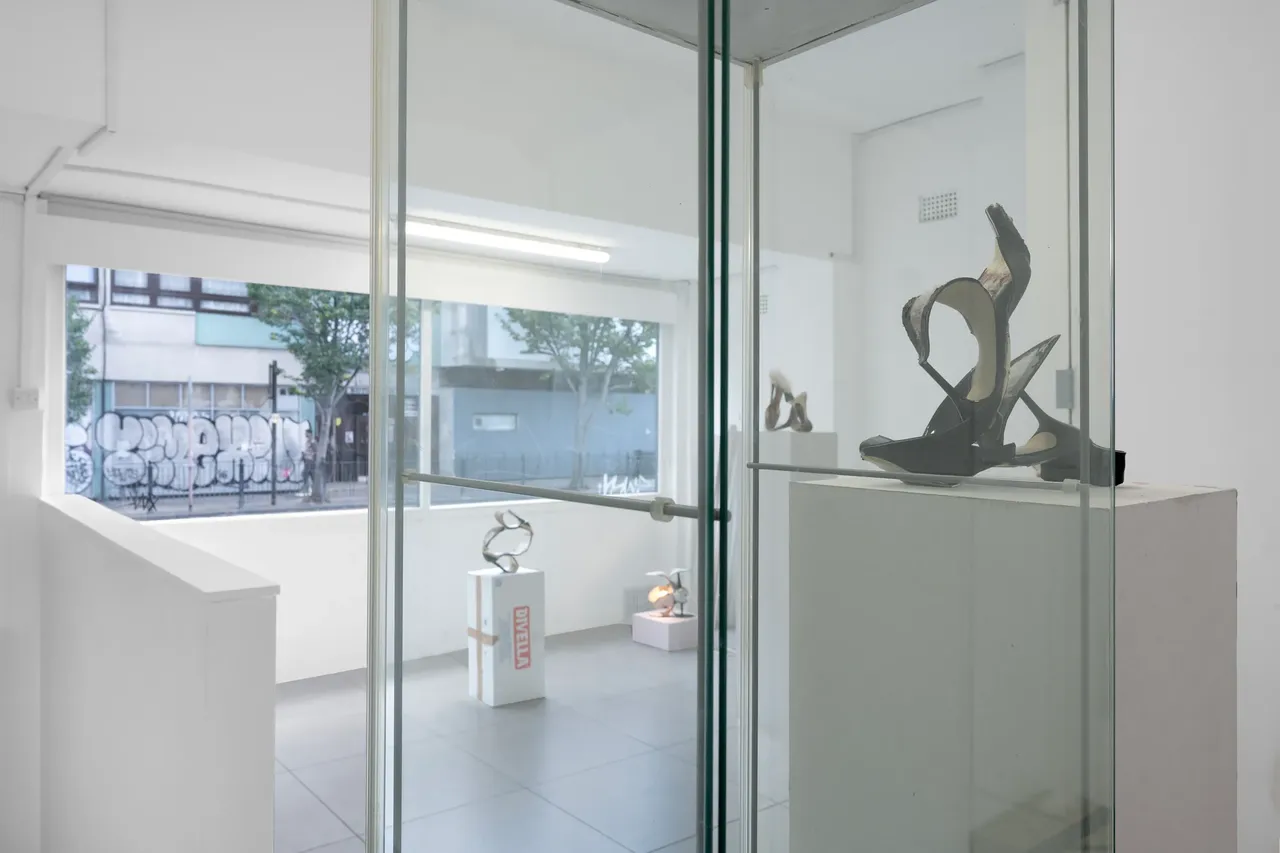
In the exhibition, the sculptures coexist with display devices, discarded objects, working materials and elements that could belong equally to a studio, a home, a showroom or a storage unit. What interests you about that ambiguous space where we can no longer quite tell what we are looking at?
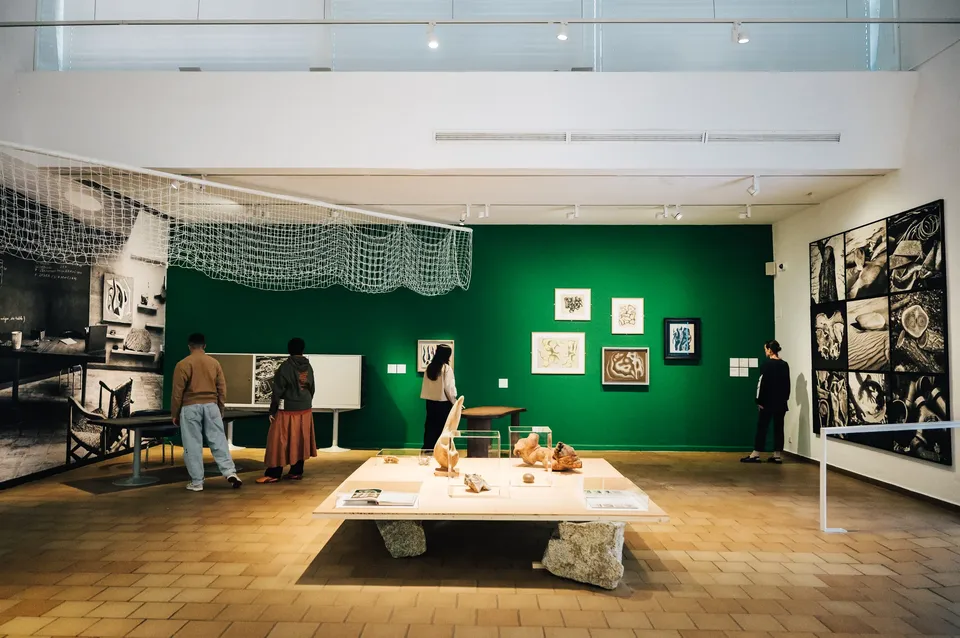
I’ve really enjoyed working with Helen at Neven. I usually curate my own exhibitions, as well as other people’s work, so collaborating with someone else on the installation has been especially productive. Helen has a great eye and a strong sense of space, as well as an ability to understand complex ideas and communicate them in a straightforward way. We had lots of conversations about wanting the exhibition itself to feel slightly unmade, bringing elements of the studio and the showroom into the gallery. Those conversations helped the installation develop in response to both the sculptures and the particular character of the space. I like exhibitions that contain the possibility of failure, confusion or unresolved problems rather than presenting everything as a series of polished solutions. My years at Céline probably shaped this approach. Its exposed walls accumulated marks, damage and traces from previous exhibitions, much like the surfaces of the shoes, where glue, discolouration and loose threads reveal their construction and use. In both cases, the materials retain evidence of what has happened to them.
If so much of your practice is about taking something that already exists and changing its context, form or way of circulating, what would you like to take apart — or look at differently — in your own work now?
Right now, I’m finishing Savage World, my film about Edwin Pouncey. I’m interested in what happens when you take the fragments of someone’s life, work, relationships and memories and reassemble them through film. It’s important that this remains a collaborative process rather than my attempt to define Edwin or create a definitive version of his life. The film includes contributions from Edwin’s collaborators and friends. Some of them, including Lydia Lunch, Bliss Blood and Thurston Moore, were icons to me growing up. Each reads and interprets a different poem by Edwin, while music by Sunn O))) adds another layer. Together, these contributions reflect how far Edwin’s work has reached and how important it is to so many people. He has remained rooted in underground culture and has been outrageously overlooked by the mainstream, despite his clear influence upon it. Edwin and I both dislike conventional talking-head documentaries, so I’ve brought these different voices and performances together in an attempt to capture his attitude and spirit rather than simply explain his life. This has also been a period of significant change for me. When I was making previous projects, I often just kept moving and rolled straight into the next thing. Now I have an opportunity to pause, look back and reflect before continuing. Perhaps the thing I most want to take apart and reconsider now is my own work, to understand the connections between the films, sculptures, exhibitions and collaborative projects.
Short Vamps for Long Wear is on show now at Neven gallery until 24th October