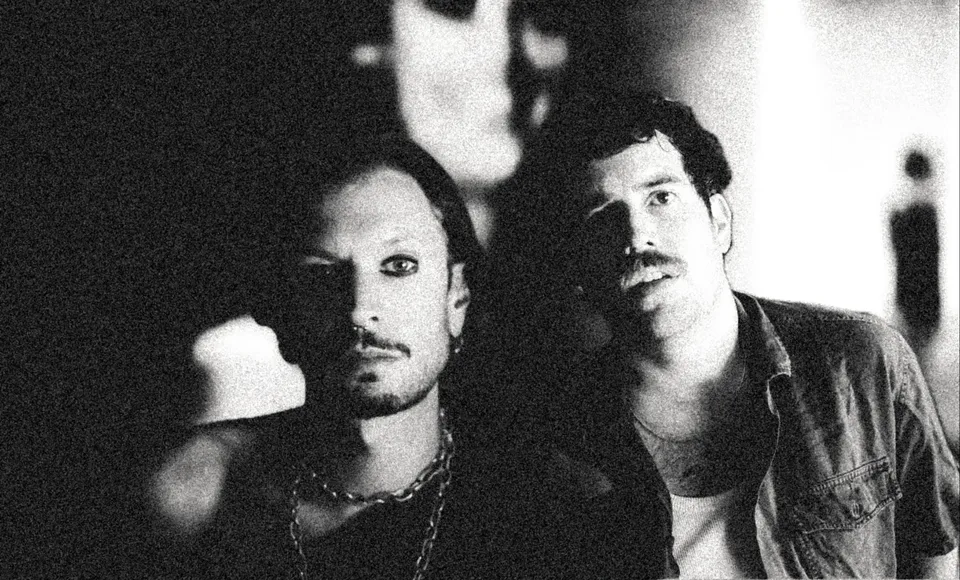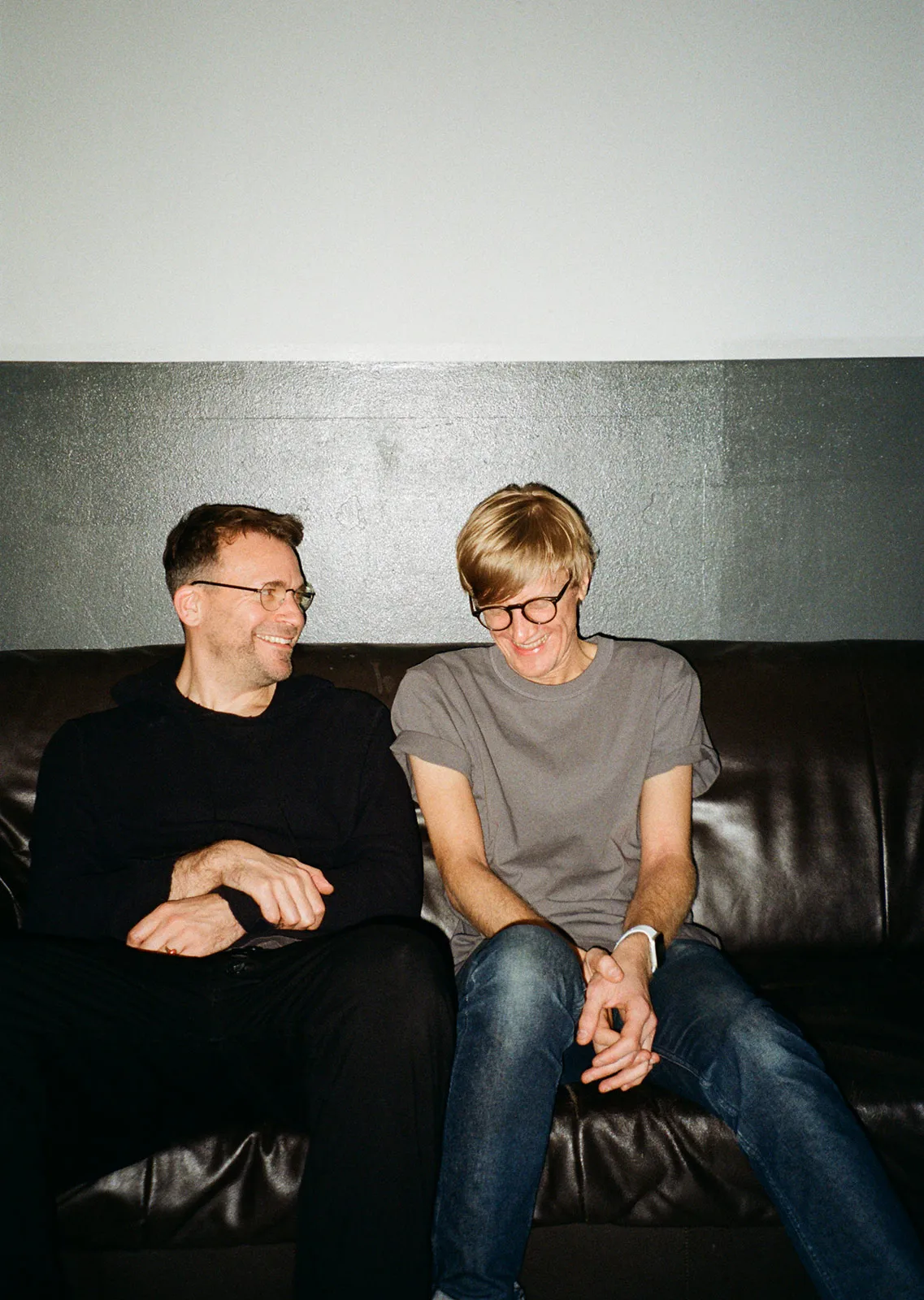
Even though Jas Shaw and Bas Grossfeldt don’t believe in fate, they can’t deny that their new collaborative album is the result of a line of serendipitous events. The Simian Mobile Disco member (Jas) and the performer, choreographer and visual artist (Bas) barely knew each other when they met in Cologne through a mutual friend, but in just two days, they recorded “the bones” of their new album, Klavier, which is out today.
“It all developed really naturally and we had a vibe going just from the start,” remembers Bas, who’d never collaborated with any other artist in his music work – he’s actually emerging in the music scene after having focused on choreography and installation art these past years. On the other hand, Jas is part of a duo (SMD) and his musical career spans a decade. But that’s not what made this collaboration successful. “That time making music has allowed me to build up a studio and plenty of experience using it, but when we are making music, I’d say that we have a fairly similar approach to things,” explains Jas. “To put it in a more upbeat way, our technique for determining if something is musical is very similar.”
Stumbling upon a Yamaha Disklavier in the live studio where they were recording was the ultimate act of serendipity. “Disklavier is one of many instruments that are very difficult for a normal musician to get access to. They are large, very expensive, and need to be in a reasonable sounding room and some capable microphones to sound good,” explains Jas. It was just natural for them to take the opportunity to experiment with it and explore the many different paths its sound could walk. Thus, in Klavier, we find tracks where the piano sounds in a rather ‘natural’ way, making it shine because of its beauty and simplicity, while in others, the artists have “pressed its strings, pushed our hands against it, tried different objects and so on.” Enjoy this musical journey around a rare and unique instrument, the Disklavier, which unites two talents for years to come.
Stumbling upon a Yamaha Disklavier in the live studio where they were recording was the ultimate act of serendipity. “Disklavier is one of many instruments that are very difficult for a normal musician to get access to. They are large, very expensive, and need to be in a reasonable sounding room and some capable microphones to sound good,” explains Jas. It was just natural for them to take the opportunity to experiment with it and explore the many different paths its sound could walk. Thus, in Klavier, we find tracks where the piano sounds in a rather ‘natural’ way, making it shine because of its beauty and simplicity, while in others, the artists have “pressed its strings, pushed our hands against it, tried different objects and so on.” Enjoy this musical journey around a rare and unique instrument, the Disklavier, which unites two talents for years to come.
Jas, Bas, first things first: how did you two meet, and when and how did you know that working together was a good idea – or just something that you wanted to do?
Jas: A mutual friend, Shumi, suggested that we would get on and I heard some of Søren’s Bas Grossfeldt stuff and really liked it, so I booked an early flight in and a late flight out around a gig at Shumi’s club Gewölbe in Cologne. We just agreed to meet up and see how things went. It was really casual but the bones of the whole record were done in those two days.
Bas: Exactly. We kind of ‘hit it off’ right from the start and I think stumbling over the Dysklavier had a part in this, because it was something we were both intrigued by. I have to admit I was really nervous because I had never worked on music with anybody else, and then Jas, with such an expansive experience comes in and wants to jam with me? But it all developed really naturally and we had a vibe going just from the start. I remember how we even played B2B with Shumi that night until the very end, had like two hours of sleep and went straight back into the studio. So from there, it all developed and we kind of grew to knowing it might be a good idea to work together.
Bas: Exactly. We kind of ‘hit it off’ right from the start and I think stumbling over the Dysklavier had a part in this, because it was something we were both intrigued by. I have to admit I was really nervous because I had never worked on music with anybody else, and then Jas, with such an expansive experience comes in and wants to jam with me? But it all developed really naturally and we had a vibe going just from the start. I remember how we even played B2B with Shumi that night until the very end, had like two hours of sleep and went straight back into the studio. So from there, it all developed and we kind of grew to knowing it might be a good idea to work together.
Jas, you’re one half of Simian Mobile Disco, with which you’ve been releasing music for the past ten years; Bas, you’re newer to the music world, but you’ve been working under your real name in choreography, installation and performance art. How do you feel your backgrounds complement each other in this joint project? What one lacks, the other has?
Jas: That time making music has allowed me to build up a studio and plenty of experience using it, but when we are making music, I’d say that we have a fairly similar approach to things. Although I have picked some limited understanding of music theory I don’t enjoy music where I’ve used it, so I approach everything as sound, equally. Bas isn’t traditionally musically trained so his approach is very similar.
At no point in the recording did we work out what key something was in – I suspect that neither of us could tell you even now. So, oddly, I think that what made this work was less our complimenting skills and more our common lack of skills? Or, to put it in a more upbeat way, our technique for determining if something is musical is very similar. In terms of skill overlap that’s it, I lack other skills. Bas also did the album cover, edited the video, arranged photos, he speaks English at least as well as me – it’s slightly embarrassing.
Bas: (Laughs) C’mon mate, you are exaggerating. But with this project, I never had the feeling it was about skills or backgrounds that overlap or complement each other, but more about an artistic approach and perspective that we shared. Of course, these are influenced by our individual backgrounds and, obviously, Jas has way more experience in music production than I have – but I never felt that either background of ours really mattered. The perspectives on sound or where we’d want to go were always something that we shared, and if we didn’t, we were open to the idea of the other and just tried it out.
At no point in the recording did we work out what key something was in – I suspect that neither of us could tell you even now. So, oddly, I think that what made this work was less our complimenting skills and more our common lack of skills? Or, to put it in a more upbeat way, our technique for determining if something is musical is very similar. In terms of skill overlap that’s it, I lack other skills. Bas also did the album cover, edited the video, arranged photos, he speaks English at least as well as me – it’s slightly embarrassing.
Bas: (Laughs) C’mon mate, you are exaggerating. But with this project, I never had the feeling it was about skills or backgrounds that overlap or complement each other, but more about an artistic approach and perspective that we shared. Of course, these are influenced by our individual backgrounds and, obviously, Jas has way more experience in music production than I have – but I never felt that either background of ours really mattered. The perspectives on sound or where we’d want to go were always something that we shared, and if we didn’t, we were open to the idea of the other and just tried it out.
Today, you’re releasing Klavier, an album “of haunted elegance, graceful poise and cerebral depth, which is centred around the Yamaha Disklavier.” It all came about by chance. Do you two believe in fate? Is this really a product of being in the right place at the right time and with the right person?
Jas: There is no doubting that this whole thing is very unlikely. I think this is the only time that I’ve added time to a gig so that I can go into the studio with someone, it’s not like it’s a regular thing for me. I do 90% of my sequencing with a hardware sequencer that I know really well and the only reason I brought my max stuff with me was that I couldn’t pack the sequencer small enough for the flights – so having to rely on that was not a decision, it was luck. The only reason that we went into the live room of the studio that Søren had arranged was that we were short of a few leads – if we had had them with us, we would have never even seen the Disklavier. I’m not a fate type of guy, but this is pretty fate-y.
Bas: It certainly was a line of events or decisions that led to this, and it’s definitely a product of being in the right place at the right time. But where do you start the recording of that process? You could go back into all our individual histories and never know if that one decision or the other led to where we are right now. So I wouldn’t call it fate in a sense of determination from an outside something. But as Jas just listed some of the points that led to this, it appears and still feels special. And maybe this lucky line of events is also audible in the record and has a part in why it sounds like it does.
Bas: It certainly was a line of events or decisions that led to this, and it’s definitely a product of being in the right place at the right time. But where do you start the recording of that process? You could go back into all our individual histories and never know if that one decision or the other led to where we are right now. So I wouldn’t call it fate in a sense of determination from an outside something. But as Jas just listed some of the points that led to this, it appears and still feels special. And maybe this lucky line of events is also audible in the record and has a part in why it sounds like it does.
While in Cologne, you booked a studio to work together, and by serendipity, there was a Yamaha Disklavier, which is the main protagonist of the LP. Why is this instrument so important, and what does it represent to you?
Jas: A Disklavier is one of many instruments that are very difficult for a normal musician to get access to. They are large, very expensive, and need to be in a reasonable sounding room and some capable microphones to sound good. I had wanted to try one out but had stalled at having it as a saved eBay search. So I guess what this represents is taking an opportunity to explore an instrument that you know you can never afford, even if it’s just for a few days.
Bas: It also kind of brought together two worlds in itself: the digital and the analogue. I usually don’t care about these being two separate things in the context of music production and don’t care about these discussions. But this instrument unites something, and we tried to explore this extensively. We triggered it with digital signals and then didn’t only record the pure sound of the instrument but also pressed its strings, pushed our hands against it, tried different objects and so on. We experimented with what we and the instrument were able to do in that moment. And one key aspect of it is probably that we both could always ‘play’ the instrument at the same time, one on the sequencer, and one on the strings.
Bas: It also kind of brought together two worlds in itself: the digital and the analogue. I usually don’t care about these being two separate things in the context of music production and don’t care about these discussions. But this instrument unites something, and we tried to explore this extensively. We triggered it with digital signals and then didn’t only record the pure sound of the instrument but also pressed its strings, pushed our hands against it, tried different objects and so on. We experimented with what we and the instrument were able to do in that moment. And one key aspect of it is probably that we both could always ‘play’ the instrument at the same time, one on the sequencer, and one on the strings.
You’ve played with it in all ways imaginable, letting it shine naturally or ‘covering it up’ with synths and electronic beats and sound distortions. Given that it was all by chance, how was the creative process like? Was it all improvisation, or after the first moment of surprise, you started planning the album, songs, what you wanted to achieve or experiment with, etc.?
Bas: All of it was really unplanned and an open process, just seeing where this would lead us. Even after the first session, we did not have a masterplan of what the next step was or what to do with it. We just knew we had something worth to continue working with. It sounds like a platitude, but we just went with a certain flow and even the order of the tracks on the album came to us like that, just naturally.
Jas: The process was recursive. The untreated, docu-style ones were done on the first session but we both took all of those session recordings away to see what we could make out of them. Fairly quickly it became obvious that some of the recordings didn’t need much work, just an edit and a mix. We met up again and did a session of treating the recordings, running them through processes that ordinarily you would run synths through. This gave us a whole new palette of sounds that were different from the dry piano but related. Then, we did another session using the treated sounds, bending these further.
Jas: The process was recursive. The untreated, docu-style ones were done on the first session but we both took all of those session recordings away to see what we could make out of them. Fairly quickly it became obvious that some of the recordings didn’t need much work, just an edit and a mix. We met up again and did a session of treating the recordings, running them through processes that ordinarily you would run synths through. This gave us a whole new palette of sounds that were different from the dry piano but related. Then, we did another session using the treated sounds, bending these further.
Merging classical instruments and music with electronic beats and gadgets isn’t new, but each time I hear artists mixing them, I’m mesmerised – for example, one of my main referents with this is German producer and DJ David August, who’s played several times with philharmonic orchestras. Did you have similar referents during the creative process of Klavier?
Jas: I’m slightly scared of the overlap between classical and electronic music. It can be fantastic but in all the cases I can think of off the top of my head, that’s when the two are present together from the start. I don’t enjoy dance music classics played by an orchestra and equally I don’t see a lot of merit in throwing a kick drum under a classical piece.
Bas: Yeah, there is a slight trend that electronic music is translated into classical orchestral settings – and sometimes it works awesomely, sometimes it doesn’t. It might be as you said, Jas, that it is different when it is thought together from the start, although I can definitely feel what you say, Arnau. However, we never saw the piano as a classical instrument that we want to translate or work with in an electronic environment. We just saw it as an instrument that has some interesting paths to explore while recording and afterwards. And interestingly enough, although we are of course aware that we are not the first ones to try this, we never thought of or heard any references during the process, which, at least for me, was very liberating.
Jas: True. What made using the piano interesting was that, right from the outset, we also wanted to fight against its ‘piano-ness’. Ironically, having a real piano makes it easier to make it sound unlike a piano.
Bas: Yeah, there is a slight trend that electronic music is translated into classical orchestral settings – and sometimes it works awesomely, sometimes it doesn’t. It might be as you said, Jas, that it is different when it is thought together from the start, although I can definitely feel what you say, Arnau. However, we never saw the piano as a classical instrument that we want to translate or work with in an electronic environment. We just saw it as an instrument that has some interesting paths to explore while recording and afterwards. And interestingly enough, although we are of course aware that we are not the first ones to try this, we never thought of or heard any references during the process, which, at least for me, was very liberating.
Jas: True. What made using the piano interesting was that, right from the outset, we also wanted to fight against its ‘piano-ness’. Ironically, having a real piano makes it easier to make it sound unlike a piano.
As you two usually work separately on many other projects, I’d like to know how has this specific collaboration meant to you personally and artistically, and what have you learnt from each other that you’re taking into future works/proposals.
Jas: It feels like this whole project has been somewhat charmed, the album really found us rather than us finding it. Bas and I have become good friends even when we didn’t know each other well and didn’t have much time to make this work. We were unsure if this would be a time-consuming dead end but we still both decided to give it a try. Sometimes it’s what you were worried about, a big waste of time; but it’s worth reminding yourself how worth it is when the gamble pays off. Bas seems naturally inclined to this, and I would like to remember from our collaboration to not grab the solution that worked last time.
Bas: Thanks mate! As said, for me it was my first musical collaboration, and I am really grateful that this work turned into a friendship as well. It’s rare to find people you connect with on a deeper level, artistically and personally. What struck out the most was our mutual interest in ‘something different’, that as you said, we often tried to not grab the solution that we knew obviously would do it or that worked last time. I am sure we will remember and continue that for our future projects, individually as well as together.
Bas: Thanks mate! As said, for me it was my first musical collaboration, and I am really grateful that this work turned into a friendship as well. It’s rare to find people you connect with on a deeper level, artistically and personally. What struck out the most was our mutual interest in ‘something different’, that as you said, we often tried to not grab the solution that we knew obviously would do it or that worked last time. I am sure we will remember and continue that for our future projects, individually as well as together.
In addition to the album, you’ve been working on new material, a live show and a club tour. I guess Covid-19 has trumped your plans, or at least postponed them until further notice. How are you living this moment and coping with the global pandemic?
Jas: Both of us are on lockdown, so there’s no sign of any touring, that’s for sure. I’m hoping that once we have this record out in the world we can do some more music and collaborate remotely. It’s not how we have worked in the past but everyone is having to learn to adapt and I’m hopeful that we can be quick learners.
Bas: Yeah, I am sure we can and our history to actually being in the room together is helping there I guess. It is a weird situation with all its complexity and even though for artists obviously this whole thing is pretty hard, I feel lucky and humbled to be living in a country that has not been hit as hard as others have and being in a privileged position.
Bas: Yeah, I am sure we can and our history to actually being in the room together is helping there I guess. It is a weird situation with all its complexity and even though for artists obviously this whole thing is pretty hard, I feel lucky and humbled to be living in a country that has not been hit as hard as others have and being in a privileged position.
Maybe this is an opportunity to think of new ways of presenting music live – during quarantine, we've seen Zoom parties like Quarantine club, or streaming concerts and DJ sets via Twitch. Have you been following anything these days that has inspired you for your own acts?
Jas: If you weigh the experience of a Zoom party or a stream against going to a club, it simply doesn’t stand up. It’s convenient but people don’t just go to see a DJ set like watching an episode of something on Netflix. You go to meet up with friends, be in a space with like-minded people, all drinking the same drinks, hearing the same music. And, of course, you go because the music is played on a better sounding rig than anyone can afford at home; you really feel music as well as hear it. Plus, your presence there influences the mood of the room, it’s a collective thing and will affect how the musicians play. It’s not something that can be meaningfully captured on some go-pros on tripods.
It’s a slightly unfair comparison though. While we can’t be in clubs, streams have come to mean something more than they did before. I’ve watched a few that were done in the artist’s home, and without all the club lighting, there’s an intimacy in this that is different to a club experience but worthwhile in its own way. Certainly, before lockdown, very few of my friends would talk about any stream, and now it’s much more common. These changes have happened really fast and it feels we haven’t found any kind of new default solution, which is kind of fascinating to watch despite the fact that it’s driven by something so grim.
Bas: Yeah, totally agree. I think as a quick response the whole streaming thing was great, but I am having my doubts seeing it as a possibility for the future. Of course, as you said, it might be an unfair comparison. But I think the interesting idea behind a DJ stream is missing most of the times in order to be a real alternative for the future. It is a sign of our times that there is just too much out there anyway, and with all these streams, something else is coming up and demanding a vast amount of attention. I don’t want to condemn it, but maybe we can use this as a tryout and an inspiration to think about how a more sustainable club and live culture could look like, in the analogue and digital world.
It’s a really complex topic but I don’t think everything was healthy before and we could use this time as a chance to come up with something different. Regarding ourselves, we will certainly let it all swirl in our heads as some welcome input and come up with something interesting, I hope. But as Jas said, there is nothing that can replace being in an actual space together and share the atmosphere, which everyone is a part of.
It’s a slightly unfair comparison though. While we can’t be in clubs, streams have come to mean something more than they did before. I’ve watched a few that were done in the artist’s home, and without all the club lighting, there’s an intimacy in this that is different to a club experience but worthwhile in its own way. Certainly, before lockdown, very few of my friends would talk about any stream, and now it’s much more common. These changes have happened really fast and it feels we haven’t found any kind of new default solution, which is kind of fascinating to watch despite the fact that it’s driven by something so grim.
Bas: Yeah, totally agree. I think as a quick response the whole streaming thing was great, but I am having my doubts seeing it as a possibility for the future. Of course, as you said, it might be an unfair comparison. But I think the interesting idea behind a DJ stream is missing most of the times in order to be a real alternative for the future. It is a sign of our times that there is just too much out there anyway, and with all these streams, something else is coming up and demanding a vast amount of attention. I don’t want to condemn it, but maybe we can use this as a tryout and an inspiration to think about how a more sustainable club and live culture could look like, in the analogue and digital world.
It’s a really complex topic but I don’t think everything was healthy before and we could use this time as a chance to come up with something different. Regarding ourselves, we will certainly let it all swirl in our heads as some welcome input and come up with something interesting, I hope. But as Jas said, there is nothing that can replace being in an actual space together and share the atmosphere, which everyone is a part of.