It’s been said that 2026 is the new 2016, so it is only fitting that Mitski has released the Tenth Anniversary Deluxe Edition of her wildly popular album Puberty 2. With an additional two songs (both previously unreleased covers) the artist enriches the album’s story and reminds listeners of the importance of reflecting on the past, our personal growth, and what love really means.
The title evokes the infamous (and not medically-recognised) ‘second puberty’ women begin in their 20s, a baffling new process of change that begins only once you are comfortable in your body and its patterns. The album’s new edition is exactly this: a discomfiting reminder of the insecurity, desire for love, and horniness of (a second round of) adolescence. Though Mitski explains that the title Puberty 2 did not have profound intention (beyond the fun of sounding like a movie sequel), she was open to the idea that in five or ten years, she would return to it with a new understanding. Funnily, a kind of puberty — a clarifying distance that can only exist as the outgrowth of time. It’s no mistake that this is the only one of her works to be re-released, and at such a significant time in its history. She returns to the album not with the intention to change it necessarily, but to understand it.
Mitski begins Puberty 2 with Happy, which throws us into a rapid drum pounding. Like the disconcerting musical tracking, her voice has a tinny reverb; she buzzes along the track more than she sings. Both her voice and the instrumental are unstable, reflecting the emotional instability she sings about as she vies for happiness. The singer personifies the emotion as a bad houseguest, one who coerces her to sleep with him before slipping away and brings treats only to devour them and leave her a mess. Because it’s not his first visit (“Again I have to clean”), she reveals happiness as a fleeting emotion, one that comes in unexpectedly and that we give in to–perhaps too easily.
However wary listeners might think she should be of his unexpected visit, Mitski holds a mirror to us. To further her train analogy, we treat happiness like our final destination, when really happiness is a pit stop we return to at different phases. When happiness is not present, we make it a goal, which is why she is so willing to let the figure take her heart when he leaves (“I’ll make no more use of it when there’s no more you”), an especially relevant message in a mediascape of constant self-help and ‘un-fuck your life’ advice. In various interludes, a saxophone joins the intensified drumbeat, emphasising the neverending cyclicality of this skewed relationship. The opening pounding returns louder, imitating the sound of a record skipping until the song ends, implying that each time this cycle repeats, it feels more frenzied and intense.
The frenzy continues in Dan the Dancer, a tongue-in-cheek indie rock celebration of masturbation and sex. The song paints love (like Mitski’s to the figure) as frantic for Dan with constant repetition, an electric guitar interlude, and an almost-screaming vocal climax. Dan is desperately trying to hang onto life, but when he finds love, his will to live is renewed. The song is a subversion of classic rock’s masculine sexuality, a commentary on gendered expectations around sex. Dan’s ease in giving in to love makes him amenable to listeners. He doesn’t treat sex as a selfish act, instead he embraces intimacy in mutual connection. Despite his healthy feelings around sex, he still exists as the product (sonically and literally) of a world that encourages unchecked male sexuality. The song ends in a timid admission of Dan’s virginity: “And he would never tell you that it was his first time.” The fact is portrayed as a secret no one can know about, creating an isolated world for Dan that only he is allowed to live in.
The singer expands this commentary in Thursday Girl, which begins with an angelic tone and her eventual “Glory, glory, glory.” The song feels hymnal but is subverted with reference to sexuality as she continues, “To the night that shows me what I am / As I go to the party / On my knees / Saying, ‘Take it, oh, please.’” Where Dan’s celebration of sexuality is framed as bright and endearing, she paints her own as shrouded in shame and complexity. Despite so brazenly begging to be wanted, Mitski reveals a hope someone will deny her: “Tell me no, tell me no / Somebody, please tell me no.” Though she is engaging in a kind of sexual liberation, she feels wrong for it (“It shows me what I am / I’m not happy or sad, just up or down / And always bad”), perhaps in part because of others’ willingness to treat her as a sexual object.
Like many women, she is caught between genuinely wanting sex and suspecting she may have been pressured into thinking she wants sex by a patriarchal society. Mitski flips the responsibility back onto the society by creating a test of denial in order to escape the cycle of sexual desire and shame. The great tragedy, however, is that regardless of outcome, she is objectified: either as an immediate sex object, or through the implication that sex degrades women and denying it from her is more ‘respectable.’ Like Dan, Mitski too is left in an isolated world.
Once More to See You and A Loving Feeling push this take even further. The former is a beautifully-composed slow drumbeat where you can hear her exhale at the song’s start. The small, intimate detail captures the romantic nature of the album’s sadness. It could be the exhale of trying not to cry or the one just after. It melts into the composition almost seamlessly, a sonic recreation of the balancing act of love. Her voice floats, lingering what feels closer to your ears than to the track itself, her falsetto delivery giving the effect of strain from trying not to cry. Her voice is layered on top of itself as she sings, “Come inside and be with me / Alone with me [...] / Then I wouldn’t have to scream your name / Atop of every roof in the city of my heart.” There’s a dichotomy between the intensity of the feeling and the small window of opportunity to experience it, an interpersonal implosion (“If I could see you / Once more to see you”).
A spiritual successor to the song, A Loving Feeling is sharp and jumpy, “What do you do with a loving feeling / If the loving feeling makes you all alone?” There’s a juvenile thread between the songs, with lyrics like “pinky promise kisses” and “Kisses like pink cotton candy.” She uses poetic lyricism to juxtapose youthful, grand expectations of love and the inevitable dissonance of its failures. If the love she has makes her so alone, then it can’t be love, can it? Listening, you find yourself wanting to say “No!” Then again, you can’t help remembering the deep loneliness of growing up, perhaps intensified by adulthood. She toes the line between resenting isolation and wanting to be alone despite loving others. For her, intimacy is a quarantined act, a delicious secret. In wanting to find a solution for Mitski, we realise we don’t have one for ourselves.
In Fireworks, in fact, she tries to end her loneliness through an artificial emotional atrophy. The song’s clicking and grain give the sense that you’re listening on a cassette tape, fittingly for the song’s lens of future nostalgia. She details a future where her “sadness will fossilise,” a process of symbolic maturation. She follows a bildungsroman (colloquially known as coming-of-age) structure where adulthood is achieved through the pairing of a couple. “I will be married to silence,” she explains, “The gentleman won’t say a word / But you know [...] in the quiet he holds / Runs a river that’ll never find home.” Mitski’s voice grows louder in the final lines, “Oh, one warm summer night / I’ll hear fireworks outside / And I’ll listen to the memories as they cry, cry, cry.” The song ends in resignation, the acceptance that to survive the monotonous pain of life, feeling must become retrospective. Deep inside everyone, then, there is an unmet desperation, a soul-crushing attempt to get through the days unscathed.
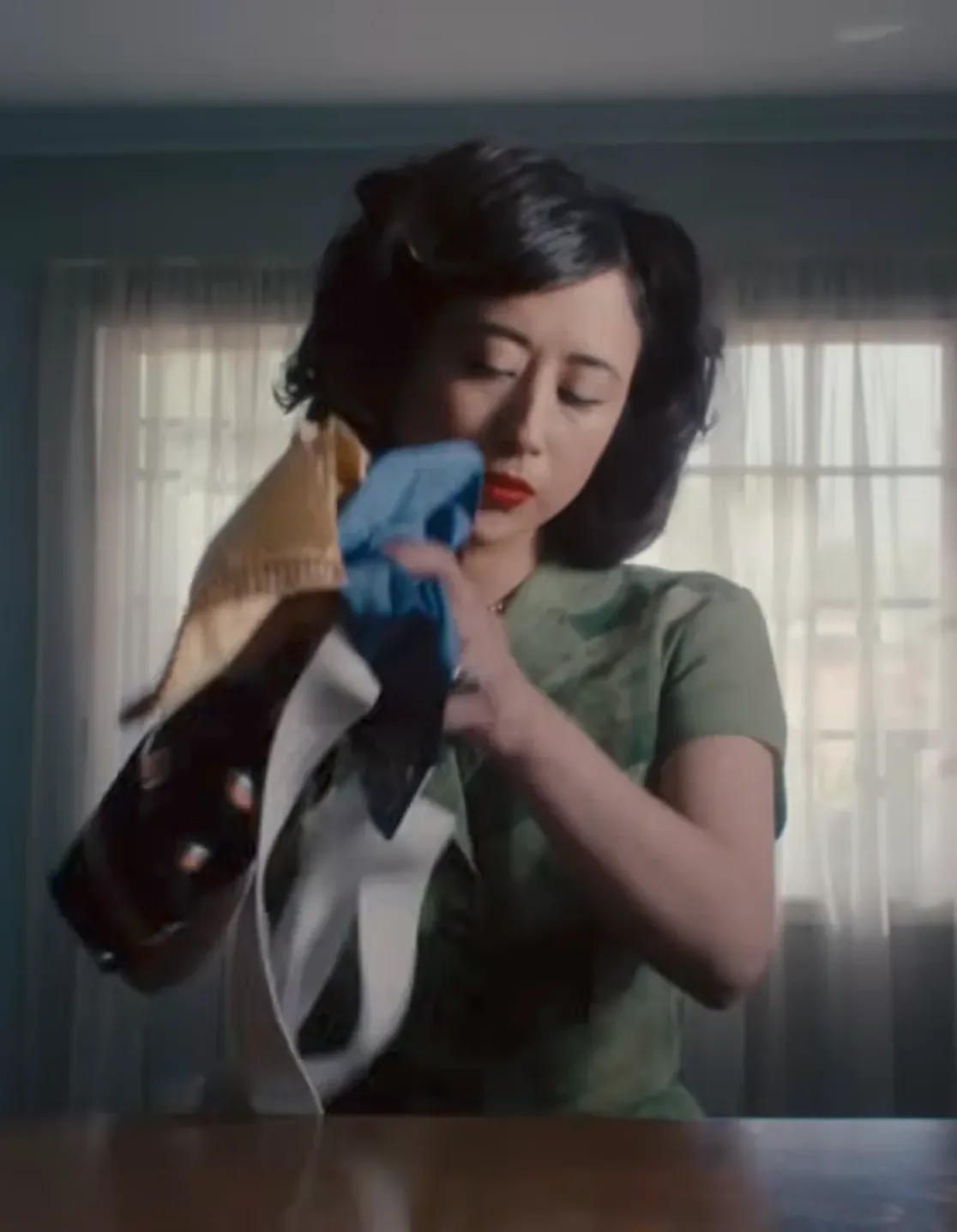
Your Best American Girl is a masterclass of Mitski’s music. The song begins with a steady strumming of the acoustic guitar, emphasising the vulnerability in Mitski’s voice, the rawness of her lyrics. In the music video, Mitski is framed opposite a white man, who seems to pay her attention until a white woman arrives, dressed in a 2016-Coachella-fied Native aesthetic (a suede tassel top, temporary arm band feather tattoos, and a flower crown). The white couple begins to kiss passionately, eventually wrapping themselves in the US flag. Mitski is left to mirror them alone, kissing instead her own hand. The couple act as a stand-in of mainstream America; as hard as Mitski, a woman of colour, attempts to prove herself worthy in front of them, they continue to ignore her. The ‘bohemian’ Native-appropriated attire, conversely, proves that the American mainstream only ignores what it has yet to capitalise on. Though the couple is quite literally face-to-face with a person of colour (the final frames showing them and Mitski to be in the same room), she has no value to them.
While the song is certainly a commentary on race, the gendered aspect also can’t be ignored. The bodies of women of colour are often the location where these ideological battles are fought, hence the white woman being the one to participate in cultural appropriation. Ethnic features move in and out of trend cycles, exacerbated by the repetitive fluctuation of women’s beauty standards. Though mainstream America rejects women of colour as human beings, it has created its own pseudo-ethnicity attempting to ‘Mrs. Potatohead’ the perfect feminine appearance. Perhaps the appeal, then, lies not in the features themselves, but in the ability to shapeshift with time’s changing perception.
The lyrics on gendered American assimilationist pressure are powerfully simple: “Your mother wouldn’t approve of how my mother raised me / But I do, I think I do / And you’re an all-American boy / I guess I couldn’t help trying to be your best American girl / You’re the one / You’re all I ever wanted.” Mitski reaffirms the refrain, “Your mother wouldn’t approve of how my mother raised me / But I do, I finally do.” Most poignantly, she ends the song with a brutally honest admission of racialised insecurity, the fear that by nature of being a woman of colour she will never be seen as ‘woman enough,’ “Your mother wouldn’t approve of how my mother raised me / But I do, I think I do.”
She expands this insecurity in one of her (understandably) most popular songs, I Bet on Losing Dogs. The initial drum clicks and “My baby, my baby / You’re my baby, say it to me” have become eponymous to the artist’s ability to emotionally crush listeners. The buzzy backing is gentle, a kind of sedative to the deep isolation of the vocals and the story of the lyrics. Mitski uses the metaphor of a dog race to explore her constant ‘betting’ on the wrong people. Because she expels so much energy in trying to get her ‘baby’ to admit that they love her as much as she loves them, she has nothing left for herself. She perpetually loses these bets because she cannot break the cycle. She “knows they’re losing,” but still decides to “pay for [her] place / By the ring.” As the song continues, she becomes even more trapped in self-destruction; it becomes an autopsychological way of enacting autonomy and feeling freedom. “I’m losing by their side / Will you let me, baby / Lose on losing dogs?” she questions. Though the story of the song proves otherwise, Mitski has deluded herself into thinking the exaggerated self-sacrifice of the narrative is reciprocal. “I wanna feel it,” she almost screams, hoping in return for “Someone to watch [her] die.”
In a huge tonal shift, the artist angrily screeches into My Body’s Made of Crushed Little Stars, where she finally refuses the self-destructive work she feels must happen to receive love. She angrily centres herself, but still flirts with death (“I pick an age when I'm gonna disappear / Until then, I can try again”). Though the popular opinion paints happiness and sadness as opposites, here she reveals the real opposites as sadness (feeling condemned to inaction) and anger (the ability to propel oneself into motion through rage). The song also engages a critique of capitalism, revealing it as a reason for resignation to inaction with lines like “I wanna see the whole world / I don't know how I'm gonna pay rent [...] / I better ace that interview / I should tell them that I'm not afraid to die,” before finally hitting a wall. Sadness and anger may be opposites in response, but their origin is ultimately the same: “Kill me, Jerusalem / Go on kill me.”
Crack Baby is an echoey, almost-aquatic soundscape. The reverb-heavy track is filled with the mesmerising siren sounds of Mitski’s quiet humming and a distorted bass. She establishes the metaphor of a crack baby, a born addict of something they can’t even conceptualise: “Crack baby, you don’t know what you want / But you know that you had it once / And you know that you want it back.” Immediately we are pulled into the metaphor (“Down empty streets, sniffing glue, me and you”) as the lyrics use the second-person to collapse listeners and the baby. With her lilting voice, it seems as if she is condescending us, asking what indignities we’d subject ourselves to in order to get what we desire. She is both behaving immaturely with the taboo metaphor and taunting, as well as depicting us as immature because we are, like the metaphor, childlike in our desperation. However, she finds herself just as desperate when she reveals a desire to help the baby, “Went to your room thinking maybe you’ll feel something.” There is a reciprocal, escapist relationship between us (as the baby) and Mitski. Though we try to escape the gorge-like void of loneliness together, it only ends up exaggerating the distance between us.
In the album’s original final song, A Burning Hill, Mitski accepts the mundane solitude and sadness of adult life, effectively completing her ‘maturation.’ The track starts with a sombre guitar strumming and the sound of fog rising from a lake, placing listeners in the setting of the forest from the album’s cover. In response to previous songs’ burning desire and self-sacrifice, A Burning Hill is toned down. She admits, “I have been a forest fire / I am a forest fire / And I am the fire, and I am the forest / And I am a witness watching it / I stand in a valley watching it / And you are not there at all.” Essentially, in her cavernous need, the artist has been the cause of, witness to, and victim of her self-destructive tendencies, none of which guaranteed the love of others. The guitar and echoey synth backing amplify the song’s timid hope (or acquiescence): “I’m tired of wanting more [...] / And I’ll go to work, and I’ll go to sleep [...] / I’ll love some littler things.” Through the ‘puberty’ of the album, Mitski realises love need not be a grandiose self-immolation for others, but can be small and directed to the self. Though the album certainly grieves this reveal in the mournful melody, the effect is not resentful. It feels like the relief after a big cry, a submission to the beast of human emotion.
However, the artist complicates this ten years later with two covers: Fireproof by One Direction and Frank Sinatra’s I’m a Fool to Want You. In Fireproof, she returns to A Burning Hill’s fire metaphor with an adapted, indie rock-ified version of the poppy One Direction original. A Burning Hill is resigned to a fire that is and burns around Mitski, but Fireproof fights back — she musicalises her inability to be burned, singing “Something deep inside me, I can’t give up.” While One Direction sings that they’ll roll until “out of luck” in the first verse, Mitski intentionally skips to the second. After an entire album of complex emotions, she decides to more actively “change” her luck.
When read with the grain of A Burning Hill’s redirection of love to the self, the stakes of Fireproof are elevated: “Nobody loves you, baby, the way that I do / It’s been so long, it’s been so long, maybe you were fireproof / Nobody saves me, baby, the way you do.” The song ends on a loud guitar whine, a hint that this kind of undestroyable confidence is delusional, albeit necessary to get through life. Using the significance of One Direction as the ‘it’ boy band of the 2010s, Mitski returns to the hopefulness of youth to propel herself into the future. The song can also be read in tandem with her relationship to the band. Though she’d later open for Harry Styles on tour, a la the ethos of Your Best American Girl, she once described Styles’s first album as a place she could project and process her feelings on the ‘beautiful people’ she only let herself notice from afar: “And maybe you’re already aware that you’re talking to each other’s projections, yet it feels intimate just the same.” The song, then, takes on a spiral quality. We project the story of our own maturation onto Mitski’s artistic success, and it feels, like however many years ago, intimate just the same.
With its starting melody, one might mistake her cover of I’m a Fool to Want You for an indie rendition of Tchaikovsky. The song fades from a synth-ified flute into a classical string composition, a reiteration of Sinatra’s orchestral original that makes use of the artist’s studio composition background. Where Sinatra’s is classic longing, Mitski’s is eerie and self-reflective. She switches between a deeper tone and a breathy falsetto. The lyrics are, like much of the rest of the album, a spiral of self-doubt and insecurity mixed with a strong desire to be loved by others: “I’m a fool to want you / To want a love / That can’t be true / The love that’s there / For others too.”
The singer, at this point in the album, has reached self-acceptance, certainly, but a trepidatious one — reflected in a repetitive dial tone that never completely ends, transmorphing into silence like a stilted heartbeat. She knows herself for better or worse, and wants to be pitied for how desperately she desires others—a musical meta-reflection on the album’s subject matter. Though more overtly confessional than her own work, the song still has the naked vulnerability of Mitski’s songwriting. Ending on Fireproof feels too expected—it would’ve ended the album too neatly–but I’m a Fool to Want You recalls the messiness of youth. The song reaches silence momentarily, then has a short interlude of electric guitar and drumming. The new sound destabilises the expectation of the album ending on a note of desire. The song reaches climax, allowing the album to sonically (and metaphorically) accept itself.
Some would consider Puberty 2 Mitski’s seminal work, and it’s not shocking why. The album builds on the sharp lyrical prowess of her first two albums but with a more streamlined story. Mitski’s strongest skill is making simple declarations: evident metaphors that feel obvious, but grow in complexity within their songs and in relation to others. Though previous albums’ sequencing is more traditional, with songs grouped by subject matter, Puberty 2’s sequencing is jarring and slams listeners back and forth between anger, lust, longing, and depression. But, Mitski doesn’t do this to confuse listeners, she does it to honestly depict the turmoils of growing older. Even with an additional two songs (covers at that), Mitski has an undeniable ability to make songs her own. Fireproof adds a levity to the album that, though not necessary to its story, is a reminder of resilience in the face of a hopeless world. I’m a Fool to Want You while not written by Mitski, is the ethos of the album processed and packaged into one song. Mitski has said before, “Right now is what matters most,” and this version of Puberty 2 is a perfect example. It tells listeners that regardless of where we were ten years ago, time and memory exist only as propellants to where (and who) we are today.