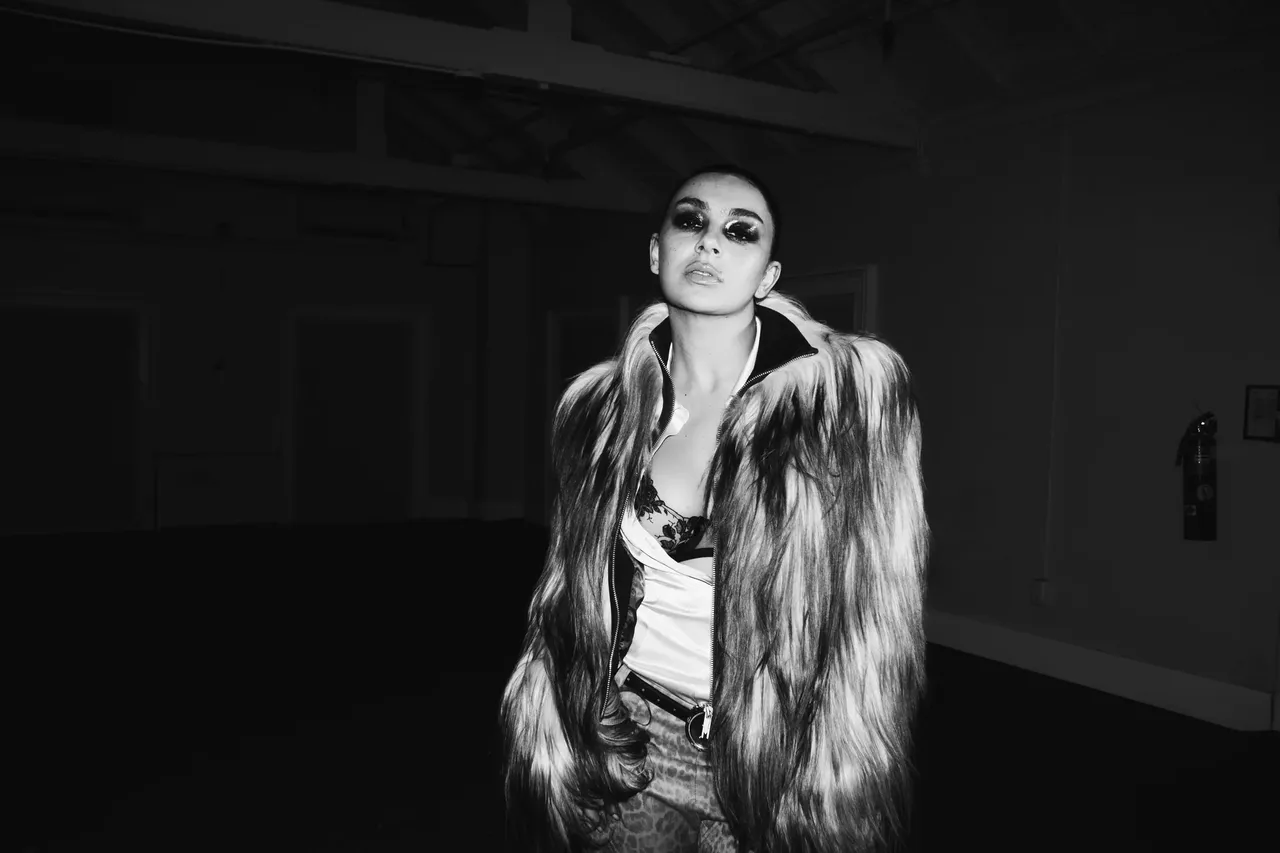
In an interview with New York Magazine during the brat era in 2024, Charli xcx discussed her viral ‘Kamala is brat’ comment during that year’s US presidential election and the impact it had on the politician’s press campaign. “My music is not political. Everything I do in my life feeds back into my art. Everything I say, wear, think, enjoy — it all funnels back into my art. Politics doesn’t feed my art,” she explained. Two years later, she’s back with a completely different sound and an album full of songs about identity, our relationship with the state of the world, and even her own longevity, titled Music, Fashion, Film.
Politics is increasingly becoming the subject of conversations and media debates for many reasons, but there’s one aspect that always surprises me. It has less to do with ideology than with semantics: politics is simply the way we live together in society. You can’t escape that; whether you’re affected by politics, interested in it or indifferent to it, every one of those positions is, in itself, political.
Many of the humanist ideas Charli explores on Music, Fashion, Film were introduced a few months ago with its first single, Rock Music. Not only is it a formidable way to launch this new chapter and present her evolving vision, it also works as an invitation to return to analogue art. “I'm really banging my head, I'm really hurting my neck / The nerve damage is real / But it's the only way to feel something,” she sings in the second verse, referring to the physicality of performing on stage. Yet beneath that lies the desire to feel something again. On Camera, Charli asks herself: “Do I wanna make music? Am I being fuckin' stupid / If I try to be a girl on the screen when I'm turning thirty-four?” It’s a search for her place within the alternative pop landscape: one she has spent years helping to redefine, and it also contains a feminist reflection that runs throughout the record, questioning not only how women are seen, but how they see one another.
Music, Fashion, Film is the statement of an artist who has earned the privilege of experimenting with the continuity of her own discourse, playing with intention. Few artists can afford to do that. Charli has reached this point through a steadily evolving career, one full of nuances, left turns and forward-thinking productions, providing her with the cultural capital to gain attention even when her work demands more than passive consumption. She occupies a singular place within alternative pop, with enough status and influence to make people stop and listen. But what is she actually trying to tell us here, especially after brat?
What Charli proposes is an escape from the algorithm, or perhaps a rewriting of its logic. We are still slaves to it, and so is music, increasingly shaped by an ecosystem fuelled by trends, metrics and endless optimisation. Yet on Music, Fashion, Film, Charli works by exploiting the algorithm’s blind spots, its absences and contradictions. The artist is faster. Charli is faster than the machine. The album is also, in many ways, a celebration of friendship and artistic community. By invoking the mythology of creative movements, in the same way that the Beat Generation, The Factory, the Young British Artists or La Movida are referenced in the media, Charli positions herself not as a solitary genius but as one of many enfants terribles within a wider collective: “Me and my friends, we go out / We take pictures and make stuff together / and sometimes we cry”, she sings in Rock Music. Her music is presented as just one expression of a much larger creative ecosystem; one she repeatedly acknowledges throughout the record. She even dedicates a song to one of her closest creative partners, A. G. Cook. “You’re my best friend, but we don’t talk / We make music, we talk that way,” she sings with remarkable tenderness on Magic Metal Montana, adding another deeply sincere entry to a catalogue that already includes songs dedicated to Lorde (Girl, so confusing) and SOPHIE (So I).
Lyrically, if brat thrived on irony, flirting with the aesthetics of apocalypse and the seductive emptiness of superficiality, Music, Fashion, Film arrives with a more uncomfortable truth: the meme, detached irony and endless layers of sarcasm might have gone too far. What’s left is to confront reality, embracing lyricism to reveal moments that feel more vulnerable, less filtered or performative. Those ideas already surfaced through the glossy cracks of brat, but here Charli turns inward. Even with her trademark shock value and playful provocations, there is an unmistakable portrait of a fractured world struggling to find direction, and that’s the one she’s observing both in and out.
The choice of musical language becomes essential to that message. Charli revisits a deliberately restrained strain of indietronica, using its modest sonic palette to frame these ideas while simultaneously questioning the narratives traditionally attached to different genres. One of the album's greatest achievements lies precisely here. Implicitly, and with her tongue firmly in her cheek, Music, Fashion, Film challenges our obsession with categorising music at all, forcing us to ask what really defines a genre. Rock, perhaps more than any other, remains burdened by a deeply patriarchal history: a tradition capable of producing moments of genuine brilliance while simultaneously elevating some of the industry's most ridiculous figures. In 2026, it still feels necessary to dismantle those myths: to question the countless men who continue to treat the guitar as a phallic extension of themselves, or the critics willing to dismiss a song like Von Dutch simply to keep praising yet another mediocre rock hero.
Some songs on Music, Fashion, Film are exceptional on every level. Others are less remarkable in isolation yet become indispensable within the album’s broader framework. This record confirms something that had perhaps only been hinted at before. Charli isn't simply an outstanding hitmaker, producer or pop star. Music, Fashion, Film cements her status as an artist determined to make us think: to interrogate sound, to play with outdated cultural avatars and the people who continue to defend them, and ultimately to dismantle them from within.
“Here's the truth, and I gotta be honest I'm not a bad girl anymore / Wink, wink, wink, wink / Yeah, people can change” she sings on Wink Wink, dissolving, almost playfully, the persona she carefully constructed across brat and Crash. 2007 is another fascinating moment, revisiting the years in which Charli first dreamed of becoming a pop star. “You're the way I wanna feel (I can take you to heaven like it's 2007) / Wanna feel it really bad (P-pop star in my bedroom like it's 2007)”. It deliberately sounds like a song from the indie sleaze era, a decision that feels simultaneously strange and perfectly fitting. Charli was only a teenager then, but for those who experienced that period firsthand, music still carried the promise that the future was something we could shape rather than simply consume. More importantly, it still felt affordable.
If not the best, SS26 is probably the album’s most significant song. Its chorus articulates a feeling that resonates across households and endlessly scrolling Instagram feeds alike: “Spring, Summer ’26, when the world is gonna end, no hope for any of it / Yeah, we're walkin' on a runway that goes straight to hell / Nothing’s gonna save us, not music, fashion or film”. Suddenly, the album's title reveals itself to be remarkably precise. Music, Fashion, Film is a direct reflection of the song's central argument. The album plays with the very subjects it interrogates. The song, together with its accompanying video, inevitably recalls Madonna's American Life in 2003, whose original video was famously withdrawn within days amid the political climate surrounding the Iraq War. Charli approaches the same relationship between spectacle and politics from almost the opposite direction.
Rather than relying on provocation, she trusts that contemporary reality has become disturbing enough on its own. A simple image of superficiality is sufficient to expose how profoundly broken the world already feels. Yet she also sings: “Can't hide the fact I'd rather take the easy road / Yeah, I think I'll be alright if I look good in the clothes”. Once again, Charli places the female experience of pop stardom at the centre of the conversation, in the same way Lily Allen did on The Fear. It may read like a passing lyric, but it encapsulates one of the album’s greatest strengths: her ability to expose the contradictions of womanhood in contemporary pop without sacrificing wit or immediacy.
Card Declined unfolds in two distinct movements. In the first, Charli juxtaposes designer fashion with concepts such as personality, kindness and emotional fulfilment. Once again, she contrasts the superficial with the essential, as though the protagonist who dominated brat had finally grown weary of material excess and begun searching for something more meaningful. The second half incorporates a fragment from the Rock Music B-side I Keep On Thinking Bout You Every Single Day And Night, reinforcing that constant dialogue between emotional intimacy and consumer culture that runs throughout the album. Persona, inspired by Ingmar Bergman’s 1966 masterpiece, offers one of the album’s few explicit references to cinema. Its rougher production, built around abrasive synths, mirrors lyrics that stand among Charli’s finest here. The song functions simultaneously as a letter to a friend and an internal dialogue, blurring the distinction between the two. Once again, performance extends beyond the artistic sphere: the carefree persona that has defined much of Charli’s career suddenly gives way to a debate about authenticity itself.
No One Lasts Forever is a magnificent way to close the album. Echoing the aesthetic imagery of Everything Is Romantic, Charli revisits recurring visual motifs — the floor of a Parisian apartment, the French girl talking about philosophy — only this time they are infused with urgency and existential reflection rather than youthful fascination. If the album ultimately teaches us anything, it is precisely this: we’re all going to die. Faced with that certainty, she quietly sings, “You need to discover that feeling of the crushing highs and lows of ego”. The closing conversation with David Cronenberg captures that philosophy perfectly: “Some artists have created art that has really survived thousands of years. And that’s fantastic, but experientially, for them… They are dead, they are gone, they are not experiencing that”.
Pop has not merely changed; it has become a multidisciplinary art form, a container for some of the most adventurous sounds being made today, even if most mainstream listeners remain largely unaware of that transformation. Perhaps the album’s most fascinating achievement lies precisely here: positioning ‘under-streamed’ pop as one of the most compelling artistic vehicles through which to examine the cultural questions of our time. Music, Fashion, Film is a cultural statement about what it means to create, perform and consume identity in an era where music, fashion, cinema and celebrity have become almost inseparable. It’s about spending time with your friends, rethinking consumerism, reflecting on vital moments and asking yourself important questions.
Charli has made Music, Fashion, Film first and foremost as an artwork for herself. Whether we embrace it or not almost becomes secondary. Yet that is precisely what gives the record its power. Even if she does not consider her music to be political, the way this record speaks about our moment is undeniable, and she has made it at a point in her career when she knows her audience is larger than ever. Even when she's being brutally honest, she’s aware that honesty itself can become a performance. In times of ignorance and indifference we’ll surely take a rebellious album, even if it is aesthetic and conceptual rather than ideological.