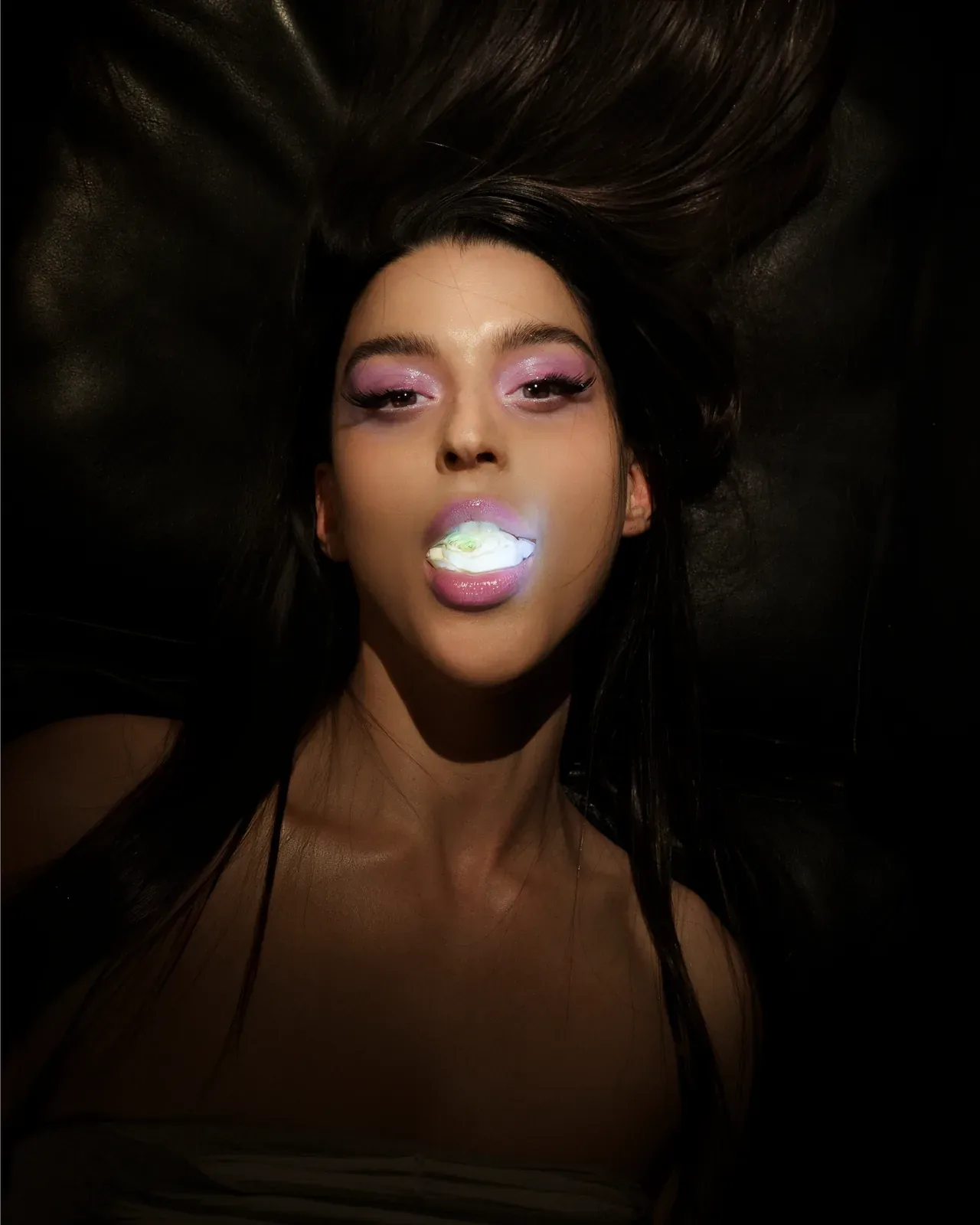
Counterculture has become suspiciously recognisable. It now comes with its own uniforms, playlists and festival line-ups. For years we’ve mistaken distortion for disruption. The aesthetics survived but the resistance to the system didn’t. Punk became fashion. Indie became branding. That doesn’t mean that music isn’t still the most challenging artistic field in which to place cultural thinking through the work of avant-garde artists. In a moment of trillions of daily releases, music magazines closing and festival line-ups gentrifying the sound, there’s still resistance. XXXXX (XL Recordings) is the new album of Arca, and it arrives just in time to reclaim the role of keeping counterculture underground to protect its nature by simply being some of the best music we’ve heard this year so far.
For over a decade, the Venezuelan producer, composer and multidisciplinary artist has refused to occupy any stable position within contemporary music. Every record has dismantled the language established by the previous one, making her catalogue less a chronology than an ongoing process of mutation. After the monumental expansion of the KiCk universe (a saga that will be studied in the future as a landmark in music), XXXXX arrives following several years of relative silence. If the previous era expanded Arca’s world outward, this record collapses it inward, embracing uncertainty, contradiction and vulnerability without ever sacrificing its hunger for sonic invention. This is a pop record full of poetry, built around its own conceptual framework. Even if Arca seems to be singing and making this music from what initially feels like a dark place, this is such a hopeful album, full of statements of self-assurance and provocation.
Originally conceived as a mixtape before revealing itself as a fully realised album, XXXXX quietly questions whether those categories still mean anything in an era dominated by streaming. Mixtapes are traditionally experimental and rough, while albums are normally a polished and formal final result. Arca inhabits both spaces simultaneously, elevating the freedom of underground experimentation into the framework of a studio album, proposing a format that belongs to neither (Gabriel Schuman does remarkable work in the mixing). What makes XXXXX remarkable is that it might be Arca’s most accessible album conceptually while remaining one of her most adventurous sonically. That sounds contradictory, but isn’t contradiction her native language? The record reveals an extraordinary sense of sonic architecture, and chaos fits the narrative of this album as naturally as the artist has embraced it in her own life.
There is a very specific thin line that the album successfully inhabits: it’s full-on weirdcore yet still so pleasant to listen to for those who might have considered her music inaccessible in the past. In XXXXX Arca manages to show her vision without losing a bit of freedom, something that becomes immediately apparent throughout the record.
Willow glides through luminous R&B-inflected production where crystalline synths and fleeting sonic details evoke speed almost cinematically in the form of onomatopoeia (“Willow, willow, willow / Leaf, leaf, leaf, leaf / Blowing in the, in the wind, wind, wind”). It recalls the meticulous attention to detail of late-‘90s innovators like Darkchild or Timbaland without ever descending into nostalgia. Futurality, meanwhile, lives up to its title by transforming sound itself into movement. It propels the listener toward what might come, using shimmering electronics and impossible rhythmic momentum as if music itself had become a vehicle capable of escaping chronological time. It feels as if the speed of sound were holographic as it lightens up the dark through its journey.
Yet beneath the astonishing production lies something unexpectedly tender. While the album initially projects darkness, its emotional core is remarkably hopeful. Again and again, Arca returns to ideas of transformation, surrender and inner certainty. She sings in Heart: “Juntando el nexo / Entre la energía y la señal / Escúchame transmutar” (Forging the link / Between energy and the signal / Listen to me transmuting). She elegantly talks about transmuting energy into signal (both ‘trans’ and ‘mutant’ are core concepts in her universe); in this journey Arca is embarking on an ethereal visit to a strange place, unknown yet certain, in which she finds spots and moments to reclaim her realm and expand her music.
For its part, Eidolon unfolds almost like a contemporary poem dedicated to inhabiting the present moment: “Lo juro por Dios. Momento, yo vivo el momento. Y brillo al viento. Lo juro por Dios, te siento adentro. Reviento, momento. Eterno, es eterno” (I swear to God. The moment, I live for the moment. And I shine at the wind. I swear to God. I feel you inside, bursting, the moment. Eternal, it’s eternal). These aren’t merely lyrics; they function as philosophical coordinates within a record obsessed with becoming rather than simply being.
Even the album’s most confrontational moments refuse to settle for provocation alone. Fxck undoubtedly stands among the strongest tracks Arca has ever produced. Framed by sleek R&B influences rather than straightforward club music, its explicit sexuality becomes an act of symbolic inversion, reclaiming patriarchal myths through pleasure, violence and absurdity. It’s a sign of her interest in Freudian psychology, and it is confrontational not because it seeks scandal, but because it dismantles inherited structures of power from within. Here, sex is usually used as a means of tricking men into their downfall. “Fuck me, like you love me, fuck me ugly, til' I pass out. Got my hair down, watch my stomach. Watch me gag on it, with the shit on mе. I'm the shit, I bite your penis. Daddy, I'm thе shit. Come on, choke me harder, kill the f*cker”.
But the club is also meant for intimate desires and the chance of flirting: “Yo sé que tú quiere' que te muestre (Ah, ah, uno, uno) Con tacón y falda apreta' Agacha y deja que te muestre (Ah, ah, uno, uno)” (“I know you want me to show you (Ah, ah, one, one) In heels and a tight skirt. Bend down and let me show you (Ah, ah, one, one)”), she sings in Taconeando. The lyrics in XXXXX shine through thanks to their perfect balance of quantity and creativity. In Finisher she whispers what reads like an ode to her own journey: “You really were never alone / And all of the love you need / And all of the love you will need lies inside of you / And now that you know it / Get bitchy”. And then the sound of a killer sword rounds off that command, ending a song that reflects her skills as a composer as well as the influence of classical music in her production.
Throughout the record, Arca demonstrates a level of sonic imagination few producers currently possess. Tracks such as Syncope (a journey in itself) and Grip become laboratories of a sound design that contributes to the nature of XXXXX with nods to her sound in Mutant (2015) and Arca (2017), while pieces like Enraptured, Throb and the closing Sueño replace the familiar mechanics of industrial music with something stranger, softer and infinitely more mysterious. Heavy string arrangements dissolve into synthetic atmospheres (those pitched violins), rhythms flicker like insects in an abandoned forest, and every texture seems suspended somewhere between machine and organism. Everything plays with an uncomfortable beat that moves too fast, like the wings of an insect that flies so rapidly that it generates distortion, which feels like another strange walk through this journey that evokes an abandoned forest in the distant retrofuture in which everything is possible and the main character is anything but afraid.
Sueño is the last song on the album, and it feels dreamlike, with a depth in which Arca’s voice dissolves into the sound of a pan flute until we can almost see that sound reflected on any surface. Arca says “Diva.Experimental” throughout the album, framing it as a mixtape, in case of any doubt, constantly reminding the listener of the nature of this new chapter and its cultural connotations, almost like a pirate radio station, inviting us to this unknown place. Diva.Experimental could be that place. It is also the two-hour livestream directed by Daniel Sannwald that offered an immersive introduction to the world of XXXXX across seven locations in Barcelona. Presented the week before the record’s release, it can now be watched on YouTube.
More than simply another chapter in her career, XXXXX feels like a statement on the current state of music itself. At a time when electronic music risks becoming increasingly standardised and once-radical aesthetics have been absorbed into the mainstream festival circuit, Arca reminds us that true experimentation still lies in challenging expectations. Following years of artistic expansion across music, visual art and fashion, she returns with one of the most compelling records of her career, one that reaffirms her place as one of the defining musical thinkers shaping the future of contemporary pop and electronic music. It was about time we got freakier in the club. It is precisely in liminal spaces like the club where new life can arise and keep giving form to a counterculture that now, beyond resisting, must distinguish itself from mere impersonations.
If we broaden our perspective to consider the spectrum of electronic music, its history is incomprehensible without the presence of trans women, from Wendy Carlos to Anohni, including Laura Les, Backxwash and Arca, as the writer Jen Ives describes in some of her most recent essays. The artists who ultimately reshape culture are rarely those who best capture the present; and ours is undeniably complicated. XXXXX imagines another route through an exhausted cultural landscape that makes the present feel obsolete. At a moment when so much music seems content to perfect existing formulas, Arca once again chooses mutation over mastery, seemingly incapable of doing one without the other. She imagines a world that resists our own through the majesty of sound. That is what true counterculture looks like today; and it sounds like tomorrow.