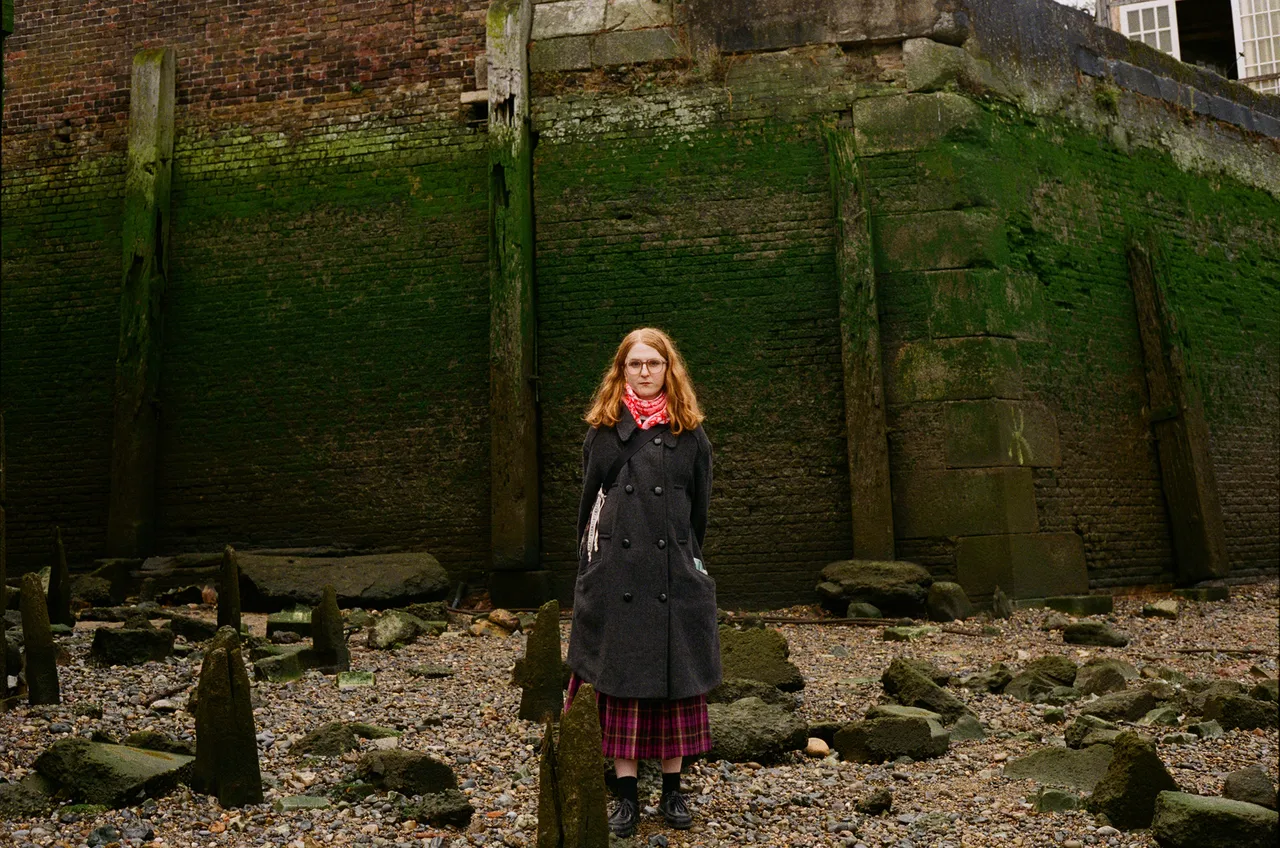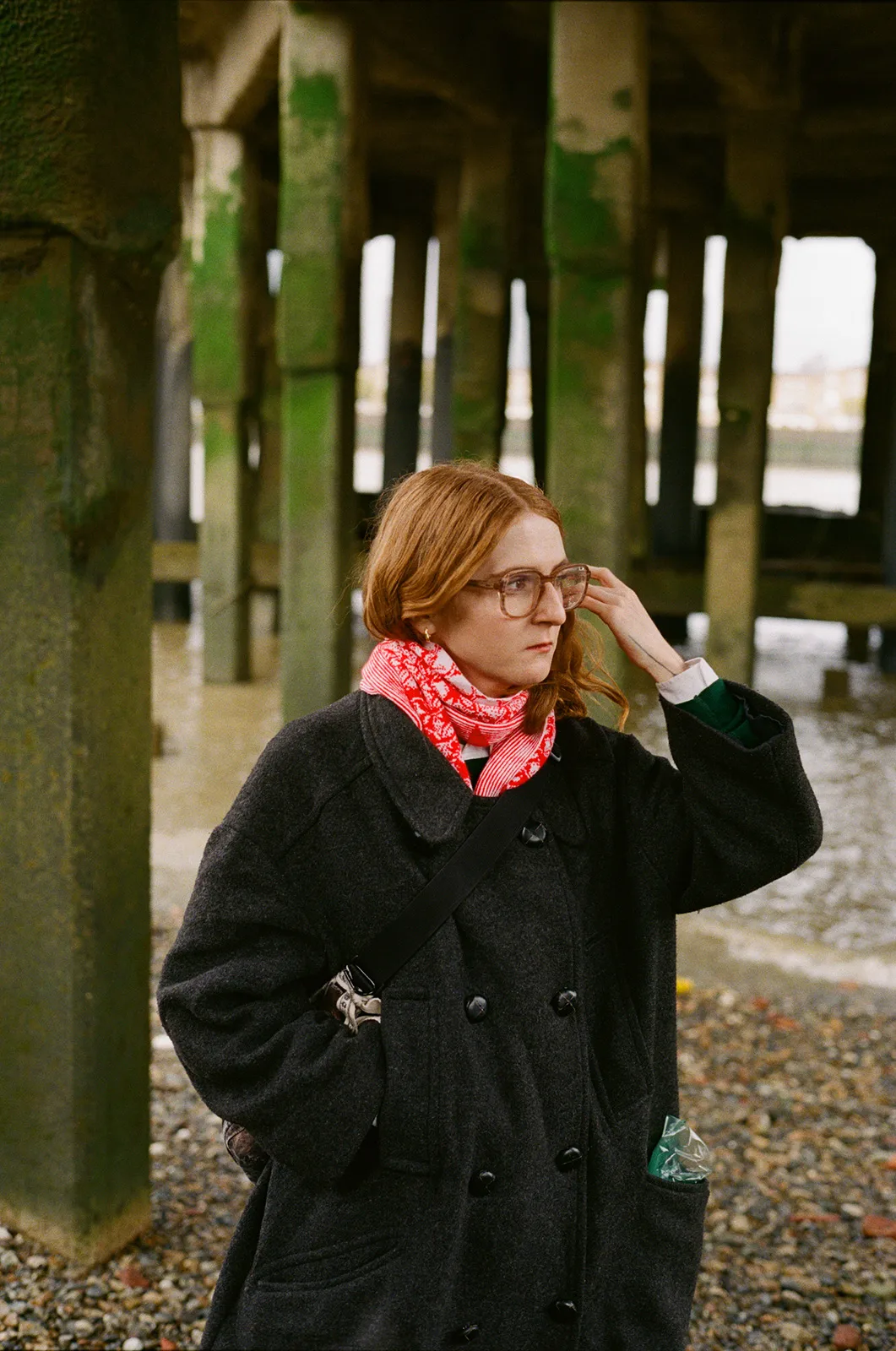
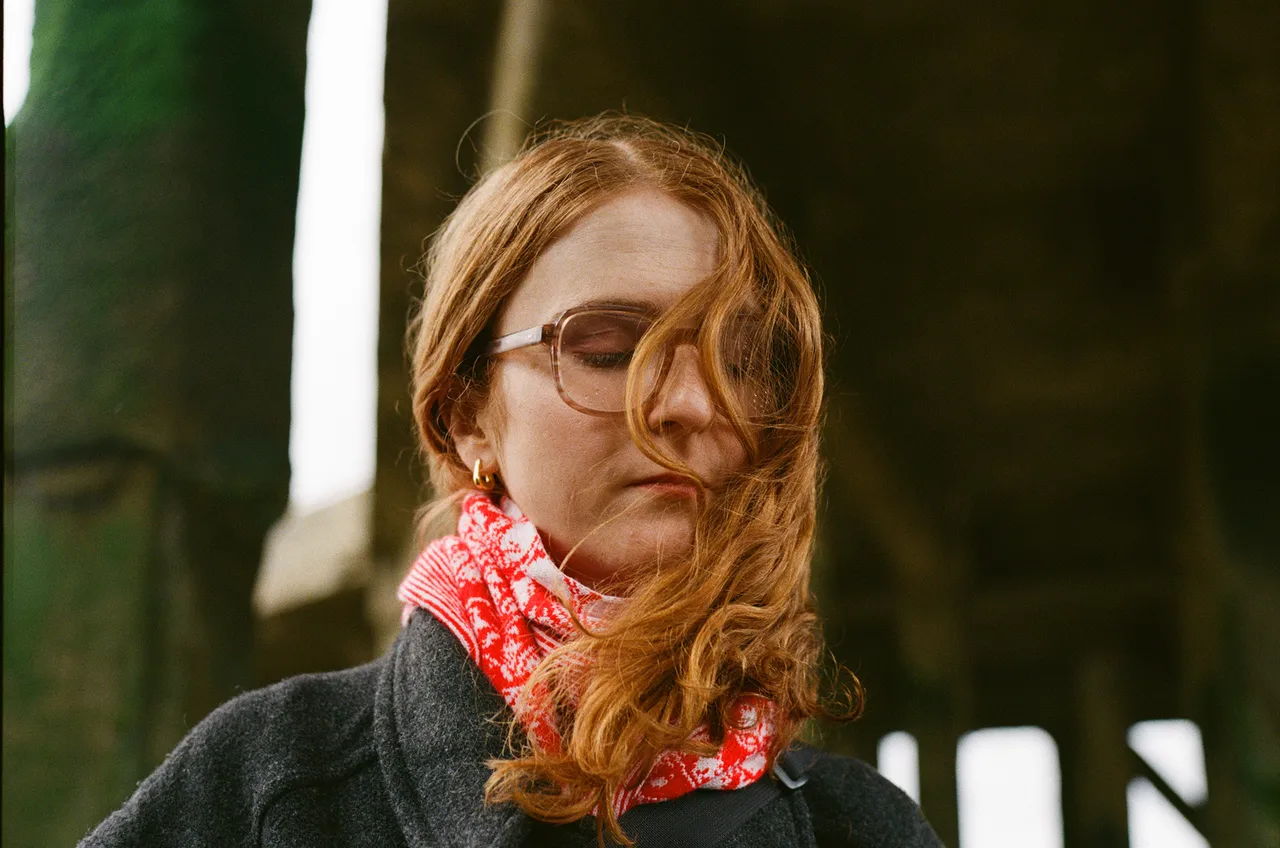
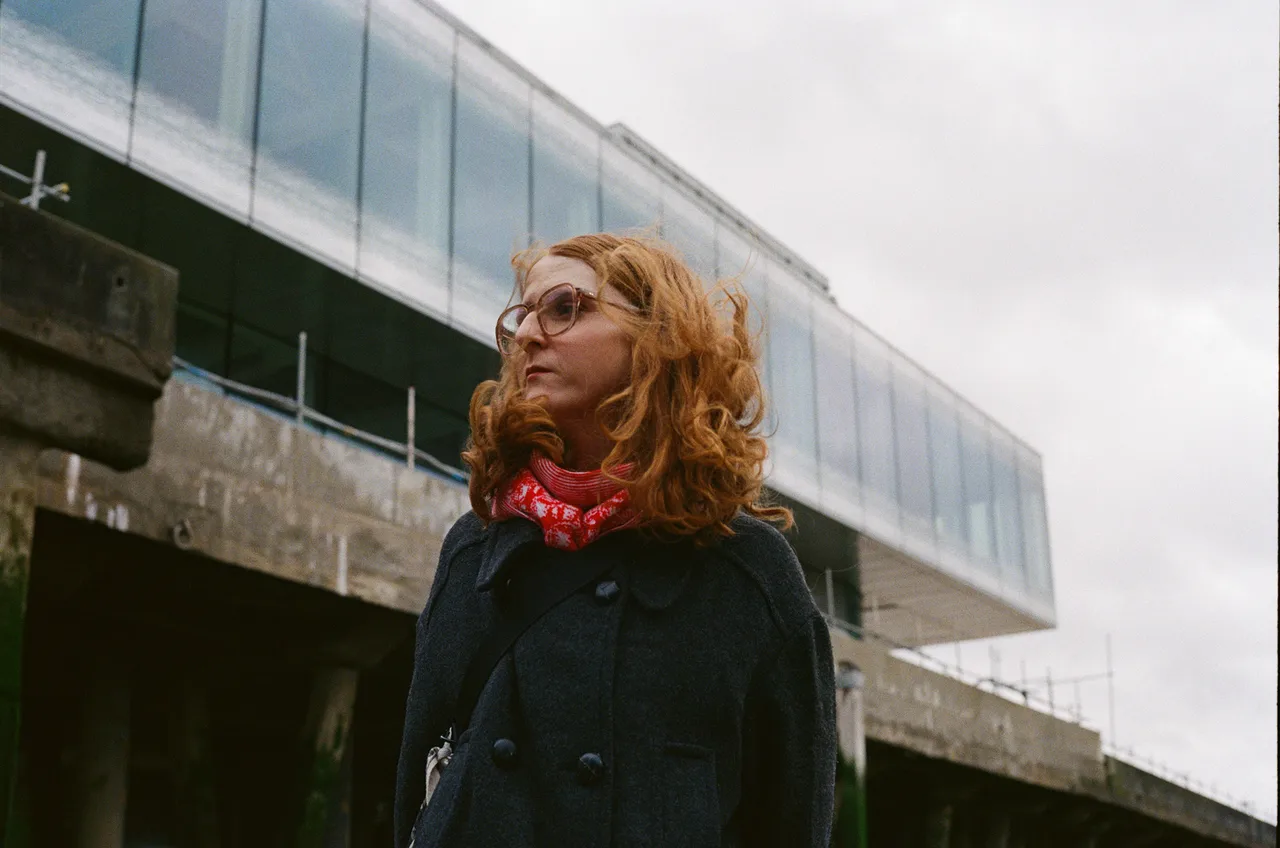
Below Watergate Stairs on the Deptford Foreshore, the Thames breaks into stones, clinker, and clay. What looks like pebbles often isn’t but thin chalk, and old brick or tile, rounded by the tide. Weed-slick timbers jut at odd angles from the ground, a counterpoint to the ordered sheen of the Canary Wharf financial hub sat across the water. This strip is a favourite haunt of musician Jennifer Walton. Her shared studio space is nearby, with the unpopulated Foreshore serving as relief from London’s more hectic side. Palms damp and eyes attuned to any circles and straight lines, mudlark casuals of today, such as Jennifer, scan what the river has sorted by weight. Look long enough and oyster shells appear, then blue-and-white ceramics, weathered glass and other oddities. “The forecast said it was low tide,” she says, with a smirk. “Actually, this is all just an elaborate plot to lure you to your death.”
Jennifer's brought resealable bags to pocket any finds, with her primary target being clay pipes that were smoked and tossed by Londoners from the 16th to 19th centuries, their bowls growing larger over time as cheap tobacco did the rounds. “If you find any with decorated bowls, they’re super rare,” she explains, while showing me a broken pipe stem minus any head. The Foreshore is London’s reliquary, with every low tide lifting the lid on the city of old, and what was dropped, lost, or thrown into the river over the centuries.
Walton’s debut album Daughters, released on October 24th via Local Action, arrives with its own reliquary. The album artwork sees her severed plait rest on the satin backing of a World War Two souvenir pillow she found at her dad’s house. It's a keepsake once sold on air bases for soldiers to send home, with soft sayings such as remember me, in case they never did. “There’s this weird vibe of the military designing these gifts for parents that are super saccharine,” she explains. “They’re crazy objects, when you think about it.” She’d cut her plait after receiving a botched bob cut, where the back was left far too long, and so braided her hair to disguise it, before abruptly chopping it off to be stowed in a drawer out of sight.
Each time she opened the drawer, the severed hair stared back, and as a curiosity with such sweetheart pillows grew, Jennifer hit on the idea of pairing the two items together. “There was something about their fusion,” she muses. “The warmth of this weird satin and my own hair that felt pertinent. Visually, and then the meaning of the two to the record, to all of it”. Shot in the nearby city of Southend, amongst the comfort of her friend Liam Cosford’s “very 70s-style living room”, the image reads as a small home altar hinting to the record’s core: the death of her father.
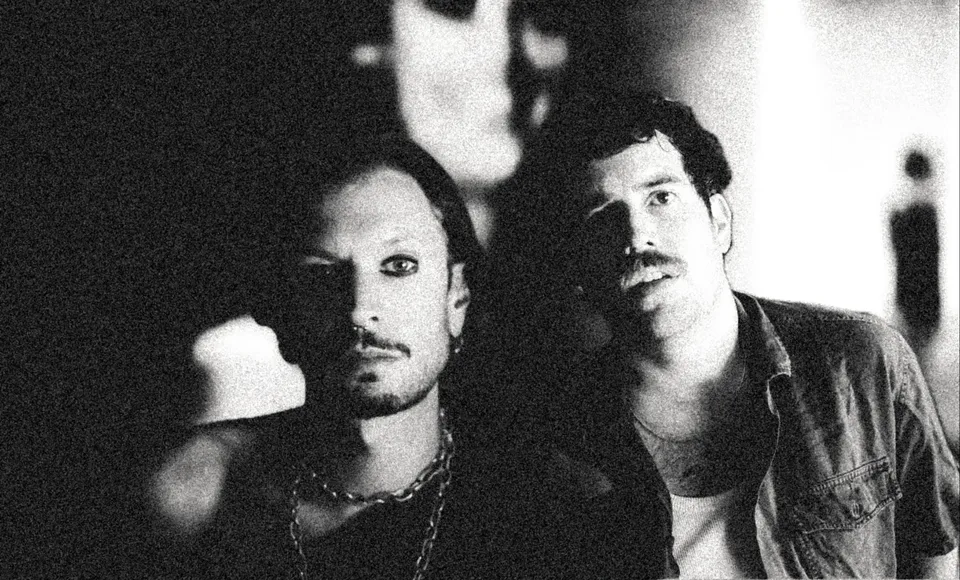
Jennifer Walton’s dad is the musician and producer Nigel Walton, best known as a member of early-90s dance quartet Opus III, whose 1992 house single It’s a Fine Day reached No. 5 on the UK Singles Chart and became a club perennial across Europe. Originally, he was born and raised in Sunderland, and began his career making dance music as part of the group Ashbrooke All-Stars (named after a residential area of Sunderland), while also working on Opus III. After the latter’s commercial breakout, however, they were quickly signed to Big Life Management, seeing Nigel move down to London ahead of a breakout tour across the Americas, Asia and beyond. As the project wound down a couple of years later, he moved behind the desk as an editor and mastering hand, with credits listed for Bloc Party, Basement Jaxx, and many others across his nearly three decades of work.
Daughters is explicitly a grief record, built from the years around her father Nigel’s terminal cancer diagnosis, and eventual death on 13 August 2022. “I knew, even before there were lyrics or anything concrete, that I wanted to write about grief,” she shares. “Not in a grand sense, but it grew slowly out of small things.”
Work on her debut record started as small demos built in the months prior to her father’s passing, however her career path to that point had largely been alienated from her own practice. “So much of my output was about working to other people,” she explains. “I was really good at reading a brief and churning. Producing for others, collaborating in some way, doing scores, even DJing. Constantly changing who I’m trying to emulate each week. So, it took me ages to actually understand what my thing was.”
Aged twenty-nine, Walton has been a part-time producer at NTS Radio for several years, as well as creating musical work across various other contexts: collaborations with Sarah Midori Perry as Cryalot, credits on recent Iceboy Violet and caroline records, and even creating the jingle for music podcast No Tags.
Her own musical references have long straddled worlds: “I’ve always been obsessed with music history, especially rock history,” Jennifer enthuses. “But when I moved to uni and started making music, I was obsessed with Deconstructed Club.” The since meme-ified genre term is much contested, but is typically founded in crunchy, metallic or otherwise unorthodox sound design of the early to mid-2010s, that offered a mutated alternative to 4/4 club rhythms and build-drop-build formulas. This encompassed artists like Total Freedom, Holly Herndon, Lotic, and Chuquimamani-Condori (FKA Elysia Crampton), club event series such as Janus and GHE20G0TH1K, and labels like Night Slugs and PAN. “All of that scene was really formative, as well as electronic-leaning band music like Crystal Castles or Nine Inch Nails, but I never went out,” she adds, referencing a lack of such a community in Hertfordshire, where she studied. “And if I did, I would treat club nights as gigs, as if it was a band. I’d turn up sober and go until 4am on my own because I didn’t really know what was going on in that way.”
In 2016, her second year at the University of Hertfordshire – incidentally, studying Music Composition and Sound for Film and Games – Jennifer moved down to London after her best friend’s sibling introduced her to friends at Goldsmiths University, South London. “I kind of just nestled at their house, and started doing this crazy two-hour commute each way to get out [of Hertfordshire] because it was so dead,” she laughs, thinking about her honorary Goldsmiths status. “I was hanging out in my friends' studios all the time. It felt really exciting because I'd thought uni was going to be the like that for me, and so this was my alternate universe.”
With help from fellow London-transplants, she eased into mixing. Namely, at an afters in Dan Evans’ (of Shovel Dance Collective) flat circa 2018, aya sinclair, chain-smoking at the window, talked Jennifer through mixing into the early hours, and the friendship stuck; with 96 Back (Evan Majumdar-Swift) they later coalesced as Microplastics, performing together and sharing her studio space. She began playing loud, fast DJ sets – typically, happy hardcore and other maximalism-first tracks she wanted to hear in the club – at light-hearted nights like Tremors, Planet Fun and Illegal Data, while also releasing the intricate EP White Nurse in 2019.
At the confluence of the subsequent global pandemic lockdowns/restarts and the growing grief of her father’s condition – as well as excessive late-night touring and general club music fatigue – she experienced a major feeling of burnout. “I really fell out of love with music generally,” she admits. “I wasn’t listening to much, unless I had to for work. And I had some growing frustrations with the DJ stuff, and how much it was about optics, clips for Instagram, and pushing this technicalism, when I think it should just be about playing songs.” It wasn’t until 2022 that music started to become a pleasurable activity for her again, reinvigorated by past pleasures. “It was coming back to these ultra-trads like The Grateful Dead, Bob Dylan, and The Beach Boys, and falling so head over heels for it, that kind of got me back,” Jennifer explains. “Because it felt really new to me at that point.”
“I think that’s why I never put out anything big,” she continues. “It felt more comfortable letting go of a club EP, which I was still really proud of, don’t get me wrong, but it didn’t exactly feel like me. Probably because I was saving it for the big project – and I guess this is it.” When Local Action’s Tom Lea first reached out, the plan was a club-leaning release, but the project shifted as grief-led songs gathered around individual stories and concepts. “Like Miss America,” Jennifer reflects. “It was a story I knew I really wanted to write about one day.”
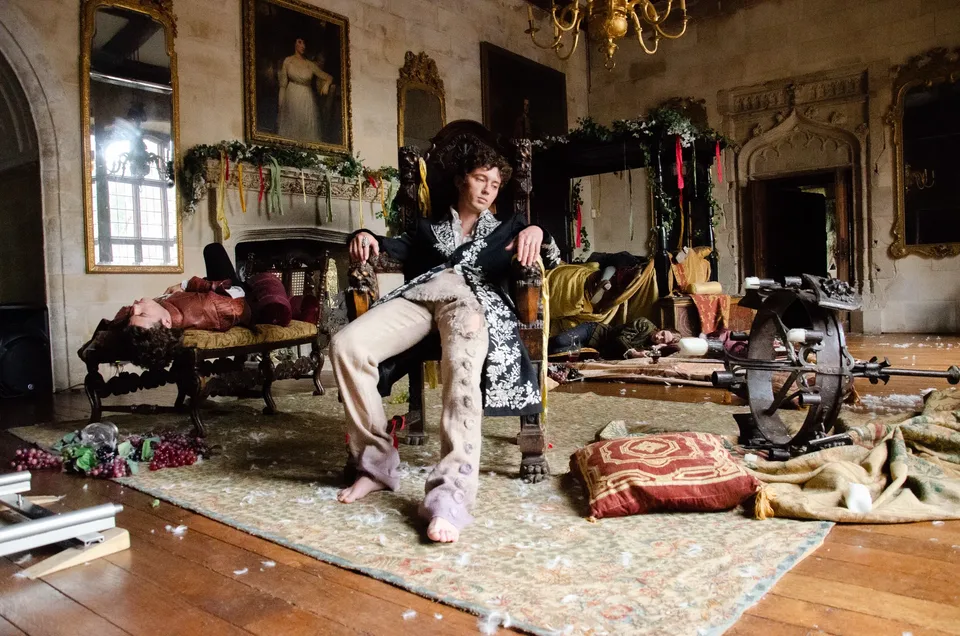
Track six on Daughter’ nine-song run, Miss America chronicles her feelings of dislocation, after learning about her father’s critical condition in a hotel room adjacent to the JFK Airport, New York, in 2018. Banal as that setting may be for such a serious rupture, it occurred towards the end of a momentous milestone, and one that mirrored her dad a quarter of a century earlier: touring North America, in what was her first time in both the US and Canada, as the drummer of indie-pop outfit Kero Kero Bonito (KKB).
Like many Brits, she had grown up on a steady diet of American culture, from TV sitcoms and Hollywood gossip, to simply chatting with Americans themselves on Xbox Live. “It was so noticeable how much less cultural exchange there was the other way around,” she notices, before regaling a dumbfounding story of how KKB were once asked if they were “the Beetle band” by a provincial diner waiter. “I really got down with the diners, actually” she adds, establishing that Dick’s Drive-In of Seattle serves the best burgers in the US.
Jennifer marks these moments on record, re-framing midnight eateries, glowing strip malls, and everything big and in motion at cultural touchstones like Los Angeles, as a backdrop to emotional turmoil. America’s near-mythical status unravels in disorientating fashion, as visions of her father floating above water, “Your body hovering far above the sea” (Miss America), weave with ground-level realities of stolen medication (after the group’s tour van was robbed) and subsequent panic attacks. Simultaneously reflective of the USA’s other faces – mass homelessness, mental health issues, and opioid addictions. The track trails Jennifer through hospital waiting rooms and police stations, battling for replacement medication and lodging reports about the theft. Life marches on beneath this cold bureaucracy, brutally indifferent to the monumental grief of losing a parent. Being Miss America isn’t all it’s cracked up to be.
Across the album, lyrics are at once plain-spoken. Title-track Daughters frames the aftermath of loss matter-of-factly: she checks her phone “once” and “twice,” finds “still no answer,” and ends up “alone in the back seat,” circling the same thoughts. On Lambs, where the language often tilts biblical, she cuts through the grandiosity with a simple, almost offhand aside about her childhood and her parent’s separation: “It was always just me and my mother.” At other points, Jennifer lets images do the heavy lifting, building a worldview that feels vivid and slightly slanted without ever fully resolving into narrative. A ponytail “already braided” falls to the floor later in Daughters, getting buried “in the garden for the next one to find”, having her bad haircut and intergenerational grief share the same small symbolic space.
Sometimes crashes Princess Grace of Monaco into a scene of cigarette ash in the eye, men of steel and white-painted houses across the bay, as history, cinema, and personal memory blur. While, It Eats Itself pushes this logic to an extreme, turning desire into a creature that wants to devour “every cloud”, “every star”, “every man every woman,” until it ends up consuming itself. For Jennifer, that mix of literal feeling and oblique image is deliberate. “It’s funny because I’m finding more and more, going through other people’s work or interviews on grief, that all these metaphors I once thought of as quite trite, are now something I’m a part of,” she remarks. “Some of my lines are quite vague, and yet I know exactly what they’re about. But to say that would completely untie all the possibilities that could exist from it.”
Initial versions of many tracks were more straight down the line, Jennifer says, as writing generally came quickly. Miss America and It Eats Itself, for instance, were both written in a single day, respectively: “Not a lot of the lyrics were that deliberated over,” she continues. “They would just kind of spin themselves out. So, it was then sometimes a task of peeling things back to something more magical, or to distil more complicated feelings. If you give too much away, then you’re only allowing for one meaning.”
Lyrical ambiguity speaks to the emotional complexity of terminal diagnosis. Once the prognosis is final, the long-tail of cancer can, confusingly for those in its orbit, be a double-edged sword. You at once know that death is here, a mightily destabilising spectre sitting in on all interactions from there on out. And yet equally, by being confronted with mortality ahead of death’s arrival, there is something of a renewed impetus to live authentically; to pay attention and be as present as possible in any time you have left, that may not have occurred otherwise. “We spent the most amount of time together we ever did after the diagnosis,” Jennifer says. “Because it was quite a long period, from then onwards. It did create this time pressure, to hang out as much as humanly possible, because I knew it was still limited. And I was so aware of trying to get everything in its right place, as much as I could. To talk everything through and ask any questions I had.”
Dad and daughter would go on extremely long walks, speaking at length on subjects such as his childhood and hers, often as part of broader caravan holidays in Devon and Scotland. She would spend increasing amounts of time at his new-build flat in Brockley, London, simply hanging out multiple days each week and sleeping over in the spare bedroom, as both worked in the city by day. “I got him into YouTube,” she remembers, with a chuckle, explaining how she logged into the streaming platform on his smart TV. “And then I'd wake up in the morning in the main room, look at the search history, and it'd be like the most dad searches ever: Old Grey Whistle Test or Devo Live 1970.
“There was nothing that was left unturned by the end, you know,” she continues, as drizzle-soaked waves come crashing into the Foreshore, somehow both appropriately and not so. “And, in some way, that was the difficulty. You think you're being pragmatic, that you're being straightforward. But then, afterwards, it's still this huge confusion. It doesn't make sense.”
Anticipatory grief doesn’t necessarily inoculate you from what is to come. Relationships are constructed from repeated spills of affection, support, connection, and joy, and just as much, moments of disagreement, frustration, and betrayal. Both innocuous everyday encounters watching TV, and intense outpourings walking coastlines stack to become what you know as that person, what they know of you, and together, your shared history. You might acknowledge that time is short, but there’s seemingly always another moment to make together, until there isn’t. “I don't think humans are actually built to understand death at all.” Jennifer articulates. “I’ve found there is this innate understanding of lots of things that happen in life. When you think of your first kiss, it feels like it's tied to this ancient, in-built knowledge somehow, and it all makes sense. And in some ways, with grief, I kind of expected it to be the same. But there is this ultimate confusion that happens afterwards: that this person isn’t here any more. You can’t wrap your head around someone being a presence, and then just not. Even though I was prepared for it, it’s still the strangest thing. And it still grows, right? It's been years now, but I still find it comes around in ways I didn't expect.”
One way that grief has surfaced as of late has, perhaps naturally so, been tied to the rollout of Daughters. Her work has opened up conversations with friends and relatives, and even strangers. In the few days prior, Irish producer and mixer Jacknife Lee had got in touch with Jennifer, sharing stories about her dad who he worked with on Bloc Party releases, as well as on her favourite Crystal Castles albums. “It’s so crazy how one of my heroes, someone I really looked up to, can come into my life through this shared loss,” she shares. Sometimes these conversations have had peculiar manifestations, however. “People have also been talking about how they wish my dad could have heard it,” Walton recounts, with a wry smile. “Which is a funny thing to wrap your head around when it’s an album that is implicitly about the grief, the death, of that person. It’s like this horrible snake, you know? One like can only beget the other.”
After bereavement, it’s common (and, reportedly, frequently beneficial) for those left living to attempt to reconstruct meaning out of such a loss. Creating memory books or service projects that honour the dead, therapeutic writing exercises to or about them, as well enacting change in themselves, in their life goals and roles come thereafter. Jennifer found that friends' experiences navigating similar emotions gave her a tangible framework for employing music — importantly, something that is her and her father’s life’s work — to cope with grief.
Mina Topley-Bird, also known as Silvertongue, was a founding member and lead singer of the South London group 404 Guild before her death in 2019. “It was this real community grief,” Jennifer says of that time, noting that the group and its offshoots, such as 404 Ellison, would go on to release music that related to and reflected on her passing. “It was encouraging to see that you can interact with grief in that way. What struck me about those releases was how strange it is to have your friend, who's a really talented writer, discuss an experience that you have also lived through. The feedback loop of that, within you and others, and being able to know the emotions of it all so intimately.”
“I really hoped it would kind of be the same kind of thing with my album, for the people who were there,” she continues. “A community thing in its own way. I am excited to have the album be a testament to, or an artefact of, this time.” In many senses, Daughters is an album of community. Throughout our conversation, Jennifer is self-effacing, almost to a fault. No surprise for someone raised in the UK, so goes the stereotype, but she’s clear that this album was built on supportive backs. “At any point I could, I would come back to relying on my friends,” she utters proudly, referring to all the collaborators on the LP, name-checking Aya in particular for her “hand-holding” in vocal processing, mixing and more. “It was about trusting them as much as possible. Because it was so personal, keeping it in the family made sense. And they’re the most talented people I know.”
“It’s even just having all these amazing people nearby, like Aya, Shovel Dance, and caroline, doing all these insane things that make you realise what's possible for yourself,” she reflects. “That doing something really grand and kind of indulgent is possible. It really encourages you to be able to trust in your thing.”
Naturally, her parents were foundations in all of this, too. “I was raised by my mum,” she explains. “And I’m very much in her image. We’re extremely close, and she’s the most supportive person in the world. But I think the biggest thing was just the fact that my dad had done it, and been quite successful, really paved the way for her to be so hands-off and trusting that music would work out.” While mum was responsible for everyday upbringing in Sunderland, her dad naturally led the way with all things music. From the moment she found Logic on his computer aged eleven when on a caravan holiday, to the album’s writing itself, which happened mostly in his Brockley flat. “When I was a teenager, instead of pocket money, I was allowed to download two albums a month on his iTunes,” she shares. “And so having my dad there, growing up, that I can show him Death Grips, or get really excited about Salem, felt super exciting. He was always so interested in me, and in new stuff generally. We’d talk really intensely on long drives to Scotland, London or just on the phone so often. He was crazy supportive.”
Her album launch show was very much proof of concept. A week prior to our chat on the Foreshore, Jennifer was performing the first band-backed performance of Daughters, hours out from its release, inside London’s sole-surviving, Elizabethan church. Many are settled on the flagstones, knees tucked and legs crossed, as Walton invites the room to join the refrain — “love will lead your way home” — of the album’s, and the night’s, final heart-swelling song. Dan S. Evans slowly brings the church’s pipe organ in with a low, anchoring hum that swells and steadies to its cathartic crescendo, as Jennifer, her on-stage choir and the surrounding room sing the line as a whole. Jennifer’s family, including her mum, stepdad, aunt and uncle, are present, alongside heaps of her friends. Looking around to their faces at that moment, after hearing such warm conversations across the congregation prior, it’s hard not to have a few tears in your eyes.
“It really felt like this collective, embodied thing,” she says. “I kept making eye contact with my mum. Being able to share that with her, as well as the release of the album and all these feelings generally, in this setting, was really cathartic. Sharing that with all the family and friends that have rallied around in their own ways through the grief. Everyone has been so positive, and I think touched by it in ways I wasn’t really expecting.”
“I’m really proud of myself,” she adds, pausing. “But also the friends that I've managed to cultivate and how talented everyone is, and that there wasn't any compromise on this record. It wasn’t like when I got the big shot, I wasn’t interested in them, you know. This has all been really hard, and such an insane amount of effort. But seeing that kind of come into being, with people you love being so close, has been so rewarding.” “It’s all about coming back to love and friendship.”