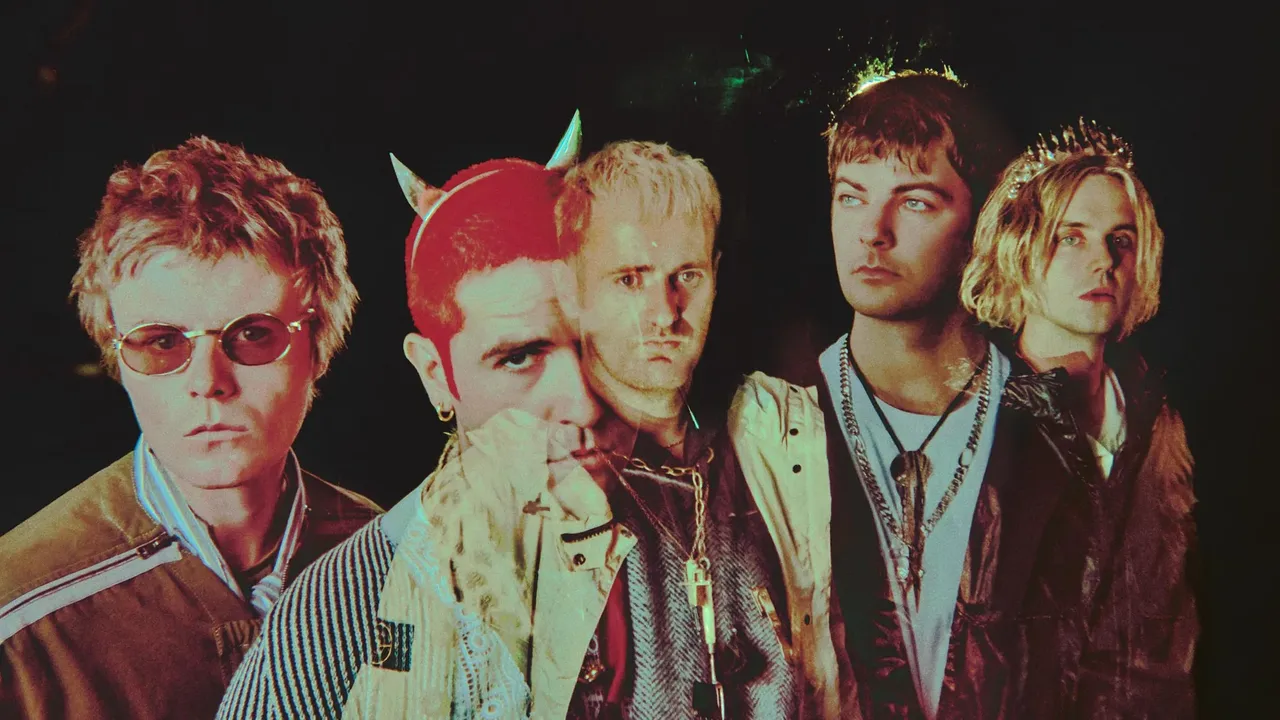
Fontaines D.C. have not made a radical turn. Their evolution has consisted precisely in abandoning, album after album, the obligation to sound like a band belonging to a particular genre. The post-punk of their early days has gradually given way to a more open sensibility, one capable of flirting with grunge, rap-inflected phrasing and the solemnity of certain ballads without losing its identity. What remains in Dopamine Chamber, their new record, is a bleak perspective on the present and a fondness for atmospheres that feel lifted from a film that never ends well.
We seek pleasure to escape discomfort, cling to relationships we know are broken, and keep chasing something — a feeling, a person, a fleeting moment of happiness — that might make everything bearable for a little longer. But the relief never lasts. We never quite seem to find what we’re looking for, or whatever might restore our desire to feel something beautiful. “You can’t escape the feeling once you’re giving it a name”, Grian Chatten concludes, as if recognising the problem were only the beginning of an uphill battle.
On Dopamine Chamber, the Irish band turn this contradiction into a collection of dark, often cinematic songs about emotional dependency, digital overstimulation and the difficulty of letting go and finding ourselves again. “Everybody’s depressed, we’re running on a wheel”, Chatten sings on Mimesis, a line that could serve as the album’s mission statement. We keep moving, consuming, and looking for distractions, but rarely seem to get anywhere. Routine becomes a prison, and even love becomes another means of escape: a fantasy of disappearing with someone else rather than confronting the world or ourselves.
Musically, Fontaines D.C. give this unease a broader, more synthetic dimension. There are keyboards that recall Depeche Mode, guitars that seem to reach for The Cure, and an electronic darkness that occasionally resembles a particularly depressed version of Orchestral Manoeuvres in the Dark. Some might describe the album as a move towards stadium rock, perhaps because the band are increasingly playing larger venues. Yet if this is stadium rock, it’s a peculiar kind: the sound may be expansive, but the emotional landscape remains claustrophobic.
Six Shot Morning sets the tone with its vision of Silicon Valley, where technology, money and the fantasy of reinvention offer little more than another form of confinement. “I woke up in a dream, I was a hurricane”, Chatten sings, evoking a future that seems to have curdled into a nightmare. On Mimesis, meanwhile, the band turn collective exhaustion into something almost anthemic. Its drumming occasionally recalls U2’s Zoo Station, while the keyboards evoke Depeche Mode and New Order. The result is one of the record’s most immediate moments: a song that sounds built for a crowd, even as it insists that everybody is depressed and running in circles.
The title Mimesis adds another layer to this sense of collective entrapment. The term refers to imitation or representation, the impulse to reproduce what we see around us until the distinction between our own desires and those absorbed from the world begins to blur. In a culture shaped by endless scrolling, repetition and the performance of happiness, even our attempts to escape can become imitations of someone else’s life. We copy the gestures, routines and aspirations that promise fulfilment, only to find ourselves reproducing the same dissatisfaction. The song’s relentless momentum mirrors that cycle: we keep moving because everyone else is moving, mistaking repetition for progress. It’s precisely this tension that makes Mimesis so compelling. The music invites collective release, yet its message suggests that we are all trapped inside the same loop, searching for an exit we can barely imagine.
The same tension shapes the album’s portraits of love. On Marianne, one of the record’s singles, a hypnotic chorus accompanies the promise “I can help you disappear”, turning romance into a fantasy of mutual escape. But the relationships elsewhere are less concerned with rescue than with the inability to leave. Happy for You delivers the unconvincing declaration “If you go, I won’t run after you”, exposing the jealousy and resentment lurking beneath an attempt to appear indifferent. Japan takes this emotional dysfunction into more disturbing territory, depicting a sexual encounter in which a woman seems to leave her own body while the man remains preoccupied with money and grievances. It’s one of the album’s starkest depictions of bodily estrangement, intimacy becoming another route towards alienation rather than connection.
By contrast, Demolition offers the intoxicating promise of making everything right and living forever inside a beautiful moment. Its enormous chorus seems to invite thousands of voices to join in, making it one of the album’s most powerful and cathartic moments. You can almost imagine screaming it back at the band from the middle of a crowd. Yet the fantasy it sells is just as fragile as the relationships elsewhere on the record. These characters don’t necessarily want to be happy; sometimes, they simply can’t imagine letting go of what makes them miserable. Familiar unhappiness can feel safer than the uncertainty of change, even when we know exactly what staying will cost us.
That is where the album’s title becomes more than a clever metaphor. The dopamine chamber is the space we retreat into when reality becomes too difficult to bear, whether through digital stimulation, romantic obsession or the repeated fantasy that things might still work out. Fontaines D.C. understand that these escapes are not always pleasurable. Sometimes, we return to the same source of pain precisely because it’s familiar, because even an unhappy attachment can feel preferable to the uncertainty of moving on. You Miss Me, with its sweeping strings and echoes of The Verve, captures the need to remain significant in someone else’s life. Being missed becomes a form of validation, proof that we have not disappeared completely, that we still matter, that we are still worthy of love.
The album briefly finds another emotional register on Where Is Gone?, the duet with Rosalía. Her voice evokes Lana Del Rey at her most languid, while the classical instrumentation recalls the cinematic ballads of the 1960s, somewhere between the duets of Nancy Sinatra and Lee Hazlewood and the scores of Ennio Morricone. Against the record’s otherwise synthetic darkness, the song feels like a faded photograph of something beautiful. Its suggestion that there is no harm in letting things die offers a possible alternative to the album’s cycles of obsession and regret. Yet the song is almost too beautiful for its own good. With two such distinctive voices, one wishes the arrangement would take a few more risks rather than remain within the reassuring elegance of its cinematic influences. It might even have made a more compelling closing track than Intimate, whose repeated images of death and destruction bring the record back to its bleak starting point.
Once again produced by James Ford, Dopamine Chamber doesn’t represent a reinvention on the scale of the transition from Skinty Fia to Romance. Instead, it expands the territory Fontaines D.C. have already been exploring, with a greater emphasis on synthesizers and cinematic arrangements. Not every experiment succeeds: Tongue, with its rap-inflected approach, feels less convincing than the band’s strongest rhythmic explorations, while Japan doesn’t always make its acoustic restraint as compelling as the rawness of its lyrics. Nevertheless, the album contains enough memorable hooks and striking arrangements to compensate for its weaker moments, from the hypnotic chorus of Marianne to the guitars that tear through Happy for You and the sweeping strings of You Miss Me.
Fontaines D.C. have spent their career expanding beyond the confines of post-punk without abandoning the disillusionment that first defined them. On Dopamine Chamber, that disillusionment takes on a more polished, cinematic form, but the underlying vision remains stubbornly bleak. These are songs for people who have mistaken nostalgia for love, intensity for intimacy and the repetition of pain for the possibility of change. The music may be big enough for stadiums, but its characters remain trapped in small rooms of their own making. Fontaines D.C. offer no easy way out. They simply make the walls sound magnificent.