Without features or the pomp and circumstance that seem to plague album releases, Vince Staples’s newest record, Cry Baby, stands out as an homage to the politically conscious origins of early hip hop and funk. Rock-rap in genre, the album is a retrospective on America, aptly timed in an era of growing conservatism. Staples holds a mirror to society, universalising the superfugue one must don to stomach the ugly underbelly of American neoliberalism.
On the cover’s red background, a plump, blond baby – a caricature of Donald Trump – cries in an American flag diaper. The words “cry baby” ring true for many young people, who are framed as overly sensitive for their political consciousness. Staples flips the stereotype on its head, instead framing the figurehead of American power as juvenile and tantrum-prone. While the words seem to caption the political cartoon, Staples’s own name appears too large to be part of the scene. The image frames the album’s politically loaded content in two ways: from the perspective of someone who is both deeply entrenched in Americanness and staunchly outside of its mainstream.
Four clicks on a set of drumsticks and Cry Baby begins on the oxymoron of Blackberry Marmalade. By definition, blackberries cannot make marmalade, a bittersweet citrus peel preserve; a blackberry marmalade is just a jam gone sour. But this is precisely what Staples pushes us to ponder. Amidst a bassy, distorted drum beat, Staples recalls the image of “Empires built on bloodstained ground,” using the first words of the album to dismantle the image of the United States as a mundane, harmless country.
The music video literalises this: viewers take on the perspective of a mass shooter who targets a restaurant full of Black patrons, before turning the gun on himself. Viewers are complicit, not just as witnesses to violence, but as perpetrators of it. Staples continues, “I pray they [empires] all fall down.” However, he remains conscious of the way his radical beliefs shape his public perception. Staples lets listeners know that he is aware of anti-establishmentarianism being marketed as a kind of aesthetic, the nefarious intent to commodify ‘Black sound’ by framing Black Americans as irrationally angry – he voyeurs his listeners right back. The ‘progressive’ acceptance of Black art, Staples exposes, falls flat. He subverts this modern minstrelsy, using an almost juvenile taunt, spelling the n-word over and over, then going off on a tangent, using the slur to label all kinds of people, tempting the audience to “say it.” The tangent’s finale poignantly names Barack Obama and Kamala Harris: figures of ‘accepted’ Blackness, as well as, ultimately, perpetrators of neoliberalism, especially in the context of the song’s critique of American imperialism.
Go! Go! Gorilla is sonically in line with the indie rock of – funnily – Gorillaz or Tame Impala. Though it strays from his signature sound, the choice reads as less West Coast and more universal, fitting given the use of police brutality as a synecdoche for institutional American violence. Though mostly insular, with the song centring the legacy of the American police system’s racist origins in slave patrols (“Why do I live in fear of a gun and a badge? / That’s the strongest enemy that we done ever had”), Staples also makes a universal appeal. Declaring that genocide means nothing “to Uncle Sam, guess it’s dignified,” the song forges a solidarity between the underclass of the United States and the entire world. This trickle-down violence results in the genocide and continued erasure of Native Americans, racialised police brutality, and also serves to perpetuate violence and genocide for the ‘well-being’ of America through the politics of representation (referencing the War on Terror specifically with “Terror rain[ing] on our parade, keep them umbrellas up”).
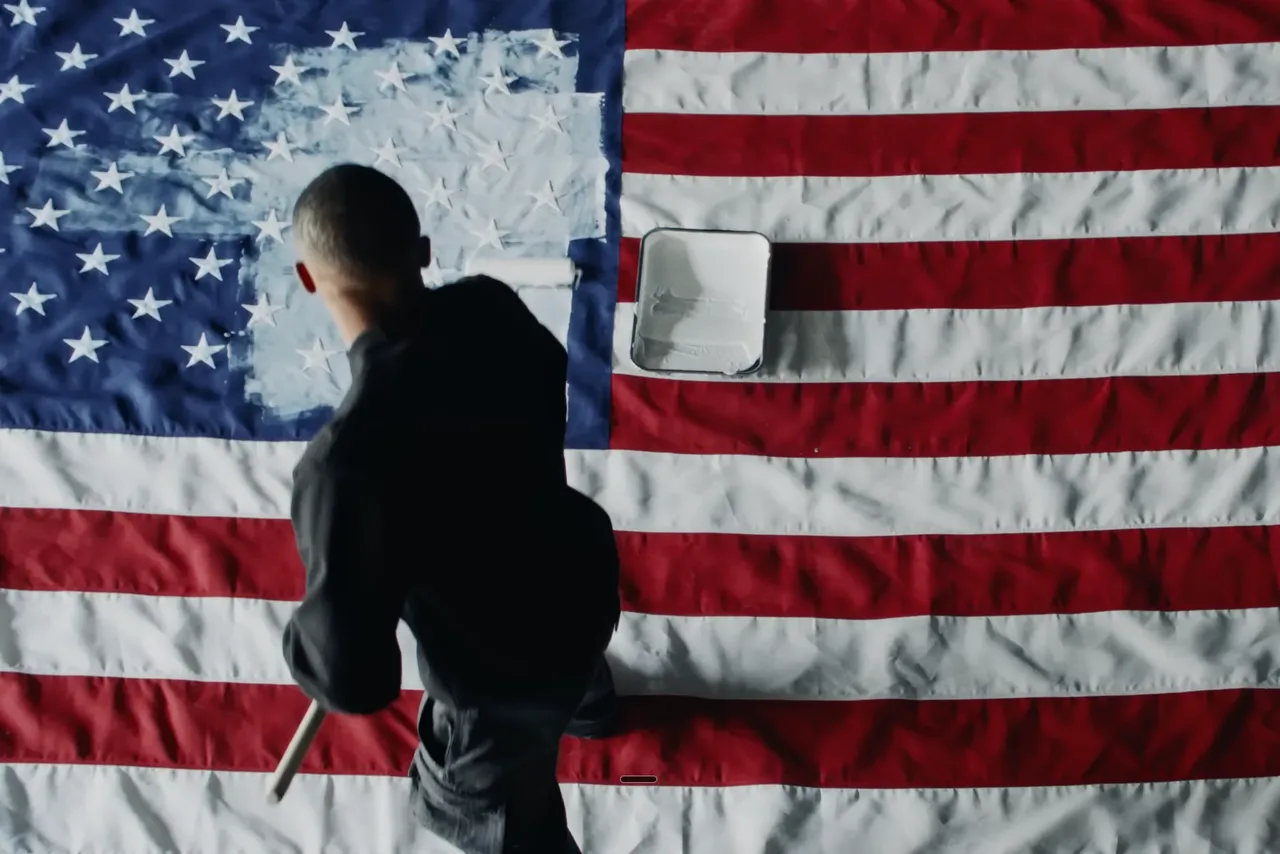
The song ends on a reverberating electric guitar beat that mixes with police sirens before fading into the slower White Flag, which cements this global solidarity. “Sometimes love can turn to war,” Staples sings as eerie backing vocals create the sense of ghosts lingering in the music, behind you as you listen. His voice shines, a sombre meditation on the dissonance between the American mainstream’s reverence of Black sound and culture without a matching reverence for Black people. In the video, which emphasises the Afropessimist framing of the song, a Ku Klux Klan member lingers in the shadows behind the American flag. Staples pulls the flag down and paints it white (a symbol of surrender), so when it is hoisted back up, viewers are left to wonder if the Klan member is still there. Either way, Staples confronts the flag, stares at it, before ultimately using an assault rifle to shoot at it, refusing surrender. Though the flag is left ‘desecrated’, the stars and stripes are visible underneath; America itself still looms as the artist walks off, a visual reminder of the power imbalance between individuals and systems of power.
The Running Man is a rallying cry of rock, with Staples immediately declaring that it’s “time for a revolution.” The quick drumbeat melts into the distortion of the electric guitar, elevating the soft, tinny repetition of the artist’s repeated urging to “Run, run, run, run, run / Let’s go.” He emphasises a “war going on outside that no man is safe from,” his inability to find religion, and comments on his complicated relationship to his audience (“I just punched my ticket at Grand Minstrel Station [...] / Controlled by my worldly desires”). All of this works together to engage with a Marxist commentary on the ambivalence of Americans (who are globally privileged) towards political upheaval so long as they are entertained and pacified. The song eventually slows, literally echoing the exhaustion and hopelessness Staples feels. There is a dissonance between the feeling he musicalises and his visibility as an artist; Staples can neither hide nor run.
This ending ethos fades thoughtfully into TV Guide, a nod to the artist’s own role in television on The Vince Staples Show. The television (a shorthand for all media, especially short-form media like TikTok) enables an aspirational voyeurism as well as a desire for privacy that no longer exists. His eyes are “Glued” to the TV, but he also asks listeners, “What the fuck are you looking at?” Everyone wants to be famous, but no one wants to be seen. Furthermore, the TV also becomes political, with its ability to distract and misinform the masses: “Lights, cameras, action! Bravo, can't you hear the guns clapping? [...] / Who really cares, though? / Who's the Great and Powerful Oz, and who is the Scarecrow?”
The Big Bad Wolf samples Slick Rick’s 1988 Children’s Story, using the socially conscious origins of hip hop to reiterate the irony of (still-rampant) police brutality. The sample details a story that is not appropriate for children given its violent nature, but discusses the violence exerted on Black children, an inherent dichotomy. Staples uses the big bad wolf as a figure in a similarly dichotomous way. The wolf is a corrupt justice system, but also a means of powerful reclamation, a call to arms toward revolution. The wolf says “you should be swinging in the jungle, black man,” but when it asks “What’s your master plan? / What are you gon’ do when the shit crack off / And the big bad wolf come and blow down yours,” the question is as much of a resignation as it is a threat. If the recognition of power exists as a result of violence, then power is necessarily fickle. The song is a lyrically charged warning, a manifesto that though power structures seem fixed, the tides may yet change.
Only in America comes in pounding, with Staples saying he’d like to “take a look” at “America the Beautiful.” The opening line is a double entendre: Staples cannot see America the Beautiful either because he is excluded from the ideal, or because the ideal simply does not exist — it is a negotiation between America as a concept and America in execution. This negotiation exists beyond just ideology, however. Staples reveals a nefarious thread between the literacy crisis and the suppression of free speech (an issue heightened by censorship around Palestine on college campuses). “You can lie, you can steal, house on a hill / Only in America,” Staples continues, “Land of the free, home of the brave, home of the Natives, home of the slaves.” Though it seems like he is commenting on white-collar crime (and certainly is), he stretches it further, tracing its origins to the colonisation of America. The United States is effectively a stolen country built through slave labour; the country is a massive white-collar crime reframed as a land of opportunity. The opportunity is not free, however, because it requires one to be “face down, ass up, hands on your knees.”
Do You Know the Devil is pared-back with a spooky indie influence. “You’re the devil,” a woman tells listeners before a baby begins to cry and the music creeps in. Staples’s voice feels empty, a reflection of his feelings of abandonment by America. “Hell, Hell, Hell / Help me, please,” he sings, but we are unsure who he sings to. We as listeners are told we’re the devil, but is the song a call to action or an appeal to emotion? Is Staples calling the God that ‘blesses’ America so immoral that the only logical response is to turn to the devil? Is America so dystopic as to be Hell? The song is positioned brilliantly in the album, following an emotional trajectory that grows heavier, climaxing at Do You Know the Devil. While most of the album is overt commentary, Do You Know the Devil is reflective, asking listeners about their role – perhaps their complicity – in the ugly America of Staples’s musical soundscape. Are we voyeuristic fans, using the artist’s music carelessly, only for our own entertainment to pacify ourselves? While it may be easy for listeners to eschew their own responsibility up until this point, his fall to the devil is so monotonously comfortable that we wonder if we are destined to do the same, or if, in fact, we already have.
Emerging from the back of the flag from White Flag, beams of light shine from bullet ‘wounds,’ and the Klan member is hung in a reverse-lynching in Cotton’s video. The song is an almost-pop celebration of music, hypnotic and spinning, tonal whiplash right after Do You Know the Devil. Over the white side of the flag, images of Black life are projected — both celebratory and traumatic. America is the blank canvas for Black identity to be projected onto, a commentary on culture-vulturism. On lyrics of intense emotional weight, Staples’s voice dips beautifully before he, once again, centres joy and lightness, music as a salve for pain. Cotton (both song and plant) is a metaphor; though picking cotton was largely slave labour, Staples instead projects idyllic cotton fields as the sun sets. Joy and pain are not separate, but intertwined, subverting narratives of Black pain as monolithic and all-encompassing.
Staples ties this idea together with 7 in the Morning, once again expanding outward to reflect on American imperialism and responsibility in destroying the sanctity of the mundane, the holiness of human life. The false promise of the military-industrial complex lingers: “America will be here soon to make a way out,” despite “Murdering our brothers for the love of Uncle Sam.” Staples questions the point of war, the point of peace “if we can break it,” referencing the protest chant “no justice, no peace.” Whatever the motives, Staples implies, if systems of power don’t change, all war is just reification, a renegotiation of who gets to dominate next.
Despite being only ten songs, Vince Staples’s Cry Baby is a lyrically rich, politically loaded album. Though the sound differs from his other work, leaning more into rock than traditional hip hop, the choice feels appropriate for the artist’s first independent venture. It distinguishes his sound as his own, allowing him a musical malleability that changes with his work’s content. Cry Baby feels like a gritty story unfolding, both for Staples in his career as well as in the world of the album. Though at times references feel underdeveloped – as if Staples has bitten off more than he can chew – that does feel fitting given the polarisation of United States politics. In an era of confusion, uncertainty, and heaviness, Staples’s album is somewhere between a reflection and a rallying cry. Perhaps reflection itself is a call to action, revolutionary by nature.