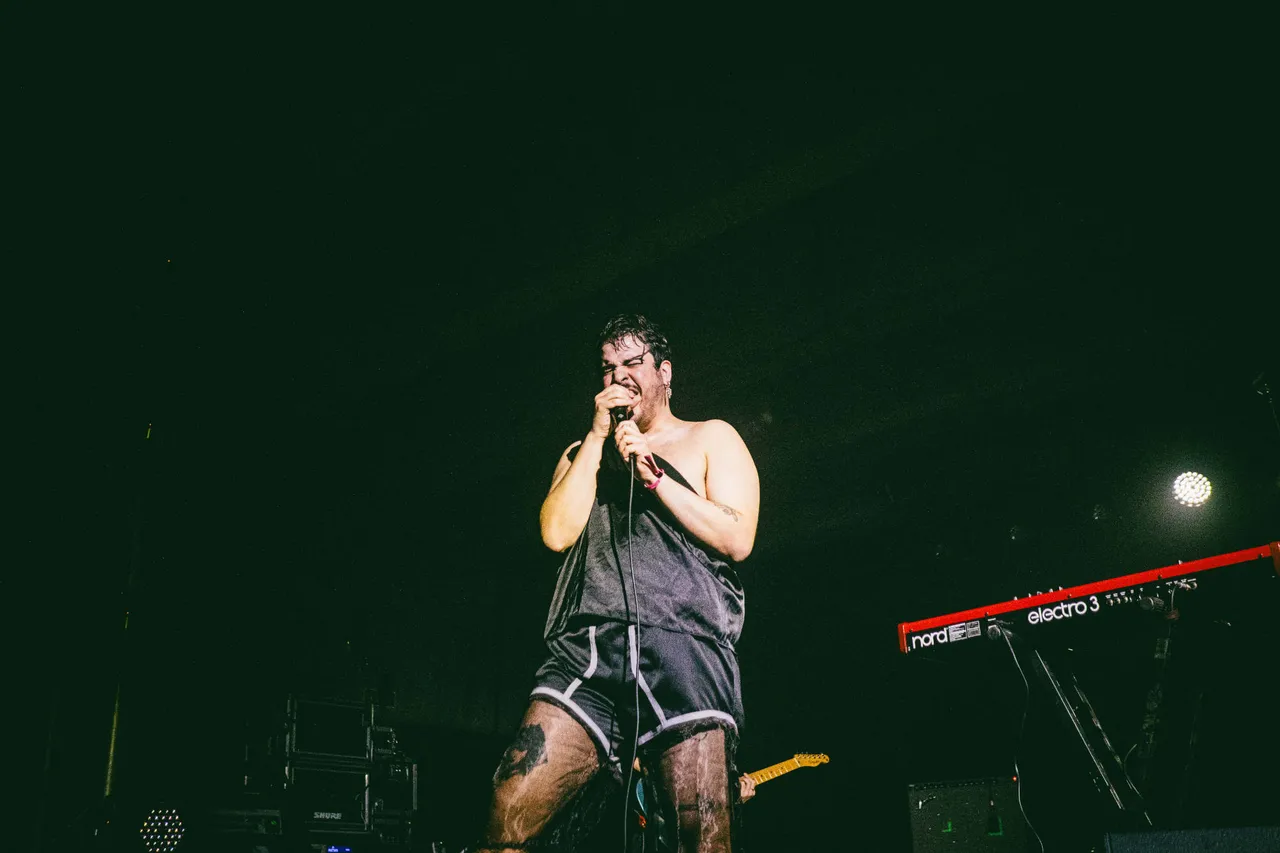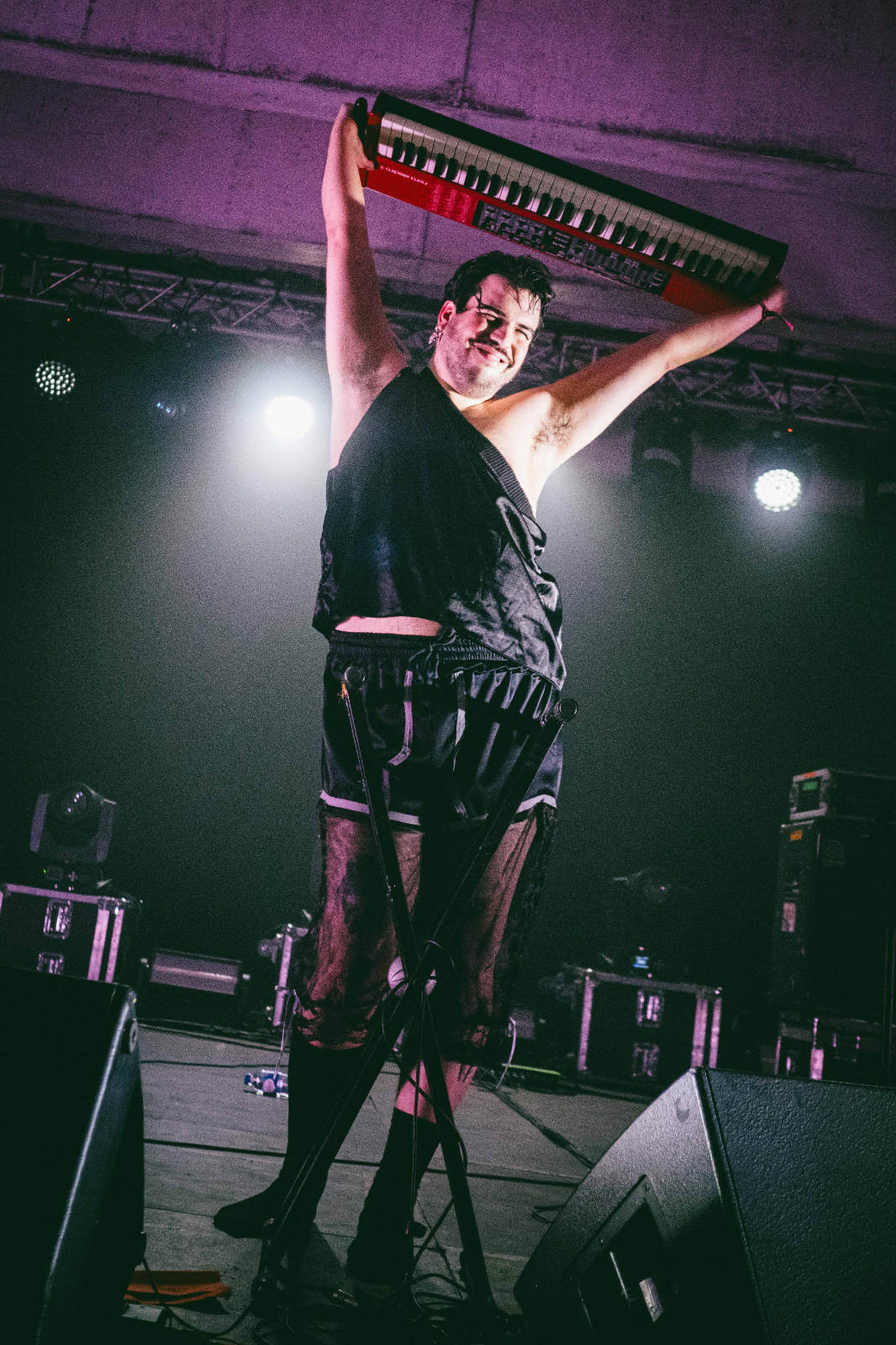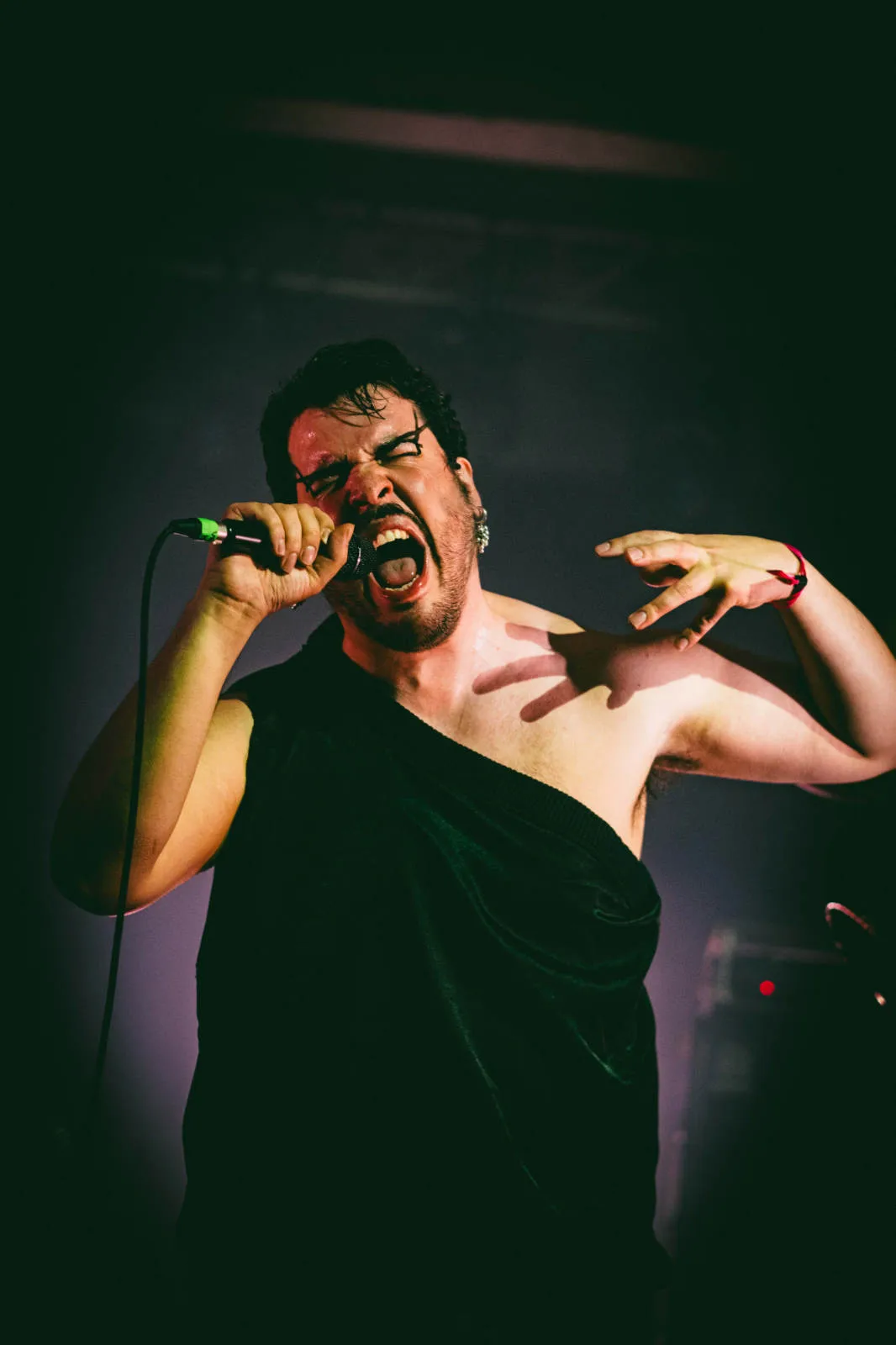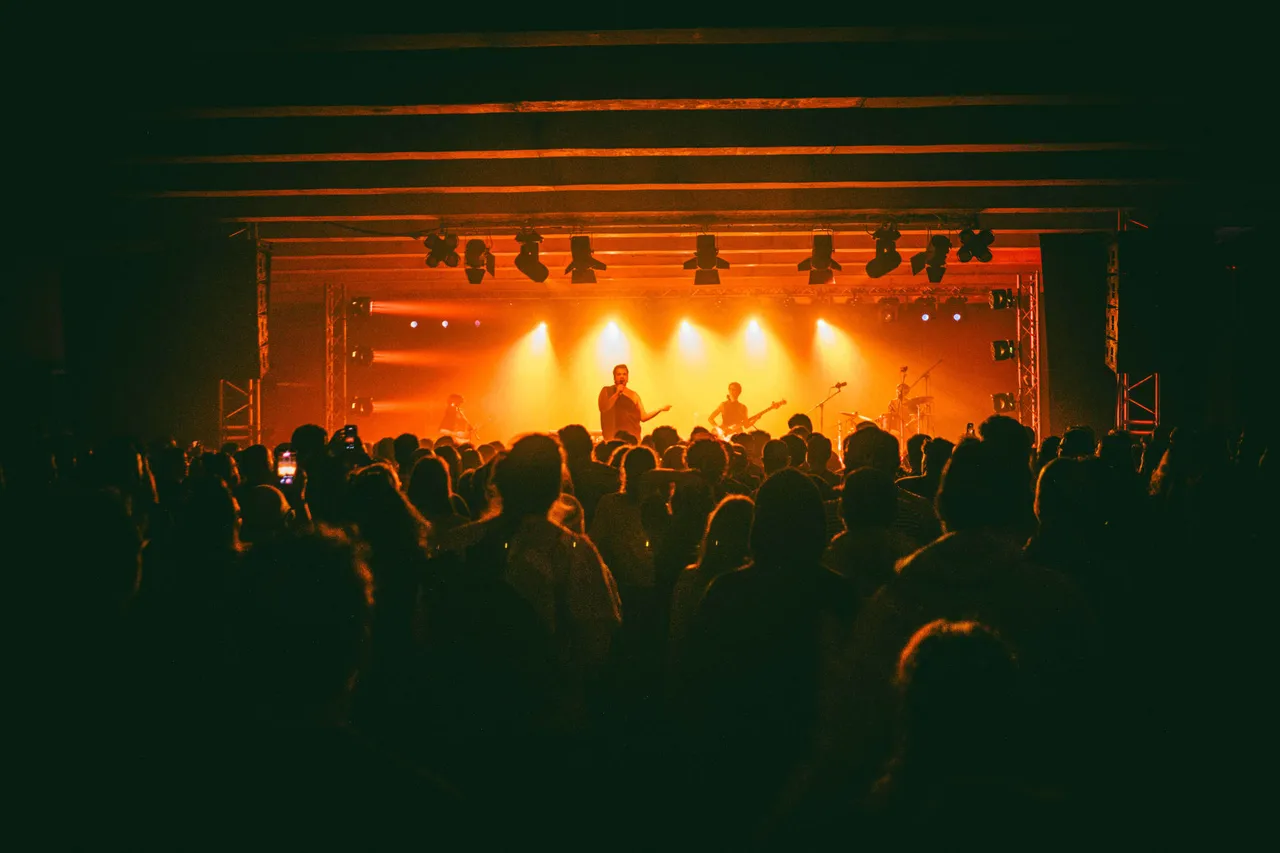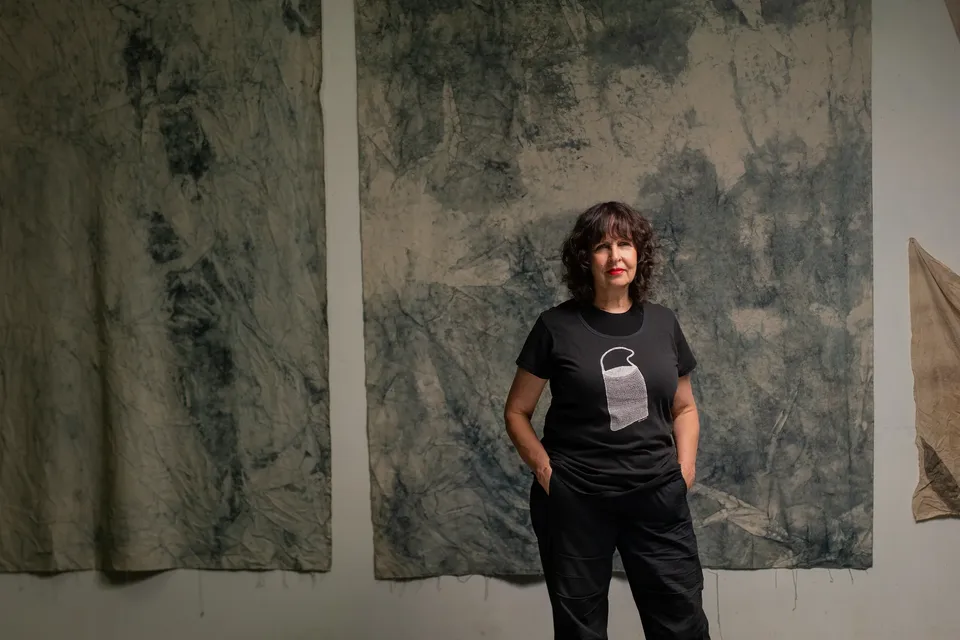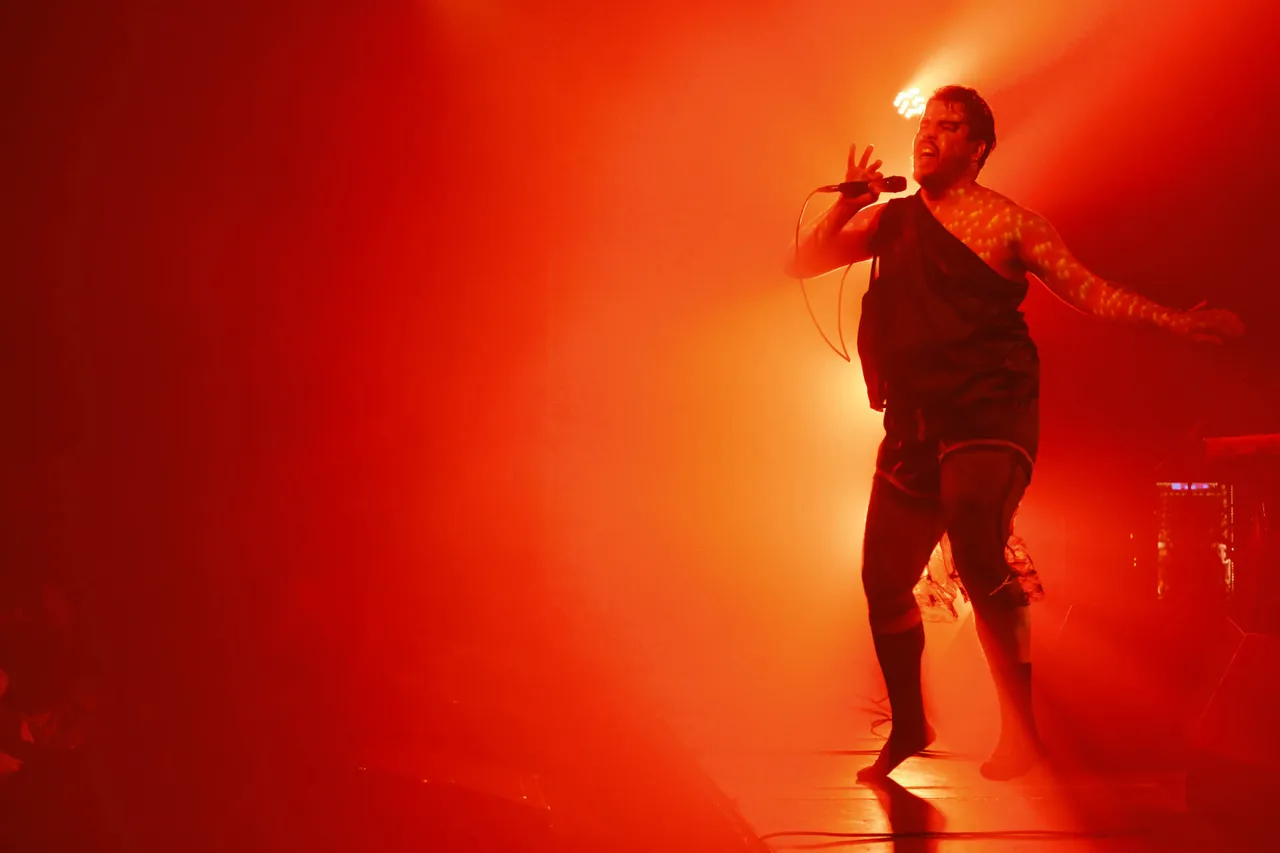
The work of Rodrigo at Vaiapraia can’t be boxed into music only; it also encompasses theatre, community, performance. He’s certainly proven so at Tremor, in São Miguel (Azores), the festival where he’s played for a second time this past week to an audience that was completely devoted to him: screaming, singing along, jumping. Everyone at Portas do Mar was giving it their all — and so was Rodrigo on stage. Moving swiftly from post-punk to garage, with lyrics that are political and personal, Vaiapraia is a project that has a lot of projection to keep growing and improving. In this interview, we sit down with Rodrigo to discuss growing up queer at a time where representation was scarce, the impressive nature of the Azores, the divine, and bitterness in love songs.
Hey Rodrigo, it’s a pleasure to speak with you. You’ve described your project as an “artistic matryoshka” where different layers (theatre, music, and community) are revealed. When you started as a self-taught artist in Setúbal, what was that first, innermost ‘doll’?
Cool question! I feel that the innermost doll was definitely music. Since my early teens, I had been finding community with other music fans I met online on MySpace or Tumblr, and obviously at gigs and festivals. Portugal was culturally so quiet about so many of my frustrations as a young queer, so I had this urgent impulse to write all these quite confessional songs about all that I went through and witnessed.
You moved from the collective energy of Vaiapraia e as Rainhas do Baile to a more singular (though still collaborative) focus. How has that process been like, both artistically and personally?
That name change happened because the lineup of the band changed and that original trio came to an end. I’ve carried on playing live both solo and with a band.
Your latest album, Alegria Terminal, is said to be born from “the dust of the domestic.” How do you find the divine or the extraordinary in mundane things like a Tupperware Furado (leaking Tupperware) or a Corta-Unhas (nail clipper)?
I’ve always had an appreciation for the small things, and as I’ve become older and lived in different places, I value more and more being at home and making a home of where you are. These objects (nail clippers, tupperwares, etc.) are stained with our memories. They’re not just functional items. Paying attention to these details is a way to dodge the daily things that are exhausting, heavy and repetitive. And I feel that the divine has very material manifestations too, not just ethereal.
There’s a sharp sense of humour in tracks like Ar Com Ar. Is irony a tool to make the ‘terminal’ nature of modern life more bearable, or is it a way to prevent the music from becoming too dark?
That irony is somehow sincere and comes off naturally. It’s not cynical, or I hope it is not read as such. Humour is a way to directly engage with that darkness rather than to hide from it.
This album feels like a puzzle of garage, post-punk, and keyboards. How did your collaboration with Francisca Ribeiro and Beatriz Diniz shape the rock heat of this record compared to your earlier lo-fi recordings?
I co-produced this album with my band (Ana Farinha, Beatriz Diniz, Francisca Ribeiro) along with our friend Katie O’Neill. It had a few stages and many steps until completion. We had a vision but we took our time to test the quality of the songs and consider our options. Nonetheless, we wanted to just do a live recording and have as few add-ons and overdubs as possible.
I guess the main difference with my early lo-fi recordings is that I used to go for it and didn’t really stop to polish nor question anything. Back then, the urge to share the music with my friends and whoever was listening would override everything else. When it comes to making a full album, now I am really trying to let the music reach its full potential. I tend to use other formats and creative outputs if I want to capture a raw gesture or idea.
I guess the main difference with my early lo-fi recordings is that I used to go for it and didn’t really stop to polish nor question anything. Back then, the urge to share the music with my friends and whoever was listening would override everything else. When it comes to making a full album, now I am really trying to let the music reach its full potential. I tend to use other formats and creative outputs if I want to capture a raw gesture or idea.
In Alegria Terminal, you often mix languages and characters. Do you want the listener to find their own truth in the lyrics, or are you telling a very specific, private story?
My intention is that the first person can be a revealing and relatable device rather than an indulgent and obscure thing. I feel that any well-told private story will have at its heart a shared truth with anybody’s life.
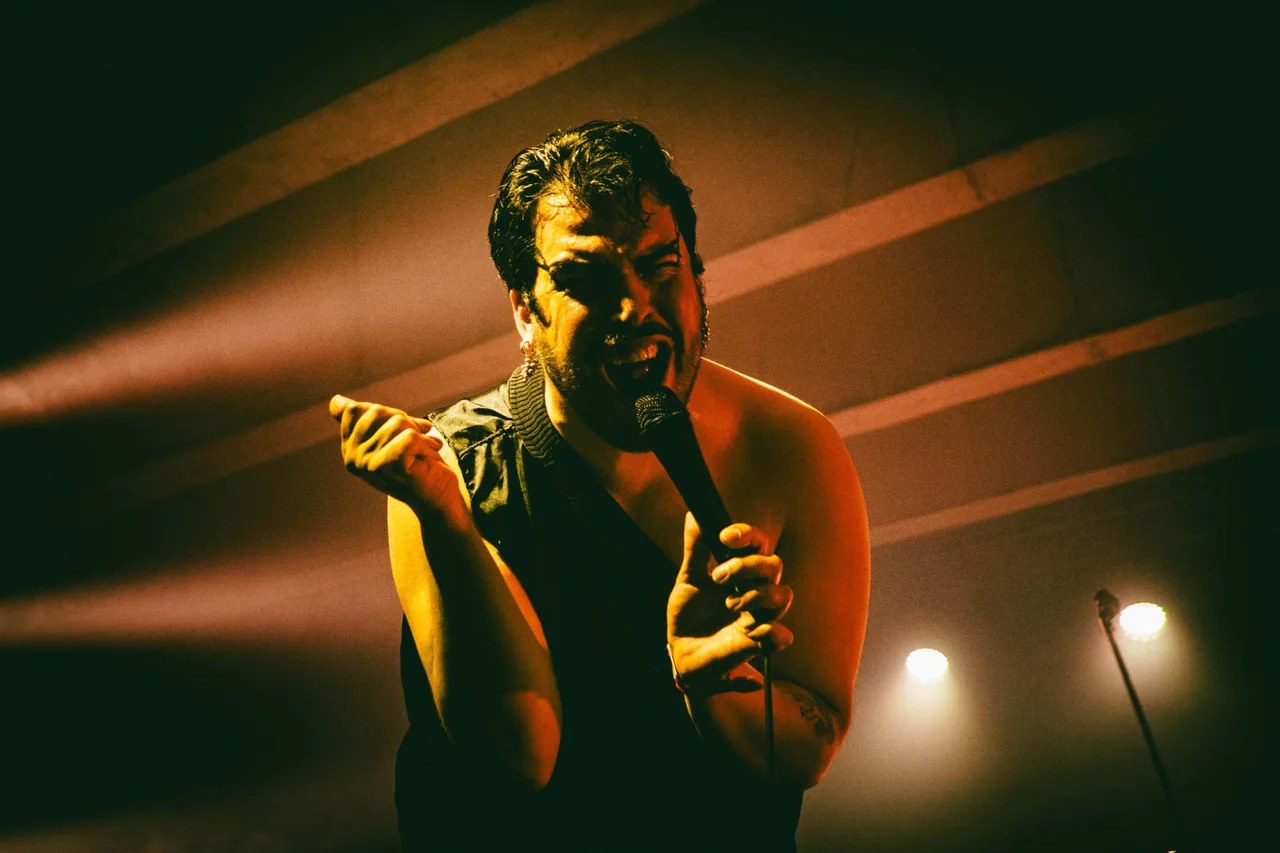
Your live shows are notoriously intense and performative. How much of Vaiapraia is a character, and how much is a raw expulsion of Rodrigo’s current state of mind?
It is an enlarged, exaggerated, louder, unhinged and impatient version of me. It is mysteriously activated in the presence of an audience. That attitudinal shift gives me a blind sense of confidence.
Tremor is a festival that lives in the cracks of the island: volcanoes, greenhouses, and secret spots. Does performing in such a raw, geological landscape change how you approach your set compared to a club in Lisbon?
This is our second time at Tremor. For us, the island and the festival can be a moment to slow down and take in so much natural beauty. Last time, we also ended up hanging out with so many friends from Porto and Lisbon. And I mean, the hot springs! Does it get any better than that? Things feel less rushed. When it comes to the show, we do our thing as always. No massive differences, but I do feel some pressure to give back to the festival and deliver my best performance.
Tremor is big on artistic residencies. If you were ‘locked’ in a volcanic crater for a week with one instrument and one book, what would they be and what kind of music would come out of it?
Omg! That would be so intense, Arnau! I feel like it would be cool to have drums. I am not a drummer but I think it would be so nice to play drums in the arid outdoors and sing into the insular void. I would definitely take some sort of book about survival tactics in the wild to figure out how I would shelter and source my food.
“Portugal was culturally so quiet about so many of my frustrations as a young queer, so I had this urgent impulse to write all these quite confessional songs about all that I went through.”
The festival talks about “unexpected experiences.” What is the most unexpected thing that has happened to you on stage during this current tour?
I can’t remember anything that happened recently on stage that was that unexpected. However, when we played in a rural area near Fátima, we went to the holy site where the miracle of Our Lady of Fátima happened after the show. This was 2 am and there were still believers awake, kneeling down and praying in the glass-paned chapel. That place is really charged with a certain magnetism and it felt special and unexpected to do this as a band. Catholic aesthetics are gorgeous, spooky and problematic, so they have a guaranteed appeal.
You’ve been involved with Rama em Flor and queer activism. How do you see your music contributing to the archive of Portuguese queer history?
I am happy that people listen to what we’re doing. And it means a lot that they relate and want more. Anyway, it isn’t my place to decide if what we’re doing will be written in history or erased out of it.
After a decade of making music, what is the one thing you haven’t shouted yet that you’re still trying to find the right melody for?
A love song without bitterness or any bit of malice is REALLY hard for me. I don’t know if I will ever be able to do it. There is also stuff I’ve written that was more ‘political’ and that I ended up not releasing because it felt forced or fake, even if my concern was real. I do think that THE SONG is the boss and it calls the shots about what works or doesn’t, even if that requires me to discard some well-meaning lyrics. It also puts me in a vulnerable but exciting position in which I have to speak up my truth and oftentimes that truth is something I was not planning to share. In the end, I’d rather write something small but personal and real. And needless to say, that can be political too.