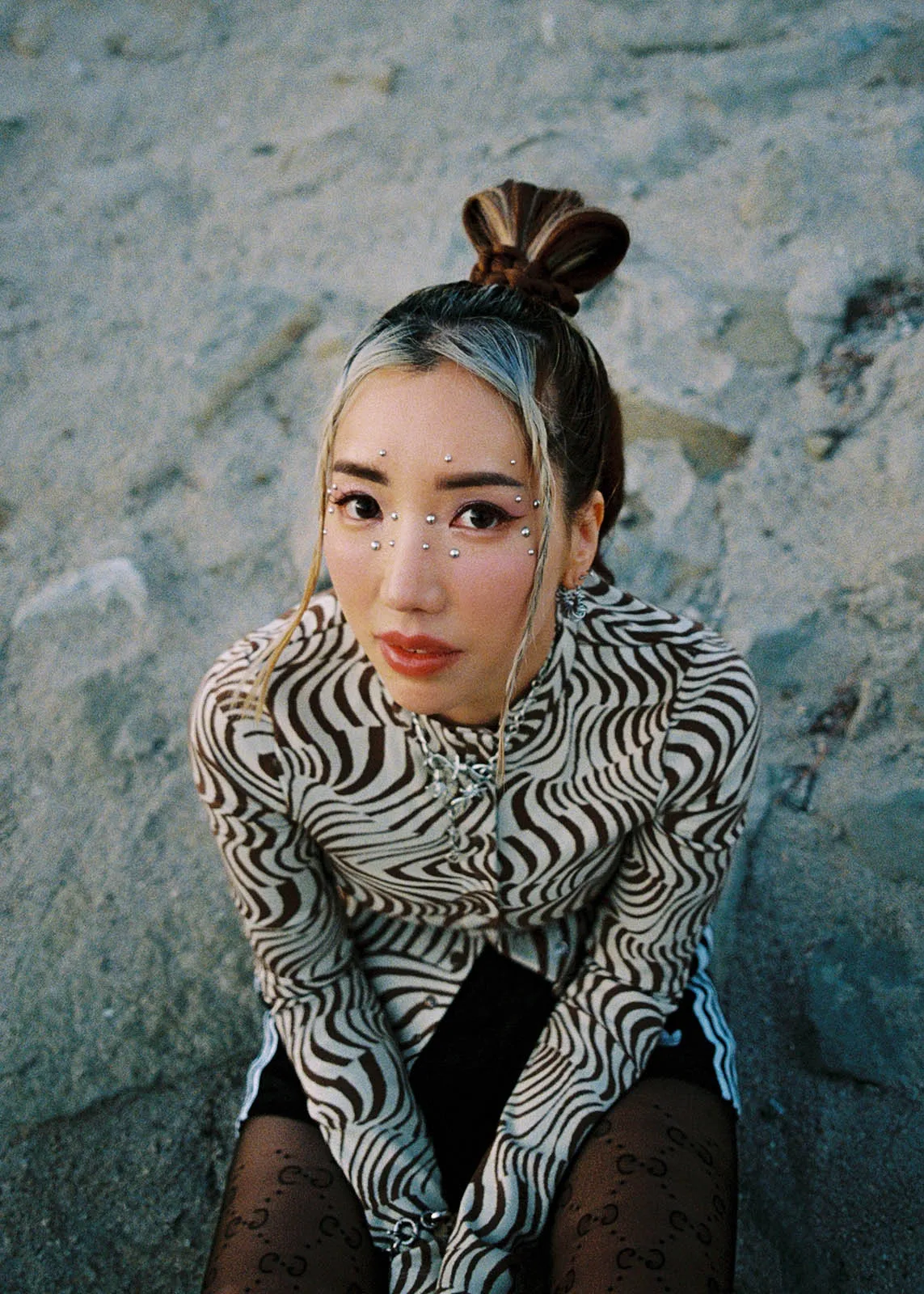
Jennifer Lee has never been one to leave a universe untouched. As TOKiMONSTA, the Grammy-nominated producer, DJ, and Young Art Records founder, she’s spent well over a decade moving between left-field beat alchemy and big, sun-streaked dance moments, turning personal upheaval (surviving Moyamoya and relearning music) into forward motion.
Now she’s handed the keys to that world to others: a new remix companion to Eternal Reverie released on July 11th reframes the album’s grief-to-joy arc for the club, inviting a cast of friends to flip its melodies, Brazilian nods, house and disco pulses into new forms. Ahead of her first UK and EU tour in over seven years this October, she talks about letting go, choosing remixers, and methods of keeping music a gift rather than an obligation.
Hey Jen, thanks for having this chat with us! How’s the Los Angeles summer treating you?
It’s been good. Hot, but mellow. Post-tour, I’ve been mostly home aside from a few random shows and trips, making music, going out here and there. LA feels slower right now, which I’m into.
Whenever I think of LA of late, my mind goes to all the fires at the start of the year. I read things are going quite slowly in terms of rebuilding the city. Fires aren’t a new thing for LA obviously, but these were some of the worst in recent memory – at least for me as a Brit, looking over from the other side of the pond. How were you caught up in all that? Have you noticed how it has affected you, your friends and family since?
I wasn’t directly impacted, but it shook people around me. Friends and peers lost their homes, others are still dealing with cleanup months later. Once the news cycle moves on, I see people kind of left on their own. So even if life feels quote unquote normal again, you know people are still in it. I’ve just been trying to stay connected, check in, help where I can. You don’t need to be in the fire to feel the heaviness of what it takes from people.
Mental health is a commonplace idea today, probably much more so than when you started out your career. You’ve said before how you can feel the warning light when music stops feeling like a gift and starts feeling more like a chore. Do you have any specific rituals that help yank you back into the right headspace, for creating music or just when general life gets overwhelming?
I have one tried and true tactic: when it feels off, step away. Pressure to create just adds to the fuel and frustration of creative disappointment. Nothing I make at that point will be worthwhile, so it’s better to remove myself, palette cleanse, and return fresh. The spark comes back when I leave space for it.
On this topic, I must ask about your experience of Moyamoya, both then and now, if that’s ok. It’s a unique position to have had it – something that can be fatal – and also, the experience of post-surgery where you couldn’t understand speech, nor speak yourself, as well as finding all music to sound like noise.
This lack of comprehension is fascinating to me. In a sense, we all experience this. We are all learning new things constantly, including literal language or the sonic language of a musical genre that we hadn’t encountered yet, and then often forgetting things over time, too. The difference is the speed at which you lost and regained that, from what I understand.
Did you, and do you today, notice your brain arranging sounds differently from how you did pre-2016? What are the differences and how do they make you feel?
This lack of comprehension is fascinating to me. In a sense, we all experience this. We are all learning new things constantly, including literal language or the sonic language of a musical genre that we hadn’t encountered yet, and then often forgetting things over time, too. The difference is the speed at which you lost and regained that, from what I understand.
Did you, and do you today, notice your brain arranging sounds differently from how you did pre-2016? What are the differences and how do they make you feel?
I don’t think my brain changed in how it processes sound. Once my brain recovered, I was equipped with the same abilities and knowledge as before. Really, what changed was me. The experience of almost dying, of losing music, shifted my priorities. Before surgery, music was constant. Afterward, I realised how fragile and ephemeral all aspects of living are. So I always keep the ethos that I make music because it means something, it’s a real gift.
On a similar thread of wellness, you’ve mentioned troubles with falling asleep in the past, inspiring songs like Waiting for the Break of Dawn on Half Shadows, for instance. Nightlife culture, particularly in the electronic scene, encourages these late nights, as well as alcohol consumption and other behaviours that can put strains on our bodily health. Of course, it can have health benefits too, to socialise and enjoy your time with others in shared communion (especially at a time when social isolation is on the rise for many globally).
How has your relationship with sleep and wellness more generally changed over the years, given your decade -plus industry experience, including creating and running your own label, as well as those health scares we mentioned previously?
How has your relationship with sleep and wellness more generally changed over the years, given your decade -plus industry experience, including creating and running your own label, as well as those health scares we mentioned previously?
I used to run on no sleep and didn’t think twice about it. Late gigs, producing until the sun rose, emails at 4am. All of that was completely normal. After several major episodes of emotional and physical burnout, I had to slow down and prioritise taking care of my mental health and body. I still stay up late and deal with insomnia, but I protect and recharge myself.
Is there any advice you’d give to young producers that you’ve learnt to serve you well, in terms of balancing intense studio time and work ethic with health?
For younger producers, I’d say don’t fall for the hustle mentality myth. You don’t have to tap yourself out dry to signal if you’re working hard enough. You can be creative without destroying yourself. Rest doesn’t make you lazy. You need a full tank to seize the day. I can accomplish more in fewer hours on eight hours of sleep than I can in more hours on less sleep.
I heard Clairo talking about the moment of their releasing Charm last year, discussing that moment of releasing as a particular type of womanhood. How the pop records of that year – Brat, Short n’ Sweet, and so on – reflect a broad, overall female experience as a collective, but also those individual strands. It seemed like a nice aspect of the album roll-out to reflect on. Albums all give us different things, but they can all be part of the same universe.
When we put Eternal Reverie into that timeline, what sorts of themes were you looking to focus on with this record? Was womanhood a factor for you when creating, or do other areas of life find their way into impacting your work more intensively than that?
When we put Eternal Reverie into that timeline, what sorts of themes were you looking to focus on with this record? Was womanhood a factor for you when creating, or do other areas of life find their way into impacting your work more intensively than that?
Womanhood is always there because, well, I am a woman and it’s part of how I move through the world. But it wasn’t something I was consciously building the album around. Eternal Reverie came out of a more internal space. It was about reflection, emotion, things that live beneath the surface that bury us and the light at the end of the tunnel that reminds us that life is worth living. It wasn’t about making a statement, but more of a philosophy of joy.
If you had to situate your work, let’s say Eternal Reverie in isolation, in a cosmic universe with three other albums, what would they be and why?
Definitely Discovery by Daft Punk. That record has joy built into every detail.Then Bizarre Ride II the Pharcyde because it’s funny, loose, emotional when it wants to be. That album doesn’t try to be perfect, it just feels good. And Post by Björk. That album is fearless, playful, and genreless in the best way.
Are there any decisions you made on this album that you think younger-you wouldn’t have felt bold enough to make?
It kind of depends on which era of younger me. I actually very intentionally tried to tap into the early version of me that was producing in the late 2000s early 2010 era, when I had my first album out. I very much wanted to tap into the freedom and lack of pressure I felt at that time. Back then, I didn’t feel as though my music had to prove something. I was just happy that anyone was down to listen to what I made. However, in the mid 2010s to the early 2020s, I was more caught up in maintaining a career, felt more pressure, and touring heavily with no days off. That version of me would probably have approached this album with more of a scarcity mindset, which would have influenced creative choices.
And how did you pick the artists for the Eternal Reverie Remixes release? What’s the process been like with each artist? Given the sheer number, it must have been quite the collaborative project. Oftentimes a remix album is more limited in scale.
I included artists I respect, whether up and coming or established. I wasn’t looking for one sound or one genre because I’m not that musician myself. I wanted contrast. Each person brought something unexpected. I didn’t give a heavy direction. I just said, here’s the track, make it yours. That freedom really shows because these tracks don’t feel like versions. Each one feels like full reimaginings.
When you have ideas for a track, how do you record them? As in, I frequently dip into my phone notes app for ideas. Some I come back to, others I don’t. I think I might need a new method to be frank, it doesn't feel too organised. But what’s your approach? Has that changed over time?
Voice memos and scattered Ableton files mostly. Some of them are just ten second loops I forget about until a year later. I don’t organise ideas that well either, but I trust the ones that matter will come back. Most of the time when I encounter an amazing idea, I need to start making the song. A lot of creative sparks make me feel a way where I can’t wait to build upon an idea. The risk is that I might not feel that same spark the next day when I approach the same little song loop I was saving for later.
Similarly, how do you typically begin to materialise those ideas? Do you open the DAW? Are there certain instruments or plug-ins you drop into straight away, or do you find yourself more hardware oriented, reaching for a keyboard to noodle away a melody idea.
Honestly, I don’t really have a set method and I like it that way, it avoids me creating formulaic music. Sometimes it starts with a feeling or a chord, sometimes it starts because I’m just bored and wanna throw spaghetti at the wall.
Lastly, who are a few artists you’d like to put us on to in 2025? It’s always interesting to hear the artists that musicians themselves are listening to, in my view. Or are you more in a moment where you are more focusing on long-time musical loves, like Wu-Tang Clan.
The up-and-coming artists I love the most are usually the ones that I am uplifting on my label Young Art. Releasing someone’s music definitely shows the depth and level of dedication I have to their creative journey. That being said, Rozet, Cakes da Killa, and Shima are my label up and comers. Lately I’ve been tapping into brazen club music hitting the landscape. Weird music with weird sounds that still rips on the dance floor, Brux lands here.