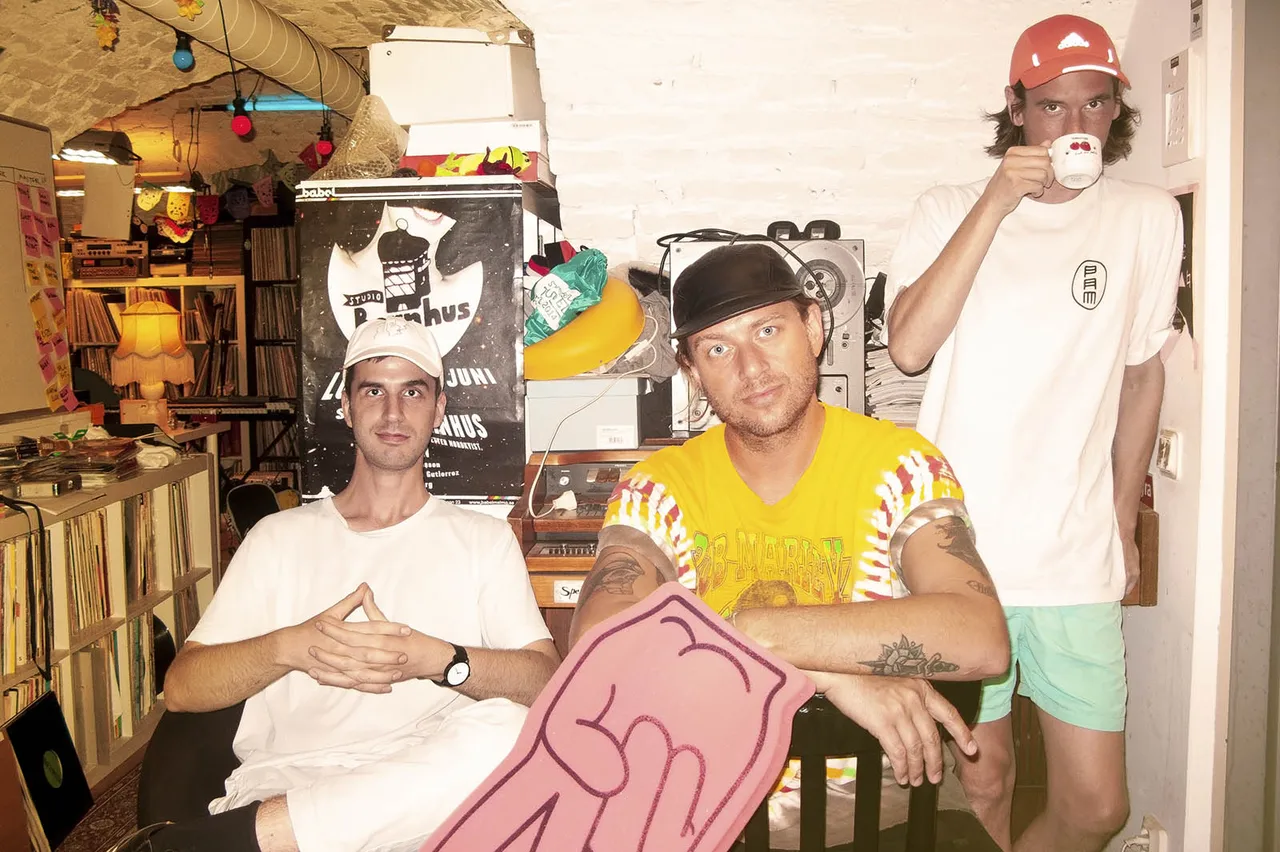
Despite being one of the coldest countries in Europe, Sweden has experienced the highest temperatures ever registered in its history – and has even beaten, at some point, countries like Spain. Just like the weather, Studio Barnhus has set a milestone after organizing the first edition of Parkfesten, a new summer festival in Stockholm trying to bring the 1970s good vibes back. And there’s another milestone yet to come: the release of Studio Barnhus Volym 1 on August 31, a compilation of the most interesting voices of contemporary pop music. Today, we talk with Axel Boman, Kornél Kovács and Petter Nordkvist, the cofounders of the label as well as a trio of DJs and producers, about the heat wave, their ten years working together, and why they should be the ones remixing the new songs of Abba.
Please tell me about your connection with Parkfesten, a new festival in Stockholm.
Axel: We are the record label that makes creative decisions and books the talent in collaboration with the beer sponsor, TT. We wanted an eclectic line-up with several styles of music. A festival for all ages, not only for the ravers. It started at midday. This was our first year and it was kind of an experiment.
How did it go?
Axel: Super. We are more used to club-dance-oriented events but there were lots of kids there. We wanted it to be like a hippie festival from the ‘70s where everybody is welcomed. It should be equally fun for people that have children or dogs, for hippies and hipsters, nerds and ravers. It was an experiment, the line-up and the venue too. We will do it next year for sure, but maybe we change the location.
Petter: It was really hot, scorching.
Kornél: We did a reggae thing. We love reggae. We played for five hours.
Petter: The concept of ‘reggae rave’ started by chance together with Superpitcher when making a reggae version of The Beach Boys. We normally play dance music but that night we did a reggae set. We played the original songs, we didn’t remix them.
Kornél: Stockholm is missing a good summer festival. We would like Parkfest to happen every summer.
Petter: It was really hot, scorching.
Kornél: We did a reggae thing. We love reggae. We played for five hours.
Petter: The concept of ‘reggae rave’ started by chance together with Superpitcher when making a reggae version of The Beach Boys. We normally play dance music but that night we did a reggae set. We played the original songs, we didn’t remix them.
Kornél: Stockholm is missing a good summer festival. We would like Parkfest to happen every summer.
You have been working together for over a decade. What has changed over the years?
Axel: We started out very loose and very incompetent record label with lots of passion for the music. We still have the same passion but now we know a little bit more about how the business works, how we can get our music out, and how to get a good working team with people we trust.
What kind of assistance do you have?
Kornél: They help us with our economy, planning, strategy, PR, merchandise, etc. It’s still the three of us making the creative decisions though.
Axel: At least, we now have the satisfaction to be paying our artists.
Kornél: We got bigger sooner than we expected. There were a few critical years but we slowly became a real company. Artistically, we got a lot of attention, way before we were an actual company.
Axel: Actually, in the beginning, I was broke and Petter didn’t have much money either – we had some cash from touring. But Kornél was rich! He paid during the first years of the label from his own pocket without questioning anything about it. We were amazed. Who would trust that? Without his help during those years, we wouldn’t have produced any record. But now we don’t depend on Kornél’s money anymore (laughs).
Kornél: Let’s keep this clear: I got the money back!
Axel: You don't have an idea about your own economy (laughs).
Axel: At least, we now have the satisfaction to be paying our artists.
Kornél: We got bigger sooner than we expected. There were a few critical years but we slowly became a real company. Artistically, we got a lot of attention, way before we were an actual company.
Axel: Actually, in the beginning, I was broke and Petter didn’t have much money either – we had some cash from touring. But Kornél was rich! He paid during the first years of the label from his own pocket without questioning anything about it. We were amazed. Who would trust that? Without his help during those years, we wouldn’t have produced any record. But now we don’t depend on Kornél’s money anymore (laughs).
Kornél: Let’s keep this clear: I got the money back!
Axel: You don't have an idea about your own economy (laughs).
What came before: the label or the artistic trio of DJs?
Petter: It all started with the actual studio we have in Barnhusgatan (Orphan Street). It was the office and the warehouse of a t-shirt company run by some friends of ours.
Kornél: I was DJing at the time and started to produce, so I looked for a studio. Axel was still in art school. These guys told us they had the space, so we rented it together. DJing together came naturally because we hanged out in the same places. Out of that, the record label came. The idea was to release our own music: the output that came from the studio ended up in the label Studio Barnhus.
Axel: It was very organic, we didn’t even coin the name. It was our friend Hjalmar Rechlin, who used to hang around and call saying, “Hey, I’m in Studio Barnhus”. So it became a thing.
Kornél: I was DJing at the time and started to produce, so I looked for a studio. Axel was still in art school. These guys told us they had the space, so we rented it together. DJing together came naturally because we hanged out in the same places. Out of that, the record label came. The idea was to release our own music: the output that came from the studio ended up in the label Studio Barnhus.
Axel: It was very organic, we didn’t even coin the name. It was our friend Hjalmar Rechlin, who used to hang around and call saying, “Hey, I’m in Studio Barnhus”. So it became a thing.
Does technological progress affect your music? In other words, has your music changed – in a fundamental way – due to new tech wear?
Axel: Not really. I think we are all more interested in the artistic side than in the tech stuff. Maybe we have more synthesizers now than we had before.
Kornél: DJing technology has changed so much in the last ten years, to the point it is kind of a new mindset. But not the production aspect of it.
Axel: We work exactly the same way, maybe just updating studio sound cards. And we got a new mixer.
Kornél: A laptop-based thing is where I come from. Axel is the one who uses more drum machines, synths and so on.
Axel: I still have a floppy disk in the studio. When we started, it was this thing of analogue versus digital.
Petter: In the early days, for us, it was a bit more about how to treat sounds with samplers.
Kornél: DJing technology has changed so much in the last ten years, to the point it is kind of a new mindset. But not the production aspect of it.
Axel: We work exactly the same way, maybe just updating studio sound cards. And we got a new mixer.
Kornél: A laptop-based thing is where I come from. Axel is the one who uses more drum machines, synths and so on.
Axel: I still have a floppy disk in the studio. When we started, it was this thing of analogue versus digital.
Petter: In the early days, for us, it was a bit more about how to treat sounds with samplers.
Over the years, you’ve gained a loyal audience. Do you believe your musical approach or the way you do the arrangements is affected by what you think people expect from you?
Axel: I’m totally sure I compose in a totally different way. I’m almost certain I squeeze into something that people expect, something that will get a good reaction from the audience when I play it live – instead of letting the creative process go wild. I think it is good to be drunk when composing in order to break down that wall of expectations; it’s a very distractive process and you don’t need alcohol to do it, but breaking down barriers is a good thing. Then, I end up doing the same track over and over (laughs).
Kornél: As a trio, we have a friendly competition between us. We can try things when playing live and see the reactions, see how it works.
Kornél: As a trio, we have a friendly competition between us. We can try things when playing live and see the reactions, see how it works.
What would you consider some of your most important milestones after all these years?
Kornél: A significant step was Axel’s first album, which was the first full length we did. That was in 2012. Then, we did Baba Stiltz’s new album in 2014. Another highlight was definitely the release of Lucas Nillström’s album.
Petter: We played at Sónar Barcelona this past June.
Kornél: It was an audio-visual show where we employed five dancers who were with us onstage all the time. We also projected visuals by Leo Lyxxx – he did our logo as well. It was our first time as a trio at Sónar.
Petter: We played at Sónar Barcelona this past June.
Kornél: It was an audio-visual show where we employed five dancers who were with us onstage all the time. We also projected visuals by Leo Lyxxx – he did our logo as well. It was our first time as a trio at Sónar.
On August 31, you’ll be releasing Studio Barnhus Volym 1 as a collective.
Kornél: It is a snapshot of where we are in the music universe right now.
Axel: It is not an anthology; it is not ‘the best of’.
Kornél: It consists of only new and unreleased tracks – there are nineteen. Some of them are by new artists, some others, by bigger names and friends of ours. We are fascinated by the music industry, you know. It is fun to release something ‘number one’ after ten years.
Axel: Every release is like an exhibition; it’s a very unique curated selection. It covers different genres and we are super proud of it. This compilation is not for DJs, it’s not meant for clubs but for a wider audience that can also listen to it at home. We’ve managed to do the most important compilation of contemporary pop music of 2018. I never felt so relevant. It feels like such a fresh move. We are feeling a void in contemporary dance music, at least in Scandinavia.
Kornél: Who knows, there might be a Volym 2 and so forth. That will be our next exhibition. This is really the first time we do something like this. It came naturally, from a place of love.
Petter: So far, we have never compromised in anything as a label but this is what we wanted to do.
Axel: It is not an anthology; it is not ‘the best of’.
Kornél: It consists of only new and unreleased tracks – there are nineteen. Some of them are by new artists, some others, by bigger names and friends of ours. We are fascinated by the music industry, you know. It is fun to release something ‘number one’ after ten years.
Axel: Every release is like an exhibition; it’s a very unique curated selection. It covers different genres and we are super proud of it. This compilation is not for DJs, it’s not meant for clubs but for a wider audience that can also listen to it at home. We’ve managed to do the most important compilation of contemporary pop music of 2018. I never felt so relevant. It feels like such a fresh move. We are feeling a void in contemporary dance music, at least in Scandinavia.
Kornél: Who knows, there might be a Volym 2 and so forth. That will be our next exhibition. This is really the first time we do something like this. It came naturally, from a place of love.
Petter: So far, we have never compromised in anything as a label but this is what we wanted to do.
Do you like to do remixes for other people regardless of the genre?
Kornél: Sure. For instance, I did a remix for Dita von Teese, like a burlesque game. Nevertheless, I’m going to quit. Even though I have enjoyed doing remixes – like this one for Dita with Sebastien Tellier, for example –, I don’t want to keep doing so because it takes as much time as doing an original track. And in the end, you don’t get as much. You don’t get to choose how it is presented or released – the artist does, obviously.
Axel: I can be quick doing a remix but it can be a disappointing experience. I did one for Fives o Fives, a Swedish pop band from the 2000s, which was better than the original, in fact – sorry guys. They never released it on vinyl, it just popped up in some Spotify playlist. I hate bragging about my music but I nailed that one. Another time, Moderat asked me to do a remix. I did it and when I sent it, I got rejected.
Petter: I used to work with James Holden. Domino asked to do a remix for Junior Boys. I was really happy. A few days later, they emailed me saying, “Sorry, we misled the artist and it isn't you who we want for this remix”.
Kornél: Major labels are bandits (laughs). Universal didn’t pay me twice. We actually pay more than them! People still think that major record labels are relevant but they do questionable operations, they’re like cartels. I’m happy not doing any more remixes unless Abba call.
Axel: I can be quick doing a remix but it can be a disappointing experience. I did one for Fives o Fives, a Swedish pop band from the 2000s, which was better than the original, in fact – sorry guys. They never released it on vinyl, it just popped up in some Spotify playlist. I hate bragging about my music but I nailed that one. Another time, Moderat asked me to do a remix. I did it and when I sent it, I got rejected.
Petter: I used to work with James Holden. Domino asked to do a remix for Junior Boys. I was really happy. A few days later, they emailed me saying, “Sorry, we misled the artist and it isn't you who we want for this remix”.
Kornél: Major labels are bandits (laughs). Universal didn’t pay me twice. We actually pay more than them! People still think that major record labels are relevant but they do questionable operations, they’re like cartels. I’m happy not doing any more remixes unless Abba call.
Actually, Abba announced they’d be releasing new songs for Christmas.
Axel: It really is the end of the world (laughs)! If anyone on this planet should do a new remix for Abba, it should be us.