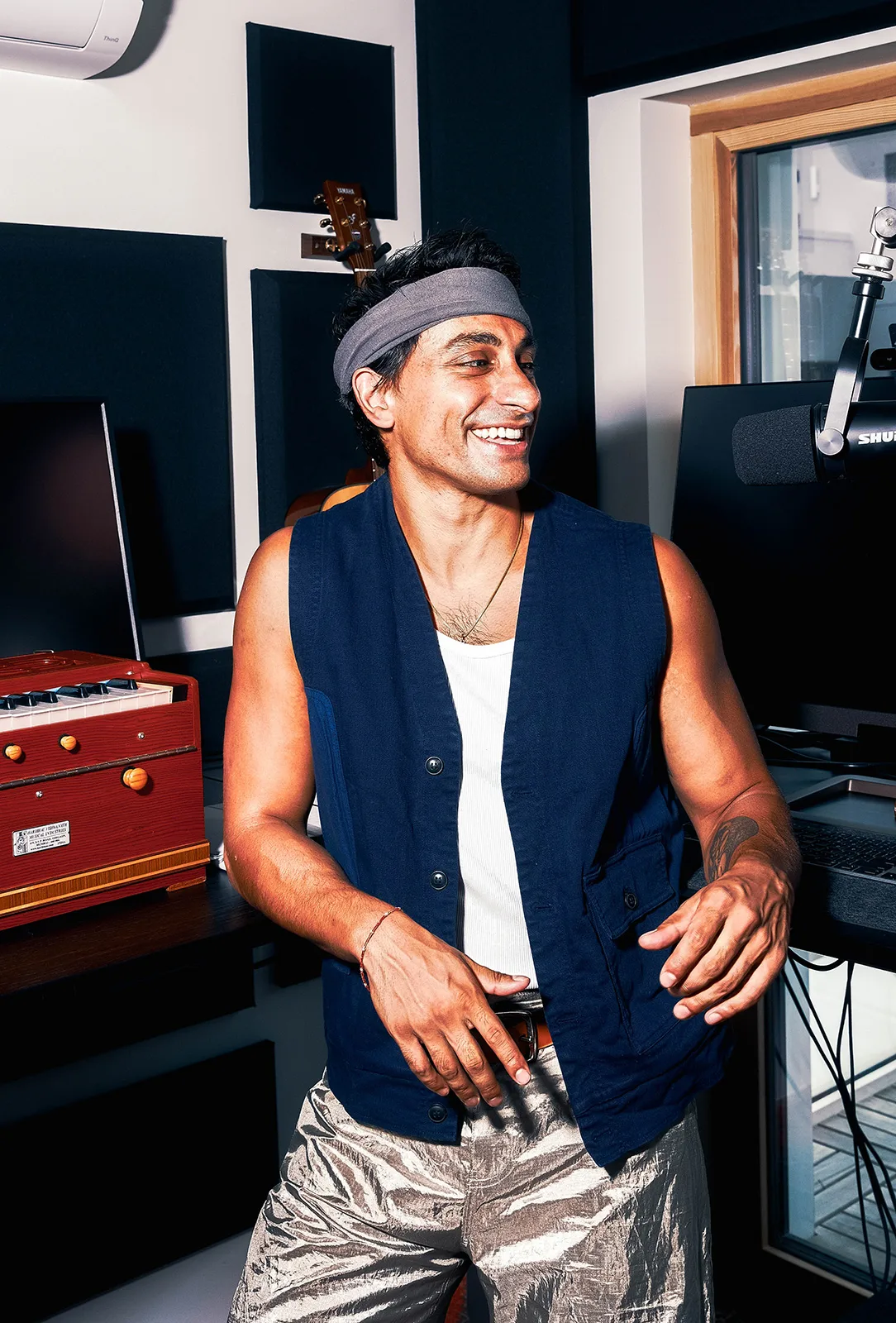
New York–based artist and meditation practitioner ShiShi returns with Indigo, a nine-track album where rock’s raw power meets the stillness of spiritual practice. Blending Indian classical influences, punk urgency, and meditative sound design, the record feels like both a personal reckoning and a collective awakening. Tuned entirely to 432 Hz, it channels two decades of evolution into a sound that’s as visceral as it is transcendent.
“There’s a moment in Indigo when chaos meets clarity,” he says, and that duality defines his world. Raised across China, Switzerland, and the U.S., ShiShi has never fit neatly into one box, turning cultural displacement into creative fuel. From the sunrise serenity of Aham Brahmasmi to the defiant roar of Loser, Indigo invites listeners to experience rock not as rebellion, but as ritual.
How are you, and where are you speaking to us from today?
I’m doing great, happy to be here. I’m speaking to you from Brooklyn, New York.
It has just been a month since the release of Indigo. How are you feeling now that the first wave of reactions has come in, both on a personal and artistic level?
I feel great. I feel really seen and understood, and I feel like people are really getting it. It’s very fulfilling and gratifying.
You’ve described Indigo as the meeting point between rock’s raw energy and the stillness of meditation. When creating the album, how did you ensure those two forces remained in balance?
It isn’t something I consciously thought about. I’m always navigating that dichotomy of energy and stillness, much like in life. You can’t have raw energy without a stillness underlying it, and you can’t appreciate stillness without the contrast of chaos and energy. The balance just seems to happen naturally in the music.
The record is tuned entirely to 432 Hz. What shifted for you when you started composing and recording at that frequency, and how do you think it changes the way people experience the songs?
432 Hz is a frequency associated with healing and heart coherence. I wanted that to be the foundation for all the music. I think it creates a subtle impact for the listener at a vibrational level, helping bring them into a state of coherence within themselves.
From the harmonium-led sunrise of Aham Brahmasmi to the fiery critique of Dopamine Machine, the album spans a wide emotional spectrum. What holds these tracks together as a single journey?
The album follows a hero’s journey, starting from feeling small and separate to waking up to our true nature: the omnipresent, ever-connected ground of being. That’s why I encourage people to listen to the album in order, so they can experience the journey as it unfolds.
Your Brooklyn live debut included a jugalbandi between tabla and Western drums, plus guided meditation woven into a rock set. What did that night teach you about blending those traditions in real time?
It showed me the world is ready for this fusion. People love seeing things combined in new ways, and that’s what creativity is. The audience reaction made it clear how exciting and powerful this spiritual fusion between cultures can be.
You grew up between China, Switzerland, and the U.S., with an Indian classical vocalist mother. In what ways did that cross-cultural upbringing influence how you approached storytelling on Indigo?
I always felt like I didn’t quite belong in any one culture, and my music reflects that. Indigo blends and clashes with different styles. The storytelling is very vulnerable, as you hear on Loser, and musically, I combine punk rock, sound healing, and electronic music. My sound is a true blend because that’s how I’ve always felt as a person.
There’s raw vulnerability in Loser and devotional surrender in Dreamweaver. How do you find the courage to revisit those emotions on stage night after night?
For me, it’s about surrendering. If the little me tries to control everything, it takes a lot of courage. But when I surrender to the greater field of being that’s moving all of us, it happens naturally and doesn’t actually require courage.
What do you want people to feel the moment they hear the opening chords of The Light That Wakes Me?
I want them to feel an invocation, an invitation into something deeper.
Dopamine Machine calls out our relationship with technology and attention. Did making that song push you to change any of your own digital habits?
It definitely made me reflect on my own habits. I try to audit myself regularly about tech use, substances, and behaviours. Creating that song helped me look deeper at these patterns, and yes, it led to making changes.
Your Full Circle event series creates alcohol-free, conscious gatherings in New York and Tulum. How has curating those spaces shaped the way you now design a rock show?
Full Circle was my first version of blending ecstatic dance DJ sets with meditation and breathwork. Seeing that it worked with dance music made me realise I could do the same with rock. It showed me rock can be just as spiritual and proved the concept for me.
You’ve worked with names as far apart as Ricky Kej and supported Major Lazer. What’s the most unexpected lesson you’ve learnt about bridging devotional mantras and power chords?
I don’t focus much on differences between genres, even though labels help us organise things. My journey is about letting go of labels and always expressing what wants to come through me, whether it’s devotional mantras or power chords. My career looks varied because I grow and change, and my music evolves with me. Building bridges between these elements wasn’t pre-planned; it came out of me naturally, and it reflects the spiritual truth that everything is interconnected.
Looking back at Homecoming and Chrysalis, which elements from those earlier projects evolved naturally into Indigo, and which did you have to let go of?
Everything I’ve made until now has influenced Indigo. Homecoming’s sound healing and meditative parts inspired tracks like Aham Brahmasmi. Chrysalis was when I began singing my own lyrics, which shaped Indigo as a full vocal record. Letting go of my past projects was needed so I could step into a new version of myself and start Indigo fresh.
You’ve said not fitting neatly into one box is your superpower. What does that mean in day-to-day music creation and touring?
It means not comparing myself to others and moving at my own pace. I don’t follow traditional schedules for touring or making music. I work best in seasons, periods focused on creating, times of going inward, and stretches for touring and shows.
You premiered the live show the day after the album dropped. What were the biggest surprises, and how are you adapting it for future dates?
We had about a month and a half to rehearse before the show. When we performed, the Blue Gods band was really tight, which gave me confidence that we could play the set anywhere in the world.
What’s next in the Indigo chapter? How do you want this project to shape how people think of rock as a spiritual practice?
I’m not trying to convince anyone that rock is the only spiritual path. Spiritual practice is anything done regularly and consciously to connect with the divine or your true self, whether through music, meditation, or anything else. This album is an expression of my own spiritual practice. My hope is to encourage people to find their own spiritual practice in whatever way feels right for them.