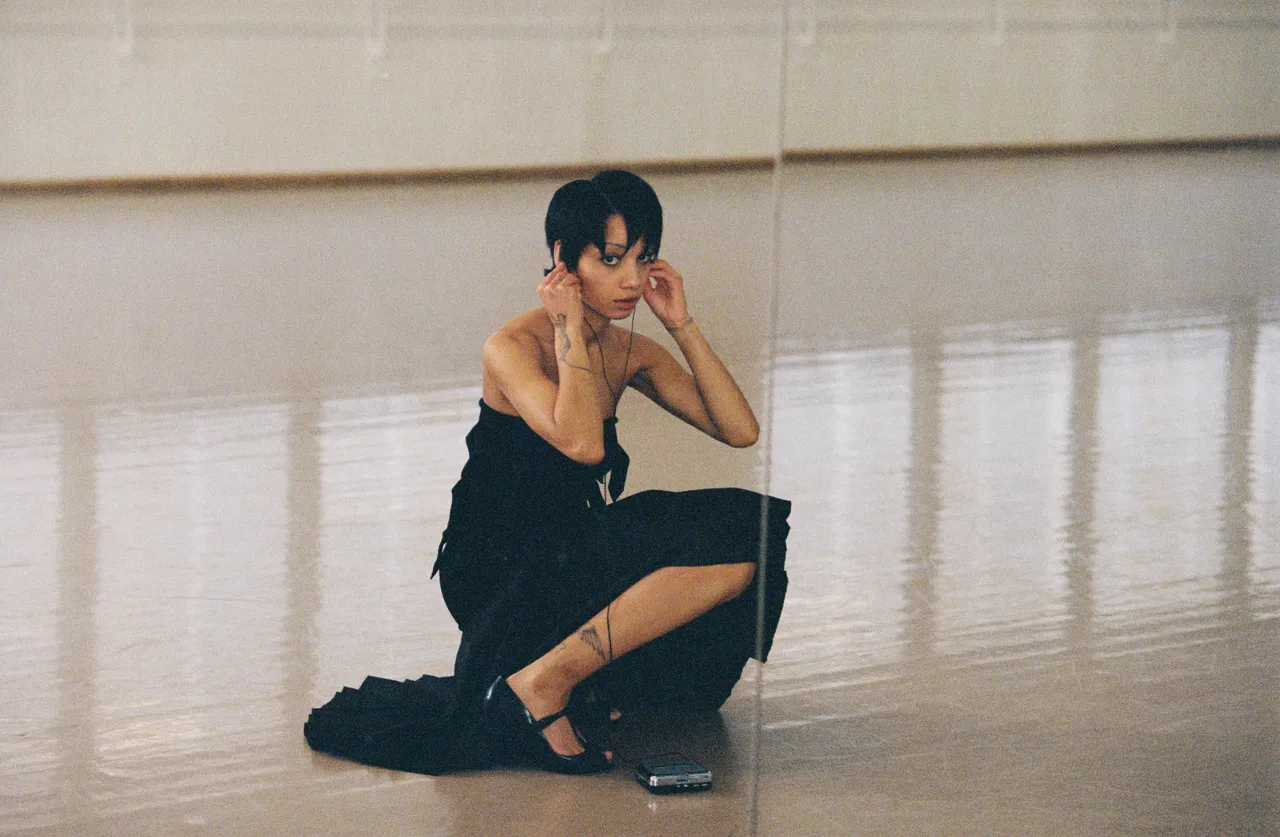
The Roman goddess of love, fertility, and sexuality is reimagined in Sei Selina’s latest record, Consider Me Venus, to uncover a less polished version of the deity, depicting another type of femininity that has nothing to do with superficial beauty or performance. It is a space where the shame of loving wholly, triumphing over deep aches, and working through discomfort instead of running from it are celebrated as core traits of womanhood, not taboos of humanity. Returning to Barcelona after four years to perform at Afers Concerts in Sala Apolo on 27 February, the Norwegian-Sierra Leonean artist has reignited her creative path, blending electronic and ambient sound with Black soul influences.
Following major life adjustments that took a toll on her physical, mental, and artistic self, Selina decided to focus on her vision for her craft, working only with those she trusted and, above all, relying on her intuition. Consider Me Venus is a poetic meditation on communal healing and the lesser-represented aspects of femininity that feel raw, while the music video renders the soul-crushing labour of women’s endurance visible. While the video may spark discomfort, it is in that unease that women have lived since the dawn of time. It is a crucial part of life to deal with anguish, to welcome it, and to overcome it. Running away can only take you so far; so, let’s dive in with Selina’s record and live performance.
Hi Sei, how are you? You are returning to Barcelona this month, four years after your last concert opening for Aurora in 2022. What are some of the biggest changes in your life since then?
Hello, I’m doing great, thanks! I’m really excited for the gig; Barcelona is one of my favourite cities. Very romantic. Since 2022, I’ve found myself in a very transformative period, both personally and professionally. After my debut EP, I had to take a step back and focus on my physical health. Suddenly, I was in recovery after major surgery, followed by multiple humbling experiences and life adjustments. But it all created a space of stillness where I found room for new reflections. It rewired the way I perceive myself and life. I manage time differently now and I’m seeking a more organic way of living.
Work-wise, it made me go completely independent. In my creative path, I only focus on things that I want to absorb, make, and write, and less on how the craft should land in the music business. I think it formed a more truthful approach to my creativity. Making art has never been so exciting! Ultimately, I move more freely in the unexpected now.
Work-wise, it made me go completely independent. In my creative path, I only focus on things that I want to absorb, make, and write, and less on how the craft should land in the music business. I think it formed a more truthful approach to my creativity. Making art has never been so exciting! Ultimately, I move more freely in the unexpected now.
You’ll be playing at Sala Apolo for Afers Concerts. What does it mean to you to be part of this campaign to uplift smaller European artists?
It’s a fantastic concept that feels so genuine and cool, and I’m so grateful they invited me. As an indie artist who wants to share what I’ve made and written, Afers is the perfect gig. I love the artistic unity that this concept signals; I find it unique. It’s an opportunity to share my music with a new audience as well. I’ll be doing a duo set: I’m bringing my guitarist, and I hope to see some friendly faces in Barcelona!
“I wanted to celebrate another side that has nothing to do with being pretty, confident, or having sexual energy; it’s about being crushed, overwhelmed, and still standing. I know that’s a superpower women across the world have.”
Your latest record is named after the Roman goddess, Venus. Do you see yourself in her?
No, I don’t see myself in Venus at all. That’s why I chose her as a figure — to express my interpretation of who she can be to me: a woman of colour, fragile, and vulnerable. Today, there is so much focus on beauty and perfection, so I wanted to create my own fantasy Venus, highlighting her darkness as her beauty. My EP is very simple, unfiltered, and honest about insecurities, being needy, or being naive — things that are connected to shame. This is my attempt to normalise it and bring some glory to the human experience, rather than resisting it.
When it comes to the Western association of Venus, not just as the Roman goddess but as a symbol of femininity, I find it hard to see an honest reflection of myself in that. My version is scarred, resilient, and complex, with hard edges that actually make her soft. I wanted to celebrate another side that has nothing to do with being pretty, confident, or having sexual energy; it’s about being crushed, overwhelmed, and still standing. I know that’s a superpower women across the world have.
When it comes to the Western association of Venus, not just as the Roman goddess but as a symbol of femininity, I find it hard to see an honest reflection of myself in that. My version is scarred, resilient, and complex, with hard edges that actually make her soft. I wanted to celebrate another side that has nothing to do with being pretty, confident, or having sexual energy; it’s about being crushed, overwhelmed, and still standing. I know that’s a superpower women across the world have.
The music video for Consider Me Venus is very emotionally and dramatically intense. Were you ever interested in getting into film? How did you develop the visuals?
The video hits a nerve that is a bit uncomfortable, and that’s the point, for us to find beauty in the uncomfortable. The video is directed by Niels Windfeldt, and this is our third music video together. The visual wouldn’t exist without Niels, his hard work, and his broad network, from gaffers to VFX. I think we are the perfect combination: one person feeling everything so deeply and being eager to express it, and another being able to grasp something concrete and produce it.
To me, this video is also a very wholesome collaboration. My stylist friend flew in from London, other friends are in the cast, and the heavy metal legend, Gaahl, blessed the screen as ‘Father Venus’. For me, he was the only person I know who could play this role. We have this deep understanding that the biggest light exists within darkness. It sounds cheesy living in Norway, but my head is always tuned more towards the worldly picture.
To me, visuals are a fantastic medium to tell a deeper story of what may hide between the lines of the lyrics, and that’s a passion I share with the director. Two years before we made it, we merged where we were each at; we discussed traumas in society, the meaning of female energy, and healing. And even though we are two very different people, there was a shared understanding of being frustrated and having a critical lens towards the entitled Western ‘healing journey’. The focus today is centred on individuality; it’s almost fetishised. I think we need to look out for our communities more. The video really holds a variety of themes.
To me, this video is also a very wholesome collaboration. My stylist friend flew in from London, other friends are in the cast, and the heavy metal legend, Gaahl, blessed the screen as ‘Father Venus’. For me, he was the only person I know who could play this role. We have this deep understanding that the biggest light exists within darkness. It sounds cheesy living in Norway, but my head is always tuned more towards the worldly picture.
To me, visuals are a fantastic medium to tell a deeper story of what may hide between the lines of the lyrics, and that’s a passion I share with the director. Two years before we made it, we merged where we were each at; we discussed traumas in society, the meaning of female energy, and healing. And even though we are two very different people, there was a shared understanding of being frustrated and having a critical lens towards the entitled Western ‘healing journey’. The focus today is centred on individuality; it’s almost fetishised. I think we need to look out for our communities more. The video really holds a variety of themes.
Vulnerability is often seen as exclusively feminine and therefore, through the eyes of the patriarchy, weak. Your lyrics and videos depict turning vulnerability into a strength. Why was this important for you?
I am very tired of our society’s view on masculinity. You can’t be masculine without embodying a huge amount of femininity, and vice versa. We tend to suffer from masking these days. If we feel something, let’s express it without putting on that mask. How else can we build bridges and come to an understanding of each other? By being just a little bit more honest, we can find out that we’re having this experience together. The patriarchy would be strengthened by more vulnerability. If the men that ruled the world could just hug and cry out their trauma together, maybe there would be fewer wars.
You stated once that you consider yourself an artist, not a producer. Has that changed at all with this EP?
No, I still consider myself an artist, and I work with incredible people, but I’m definitely very hands-on in every aspect of my artistry. I’d rather be annoying to my co-workers by expressing my vision than be displeased with the final sound or result. What I love about this EP is that it was written in a personal climate where it wasn’t meant for anybody but myself. I didn’t even realise I was making this EP until the final song was written — Consider Me Venus. Then I suddenly saw a line from my past work ending there. I write mostly by myself when I’m at home with my guitar, but I do see myself producing more in the future. It’s a learning curve.
Your work spans many genres, from neo-soul to pop to indie folk. When composing, who are some of your greatest inspirations?
I grew up in a multicultural household, being half Sierra Leonean and half Norwegian, and I think that has shaped me to be very open-minded but also confused at times. I would often find myself placed between these massive contrasts, but I enjoyed both ends. My father played West African drums in a band, but would suddenly put on Keane. My mother loves opera and music by Secret Garden, but also reggae. That upbringing made me curious and receptive to all genres. Gospel and Black soul music were mostly on repeat, and that’s where I found my first obsession: Nina Simone. I love her lyrics, and I generally just feel drawn to folk, soul, and music with lots of words. But I also love an ambient, alternative world.
You started your artistic career with poetry, which we can really hear in your lyricism. Was there a poet or a piece that pushed you to evolve into a musician, or did it happen naturally of your own volition?
It started early with me writing a lot in my journal while growing up. I was a sensitive kid who often felt quite lonesome and odd, being the only girl of colour in my class. Poetry gave me a personal space where I felt comfortable being open and honest. Later on, I discovered writers like Audre Lorde, Nikki Giovanni, and Maya Angelou. But the singing out loud part was hard for me; I didn’t dare to do it until my late teens. There is something so personal and revealing about using your own voice like that, but I’m glad I got through it. It remains forever intense for me.
You said that you didn’t write any of these songs in the studio, but out in the world. Once you’ve written them, do you find it hard to record in the studio? Is there a process you use to ground yourself in the recording or writing process?
Yes, this is a problem for me! But what I love about bringing pieces of lyrics into the studio is that it challenges typical pop structures. I may be working with something that was originally just an internal monologue or poetry written in a shitty bar or a toilet in Oslo. So, making it make sense musically within a structure can be hard, but weirdly, it also falls quite naturally. The music itself is not too crazy, but I think it’s harder for my band to understand where we are at all times when we play live; we laugh about it. I’m really grateful they tune in!
How do you know when a project feels finished, if ever?
It’s never really finished. But when you close that door, a new one awaits. For me, Venus is that. I had to let that go in order to move onwards with my true self. I’m very excited for that next chapter.