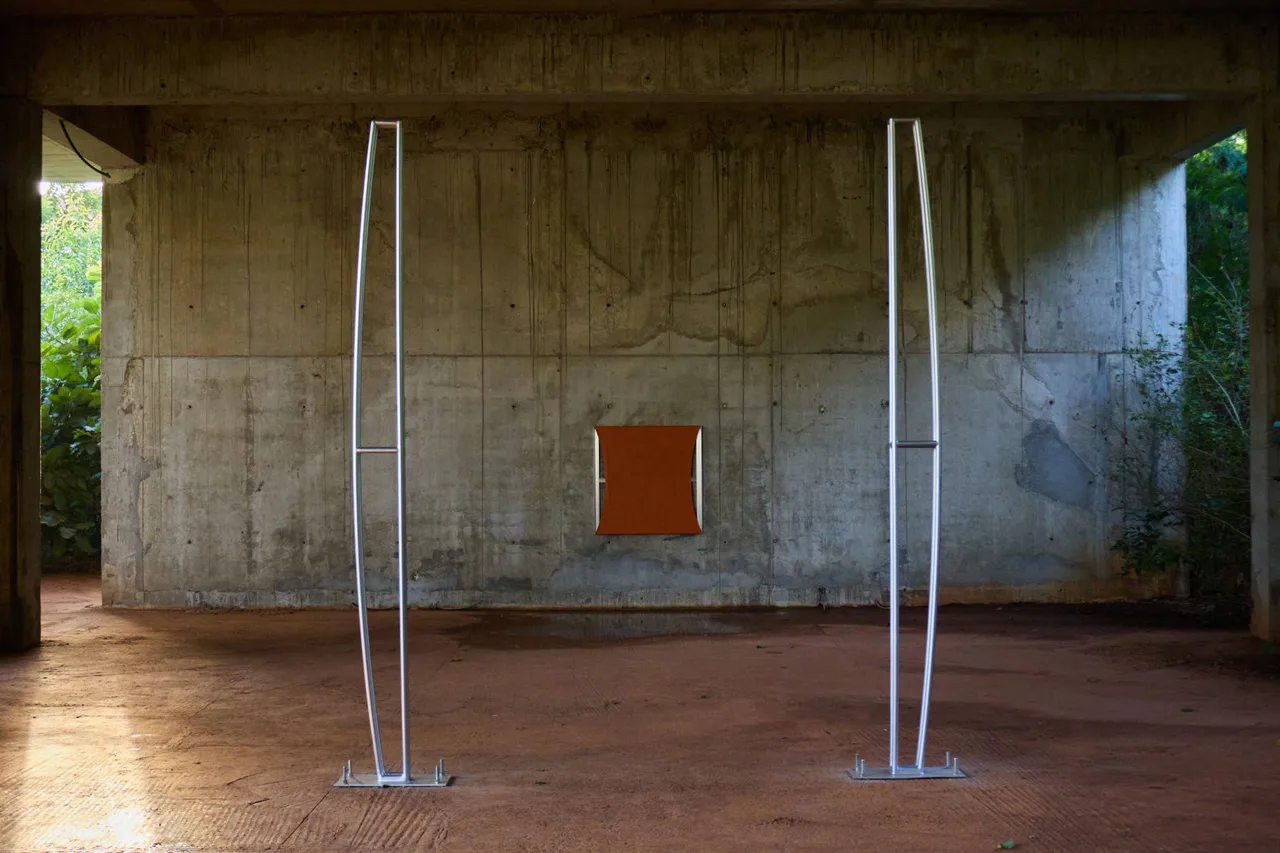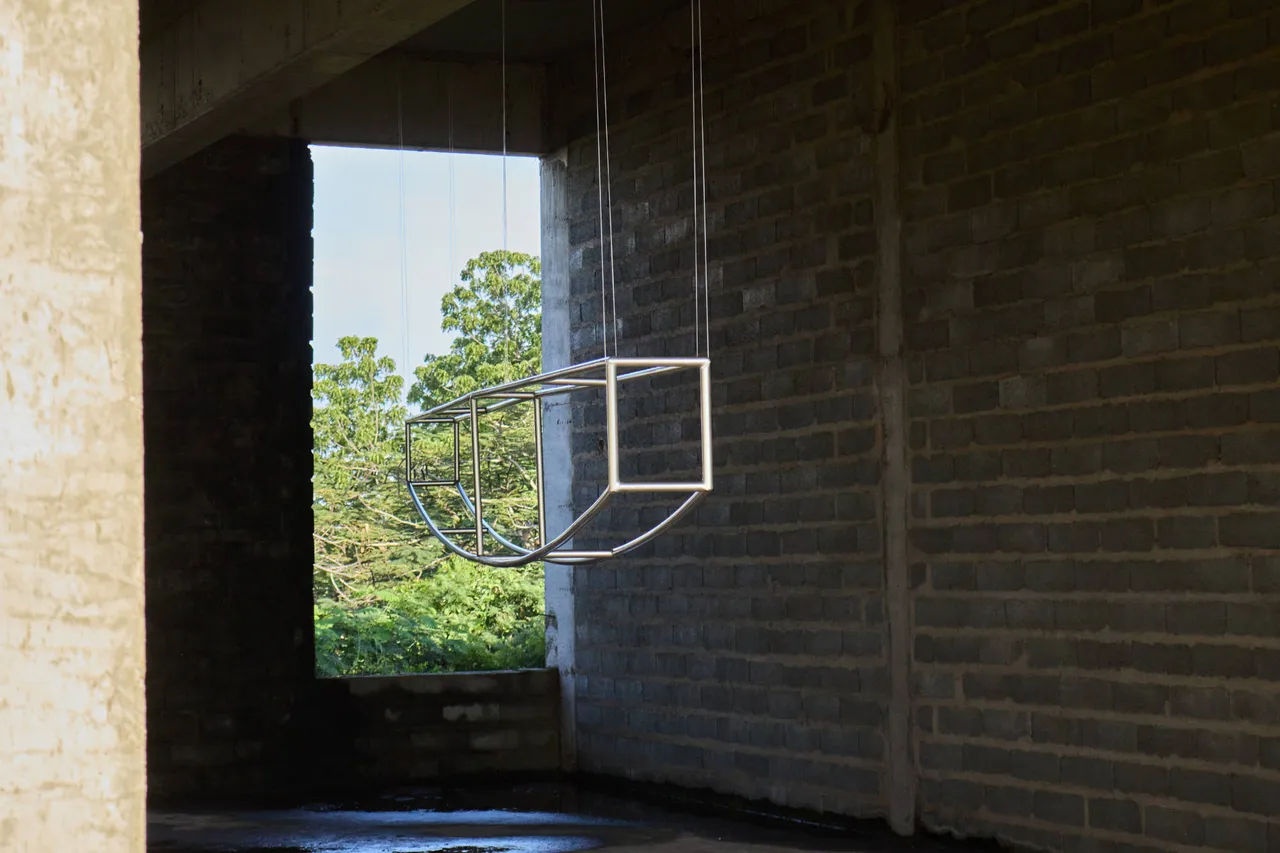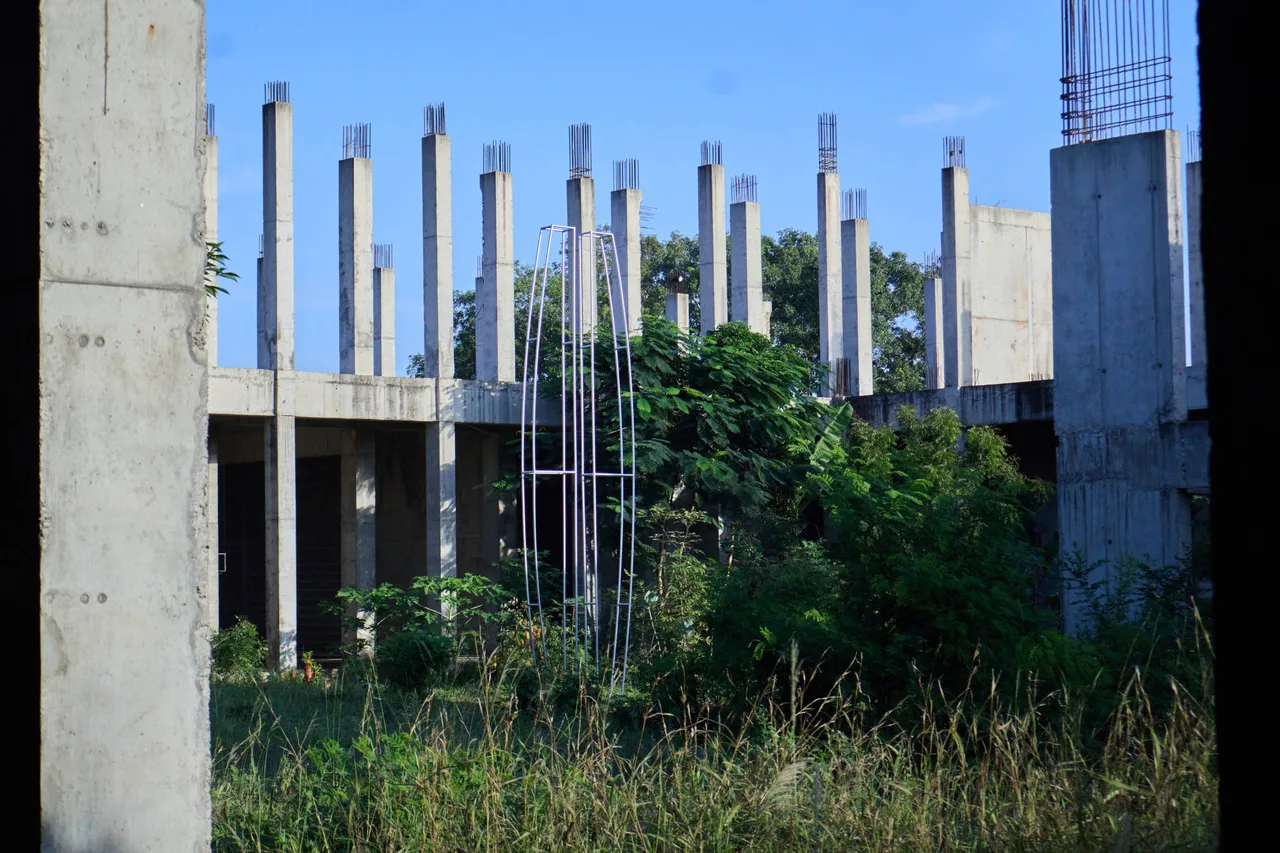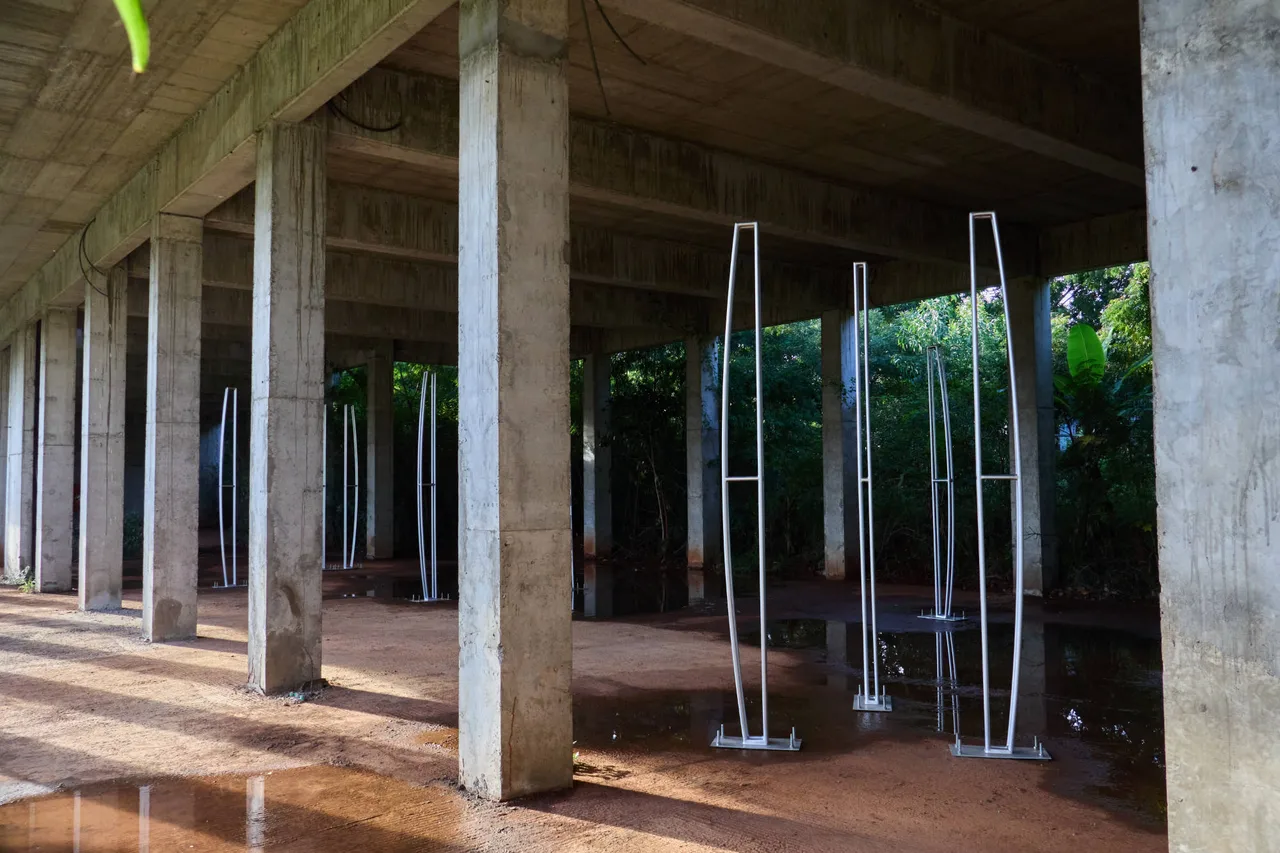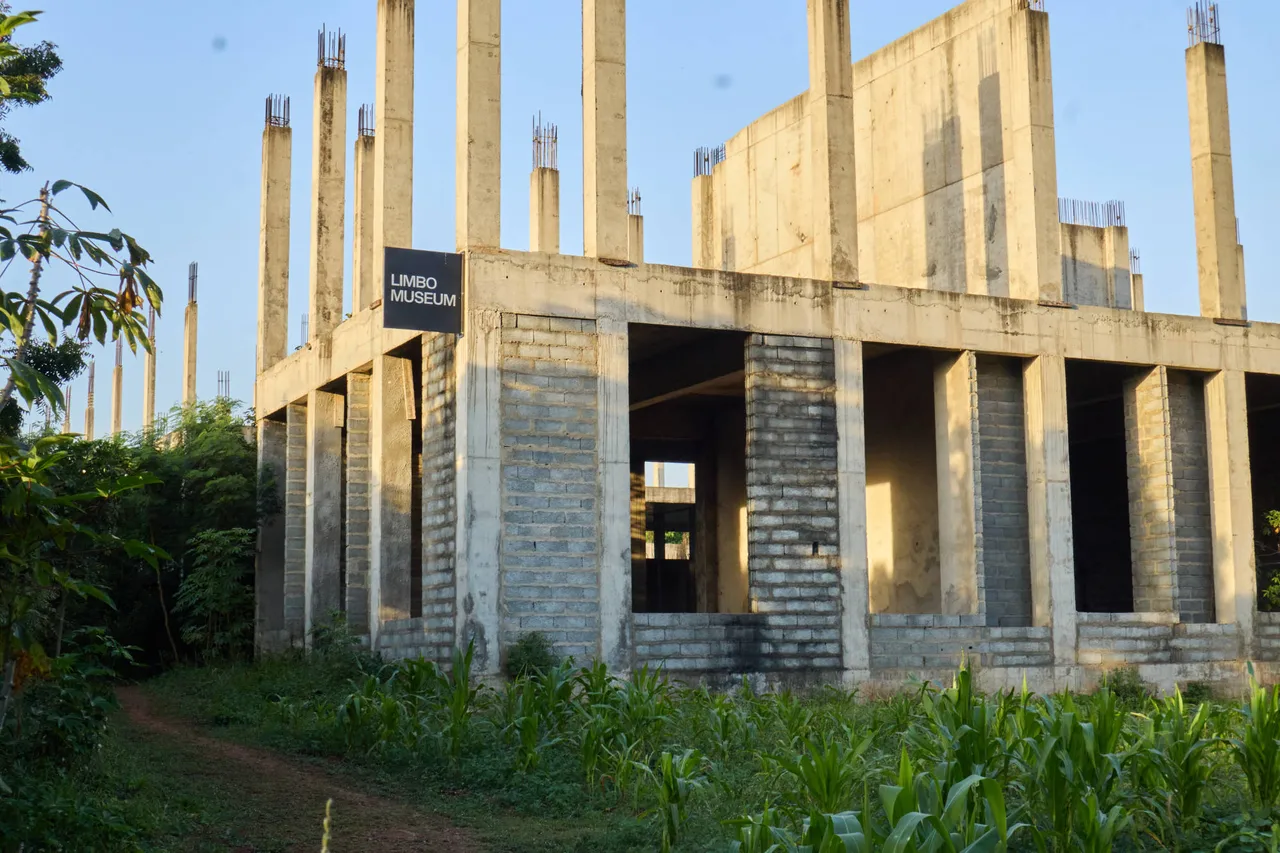
Walking up the path to reach Limbo Museum, you find yourself in a science fiction novel where nature has reconquered the brutalist, unfinished structure. Reginald Sylvester II’s exhibition, On the Other Side of Languish, on display until 9 January 2026 in Accra, Ghana presents as a love letter to the homeland and to the wider African diaspora. Curated by Diallo Simon-Ponte and produced in collaboration with Gallery 1957, the exhibition feels like no other. The space seems as though it has been tailor-made for Sylvester’s work, not as if it were an abandoned building forgotten amidst Accra’s bustling landscape. It is a vessel to show the art and a piece of art in and of itself.
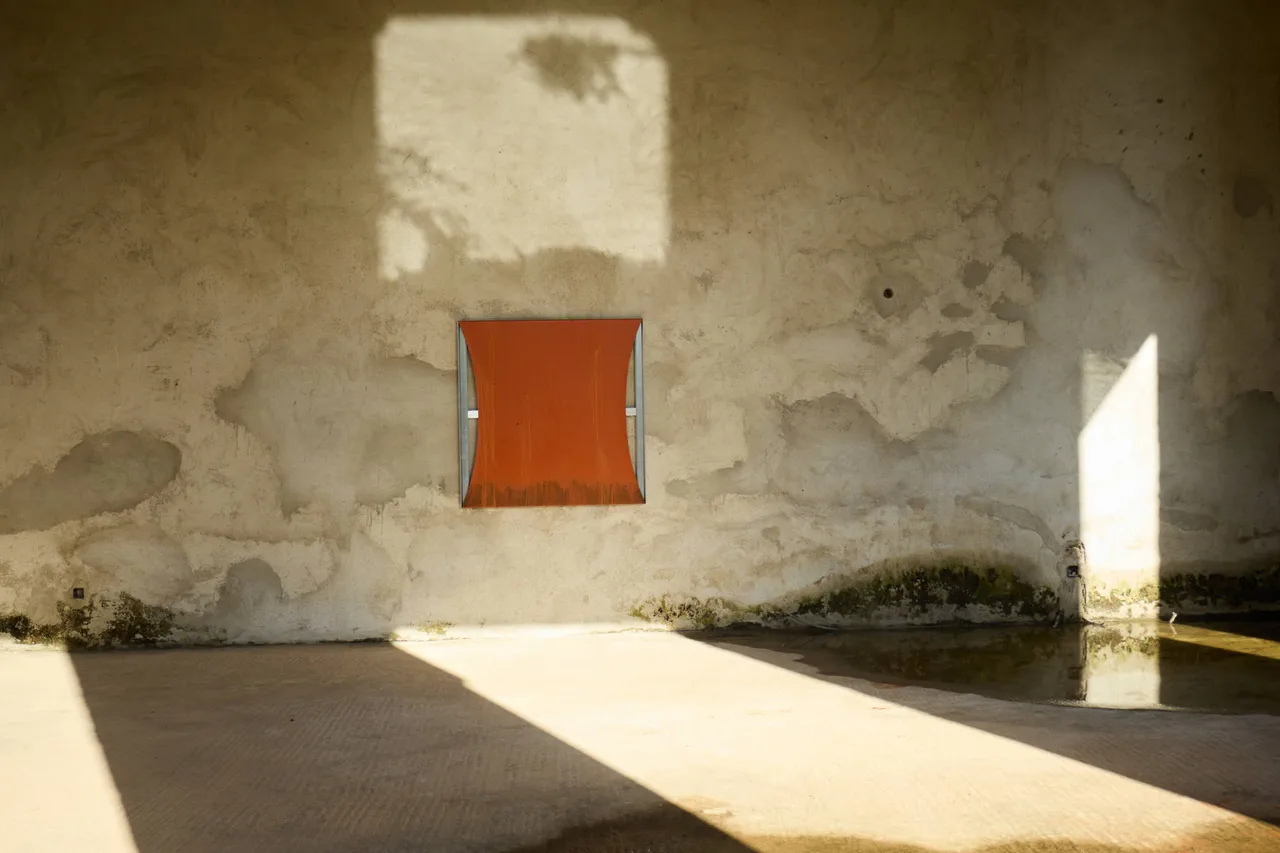
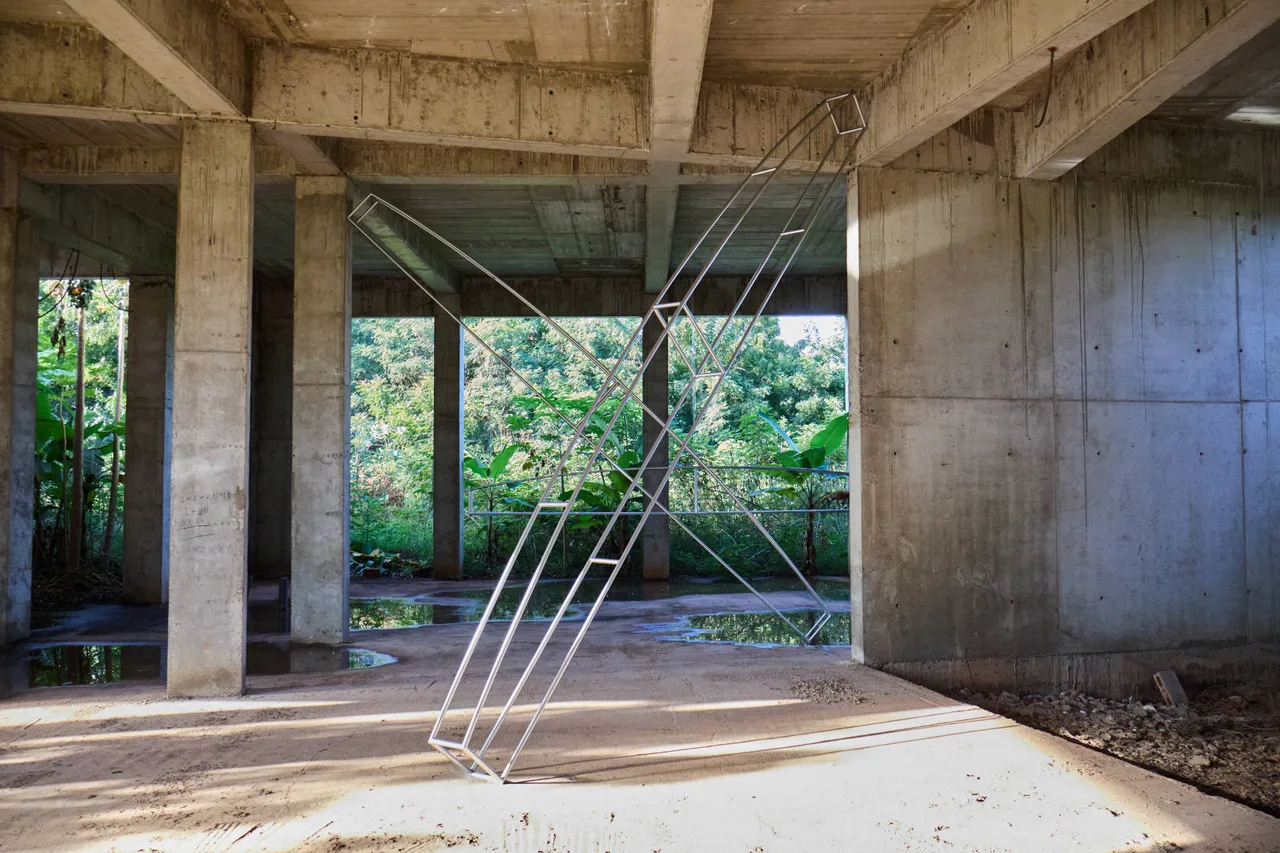
Bursts of bright orange painted on stretched-out rubber hang on the cement walls, a more vivid shade of the rust-coloured clay covers the floor. Gates to the afterlife made of galvanised steel pipes, resembling the floor plan of ships used in the Trans-Atlantic slave trade, emerge among the foliage that is sure to grow tall. Weave your way through these gates, between the cement beams, and under the branches, it is impossible not to identify with Sylvester’s work.
We speak with him about Black revolutionaries, inspiration in Ghana, experimentation with materials, and breathing new life into unfinished spaces.
You got your start in graphic design, and your father was also a creative with comic strips, typography, etc. So, with your expert eye, what is your favourite font?
Oh wow, you’re really taking me back. I’ll go with my first love. In terms of typography, that was Futura. I had an incredible graphic design teacher who specialised in type, her name was Jennifer Sterling. She was an exceptional designer: always dressed in black, very chic. She’s the one who truly taught me how to see and understand typography. Futura is such an OG, timeless typeface, and it’s always stayed with me.
This exhibition and your residency in Ghana were the first time you went to the continent of Africa. The programme also encourages artists to explore Accra, use the city’s materials, and really immerse themselves in the environment. What was this experience like for you?
It was an incredible experience and my first time on the continent. I learned so much about Ghana’s history, particularly the legacy of activism in Accra and the influence of Kwame Nkrumah, not only across Ghana but also his influence on revolutionaries in the States. That history felt deeply enriching to sit with.
Seeing Accra’s development was interesting — the city feels suspended in transition, with everyday and impoverished areas existing alongside highly developed spaces. That industrial contrast really stayed with me and connected directly to Limbo’s mission of activating abandoned spaces. Aesthetically it was cool to see but morally unsettling in a lot of other ways.
I also had the chance to work with a fellow contemporary artist, Joseph Awumee along with an incredible group of artisans also from Tema, just outside Accra. Using raw, industrial materials like galvanised steel piping for the first time, pushed my practice in new directions.
Seeing Accra’s development was interesting — the city feels suspended in transition, with everyday and impoverished areas existing alongside highly developed spaces. That industrial contrast really stayed with me and connected directly to Limbo’s mission of activating abandoned spaces. Aesthetically it was cool to see but morally unsettling in a lot of other ways.
I also had the chance to work with a fellow contemporary artist, Joseph Awumee along with an incredible group of artisans also from Tema, just outside Accra. Using raw, industrial materials like galvanised steel piping for the first time, pushed my practice in new directions.
You mentioned the old president of Ghana, Nkrumah. He, DuBois, X, and Padmore were all mentioned in the Resilience 2025 piece, which I thought was interesting because you only use their last names. To me, it highlights the enduring effects of colonialism — the inherited names from colonisers, refusing to use the coloniser name, and then who was able to keep their names. So, I was wondering if you could tell me more about that decision.
I used Nkrumah for the first painting on the far left because he represents the spearhead of these ideas — seeing Africa as a unified continent, not just Ghana. He led the independence movement with a revolutionary mindset and built strong connections across the Atlantic, influencing figures like W.E.B. Du Bois and Malcolm X. Padmore, who appears at the other end, was a close collaborator and ally of Nkrumah.
I used last names as a concise way to reference these figures rather than full titles. They point to individuals who, to me, embody resilience and collective ideology. I didn’t initially intend the titles to reference colonial naming structures, but that reading adds another meaningful layer that allows the work to open up through both form and name.
I used last names as a concise way to reference these figures rather than full titles. They point to individuals who, to me, embody resilience and collective ideology. I didn’t initially intend the titles to reference colonial naming structures, but that reading adds another meaningful layer that allows the work to open up through both form and name.
And, like you said, their ideological backgrounds, all of them at one point supported Pan-Africanism. It really ties into the fact that a lot of the African diaspora don't have the privilege to know where their roots lie because of the Trans-Atlantic slave trade. And Pan-Africanism connects Black folk from all over the world to their history, pre-enslavement and colonisation. How do you think your art also contributes to this message of unity?
These revolutionaries were definitely grounded in Pan-Africanism, calling the diaspora to reconnect with Africa. My aim, though, is to pull on something deeper than geography or ideology. There's a deeper ancestral history beyond just the continent and the Pan-African gaze. My hope is that the work speaks on things as well as our connection with The Creator.
At the same time, I don’t shy away from the brutal histories of the Trans-Atlantic and sub-Saharan slave trades. The use of rubber directly referencing the violence of its industrialisation in the Congo under King Leopold and the atrocities committed against Congolese people. Through the material, the form, and the ideas behind the work, I want viewers to move past the continent as a fixed endpoint and think more deeply — spiritually, historically, and ancestrally.
At the same time, I don’t shy away from the brutal histories of the Trans-Atlantic and sub-Saharan slave trades. The use of rubber directly referencing the violence of its industrialisation in the Congo under King Leopold and the atrocities committed against Congolese people. Through the material, the form, and the ideas behind the work, I want viewers to move past the continent as a fixed endpoint and think more deeply — spiritually, historically, and ancestrally.
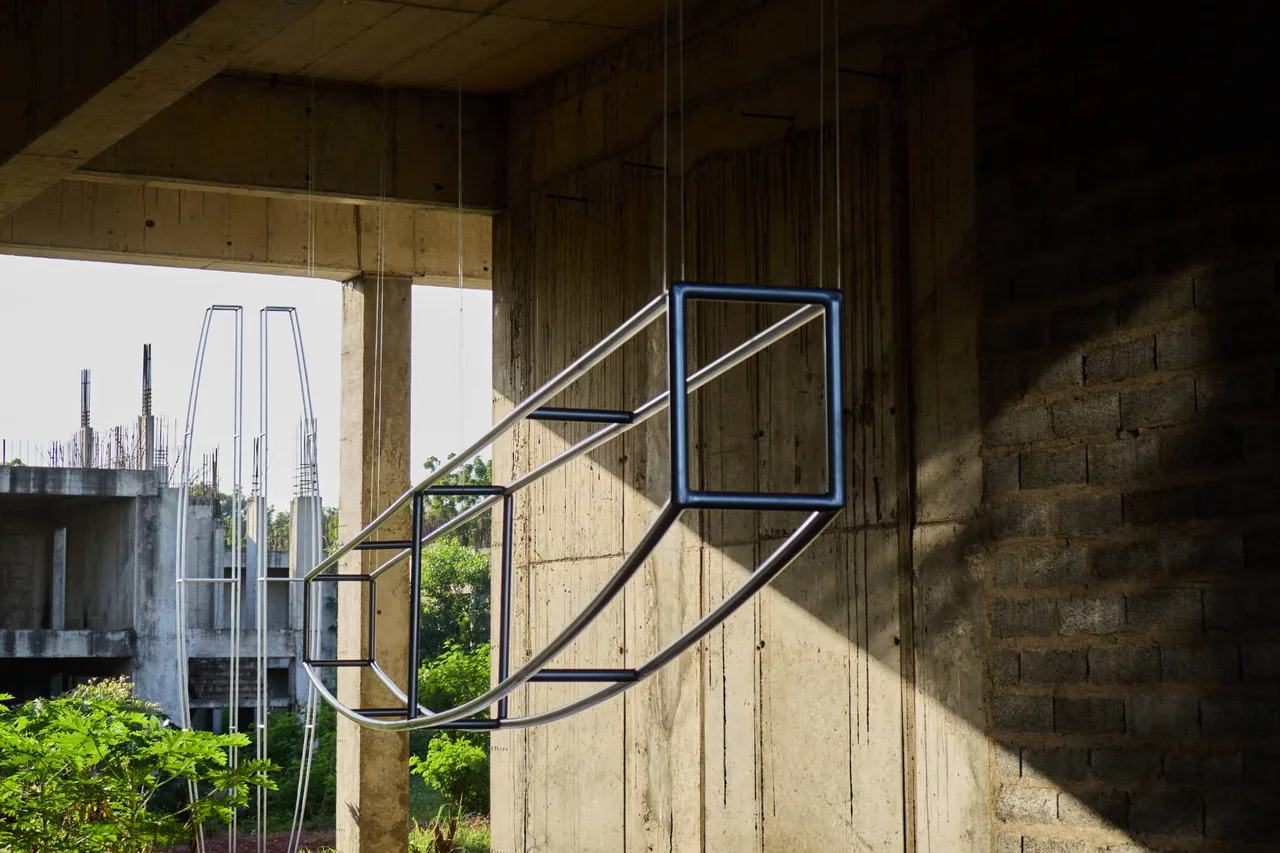
Throughout the whole exhibit, you also have the Gates that you had in your last exhibit that we spoke with you about, T-1000. That same shape mimicking the layout of a slave ship but also representing the gates to heaven is present in On the Other Side of Languish too, but with new materials and configurations. What was the reasoning behind that?
Working with Diallo, his goal from the beginning was to push my sculptural practice. Our conversations often returned to Nkrumah and how his ideas continue to echo throughout Ghana, Africa, and the wider diaspora. I began to see the Gates as portals, ways for those ideas to continue moving through space and time.
While the forms reference the floor plans of slave ships and function as gates for those lost during the Trans-Atlantic slave trade, they also respond to space. The layered structures mirror the excavated landscape at the University of Ghana — the passages, sight lines, and sense of movement within the space.
I wanted the sculptures to feel both solid and poetic — grounded, yet suggestive of passing through. I wanted them to have this solid structure, but at the same time, this notion of passing through. That kind of language came from seeing the abandoned structures throughout Accra. I was working to synthesise these things from a sculptural, an ideological aspect, or even a metaphorical and historical aspect.
While the forms reference the floor plans of slave ships and function as gates for those lost during the Trans-Atlantic slave trade, they also respond to space. The layered structures mirror the excavated landscape at the University of Ghana — the passages, sight lines, and sense of movement within the space.
I wanted the sculptures to feel both solid and poetic — grounded, yet suggestive of passing through. I wanted them to have this solid structure, but at the same time, this notion of passing through. That kind of language came from seeing the abandoned structures throughout Accra. I was working to synthesise these things from a sculptural, an ideological aspect, or even a metaphorical and historical aspect.
I imagine Limbo’s space being this unfinished brutalist structure breaks down that divide between the outside and inside by being extremely open with plants crawling around the whole place. What made this the right space for you and your work?
It was a real privilege to have the opportunity to show the work. When I first spoke with Dominique, I assumed we would be using a previous exhibition space. When she brought me to this space, I was completely blown away. I had no idea I would be working in a building like this.
The space immediately brought up the idea of the finished and unfinished. Architecturally, the building feels incomplete, yet it also feels resolved. That tension for me became a metaphor for the diaspora, for Black folks in the States. This idea of becoming, of being both finished and unfinished, saved and unsaved.
I was reminded of a conversation with Frank Bowling’s son, who described painting as “soul food.” Creating something nourishing and beautiful out of what was once discarded.
I’ve always been drawn to images of abandoned silos overtaken by moss and greenery, structures finished by nature over time. I had dreamed of exhibiting in a space like that, and it felt almost divine to experience it on the continent itself. The materials I use are meant to endure weathering and exposure, to exist alongside nature and industrial landscapes. My hope is that the main sculpture in the foyer remains there, allowing nature to slowly take over and fully complete the work.
The space immediately brought up the idea of the finished and unfinished. Architecturally, the building feels incomplete, yet it also feels resolved. That tension for me became a metaphor for the diaspora, for Black folks in the States. This idea of becoming, of being both finished and unfinished, saved and unsaved.
I was reminded of a conversation with Frank Bowling’s son, who described painting as “soul food.” Creating something nourishing and beautiful out of what was once discarded.
I’ve always been drawn to images of abandoned silos overtaken by moss and greenery, structures finished by nature over time. I had dreamed of exhibiting in a space like that, and it felt almost divine to experience it on the continent itself. The materials I use are meant to endure weathering and exposure, to exist alongside nature and industrial landscapes. My hope is that the main sculpture in the foyer remains there, allowing nature to slowly take over and fully complete the work.
You’ve said a few times that you make art for the Black and Brown experience. How is the Black experience on the continent? What changed your perspective the most in your time there working and creating?
While black and brown folk as well as the diaspora are often central to my thinking, my hope is that the work speaks to everyone. I may be having a direct conversation that’s rooted in something, but it doesn’t exclude others from engaging or finding their own connection.
The work is shaped by many influences beyond the diaspora — Italian painting, Arte Povera, artists like Jannis Kounellis and Lucio Fontana. One of the paintings in the exhibition is even an ode to Fontana.
During the exhibition, I spoke with people of many backgrounds, ages, and nationalities, and everyone connected to the work in different ways. That’s important to me. Even when the work begins from a specific place, it opens up multiple conversations at once.
The work is shaped by many influences beyond the diaspora — Italian painting, Arte Povera, artists like Jannis Kounellis and Lucio Fontana. One of the paintings in the exhibition is even an ode to Fontana.
During the exhibition, I spoke with people of many backgrounds, ages, and nationalities, and everyone connected to the work in different ways. That’s important to me. Even when the work begins from a specific place, it opens up multiple conversations at once.
Because at some point it's about the message of the artist, but it's also about what message the audience is receiving, and that could be completely unintended from your side.
1000%. Absolutely. At a certain point, I make the work, but once it’s installed, it takes on a life of its own. I’m no longer attached to controlling its meaning, that’s the most exciting part.
Whether the work is shown in Ghana, Europe, or even the Middle East, it begins to have conversations beyond me. It continues to travel, resonate, and evolve in new contexts. Even this conversation — thinking more deeply about the titles — has made me realise that while I named the works intentionally, there are still layers being revealed beyond my original intent.
Whether the work is shown in Ghana, Europe, or even the Middle East, it begins to have conversations beyond me. It continues to travel, resonate, and evolve in new contexts. Even this conversation — thinking more deeply about the titles — has made me realise that while I named the works intentionally, there are still layers being revealed beyond my original intent.
“I had dreamed of exhibiting in a space like that, and it felt almost divine to experience it on the continent itself.”
Is there any other medium or form of art that you still want to experiment with?
I'm a big fan of design. I have been from those early days of training as a graphic designer working with typography. I've always been interested in design objects and functional furniture. I'm a huge Dieter Rams fan. I'm a huge fan of Mark Newson. I've made a few design objects presently, in the last two years or so, but I would love to make more. Whether it be bookshelves or tables or chairs or sofas, that's a huge interest of mine. I'm always thinking about how people live with the work and art objects, or furniture objects, or functional objects that are around the work. That's something that I would love to continue to explore if I can.
It's interesting the way you talk about it because you say art objects, functional objects, design objects, and most people would just say furniture or art. They would put it into a production mindset, whereas you keep it in an artistic mindset.
I think in terms of art, people always think art should be beautiful. So, there's that aspect. But then where do beauty and functionality meet, right? I guess I refer to design or furniture as art objects or design objects because there's this balance between functionality and beauty. But I think beauty should always be in the equation. I like to think of the design that I love, as functional yet gorgeous.
Would you ever consider opening your own furniture line?
I most definitely would. Maybe a design house, where I could design and produce beautiful functional objects. I would just paint because I love painting.
I actually wanted to also ask you about your training in painting and art, because you don't exactly have a traditional or formal training. Do you ever feel like that's held you back or that your work has been questioned because of this?
On my second or third trip to New York, I went to the Met and saw the Abstract Expressionist wing. It completely changed me. Seeing works by Sam Gilliam, Willem de Kooning, and Joan Mitchell showed me that energy could be embedded in an object and still be felt. It was a powerful moment.
I didn’t go to school for painting. Traveling, seeing exhibitions, reading books, studying catalogues, and attending retrospectives became my art education. Learning this way allowed me to develop my own sensibility and way of working.
I used to think not going to art school would limit me. But over time, as I’ve matured, I realised that every artist’s path is different, and that difference has actually become one of my strengths.
I didn’t go to school for painting. Traveling, seeing exhibitions, reading books, studying catalogues, and attending retrospectives became my art education. Learning this way allowed me to develop my own sensibility and way of working.
I used to think not going to art school would limit me. But over time, as I’ve matured, I realised that every artist’s path is different, and that difference has actually become one of my strengths.
Training, especially in art, is so versatile and subjective that you can understand all the different pillars of different canons, but at the end of the day, living above all else and being able to experience art is what is important.
Not so long ago, Pope.L said that knowing exactly what you’re doing as an artist is overrated, and that really stuck with me. School often trains you to know, but finding your way can be more meaningful.
When I first learned about Willem de Kooning, I was struck by how he described painting as a process of finding an image — starting with colour and texture and arriving along the way. That approach resonated deeply with me, even still to this day.
I connect that process to faith. We don’t know what heaven or the afterlife looks like, but we move forward by trust and searching. For me, abstraction has always felt like a painterly way of faith.
When I first learned about Willem de Kooning, I was struck by how he described painting as a process of finding an image — starting with colour and texture and arriving along the way. That approach resonated deeply with me, even still to this day.
I connect that process to faith. We don’t know what heaven or the afterlife looks like, but we move forward by trust and searching. For me, abstraction has always felt like a painterly way of faith.
It sounds like in Accra, you were able to do a lot of that because you had so much freedom, liberty. You had so much to explore.
For sure. The residency was split into two visits. The first visit was just soaking up as much culture as I could, information, history. The second visit was me synthesising all of that and creating. It did feel liberating to reach a new place within my sculpture practice, try some new things with the paintings, and work to push things overall.
What was it like to present the exhibition and walk around with people that were from Accra, but also people that travelled in to see the exhibition?
It was a great experience. This was my first time guiding a large crowd throughout an exhibition of mine. It was cool to witness how people responded, seeing them connect with what the work was communicating.
My final question for you is what advice would you give to young artists today who are just itching to create something?
True making is not going to always be enjoyable. Don’t wait for inspiration to hit you. Continue to look at things that inspire you, even if it's not art related. If that walk inspires you, if that book you're reading inspires you, if that same record that you listen to that gives you that particular feeling inspires you, if that podcast moves you, continue to surround yourself by things that move you, that give you that kick in the ass to hit the studio and create.
You have to fight to be inspired, fight to be moved in order to continue to have the courage to make. Every day is not going to be a battle you win in the studio, but there's always something you're going to learn. Make work for you first. Sometimes the audience has to catch up with your vision.
You have to fight to be inspired, fight to be moved in order to continue to have the courage to make. Every day is not going to be a battle you win in the studio, but there's always something you're going to learn. Make work for you first. Sometimes the audience has to catch up with your vision.