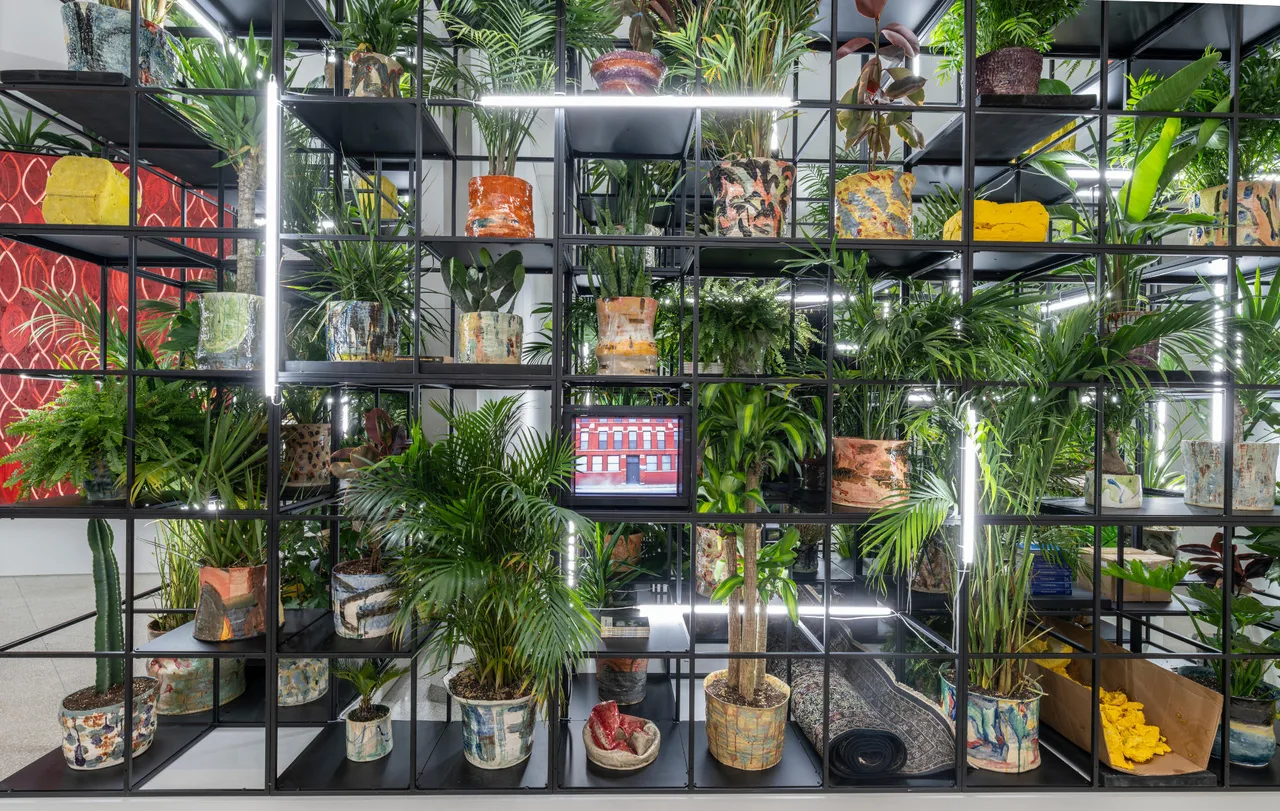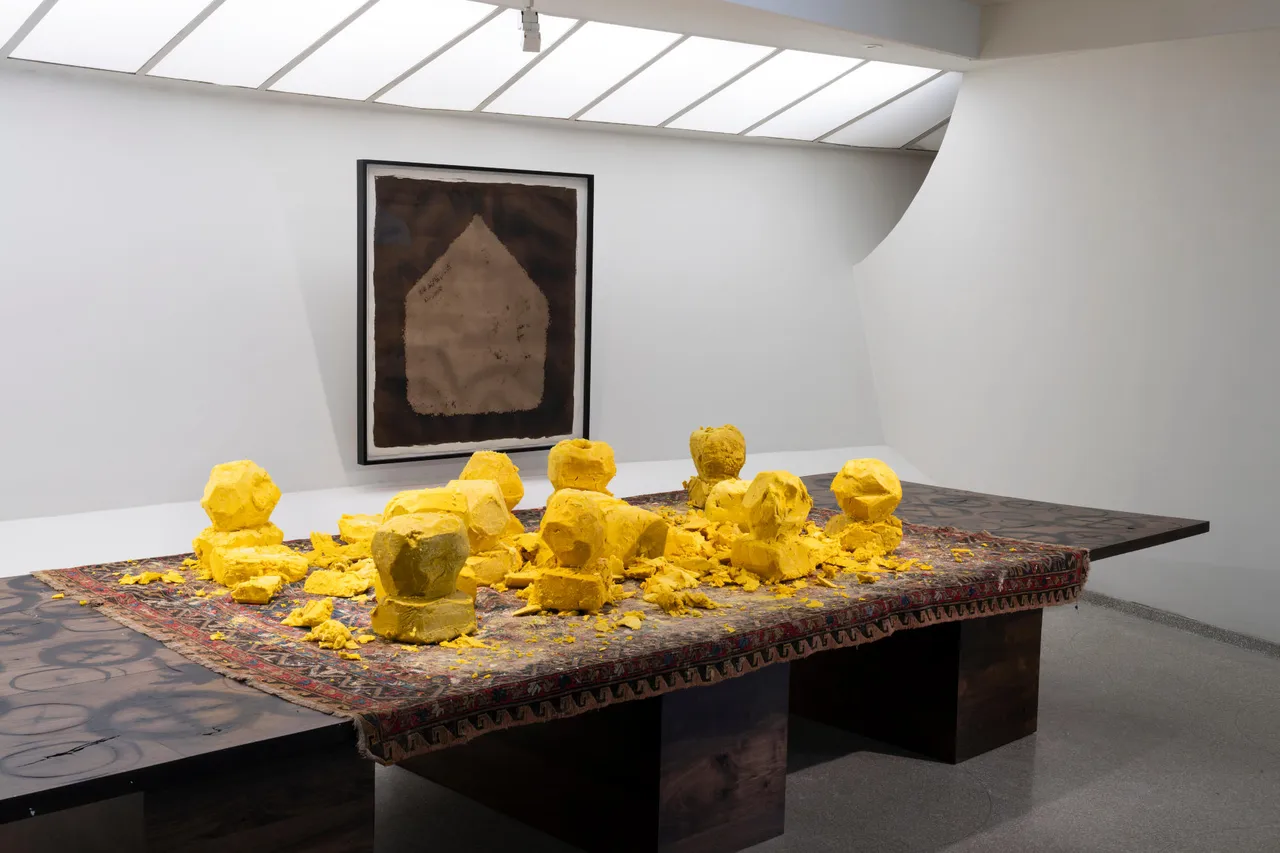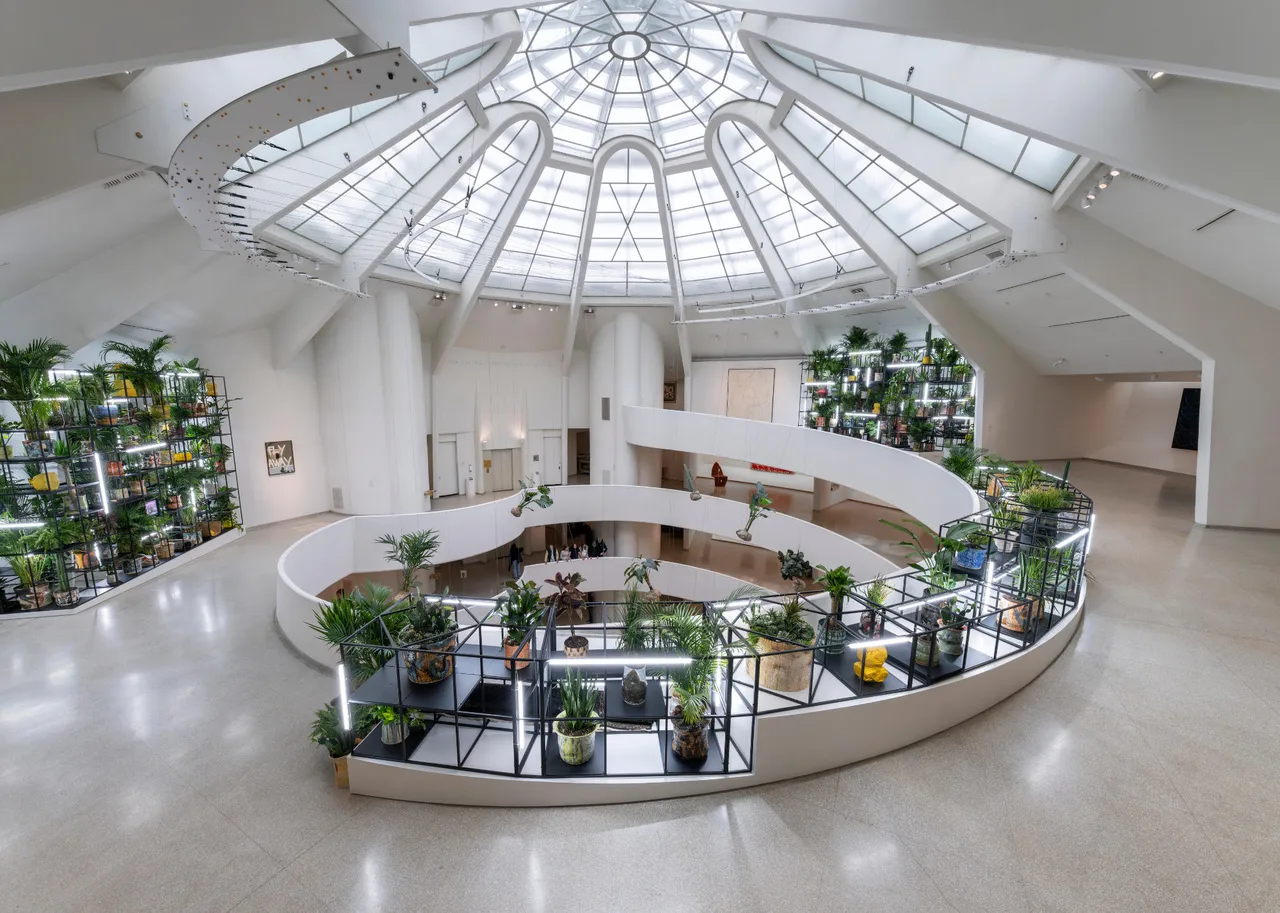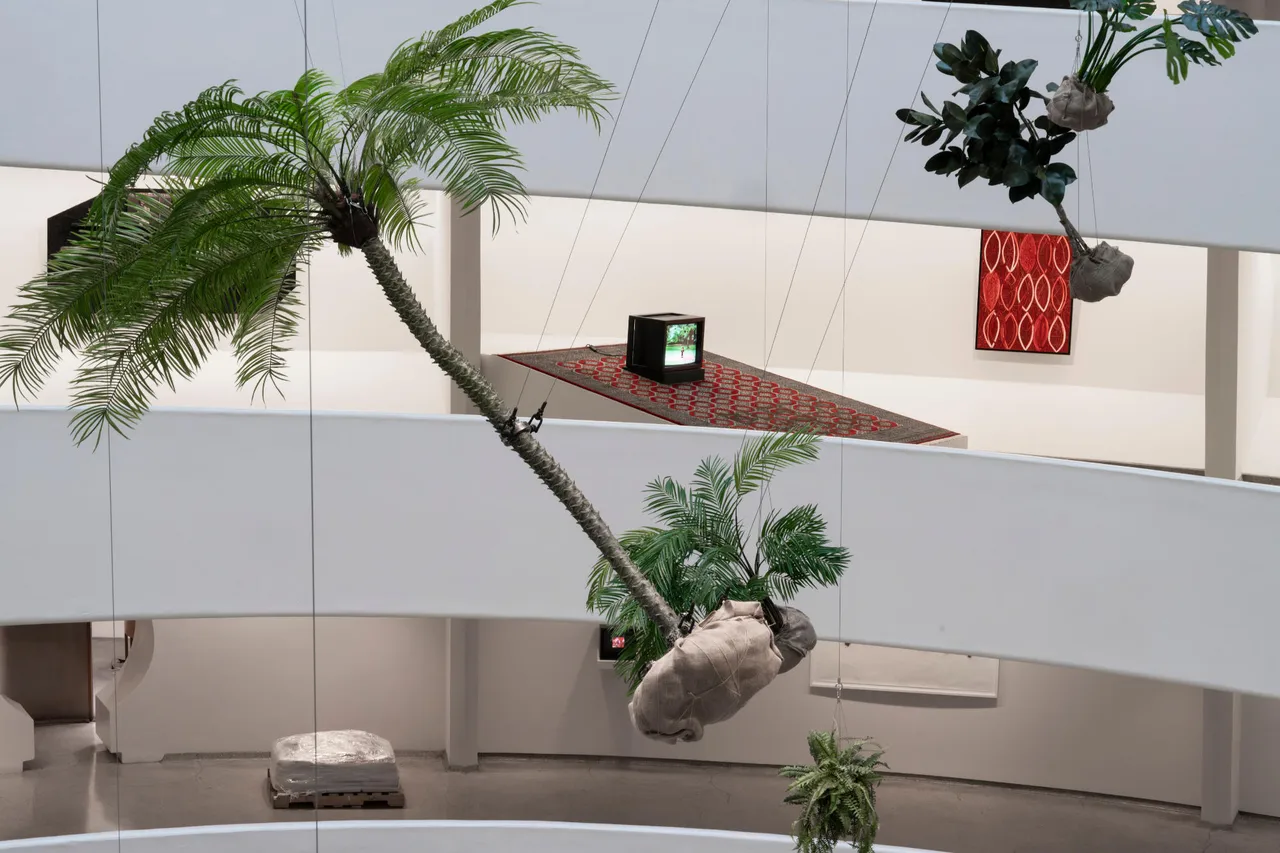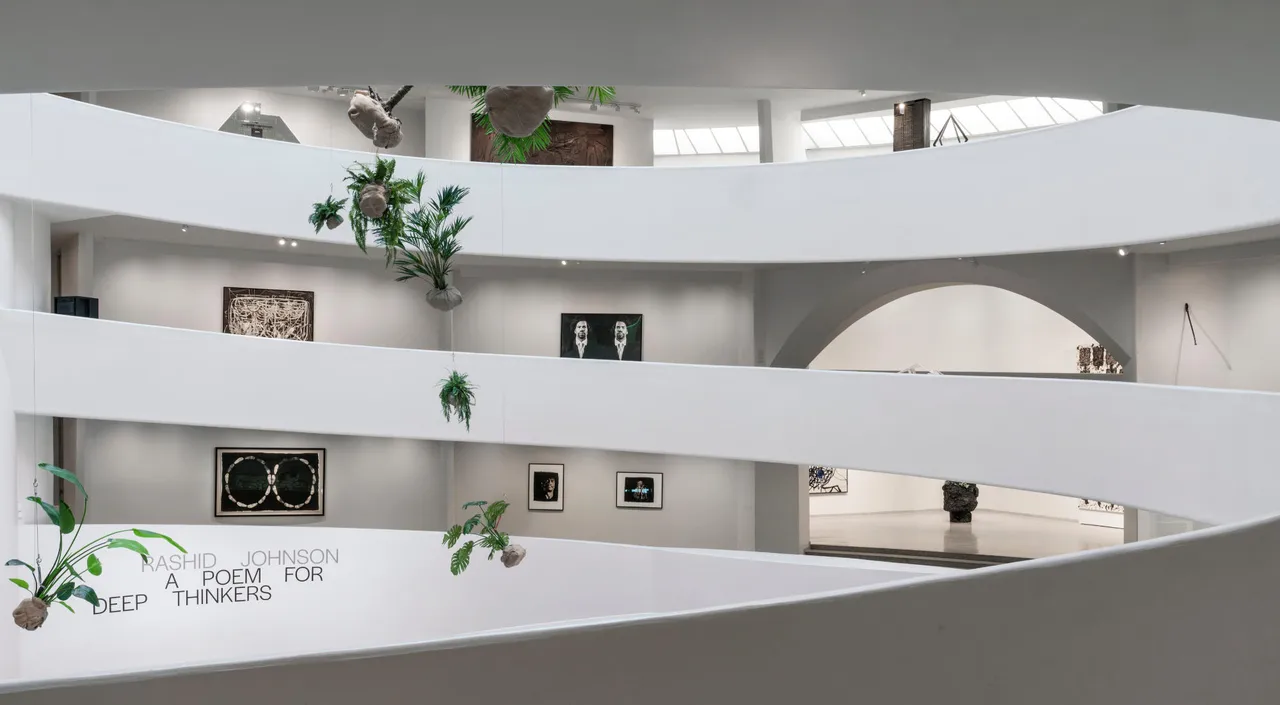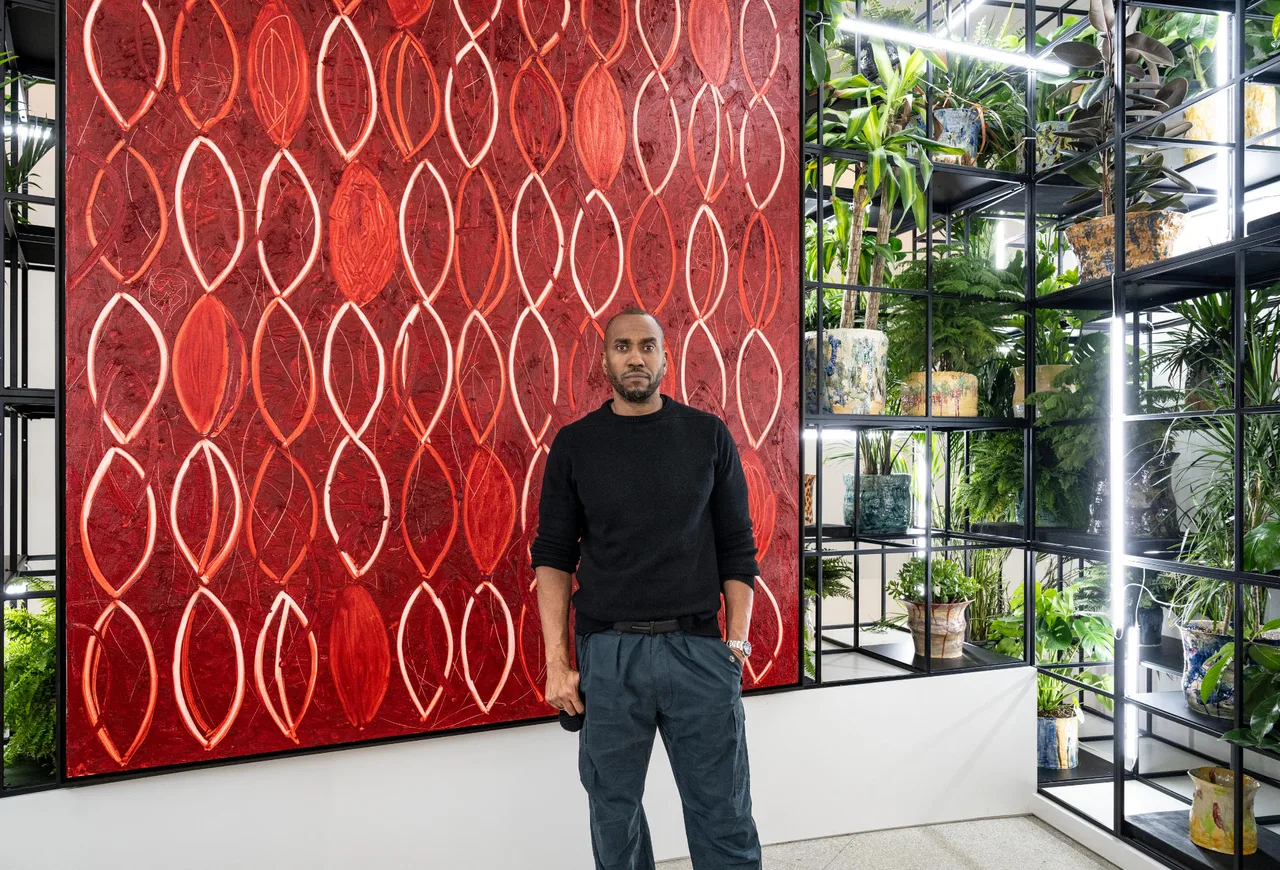
Plants dangling from the heavenly skylight of the Guggenheim museum, mirrors reflecting the passers-by, blocks of shea butter resting on a rug atop a dining table, short films playing on vintage television sets… The retrospective exhibition Rashid Johnson: A Poem for Deep Thinkers, co-curated by Naomi Beckwith, Jennifer and David Stockman, on display until 19 January, 2026, leaves you grounded and curious, yearning for answers that people spend their whole lives searching for. His use of collage, mosaic tiles, and mixed media celebrate the inherently human experience of being constructed and moulded by a myriad of people, places, environments.
Rashid Johnson’s work employs compelling historical imagery informed by the artistic and political trends he grew up with and what his parents taught him. I sometimes hesitate to call it Black history because these were not instances that only affected the Black community, but caused waves of change for all communities of colour and also white people. There is no American history without Black Americans. And yet, the term Black history offers a more holistic perspective on the contributions the Black community has made toward the art, culture, politics, economics (and so much more) of the US and beyond.
His early photography from the late 90s to early 2000s portrays significant Black figures through remade portraits of Thurgood Marshall, the first African American Supreme Court Justice; Frederick Douglass, one of the most notable abolitionists of the 19th century; and Emmett Till, a fourteen-year-old victim of lynching. In the last two, the concept of double consciousness is invoked by mirroring the portraits side by side. Double consciousness, coined by sociologist and Pan-Africanist W.E.B. Dubois, describes the psychological phenomenon among the Black community of seeing yourself through the eyes of the oppressor and through your own eyes. It implies a dual identity where one side is in constant negotiation – and at times conflict – with the other. Johnson’s historical reference material is rich and his message offers education and incentivises internal reflection.
His Soul Paintings reflect a deep understanding of what it means to question yourself, how to stay present, and what reckoning with your own emotions looks like. The souls look like boxy cartoon-ish heads with heavy eyes that weigh down the face. Where you would imagine the mouth to be are instead scribbles, or nothing at all. This is especially poignant when the world, but especially the US, is being confronted with a crisis of the soul, of humanity. What do our souls look like when they are fulfilled? When they are scared, troubled, anxious?
These emotions connect to his pieces on fatherhood in his more recent work, where he depicts the generations of men connecting and taking care of one another in the short film Sanguine. He asks how the soul mediates our innermost fears and how remaining present in the ‘now’ can alleviate those anxieties. Although, there is still an inkling of unanswered questions about the soul, there is something we don’t know – maybe we shouldn’t know. Nevertheless, Johnson leaps into this unknown, and we leap with him.
His work aims to break free of limitations and boxes; he wants it to be as free as the plants that levitate through the space: growing, wilting, dying, reviving. As the exhibition is titled after an Amiri Baraka piece, it only seems fitting to end with some of his words: “To revere art and have no understanding of the process that forces it into existence, is finally not even to understand what art is.”
The exhibition A Poem for Deep Thinkers by Rashid Johnson is on view through January 19th, 2026, at the Guggenheim museum, 1071 5th Ave, New York City.