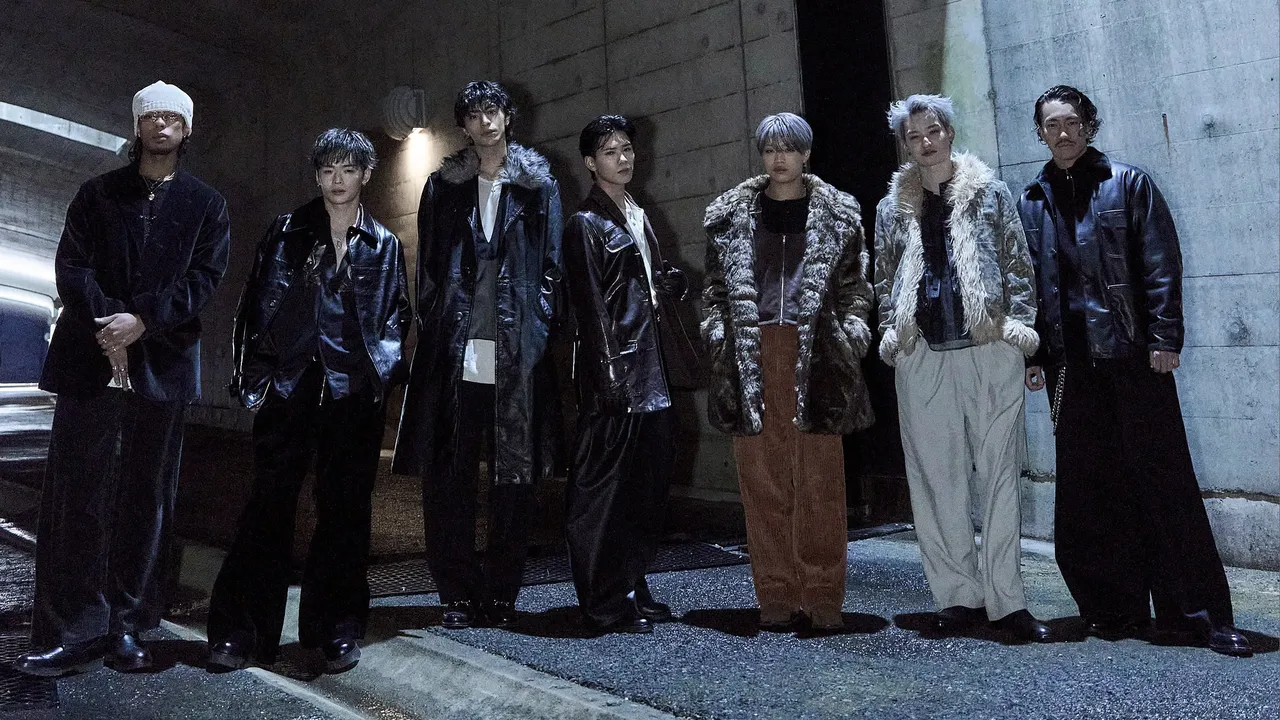
The world has finally opened its mind and its ears to receive the wonders that come out of the Asian music industry. Japan has always given us a variety of memorable, nostalgic, innovative, and iconic songs and artists, and with PSYCHIC FEVER, it has been made clear that they also excel in the boy group realm. For the past four years, the seven-member project has been making themselves heard by the world with vocal and rap abilities, perfectly executed dances, and a personal style that equally represents the unique fashion of Japan and the individual tastes of each of the members. Their upcoming sophomore album, DIFFERENT, and their new single, I Got Ways, are adding steps to the ladder that promises to reach far.
The audience and the fans always love a boy group. It has been proven again and again how the magnetism born from a group of guys that know how to sing and dance is timeless, ever-present, and always needed. Some decades ago the offer was not that vast, the complete opposite to now, where there seems to be a new boy group born every week. Despite all the noise and the market saturation, which we are honestly not complaining about, some voices and proposals stand out from the crowd, and this has been the case of one of the most prominent boy groups that have come out of Japan in the past years and that have managed to successfully land all around the world.
KOKORO, WEESA, TSURUGI, RYOGA, REN, JIMMY, and RYUSHIN have been traveling, performing, and working nonstop not only since 2022, the year of their debut, but since 2019, when the group was initially formed. With the discipline and commitment of young artists who want to make it in such a competitive industry, PSYCHIC FEVER has perfected their sound and their joint dynamic through the years, reaching an all-time high with Just Like Dat, a song that did everything: put their name on the map, take their proposal outside Japanese borders, and build a strong pillar from where to start aiming higher. That's what 18 million streams and 21 million views can do.
But outside the phenomenon that this song was, they have demonstrated they know how to work across all genres while keeping all eyes on them, and now with I Got Ways, the first taste we have of this new era that sounds more seductive and mature but is equally Psychic-Fever-esque as always, they plan to keep doing so. We talked with the group about this step into the future — that comes alongside a new album set to drop on Friday, July 10 — their personal style, their evolution as artists, and their music taste.
Hi guys, thank you so much for taking the time to speak with METAL despite your hectic schedule. To start, where are you answering us from right now, and what are you currently excited about?
KOKORO: We’re currently in Tokyo. Lately, I’ve been really into practising piano and working on music production. I actually got hooked on piano while creating cover songs for the short videos I’ve been posting recently. It inspired me to go back and study the songs and chord progressions I’ve always wanted to learn. As for music production, I’ve been spending a lot of time in the studio with JIMMY, experimenting and developing ideas together. We get so immersed in the process that before we know it, three or four hours have gone by. It’s something I’m really passionate about right now.
Congratulations on the release of I Got Ways! I really loved the sleek, dark energy of both the song and the video — it feels very sexy and mature in such an elegant way. What is your favourite element of the project?
JIMMY: Thank you! Our favourite part is the mature atmosphere we created. We love the violin intro and how the music 'drops' at the hook for a sexy, R&B feel. It was a great challenge to use falsetto and melodic vocals instead of our usual style. Visually, the monochrome MV and rain scene perfectly capture that sleek energy, while the choreography by kazuki (s**t kingz) brings it all together with dynamic, synchronised movements.
How does this second album relate to the first one? Would you say it is a continuation of the style you have been developing, or does it represent something completely different? How do both records connect with each other?
RYOGA: For PSYCHIC FEVER, the world view and core identity we presented in our first album naturally continue into DIFFERENT. The groove we carry as a group, as well as the atmosphere created by each member’s individuality, is something we’ve valued since our debut, and I believe that continues as a single consistent line between the two works. At the same time, DIFFERENT, as the title suggests, is also an album that embraces difference and change without fear. If the first album was about presenting what kind of group PSYCHIC FEVER is, this one goes a step further — exploring how far we can push our evolution and freedom of expression. It’s a project filled with that challenge.
Your new song was produced by Grammy-winning producer Rykeyz. How does it feel to have reached a point in your career where you are able to collaborate with such highly regarded artists and creators?
JIMMY: I had already been a big fan of his music in my personal life, so I was really happy to have the opportunity to work with him. It was also a great source of inspiration for me. I’m really looking forward to continuing to work with a wide range of songwriters and producers in the future. At the same time, I think what becomes key is how we can express PSYCHIC FEVER’s identity, as well as how I can bring out and further develop my own writing abilities.
There is a unique groove in PSYCHIC FEVER’s music — a smooth yet powerful vibe that makes your sound stand out within the scene. How did you work toward achieving such a distinctive identity as a group? Was it something that came naturally, or was it a more conscious process?
What I’ve come to realise through performing in different countries is that our identity isn’t something we forcefully create. It comes from continuing to believe in what we personally think is cool. It’s not just about following trends but constantly updating ourselves while staying true to our own sense of style. That accumulation has built our identity today.
This new single and album have been described as the beginning of a new era for you. What does this new chapter represent? Does it feel like a new beginning? Is there something from the past you are leaving behind, or perhaps a side of yourself that you now want to show more openly to the world?
WEESA: Since this is our second album, it feels like a new challenge for us all over again. Through this album, we hope to share our music with the world from Japan and take another step forward as artists. In that sense, it really does feel like the start of a new chapter for us.
The music industry in Japan is very unique. Local artists can achieve huge success domestically, but breaking into the international market often feels like a completely different challenge. You have managed to do that successfully, and your name is now recognised far beyond Japan. Was international recognition always one of your goals when you first started? And when it finally happened, did it feel expected, or did it take you by surprise?
TSURUGI: From the very beginning, we always saw ourselves as a group that would be active on a global scale. Being able to perform and work around the world today is something that makes me incredibly happy. At the same time, I’ve realised that the world is much bigger than I ever imagined and that the entertainment industry is constantly evolving. While adapting to the changing trends and pace of the times, we believe it’s important to express our individuality and stay true to who we are. That’s something we always keep in mind as artists. The Japanese music market is also quite unique in many ways. Even as we expand into the global market, I think it’s important to respect and embrace those characteristics rather than leave them behind. Finding a balance between our roots and a global perspective is something we truly value.
After Just Like Dat went incredibly viral and essentially changed the game for you, did you ever feel the need or pressure to adjust your sound or image to appeal to the new audience that suddenly started paying attention to you? I imagine the recognition must feel rewarding, but did it also come with a level of pressure that was perhaps difficult at times?
REN: Rather than feeling the need to change our musical style, we wanted to challenge ourselves with different kinds of music and show people the many sides of PSYCHIC FEVER. That’s why we’ve worked on songs across a wide range of genres. As we kept exploring different sounds, seeing Just Like Dat resonate with so many listeners around the world made us realise that all the things we had been doing up to that point weren’t in vain. It felt like our efforts had paid off. Because of that, I honestly didn’t feel too much pressure. I was mainly grateful and encouraged by the response.
The year it was released, Just Like Dat became one of my most-played songs. No matter how many times I replayed it, I never got tired of it. In your opinion, what is the secret behind creating a song that people can listen to over and over again without losing interest?
JIMMY: That’s a difficult question. I think there are many factors involved in creating that kind of song — such as the key and structure of the track, the trends at the time of release, and the synergy between the song and the artist. Sometimes it works best to carefully align all of those elements in a well-planned way, and other times it can be effective to intentionally go against them to create impact. There isn’t a single answer, but personally, I believe that in order to create something that truly moves people’s hearts, it ultimately comes down to how much passion the creator puts into it.
At this point, you have performed all around the world. Have you noticed differences in the way your music connects with audiences from different countries or cultures? Is there a particular place where you feel your vibe resonates especially well?
RYUSHIN: Depending on the country, the songs that get the crowd going and even the style of our performances change, so every time we visit a new place, we really look forward to seeing the reactions. It’s also a great learning experience for us. I feel like our vibe actually suits all countries, and at the same time, we adjust how we deliver our performances depending on each place. There are even moments when the audience’s energy surpasses ours, and in those times, we honestly feel incredibly happy and grateful.
Throughout your discography, you have explored many different genres and moods, from catchy pop tracks like Love Fire to heavier, rap-focused songs like Swish Dat and everything in between. As a group, you work convincingly across all these styles, but individually, what kind of sound or vibe do each of you feel the most comfortable or connected with?
KOKORO: I genuinely enjoy all of our songs and listen to different styles depending on the mood or situation. That said, I particularly love Paradise because it allows us to express a more sophisticated, luxurious, and mature side of ourselves. On the other hand, when it comes to songs that really let me unleash my energy on stage, What’s Happenin' is my favourite.
Both What’s Happenin' and Paradise were huge hits. Beyond the music itself, the visuals and styling of both projects captured a very specific sense of nostalgia that clearly resonated with audiences. What are some things each of you personally feel nostalgic about?
REN: For the outfits in What’s Happenin', we took inspiration from music videos by artists we watched when we were younger. We also recreated the visual format and overall feel of early-2000s music videos. While working on it, we felt a sense of nostalgia ourselves, but at the same time we added our own PSYCHIC FEVER flavour and perspective. I think that combination allowed us to create something that feels familiar yet completely new.
Even though you work together very cohesively as a group, each member has a very distinctive personality, especially when it comes to fashion and personal style. Individually, what inspirations or references influence the way each of you presents yourselves?
JIMMY: Through PSYCHIC FEVER’s activity, I’ve experienced many moments where things I couldn’t express on my own — or things I would never be able to do individually — became possible as a group. I believe that’s only possible because each member has their own unique style, which expands the group’s range of expression. Being part of such a group motivates me to keep improving my own skills so that I can contribute even more to the collective.
After experiencing so many major milestones in your career, it feels like there is no limit when it comes to dreaming bigger. No matter how ambitious or unrealistic it may sound, what is one big dream or goal you still hope to achieve as PSYCHIC FEVER?
RYUSHIN: No. 1 on the Billboard Hot 100, definitely. We’ve been saying this since the very beginning, and it’s something we are absolutely determined to achieve. We also want to do a world stadium tour and spend even more time with our ForEVER. That’s something we truly hope for.
RYOGA: The more we continue our activities, the more we feel that there really are no limits to dreams. We’ve experienced moments where things that once felt distant or impossible suddenly became reality right in front of us, so we’ve stopped deciding in advance that something “can’t be done". That’s why we now seriously aim for reaching No. 1 on the Billboard Global 200 and Hot 100, as well as completing a world tour. But beyond that, we hope our music can become something that transcends borders and languages and stays close to people’s lives. Of course, we also want to perform at major festivals and hold arena and stadium shows as a headlining act. We know there is still so much we need to build in order to reach those goals. Step by step, gaining experience, we want to continue challenging the world in our own way.
RYOGA: The more we continue our activities, the more we feel that there really are no limits to dreams. We’ve experienced moments where things that once felt distant or impossible suddenly became reality right in front of us, so we’ve stopped deciding in advance that something “can’t be done". That’s why we now seriously aim for reaching No. 1 on the Billboard Global 200 and Hot 100, as well as completing a world tour. But beyond that, we hope our music can become something that transcends borders and languages and stays close to people’s lives. Of course, we also want to perform at major festivals and hold arena and stadium shows as a headlining act. We know there is still so much we need to build in order to reach those goals. Step by step, gaining experience, we want to continue challenging the world in our own way.
Every artist is shaped by their origins and where they come from. What does coming from Japan bring to you as artists that you feel is unique? What aspects of your culture or country are you most proud to represent to the world?
TSURUGI: Japan has long valued qualities such as respect, discipline, spirit, and what is often referred to as Bushido. These values have always been an important part of our culture. Personally, my roots come from both karate and cowboy culture. Through karate, I learned discipline, respect, and proper etiquette. Through cowboy culture, I learned about survival, responsibility, and the value of life itself. These experiences have shaped my mindset, and I take great pride in expressing that mentality through my performances. Of course, where you come from is important, but as an artist, I believe what truly matters is how you choose to live, what you believe in, and what continues to drive you forward.
You have all grown up together over the years, and I am sure that both individually and as a group you have reached a new level of maturity. In what ways have you noticed the biggest changes in yourselves that make you realise you are no longer the same young kids who started this journey?
KOKORO: When we’re preparing for a live show, we now pay attention to much more than just the choreography and performance itself. During rehearsals, we carefully discuss and fine-tune every detail, including the lighting and sound design. I think that level of attention and commitment comes with experience and maturity. Because of that, I believe audiences can truly feel the essence of PSYCHIC FEVER when they watch our live performances.
Before we finish, since you are all such great artists, I am sure your music taste is just as good. Could each of you leave our readers with a song or artist recommendation that you have been loving recently?
TSURUGI: I’ve been listening to a lot of music by Shaboozey lately. There’s something about both his mindset and his musicality that naturally draws people in. I actually had the chance to see him perform at the Houston Rodeo, and I was completely captivated by his performance. My favourite songs are A Bar Song (Tipsy) and Amen. I’d highly recommend checking them out.
RYOGA: Recently, I’ve been drawing inspiration not only from R&B and hip-hop but also from genres like Afrobeats, Latin, and UK garage. I’ve been listening to a wide range of music from all over the world. Personally, I’ve recently been inspired by Smoke by Skrillex, ISOxo, Cristale, and TeeZandos. I feel that if we were to sing over sounds like these, it could reveal a whole new side of PSYCHIC FEVER. I hope everyone can freely enjoy different genres and cultures alongside our music as well.
REN: I’d recommend an artist called Dijon. Lately, I’ve really been enjoying more mellow and laid-back R&B, and my favourite song of his right now is Yamaha. I’ve loved R&B for a long time, but I hadn’t listened to many songs with such a relaxed atmosphere before. Recently, though, it’s become one of my favourite tracks, and I find myself listening to it a lot.
JIMMY: There are many, but recently I’ve been really into Baby! by Dijon. I was particularly impressed by the song’s lyrical structure and the way the lyrics are crafted. I also host a regular radio programme called No Border Boundaries in Japan, where I share recommended songs every week.
KOKORO: I’ve been listening to Rock With You by Michael Jackson a lot lately. He’s the King of Pop, and it’s one of those songs that can instantly lift your spirits no matter what generation you belong to. Whenever I’m feeling down or need something to energise me and get me ready for the day, it’s a song I always come back to. I’d definitely recommend giving it a listen!
RYUSHIN: I’ve recently been really into Charlie Wilson. One song I often listen to is Good Time. It really lifts your mood, so I definitely recommend checking it out!
WEESA: Lately, I’ve been revisiting the album Justice by Justin Bieber. Even now, it feels incredibly fresh and continues to inspire me, so I’d definitely recommend giving it a listen.
RYOGA: Recently, I’ve been drawing inspiration not only from R&B and hip-hop but also from genres like Afrobeats, Latin, and UK garage. I’ve been listening to a wide range of music from all over the world. Personally, I’ve recently been inspired by Smoke by Skrillex, ISOxo, Cristale, and TeeZandos. I feel that if we were to sing over sounds like these, it could reveal a whole new side of PSYCHIC FEVER. I hope everyone can freely enjoy different genres and cultures alongside our music as well.
REN: I’d recommend an artist called Dijon. Lately, I’ve really been enjoying more mellow and laid-back R&B, and my favourite song of his right now is Yamaha. I’ve loved R&B for a long time, but I hadn’t listened to many songs with such a relaxed atmosphere before. Recently, though, it’s become one of my favourite tracks, and I find myself listening to it a lot.
JIMMY: There are many, but recently I’ve been really into Baby! by Dijon. I was particularly impressed by the song’s lyrical structure and the way the lyrics are crafted. I also host a regular radio programme called No Border Boundaries in Japan, where I share recommended songs every week.
KOKORO: I’ve been listening to Rock With You by Michael Jackson a lot lately. He’s the King of Pop, and it’s one of those songs that can instantly lift your spirits no matter what generation you belong to. Whenever I’m feeling down or need something to energise me and get me ready for the day, it’s a song I always come back to. I’d definitely recommend giving it a listen!
RYUSHIN: I’ve recently been really into Charlie Wilson. One song I often listen to is Good Time. It really lifts your mood, so I definitely recommend checking it out!
WEESA: Lately, I’ve been revisiting the album Justice by Justin Bieber. Even now, it feels incredibly fresh and continues to inspire me, so I’d definitely recommend giving it a listen.