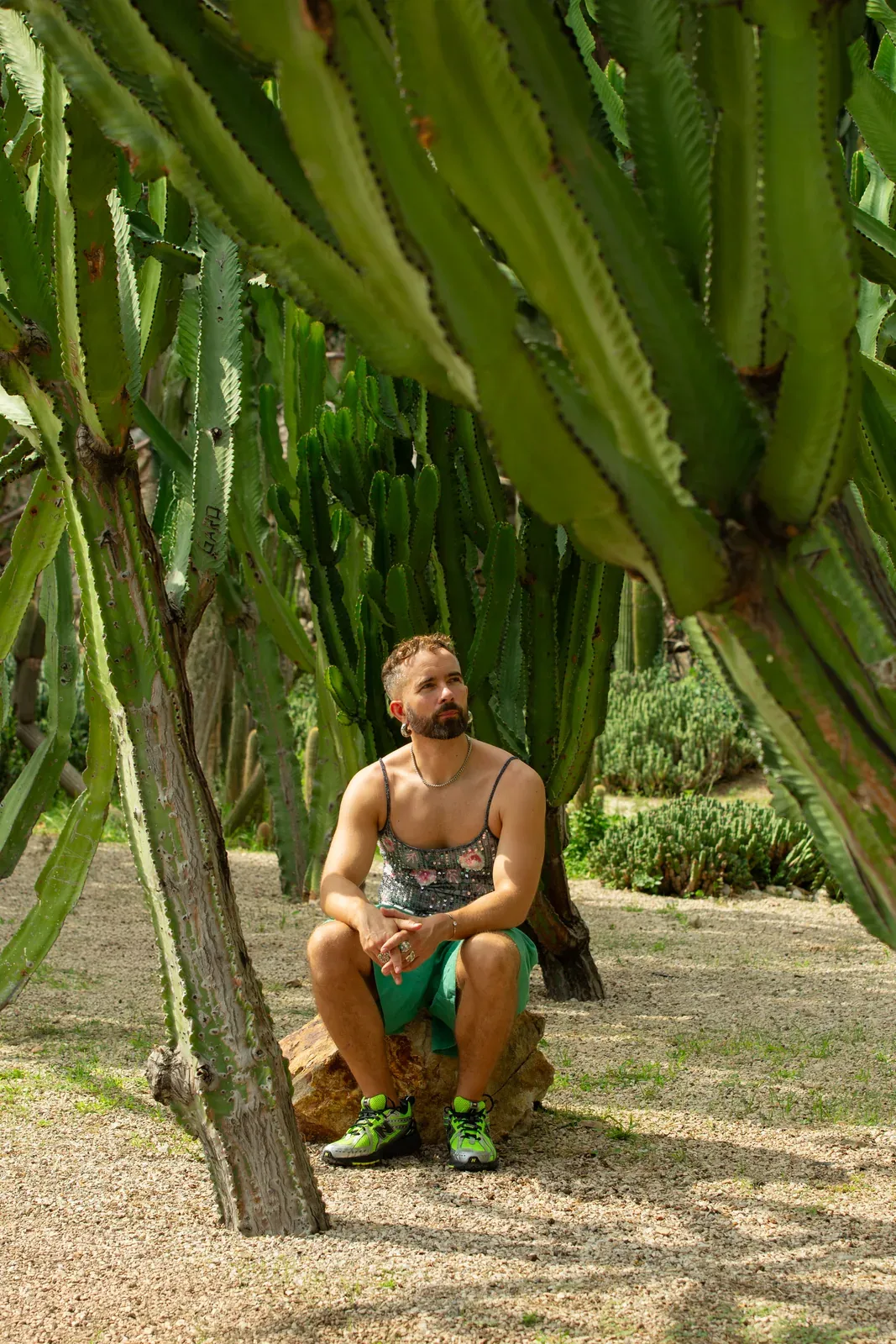
There are artists whose work can be separated from their public persona, and then there are artists for whom that distinction becomes almost impossible, because their creative output has always functioned as an extension of their ethics, politics and way of inhabiting the world. At a time when cultural conversations increasingly revolve around accountability, responsibility and the moral implications of art itself, the figure of Olof Dreijer feels especially significant and inspiring. For more than two decades, he has insisted on understanding music as something far greater than entertainment alone: a space where pleasure, experimentation, political consciousness and collective imagination can coexist. As they do in Loud Bloom (dh2), his much-anticipated debut album.
Together with his sibling Karin Dreijer, Olof formed The Knife, one of the most influential and uncompromising musical projects of the 21st century. Across albums and performances that reshaped the possibilities of electronic and pop music, the duo challenged structures of power both sonically and politically, from questioning wealth inequality and environmental collapse to openly denouncing Sweden and the European Union's asylum policies during the era of Shaking the Habitual. Their work existed simultaneously as music, performance art, political gesture and cultural provocation. Even moments that could have passed as playful absurdism, such as sending gorilla-masked representatives to collect awards at the Swedish Grammis in reference to the Guerrilla Girls, carried a precise artistic and ideological intention.
Although Loud Bloom arrives as Dreijer’s debut solo album, it does not feel like the beginning of a career so much as the latest transformation within an already essential body of work. Over the years, his presence has expanded continuously through projects such as Oni Ayhun, productions for Fever Ray, and collaborations with artists including Björk, Rosalía and Robyn. At the same time, his work beyond music, from establishing a music school for refugees in Berlin to teaching creative production to immigrant youth in Sweden, has reinforced the sense that community and artistic practice remain inseparable within his worldview.
What makes Loud Bloom particularly compelling is the way it embraces joy without abandoning political consciousness. The album resists the disposability that often defines contemporary dance music, transforming club structures into something emotionally enduring, sensual and deeply alive. Across collaborations with artists such as MaMan, Diva Cruz and Toya Delazy, Dreijer continues to challenge the overwhelmingly white and Western canon of electronic music while constructing a record overflowing with movement, colour and openness.
There are ecstatic rhythms, microtonal ambient passages, euphoric synth lines and moments that feel closer to collective release than simple escapism. Even at its most playful, Loud Bloom carries the same commitment that has always defined Dreijer’s work: the belief that music can create new emotional and political possibilities for the people dancing to it.
Now, after years of shaping electronic music from both inside and outside the spotlight, Dreijer steps fully into focus with a record that feels intimate, radical and celebratory at once. We speak with him about Loud Bloom, queer identity and postcolonial studies in dance music, collaboration, experimentation, what the audience can expect from his set at Primavera a la Ciutat on 3 June in Barcelona, and the enduring relationship between politics and pleasure within artistic creation.
Hi Olof! It is so nice to talk to you. Loud Bloom is out now, and it is immense. Listening to it feels like travelling the world in a very cool plane, watching it from above and discovering new shades of colour. How do you feel now that it is out?
It is very nice. I am happy it has been received well; I could not have expected such a good reception!
I love the idea of “celestial dance tracks”, as your music is described in the album text. Even with all the countless nuances involved in these songs, Loud Bloom captures exactly that: an explosion of serotonin and optimism, something we first heard when you released Rosa Rugosa in 2023. What has the process of making the album been like over the past few years?
It has been a fun and joyful process, although I have worked a lot. I work very slowly, so it takes time. But I have been having a good flow, and it is even better now. It was also a process of finding what my sound is today after not having made my own music for a longer period. Now, after five years or so since I started making these tracks, I feel like the expression is landing and becoming even clearer.
Acuyuye, featuring Diva Cruz, is one of the standout songs on the album. The lyrics are so, so fun, the track progression is fierce, and it is a perfect match between your individual realms. How did this feature come about?
After making the two other tracks for the EP for Dekmantel, Brujas and Black Queen, which are more explicitly political, we thought we would make something easy and fun. We made Acuyuye quite quickly because we also had a gig coming up and thought we needed one more track. I had also had this idea for a while that I wanted to build a colder kind of disco beat around the timbales, both giving the main groove and also a solo, so that was quite fun too. And Diva, I think, wrote the lyrics quite quickly. They are about cooking, which we both love a lot!
There are also two other incredible collaborations: the single Echoed Dafnino, alongside MaMan, and Makwande, with Toya Delazy. What drew you to work with each of them? And what did you learn in the process?
Yeah, it was actually Toya who reached out asking if we could do something, and I was very happy because I had already done mashups of her tracks for my DJ sets and loved her vocals. For MaMan, I wanted to include his track Dafnino in my DJ sets and tried making different mashups but it never clicked, so I started working on a remix, which he liked a lot. He recorded more vocals and I made more melodies, and it grew into something new, so I thought, let us include it on the album, which I had not planned initially.
It has been really nice to get to know Toya; she is amazing and so strong, the way she left her previous pop career to embark on something different. MaMan liked what I did a lot, and he asked me to produce some things for him, so I’m looking forward to finding time for that too!
It has been really nice to get to know Toya; she is amazing and so strong, the way she left her previous pop career to embark on something different. MaMan liked what I did a lot, and he asked me to produce some things for him, so I’m looking forward to finding time for that too!
The percussion in this album is, to me, one of its main guiding elements. It is coherent with your previous work, it is inspired by sound styles from different places, and even when it disappears in some tracks, within the album it feels like a whole musical statement. It is one of the things pop music tends to overuse; here it flows in the right doses. How did you approach the album in this sense?
Thank you! I am not sure what to say, but, as with all sounds and grooves I make, I usually try to do it in a way that balances being done in a way I have not heard before with also not being too alien to the listener. I like to keep a respect for the tradition of an instrument while presenting it in a way that is new to me. So usually, I would treat sounds with different effects so that they sound just slightly different. I also try to integrate acoustic sound into the electronic world as much as possible. I don’t like it when you have an electronic beat and then let the acoustic instrument sound completely ‘normal’ or ‘authentic’ on top, because then they don’t quite live in the same sonic world.
I saw a recent interview you did with RPS Music in which you talked about flamenco and all the genres it contains. Being based in Barcelona, have you had the chance to get to know it better?
Yes, I have gone to many flamenco shows, but I don’t know if I understand it better :) It is so advanced!
“I like to keep a respect for the tradition of an instrument while presenting it in a way that is new to me. So usually, I would treat sounds with different effects so that they sound just slightly different.”
Do you see yourself incorporating it into your work in the future?
Yeah, it would be fun to do some flamenco collaboration some time!
You explained that in this record there are some microtonal and calmer, jazzy improvisations. How did this new side of your musical path come about?
I dove into microtonal land around 2010, and we made some microtonal stuff on Shaking the Habitual with The Knife. It connected so well to talking about queer theory, where you question everything that is socially constructed, and the microtonal scales really push that question: why have we agreed on this twelve-note scale when there are so many more notes outside it!?
On Loud Bloom, it is a few smaller explorations because I think that when I started up again with these tracks around 2020, I thought microtonal was a bit exclusive and I wanted to give equal temperament a chance. And now I am back thinking I want to explore microtonal again — it goes in cycles…
The jazzy side, I think, came about when I was in school for social/youth work in 2018/2019 and was thinking I would only have music as a hobby. So I started playing the piano when I came home from school as a way to relax, and thought that would be the way I would have music in my life. I kept those improvisations as songs and they made it onto the album because I think they were part of making the themes for the dancy tracks. But it is not a normal piano, of course. It is with duct tape and felt on the strings.
On Loud Bloom, it is a few smaller explorations because I think that when I started up again with these tracks around 2020, I thought microtonal was a bit exclusive and I wanted to give equal temperament a chance. And now I am back thinking I want to explore microtonal again — it goes in cycles…
The jazzy side, I think, came about when I was in school for social/youth work in 2018/2019 and was thinking I would only have music as a hobby. So I started playing the piano when I came home from school as a way to relax, and thought that would be the way I would have music in my life. I kept those improvisations as songs and they made it onto the album because I think they were part of making the themes for the dancy tracks. But it is not a normal piano, of course. It is with duct tape and felt on the strings.
You have been involved in social work, both teaching creative music production to immigrant youth in Sweden and establishing a music school for refugees in Berlin before continuing to teach. Has working and spending time with them helped you connect to music from different parts of the world?
Yes, definitely. I am very grateful for that experience. For example, I worked with many people from Afghanistan, and I met this young guy who plays the rubab, a string instrument from there. We recorded him on Tunisian composer Houeida Hedfi’s album, which I produced.
Your last show with The Knife was Post-Colonial Gender Politics Come First, Music Comes Second. It feels like that concept is still part of your more recent work. If I am correct, the band was formed in 1999. Looking back now, how do you feel about all the things you both achieved? Not only musically, which is an obvious milestone, but also as a band who talked politics through their art?
I am grateful for having been able to try different strategies to process the different topics through music. Some strategies were better than others. For example, I was studying gender studies/postcolonial studies at university around 2010, and it was very exciting to read all these amazing writers. We wanted to share this with others, but today I would go about things much more carefully and try to be more strategic, packaging these ideas much better and making them less academic. Because it is very clear that if you aren’t intersectional, if you don’t think about all sides of power at the same time, you end up excluding many people, and we have been very guilty of that.
“ I believe more than ever in using the ways of the mainstream as a strategy to be present there.”
You will be playing Primavera a la Ciutat on 3 June. What can the audience expect from the show?
A mix of rap/R&B mashups with stompy house and techno, my own music, and some new experiments I am working on.
You mention being inspired by Akwaeke Emezi and their ability to smuggle radical ideas into accessible forms. Do you think dance music can carry political or philosophical ideas more effectively when it first seduces people emotionally? And does that mean rethinking the club, or finding other kinds of spaces for music and dancing?
Yes, absolutely! Even if it is not spreading an important message, just mirroring a person in the audience is, of course, so strong for that person. I think a lot about inclusion when I do my DJ sets.
Across your career, from The Knife to activism, education and now Loud Bloom, there has been a consistent resistance to rigid identities and structures. Similarly, it gets tougher and tougher to stay critical when capitalism absorbs every fight and turns it into a trend. At this stage, what feels most important for you to protect creatively and politically?
Oh yes! The force is strong. Meaning the commodification of things at this time is stronger than ever, and it is done in very obvious ways. But at the same time as, for example, queer stuff is being commodified, we also live in a regression, so even though some things can be commodified in one context, they are still very radical in another. But I believe more than ever in using the ways of the mainstream as a strategy to be present there, because it usually reaches more different kinds of people. Well, my idea of mainstream, which the mainstream probably thinks is weird...
Finally, what are your artistic plans for the rest of the year?
Live tour in the autumn! But first, holiday in the summer :)