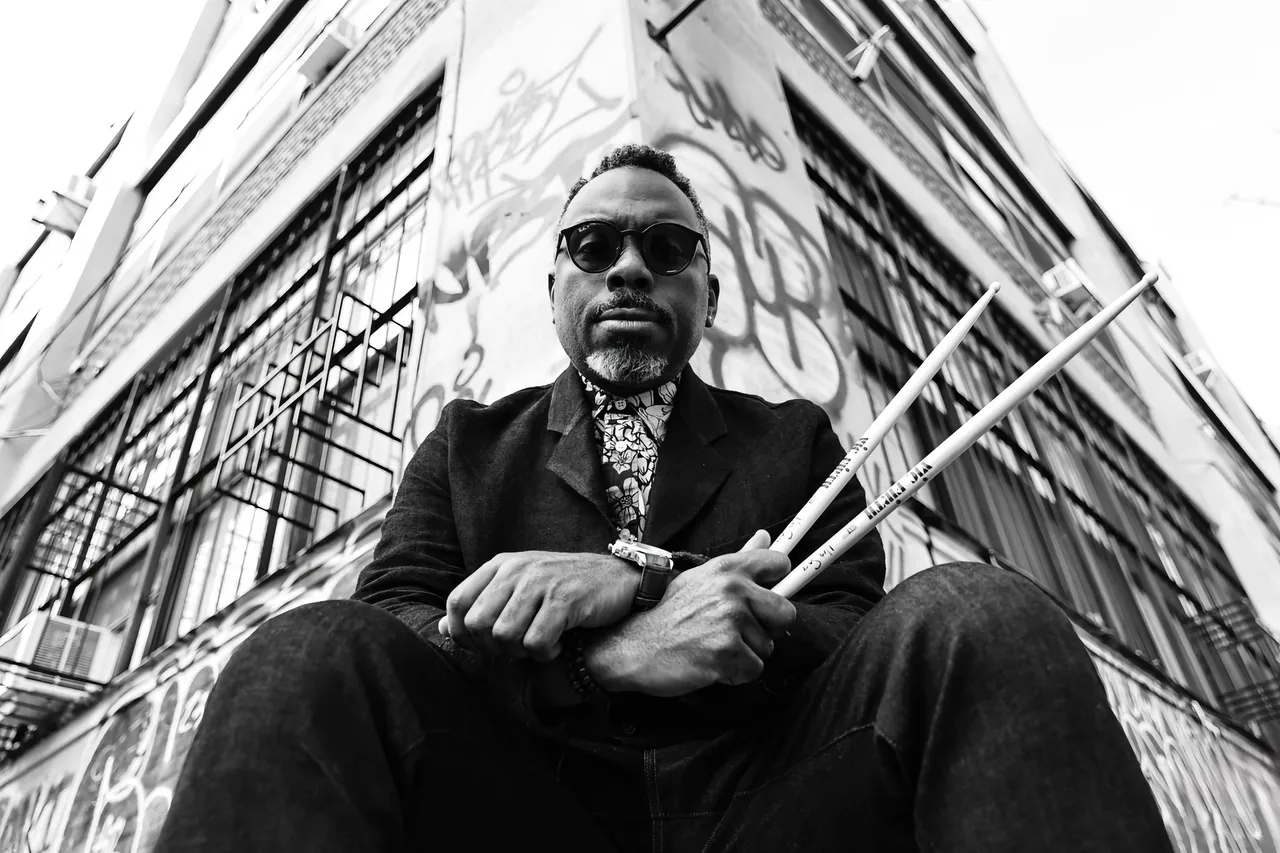
With LIVE-ACTION, Nate Smith strips jazz back to its bones, recording live with no programming, no sequencing, and only a handful of takes. The two-time GRAMMY nominee is already known for his razor-sharp groove and boundary-crossing collaborations, but this project feels different. It’s the sound of an artist refusing to sand down the edges, choosing instead to lean into imperfection and let the music breathe with an urgency that feels both timeless and immediate.
We caught up with Smith a few weeks after the album’s release, just as he was finalising the details of a tour that has kicked off this week. Balancing the anticipation of the road with the resonance of a record that thrives on honesty, he spoke about chasing humanity over perfection and finding beauty in limitation. With a guest list that spans icons and rising voices alike, LIVE-ACTION is proof that imperfection can sound magnetic.
It’s been about three weeks since LIVE-ACTION dropped. How have things been for you since then?
Things have been a bit of a blur since LIVE-ACTION came out, as I've been in tour-prep mode for the majority of the time. I’ve been receiving a lot of love from listeners and supporters, which of course feels amazing. More than anything else, I’m excited to hear this music evolve on tour.
You’ve said you wanted the album to sound like it was recorded on a cassette in your bedroom with all its imperfections. Why did embracing mistakes and limitations become more interesting to you than chasing polish?
I believe perfection is an elusive quest, and I also believe that sometimes the quest for perfection is antithetical to the creation of music. I think perfection occurs when all of the imperfect pieces work together, rather than the idea of making each piece perfect.
The list of collaborators on LIVE-ACTION is amazing, from Lalah Hathaway to Lionel Loueke. How did you decide who to work with, and were there moments when someone brought out a side of you that you didn’t expect?
Some of the collaborators on LIVE-ACTION I’ve known for many years. I met Lionel Loueke back in 2011, and Michael League not long after that. Other relationships are relatively new; I just met Kiefer and CARRTOONS in 2023, and played with Marquis Hill for the first time the same year. I’d never met Lalah before reaching out to her for this collaboration. They all brought beautiful music to the table and truly brought out the best in my playing, whether remote or in person.
Even with large ensembles, there’s a lot of intimacy in the record. Was that something you aimed for from the start, or did it just naturally appear once you were in the studio?
I think the intimacy is kind of built into the music. These ideas are pretty personal, and the fact that I'm playing all the instruments (drums, keys, keyboard, bass) on the majority of the album gives it a personality that feels individualized.
You’ve done so much in your career already, from being invited by Betty Carter to more recent projects. How do you see your identity as a drummer, producer, songwriter evolving over time? Are there sides of yourself you’re only now getting to express?
I’m learning and growing in all ways: drummer, producer, songwriter, bandleader. I’m trying to apply some of the lessons I’ve learned from the musicians I’ve worked with who’ve gotten it right. And in terms of expressing different sides of myself, I think that will continue to unfold naturally as I progress. It’s my hope that the listeners and supporters I’ve earned will trust the evolutionary process.
Which track on the album surprised you the most in the end, the one where you listened back and thought it turned out very differently than you expected?
I gotta say, Lionel added a whole other dimension to Magic Dance. I mean, jaw-dropping. More than I ever could’ve imagined for the record. What a musical imagination he has.
Working with Lalah Hathaway on Automatic, reimagining a classic, how did that collaboration come about, and what was it like taking on something that already lives in people’s memories?
Michael League reached out to Lalah on my behalf, letting her know I had a collab in mind for my new record. When she reached back out to me, I had already put together a demo with the a cappella from the original record. I sent it to her and she dug it. She turned it around so fast and so perfectly. I literally dragged and dropped her vocals into the record, and it was amazing.
Recording everything live with no programming or sequencing must have created both tension and joy. What do you hope listeners feel when they hear those raw takes?
I really hope listeners feel a bit of the joy and discovery I felt making the record. Yes, there was tension, and there are some “mistakes” on the record, but it’s honest. It’s the record that I think sounds the most like me in total: composer, producer, and drummer.
Do you feel more freedom now as an artist than you did early in your career?
I feel more freedom in general, not just as an artist but as a man. I hope that comes through in the music.
Looking back at KINFOLK: Postcards from Everywhere and comparing it to LIVE-ACTION, what has changed most in your creative process, and what has stayed the same?
I try not to compare the two records. They’re different records with different intentions. KINFOLK was a band with a band sound. My creative process hasn’t changed that much, but I do believe it’s a bit of a challenge to maintain the same regular practice that created the KINFOLK music. I’m busier now than I was then, so maintaining the regularity of composing practice has been more difficult. I now find myself composing on the go, in motion.
When you’re working on new music, do you thrive more in the quiet of the night or in the energy of the morning, or does it depend on the day?
It depends on the day. But I will say I usually do compose alone, sitting at the piano and fishing for chords that make some kind of sense to me.
Outside of music, what do you enjoy that inspires you? Is there anything unexpected that feeds into your work?
Art of all kinds inspires me. I draw inspiration from reading books, visiting museums, seeing films, and binging TV shows.
Your tour kicks off this week with shows across North America and beyond. What are you most excited about when it comes to playing these songs live, and what challenges do you think about before hitting the road?
The pre-tour jitters are real. I hope all the travel goes smoothly, that all the logistics are sorted, and that people show up! With the heavyweight musicians I’ll be traveling with for this tour, I worry least about the music. I know the music will be fun!
Your stop in Madrid at Sala Villanos on November 6th is coming soon. How are you feeling about that show?
I am very, very excited about the November 6th show at Sala Villanos in Madrid. It will be the premiere of this configuration of musicians: James Francies, Michael League, Josh Johnson, and me. Can’t wait to hear it for myself!
If you could dream up one collaboration with anyone, from the past or present, who would it be and why?
Too many to choose just one, but I would love to have been a fly on the wall in the studio with Quincy Jones, just to watch him work with people. He seemed to be a brilliant collaborator.