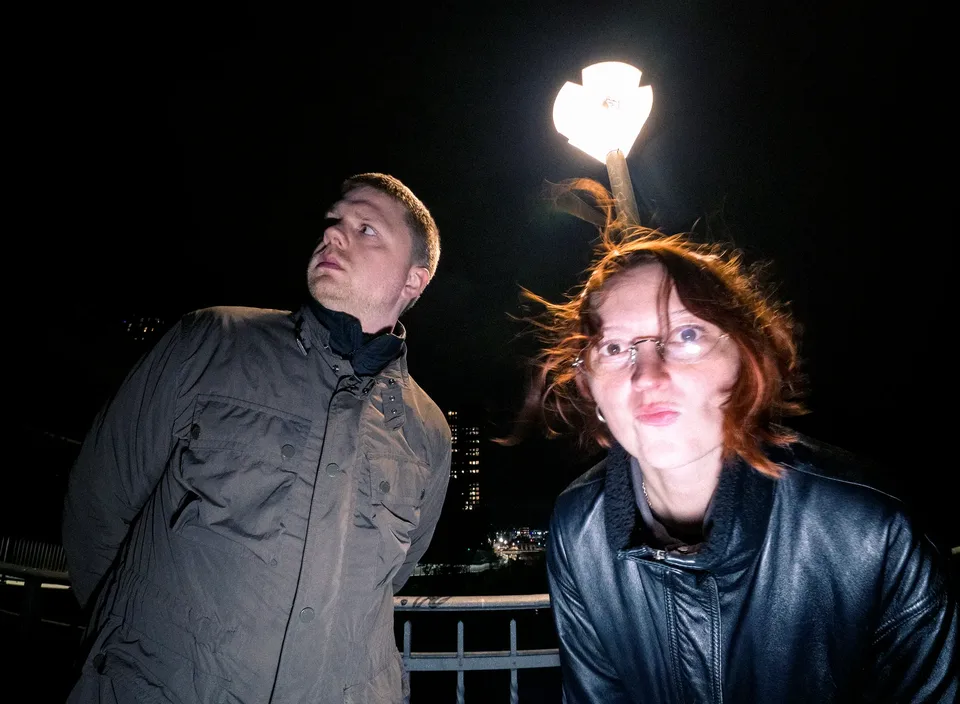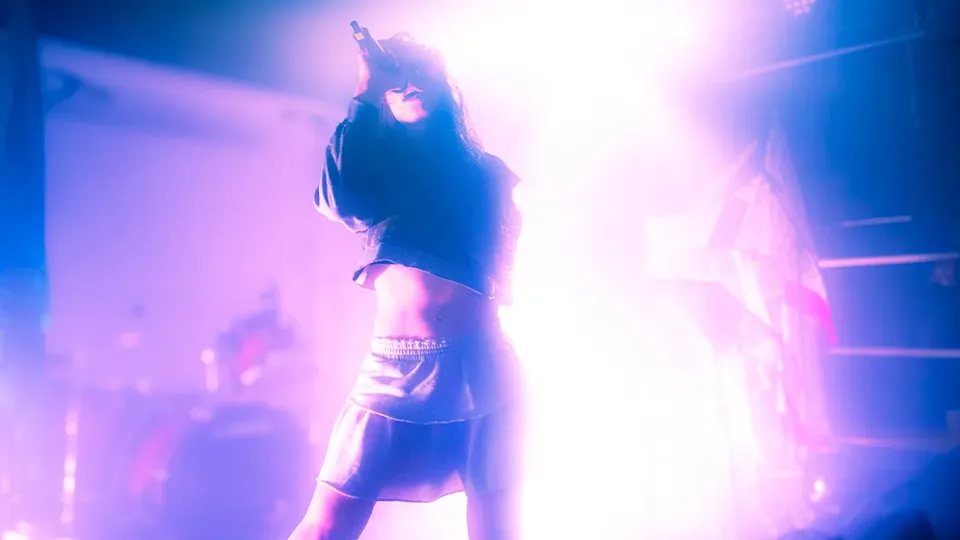
The Russian pop star recently left her home base in Moscow, dropping down in the one and only Los Angeles, where she continues to make a name for herself in the dark pop genre. Nastiya Kai is young and maybe doused in gasoline or whisky, because my god is that girl on fire. Looking at the artist, you see a young woman with fiery red hair—"hair red like chimaera,” she says in her song Demon Era—clad in leather and fur, often black or of the same fiery red. She says no to no grommet, studded belt, or striking pair of boots. The name Demon Era is fitting: Nastiya Kai would stand out less at a dinner party attended by Cruella Daville, Ursula, and the Evil Queen than at a luncheon with Cinderella, Snow White, and the Little Mermaid. But ultimately, Kai’s dark aesthetic is challenged by her unbelievable candidness and vulnerability.
Kai is both cool and lonely. In Party at My House, Kai’s opening line is, "There’s a party at my house!” Her voice is just raspy enough; we can immediately tell she’s cool. Already, we wish we’d been invited to this party. But then she goes on: “I don’t know anyone; it’s strange they’re all here. I go back to my room and take a line. I look into the mirror and see a stranger.” She explores the dissonance between cool parties attended by cool people and the inner void so often deepened in their wake. Kai is saying what we want to say but can never find the words for.
Throughout her LP, listeners hear her vacillate between self-hatred and a kind of God complex—a concept so relatable to young women of today, who have more freedom afforded to them but still the same judgements, pressure, and politics of the generations before. “I get to the club; I'm the cool kid; I’m the hottest; sue me!” Kai boasts in Wild. Self-hatred and self-consciousness have a flipside, and sometimes that feeling is power. But it’s a particular kind of power. [At the club,] Kai says, “I don't even wash my makeup off so they’ll know I've been through it.” In our society, pain can be an ingredient in glamour. And Kai wants to leave us with that thought.
The LP, Demon Era is an exploration of self. Part of that, for Kai, is orienting herself in relation to romance and to other humans in general. In The One, she says, “All these women look at me like a joke.” Just one line, and Kai has touched on the patriarchy’s manifestation in antagonisms between women and on the propagation of shame. Her shame continues in her romantic endeavours, as she is intensely aware of herself and of the space she takes up. Her song I’d Do Anything begins with a light melodic instrumental, so wonderful and uncharacteristically pleasant that you might initially be tricked into thinking you’re hearing Sufjan Stevens or Angèle. But soon, it all becomes clear: the beat slows, the bass lowers, and the plot thickens. “Me with my muddy vans on your white carpet... turning heads, but I’m a mess... [I] promise I’ll be better at the top.” Kai anguishes, ashamed of her dirty shoes and their effect on a spotless surface.
“Whatever happened to the girl next door,” Kai wonders (still in I’d Do Anything). “I go to bed with snakes now; I’m the queen of their lair.” Lamenting the ways she’s become impure, dwelling on her move to the dark side—that’s what we think is happening. And it doesn’t feel great. But then Kai, the Kai we know and the Kai that never ceases to amaze us, returns with characteristic fierceness: “I never thought I’d say this, but I kind of like me better with my scars.” A breath of release. We agree.
Kai plays the “tough card,” but in reality, she is in pain and she is searching for herself, for belonging, and for love. And she’s not too scared to say so. To quote the woman herself, Nastiya Kai is a “resplendent woman full of ghosts.”