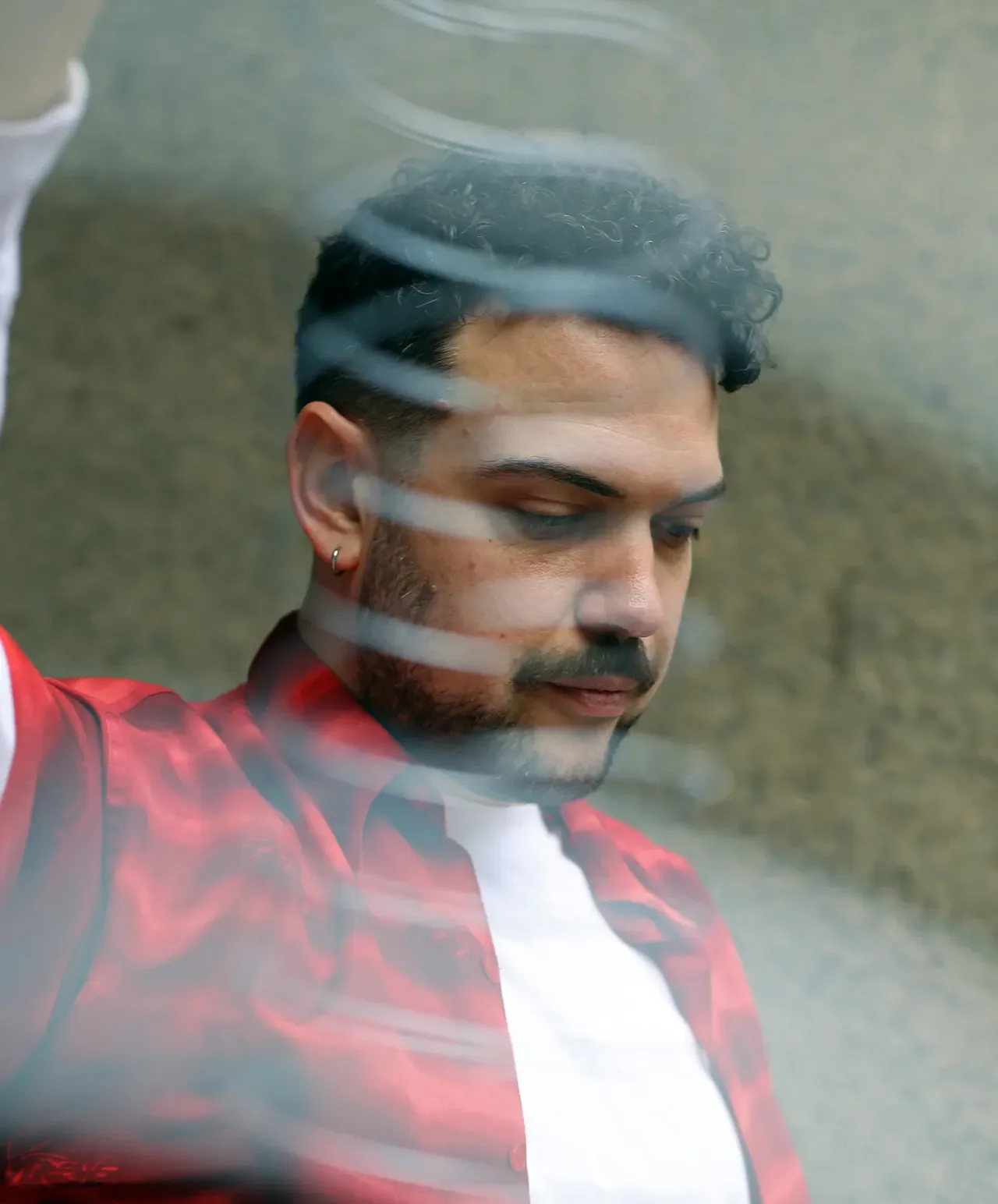
Sometimes life leaves us strange clues or places certain things in our path, giving our intuition a sense of purpose. It might just be a trick of the mind, or something we humans have chosen to believe so that we can feel everything has a meaning. Imagine that one day you pick up a bargain record for £1, and it contains an unknown a cappella track that suddenly clicks. This happened to Morgan Hislop, who has just released his new EP, Nice Try!. The leading single, Sitting by the Phone, came about through this lovely coincidence and ended up being named by Complex as one of the best songs of 2025.
However, this new EP is not the result of chance or some cosmic conspiracy; rather, it is the culmination of an artistic career in which attention to detail and storytelling have always driven Hislop’s creative impulse. The London-based multidisciplinary artist has been making music since 2018, while also expanding his realm through DJing, visual art, and creative direction. A key figure in London’s electronic scene, he has produced visuals for Sherelle, Waterworks, and Sega Bodega, with work exhibited at Tate Britain. His vibrant, forward-thinking productions—alongside club edits of artists like Rosalía and Charli xcx—have been supported by DJs including VTSS and Anna Lunoe. He has also held residencies on Rinse FM, Radar Radio, and Reprezent Radio, while performing internationally at events such as Glastonbury and SXSW.
In 2022, he released his debut album Ghostin’ Me via Remedy!, a fully self-directed project blending club influences with future-pop sensibilities that received critical support from Mixmag and BBC Radio 6 Music. However, the intensity of independently managing every aspect of the release led to burnout, prompting Hislop to step back and reassess his creative approach. Returning to his fine art roots in collage, he began embracing sampling as a central, expressive tool, drawing on ‘found’ sounds in a more instinctive and unpolished way. Influenced by plunderphonics, he shifted towards creating music that feels timeless yet recontextualised.
This evolution led to the launch of Mystery Shopper, a multidisciplinary platform spanning music, visual art, and design, grounded in a lo-fi, resourceful ethos. While initially focused on his own releases, the label also aims to connect with like-minded artists driven by experimentation and conceptual ideas rather than genre. His new EP, Nice Try!, reflects both personal and wider disconnection: it captures his uncertainty after time away from music, while also addressing a broader sense of societal fragmentation in an increasingly hyperconnected world.
In this interview, we delve into the creative process and inspiration behind the EP, sampling as a form of musical recycling, and the visual approach to his work as an artist.
Hi Morgan! How are you? I’m delighted to be doing this interview; I’ve been a fan of yours ever since I heard Ghostin’ Me. Almost four years on, you’re back with a new EP. How have things been for you in the meantime?
I am so good! Yeah, it’s been a long while. I came out the other side of Ghostin’ Me feeling existential and burnt out. I remember speaking to people saying I was considering giving it up. But I think I just needed to go back to the drawing board and start making music just for the love of it, without a specific project on the horizon that I was working towards — to just indulge and have no deadline. In that time, I re-established what it is I love about making music and how to conserve that. So, this new EP materialised pretty naturally and I like to think you can hear that in there.
Nice Try! is out now. How does that make you feel? It’s more than just a musical project! And what inspired you to choose that title?
I’m a little nervous! I feel like I’m starting out again from scratch, so there is some trepidation. The title is like a word of encouragement to myself; a sign that I’ve given music another go, another effort. But I guess there’s a sarcasm to that phrase too; a sourness that implies maybe it hasn’t landed quite where I’d hoped my efforts would go. Nice try, loser, but not good enough! (Laughs)
What is the concept behind it? Can you tell us a little bit about the themes and the sonic direction of this EP?
The EP itself is a reflection on the loss of connection with others. Both on a personal level (the worry of being out of action in music for so long and feeling like I might have no one to call on anymore) but also on a grander, societal scale. How the world feels so ‘lost in translation’ with itself; there has never been more discourse, yet it feels more disconnected than ever.
The record is purposefully littered with missed phone calls, people hanging up on each other, ghostly conversations, and pockets of dialogue with no resolution. There are a lot of voices heard throughout, but they all feel isolated or as if they are missing a recipient. The record gives the impression of endless dialogue, at all hours of the day and night, but with nothing of substance. Sitting by the Phone’s central vocal line boasts about a missed interaction, for better or for worse. Weirdo’s lyrics are like a miscommunication of expectations in a relationship. City Light Streaks starts with a mysterious prank phone call fading into the sound of skipped TV channels. Who’s listening anymore? To anything… let alone my music! This is what Nice Try! is about.
The record is purposefully littered with missed phone calls, people hanging up on each other, ghostly conversations, and pockets of dialogue with no resolution. There are a lot of voices heard throughout, but they all feel isolated or as if they are missing a recipient. The record gives the impression of endless dialogue, at all hours of the day and night, but with nothing of substance. Sitting by the Phone’s central vocal line boasts about a missed interaction, for better or for worse. Weirdo’s lyrics are like a miscommunication of expectations in a relationship. City Light Streaks starts with a mysterious prank phone call fading into the sound of skipped TV channels. Who’s listening anymore? To anything… let alone my music! This is what Nice Try! is about.
You take this technique to another level in the video for Midnight Multiplex. Regarding the single, you mentioned that in recent years you’ve become increasingly aware that it’s films and cinema that inspire your sound, and you’ve recently shared that the inspiration for this song comes from the work of Wong Kar-wai, David Cronenberg, Takeshi Miike, and Gaspar Noé. How does that translate into the music?
Yeah, the Midnight Multiplex music video was so fun to make! I trawled through hundreds of obscure films, old adult videos, and TV to find clips that were ambiguous enough to be compiled into a new visual narrative for the music to soundtrack. Much like sampling audio, I love repurposing existing material to add new context to it; it’s like building new worlds.
I always aim for a cinematic escapism in my sound; film and contemporary art play such a huge part in my music. The lines blur between influences, whether they are music-related or not; it’s the same with how music often inspires the visual work. He’s loved so universally at this point that it’s become a cliché to mention David Lynch, but I have always admired the fact that the term ‘Lynchian’ can be applied to both a type of music and a type of cinema. It’s a vibe or an atmosphere that manages to encompass whatever medium it might be. This notion of transcending medium and capturing a feeling instead is hugely inspirational to me.
I always aim for a cinematic escapism in my sound; film and contemporary art play such a huge part in my music. The lines blur between influences, whether they are music-related or not; it’s the same with how music often inspires the visual work. He’s loved so universally at this point that it’s become a cliché to mention David Lynch, but I have always admired the fact that the term ‘Lynchian’ can be applied to both a type of music and a type of cinema. It’s a vibe or an atmosphere that manages to encompass whatever medium it might be. This notion of transcending medium and capturing a feeling instead is hugely inspirational to me.
“You thought that I was sitting by the phone / The joke’s on you, I wasn’t even home.” These fierce lyrics and incredible production fuse in the project’s first single, Sitting by the Phone. It has a cinematic feel to it, in the sense that it depicts a scene, a part of a wider story. I love the kettledrums/timbales in the background. How did this song come about?
This was the first track that materialised when I started digging around and being more bold in sampling found sounds and records. I found the a cappella in a £1 bargain bin and just immediately fell in love with it. In just two lines of lyrics you get so much narrative: someone’s been stood up, there’s a reversal of a power play, someone’s now out of the house and revelling in it. It’s cheeky but also empowering.
For a long time this track had no drums; I was intending to keep it beatless, just layers of pads and delicate little melodies with that repeated vocal. And then I found the crunchy percussion/drum sample in another bargain bin and knew I had to bring the energy up and make it more of a dance track!
For a long time this track had no drums; I was intending to keep it beatless, just layers of pads and delicate little melodies with that repeated vocal. And then I found the crunchy percussion/drum sample in another bargain bin and knew I had to bring the energy up and make it more of a dance track!
Weirdo seems to follow up the story with a more carefree attitude. And it was recently added to KEXP playlists! You collaborated with I Dress Louise for this one. How did you two end up working on this song together?
We met backstage at a salute show in London. We got talking as I am a big fan of Andy Smith (formerly Lxury), who is a collaborator on a lot of her music. She’s a true artist; her approach to her musical projects (she used to release music under the name Hockeysmith) comes from a place of experimentation, but it’s still really accessible and captivating. We sent demos back and forth for a long while, and then she sent footage of her performing the track down on the beach in Cornwall, which I later manipulated and edited for the Weirdo music video.
And all of this is happening within the context of a big achievement: the creation of the label Mystery Shopper. You said of it: “It’s a developing concept; a creative outlet to shoot ideas out into the world, limited not just to music, but equally in accompanying visual art, video pieces, physical media, merch, and design.” It takes courage and determination to take on a project like this, but the approach sounds very promising. What made you decide to start the label?
I think there was a ‘eureka’ moment after the release of Ghostin’ Me when I realised I had the ability to be in control of almost every element of a music release. I was doing almost all the artwork and video myself, so why not just own that and launch a discography of releases that all shared a similar energy?
It’s already feeling like a lot, and I admit it feels as though I’m groping around in the dark and testing things out — I have no clue what I’m doing! But I’m super passionate about making it work, and I’m really keen to open it up for collaboration with other artists while not just focusing on music. It can be whatever we make of it. The validity of a record label is definitely under threat in 2026, so I like the idea of stretching the expectations of what it can be.
It’s already feeling like a lot, and I admit it feels as though I’m groping around in the dark and testing things out — I have no clue what I’m doing! But I’m super passionate about making it work, and I’m really keen to open it up for collaboration with other artists while not just focusing on music. It can be whatever we make of it. The validity of a record label is definitely under threat in 2026, so I like the idea of stretching the expectations of what it can be.
“The record is purposefully littered with missed phone calls, people hanging up on each other, ghostly conversations, and pockets of dialogue with no resolution.”
You recently did a DJ set to present Mystery Shopper at Voices Radio, with a fantastic selection of sounds. Sonically, was it referential to the type of sound the label will be working on?
Yeah, I think so. I always want to use mixes and radio to try and make sense of the sounds I gravitate towards. I often worry that my sound is too eclectic; too often eclecticism is seen as a dirty word, or a sign of an artist struggling with their identity! But I’m usually drawn more to a feeling—of melody, vibrancy, and energy—than to boxing myself into binary music genres. Radio allows me to figure that out and be retrospective in a public way. But yes, the label will centre around a more cinematic, evocative feeling, and also on sounding somewhat timeless. There’s far too much music out there today that feels like a pastiche of a nostalgic sound or a clone of a current trend, and I want to surpass that.
You are more than a DIY music artist. You work on all aspects of your project: visually, promotionally, the events… everything. We’ve entered a time in which DIY is a concept that seems to have been romanticised by the media, but it also reflects a certain autonomy and creative independence. How sustainable is this ‘model’ for you and other peers you know?
I can’t lie, it’s hard, and I think this is where I would love to try some new approaches in the future. I think the music industry, and the creative industry as a whole, really, can be so hostile for people who are broad in their artistic expression. One week I’m all about the music, and the next it might be all about visual artwork or a video — and it makes it hard to find your people when maybe it takes longer to explain what you do.
We’re being pushed to narrow our creative field in order to be easier to compartmentalise or ‘market’ on social media platforms; to grab that thin sliver of someone’s attention. I like being self-sufficient, but if part of the joy of making music is about creating connections with other humans, the DIY way (doing everything yourself) can often be an isolating place.
We’re being pushed to narrow our creative field in order to be easier to compartmentalise or ‘market’ on social media platforms; to grab that thin sliver of someone’s attention. I like being self-sufficient, but if part of the joy of making music is about creating connections with other humans, the DIY way (doing everything yourself) can often be an isolating place.
You have produced visual designs for Sherelle, Waterworks, and Sega Bodega, and some of your work has been exhibited at Tate Britain. There’s a strong connection in your music to colour, but collage as a concept also seems to be at the core of your artistic vision. Do you remember how and when you were first drawn to the arts, and how your particular style developed?
I’ve always been into modern art from a very young age. I studied video art at art school, where I specifically experimented with collage and found-footage video, layering and manipulating imagery in lo-fi ways. I was obsessed with video artists like Bill Viola, Pipilotti Rist, and Nam June Paik—we actually visited Paik’s childhood home in Seoul last year, which was something of a milestone moment for me. These artists all used cinematic touches and colour in abstract ways, yet there was always a resourceful and upfront approach to that era of early video art that I loved.
Alongside art school, I was balancing being a session drummer for electronic artists as well as noise rock and math rock bands. I remember loving how Zach Hill (of Death Grips) was a musician but also produced all of their music videos and artwork. So, that balance between music and visual art has always been there, and the influences have really intertwined. Later, this gave way to artists like SOPHIE, who had such an evocative sound and art-adjacent visual identity that really influenced the vibrant, melodic side of my music.
Alongside art school, I was balancing being a session drummer for electronic artists as well as noise rock and math rock bands. I remember loving how Zach Hill (of Death Grips) was a musician but also produced all of their music videos and artwork. So, that balance between music and visual art has always been there, and the influences have really intertwined. Later, this gave way to artists like SOPHIE, who had such an evocative sound and art-adjacent visual identity that really influenced the vibrant, melodic side of my music.
“I like being self-sufficient, but if part of the joy of making music is about creating connections with other humans, the DIY way (doing everything yourself) can often be an isolating place.”
City Light Streaks, We Home is the closing track of the EP. It’s both luminous and frenzied. I love its progression; it feels like the narrative is telling us ‘to be continued’, like another fragment of the story. What can you tell us about this song?
Thank you! Yeah, this track felt like a breakthrough moment in the way it progresses. I was really inspired by William Orbit, specifically the sounds he created for Madonna’s Ray of Light. Those slightly abrasive analogue textures where you can hear him turning dials and knobs on real machines. I wanted moments that captured that late-90s electronica sound like Orbit’s.
Thematically, City Light Streaks captures that dizzying energy of a night out: dining out and socialising with friends, your head spinning as you take public transport across the city half-drunk, the dazzling lights of the club amongst crowds of people, but also those moments of transition from being surrounded by friends to being all on your own. There’s an introspection buried in there, for sure.
Thematically, City Light Streaks captures that dizzying energy of a night out: dining out and socialising with friends, your head spinning as you take public transport across the city half-drunk, the dazzling lights of the club amongst crowds of people, but also those moments of transition from being surrounded by friends to being all on your own. There’s an introspection buried in there, for sure.
I wonder who the artists are that inspire you, both musically and visually, at this moment. What are your ‘musts’ for this season?
Music-wise, I’m loving the new PPJ EP, Coeur. This duo fills me with so much life. If you ever get a chance to see them live, they are absolutely captivating. It sounds like they are having so much fun making whatever music they like, and we’re along for the ride. There’s also a great London producer called Flaurese who nails this super summery house music; it’s impeccable, uplifting, and has a lot of heart. And I’ve been glued to an EP titled Palomino by an artist called Dove. We saw her perform in Kyoto alongside Le Makeup last summer and she blew me away. It’s like minimal electropop, but her vocals are just sublime.
And visual favourites right now? Maybe not something brand new, but I went to see a screening of Andrzej Żuławski’s On the Silver Globe at the end of last year and I have not stopped thinking about it. A bombastic, over-ambitious sci-fi nightmare by the guy who directed Possession. You will not be the same after!
And visual favourites right now? Maybe not something brand new, but I went to see a screening of Andrzej Żuławski’s On the Silver Globe at the end of last year and I have not stopped thinking about it. A bombastic, over-ambitious sci-fi nightmare by the guy who directed Possession. You will not be the same after!
And finally, what’s next? Are you planning on taking the project into live spaces and DJ sets soon?
I’m keen to try and start building a community or a tribe around the label; I feel that’s something I’ve lost in the break since Ghostin’ Me, so I’d love to arrange some parties, listening sessions, and exhibitions — just to get people together in a room. I’ve got a short-form book, like a zine, that I’m writing; I want to try and launch that through the label next, as well as introducing some new artists and building out Mystery Shopper’s sound. I give myself too much work!