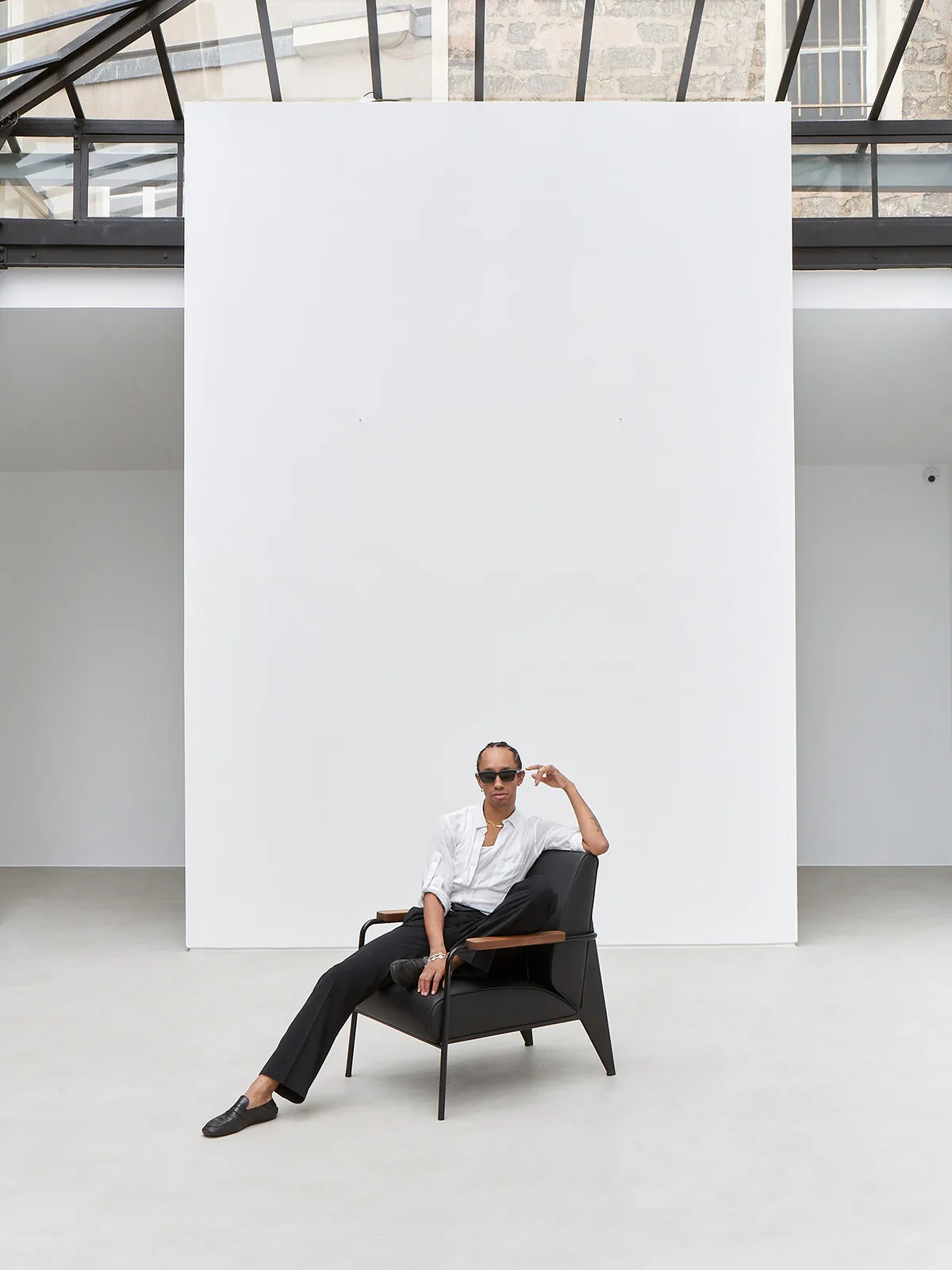
My first encounter with Miles Greenberg was in Berlin, 2022, at the Julia Stoschek Collection film presentation of his performance Fountain I — a hypnotic meditation where the body became a living sculpture, a vessel, a monument to its own surrender. Montreal-born and New York-based, Greenberg has emerged as one of contemporary performance’s most singular voices, moving fluently between endurance, sculpture and ritual.
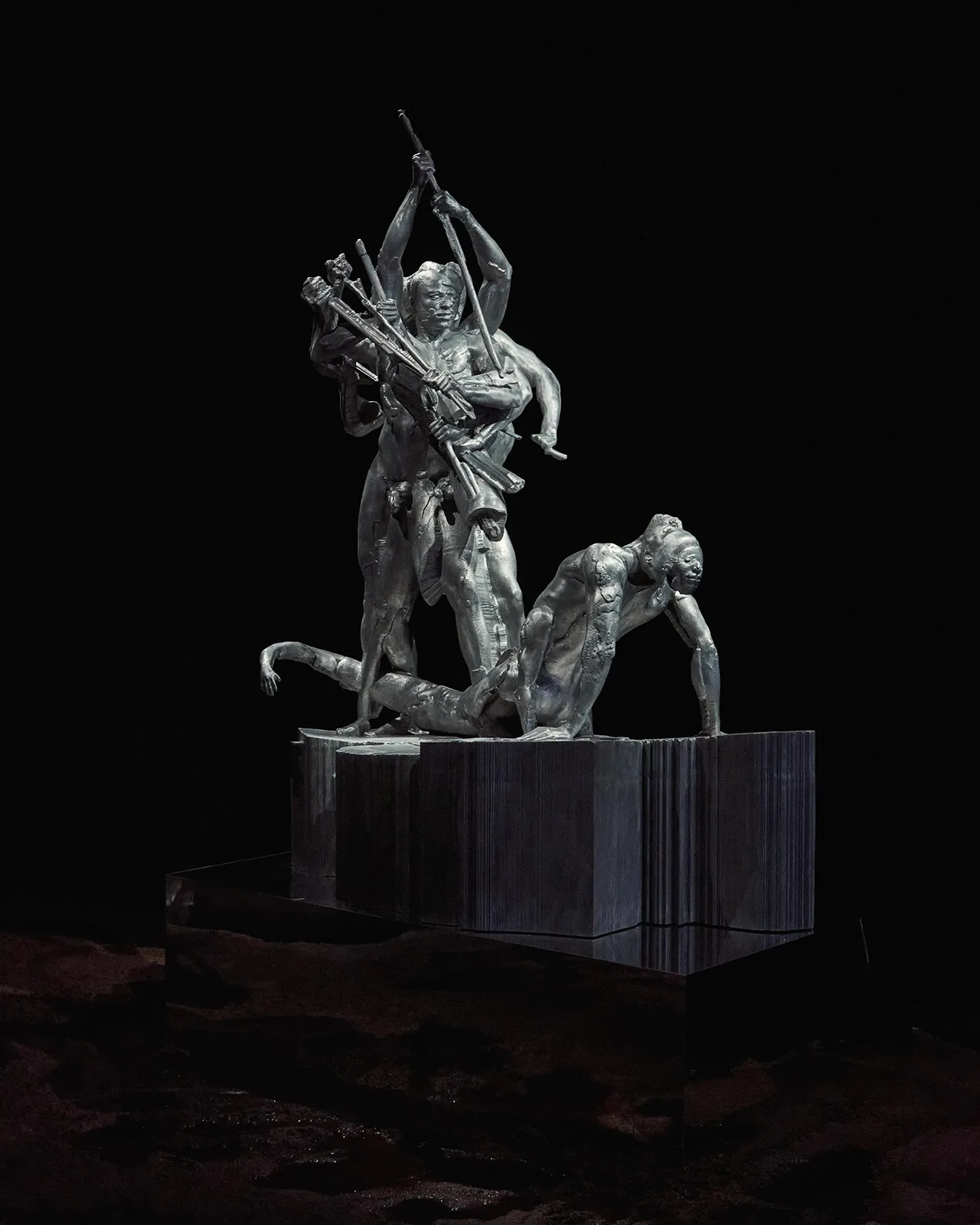
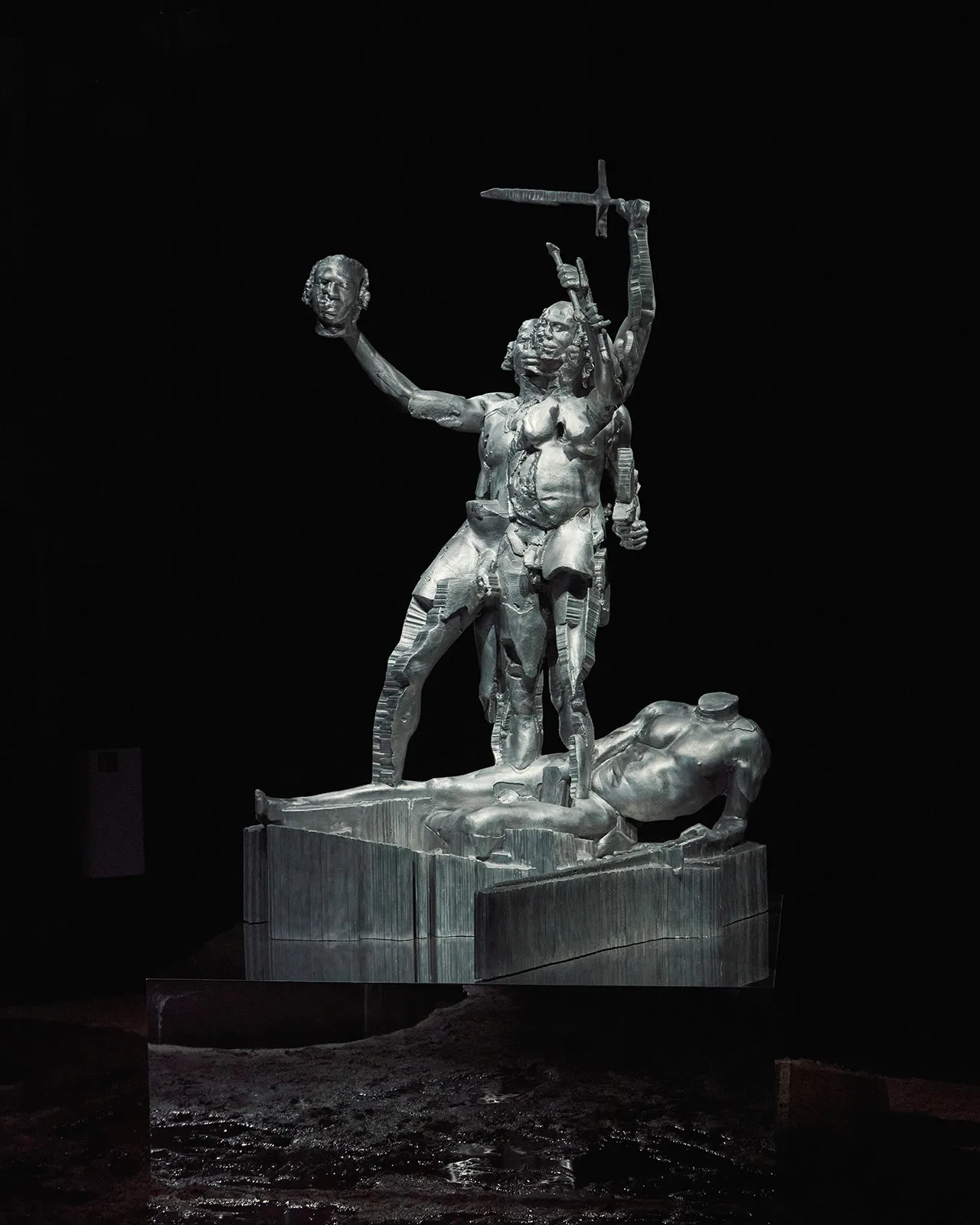
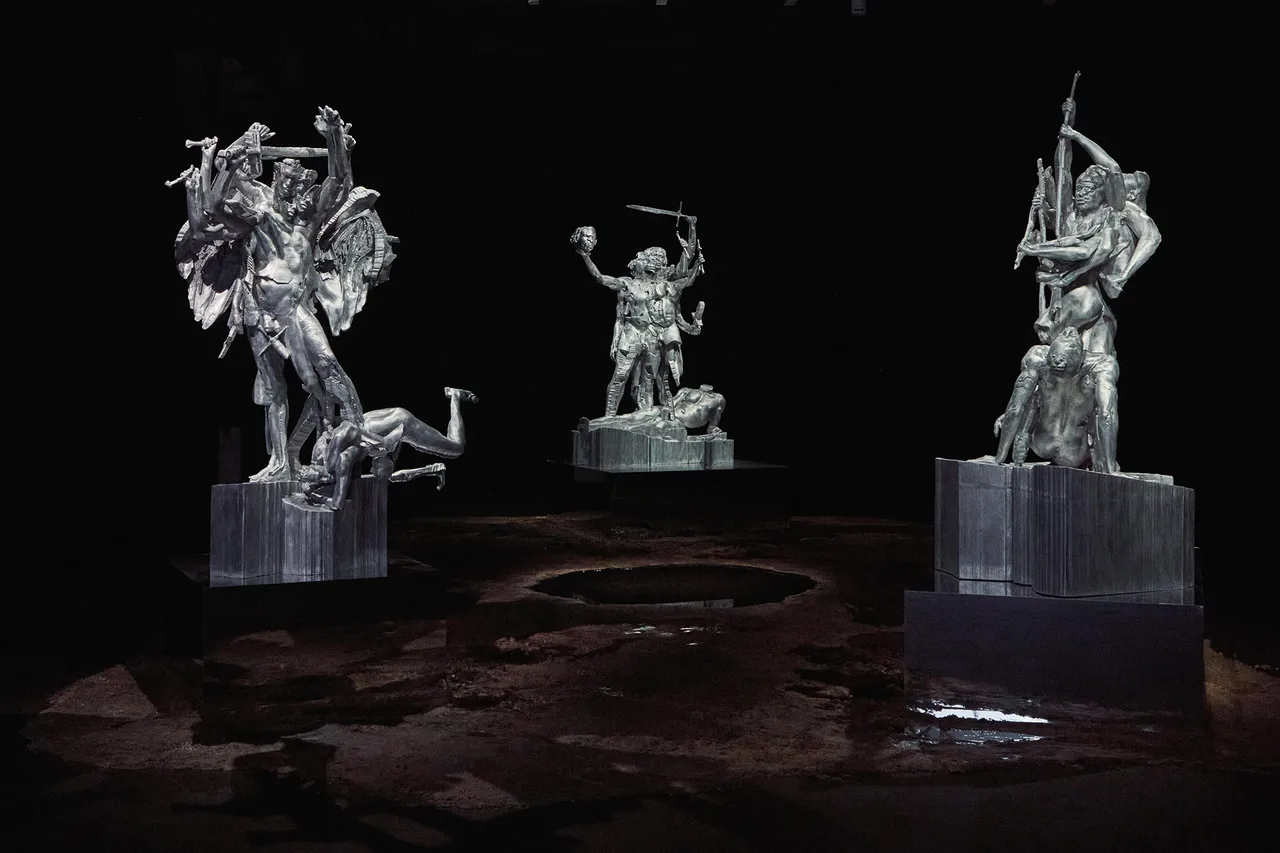
Two years later in Paris, under the curatorship of Olivia Anani, Greenberg unveils Gods of Solaris at Reiffers Arts Initiative: an immersive, subterranean landscape of mud, mirrors, and metal where myth and flesh are suspended in luminous tension. Presented in dialogue with Daniel Buren, whose vibrant geometry occupies the space above, the exhibition becomes a vertical confrontation between earth and sky, weight and light. Here, transcendence is carved through matter, and the body remains both origin and aftermath: a relic, a ghost, a pulse that refuses to fade.
To go further, I spoke with Miles about permanence, ritual, and the invisible architecture of the body.
Who are you when no one’s watching?
If I told you, I wouldn’t be unwatched anymore, would I?
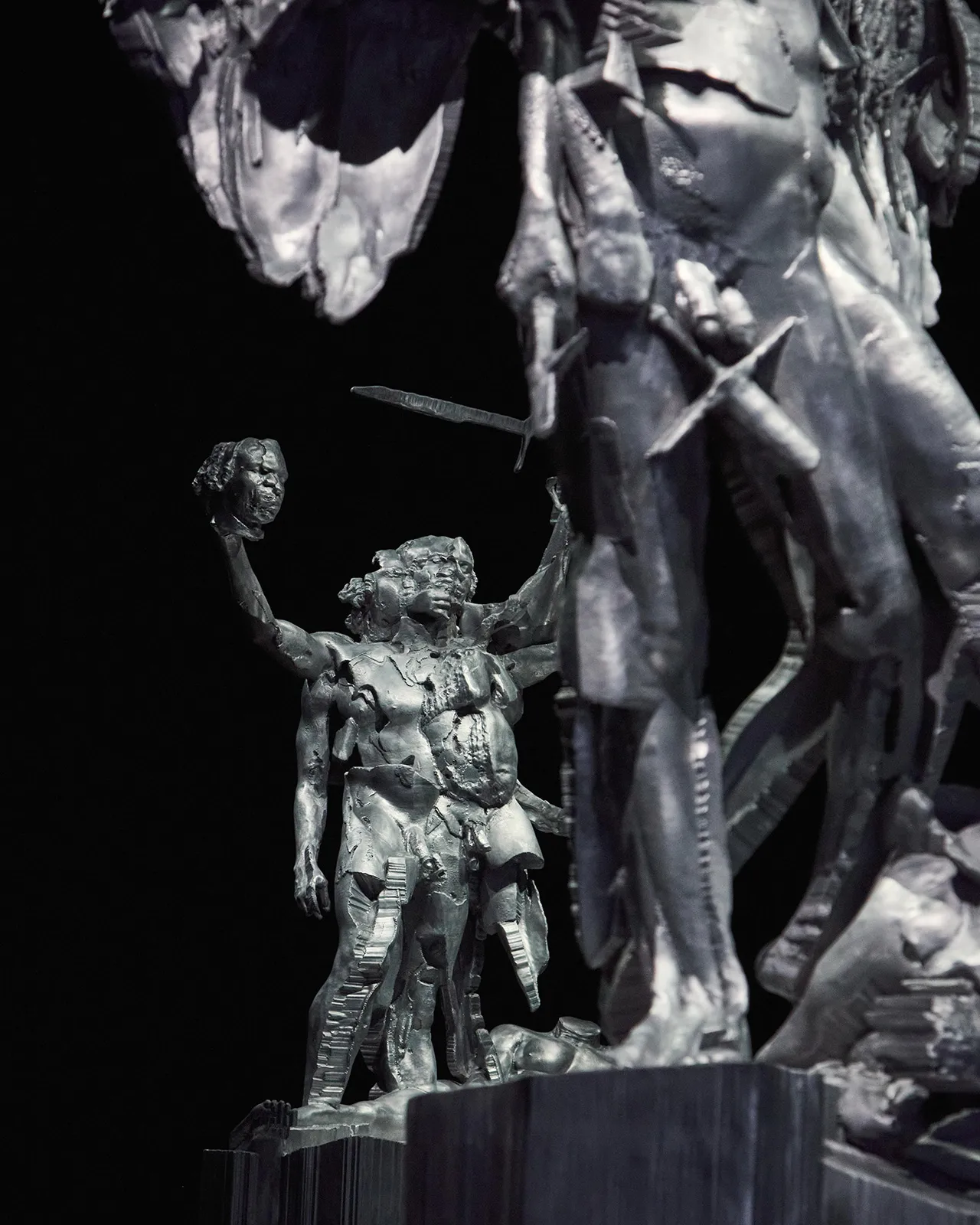
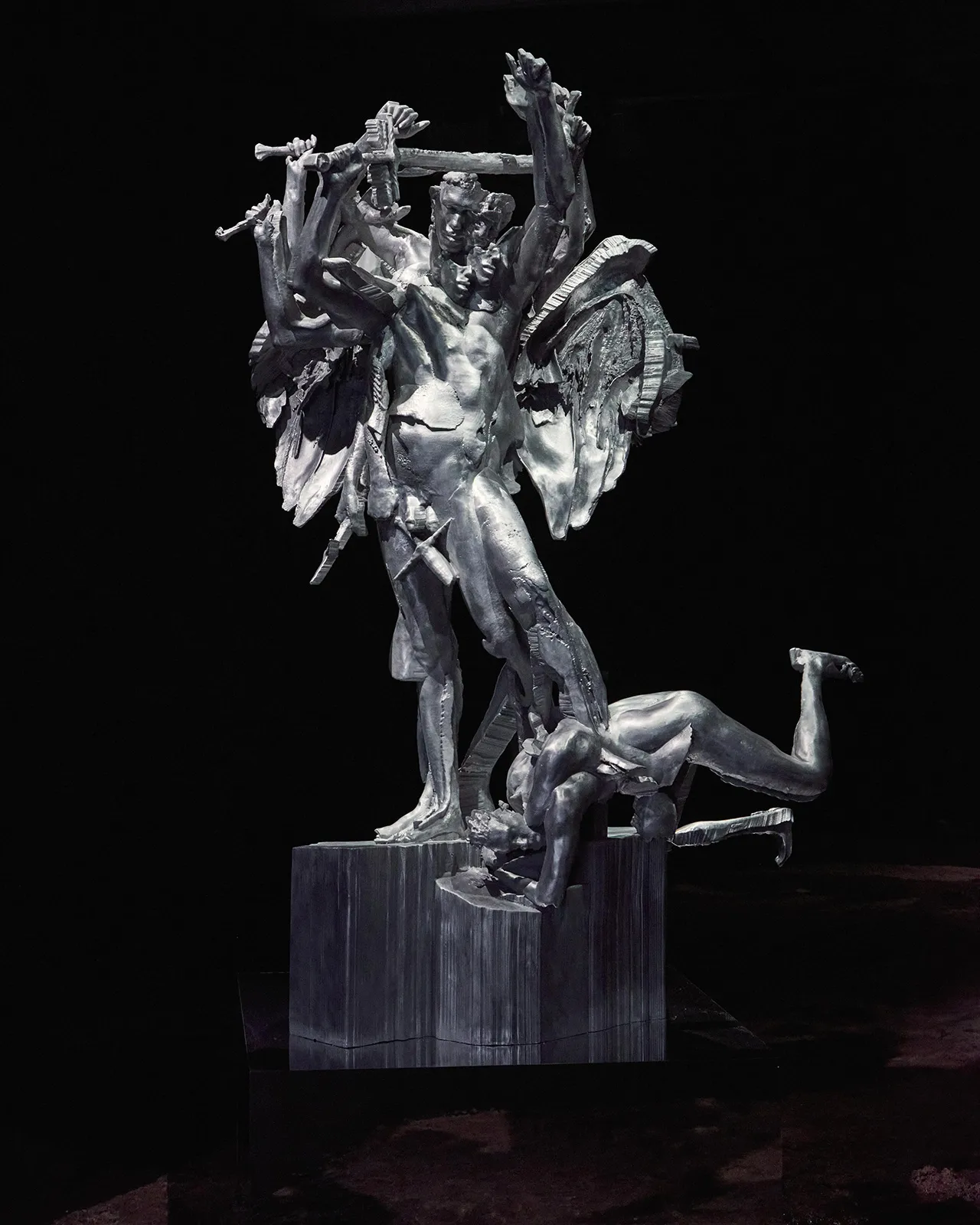
In Gods of Solaris, your sculptures depict mythological figures such as Saint George and the dragon, Perseus with Medusa’s head, and Saint Michael the Archangel defeating the demon. What dialogue do you aim to establish between the monumentality of these figures and the fragility or ephemerality of their surrounding environment?
The temporality embedded in the forms I’m working with is something that makes them somehow fragile, too. If not fragile, then fleeting. It’s a diaphanous, slippery ghost frozen in a block of something hard.
Your work has always touched on both transcendence and vulnerability. When was the last time you felt truly grounded?
At home, in Quebec, in the Laurentian mountains where I grew up. Geologically speaking, it’s one of the oldest mountain ranges on earth.
Daniel Buren intervenes in the same adjacent space with colour and geometry. How do you perceive the tension or dialogue between your visceral, bodily approach and Buren’s conceptual and geometric language?
Mine is dark, his is light; my light comes from the depths, his from the sky; I’m working from the center of the earth out, he’s working from the sky above in. These contrasts are exactly why he selected me for the project and I think it worked out pretty elegantly. For months, we tried to marry the two worlds, but it kept clashing. The moment we finally relented and allowed oil and water to separate into two distinct levels, the correlations became apparent and complementary. He’s a tough guy, though— he doesn’t suffer bullshit, and he’s very exacting, which I appreciate. This was neither a collaboration, nor a mentorship, it was an intergenerational boxing match, and it was a hell of a lot of fun.
Extreme corporeality and implicit rituals seem to be a recurring thread in your work. What role do these contemporary rituals play in the viewer’s experience of Gods of Solaris?
That should be intuitive for every viewer. Each figure is composed of traces of a real living, breathing body. When we are before a body, we react intuitively and empathetically. How do you feel standing in front of works from antiquity?
Beyond the studio, what practices or rituals help you sustain that same intensity in your everyday life?
Over thirty-five different supplements throughout the course of the day, for starters. I’ve also been doing a lot of cupping, lately.
The choice of aluminum for the sculptures is new in your practice, contrasting with more organic materials like clay and water. What does this material contrast contribute to the perception of permanence and fragility in the work?
All my sculpture work is meant to last ostensibly forever, which is a bit of a joke in and of itself because we will all be dust sooner or later. But I'm following the same intuitive principles around the purpose of the work that the Greeks and the Romans did, and that has been prevalent in the western canon of art. It’s about creating an illusion of permanence as a tool for deeper understanding. A moment flickers past us and we might understand one percent of it, but if we freeze it in space and time in a material like marble or metal or wood, not only does it endure, but we know that it will endure. That perception component is crucial, because when we feel as though something is built to last forever, we can metabolise it at our own pace. More layers can emerge. Aluminium reflects light in a very beautiful, white hue. It recalls Soviet-era sculpture to me, which is also a style that is prevalent in monuments on the African continent from a certain era as well. I thought it was fitting, and it’s light and holds plenty of pretty mistakes.
Your sculptures reinterpret ancient myths in a contemporary, urban context. How do you see these mythic narratives engaging with current concerns about ethics, power, or transformation?
That’s not my job to interpret, or rather, I’m not interested in dictating that reading for the audience.
Do you believe the body remembers more than the mind?
The mind is the body is the spirit.
The juxtaposition of performance and sculpture raises questions about authorship. Where does your body end and the work begin? Where does the spectator fit within this equation?
It’s all one thing.
The exhibition invites viewers to simultaneously encounter the sublime and the unsettling. What role does discomfort or sensory provocation play in your conception of art?
Discomfort isn’t a topic, it’s a doorway. With all due respect, I think the laziest reading of my work is when people fixate on the pain aspect, and worse, funnel that into ethnically-charged narratives of subjugation. It’s just not what I’m talking about, per se. Look a little deeper and you’ll find as much range in my topics as in anyone from any canon. I don’t care much for the audience’s guilt or concern for my wellbeing, it’s not the point.
The chosen mythological figures depict epic battles and moral narratives. How do you see these stories influencing the construction of the spectator’s emotional experience?
I wanted to illustrate victory and defeat in one body, of one body. It’s like if an alien were trying to understand the nuance of two opposing things to be true at once, and struggling.
What do you fear the most: stillness, or change?
I don’t believe in stillness; it barely exists.
What zodiac sign are you? Do you believe in astrology?
Scorpio, first day, October 23rd. Year of the Ox. The opening of the Paris show was on my birthday! For what it’s worth, I was born two weeks late and after forty hours of labour, I somehow wound up being delivered about ten minutes into Scorpio. All that to say, I believe in astrology insofar as I think saying you’re a Scorpio is chic.