Merike Estna moves within the dichotomy that arises from doubting when a work is truly finished. One can approach the question from a technical perspective, deciding whether the appropriate varnish is matte, satin, or gloss, protecting it and signing it. Alternatively, one can turn to something more subtle and choose to conclude it through the creative process itself, sealing in concepts such as balance, perspective, and aesthetic intention.
There is a third path that chooses to keep tension alive. In a contemporary scene dominated by immediacy, visibility, and impact, Estna arrives at the Biennale di Venezia, Estonian Pavilion, with a groundbreaking concept of what the exhibition experience can be: from object to process, from result to time, from spectacle to sustained action.
For six months, her studio will become The Church of the Patronato Salesiano Don Bosco, a former Venetian church now used as a community centre, where everyday activities will intertwine with the immersive experience of a painter’s life. Thus, inviting coexistence of imagination, error, and repetition with the gazes, judgments, and conversations of others. Duration, persistence, daily creation carried out in public view. A subtle yet forceful shift that, instead of presenting a closed work, proposes a situation; time in which the audience can step into the artist’s reality and daily life.
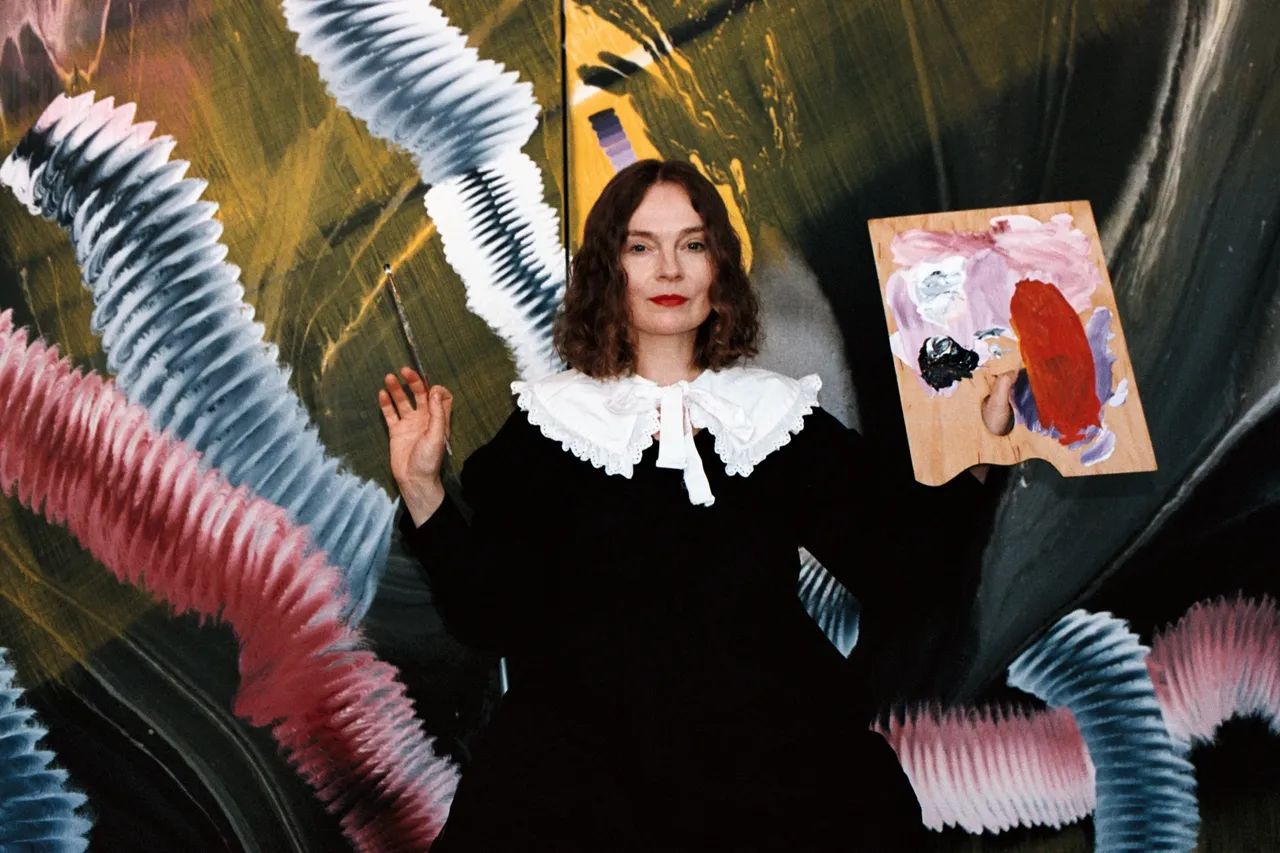
Photo: Marta Vaarik/ Estonian Centre for Contemporary Art
This is not a conventional exhibition. It’s an ongoing project that requires you to work live for six months. The dedication will be relentless. What does this project demand from you, beyond the artistic aspect?
Because I have a family, this project involves more than just my own commitment — I’m moving to Venice for six months with my husband and two small children. In that sense, the project extends beyond the artistic work itself and becomes intertwined with everyday life. But for me, art and life have never really been separated. They form a single whole. The different roles I inhabit in life naturally overlap. We moved from Mexico to Tallinn in August, so that I could begin preparing the pavilion, and at the same time I also started teaching at the Estonian Academy of Arts. So, in many ways, this kind of intertwining and being on the move feels quite natural to me.
Where does an idea like this come from?
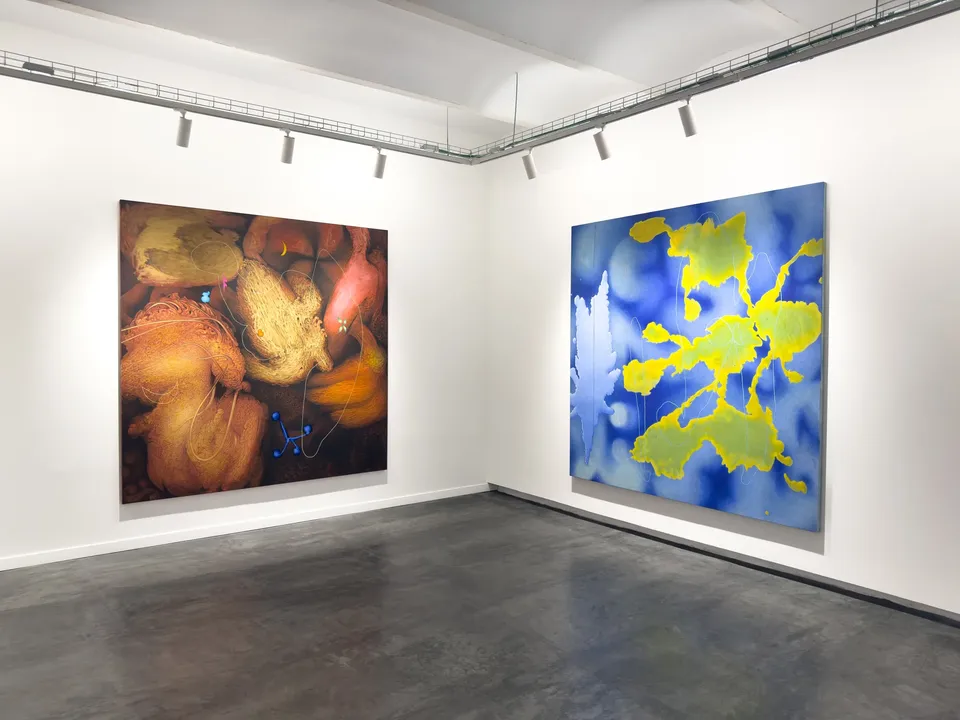
For the past few years, I’ve been working with the idea of living painting. I’ve been interested in painting not as a fixed, precious object, but as something open, something that continues to live beyond the moment it is considered finished.
I’ve experimented with different ways of keeping painting alive. For example, I’ve made paintings that function as floors, where there is no single point of view and the work constantly shifts, depending on how you move through it. I’ve also made paintings as robes, wearable objects that enter the world and interact with it. But they also have a limited lifespan, eventually they wear out and disappear. I’ve organised picnics on paintings as well, trying to present painting as a place to spend time, to talk, or to exchange ideas.
Just before applying for the Estonian pavilion at the Venice Biennale, I realised that the most obvious answer had been right in front of me all along: a painting is most alive when it’s being born in the studio. This is when everything is still possible. So, the idea became to show that moment, the process rather than the finished object, in all its fragility, uncertainties and ups and downs.
I’ve experimented with different ways of keeping painting alive. For example, I’ve made paintings that function as floors, where there is no single point of view and the work constantly shifts, depending on how you move through it. I’ve also made paintings as robes, wearable objects that enter the world and interact with it. But they also have a limited lifespan, eventually they wear out and disappear. I’ve organised picnics on paintings as well, trying to present painting as a place to spend time, to talk, or to exchange ideas.
Just before applying for the Estonian pavilion at the Venice Biennale, I realised that the most obvious answer had been right in front of me all along: a painting is most alive when it’s being born in the studio. This is when everything is still possible. So, the idea became to show that moment, the process rather than the finished object, in all its fragility, uncertainties and ups and downs.
How is this pace going to be sustained for six months? How do you make it become a routine while rejecting this idea of utilitarianism and aiming for something deeper in the process?
In many ways, the pace isn’t so unusual for me. I often work from project to project. For example, last winter I spent about nine months preparing for a show, going to the studio every morning and focusing on a series of large-scale paintings. It was a very regular, concentrated process. After periods like that I usually step away from painting for a while and shift to other things, maybe making works on paper or working on related projects. Alongside preparing works for the Biennale, for instance, we’re also working on a book. So, the rhythm of sustained focus followed by a shift in activity is quite natural for me.
When the pavilion opens, I’ll begin with the canvases as planned. In many ways I think it will be a pleasure simply to go to the studio each morning and paint. What will be very different, of course, is that there will be people present in the studio in Venice. But that’s something we’ll discover along the way, how it changes the experience. Because I want to show the real process of making a painting, rather than performing the act of painting. I’ve deliberately avoided planning everything in advance. I haven’t made many sketches. I want to keep the process open and alive, combining images and decisions on site as the work unfolds. Before the pavilion opens, I’ll spend some time there alone to get into the right focus. I don’t want the space to feel like a stage once people arrive, I want it to remain a working studio.
When the pavilion opens, I’ll begin with the canvases as planned. In many ways I think it will be a pleasure simply to go to the studio each morning and paint. What will be very different, of course, is that there will be people present in the studio in Venice. But that’s something we’ll discover along the way, how it changes the experience. Because I want to show the real process of making a painting, rather than performing the act of painting. I’ve deliberately avoided planning everything in advance. I haven’t made many sketches. I want to keep the process open and alive, combining images and decisions on site as the work unfolds. Before the pavilion opens, I’ll spend some time there alone to get into the right focus. I don’t want the space to feel like a stage once people arrive, I want it to remain a working studio.
What does “eleven monumental paintings” mean? Where does this monumentality lie? In the size, in the duration, in the subject matter?
Actually, the project has evolved a bit. We now have twenty-two canvases that together form one monumental painting measuring about twenty-two by six metres. From the beginning, the project has been closely connected to historical women artists who were also mothers. I was thinking about the Italian painter Lavinia Fontana and her eleven children, which initially inspired the number eleven. But as the concept developed, the scale expanded. And, in the pavilion, I will ultimately create twenty-two paintings.
The monumentality exists on several levels. There is the physical scale of the paintings, of course, but also the duration of the project, the fact that the work unfolds over six months in front of an audience. The subject matter also plays a role. For me, motherhood is something truly monumental, even cosmic in a way.
At the same time, there is also a conscious statement behind this scale. Historically, this kind of monumentality has largely belonged to the realm of male painters. Here, the scale remains monumental but the perspective and subject matter are very different.
The monumentality exists on several levels. There is the physical scale of the paintings, of course, but also the duration of the project, the fact that the work unfolds over six months in front of an audience. The subject matter also plays a role. For me, motherhood is something truly monumental, even cosmic in a way.
At the same time, there is also a conscious statement behind this scale. Historically, this kind of monumentality has largely belonged to the realm of male painters. Here, the scale remains monumental but the perspective and subject matter are very different.
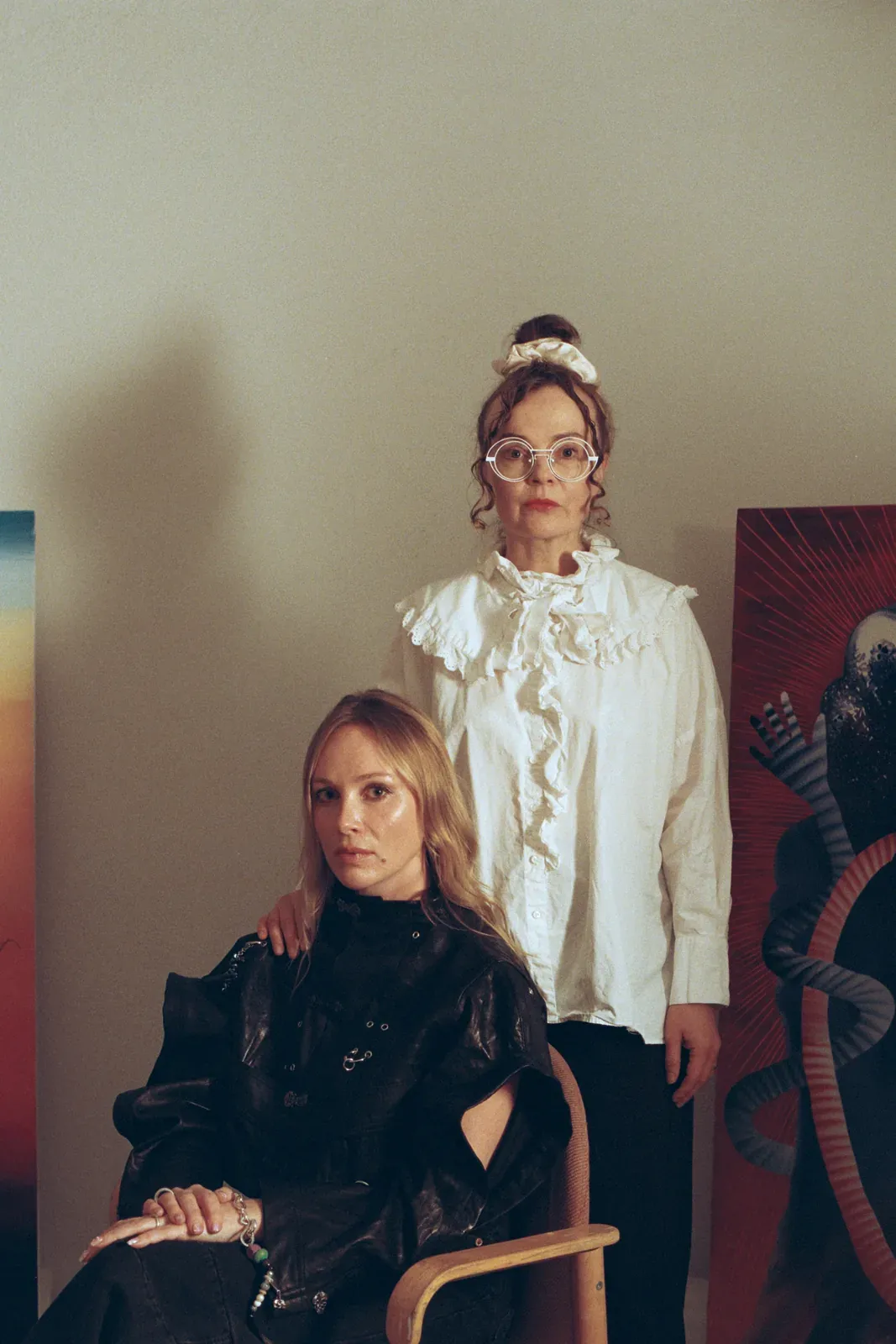
Merike Estna and Natalia Sielewicz. Photo: Silver Mikiver/ Estonian Centre for Contemporary Art
A final work made up of twenty-two joined canvases; one of the largest results the Biennale has ever seen. Is there a moment when the pavilion’s final work stops being the sum of many parts and becomes something indivisible?
I’m imagining the painting almost like a transformer. It can exist as one large work when all the canvases are joined together but it can also be shown as twenty-two individual paintings. In that sense, it’s both at the same time — one whole and many parts.
On a broader level, though, for me the pavilion and everything happening inside it is indivisible from the very beginning. Just as I don’t really separate art from life, the continuous process at the centre of the pavilion connects everything — the paintings, the time spent making them, the space, and the people who encounter the work. All of these elements form a single whole, both as an artwork and as part of my life lived as an artist, a woman and a mother.
On a broader level, though, for me the pavilion and everything happening inside it is indivisible from the very beginning. Just as I don’t really separate art from life, the continuous process at the centre of the pavilion connects everything — the paintings, the time spent making them, the space, and the people who encounter the work. All of these elements form a single whole, both as an artwork and as part of my life lived as an artist, a woman and a mother.
When working this way, how much room is there for error?
When you work like this, unpredictability is part of the process from the very beginning. Painting live means that uncertainty is built into the work. There are days when I don’t particularly like what I’m making or where the painting seems to be going and that can be difficult to manage. But at the same time, that’s exactly what makes the process alive.
For me, sharing that aliveness, being inside the process with all its shifts and doubts, is worth it. It also requires a certain surrender: accepting moments of confusion or even failure and then finding a way through them. In that sense, error isn’t something to avoid but something that becomes part of the work’s unfolding.
For me, sharing that aliveness, being inside the process with all its shifts and doubts, is worth it. It also requires a certain surrender: accepting moments of confusion or even failure and then finding a way through them. In that sense, error isn’t something to avoid but something that becomes part of the work’s unfolding.
Another key aspect of working live is that the audience can witness the process. How does that change the experience for the viewer?
I hope the audience feels invited to be part of the process rather than simply observing it from a distance. The setting is inevitably somewhat performative, but I will actually be working there, not performing the act of work. I hope visitors are mindful of that difference.
At the same time, I’m excited to open up the studio and bring an artist’s working process into the open. Traditionally, painting has been associated with the image of the solitary male genius working alone in a studio. By working in public, I want to challenge that myth and share the process more openly.
At the same time, I’m excited to open up the studio and bring an artist’s working process into the open. Traditionally, painting has been associated with the image of the solitary male genius working alone in a studio. By working in public, I want to challenge that myth and share the process more openly.
Your work, beyond engaging with the audience that comes to the Biennale, will engage in direct dialogue with the art that surrounds it. The Church of the Patronato Salesiano Don Bosco, covered in frescoes and history, will be your studio but also your stage. How does the space influence your work?
The pavilion is located in a former church that is now used as part of a community centre. That aspect of the space is very important to me. The Patronato will continue its everyday activities throughout the Biennale, children will still be playing there, people will continue using the space as part of their daily lives.
We are very aware that we are guests in that environment. At the same time, I will also be bringing my own daily life there. I’m moving to Venice with my family for the duration of the project, and part of the pavilion team will be there as well. So, in a way, different layers of everyday life will overlap within the space.
We are very aware that we are guests in that environment. At the same time, I will also be bringing my own daily life there. I’m moving to Venice with my family for the duration of the project, and part of the pavilion team will be there as well. So, in a way, different layers of everyday life will overlap within the space.
How does the classical art of the space coexist with the contemporary art of your work? Do they engage in an active dialogue, or is it simply an inexorable exchange?
In recent years I’ve often used references to classical artworks and literature in my practice. And it’s a continuous exchange. I tend to place works within a broader network of references that I draw from — art history, folk traditions, craft, mythology, and contemporary life. It’s about tracing lineages, for example of women in art history or of motherhood as a subject in art, while grounding the work very firmly in the present moment.
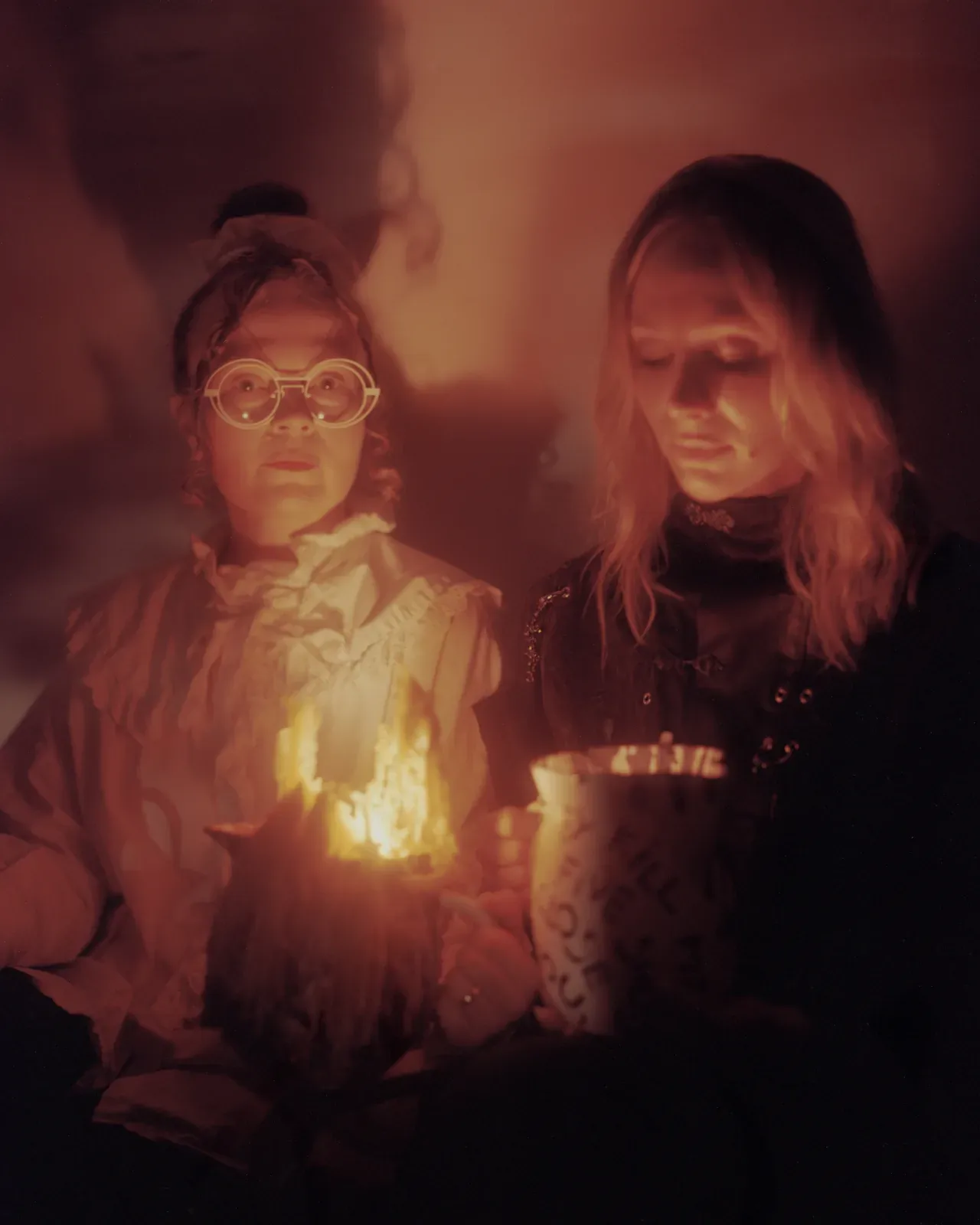
Merike Estna and Natalia Sielewicz. Photo: Silver Mikiver/ Estonian Centre for Contemporary Art
How will the concepts of motherhood, care and female labour be included in the process and outcome? How will they dialogue with the frescoed ceiling by Giuseppe Cherubini?
The pavilion space is quite unique: it’s essentially a basketball court with the original frescoed ceiling still intact. For the pavilion, I’ve created a tiled floor on top of the basketball court, which depicts motifs of women. Some reference art history, others depict very ordinary moments of life — pregnancy, traditional wedding textiles or scenes that evoke everyday forms of work traditionally done by women. In a way, it feels like women looking up from the ground, from daily labour and lived experience, toward a monumental painting by a male artist above them. That relationship between the two layers of the space is something I find very powerful.
The idea of making art that endures over time rather than simply creating a spectacle has returned to contemporary art. Understanding art as a journey rather than a destination. Is each step of the painting, each moment the audience can witness, a work in itself?
Yes, I would say so. The performative aspect of the project carries the material elements of the pavilion from moment to moment. The process itself becomes the thread that ties everything together — the paintings, the space, the time spent there, and the audience witnessing it.
It’s difficult not to chase spectacle in a process like this: an exhibition like the Biennale, a Venetian church turned community-space, a live artistic process. How will the idea of productivity and utilitarianism be separated from the work itself?
The Biennale is of course a very spectacle-oriented event. That’s precisely why I wanted to begin the exhibition with blank canvases at the most prominent moment, the opening. At the centre of the project is the idea of the pittore senza opera, the painter without works. This is what happened to many early women artists, their work disappeared from the historical record. By starting with empty canvases, I also want to emphasise everything that still lies ahead, the labour, time, and uncertainty that are part of making an artwork.
How does your way of working change when the goal is not spectacle but the impact and durability of the work?
For me it means focusing on the continuity of the process rather than on a single climactic moment. The work grows gradually through time, through daily practice, and through the accumulation of decisions and gestures. In that sense, the durability of the work comes from the depth of the process behind it rather than from a single spectacular outcome.
What does it mean for you to represent your country, Estonia, in a space like the Biennale?
Working within the pavilion format allows me to work on a scale I’ve never experienced before — both in terms of time and resources. It also places the work in the very specific context of the Biennale, which brings together artists and audiences from many different places. For me, the value of that moment lies in seeing what grows simultaneously across different contexts. It’s less about nationality and more about geographic location — about people from different parts of the world coming together and entering into dialogue in a particular moment of time.
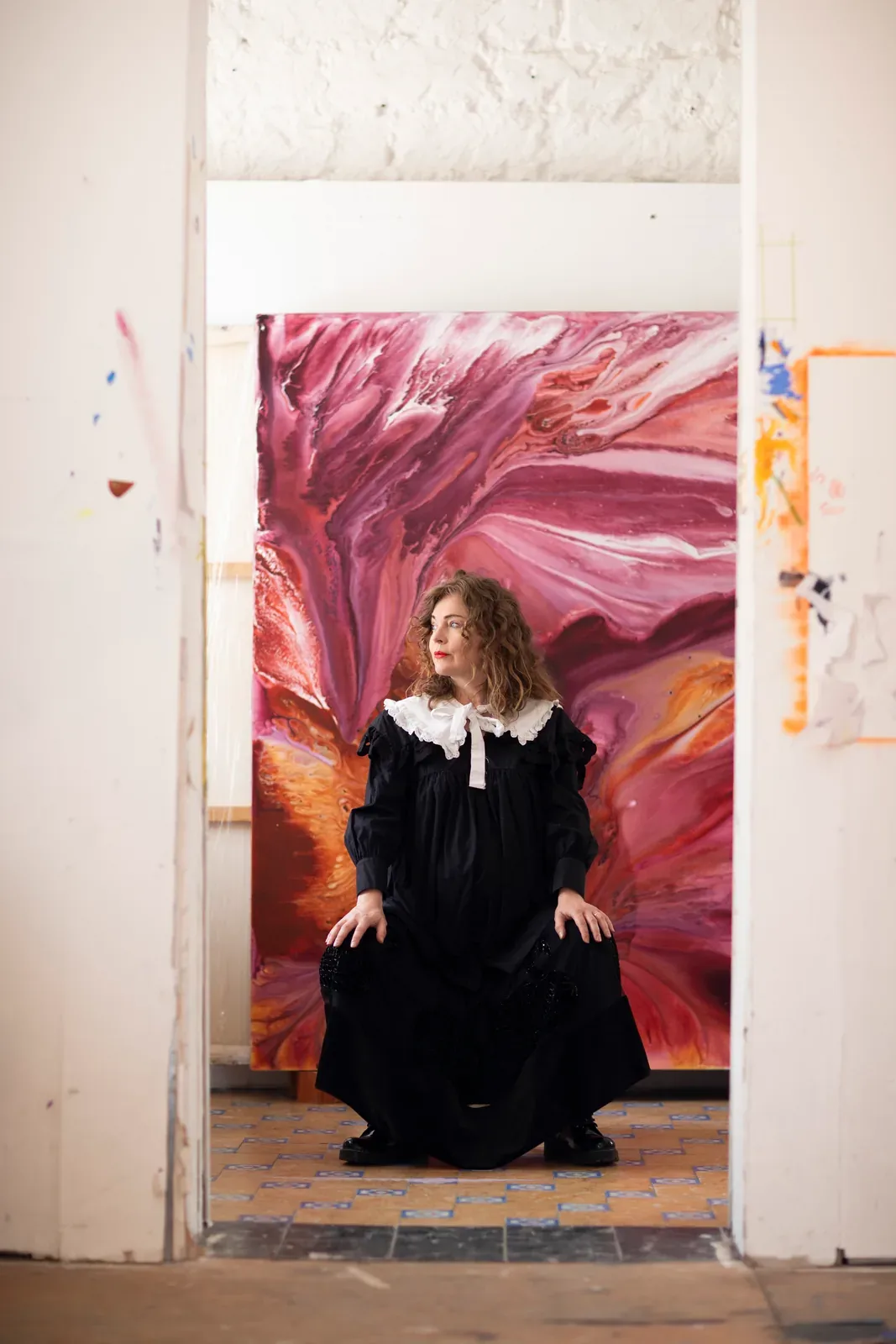
Photo: Ana Hop/ Estonian Centre for Contemporary Art
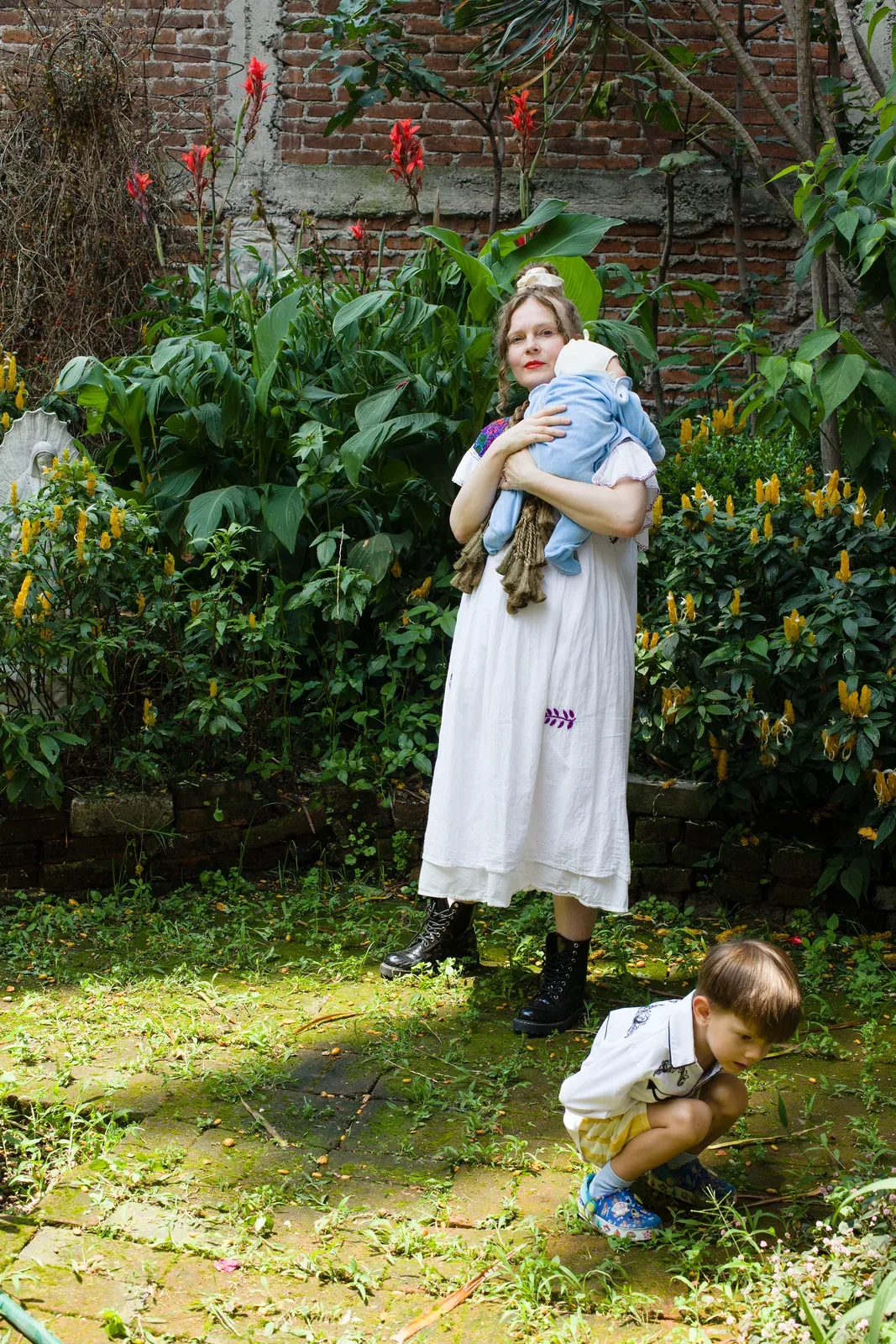
Merike Estna with her children in her studio in Mexico City in 2025. Photo: Aime Estna