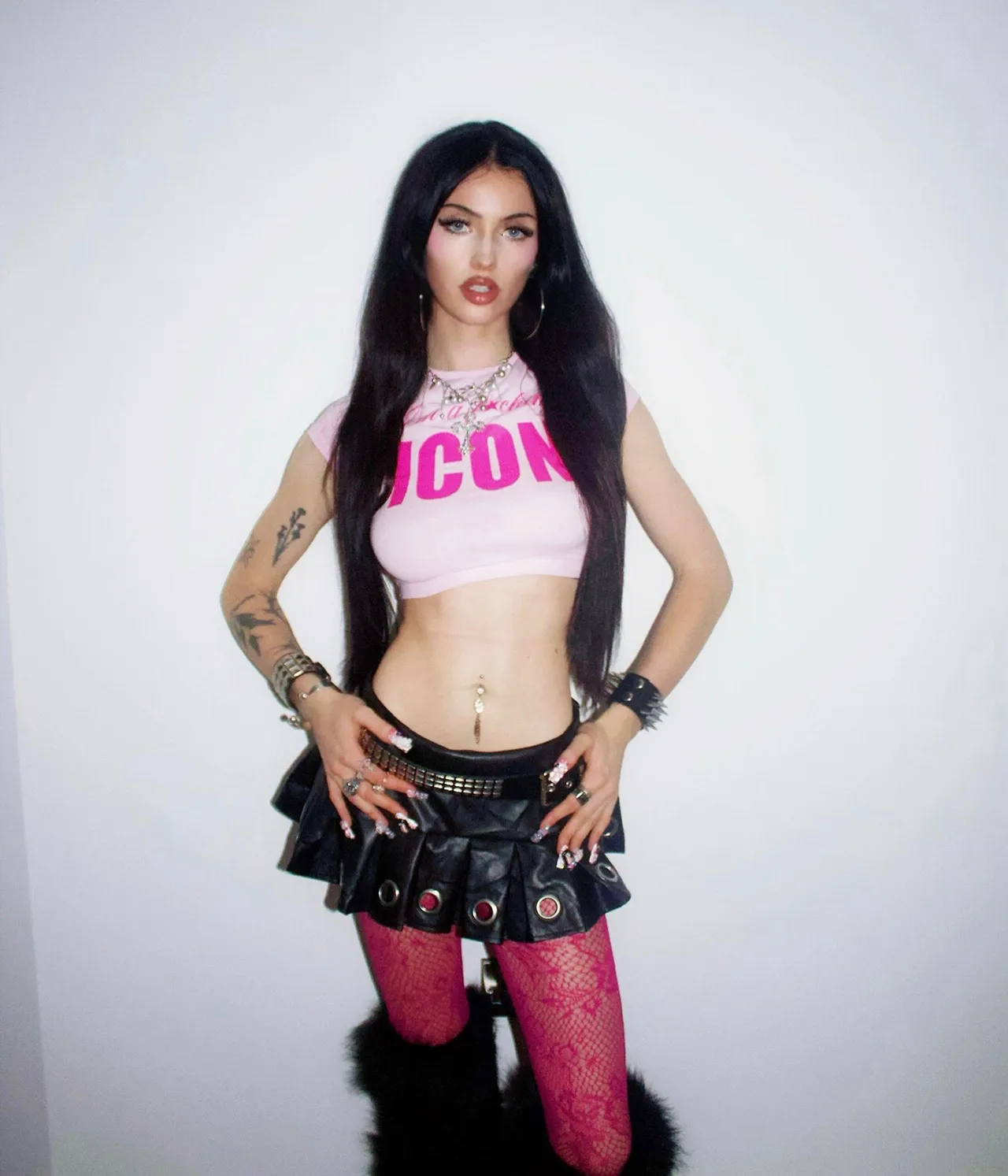
MELTX hails from Limerick, boasting a background that is rare in hard techno: trained in musical theatre at the age of eleven, shaped by film studies at Trinity College, and sharpened through award-winning work that explored mental health with striking honesty. Less than a month after releasing her self-released debut, CANDYCORE, she steps into a moment where her film instincts, her Y2K references and her vocal-driven production finally align into something unmistakably her own.
Her rise has been propelled by intention rather than accident. Opening for heavyweights, landing releases on Hekate, Taapion, and 999999999’s label and shaping her shows with filmic discipline, she’s carved a space defined by emotion and aesthetic precision. CANDYCORE gathers those threads into eight hard-dance confessions, entirely self-produced and mixed. “I want every track to feel like a scene you can’t walk away from,” she says.
You’ve been everywhere these last months: Manchester, Paris, India, Ibiza, Scotland, or Amsterdam, among others. How are you feeling right now?
I’m feeling so grateful. I feel alive and my soul is fulfilled. People assume constant travel is exhausting, but I thrive in it. When you’re moving that fast, every crowd becomes an anchor with whom you connect and share energy, reminding you why you do this. I’m learning to breathe inside the chaos rather than trying to escape it.
You trained in musical theatre at eleven, studied film at Trinity College, lived in Paris, and eventually found yourself in hard techno. When you look back at that journey, does it feel connected or do you see it as a series of different lives you’ve carried with you?
It’s all connected. Musical theatre taught me discipline and transformation. Film gave me storytelling. Paris showed me how to live with romance and edge in the same breath. Hard techno is just the medium where all of that finally makes sense together. Every ‘life’ was a rehearsal; MELTX is the performance.
Your short film, Silent, went viral and directly addressed mental health. Has that experience shaped the way you think about emotional intensity in your music?
Absolutely. That film was raw, and I didn’t expect people to see themselves in it the way they did. It made me realise that intensity isn’t something you have to apologise for. In my music, I try to hold space for feeling everything at once: beauty, fear, nostalgia, euphoria. Techno isn’t just kicks and bass; it can be a confession.
You often describe your releases, mixes and sets as if they were films. What does building a storyline inside a techno track look like for you?
Honestly, I think in scenes. The kick is the camera angle, the synths are the lighting, and the vocal textures are the characters. I want tension, release, a twist you didn’t expect. The drop shouldn’t just make you jump, but it should reveal something about why you showed up that night. Every set is a narrative arc. You shouldn’t leave the way you arrived.
“I feel alive and my soul is fulfilled. I’m learning to breathe inside the chaos rather than trying to escape it.”
Do you remember the moment at your first rave when you realised that this world made sense for you?
There was a moment when the lights cut out and the crowd screamed before the next track hit. I wasn’t thinking and I just felt. It was like everyone’s heart was beating at the same tempo. I realised music could be a language that doesn’t need subtitles. That was the moment I knew I belonged there.
You composed for your own films before producing hard dance. What changed inside you when you shifted from scoring imagery to building music for crowds?
Film scoring is conversation with a frame; club music is conversation with a body. When I started producing for crowds, I stopped trying to be clever and started trying to be honest. There’s no hiding live, and if a track doesn’t move someone, they’ll tell you with their feet. That vulnerability changed me. It made me braver.
A year in Paris seems to have deeply shaped your visual identity. What did that time give you that you’re still carrying now?
Paris taught me tension, elegance with danger, softness with claws. The city doesn’t apologise for existing loudly and beautifully. It taught me that aesthetics is a language of self-respect. I learned how to make visual identity feel like armour and perfume at the same time.
Your rise has been fast but very self-built: networking, supporting major acts, organising shows, filling every gap you could find. What did those early years teach you about patience and self-belief?
They taught me that no one hands you a stage; you build one plank at a time. And you don’t need to ask permission to dream loudly. Patience is trusting that consistency matters more than hype. Self-belief isn’t confidence; it’s commitment. It’s waking up every day and choosing the long game.

You’ve spent 2025 in near-constant motion. Has this pace changed the way you think about performance?
It’s made me realise performance is less about perfection and more about presence. When you’re jet-lagged or emotionally drained, you learn to tap into something deeper. Crowds don’t want a robot; they want a human being who cares. That honesty is stronger than any BPM.
Your debut album, CANDYCORE, came out less than three weeks ago. After living with it privately for so long, what does it feel like to finally have it out in the world?
It feels like unlocking a diary and trusting the universe to read it gently. For so long, it belonged only to me — to my scars, my teenage fantasies, my heartbreaks, and victories. Now it belongs to everyone who listens. That’s equally terrifying and liberating.
When you listen back to the album now, is there a moment that hits you differently from when you first made it?
Yes, absolutely. There’s a track that used to feel like revenge and now feels like forgiveness. I think that’s the beauty of music: it changes as you change. What once was anger becomes softness. What was a scream becomes a whisper you’re finally ready to hear.
If the album were a colour, a flavour, and a scent, what would they be and why?
Neon pink: thrilling, reckless, slightly dangerous. Sour cherry-sweet, acidic, addictive. Burnt sugar and nostalgia with teeth.
“There’s no hiding live, and if a track doesn’t move someone, they’ll tell you with their feet. That vulnerability changed me. It made me braver.”
You chose to self-release CANDYCORE. What kind of freedom were you looking for at this stage of your career?
I wanted to protect its identity. Labels are incredible partners, but this album was too personal to compromise. I needed full ownership of how it sounded, looked, and moved in the world. Creative freedom is worth the risk when you know exactly what story you’re telling.
Your visual world is incredibly precise. When you’re shaping a new era, where do those ideas begin?
Always with emotion. I start with how I want people to feel (seductive, unsettled, obsessed, hopeful) and then I build textures, colours, and characters around that. Aesthetics for me are not decoration; they’re mood architecture.
Hard techno can be intense, fast, and often male-dominated. What has it been like to carve out a space in that environment as a young woman from Ireland?
It’s been empowering. You walk into rooms where you’re underestimated and you turn that into velocity. I don’t want to be the exception; I want to be part of a wave of women who rewrite the atmosphere. Power shouldn’t be loud or aggressive; it can be velvet, hypnotic, relentless.
After a year of festivals and airports, what did you learn about yourself that genuinely surprised you?
That I don’t need everything to be perfect to feel grounded. I thought stillness was the only way to find myself. Turns out I can find myself in turbulence, too. I’m stronger than I thought, and more sensitive than I ever admitted.
And looking into early 2026, what kind of world do you want to build next?
A world where techno is cinematic, feminine, and communal. Where the dance floor isn’t a battlefield but a shared ritual. I want to build spaces where people can feel beautiful and wild at the same time — where the music doesn’t just shake your body, it rewires your heart.