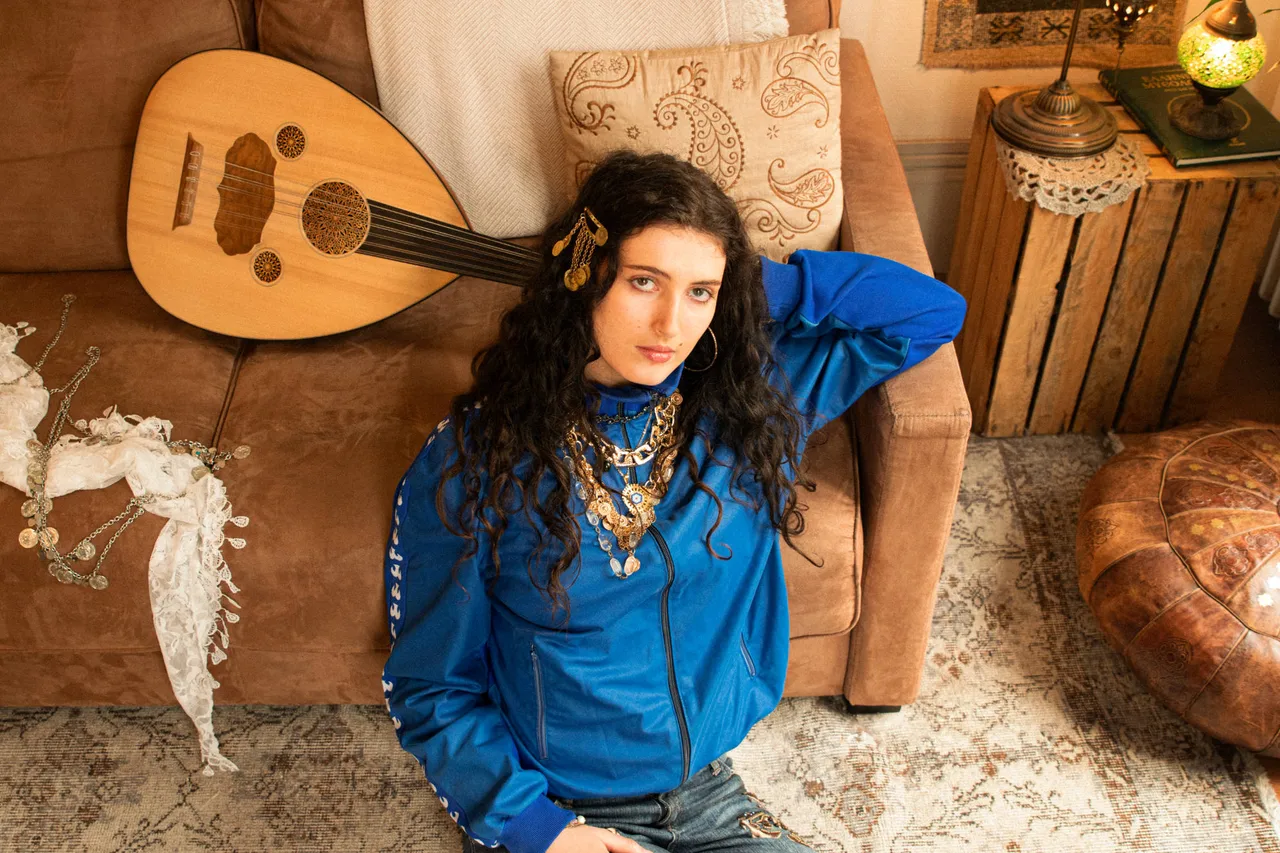
When Melina Vlachos, or just Melina, is on stage, the crowd dances. In circles or alone. The band smiles as she performs a belly dance that makes her golden hip belt tinkle. Blue stage lights illuminate her silhouette. Someone screams in Spanish, “¡Qué guapa, Melina!” Others clap in a rhythm that probably every child in Greece knows: three slow claps followed by two short ones. Clap – Clap – Clap, clap clap. You know what I mean. The Greek-French artist is still fairly new under the radar, but anyone who saw her perform last week at ESNS 2026 in Groningen knows this girl has star potential.
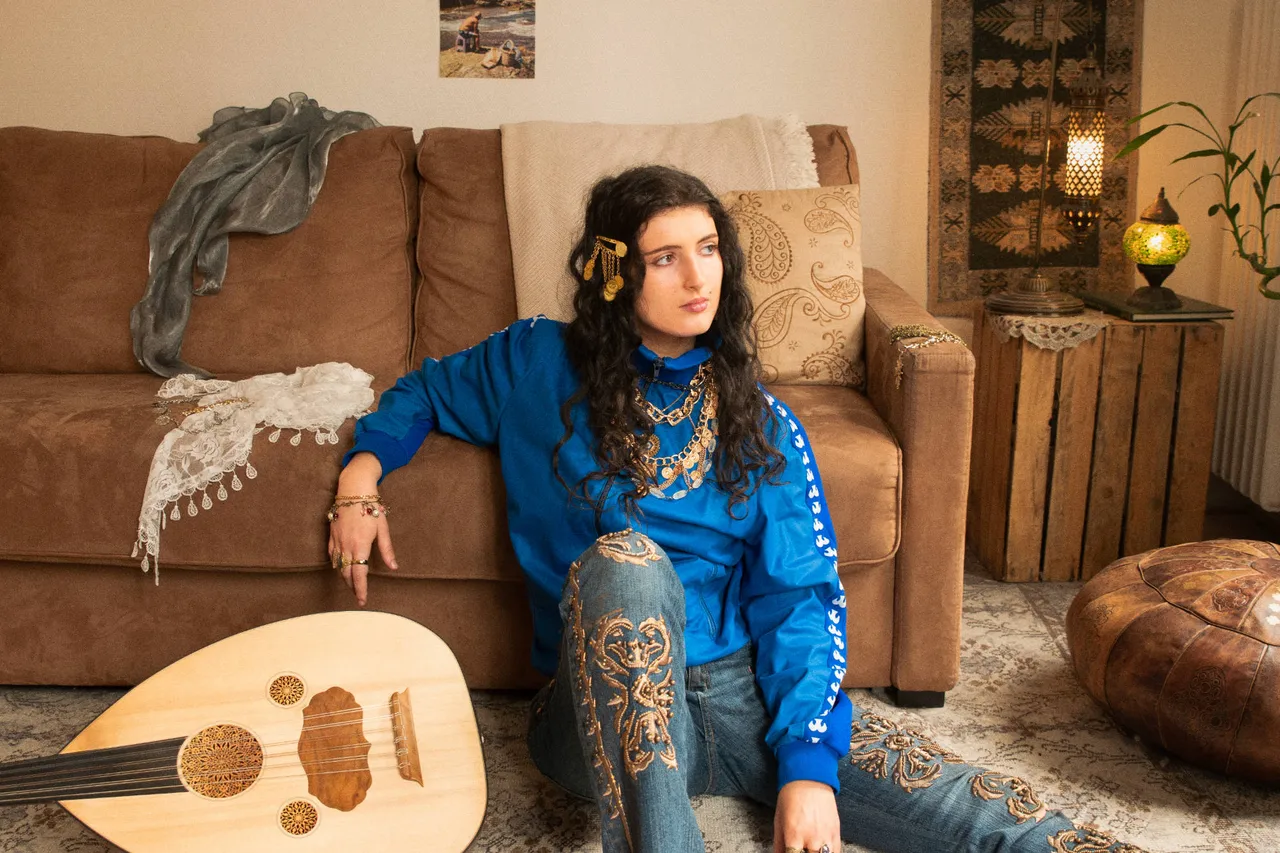
Melina’s music isn’t easy to put in a box. And it shouldn’t be anyway. Her sound is free-spirited and experimental. Captivating in the way it explores her Greek heritage through melismatic ornamentation, dance, and instruments mixed with contemporary elements. On stage, she wears brooches and scarves woven into her long hair paired with some cool Y2K jeans and sneakers. She plays the oud, or traditional zills. The result sits somewhere between warm, angelic, and badass. Between pop and folk, you could say.
Since releasing her self-titled debut EP last year, the Paris-based artist has gained a lot of attention and earned nominations for the Music Moves Europe (MME) Awards as well as the Public Choice Award at Europe’s leading newcomer festival, the ESNS. On the morning before her performance in Groningen, we met Melina at the Stadsschouwburg. She’s a little tired but smiling, and together we slip into a long conversation about tradition and innovation. About intervals, talking to your ancestors, why you can find France in your hands, and how to learn from the past without losing sight of the future.
Hi Melina, are you nervous about your performance today?
A little bit, to be honest, but also very excited.
I’ve read that your name means honey. So, just like honey, where do you feel sweet in your music, and where do you like to sting?
I feel sweet sometimes when I sing with a lot of melismatic ornamentation. In Greek music, Balkan music, there are a lot of little ornaments. You never get a note directly. You always kind of come from behind. For me, this is a very sweet way of singing. But I definitely sting sometimes in the lyrics when I talk to somebody who has done me wrong, about something I don’t like. In this, I can be more feisty.
Can you tell me what stories you generally tell with your music?
So, there are the stories, like I said, of just me talking to somebody. There’s a song where I say, “please let me be alone,” and I fantasize a lot about talking to a boy and telling him just to chill. And then there are other songs that are more humoristic and maybe just a way of seeing life. For example, there’s this one song that I wrote while I was walking. There’s this idea of searching for something but not really knowing for what. Just walking, searching, dancing. It’s this sense of being lost but not being anxious about it.
Traditional Greek music is known for being very melancholic, very sad, and nostalgic. How does longing sound for you?
Greece is a country where lots of people have been displaced. Before, the Greeks were in all the Ottoman Empire. So, I think there’s something in the culture where lots of people feel a longing for a place that they don’t even remember, or they have never even known. In every song from traditional music, you can feel this sense of lostness, and you’re right, it is something kind of melancholic and nostalgic. The thought of a place that doesn’t exist anymore. For me, it’s very present in music. It’s music that is quite sad.
You blend this longing, this folk style with pop. What’s the most pop thing you’re currently obsessed with?
I don’t know, but on the train coming here I was on YouTube and I randomly found a video of Lady Gaga performing. I don’t remember where exactly. But I was like, wow, she was so pop. Her way of being, her singing. I was amazed. Then I went down the rabbit hole, watching so many videos of her from around 2010 and 2015.
Oh yes, she’s iconic. Lady Gaga is also very popular for her fashion style. What does fashion mean to you on stage?
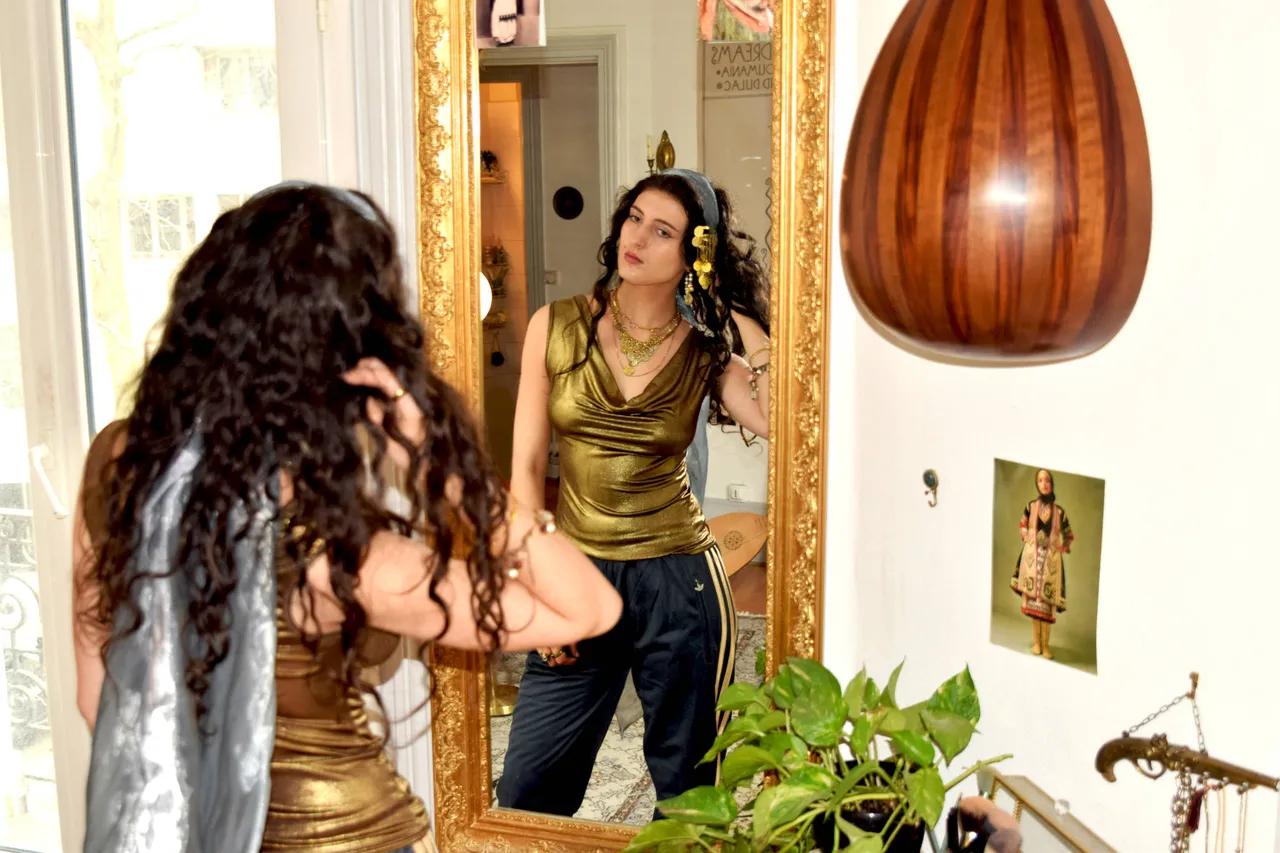
It’s another part of the music because it can speak when music cannot. At the beginning of the project, I was kind of alone and I didn’t have the pop sound yet. I hadn’t found it, or the people to do it. I always said, okay, I will do more traditional things because that’s what I know how to do. And finally, it was my clothes that I could show. It was my way of reaching an audience all by myself. So for me, it’s always about showing the blend. I dress quite simply but I like to include elements from traditional, folk wear. I like things on the head. Mixing tradition with modern, everyday clothing.
How does your French side come up into all this?
I’m really a child of Paris. I was raised there and it marked me deeply. Not so much in a narrowly ‘French’ way, but through the mix of cultures and music. Paris is full of that. My parents, especially my father, are very rooted in the Greek community, very close to their own. But still, in France I was surrounded by so many other cultures — Arabic cultures especially: Kabyle, Syrian… people from everywhere. That’s something I really took from Paris. In Greece, you don’t have that same mix.
Also, France made it easier to imagine making music. There’s more support for artists, more space to experiment. In Greece, it’s so hard. I saw it when I wanted to go to university there, how difficult it was for musicians. Young creatives don’t have many chances right now. So France gave me that environment, that possibility, and I feel that very strongly.
Also, France made it easier to imagine making music. There’s more support for artists, more space to experiment. In Greece, it’s so hard. I saw it when I wanted to go to university there, how difficult it was for musicians. Young creatives don’t have many chances right now. So France gave me that environment, that possibility, and I feel that very strongly.
How do you know when to honour and value traditions, and when to break them?
Oh, it’s about what feels right at the moment. I’m not in the process of, okay, I’m going to do a song that mixes this traditional sound with this modern sound. Because sometimes, I think it’s not that interesting. I just follow the song I’m working on. I see where it goes, and I think there are some things you have to respect. Like the Makams, for example, which is a way of having some scales with microtones.
In Western music, we have two second intervals. And in Turkish, Arabic, and Greek music, you can have up to nine little notes. For some people it can sound flat, but I don’t think so. Because you can always feel that there is a sense of rightness in it. I’ve studied this music a lot, and I always respect it. And if sometimes I don’t respect it, I try to understand where it comes from, from the people that do it, and try to be okay with everything that I do.
In Western music, we have two second intervals. And in Turkish, Arabic, and Greek music, you can have up to nine little notes. For some people it can sound flat, but I don’t think so. Because you can always feel that there is a sense of rightness in it. I’ve studied this music a lot, and I always respect it. And if sometimes I don’t respect it, I try to understand where it comes from, from the people that do it, and try to be okay with everything that I do.
In the end that’s the most important thing, right? There will always be people who like your stuff and people who don’t, so you must be the one to always like it.
Yeah, and I think with tradition in general, it is so weird what we call traditional music. Because in Greek music, what is now considered traditional used to be innovation. With time, everything becomes tradition. For example, there’s a genre in Greek music, Rebetiko; now it’s seen as traditional, but it’s written music, so we don’t exactly say it’s traditional. At the time when Rebetiko started coming up, it was very underground. It was in the prisons, and it wasn’t well seen. But now you have to respect Rebetiko. It’s so weird how things evolve. How tradition is ever-evolving. Maybe the music they don’t like now will also be traditional in fifty years.
If your Greek heritage was a place you could visit inside your body, which part of your body would it be?
I think it would be in the centre of your being, the core, the place where you want to be very aligned. Here, down in the stomach.
And the French part?
I don’t know why, but I feel like that’s in the hands. Because when you touch, when you feel, you do it with the hands.
On Instagram, there’s one quote where you say that people who like your music also like talking to their ancestors. What did your ancestors say to you before your upcoming performance tonight?
Usually, it’s like two hours before the show. It’s when I concentrate and meditate and try to feel them. And sometimes they speak. Sometimes you can just feel that they’re there and that you’re accompanied on stage. They will be with you. They’re kind of heavy sometimes on your shoulders. But I believe in them. It gives you a purpose and the force to go.
Talking to your ancestors, valuing traditions — that’s often a look into the past. So, my question is, how do we honour and learn from the past without losing sight of what lies ahead?
That’s such a beautiful question. I think it’s about always respecting the past and never forgetting. It’s about this cliché idea that people aren’t gone if you still think of them. Thinking of people is sort of magic. Having them in your life. So, when you think about the past, about everyone who came before us, you remember that you’re just one link between now and what comes after. It’s about hearing them, listening, learning and also not trying to simplify the past.
If you could travel through time, where and when would you travel to?
Maybe I would want to go to see what the steppe in Anatolia looked like when there were the nomadic tribes. So, Asia, Persia, these places where there were lots of grasslands and deserts.
And tonight, when you’re performing at ESNS, what kind of version will we see from you?
I will be a bard because, at the beginning, I play the oud. So, kind of very folk. Not folk in the traditional way, but folk in a popular way, which is guitar and voice, and then I will be kind of a diva, belly dancing. I will be kind of a rock star, and I will also be a sad nymph.