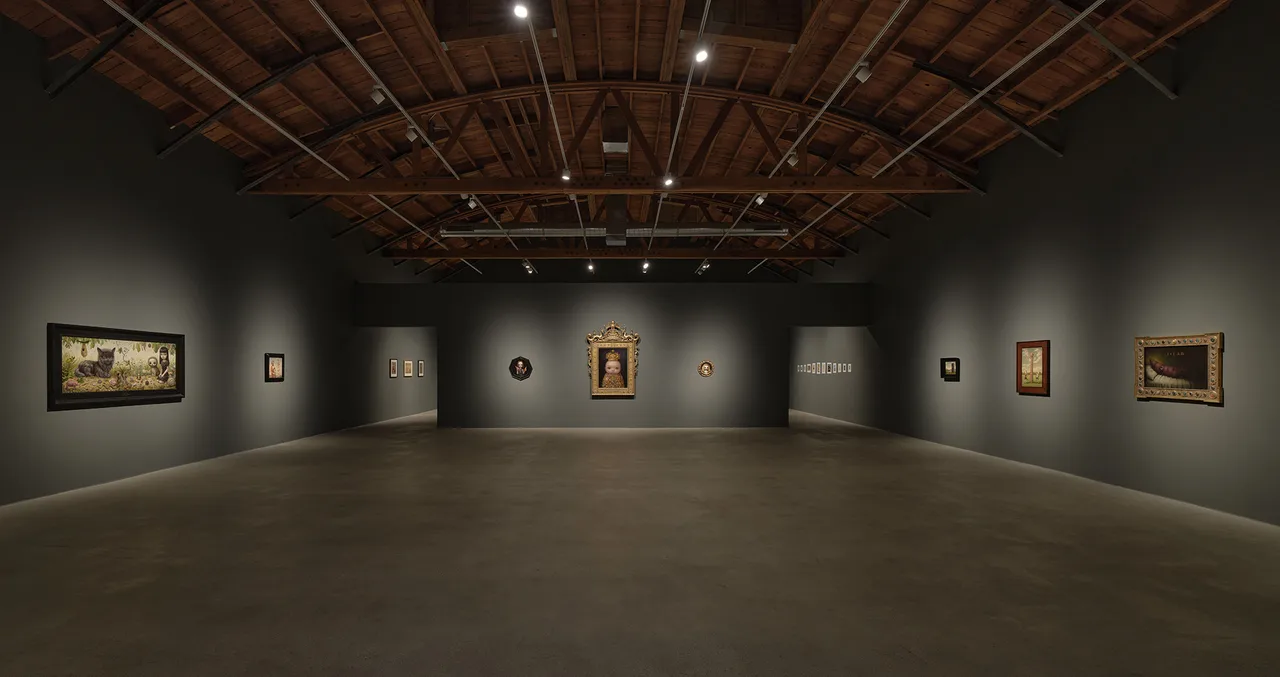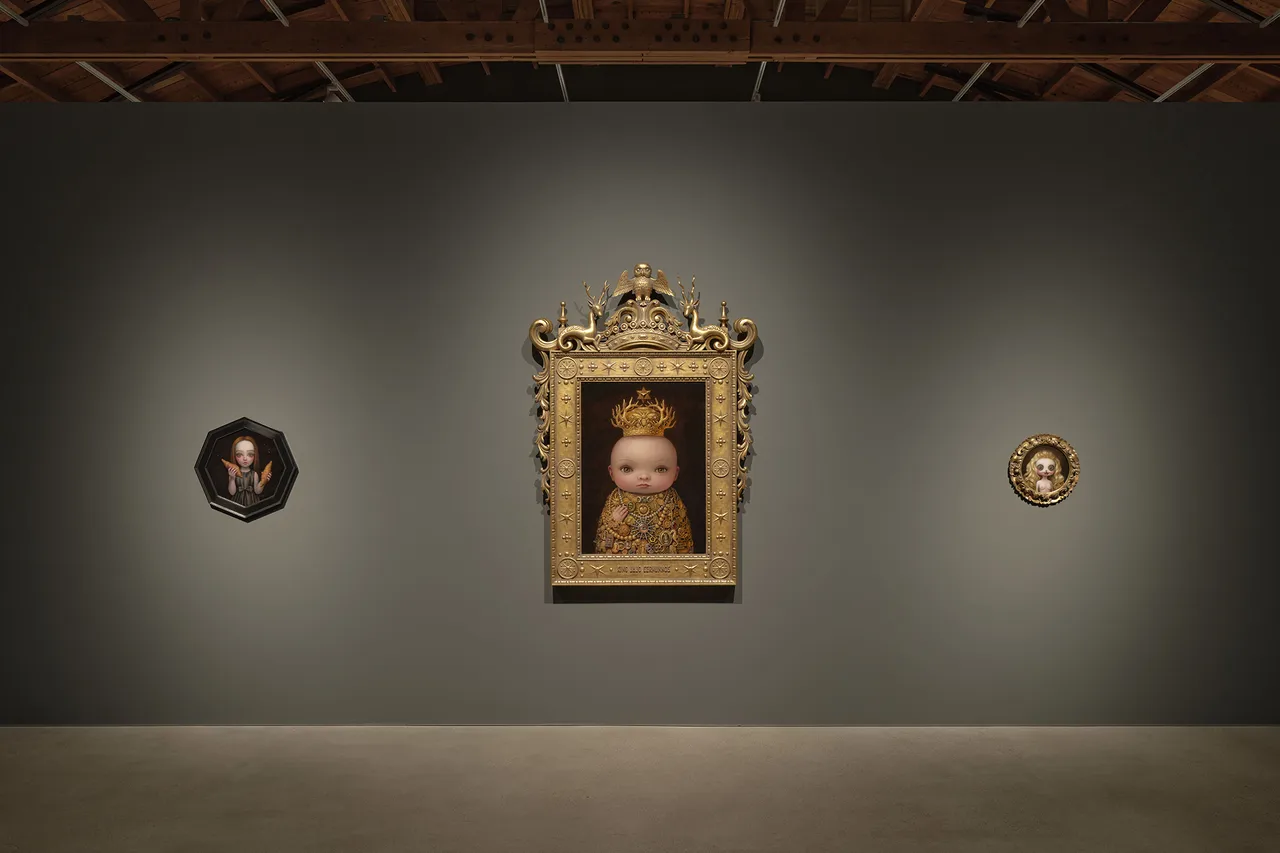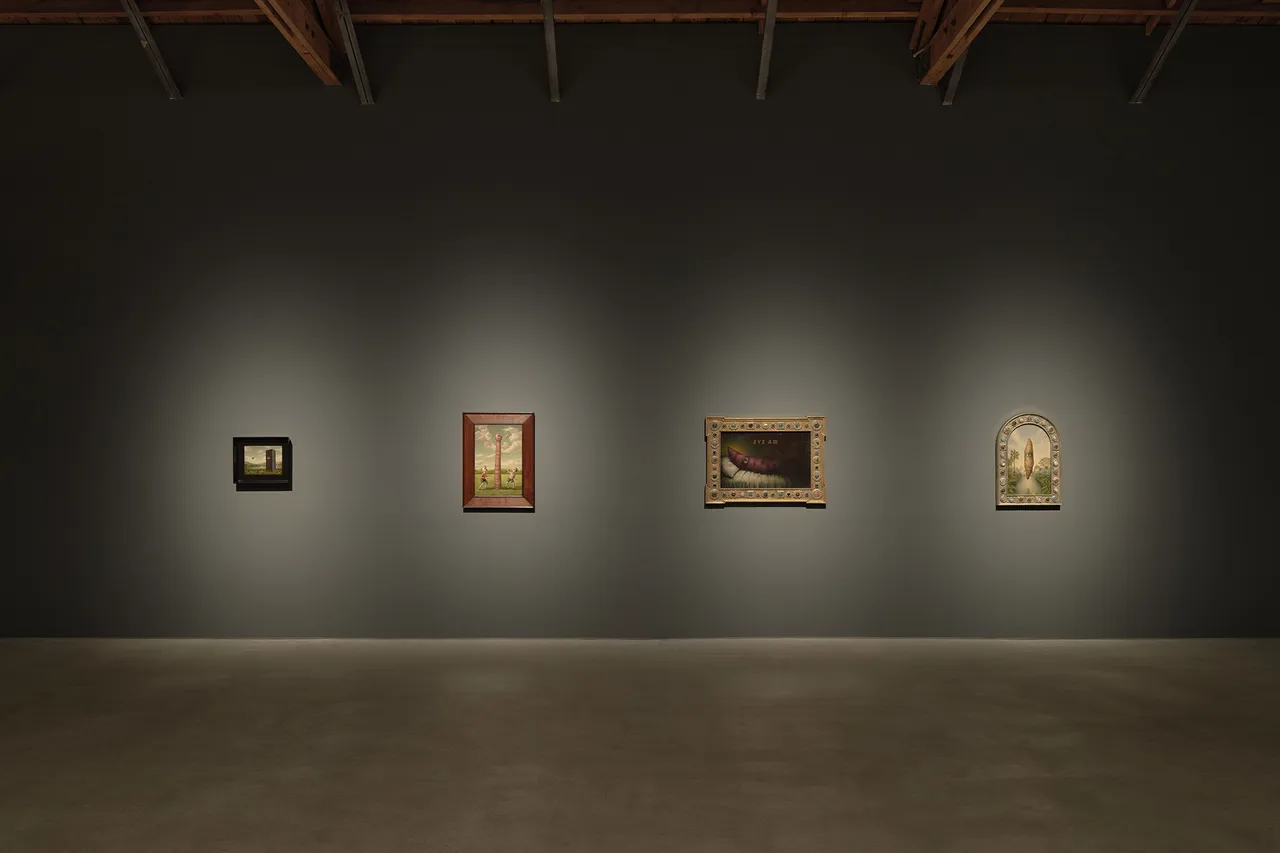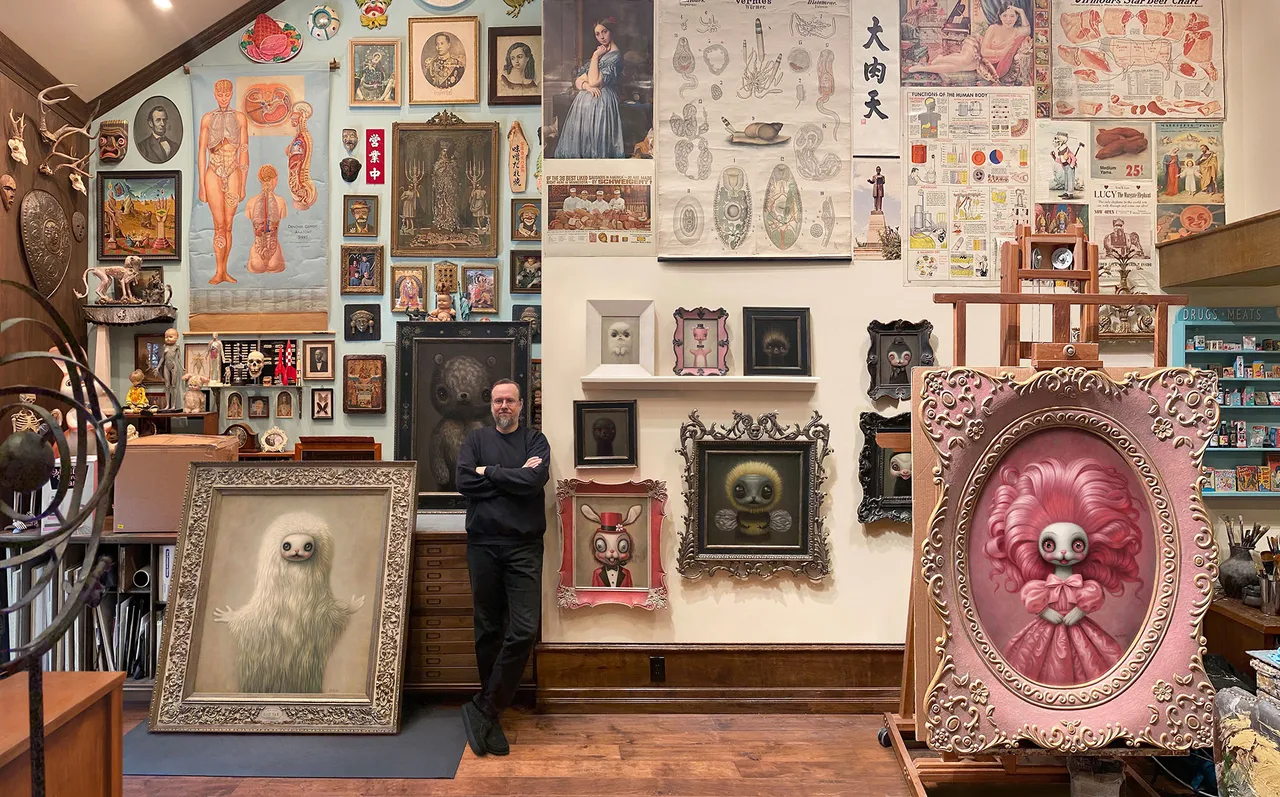
A yam. A purple, crooked yam. Laying in a bed at night. Painted with soft, realistic brush strokes. Its head is illuminated by an unknown source of light. The ending of its body disappearing in darkness. With a single, big greenish-brown eye that stares up at an inscription: “Eye Am”. Is the yam keeping vigil of this inscription? Or is it perhaps aware of its own existence? Of its own summoning? Eye Am is also the title of Mark Ryden’s latest solo exhibition in LA, to see until December 20th at Perrotin.
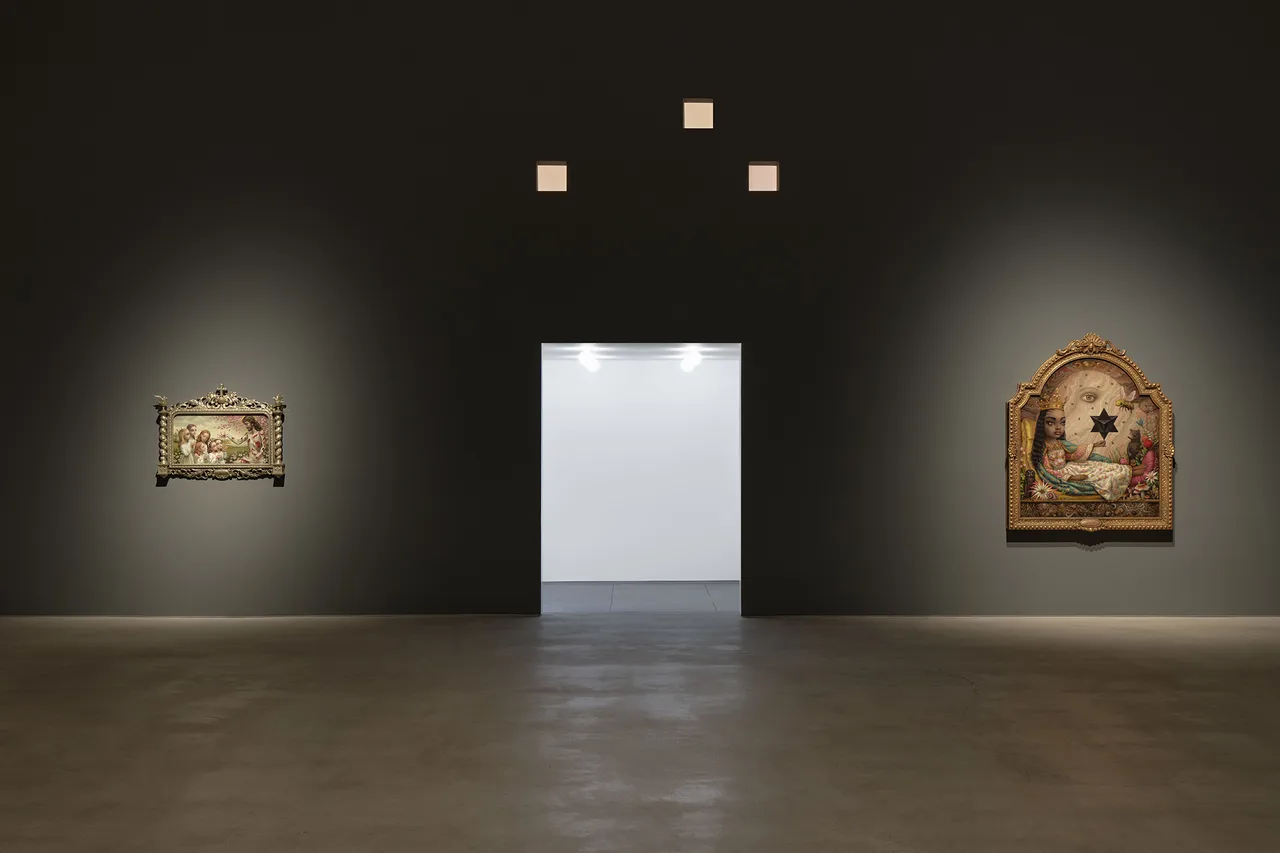
You might now expect a more detailed answer to what the yam in the painting is actually doing. What it knows. But we have to disappoint you. The US-American artist’s work resists explanation. Opposes it even. Instead, his paintings run a separate, mystical logic. A logic that starts, where language and words end. The outcome is wondrous. Nonsensical. Nightmarish. Unsettling. In a weird way, it’s cute at the same time. There’s a lot of room for interpretations and subconscious feelings. A wide-eyed baby looks like a king, dressed in gold and symbols, for example. An Abe Lincoln chaperone. Christ pouring wine from his own bloody veins, a snow lion. There are dreamscapes, soil, wombs, fetuses. And the yam as a recurring figure.
Eye Am showcases overall twelve pop surrealistic paintings and a wide selection of drawings. In moments where he deliberately left all thoughts of the waking mind behind. It’s an exhibition that invites us to immerse ourselves in the subconscious. As well as what could be religious historic images. Just by looking at the paintings, you can feel Ryden’s passion for sacred geometry and mysticism, for history and icons. For toys, beauty, and the bridge between the visible and the invisible. And you can become part of it.
Right after the opening of Eye Am, we have the rare opportunity to meet Ryden to dive into an honest conversation about why mystery is much more intriguing than overanalysing. As well as what makes the Portland-based artist nervous and King Jajo Cernunnos. He shares how wooden frames become part of a painting and the most beautiful thing he has seen today.
Hi Mark, what’s your spirit animal?
I had an exhibition in 2020 that I was originally going to call Super Spirit Animals, but I received feedback that, as a non-Indigenous person, using that term might be offensive. So, I changed it to Anima Animals. I understand how the term “spirit animal” has been used in silly disrespectful ways, like “a six-pack of beer is my spirit animal,” but if you approach the concept honestly and respectfully, I think it’s wonderful. I also think it’s good for different cultures to share the meaningful parts of their traditions. So, I have a hard time picking my own spirit animal. Sometimes I feel an affinity for a monkey, other times a goat. My wife says I’m more like an owl or a snow leopard.
Do you dream in the same style as you paint? Are these happy dreams or nightmares?
I have happy dreams about magical, enchanted places, but I also have nightmares, often involving human anatomy. Overall, dreams are full of strong feelings, but they’re often vague in specific detail. In my work, I try to capture that dreamlike feeling, which is the real challenge.
What was your last dream about?
It is important to write down your dreams so they don’t float away, but I don’t often take the time to do that. I do vaguely remember a recent dream that involved a dusty old antique store with giant versions of vintage tin toys. I should have written the whole dream out!
Your new exhibition Eye Am has opened. What were you most nervous about before it?
I get nervous facing the public, especially so many people at once. I prefer smaller gatherings to a gallery opening. I’m very shy and private. Of course, I love that people are interested in my art, but I don’t like being the centre of attention myself.
The title plays with language, identity and also consciousness all at once. What does it mean for you?
I like yams. I like eyes. I like putting them together. It is what it is, and I am what I am.
Most of the paintings you are showcasing in the exhibition seem to look back at the viewer. You could even say it’s a mutual gaze. How do you think about the act of seeing in this series? Who is really observing whom?
A painting will have a completely different feeling whether the subject of the painting stares back at the viewer or not. Each painting feels like it needs to be one way or the other. The painting dictates that choice. A painting like Creatura has the feeling that you have snuck a peek at a private moment, while in The Unturning Wheel, the subject is aware of being on display. That difference profoundly affects the tone and mood of a painting.
One painting that seems to observe us is King Jajo Cernunnos. What kingdom is he the ruler of?
I think if you look at all the details, icons, and symbols, and spend some time with the imagery, perhaps you can come up with your own ideas of what makes him a king. He is definitely not a patriarchal king.
King Jajo Cernunnos has an extraordinary wooden frame. Something that is inseparable from your work. What layer do these frames add to your paintings?
I’ve always felt that a frame and a painting belong to each other. A painting is an object, and the frame is part of what defines it. That doesn’t mean a frame needs to be ornate and elaborate, even though many of mine are. Some works call for something very simple, or even no frame at all, but it should never be an afterthought. I develop the frame as I’m working out the image itself.
A recurring figure across the exhibition is the yam, suspended somewhere between the sacred and the absurd. What drew you to choose the yam as a central motif?
Looking for a reason for the yams misses the point. They found their way into my work on their own. I never consciously decided to paint yams. Good art comes from intuition, the subconscious, and the unexplained, not literal reasoning.
Mystery is a big part of your work, yet the modern world hungers for clarity and transparency. How do you protect the unknown from being explained away?
People want answers about my art, but I try to be honest and tell them that explaining everything would take away the image’s power. I don’t want to seem evasive, but I find it boring when any artist over-explains their work. In the end, mystery is what makes life interesting. It is good to learn to enjoy it without needing it solved. The challenge is to live with the unknown.
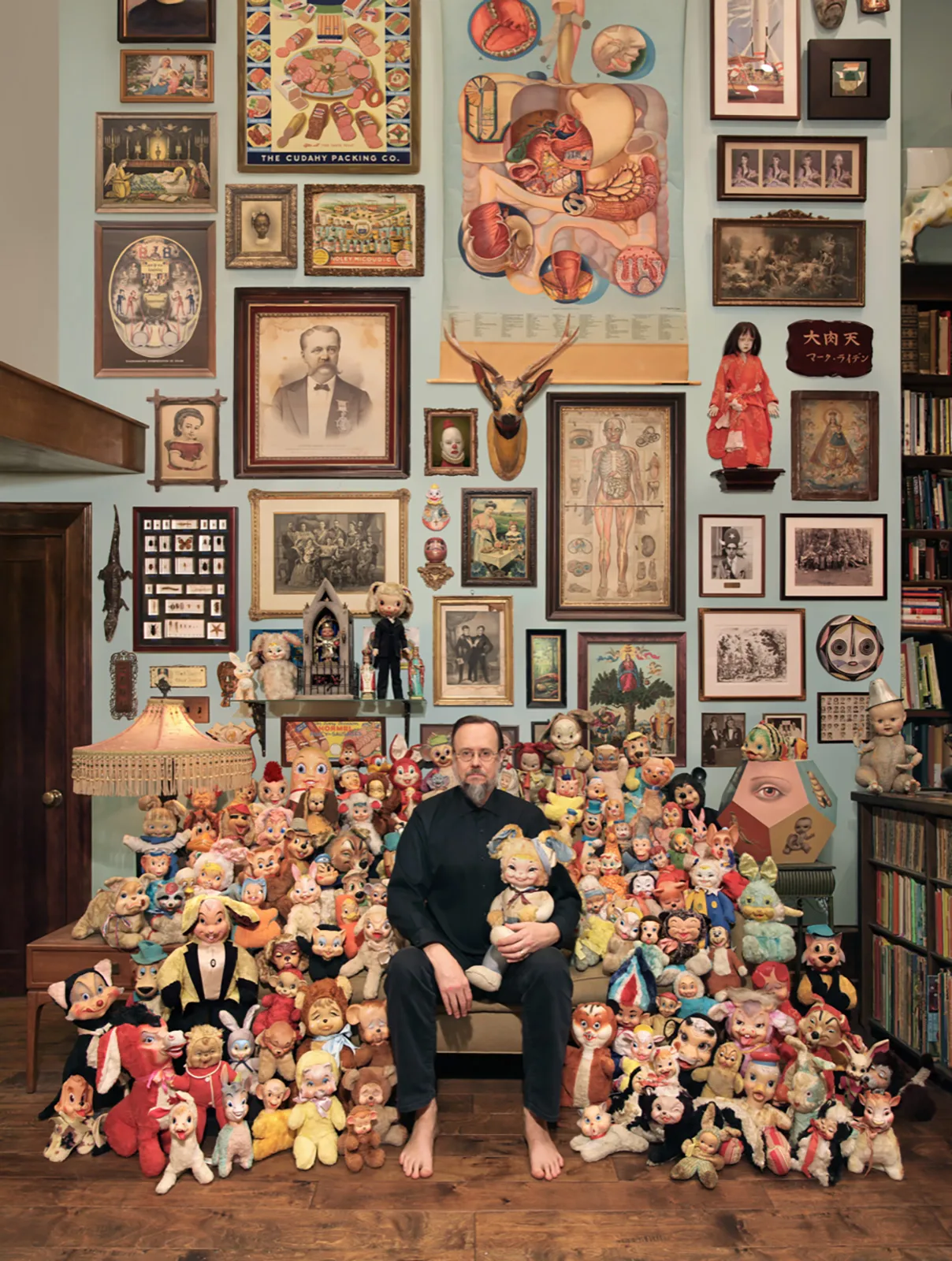
You called yourself an iconophile, but you also collect toys, ephemera, books, statues. What is one object or image you’re currently obsessed with?
I jump from one obsession to another constantly! My art reflects what I have been into lately. I have a new mask I have been looking at, and also a new vintage baby doll that intrigues me. I think it is the combination and range of objects I am interested in that defines me and my work.
Is there a symbol you fear, one you’ve never dared to paint?
I used a swastika in a painting in 2001 (Little Boy Blue). The symbol has a long history in many cultures, but was appropriated by the Nazis and became a symbol of hate. The interesting history and great power of the symbol interested me as something to use in a piece of art. At that time, I could approach it as a symbol from the past. Today, with the resurgence of white supremacy and far-right fascism, I wouldn’t use it again.
What’s the most dangerous thing about beauty?
It can seem superficial and make you forget to look deeper.
To come to an end: What’s the most beautiful thing you’ve seen today?
My wife, and I am lucky enough to see her most every day